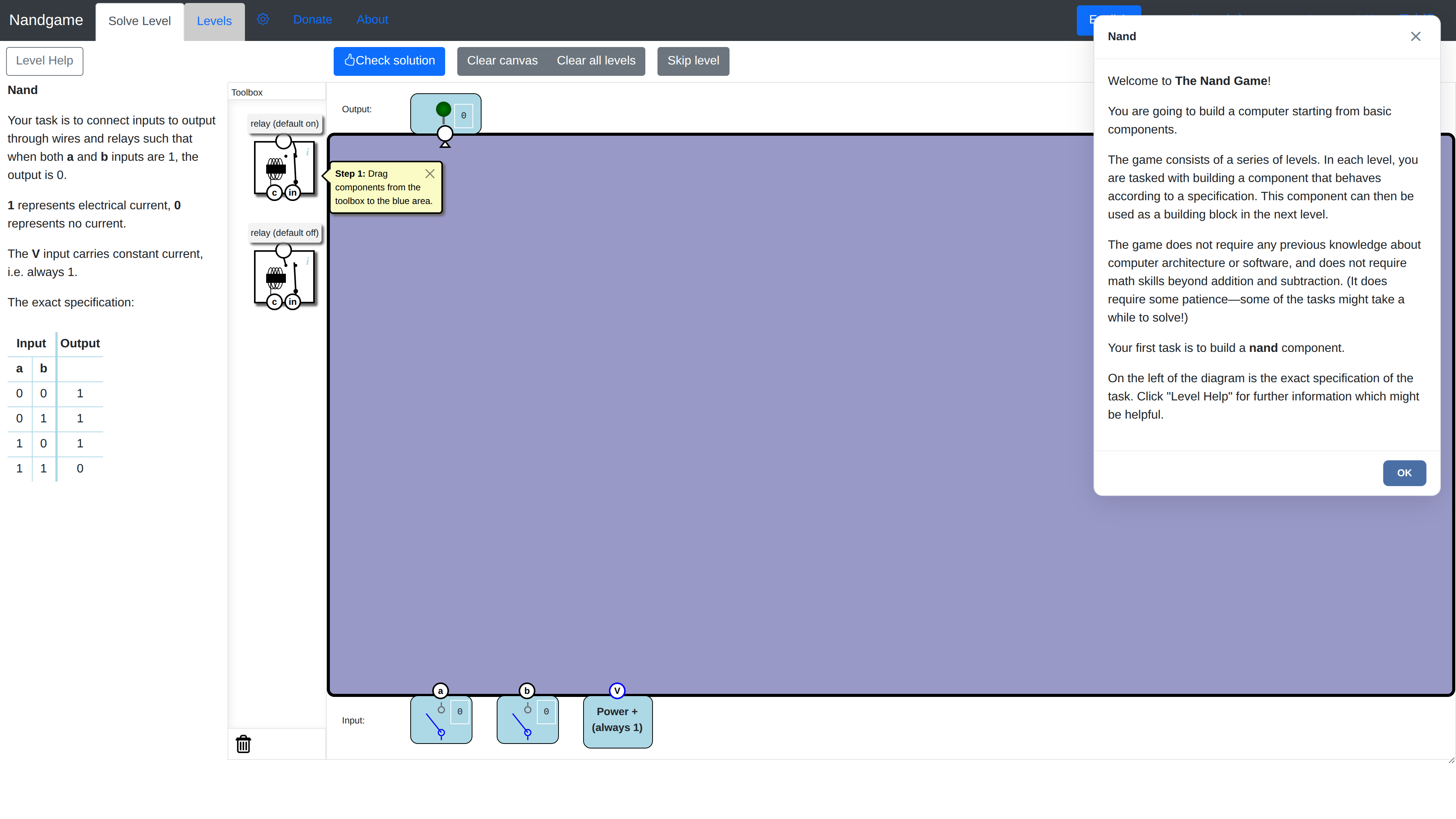
NandGame is an educational puzzle game: starting from the humble NAND gate, you build your way up level by level until you have constructed a programmable computer. The official description says it requires no previous knowledge of computer architecture or software, and no math beyond addition and subtraction — though "it does require some patience." The game is developed by Olav Junker Kjær (credited on the About page), free to play, with no account needed.
At a Glance
| Item | Details (as of 2026-09-30) |
|---|---|
| URL | nandgame.com |
| Type | Educational puzzle game (computer architecture) |
| Cost | Free (voluntary donation link on the page) |
| Account | None required |
| Language | English only |
How It Plays
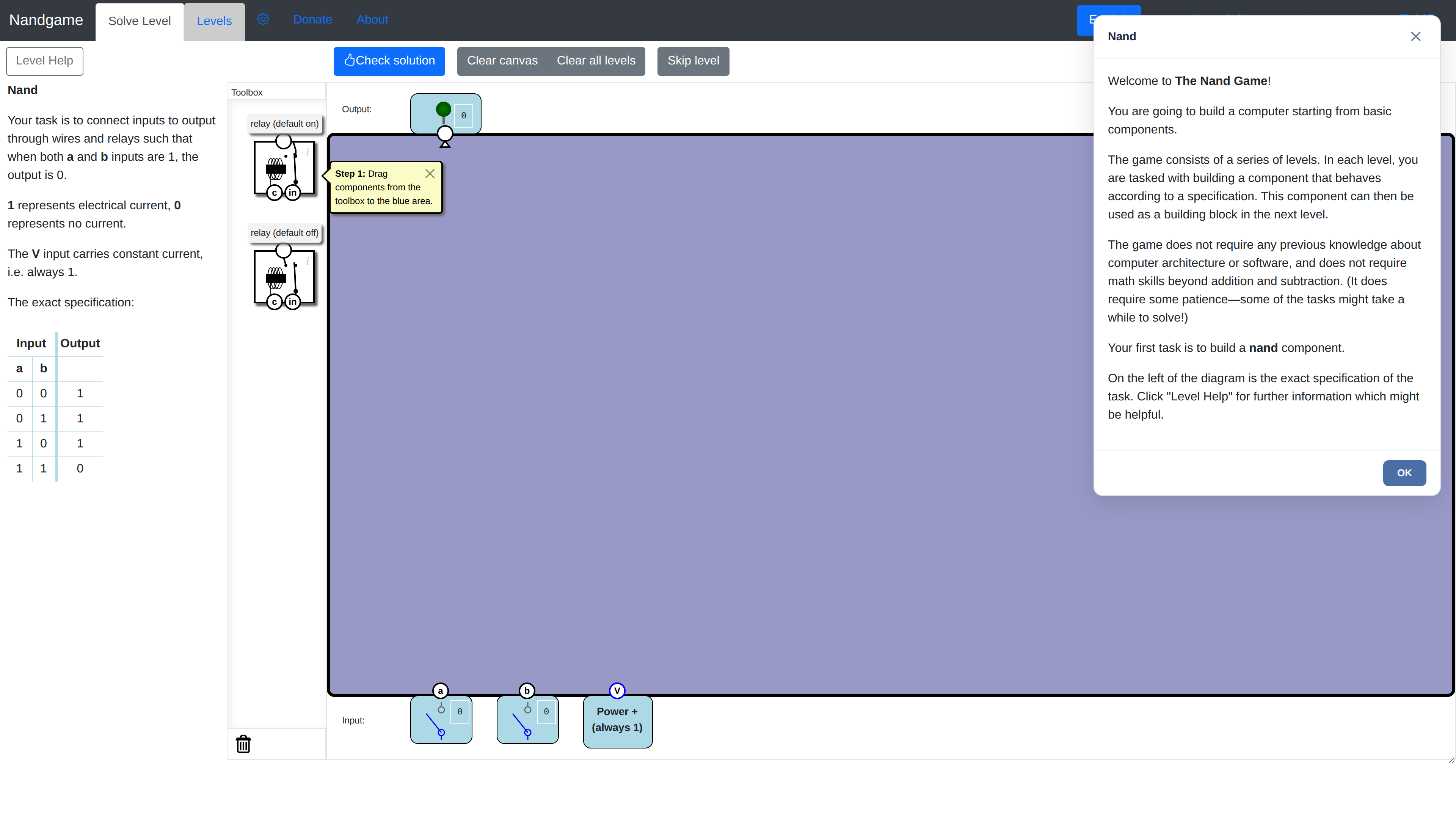
Each level asks you to build a component that satisfies a specification — a truth table or behavioral description. The left panel gives the exact spec and I/O pins; on the central canvas you drag parts from the toolbox and wire them together, then hit "Check solution." Once a level is solved, the component you just built joins the toolbox and becomes a building block for the next level: relays become NAND gates; NAND gates become AND, OR and NOT; then adders, memory, an ALU, a CPU, and finally a computer that runs machine code you write yourself.
Background
Olav Junker Kjær maintains the project personally (contact on the About page, with a donation link in the navigation). The subject matter shares its lineage with the well-known Nand2Tetris course, but the form differs: NandGame is fully drag-and-drop graphical wiring with no HDL code to write, making it friendlier to readers without any programming background. It has repeatedly sparked discussion in tech communities (a December 2020 Hacker News thread drew over a hundred comments).
Good For
- Complete beginners wondering how a computer can compute;
- CS students looking for an intuitive companion to a computer-organization course;
- Fans of logic and engineering puzzles in the Zachtronics tradition.
Limitations
- English-only interface, with some technical vocabulary in level descriptions.
- No account system; progress stays in local browser storage, so switching devices means starting over (an inference from the no-registration design).
- Hardware-focused: operating systems, compilers and other software layers are out of scope.
- Wiring gets dense in later levels, which is awkward on small screens.