n8n (n8n.io) is a workflow automation and AI agent orchestration platform built by Berlin-based n8n GmbH. On a visual node canvas you wire SaaS apps, databases, and AI models into automated processes, and any step can be replaced with JavaScript or Python code. The problem it solves is stitching scattered systems and models into business processes that actually run — from CRM syncs and ticket handling to multi-step AI agents. Its verifiable differences from hosted incumbents like Zapier and Make: you can write code, you can self-host it entirely (even air-gapped), and the source code is publicly readable. One nuance matters, though: n8n is distributed under its own fair-code terms (the Sustainable Use License), and source-available is not the same as OSI-defined open source — the company itself says it does not call n8n open source. As of 2026-09-12, its GitHub repository has over 204,000 stars, the official integration directory lists 2,174 integrations, and the template library holds more than 12,000 community workflows.
At a glance
- URL: https://n8n.io
- Type: Workflow automation platform + AI agent orchestration (visual low-code with full-code escape hatches)
- Cost: Self-hosted Community Edition is free (fair-code license, internal business use); n8n Cloud is subscription priced by monthly workflow executions, Starter from $20/month billed annually; Business and Enterprise tiers add enterprise features (as of 2026-09-12, see pricing table below)
- Sign-up: Browsing the site, integrations, and templates needs no account; self-hosting needs no n8n account (you create a local owner on first launch); n8n Cloud requires an email sign-up, and the free trial needs no credit card
- Interface language: English only (product UI, documentation, and template library)
- Launched: Public release in October 2019 (GitHub repo created June 2019)
Background
n8n was founded in Berlin in 2019 by Jan Oberhauser, who previously worked in film visual effects and pipeline engineering (Wikipedia, cross-checked against IMDb). The name is a contraction of "nodemation" — node (the node view and Node.js) plus automation — pronounced "n-eight-n" (the founder's note in the GitHub README). The operating company is n8n GmbH, registered in Berlin (imprint).
Funding and scale milestones:
- March 2020: $1.5M seed round co-led by Sequoia Capital and firstminute capital (TechCrunch).
- April 2021: $12M Series A led by Felicis Ventures (TechCrunch); roughly 200 app integrations at the time.
- March 2025: €55M Series B led by Highland Europe (official blog); the company reported 200,000+ users and 3,000+ enterprise customers.
- October 2025: 2.5B valuation and $240M raised in total (official blog); the company cites 6x user growth and 10x revenue growth that year.
- May 12, 2026: SAP made a strategic investment alongside a multi-year commercial partnership, doubling the valuation to $5.2B; n8n will be embedded natively in SAP's agent-building environment Joule Studio, with general availability planned for Q3 2026 (press release, n8n blog). The investment size was not officially disclosed; Bloomberg and others reported more than €60M for a stake of about 1.3%. Per the release: 1,400+ enterprise customers and 1.7M monthly active developers and builders.
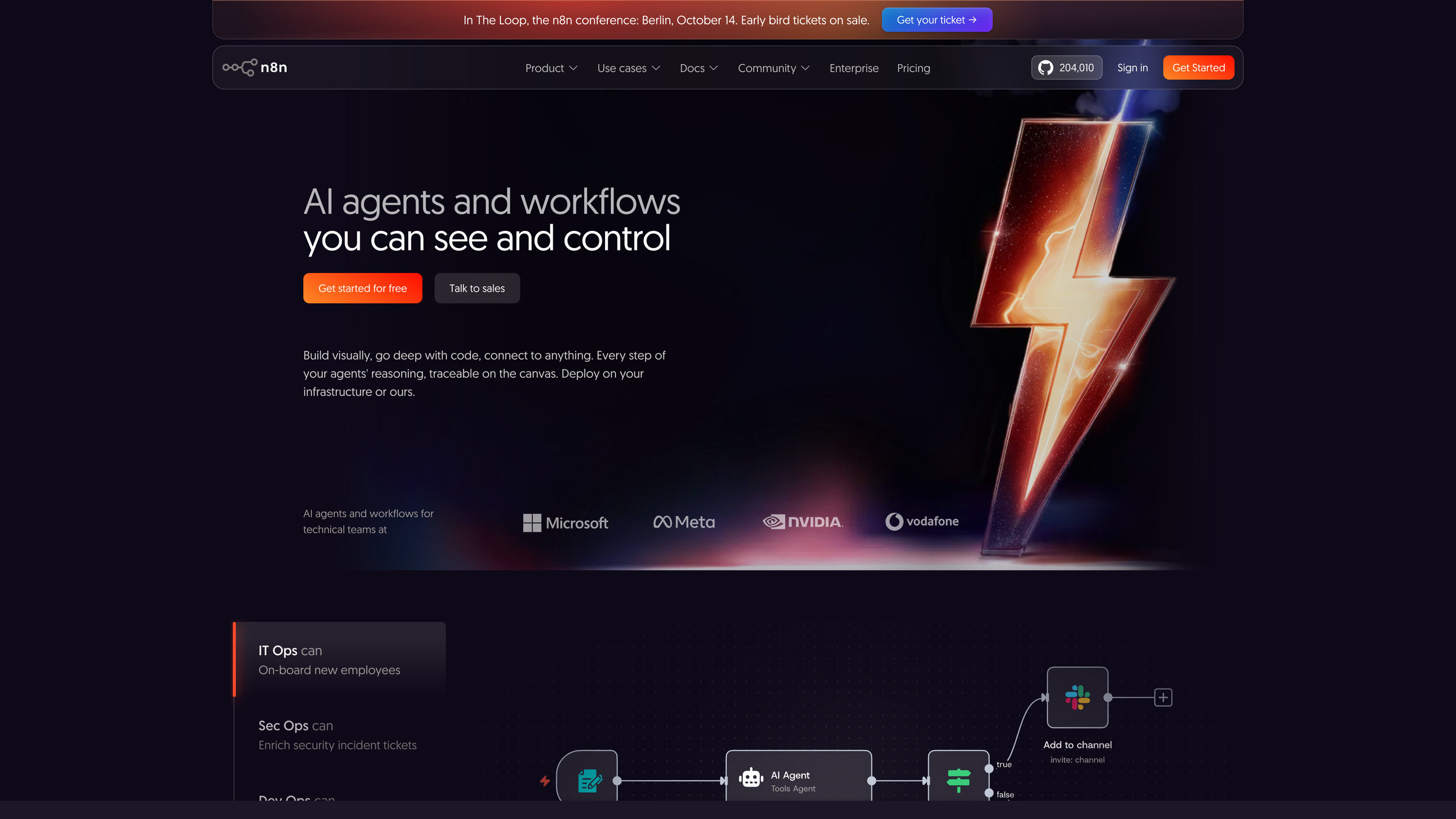
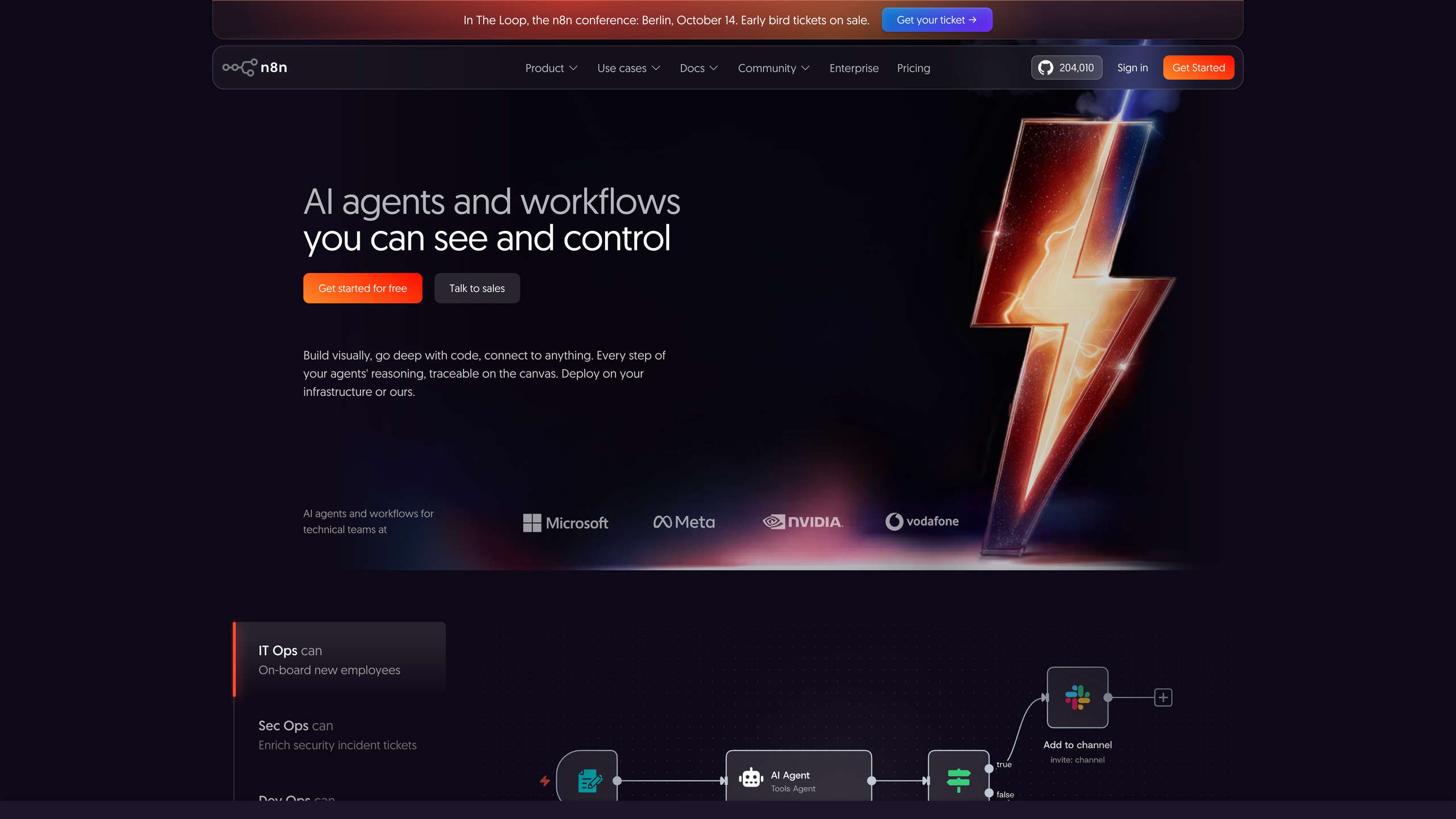
The homepage above states n8n's current positioning directly — AI agents and workflows you can see and control — and names technical teams at Microsoft, Meta, NVIDIA, and Vodafone as users.
Core capabilities: canvas, code, and AI agent orchestration
An n8n workflow is a set of nodes connected on a canvas: a trigger (schedule, webhook, app event, and so on) followed by action nodes, with branching, loops, error handling, and retries. Any step can become a Code node running JavaScript or Python — with npm packages when self-hosting — and every node shows its input and output data inline, so you can re-run single steps and debug with mocked data instead of executing the whole flow each time (product page).
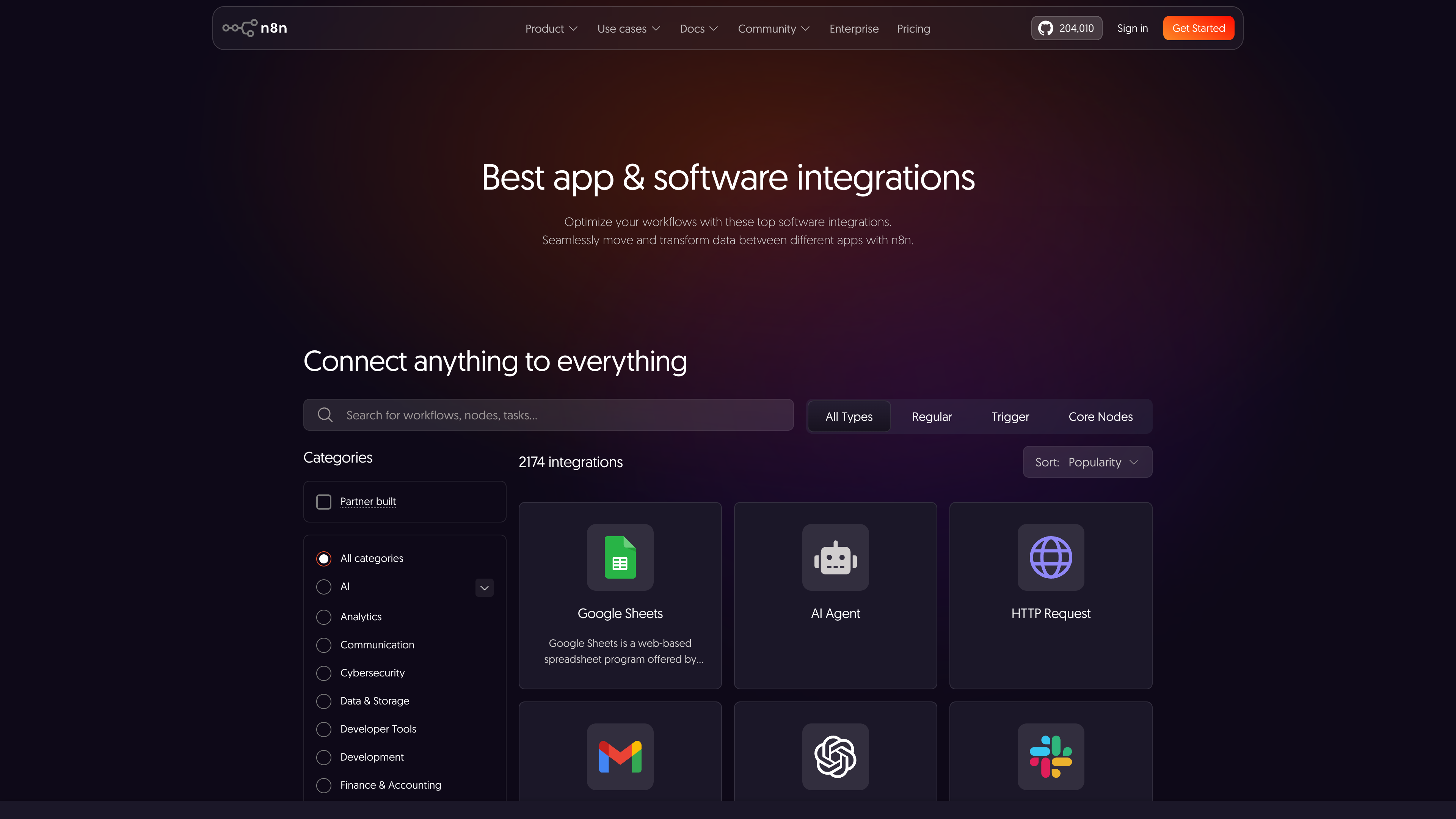
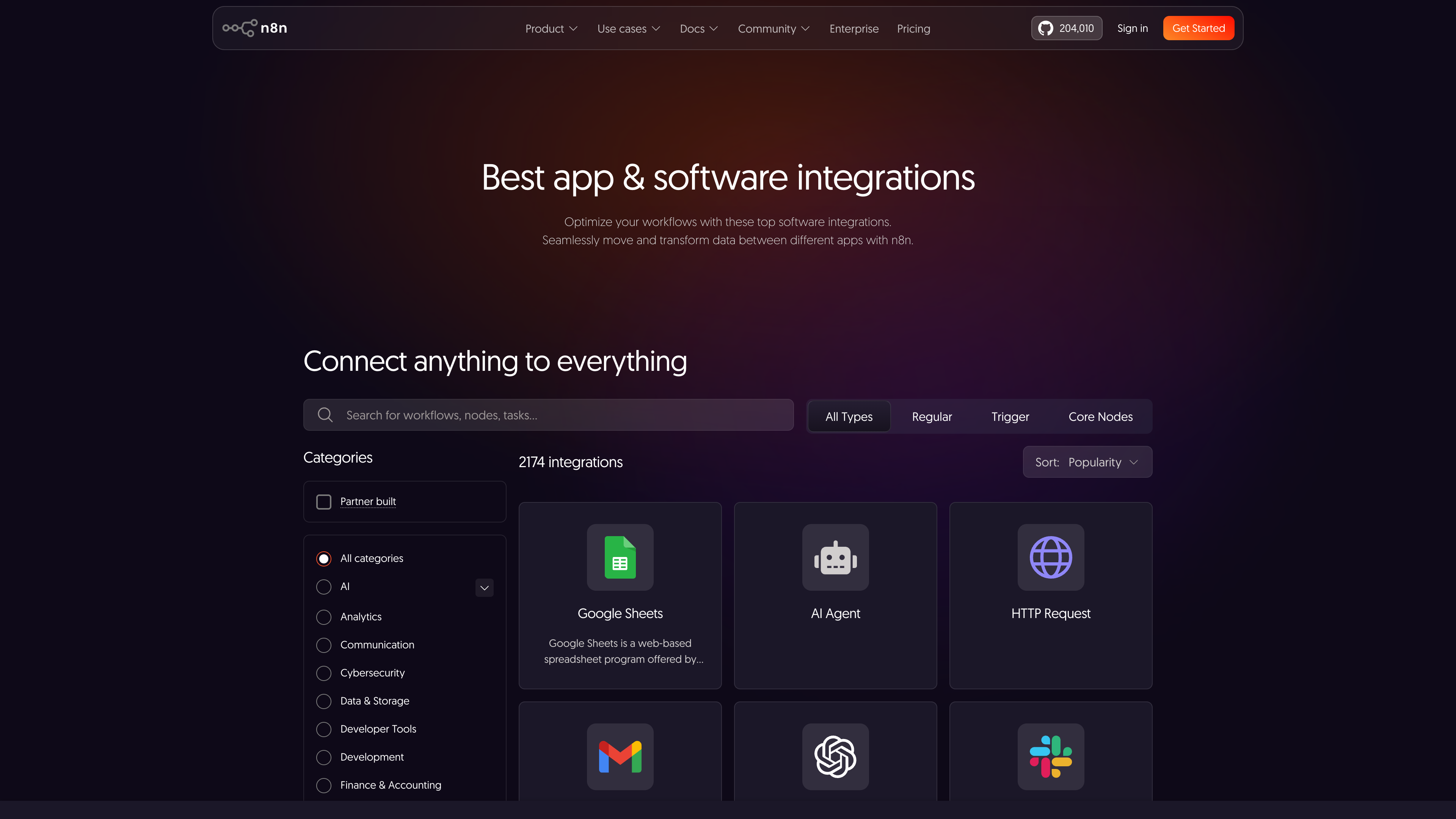
Integrations and openness. As of 2026-09-12, the official integration directory lists 2,174 integrations, more than half of which the company says are built and maintained independently by technology partners. Systems without a dedicated node can be reached through the HTTP Request and webhook nodes or by importing cURL commands, and you can build custom nodes.
AI capabilities. Since 2022 n8n has reoriented around AI orchestration (Series C blog): a LangChain-based AI Agent node can be equipped with tools and memory, with support for multi-agent setups, RAG, and MCP connections, while the model layer swaps freely between OpenAI, Anthropic, Google, and local or open-source models (Advanced AI docs). For governance there are human-in-the-loop approvals, native evaluations, and guardrails such as PII detection. A metered AI Assistant (in preview) and AI Builder can scaffold workflows from natural language using monthly credits.
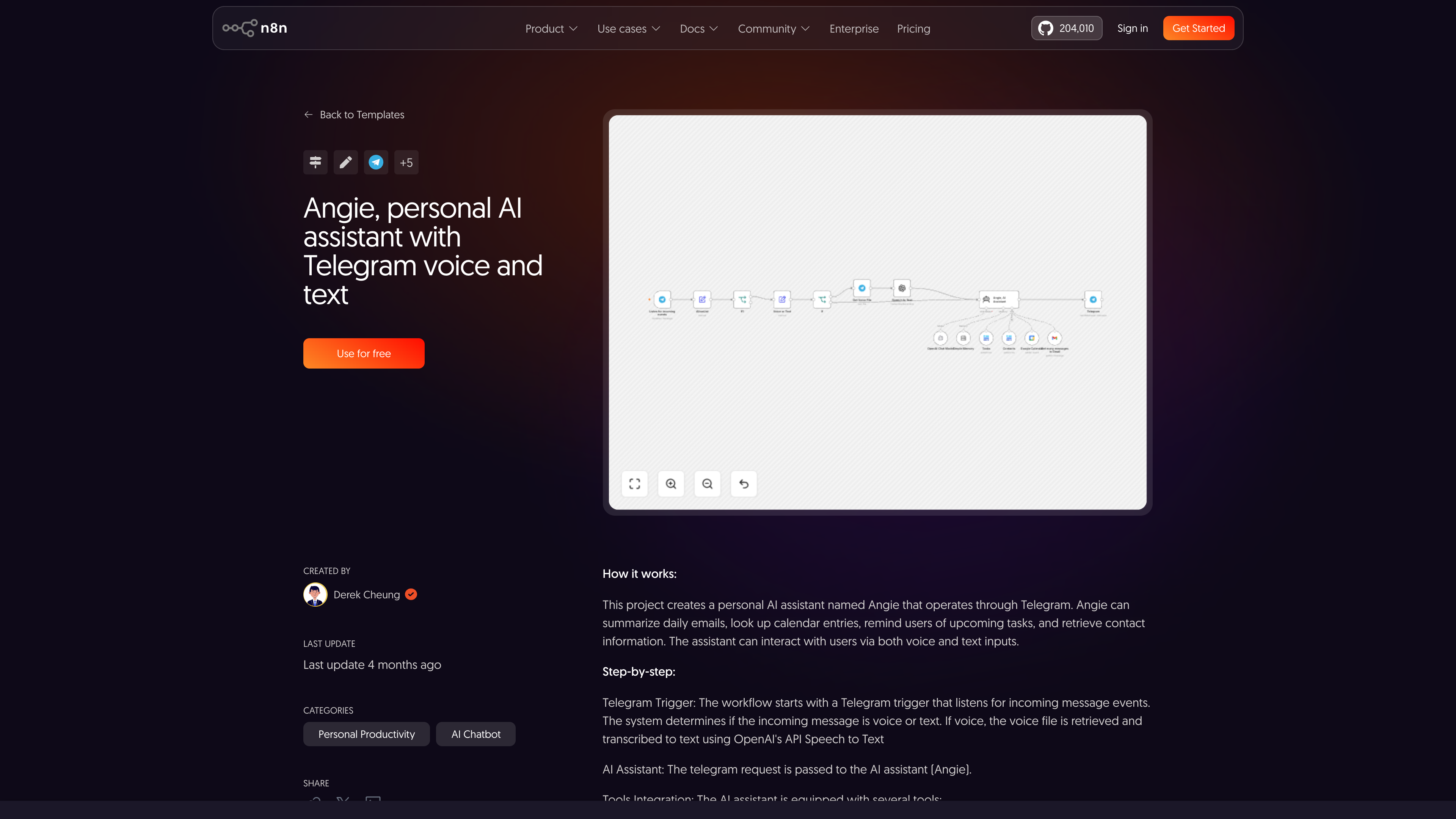
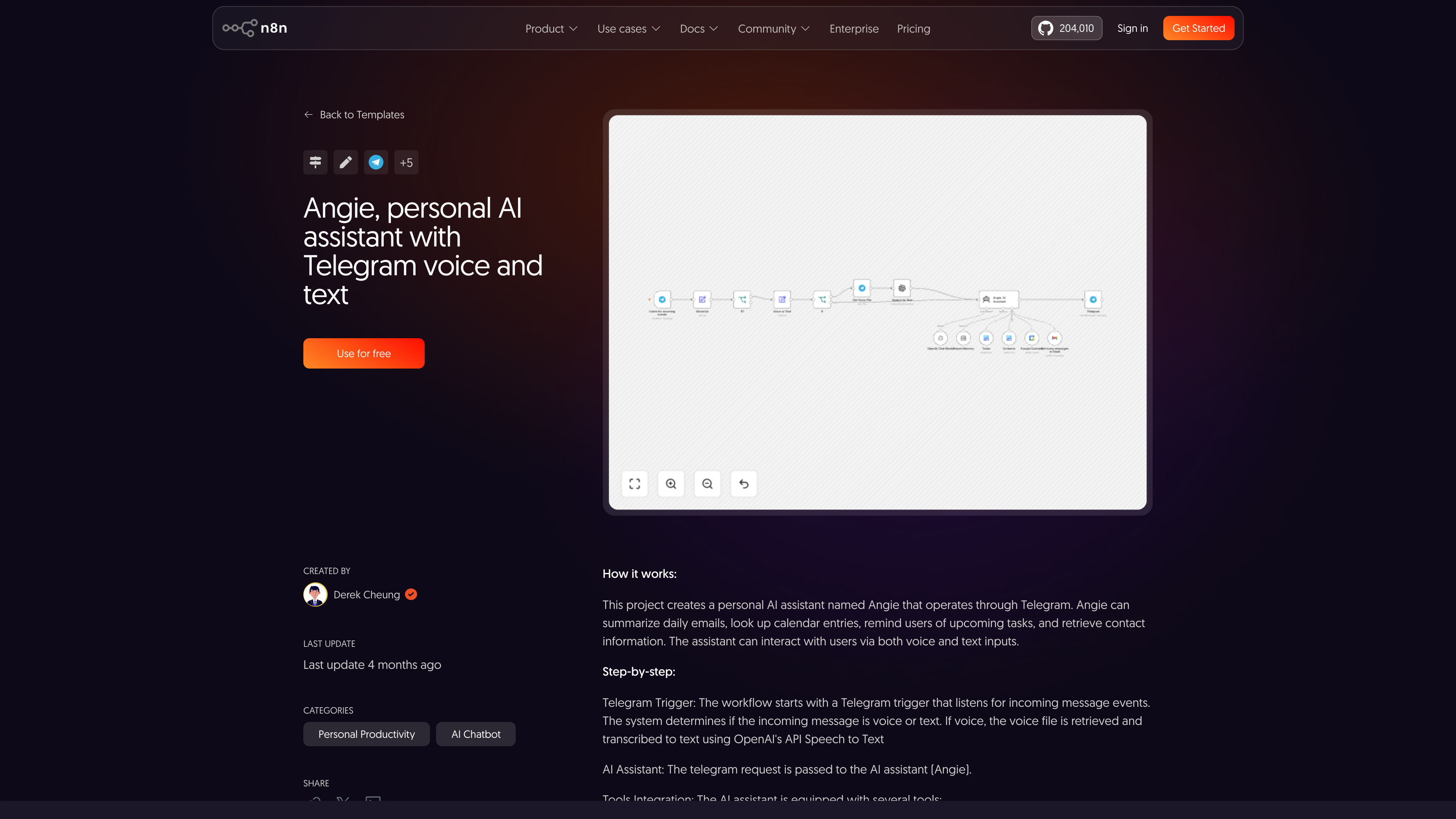
Template library. As of 2026-09-12, the official template library lists 12,326 community-contributed workflows across categories such as AI, IT ops, marketing, sales, and support, each copyable into your own instance. The screenshot below shows a Telegram voice-assistant template: the description on the left, and the actual workflow canvas preview on the right — node structure visible without any login.
Deployment and accounts
n8n comes in two shapes with different account requirements:
- Self-hosted (Community Edition and paid self-hosted tiers): Docker is the recommended install (map port 5678 and open the editor), npm is also supported; data defaults to SQLite, with PostgreSQL recommended for production (Docker install docs). No n8n account is needed — you create a local owner on first launch. Self-hosted instances report anonymous usage telemetry by default, which can be turned off per the privacy policy. Releases ship most weeks (stable was 2.38.6 on the check date), and the docs explicitly recommend self-hosting only for users with server administration experience.
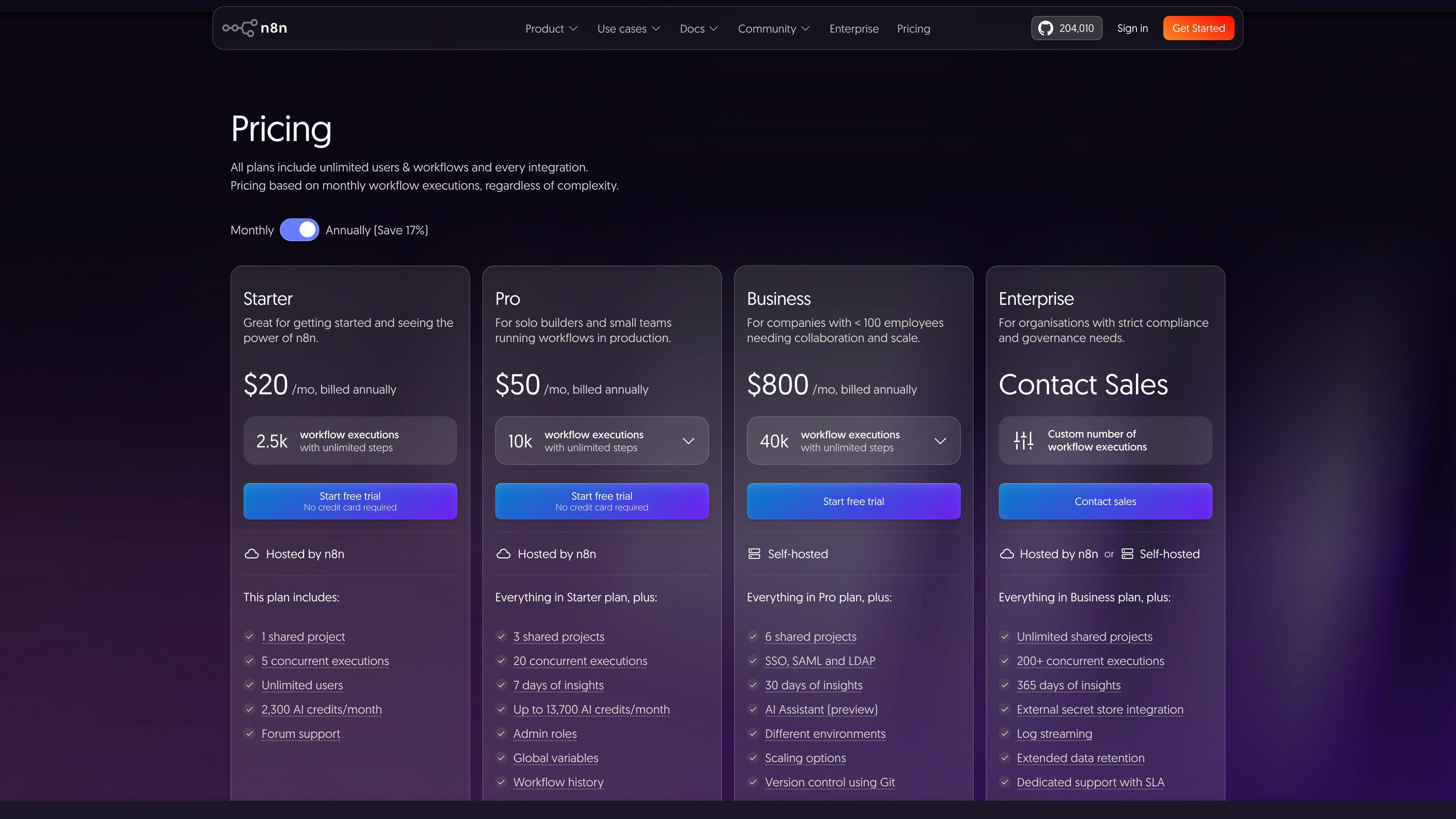
- n8n Cloud: the managed service, with email sign-up. Every paid tier includes unlimited users and unlimited active workflows; billing is per monthly workflow execution — one full run of a workflow counts once, regardless of steps or data volume (pricing page).
Advanced capabilities include controlling instances via API and CLI, Git-based version control with workflow diffs (paid tiers), and embedding flows such as chatbots into your own product (mind the license boundary below). The community ecosystem spans an official forum, community-built nodes, and the template library.
Editions and pricing
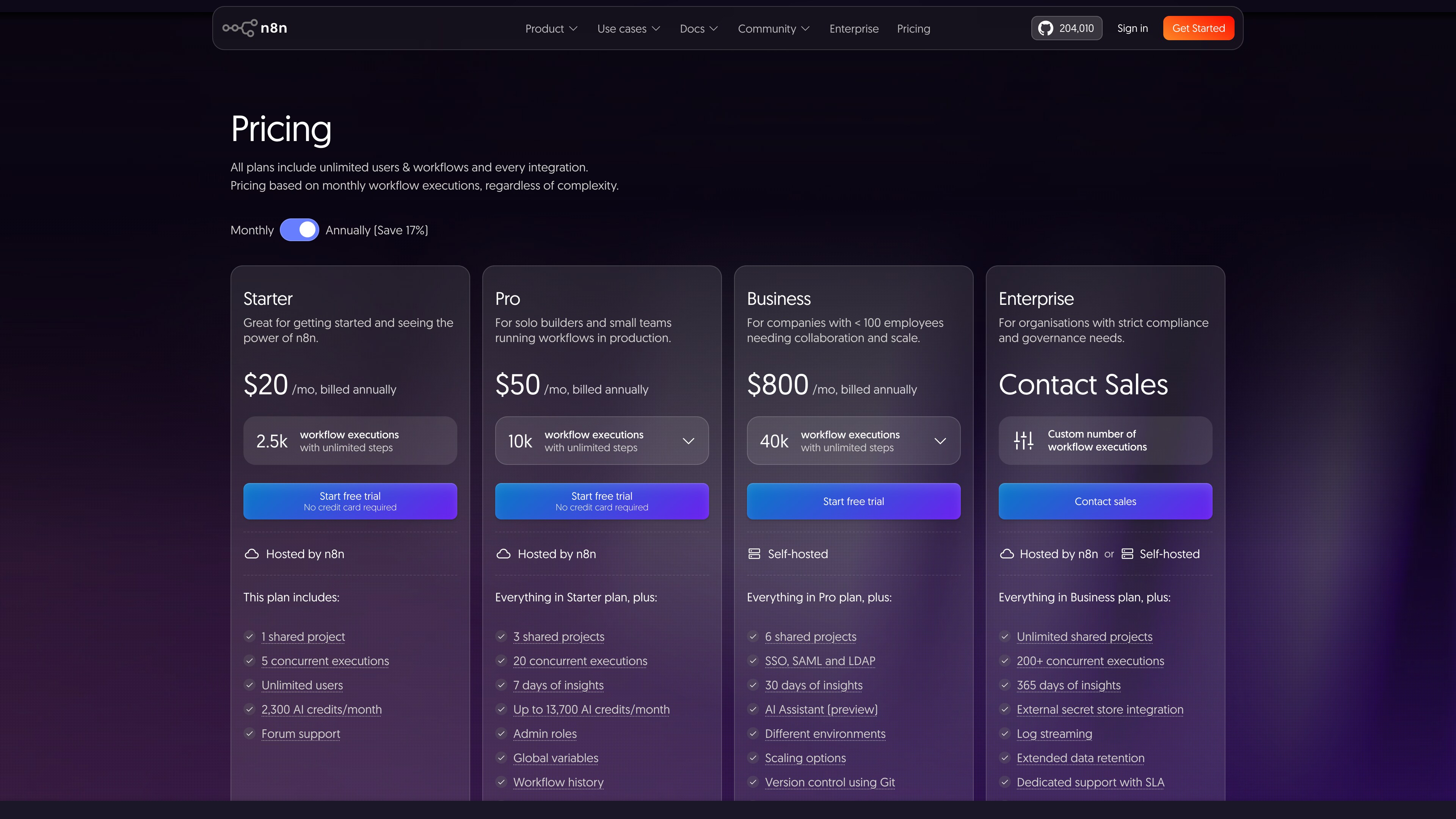
From the official pricing page as of 2026-09-12 (USD list prices; eurozone prices slightly lower):
| Edition | Price | Highlights |
|---|---|---|
| Community Edition (self-hosted) | Free | Sustainable Use License: free to use, modify, and redistribute for internal business purposes; full canvas, all integrations, code nodes |
| Cloud Starter | 24 monthly) | 2,500 executions/month, 5 concurrent executions, 1 shared project, 2,300 AI credits/month |
| Cloud Pro | 60 monthly) | 10,000 executions/month, 20 concurrent, 3 shared projects, up to 13,700 AI credits/month |
| Business (self-hosted) | From $800/month billed annually (€667/month in EUR) | For companies under 100 employees: 40k executions, SSO/SAML/LDAP, Git version control, environments, 30-day insights |
| Enterprise (cloud or self-hosted) | Custom | 200+ concurrent executions, 365-day insights, external secret stores, log streaming, SLA support |
n8n Cloud offers a free trial with Pro-level features and a 1,000-execution allowance, no credit card required; the Business tier has a separate 14-day trial. Companies with fewer than 20 employees can apply for a Start-up Plan at 50% off Business.
Licensing and content policy
This is the section to read before adopting n8n. n8n is not open source by the OSI definition; the company calls its model fair-code: source code publicly available, broadly free to use, extensible by anyone, but commercially restricted by its authors (license FAQ). GitHub accordingly flags the repository license as NOASSERTION.
There are two license layers:
- Sustainable Use License (created in 2022, covering most of the main repository): free use, modification, and redistribution, but only for internal business purposes or non-commercial/personal use. Explicitly forbidden: white-labeling n8n for sale, or hosting n8n and charging others for access. Explicitly allowed: syncing company data internally, providing n8n consulting and deployment services, and building node integrations. Using n8n as the back end of your own product is usually allowed only if it does not collect end users' own credentials; anything beyond the license needs a separate commercial agreement.
- n8n Enterprise License: covers enterprise-feature source files marked
.ee.(SSO, Git version control, and similar), which require a paid license.
Until March 17, 2022 the project used Apache 2.0 with the Commons Clause; the company says it switched because that wording was ambiguous and restricted consulting services. Contributors must sign a CLA, which also lets n8n change the license in the future.
On privacy, n8n GmbH operates under the GDPR (privacy policy, dated 2026-06-24): it states personal data is not used to train machine-learning models; Cloud payments are handled by Paddle as Merchant of Record; self-hosted instances send usage telemetry by default with an opt-out; the service is not intended for users under 16.
Good fits
- Technical teams automating across systems — CRMs, ticketing, databases, internal APIs — who want code-level depth when the visual layer runs out.
- Organizations whose data cannot leave their network: fully self-hosted (optionally air-gapped) with auditable source code, a common reason financial, government, and security teams shortlist it (Vodafone's threat-intelligence SOAR is an official case study).
- Taking AI agents from prototype to production, with LLM calls, tool use, human approvals, and monitoring in one observable flow.
- Low-cost automation for individuals and small teams: a self-hosted Community Edition costs only the server it runs on, with no execution caps.
Limitations
- Not open source, and the commercial boundary is yours to judge. Fair-code bars productizing n8n itself; embedding it into a product you sell may require confirmation and a commercial agreement with n8n. Organizations that need license certainty should weigh this.
- Enterprise features sit behind paid tiers even when self-hosting. SSO/SAML/LDAP, Git version control, and environments require the Business license (from roughly $800/month billed annually), so full-featured self-hosting is not cheap for small teams.
- Cloud billing scales with executions. The default 2,500–10,000 executions per month can be tight for polling-heavy workflows, pushing upgrades; concurrent execution limits also apply.
- Self-hosting carries real operational weight. The docs recommend it for expert users only; the default SQLite is not production-grade, so you manage PostgreSQL, backups, scaling, and hardening yourself. The project ships fast (new minor versions most weeks) and publishes security advisories frequently — seven on 2026-09-02 alone, including high-severity sandbox escapes (GitHub Security Advisories) — so instances need consistent patching.
- English-only product and docs. No localized UI, documentation, or template library; no official mobile app, and the editor targets desktop browsers.
- Template quality varies. Most templates are community-contributed, so review what each node does before connecting real accounts and credentials (an observation, not an official statement).
Alternatives
- Zapier: the fully hosted category leader with the largest app ecosystem, billed per task; no self-hosting and comparatively limited custom code.
- Make: fully hosted visual automation billed per operation, strong at complex routing and data transformation; likewise not self-hostable.
- Activepieces: an MIT-licensed open-source alternative with self-hosting, close to n8n in spirit but with a smaller ecosystem.
- Node-RED: Apache-2.0 flow-based programming aimed more at IoT and edge scenarios — a different take on the node-canvas idea outside business automation.
References
- n8n homepage (checked 2026-09-12)
- n8n GitHub repository (README and star data) (checked 2026-09-12)
- Sustainable Use License FAQ - n8n Docs (checked 2026-09-12)
- n8n pricing page (checked 2026-09-12)
- n8n integration directory (checked 2026-09-12)
- n8n template library (checked 2026-09-12)
- Docker installation - n8n Docs (checked 2026-09-12)
- Advanced AI - n8n Docs (checked 2026-09-12)
- n8n Privacy Policy (2026-06-24) (checked 2026-09-12)
- n8n Imprint (checked 2026-09-12)
- n8n closes €55M Series B round led by Highland Europe - n8n Blog (checked 2026-09-12)
- n8n raises $180m to get AI closer to value with orchestration - n8n Blog (checked 2026-09-12)
- n8n valuation doubles to $5.2bn as SAP makes strategic investment - PR Newswire (checked 2026-09-12)
- n8n Partners with SAP to bring Visual AI Workflow Orchestration to Enterprise - n8n Blog (checked 2026-09-12)
- n8n nabs seed funding from Sequoia - TechCrunch (checked 2026-09-12)
- n8n raises $12M for its 'fair code' approach - TechCrunch (checked 2026-09-12)
- Fair-code pioneer n8n raises $60M for AI-powered workflow automation - TechCrunch (checked 2026-09-12)
- N8n - Wikipedia (checked 2026-09-12)