MusicBrainz (musicbrainz.org) is a community-maintained, open encyclopedia of music information. It does not host audio files — it collects structured metadata about artists, albums, singles, tracks, songwriters, and labels, and releases that data under open licenses for anyone to use. The project exists because of a gap left when the CDDB database was commercialized: it keeps contributor-built discography data free instead of locked behind a paywall. Among comparable music databases, its verifiable distinctions are that it is run by a US 501(c)(3) nonprofit foundation, its core data is dedicated to the public domain (CC0), the whole database can be downloaded and mirrored, and the API is free.
At a Glance
- URL: https://musicbrainz.org/
- Type: Open music metadata database / online music encyclopedia (data only, no audio)
- Cost: Completely free, no ads; commercial data users are asked to fund the foundation but are not charged for access
- Registration: Not required for browsing or searching; a free account (a unified MetaBrainz account) is required to edit data
- Interface language: English by default, with community-maintained German, French, Italian, and Dutch interfaces linked in the footer; no Chinese
- Mobile: The website uses a classic desktop layout and requires horizontal scrolling on small screens; an official Android app exists but is in maintenance mode
(Verified by direct visit on 2026-09-02.)
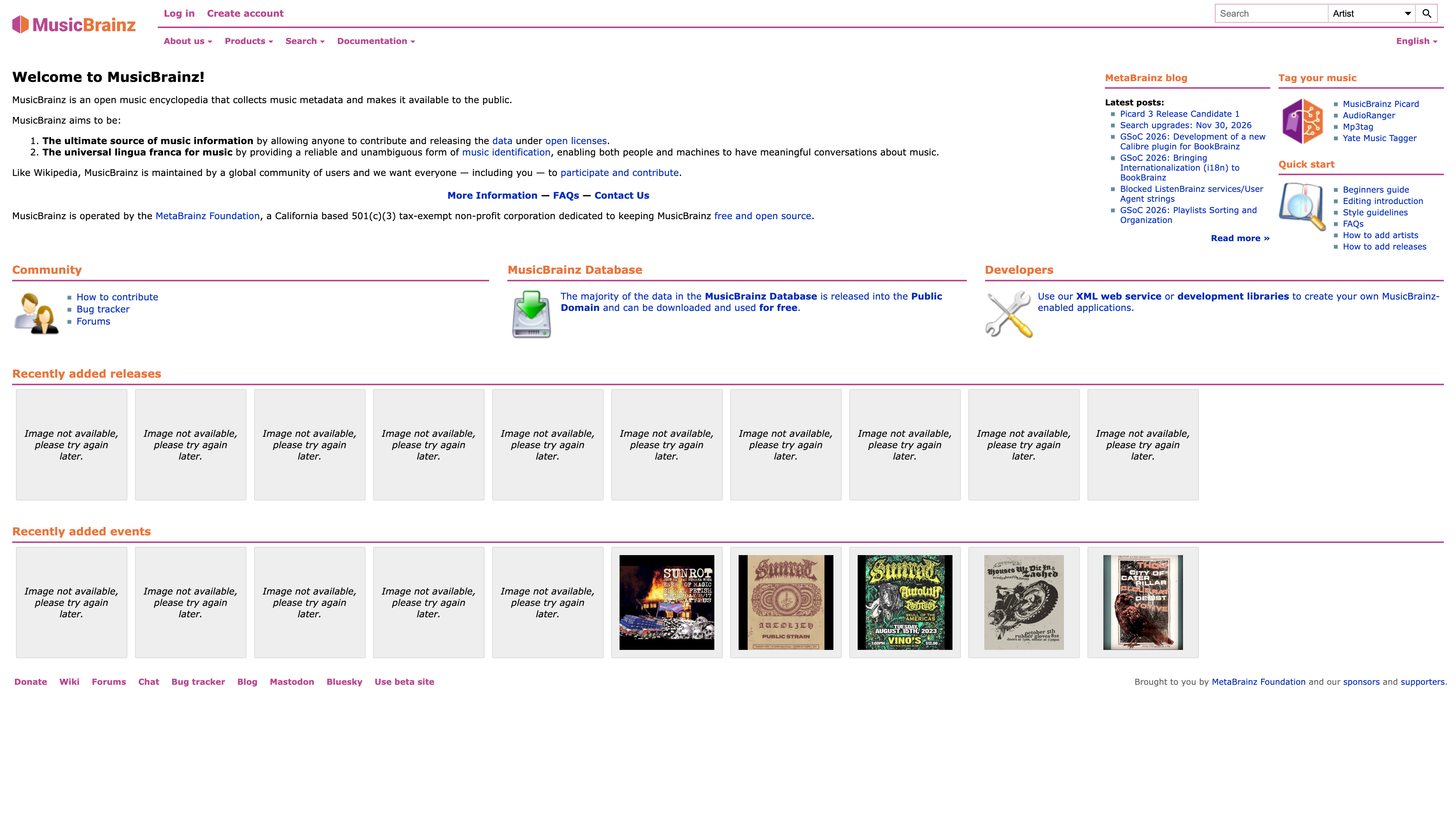
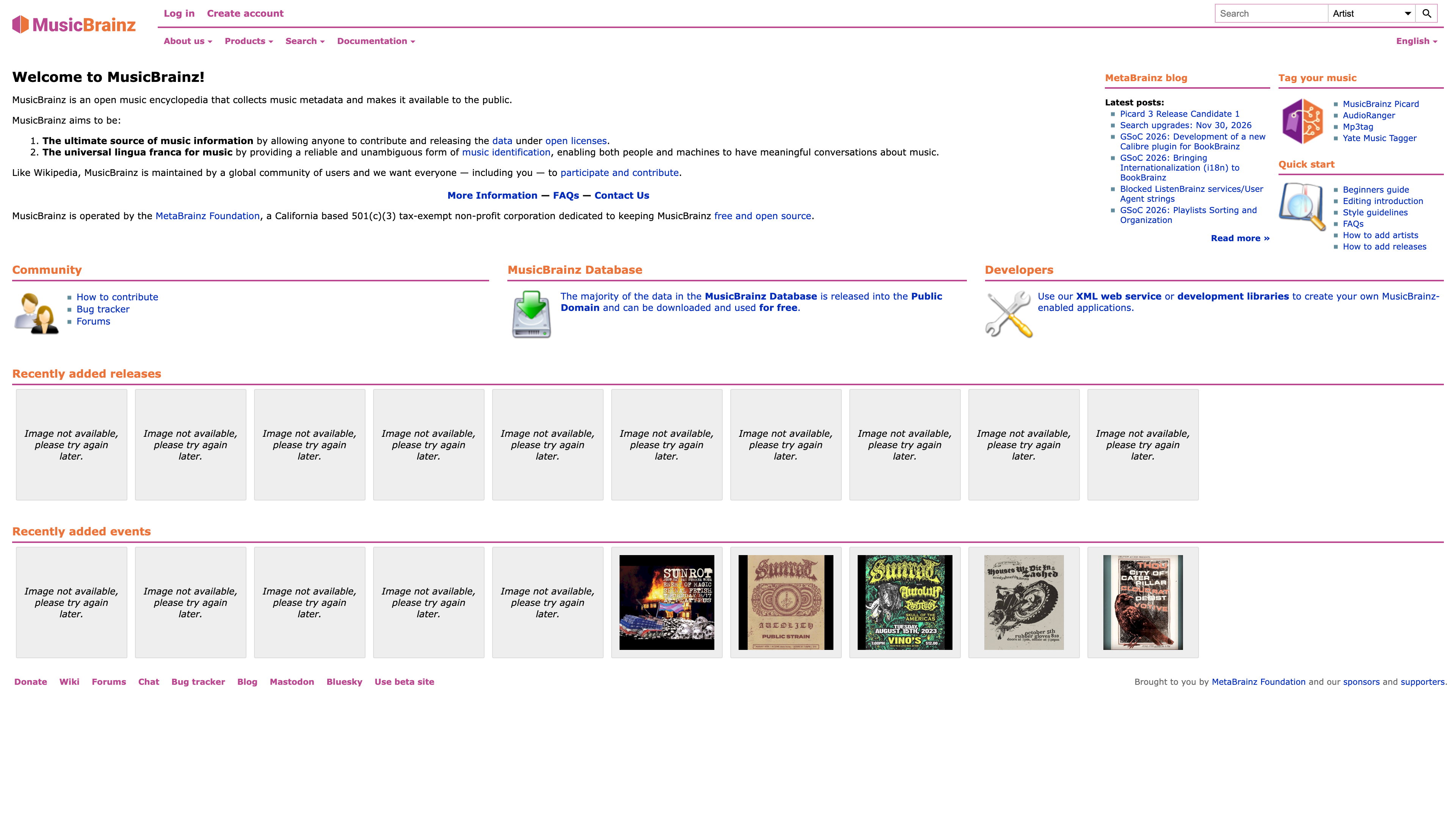
The homepage states the project's positioning up front: the twin missions of becoming "the ultimate source of music information" and "the universal lingua franca for music", followed by community entries, database download notes, and developer resources, with recently added releases and events at the bottom. There are no ads and no recommendation feed — the first screen makes it clear this is a utility database.
Background
MusicBrainz was born from an "open data enclosure" event. In 1998, the open CD-information database CDDB was sold to hardware maker Escient, which rebranded it as Gracenote, cut off free access, and began charging for data its own users had contributed. In response, Robert Kaye founded MusicBrainz on July 17, 2000 as a not-for-profit, collaborative music database (official About page).
In 2004, Kaye established the MetaBrainz Foundation in San Luis Obispo, California — a 501(c)(3) tax-exempt nonprofit — to take over the project. The foundation today also maintains a family of sister projects: ListenBrainz (listening histories), CritiqueBrainz (reviews), BookBrainz (literature), and the official tagger MusicBrainz Picard (MetaBrainz projects). Its finances are published quarterly, funded by user donations, sponsors, and commercial data users who choose to pay.
Data Model and Scale
Built on PostgreSQL, MusicBrainz models the music world as entities with permanent identifiers (MBIDs): artists, release groups, releases, recordings, works, labels, areas, places, events, instruments, and more — all interlinked through typed relationships, such as who composed a recording or who played drums during which period (database documentation). The project states explicitly that it does not store, or have access to, any music recordings (About).
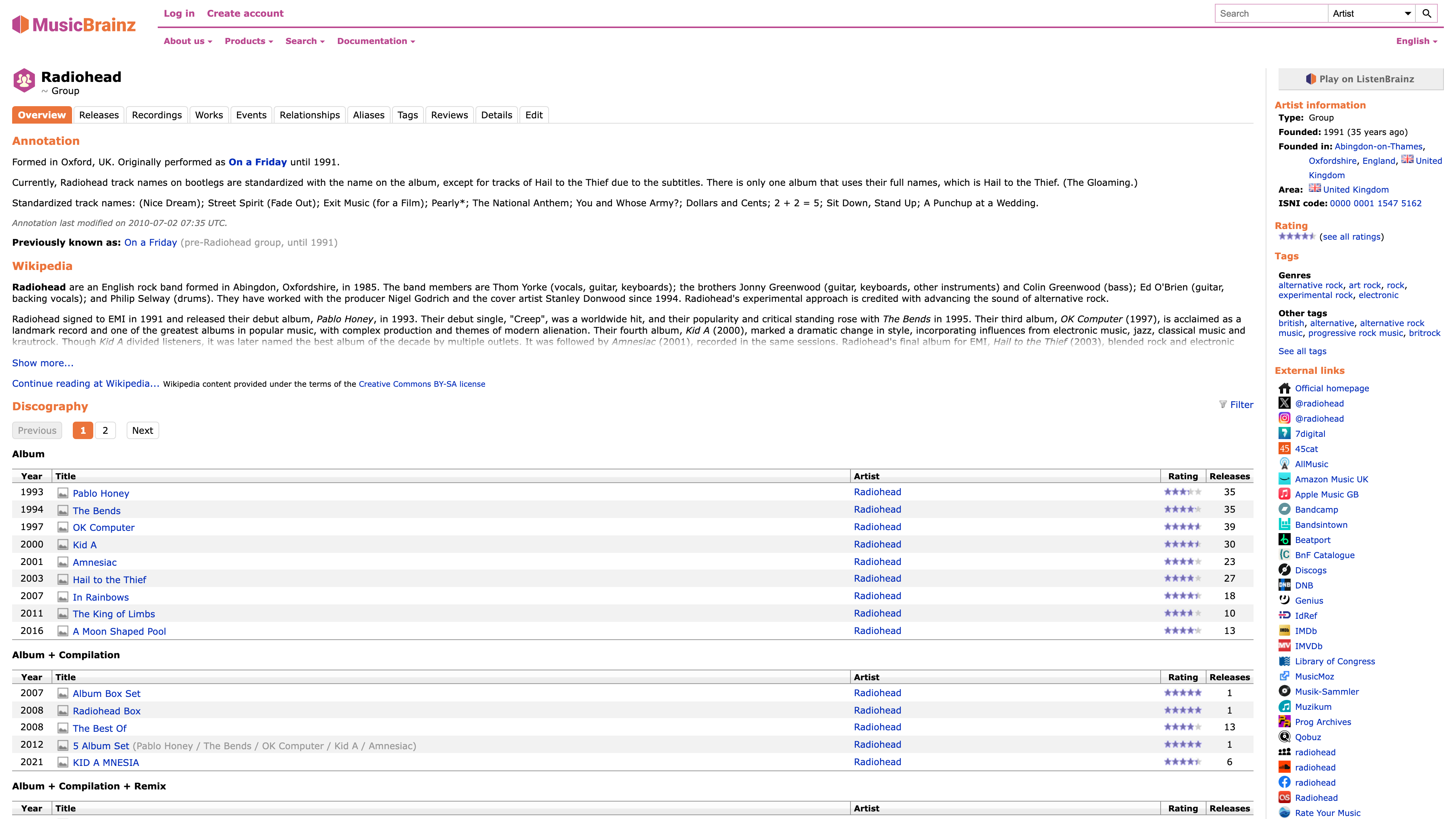
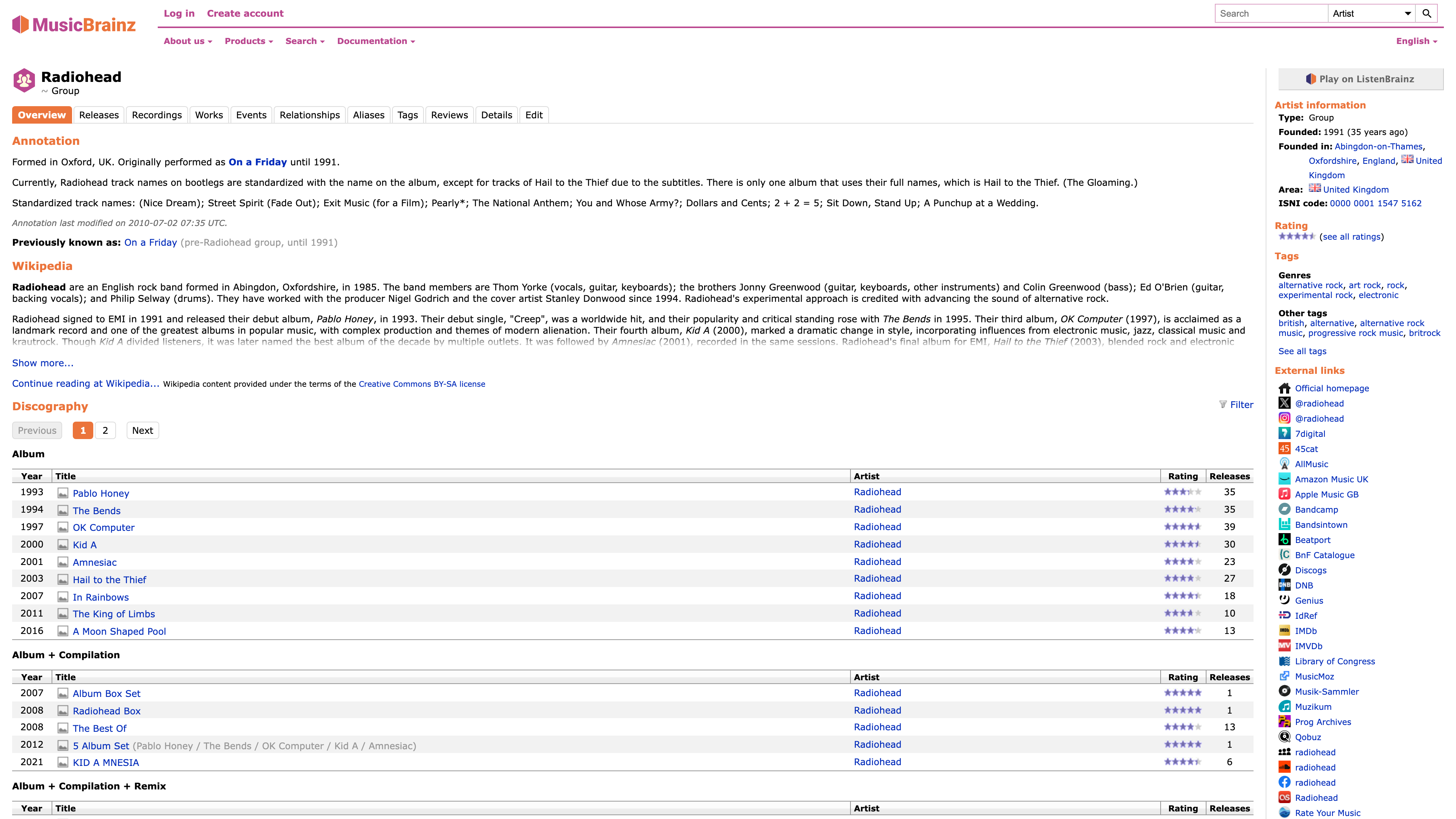
The screenshot above is Radiohead's artist page: a community-maintained annotation and Wikipedia summary on the left, a discography grouped by type (Album, Album + Compilation, and so on), and a sidebar with the entity type, founding location, ISNI code, user ratings, genre tags, and official external links to AllMusic, Bandcamp, Deezer, and others.
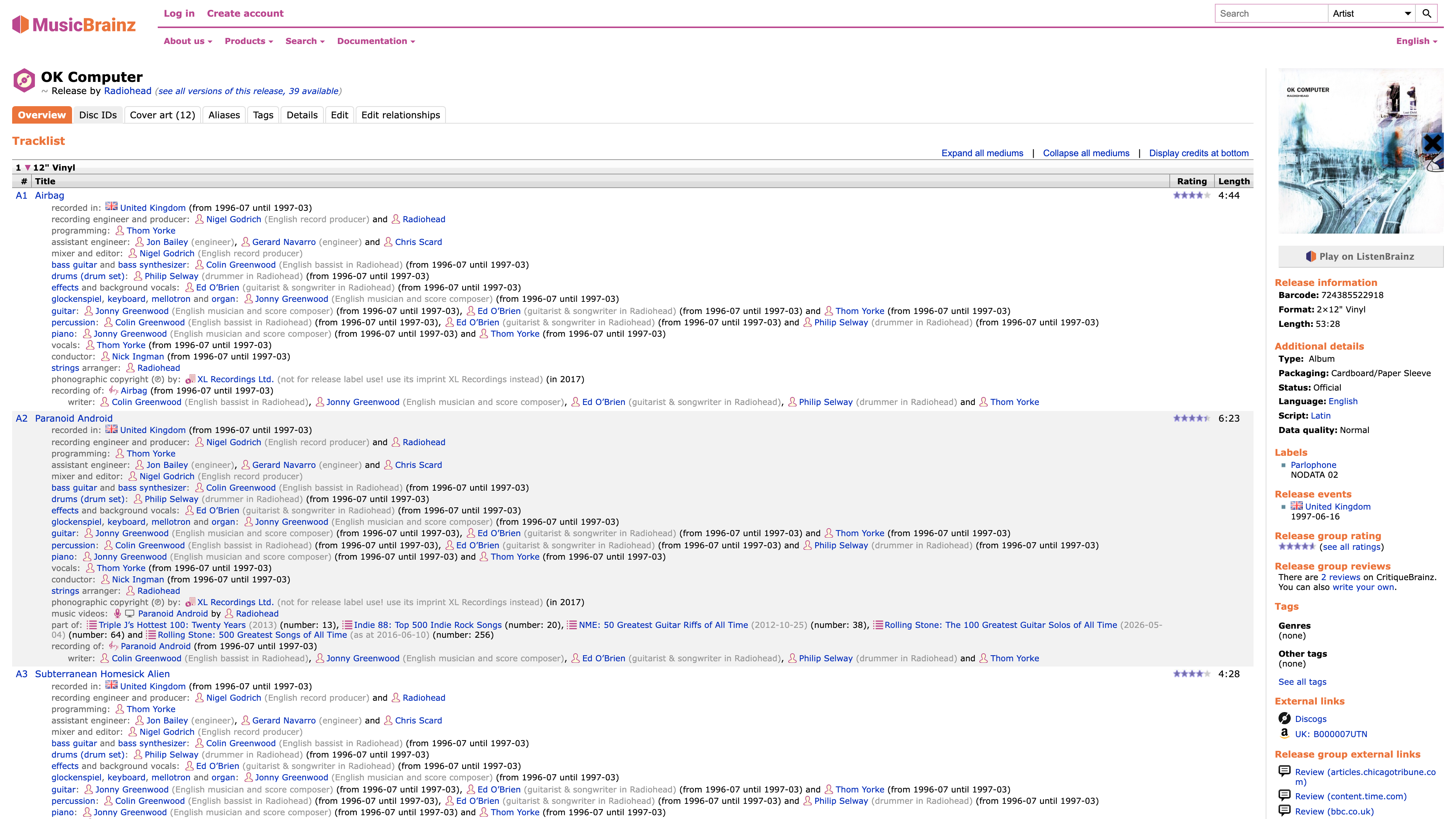
One level deeper, a release page holds the cataloging detail of one specific edition:
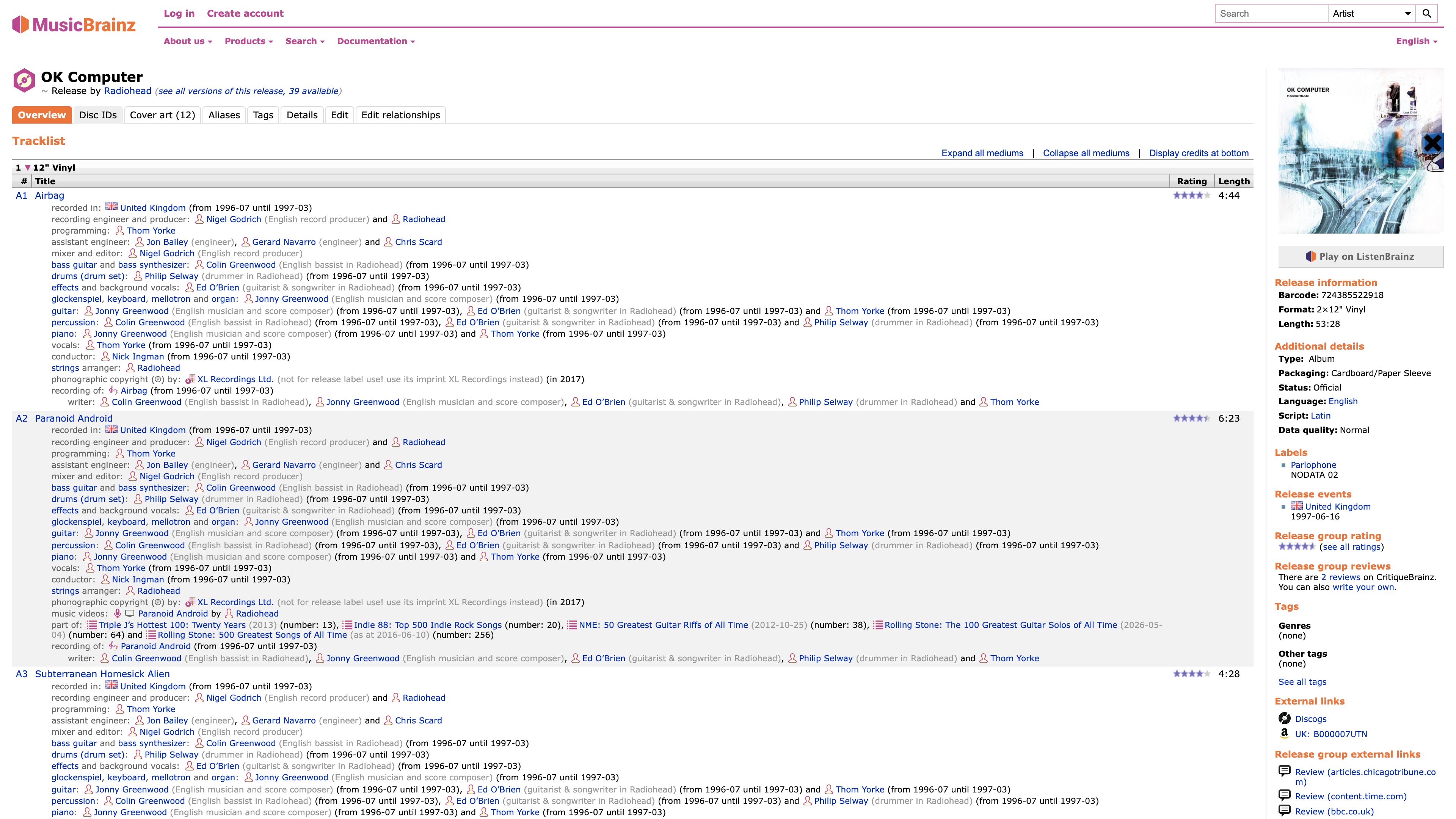
On this page for the 1997 UK 2x12" vinyl edition of OK Computer, every track carries its own writing, performance, and production credits (down to the exact period each credit covers), while the sidebar records the barcode, medium format, label, catalog number, release status, language, and cover art. This per-edition, per-track depth is what separates it from ordinary artist-profile sites.
As for scale, the official statistics page (data refreshed 2026-08-25, checked by us on 2026-09-02) reports about 2.97 million artists, 5.73 million releases (4.48 million release groups), roughly 39.9 million recordings, 2.82 million works, and 348 thousand labels; about 1.36 million registered editors have made 146 million edits in total (MusicBrainz statistics).
Accounts and Community Editing
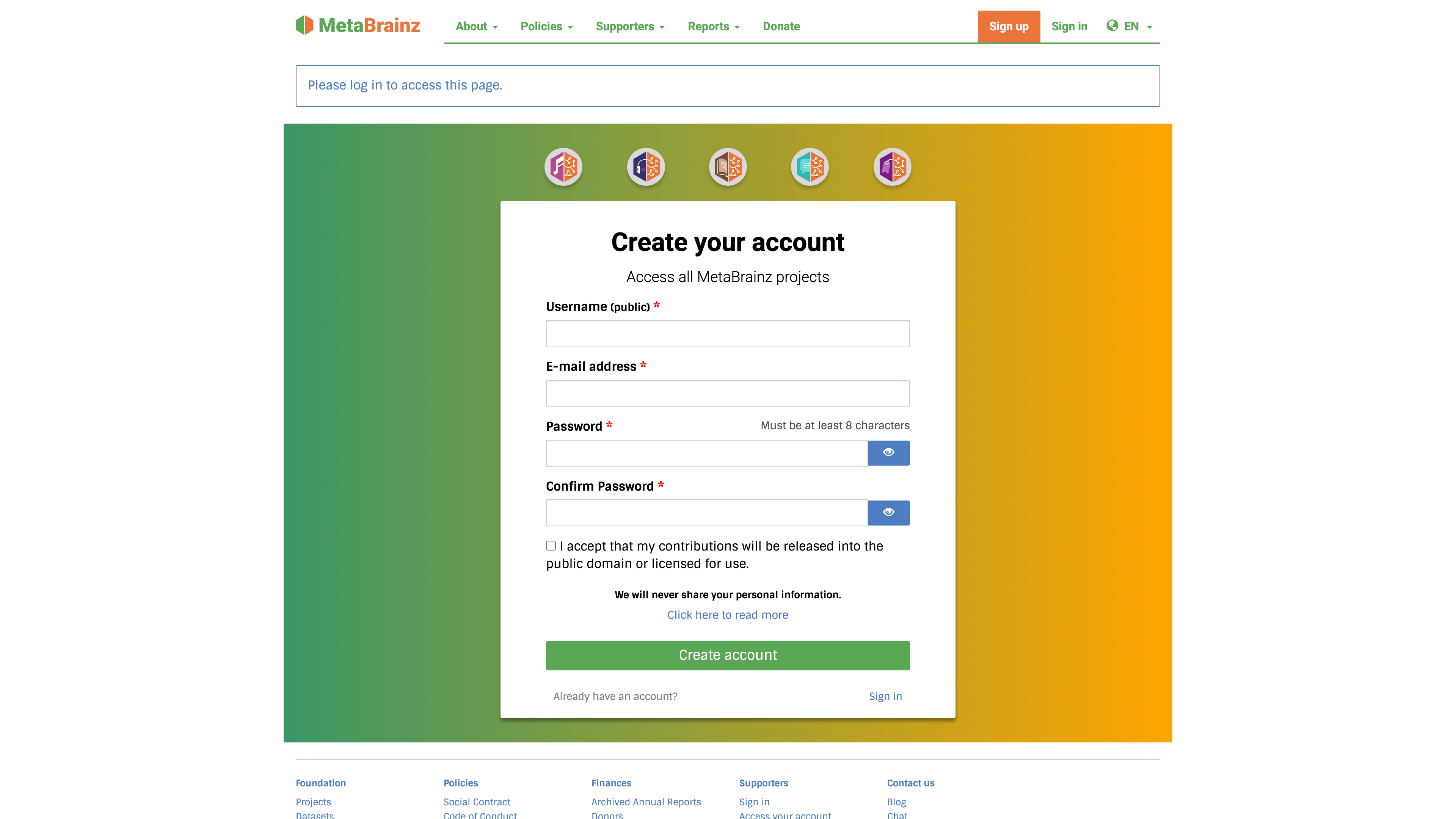
Browsing and searching everything requires no account. Editing does — and it is free. As of 2026-09-02, the register link on MusicBrainz redirects to the MetaBrainz Foundation's unified sign-up page (musicbrainz.org/register), which asks only for a public username, an email address, and a password of at least 8 characters; one account works across all MetaBrainz projects:
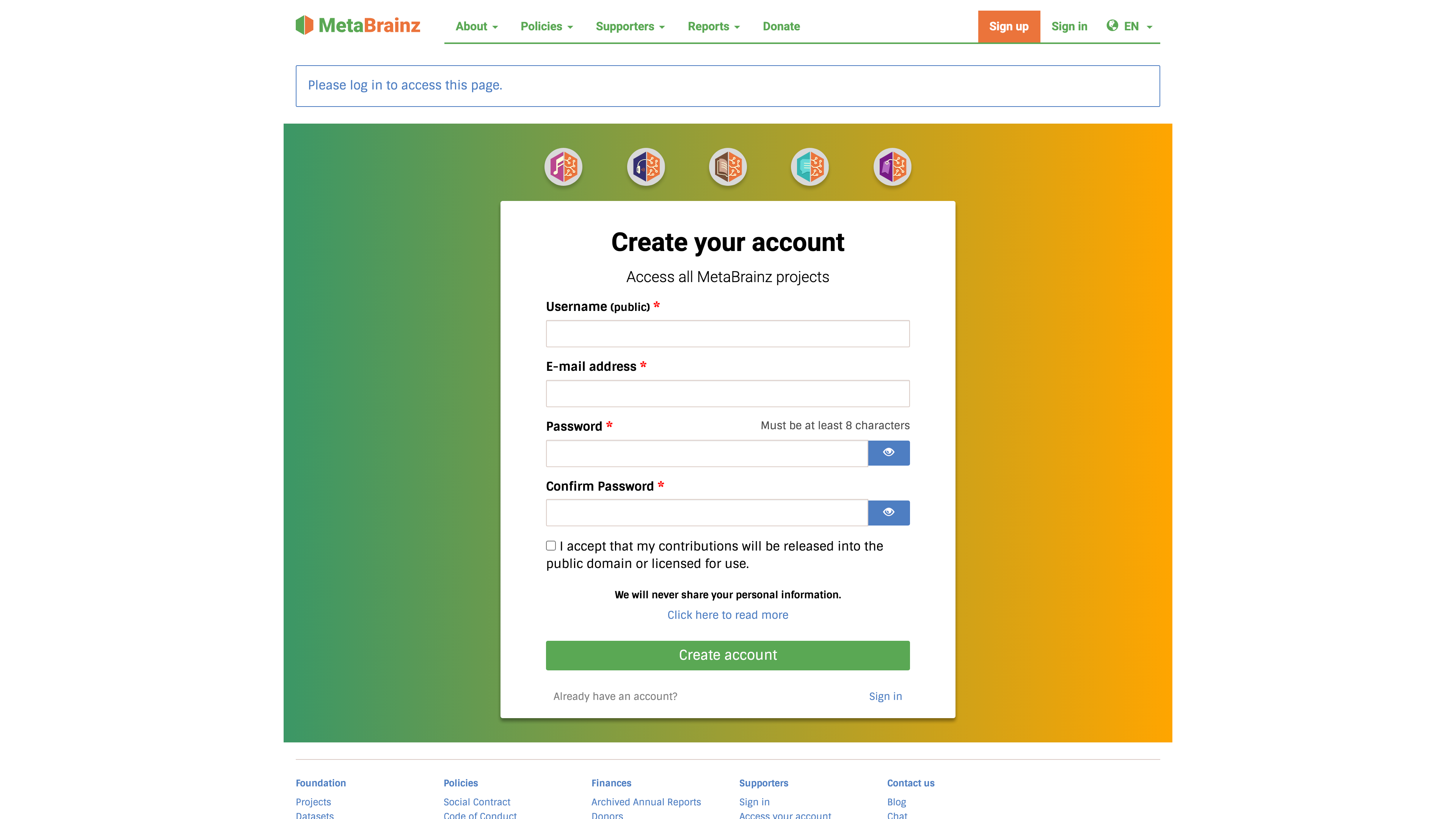
Data quality is maintained through peer review by editing and voting (How Editing Works):
- Anyone may submit a change to any entry, following community-written Style Guidelines;
- Each edit enters a public voting process: three unanimous votes apply or reject it immediately; otherwise it is settled after 7 days by vote count, and edits with no votes are accepted by default;
- Every change is kept in a permanent, publicly auditable edit history.
The checkbox on the sign-up page — agreeing that your contributions enter the public domain or are licensed for use — is the entry point of its open licensing stack, detailed below.
Open Interfaces and Tooling
For developers, MusicBrainz offers three tiers of open access:
- Web Service API (musicbrainz.org/ws/2/): a free query API serving XML or JSON. The official rate limit is on average 1 request per second per IP address; exceeding it returns HTTP 503 for all requests until the rate drops, and every client must send a User-Agent with contact information (rate-limiting documentation).
- Full database downloads: complete snapshots are generated twice a week for import into your own PostgreSQL instance.
- Live Data Feed: hourly replication packets keep a local mirror in sync with the main server; you run the mirror yourself, as no hosting is offered (Live Data Feed documentation).
For everyday users, the official tagger MusicBrainz Picard (GPL-licensed open source) is the most common entry point: it supports MP3, FLAC, Ogg, M4A, WMA, WAV, and more, identifies metadata-less files through AcoustID audio fingerprints, and completes tags and cover art in one pass, with scripting and plugin support. Album covers are hosted by the Cover Art Archive, a joint project with the Internet Archive — 66.2% of releases had CAA cover art as of the 2026-08-25 statistics. There is also an official Android app (on Google Play and F-Droid), though it is in maintenance mode per its project page.
Copyright and Content Policy
As a user-generated-content site, MusicBrainz layers its licenses clearly, each documented on an official page:
- Core data (cataloging information about artists, releases, recordings, etc.) is dedicated to the public domain under CC0 — usable by anyone, for any purpose, including commercially;
- Supplementary data (user annotations, tags, ratings, edit history, search indexes) is released under CC BY-NC-SA 3.0 — non-commercial use only, with attribution and share-alike;
- Live Data Feed replication packets are likewise CC BY-NC-SA 3.0; non-commercial users get free access tokens, while commercial users are asked to support the foundation financially — but MetaBrainz explicitly "does not charge for access to the data" (Live Data Feed);
- Contributor terms: the sign-up page states that contributions enter the public domain and/or are CC-licensed, and grants the MetaBrainz Foundation the right to license the data commercially;
- Cover images: cover art remains the property of artists and labels; the Cover Art Archive exists for archival purposes and tells users to "use the images at your own risk";
- Server software is open source under GPL v2 or later.
Who Uses MusicBrainz Data
- BBC: licensed the Live Data Feed in 2007 to power its music web pages, with BBC music editors joining the contributor community (MetaBrainz blog, June 2007);
- beets (the command-line music library manager): uses MusicBrainz as its default metadata source (beets documentation);
- Kodi (open-source media center): its official wiki strongly recommends tagging with Picard, and Kodi natively reads the MusicBrainz tag family (Kodi Wiki);
- WiiM (streaming audio brand): a commercial supporter using MusicBrainz to enrich users' music library metadata (MetaBrainz supporters page); the same page lists research users such as Queen Mary University and Universitat Pompeu Fabra.
Good Use Cases
- Tidying a local music library: batch-complete and correct tags and cover art with Picard or beets;
- Verifying discography facts: editions, barcodes, ISRCs, songwriting and performance credits, release histories;
- Building music apps: start cheaply with the free API plus twice-weekly full dumps, and self-host a mirror for heavier workloads;
- Musicology and information-retrieval research: the CC0 core data is free for academic and analytical use;
- Contributing to open data: complete and correct entries for artists you care about.
Limitations
- Not a listening or discovery tool: the site serves metadata only — no streaming, playback, or recommendations (recommendations live in the separate ListenBrainz project);
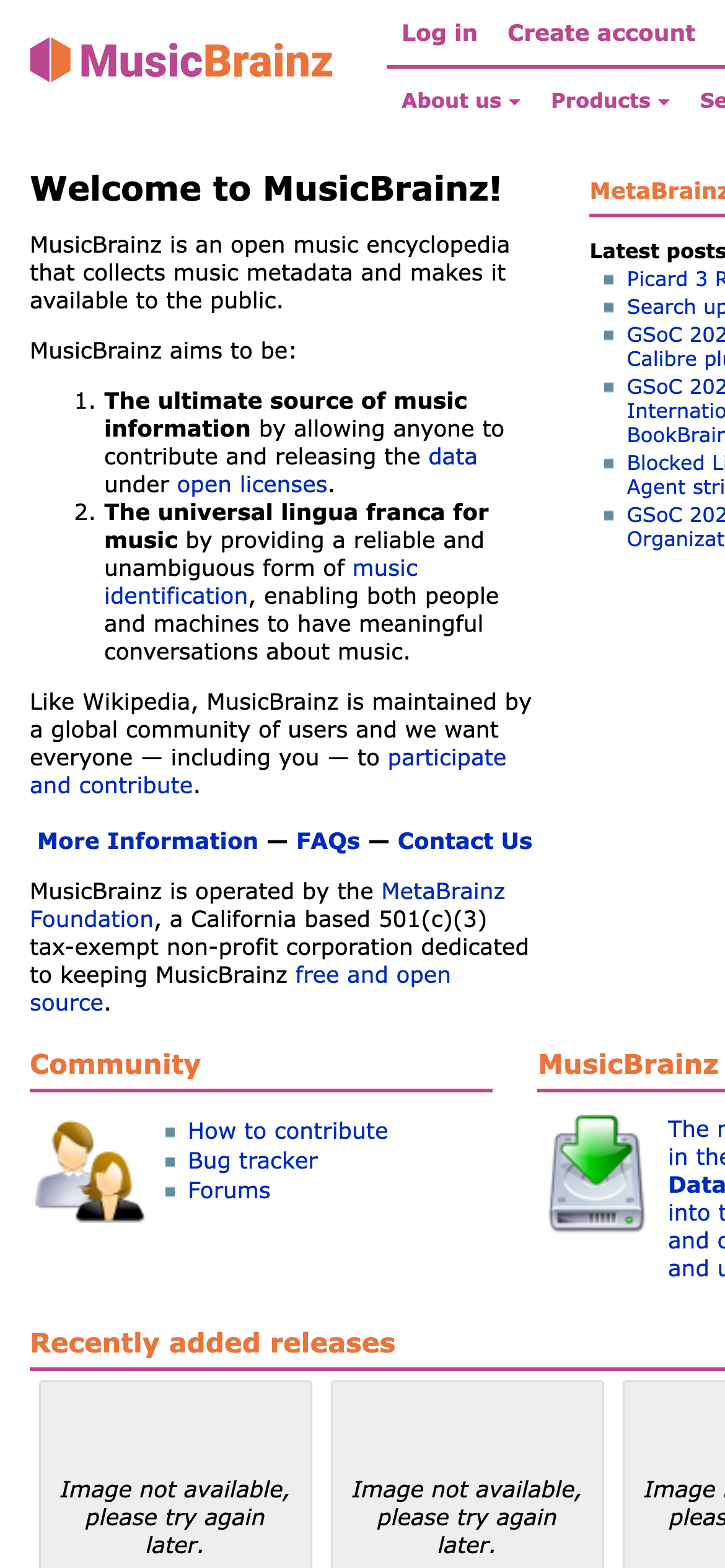
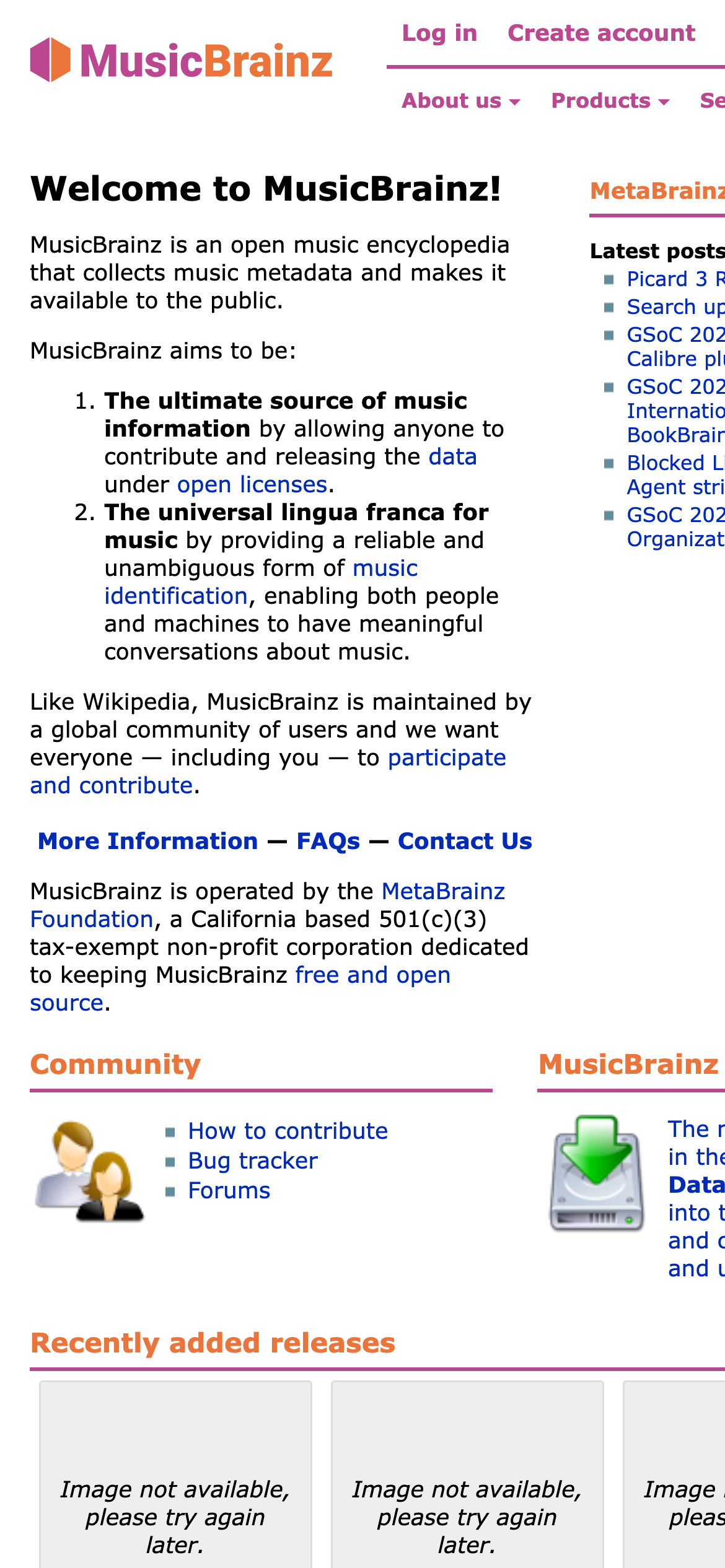
- Not mobile-friendly: in our 2026-09-02 test at a 390px viewport, both the homepage and entry pages required horizontal scrolling (see below); the official Android app is in maintenance mode and there is no official iOS app;
- Coverage follows community activity: popular and Western music is documented in depth, while long-tail, newly released, and non-English music can be missing or stale (a reasonable inference from the contribution model);
- Uneven data vetting: per the statistics page, 99.8% of releases remain at the default data-quality level and only about 0.1% are rated "high quality" (2026-08-25 data), so most entries have not been fully reviewed;
- Tight API rate limit: 1 request per second pushes bulk use cases toward data dumps or self-hosted mirrors, shifting the operational burden to the consumer;
- Limited interface languages: only English, German, French, Italian, and Dutch interfaces (non-English ones are community-maintained), with no Chinese UI.
Compared with Discogs
The most common point of comparison, also founded in 2000, is Discogs: both build their databases through user contributions, but Discogs is operated commercially by Zink Media and centers on physical-record collecting and a secondhand marketplace (Wikipedia); MusicBrainz is run by a nonprofit foundation, runs no marketplace, and releases its core data under CC0 with full mirroring allowed. For pricing and trading records, Discogs is the natural tool; for freely obtaining, building upon, or offline-mirroring an entire music metadata corpus, MusicBrainz is the better source.
References
- MusicBrainz official site and About page (checked 2026-09-02)
- MetaBrainz Foundation - About and projects
- MusicBrainz Database (data model and licenses)
- MusicBrainz database statistics (data refreshed 2026-08-25)
- How Editing Works (editing and voting)
- XML Web Service rate limiting and Live Data Feed
- MusicBrainz Picard, Cover Art Archive, MusicBrainz for Android
- The BBC partners with MusicBrainz (MetaBrainz blog, 2007-06)
- beets auto-tagger documentation, Kodi Wiki - Music tagging, MetaBrainz supporters
- MusicBrainz (English Wikipedia), Discogs (English Wikipedia)