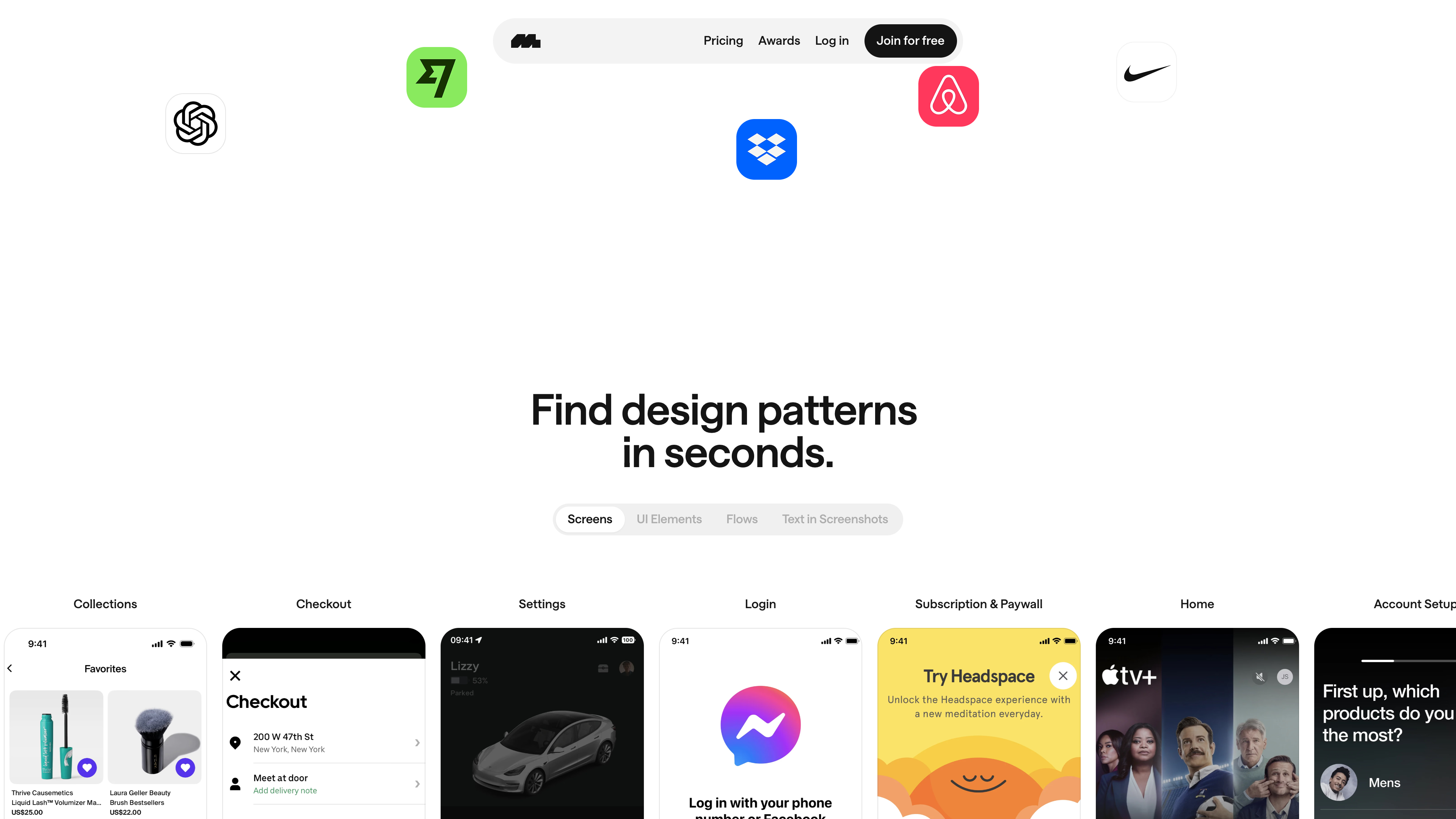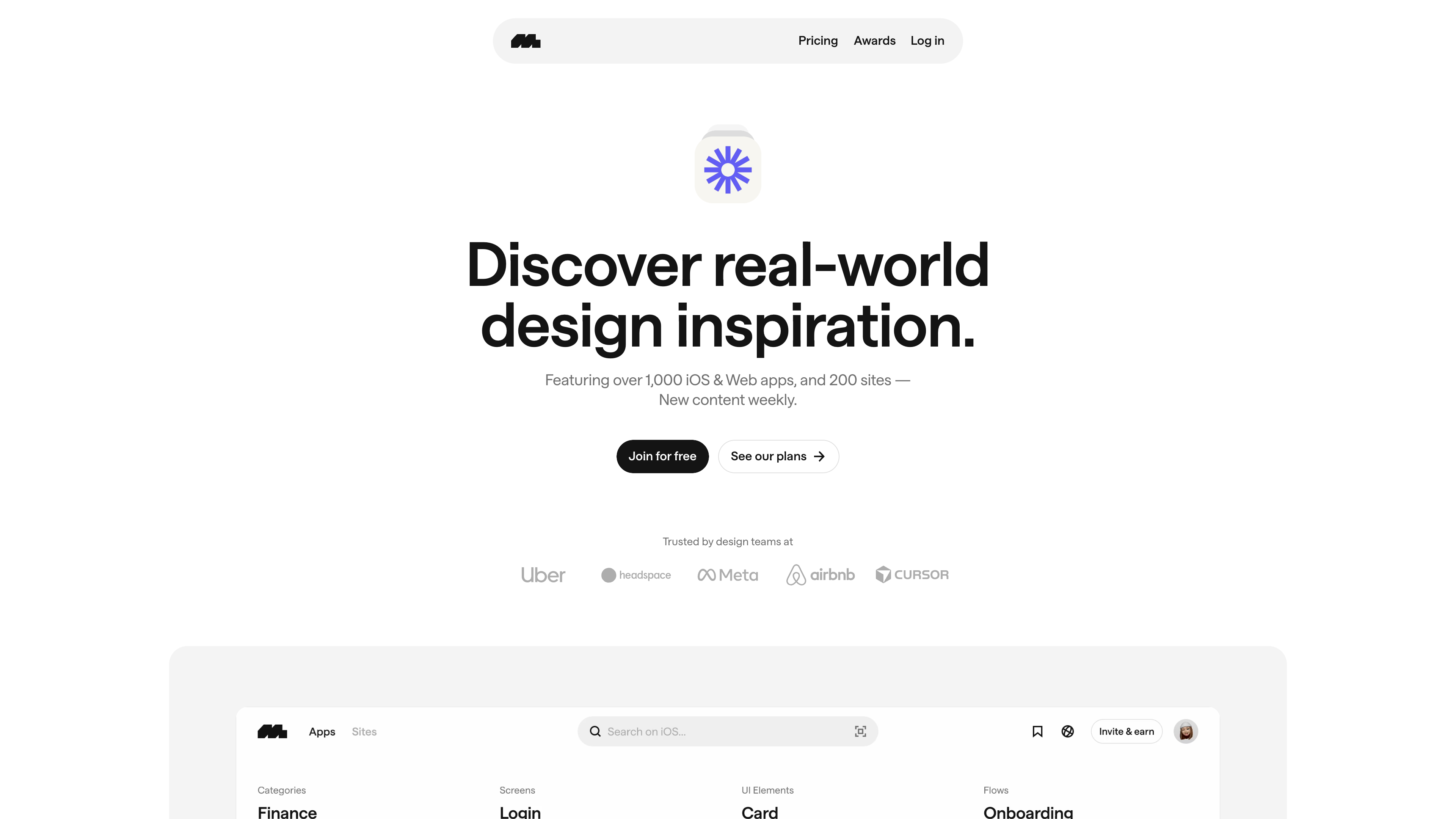
Mobbin (mobbin.com) is a UI/UX design reference library: it takes real, shipped mobile apps and websites apart into interface screenshots, multi-step user flows, and motion videos, then hand-labels everything by screen pattern and UI element so designers can search across the collection. As of 2026-09-08, the homepage lists 1,428 apps, 621,500+ screens, and 323,900 flows, with new content added weekly. Unlike Dribbble or Behance, which are dominated by designers' concept work, everything on Mobbin comes from products that are actually live and in users' hands; unlike downloading apps and screenshotting them yourself, the pattern research has already been done and indexed.
At a glance
- URL: https://mobbin.com/
- Type: UI/UX design pattern reference library (screenshots and flows from real products)
- Cost: Free tier with limited content, no search, and a 3-collection cap; Pro at US16/member/month (billed yearly), Enterprise custom; paid plans bill yearly or quarterly only (pricing page, 2026-09-08)
- Sign-up: Marketing pages are open; the library itself requires an account (Google one-tap sign-up supported)
- Interface language: English only
Background
Mobbin was founded in 2018 by Jiho Lim. According to a founder interview and a Growthmates retrospective with co-founder Jovin Liew, Lim was a university student in Singapore doing freelance mobile interface design at the time. Every new project meant downloading dozens of apps, taking hundreds of screenshots, and sorting them into folders like "Onboarding", "Checkout", and "Settings". He first organized this in a shared Dropbox folder, then spent about three months building a searchable web app — the first version of Mobbin — which launched on Product Hunt and spread through the design community.
The company behind the site is Mobbin Pte. Ltd., registered in Singapore (UEN 202105940R). It has remained bootstrapped; the December 2025 retrospective put the team at 25+ people across several countries, and the company's 2023 year-in-review described nine new hires that year spanning six countries. The official About page claims 400k+ users (as of 2026-09-08; that page's screenshot count is clearly stale, so the homepage figures are the ones to trust). The homepage names design teams at Uber, Meta, Airbnb, Headspace, and Cursor among its customers.
The library and how you search it
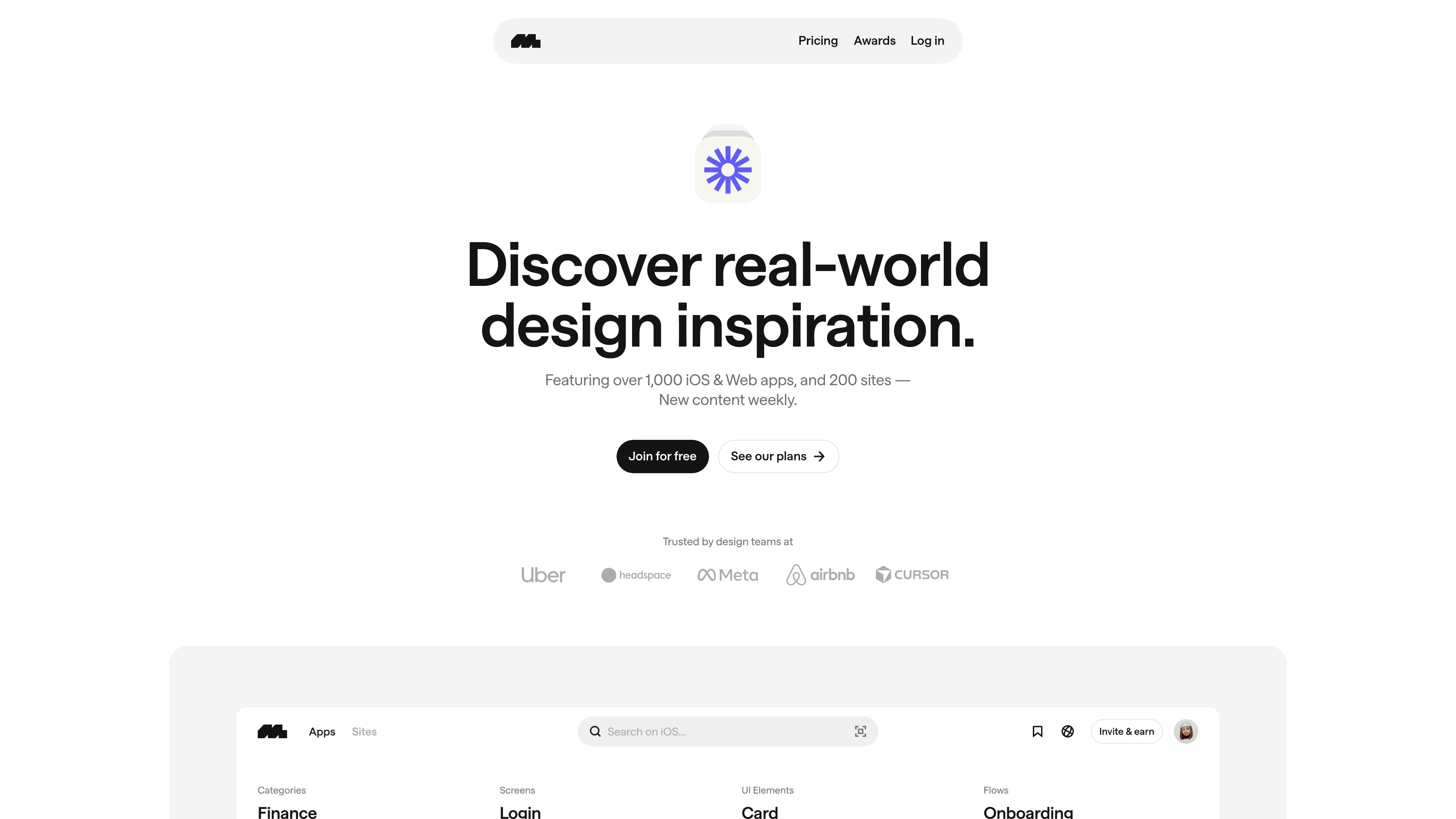
Mobbin's core value is that real product interfaces are structured rather than dumped in a gallery. As shown on the homepage, content is organized along four dimensions:
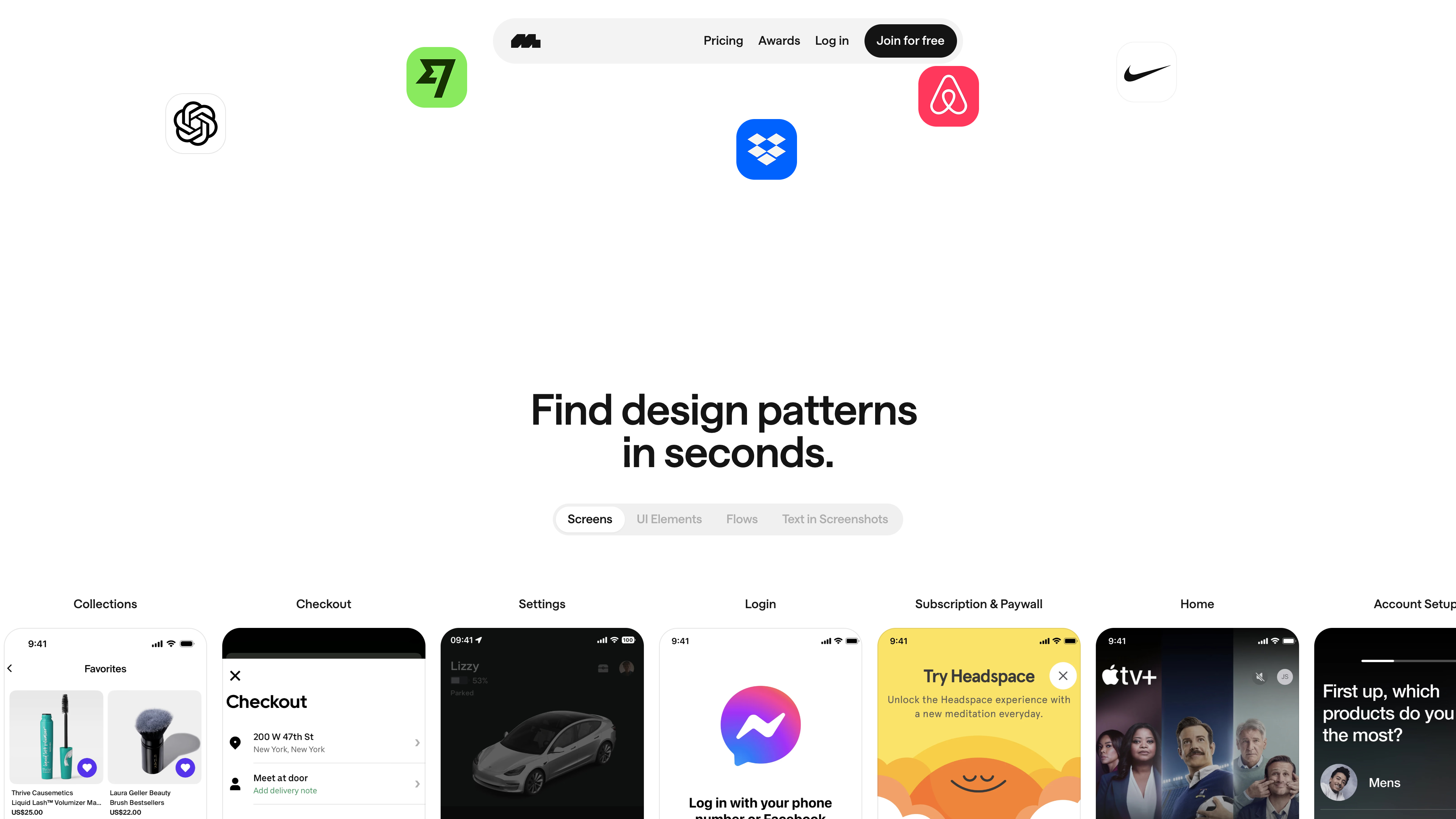
- Screens: every screenshot is tagged with its app and a screen pattern (Onboarding, Checkout, Settings, Subscription & Paywall, and so on), so you can compare how a dozen apps handle the same screen side by side.
- UI Elements: component-level granularity — Cards, Bottom Sheets, and similar — for checking how specific controls are usually done.
- Flows: multi-step journeys such as sign-up, verification, or checkout, strung together in order. Since 2024, flows include screen recordings, and an Interactive Mode lets you walk through a flow step by step via hotspots, much like a Figma prototype presentation (official changelog).
- Text in Screenshots: search for copy that appears inside the screens themselves (button labels, prompts), with matched words highlighted in the results.
The library also covers Animations (short videos capturing interface motion), iOS Live Activities and widgets, and — since 2025 — Mobbin Sites, a collection of marketing websites filterable by page section (Hero, Pricing, …) and style (Brutalist, Minimal, …). App detail pages keep version history, so you can compare how an app's interface evolved (fully available on paid plans).
On the search side, a 2026 overhaul merged screens, flows, and site sections into a single query and added Deep Search: describe what you need in plain language and an AI layer matches it semantically, with the same result ordering used across the site's Chat and the API. If you spot an interface you like elsewhere, visual search finds similar screens from an uploaded screenshot (the changelog notes this only covers mobile screens).
Collections, collaboration, and export
Anything you find can be saved into Collections (capped at 3 on the free tier), and you can upload your own screenshots alongside Mobbin's content. Starting in 2024, Mobbin added community features: public collections, public profiles at mobbin.com/@username, and public comments on screens and flows; the Team plan adds shared collections, workspace-scoped comments, and member management. For export, single screens copy to the clipboard, and the official Figma plugin pastes multi-screen selections or whole flows into Figma/FigJam in one step — note that what lands on the canvas is images, not editable layers.
Pricing and open access
As of 2026-09-08, the official pricing page lists the following (paid tiers bill yearly or quarterly only; yearly billing saves about 33% over quarterly):
| Plan | Price | What you get |
|---|---|---|
| Free | $0 | Limited apps and sites; no Flows, Animations, or search; up to 3 collections; limited copying, downloads, and version history |
| Pro | US$10/month (billed yearly) | All apps and sites, Flows, Animations, unlimited collections, Deep Search, MCP, hidden screen footers; 1 member |
| Team | US$16/member/month (billed yearly) | Everything in Pro plus invites, shared collections and comments, team management, centralized billing, API access, SOC 2 reports |
| Enterprise | Custom | Unlimited members; SAML/SCIM, invoice/PO billing, priority support, privacy controls |
Two add-ons sit alongside: Finance+ (65+ banking, crypto, and investment apps, US$399/month billed yearly, Team and Enterprise only) and a 50% education discount on Pro for students and educators at accredited institutions (up to 2 years, verified via a school email address).
For programmatic access, Mobbin launched an official MCP server in May 2026, letting AI tools such as Claude pull real interface references from the library (Pro and above); Team and above also get API access. API and MCP usage is metered through AI Credits, and the terms explicitly forbid using retrieved content to build a competing library.
Copyright and content policy
Everything in the library is a screenshot or recording of a third party's interface. The terms of service state that copyright and trademarks in these materials belong to their respective owners (IP Holders), that Mobbin claims no ownership over them, and that rights holders can request removal via the Help Center or the registered address. For users, the terms allow use of the materials only within the Fair Use provisions of Singapore's Copyright Act 2021, and prohibit scraping, re-hosting, mirroring, commercial exploitation, and using the content to train AI models; account sharing is explicitly banned and can lead to termination. Refunds are not offered unless required by law, and cancellations take effect at the end of the current billing period. The privacy policy discloses collection of standard log data (including IP addresses), device data, and account information; content you publish publicly can be indexed by search engines, and data is stored in the United States and Singapore.
Where it fits
- Before designing a specific screen (sign-up, checkout, a subscription paywall), pull up a dozen real products' takes on it instead of downloading apps one by one.
- Checking how a category of flow (KYC verification, onboarding) is typically structured and worded across an industry.
- Building a shared competitive-reference base for a team: shared collections with comments instead of screenshots scattered across chat threads.
- Feeding real interface references into AI-assisted design or development workflows via MCP or the API.
Limitations
- The free tier is narrow: per the official comparison table, it excludes search, Flows, and Animations, limits the apps and sites you can see, and caps collections at 3 — fine for evaluating the product, not enough for day-to-day research.
- No monthly billing: Pro and Team bill yearly or quarterly only, and refunds are not offered in principle, which makes one-off research relatively expensive.
- Reference, not source material: exports are images, not editable design files, and the terms restrict reuse to fair use — you cannot lift the material directly into your own product.
- iOS and web focus: the current pitch is 1,000+ iOS and web apps plus 200+ sites; desktop software, Android, and mini-program ecosystems are not part of the advertised coverage, and niche or regional apps may simply not be included.
- English only, both the interface and most of the catalogued products.
- Uneven freshness: content is added weekly, but individual apps are captured at different times — check the version and date on an app's detail page before treating a screen as current.
Alternatives
- Page Flows: a subscription library of product flows built around screen recordings; stronger on video, but without Mobbin's fine-grained tagging by screen pattern and UI element.
- Dribbble / Behance: designer communities centered on concept work and portfolios — good for visual style trends, but the content is mostly unpublished work and can't serve as evidence of real product patterns.
References
- Mobbin homepage (checked 2026-09-08)
- About - Mobbin (checked 2026-09-08)
- Pricing - Mobbin (checked 2026-09-08)
- Platform Terms of Service - Mobbin (checked 2026-09-08)
- Privacy Policy - Mobbin (checked 2026-09-08)
- Changelog - Mobbin (checked 2026-09-08)
- Copy to Figma - Mobbin Changelog (checked 2026-09-08)
- 2023 Wrapped - Mobbin Blog (checked 2026-09-08)
- Mobbin for Education - Mobbin Help Center (checked 2026-09-08)
- Mobbin Launches MCP Server… - Business Wire (via Morningstar) (checked 2026-09-08)
- How Lim Jiho Built Mobbin - Starter Story (checked 2026-09-08)
- The 3 PLG experiments that grew Mobbin's expansion revenue +20% - Growthmates (checked 2026-09-08)