MIT OpenCourseWare (OCW) is the Massachusetts Institute of Technology's long-running project to publish its real classroom materials online for free: syllabi, lecture notes, assignments, and exams are available to anyone who opens the site, many courses include complete video lectures, and none of it requires an account or runs on a schedule. The project was announced on April 4, 2001 by MIT President Charles Vest and soft-launched as a pilot site on September 30, 2002, making it the first university open courseware initiative and the first institutional adopter of Creative Commons licenses. As of 2026-09-02, OCW lists 2,585 courses covering the bulk of MIT's undergraduate and graduate curriculum across all five schools and 33 academic units.
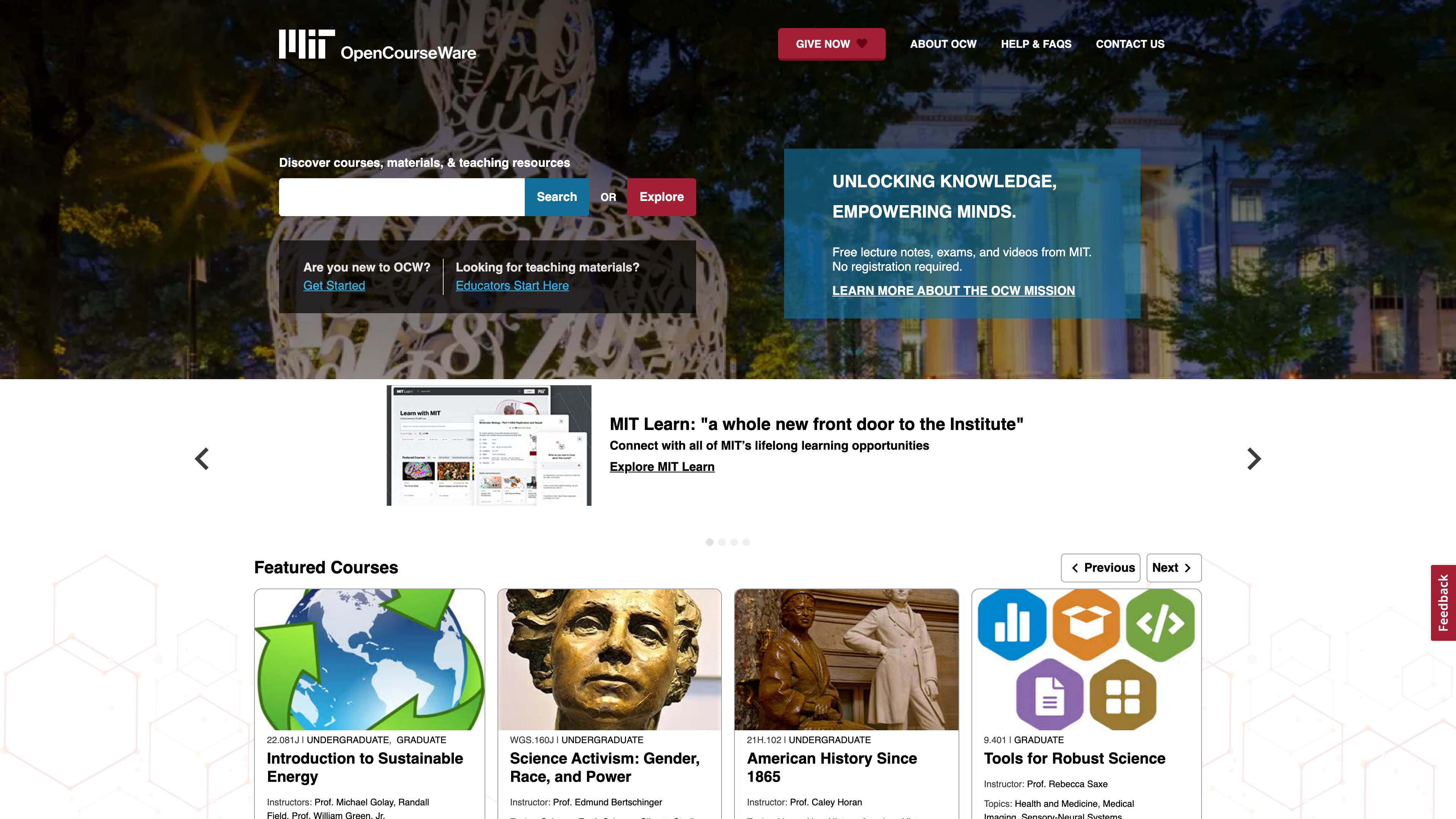
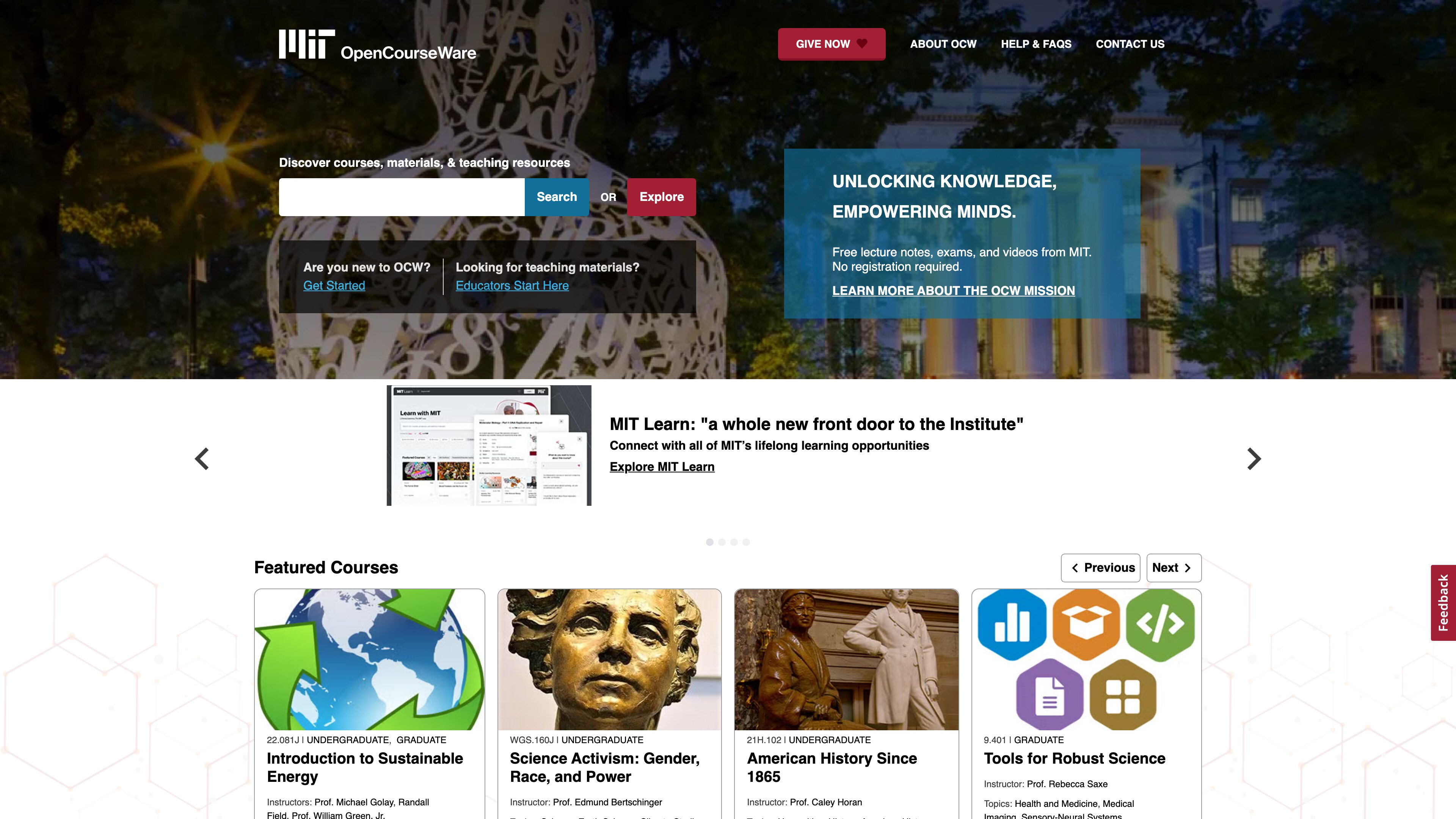
The homepage above shows the main entry points: a search bar for courses, materials, and teaching resources; a banner stating the mission ("Unlocking Knowledge, Empowering Minds" — free lecture notes, exams, and videos from MIT, no registration required); a Featured Courses carousel; and a promotion for MIT Learn, the unified lifelong-learning hub MIT launched in 2025.
At a Glance
- URL: https://ocw.mit.edu/
- Type: Open courseware / open educational resources (OER) publication platform
- Cost: Free, no advertising
- Registration: None — everything is readable and downloadable without an account
- Interface language: English
- Launched: Announced April 4, 2001; pilot September 30, 2002; official site October 2003
- Operated by: Massachusetts Institute of Technology (MIT Open Learning)
- License: Creative Commons BY-NC-SA 4.0 (Attribution-NonCommercial-ShareAlike)
Background
OCW grew out of a reversal: in the fall of 2000, an MIT study group charged with designing a commercially self-sustaining lifelong-learning venture concluded, at the last moment, that the Institute should instead give away the teaching materials from virtually all of its courses — the name and inspiration were borrowed from open-source software. President Charles Vest announced the plan on April 4, 2001, landing on the front page of The New York Times; the Mellon and Hewlett foundations provided the initial $11.5 million in funding. (Source: MIT Faculty Newsletter's 20th-anniversary retrospective)
The pilot site opened quietly on September 30, 2002 with materials from 32 courses across 16 departments — among them Professor Gilbert Strang's 18.06 Linear Algebra with 30 video lectures, which went on to become one of the most popular courses in the catalog. It drew more than 13 million page requests in its first week. The catalog reached 500 courses within a year, the official site launched in October 2003, and by 2007 OCW met its original goal of representing the entire MIT curriculum with more than 1,800 courses.
The model spread: more than 250 universities worldwide went on to publish their own open courseware and formed the OpenCourseWare Consortium (now Open Education Global, of which OCW is a member). As of 2026-09-02, the OCW website and YouTube channel together have passed 500 million lifetime visits, and OCW maintains 440 mirror sites at schools in bandwidth-constrained regions.
What a Course Contains
A typical OCW course includes a syllabus, at least one kind of instructional material (lecture notes or a reading list), and learning activities (assignments or exams); many courses add complete video lectures, free online textbooks, and Instructor Insights written by the faculty who taught them. Most content comes straight from real MIT classrooms and is archived as a snapshot of the semester in which it was taught — a course labeled "Spring 2010" reflects that semester's teaching exactly. (Source: Get Started)
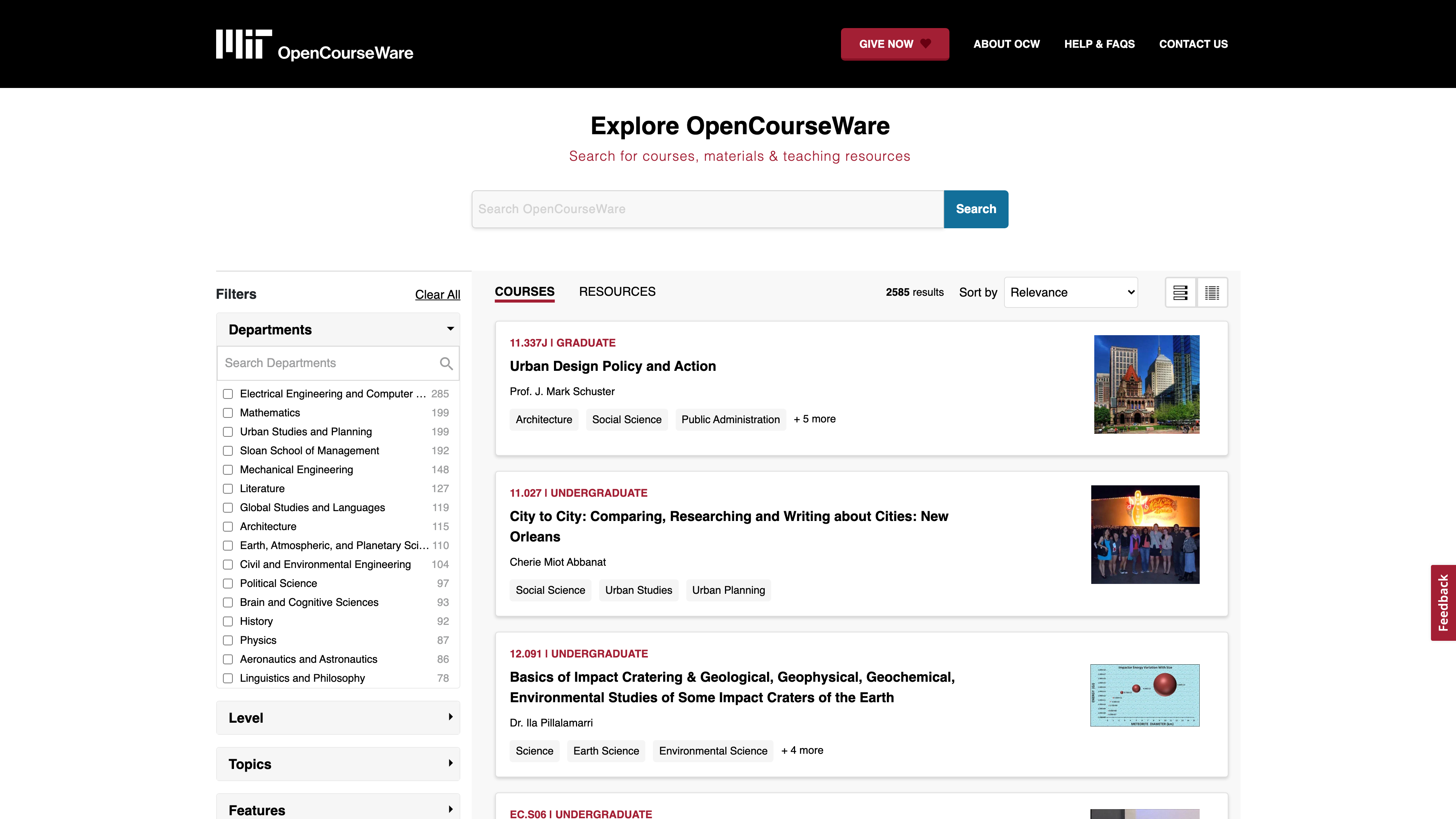
The search page above lets you filter by department (shown here: 285 courses from Electrical Engineering and Computer Science, 199 from Mathematics, and so on), by undergraduate or graduate level, by topic, and by resource type; as of 2026-09-02 it lists 2,585 courses. OCW also curates lists of its most popular courses, courses with lecture videos, and OCW Scholar courses that assemble all components a self-learner needs.
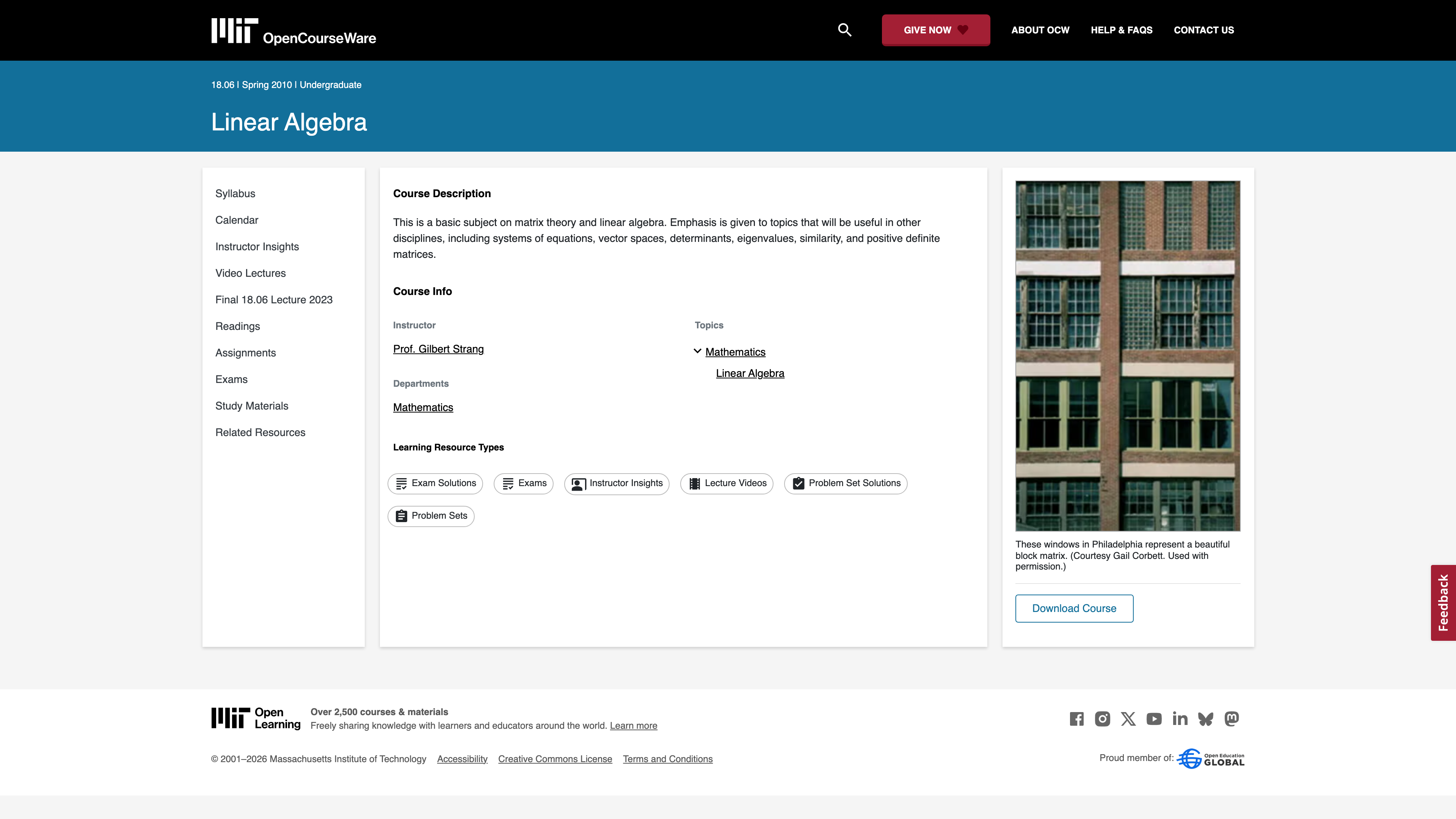
Above is the course page for 18.06 Linear Algebra: the left navigation leads to the syllabus, calendar, video lectures, readings, assignments, and exams; the right column names the instructor and department and lists the resource types the course offers (lecture videos, exams with solutions, problem sets with solutions). Every course offers a "Download Course" bundle. OCW's official YouTube channel has passed 6 million subscribers, and select courses support offline mobile use through OCW To Go.
Licensing and Terms of Use
All OCW content is published under CC BY-NC-SA 4.0: you may copy, adapt, and redistribute it as long as you credit MIT OpenCourseWare, do not use it commercially, and share derivatives under the same terms. The terms page spells out MIT's interpretation of "non-commercial" — the use, not the user, determines compliance, so a company may use OCW for internal training while a paid course built on OCW materials would not be allowed; recovering the cost of making small numbers of copies (under 1,000) is permitted.
The same page explicitly allows OCW content to be used for AI training, provided attribution is maintained, the resulting models are used non-commercially, and derivatives are released under CC BY-NC-SA 4.0 or a compatible license. MIT's name and logos are trademarks and fall outside the license. Note that third-party copyrighted materials referenced by courses — course packs and assigned readings — are not covered and cannot be distributed by OCW; you will need a library or bookstore for those.
On privacy, OCW states that it does not collect personally identifiable information unless you volunteer it (for a newsletter or feedback form). The site uses Google Analytics, but disabling cookies does not block any content.
Who It's For
- Self-learners working through a full university course: start from the syllabus and calendar, study the notes, test yourself with the problem sets and exams
- Teachers designing their own courses: reuse the structure of an MIT equivalent and read the Instructor Insights
- Enrolled students previewing or reinforcing their own classes, especially in math, computer science, and physics
- Offline or low-bandwidth settings: whole-course downloads, mirror sites, and OCW To Go
Limitations
- No credit or certificates: OCW publishes materials rather than running courses. MIT is explicit that it offers no degree, credit, or certification for OCW use, and there is no grading, instructor feedback, or learning community. Learners who need a credential should look at MITx on edX, MicroMasters, or similar programs.
- Video is not standard: because video production is expensive, only some courses include lecture videos; many offer notes and problem sets only.
- Content is a semester snapshot: course pages are archives of how a course was taught in a given term, so materials can be dated and are not continuously revised.
- English only: both the interface and the materials are in English.
- Some readings missing: copyrighted course packs and assigned texts must be sourced elsewhere.
Alternatives
- MITx on edX: MIT's MOOC arm on edX, with scheduled course runs and paid verified certificates on some courses — complementary to OCW's publish-the-materials approach.
- Open Yale Courses: Yale's OCW-style project, likewise free with full lecture videos, but at a much smaller scale.
References
- MIT OpenCourseWare (checked 2026-09-02)
- About Us | MIT OpenCourseWare (2,500+ courses, 500M+ lifetime visits, 440 mirror sites, 6M YouTube subscribers, funding structure)
- Get Started | MIT OpenCourseWare (no registration, no credit or certificates, video and course-pack limitations)
- Privacy and Terms of Use | MIT OpenCourseWare (CC BY-NC-SA 4.0, non-commercial interpretation, AI-training terms, privacy policy)
- MIT News: OCW marks 10th anniversary of pilot site launch (September 30, 2002 launch, first 32 courses, first-week traffic)
- MIT Faculty Newsletter: On the 20th Anniversary of OpenCourseWare (April 4, 2001 announcement, committee origins, foundation funding, first institutional Creative Commons adopter)
- OCW course search (2,585 courses as of 2026-09-02)