Midjourney (midjourney.com) is a subscription-only AI image and video generation service: you type a text prompt, the model returns four candidate images, and you then upscale, vary, repaint regions, extend the canvas, or turn a still into a short video clip. The problem it solves is turning a mental picture into usable visual material without drawing or 3D skills. Its verifiable differences from peers: it is fully closed-source, sells subscriptions only with no free tier, and is known for a stylized, aesthetics-first look. Operator Midjourney, Inc. describes itself as a self-funded independent research lab — the homepage currently calls it "a community-funded research lab of 60 people." As of 2026-09-12, the latest public model is V8.2 (released July 2026).
At a Glance
- URL: https://www.midjourney.com/
- Type: AI text-to-image / image-to-video service (closed-source models, subscription)
- Pricing: Four tiers — Basic 30/mo, Pro 120/mo, ~20% off billed annually; see the official plan comparison (as of 2026-09-12)
- Account: Browsing the homepage and help center needs no account; generating requires sign-in plus an active subscription. No free trial on the website or Discord (a limited trial exists only in the niji·journey mobile app); minimum age 13
- Interface language: English (no official localized UI observed)
- Launch: Discord server opened March 2022; open beta started July 12, 2022
Background
Midjourney, Inc. is based in San Francisco and was founded by David Holz, previously co-founder of the hand-tracking hardware company Leap Motion (The Register interview, August 2022). Note that secondary sources disagree on the incorporation year (2021 vs. 2022); what can be verified precisely is the product timeline: the Midjourney Discord server opened on March 14, 2022, and the image service entered open beta on July 12, 2022 (Wikipedia). In that 2022 interview Holz said the company was already profitable and had taken no outside investment — a "self-funded" stance the site still repeats today.
Key product milestones:
- 2022: The service launched as a Discord bot, where users generated images with
/imaginein public channels; the model iterated quickly to V4, and the anime-tuned Niji model arrived in December (Wikipedia version table). - September 2023: Vary (Region) added inpainting — regenerating only a selected area.
- August 2024: A full web interface and web editor launched alongside V6.1, ending the hard dependency on Discord (the website had earlier required users to generate a quota of images via the bot first).
- April and June 2025: V7 shipped, followed by the first video model V1 — image-to-video, producing four 5-second clips per run, web-only at launch (TechCrunch).
- 2026: The V8 line rolled out; as of 2026-09-12 the latest is V8.2 (July 24, 2026), which the help center describes as focused on aesthetics, image quality, and personalization. The homepage also lists upcoming projects in software, medical, and hardware, mostly marked TBA.
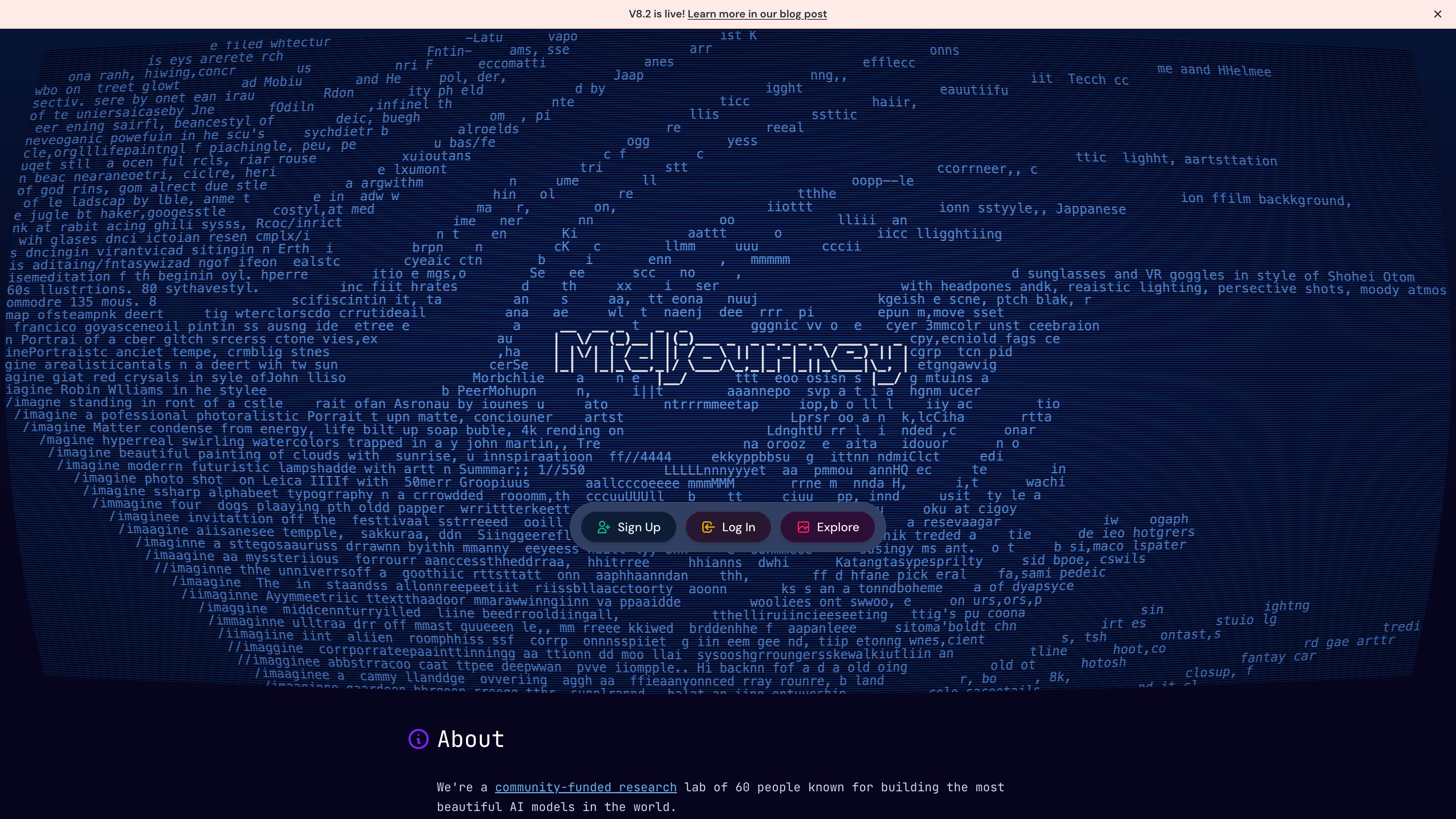
The homepage above does not demo features; it routes visitors to sign-in, sign-up, and the Explore gallery. The footer states the "community-funded research lab of 60 people" line and lists billing and press contacts.
Core Capabilities: From Prompt to Image and Short Video
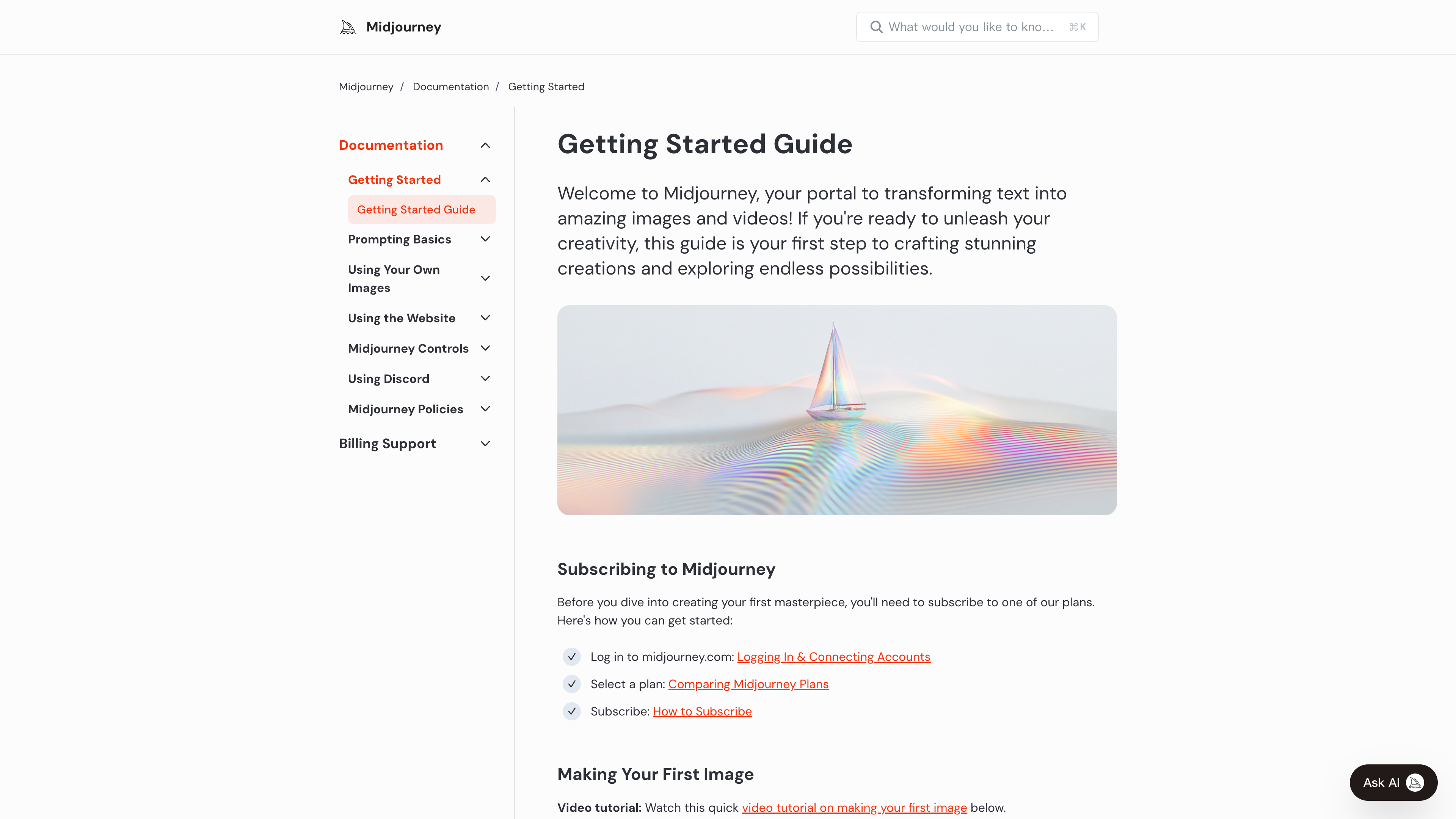
Per the official Getting Started Guide, the flow is: subscribe, type a prompt into the Imagine bar on the web Create page, get a grid of four images, then keep refining. Main capabilities:
- Text-to-image: four candidates per run; parameters for aspect ratio, stylization, model version, and more; the Niji line targets anime styles.
- Editing and iteration: Upscale, Variations, Zoom Out / Pan (outpainting), Vary Region (inpainting), plus an Edit Model / web editor that modifies images with text instructions.
- Reference controls: Image Prompts steer composition and color from an uploaded image, Style Reference transfers a look, Omni Reference keeps subjects such as characters consistent; Personalization and Moodboards tune output to your taste.
- Image-to-video: animates Midjourney-generated or uploaded images into short clips; the plan page shows Basic is limited to SD resolution while Standard and above support SD and HD.
- Two front ends: the same account works on the website and via the Discord bot (server, DM, or invited to your own server); the docs maintain a "Web vs Discord" comparison.
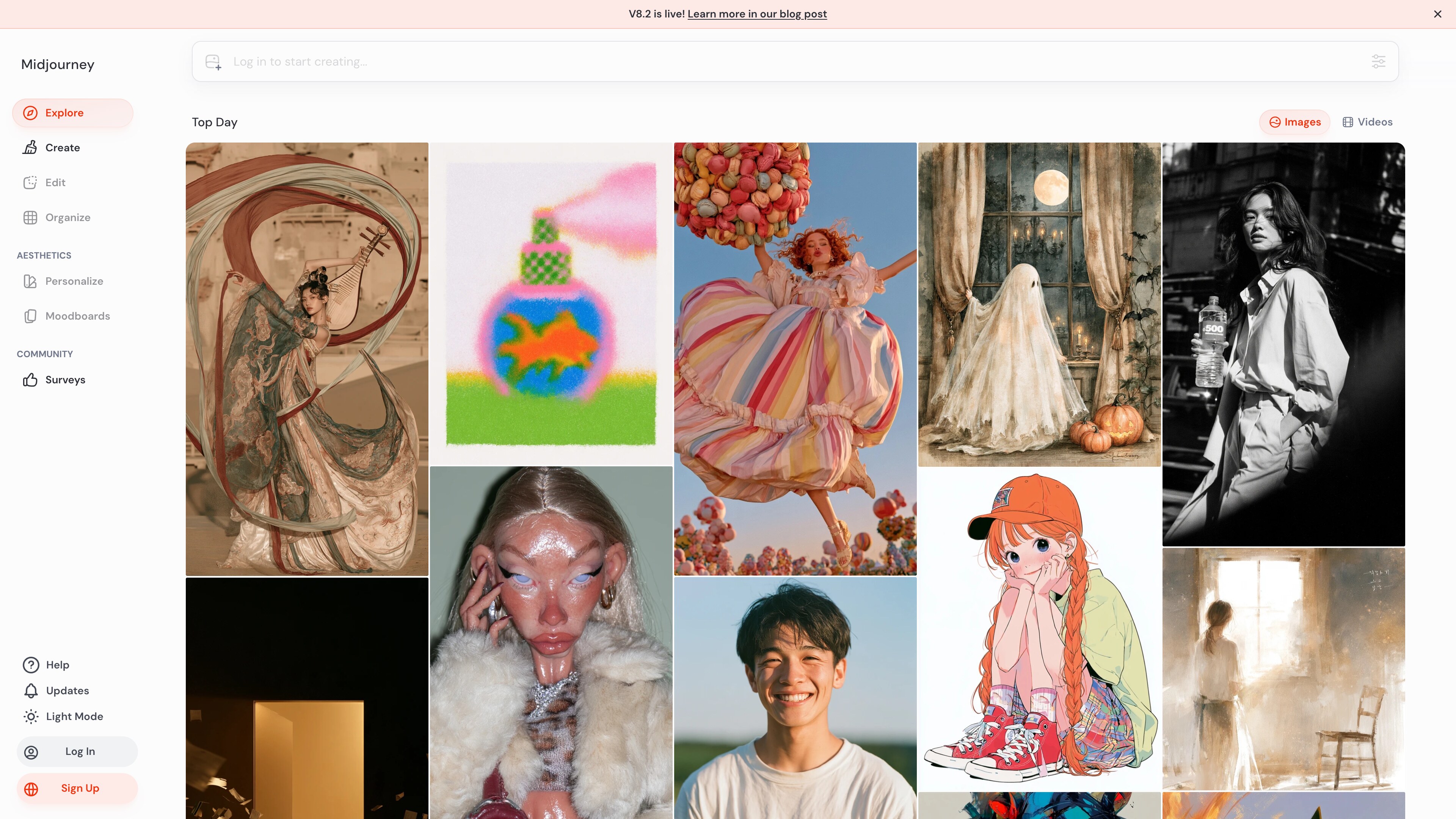
- Community gallery: the Explore page is publicly viewable without an account (checked 2026-09-12: the Top Day ranking loads logged-out), split into Images and Videos — a direct illustration of the "public by default" rule described below.
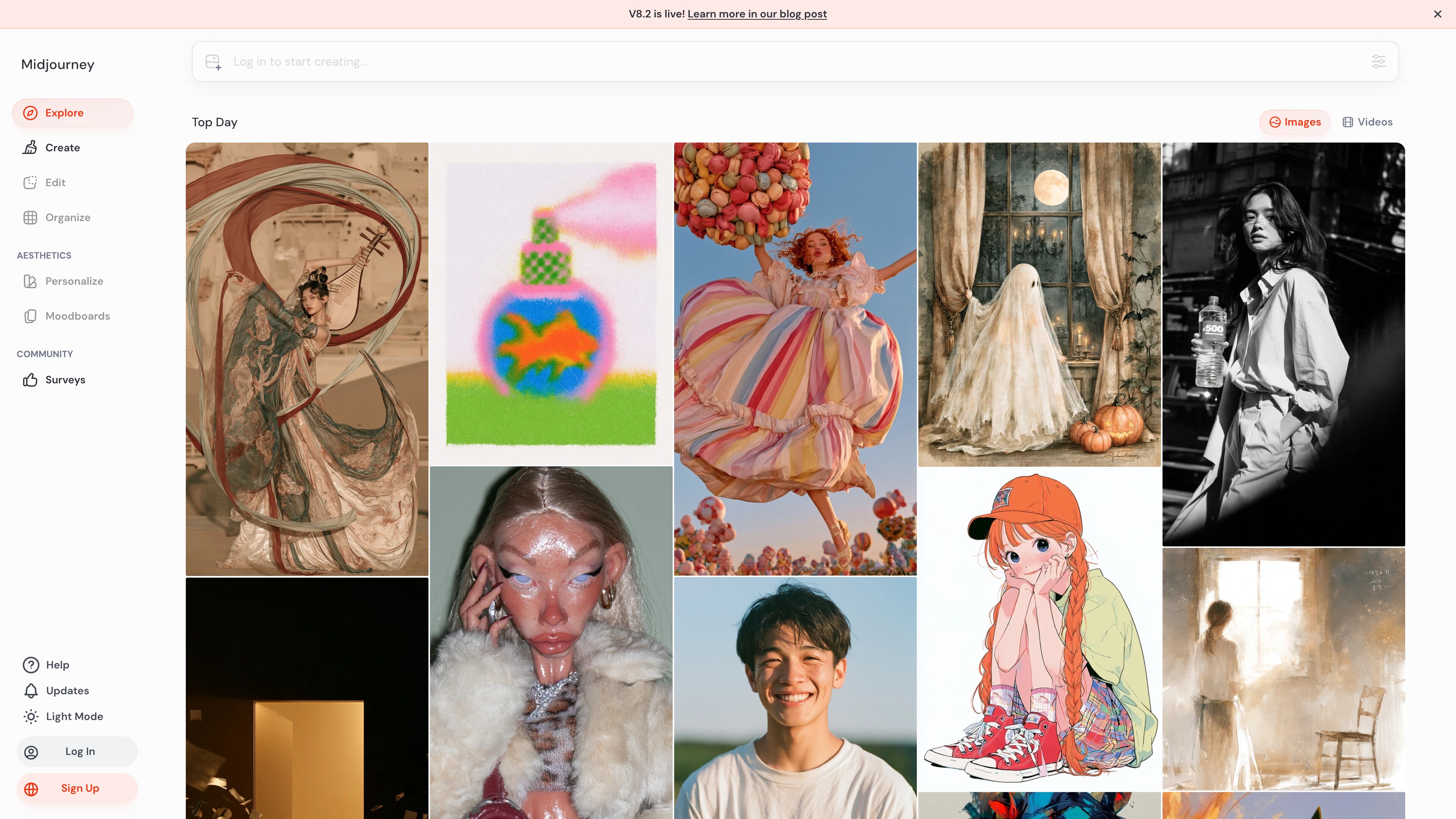
The screenshot above shows the Explore gallery while logged out: the left rail lists the web app's sections (Create, Edit, Organize, Personalize, Moodboards), and the right side is the daily top-rated public feed with an Images/Videos toggle.
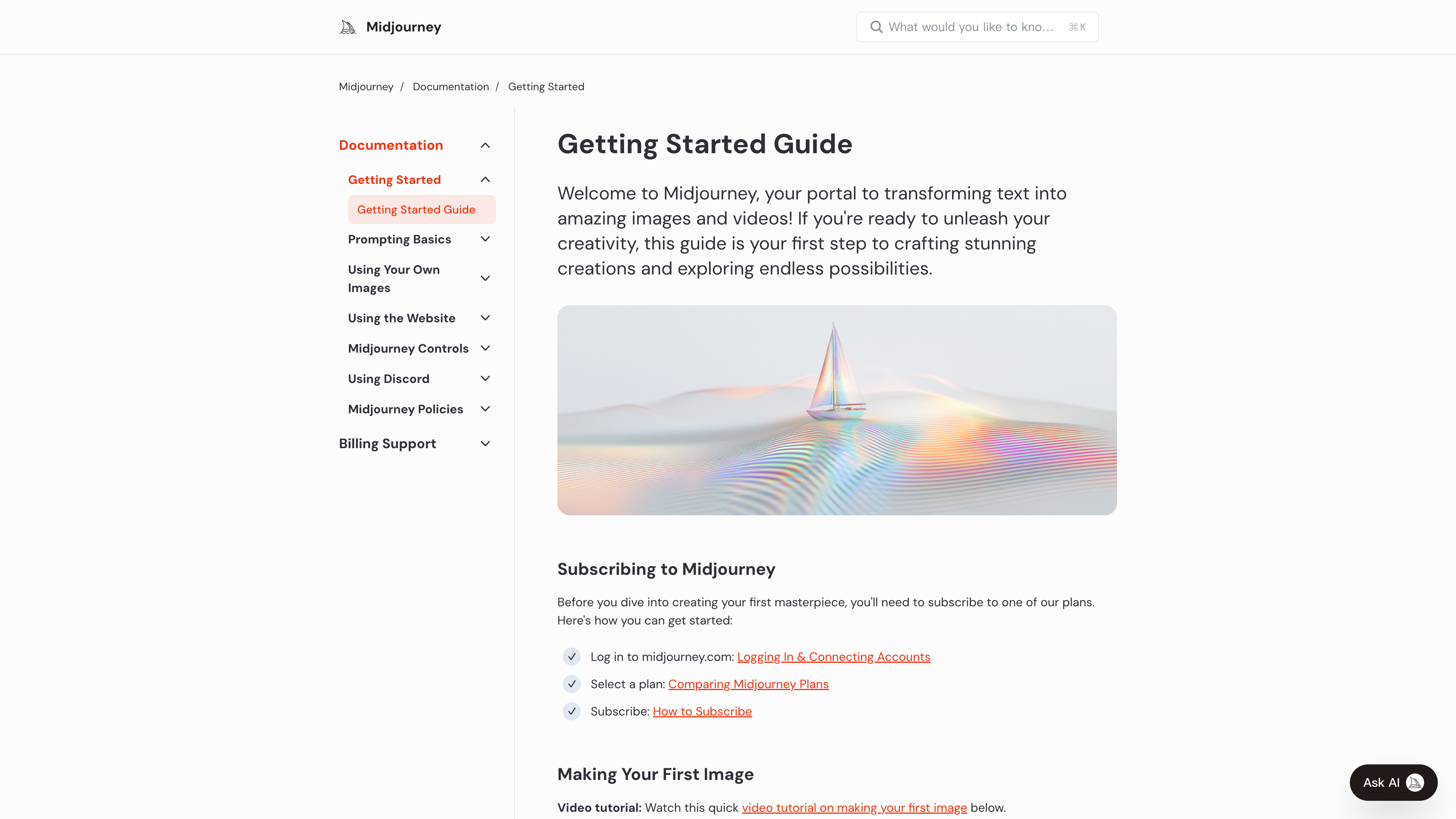
The help center (docs.midjourney.com) is the most complete source of product documentation: beyond the starter guide it documents every parameter, GPU billing, Stealth mode, and policy text. Prices and rules in this article are taken from there.
Plans and How Billing Works
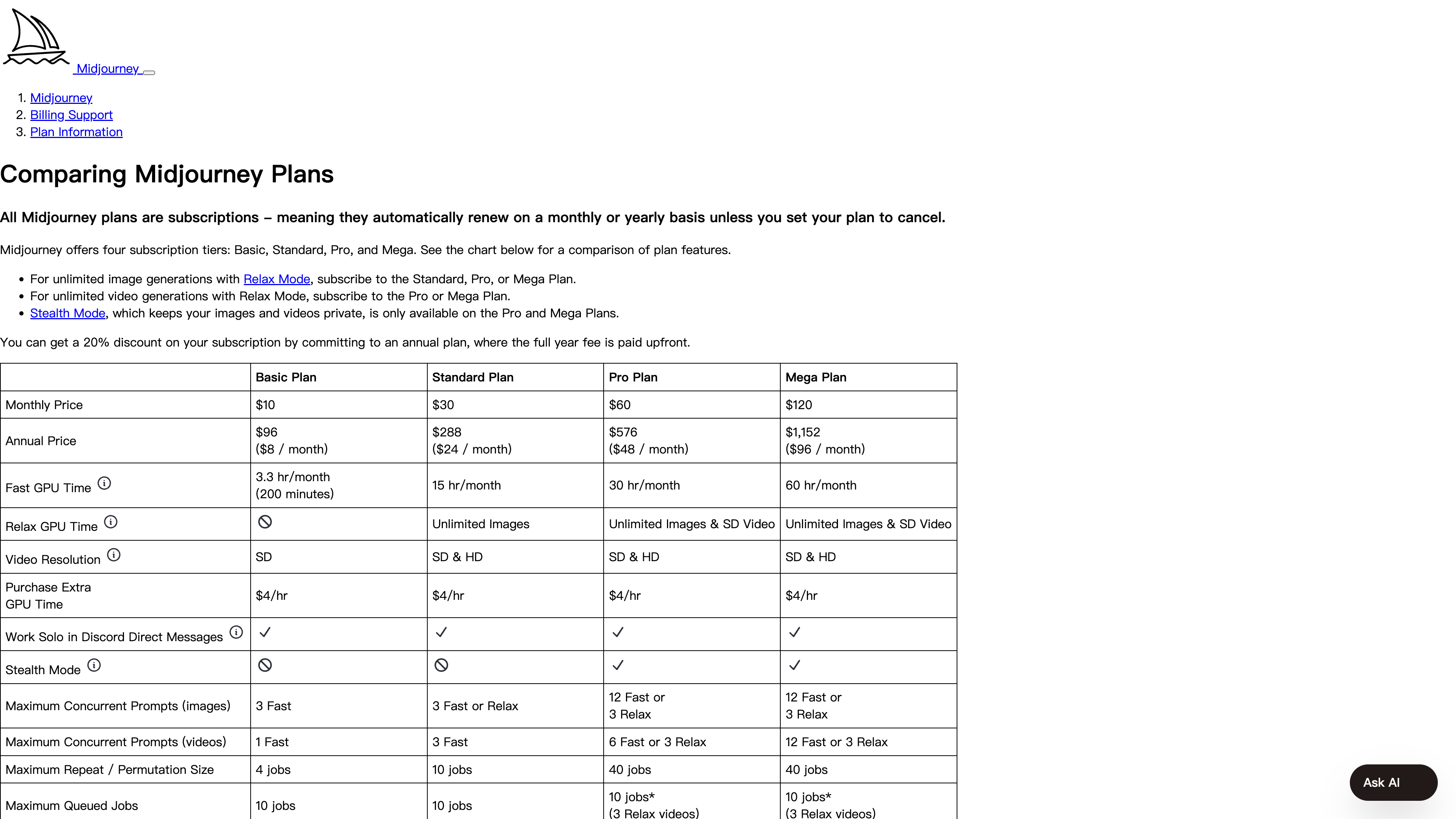
Midjourney bills by "Fast GPU time," not per image: one image run costs roughly one GPU minute, and video costs far more. The official plan comparison as of 2026-09-12:
| Plan | Monthly | Annual | Fast GPU time/mo | Relax mode | Notes |
|---|---|---|---|---|---|
| Basic | $10 | 8/mo) | 3.3 hr (200 min) | — | Video SD only |
| Standard | $30 | 24/mo) | 15 hr | Unlimited images | Video SD & HD |
| Pro | $60 | 48/mo) | 30 hr | Unlimited images + SD video | Stealth mode included |
| Mega | $120 | 96/mo) | 60 hr | Unlimited images + SD video | Stealth, more concurrency |
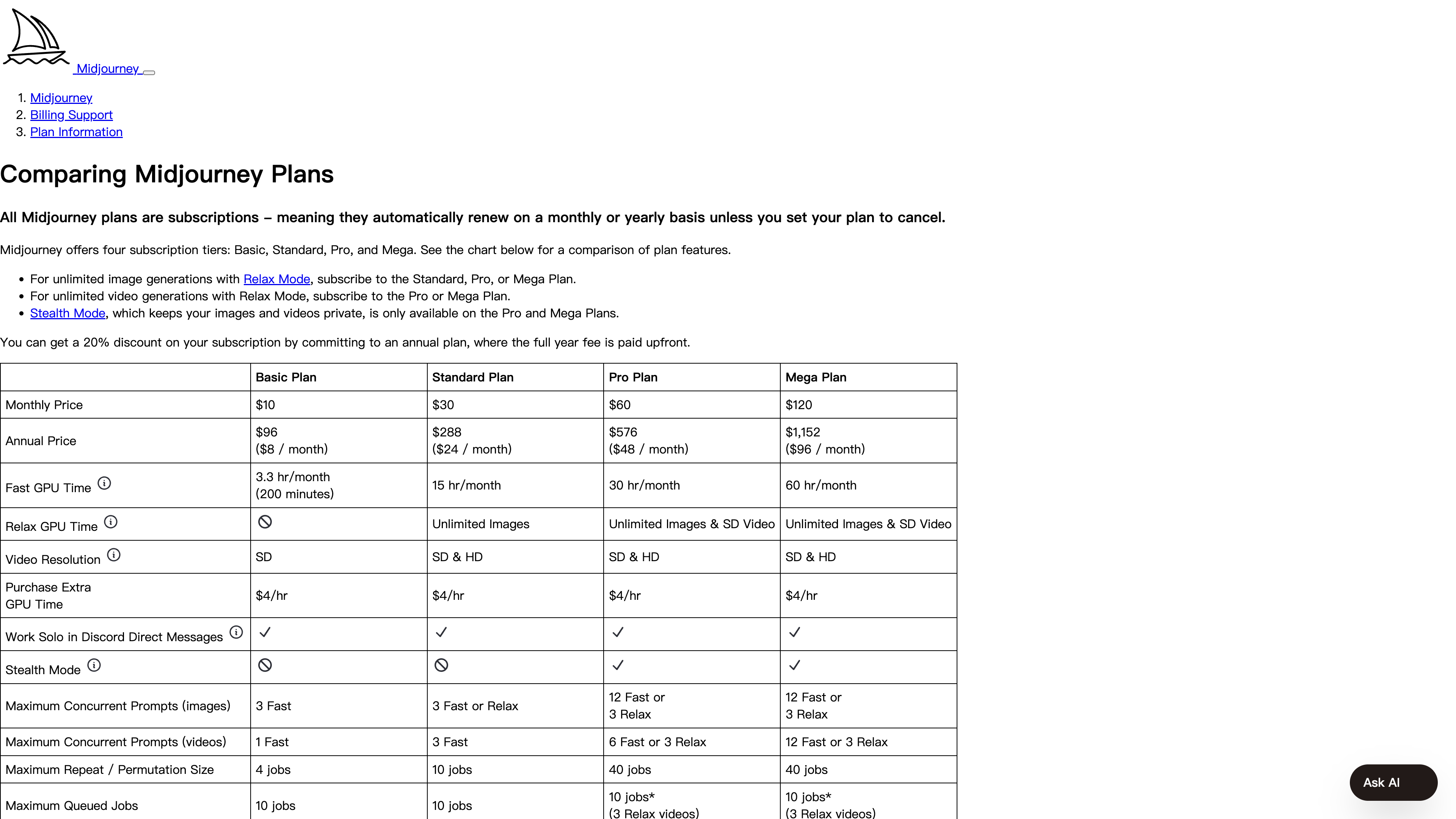
Additions from the same page: extra Fast GPU time costs $4/hour; Stealth mode (keeping creations private) is Pro/Mega only; rating images on the site earns free GPU time; annual billing is prepaid at roughly 20% off. Cancellation takes effect at the end of the current billing period with no refund for the current period (Terms §8).
Copyright and Content Policy
For an AI-generation platform, the rules come in two layers — what you may do with your output, and what is being disputed around the platform itself. Both are worth reading before use.
Your rights to the output (Terms §4 and Using Images & Videos Commercially):
- Any paying subscriber (including Basic) owns the images and videos they create "to the fullest extent possible under applicable law," may use them commercially, and keeps them even after canceling.
- Companies (and their employees) with more than $1,000,000 USD in annual gross revenue must be on Pro or Mega to own and commercially use their assets.
- If you upscale someone else's image, it remains owned by the original creator and using it requires their permission.
- The reverse obligation is equally explicit: you grant Midjourney a "perpetual, worldwide, non-exclusive, sublicensable, royalty-free, irrevocable" license over your prompts and output; by default your creations are publicly viewable and remixable by others, with Stealth mode (Pro/Mega) as the only opt-out.
Copyright status of the output: Midjourney explicitly does not offer legal guidance on copyright. In the United States, the Copyright Office's February 2023 Zarya of the Dawn decision refused registration for individual Midjourney-generated images, and its January 2025 Copyright and Artificial Intelligence, Part 2: Copyrightability report reaffirmed that prompts alone do not constitute human authorship. In other words, "the contract says you own it" does not equal "you can register a US copyright" — a real constraint for uses that need exclusivity, such as brand assets.
Disputes around the platform: In January 2023, three artists filed a class action (the Andersen case) against Midjourney, Stability AI, and others over training on scraped images. On June 11, 2025, Disney and NBCUniversal sued Midjourney in the Central District of California, calling it "a bottomless pit of plagiarism" (Wikipedia litigation section); Warner Bros. Discovery filed a parallel suit on September 4, 2025, and the cases were consolidated on November 4, 2025. As of 2026-09-12 the consolidated case remains in discovery with no ruling on the merits; Midjourney is defending on fair-use grounds (fiund case tracker). The Community Guidelines additionally ban adult and gore content and images for political campaigns, and a DMCA takedown channel exists.
Good Fits
- Concept exploration and mood boards: early-stage directions for illustration, concept design, and advertising — Holz himself described artists using it to show clients rapid prototypes.
- Illustration material for content: article headers, social media visuals, presentation graphics, provided you accept the copyright uncertainty above.
- Anime and stylized work: the Niji model and Style Reference suit batch exploration of specific looks.
- Short motion clips: animating stills into a few seconds of motion for social content or creative previews.
Limitations
- No free tier, payment first: no trial on the website or Discord; the floor is Basic at $10/month (3.3 Fast GPU hours). Zero-cost evaluation is only possible via the mobile app's limited trial.
- Closed-source, no public API: weights are not released and there is no official public API; automation relies on unofficial third parties, and the Terms explicitly ban automated access (account bans are a risk).
- Non-intuitive billing: GPU-time billing is harder to reason about than per-image quotas; video and high-res upscales burn hours quickly.
- Public by default: without Pro/Mega Stealth, your generations are publicly visible and remixable — unsuitable for unreleased commercial work.
- Copyright and litigation risk: output may not be registrable for copyright in the US; the Disney/Universal/Warner suits are unresolved, and the risk of generating well-known characters sits with the user.
- Content boundaries: no adult, gore, or political-campaign imagery; the Terms impose binding arbitration and a class-action waiver (AAA, Santa Clara County).
- English only: the site, docs, and community are English-language with no official Chinese (or other) localization.
Alternatives
- DALL·E (OpenAI): text-to-image inside ChatGPT, convenient if you already live in that ecosystem; a different aesthetic from Midjourney.
- Stable Diffusion (Stability AI): the open-weights route — self-hostable and fine-tunable, suited to teams that need a controlled, private pipeline; the philosophical opposite of Midjourney's closed subscription.
- Adobe Firefly: Adobe's commercially oriented generative imaging, pitched on training-data compliance — relevant where copyright certainty matters most.
References
- Midjourney homepage (checked 2026-09-12)
- Comparing Midjourney Plans - Midjourney Help Center (checked 2026-09-12)
- Terms of Service (effective 2026-05-27) - Midjourney Help Center (checked 2026-09-12)
- Using Images & Videos Commercially - Midjourney Help Center (checked 2026-09-12)
- Free Trials - Midjourney Help Center (checked 2026-09-12)
- Getting Started Guide - Midjourney Help Center (checked 2026-09-12)
- Privacy Policy (updated 2026-09-03) - Midjourney Help Center (checked 2026-09-12)
- Midjourney - Wikipedia (checked 2026-09-12)
- David Holz, founder of AI art generator Midjourney, on the future of imaging - The Register (checked 2026-09-12)
- Midjourney launches its first AI video generation model, V1 - TechCrunch (checked 2026-09-12)
- Disney & Universal v. Midjourney - fiund lawsuit tracker (checked 2026-09-12)
- Copyright and Artificial Intelligence, Part 2: Copyrightability - U.S. Copyright Office (checked 2026-09-12)