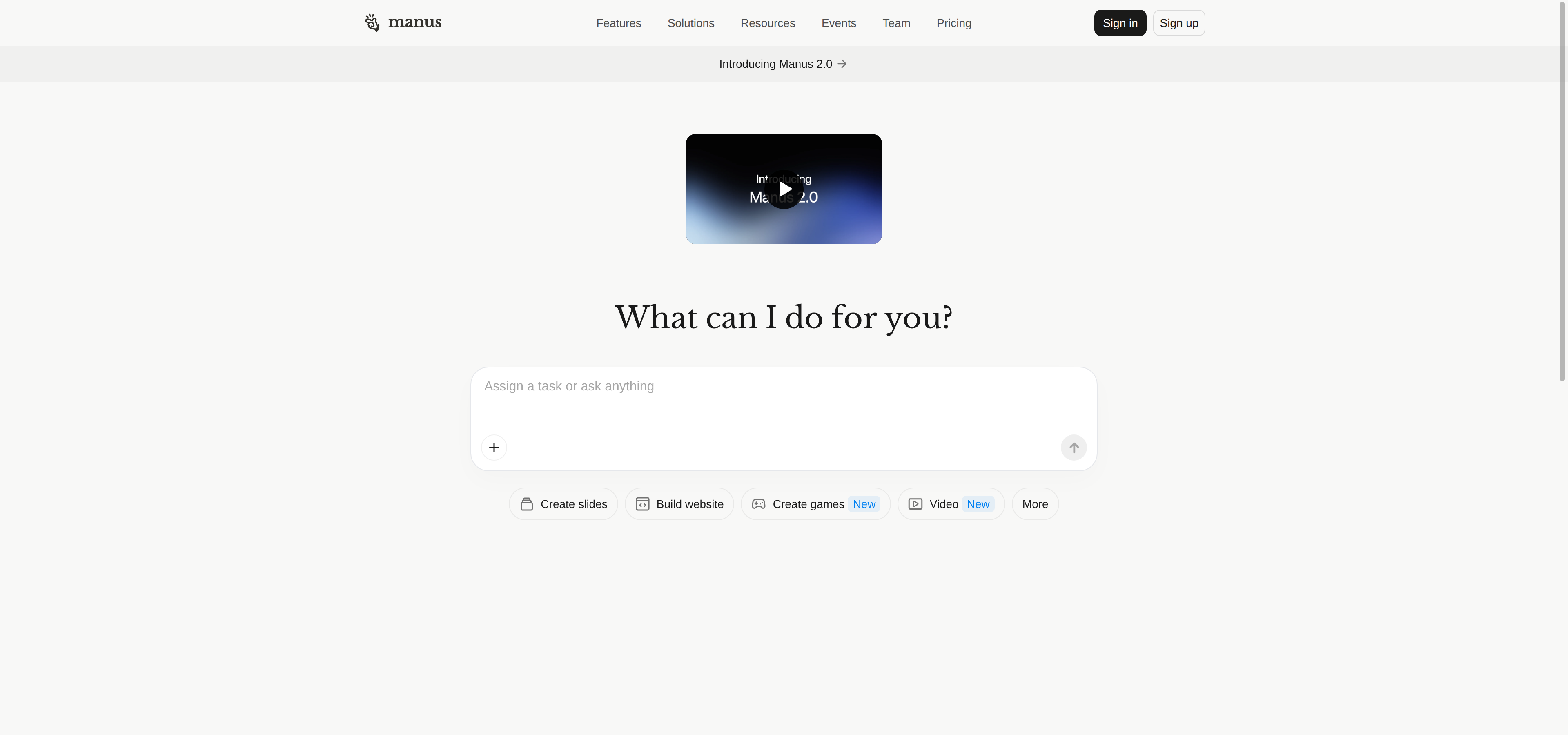
Manus is a general-purpose AI agent: you describe a task in natural language, and it plans and carries out the work inside a cloud virtual machine with internet access — browsing the web, running software, writing code — then delivers finished artifacts such as research reports, slide decks, deployed websites, and videos, rather than a text answer alone. It is operated by Butterfly Effect, a company incorporated in Singapore, and went viral after its March 2025 debut. A dramatic corporate saga since then — an announced Meta acquisition, blocked by Chinese regulators, followed by a return to independence — has also made it a notable case study in the AI agent industry.
At a glance
- URL: https://manus.im/
- Type: General AI agent / autonomous task-execution platform
- Cost: Free tier plus credit-based subscriptions; Pro from 20/seat/month (as of 2026-10-02)
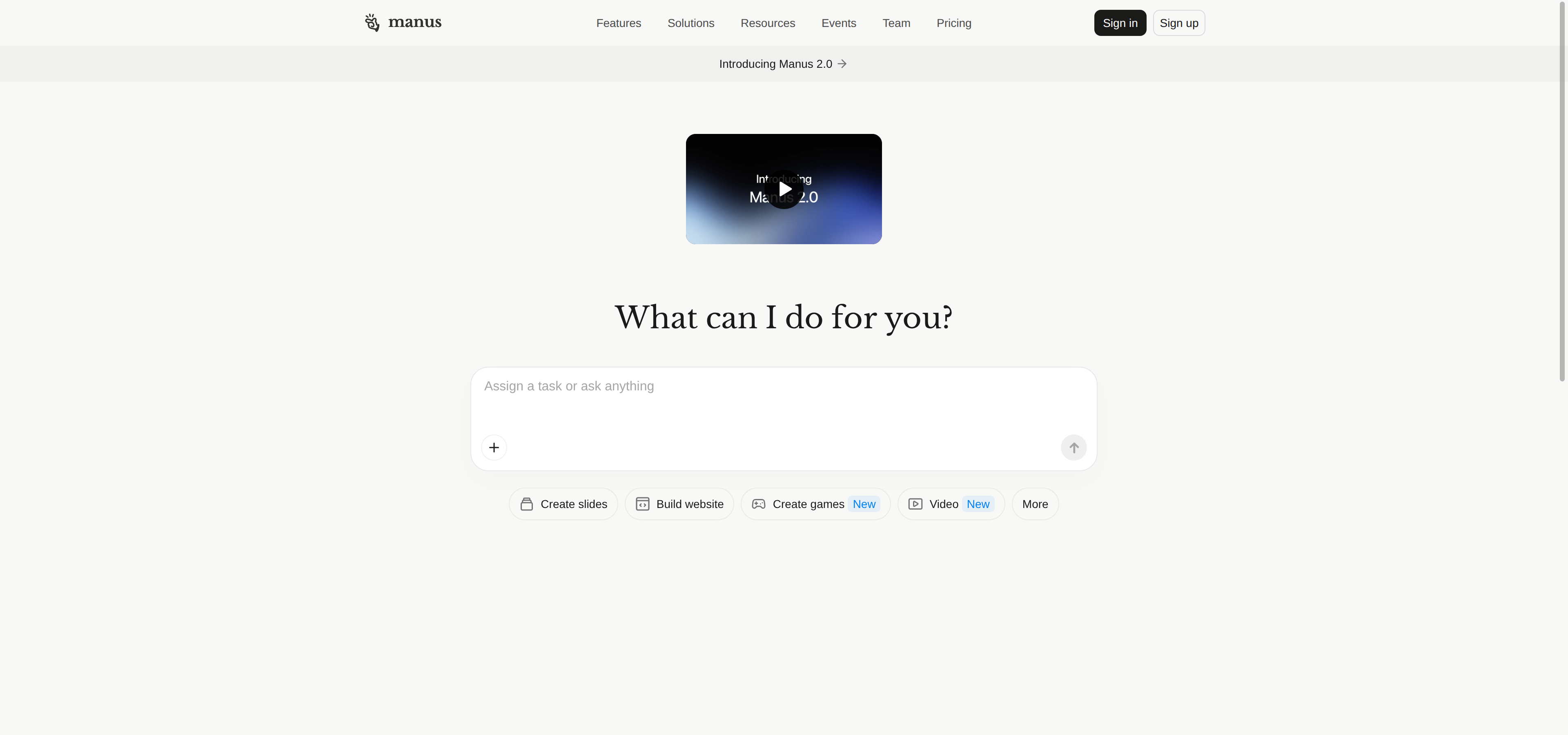
- Sign-up: Required. Google, Apple, or Microsoft accounts (no phone verification), email (phone verification required), or passkey
- Interface languages: 17, including English, Simplified and Traditional Chinese, Japanese, and Korean
- Platforms: Web app, Windows/macOS desktop (Manus Studio), iOS/Android mobile apps
Background
Manus's parent company, Butterfly Effect, was founded in Beijing in 2022 by Xiao Hong, Yichao Ji, and Tao Zhang (per TechCrunch). The product name comes from MIT's motto "Mens et Manus" ("Mind and Hand"); the team's first-anniversary letter frames the idea as "AI shouldn't just think, it should also do."
Key events:
- March 6, 2025: Launch in invitation-only preview (same-day coverage by multiple outlets; TechCrunch, 2025-03-09 described it as "launched in preview last week"). The demo video went viral, and invitation codes were resold at high prices on Chinese secondary markets. At launch the product reportedly combined existing and fine-tuned models including Anthropic's Claude and Alibaba's Qwen; the team claimed it outperformed OpenAI's Deep Research on the GAIA general-agent benchmark.
- April 2025: A roughly 500 million post-money valuation, with Benchmark partner Chetan Puttagunta joining the board (TechCrunch); earlier backers included Tencent, ZhenFund, and HSG (formerly Sequoia China). Manus's own blog says the round was raised "prior to our launch."
- Mid-2025: Headquarters relocated from China to Singapore (TechCrunch).
- December 17, 2025: The company announced more than 125M, saying it had processed over 147 trillion tokens and created more than 80 million virtual computers since launch; it then had 105 employees across Singapore, Tokyo, and San Francisco.
- December 29, 2025: Manus announced it was joining Meta, saying it would keep operating from Singapore and continue selling subscriptions; The Wall Street Journal put the deal at roughly $2 billion (via TechCrunch).
- April 27, 2026: China's National Development and Reform Commission (NDRC) blocked the acquisition and ordered the parties to unwind it (TechCrunch; same-day coverage by Reuters, AP, BBC, and others). Reports said Xiao Hong and Yichao Ji were placed under exit bans.
- June 2026: Meta began unwinding the deal, cutting Manus off from internal systems and data sharing (TechCrunch, citing Bloomberg).
- August 11, 2026: An official note to users explained that, as part of the separation from Meta and to comply with regulatory requirements in specific jurisdictions, data generated by certain users on or after December 29, 2025 would be deleted on August 23–24, 2026 (SGT), with a backup window beforehand and restoration from August 25.
- September 1, 2026: Manus formally resumed independent operations under its founding team. Later that month, The Wall Street Journal reported it was seeking to raise about 4 billion valuation and considering a Hong Kong IPO restructuring (via TechCrunch; not officially confirmed).
- September 28, 2026: Manus 2.0 launched with Cascade (a new in-house agent harness), purchasable dedicated Cloud Computers, event-triggered Automations, the desktop app upgraded to Manus Studio, plus a new Video Editor and Game Dev environment.
What it does: task execution inside a cloud VM
According to the official documentation, Manus operates in a complete sandbox — a virtual computer with internet access, a persistent file system, and the ability to install software — so it can hold context across long tasks and deliver "production-ready" results. The company positions it as a "general AI agent," meaning it is not limited to one task category.
Based on the site and docs, current capabilities include:
- Research and analysis: in-depth research, Wide Research (a parallel multi-agent system for large-scale research), and data analysis/visualization.
- Documents and design: slide generation with speaker notes, documents, PDFs, AI design, and image/music generation.
- Website and app building: full-stack sites and apps from natural language, with built-in databases, managed hosting and deployment, custom domains, SEO, code export to GitHub, Figma import, third-party integrations (Stripe, Shopify, Google Maps, and more), and mobile app publishing.
- Multimedia: AI video generation; 2.0 adds a timeline-based Video Editor (letting you swap individual clips, audio, and graphics in generated videos) and a game-development environment.
- Automation and integrations: scheduled and event-triggered Automations, Slack integration, the Mail Manus email interface, the Browser Operator extension that drives your local browser, MCP connectors, Zapier, and a public API.
- Run modes: Chat Mode for lightweight questions (cheaper in credits), and Agent Mode in three tiers — Manus 2.0 Lite, 2.0, and 2.0 Max; free users only get Lite (per the Help Center).
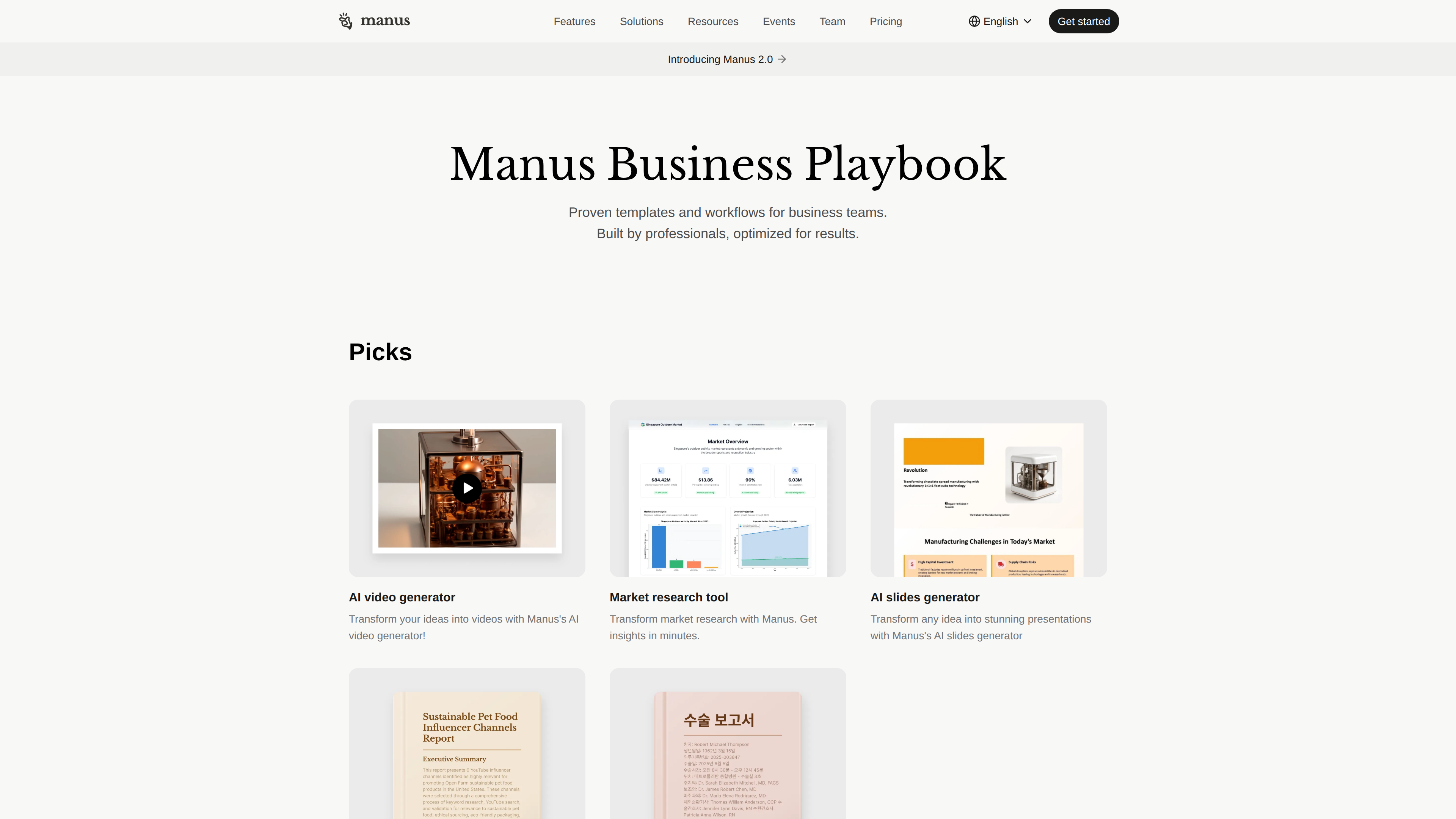
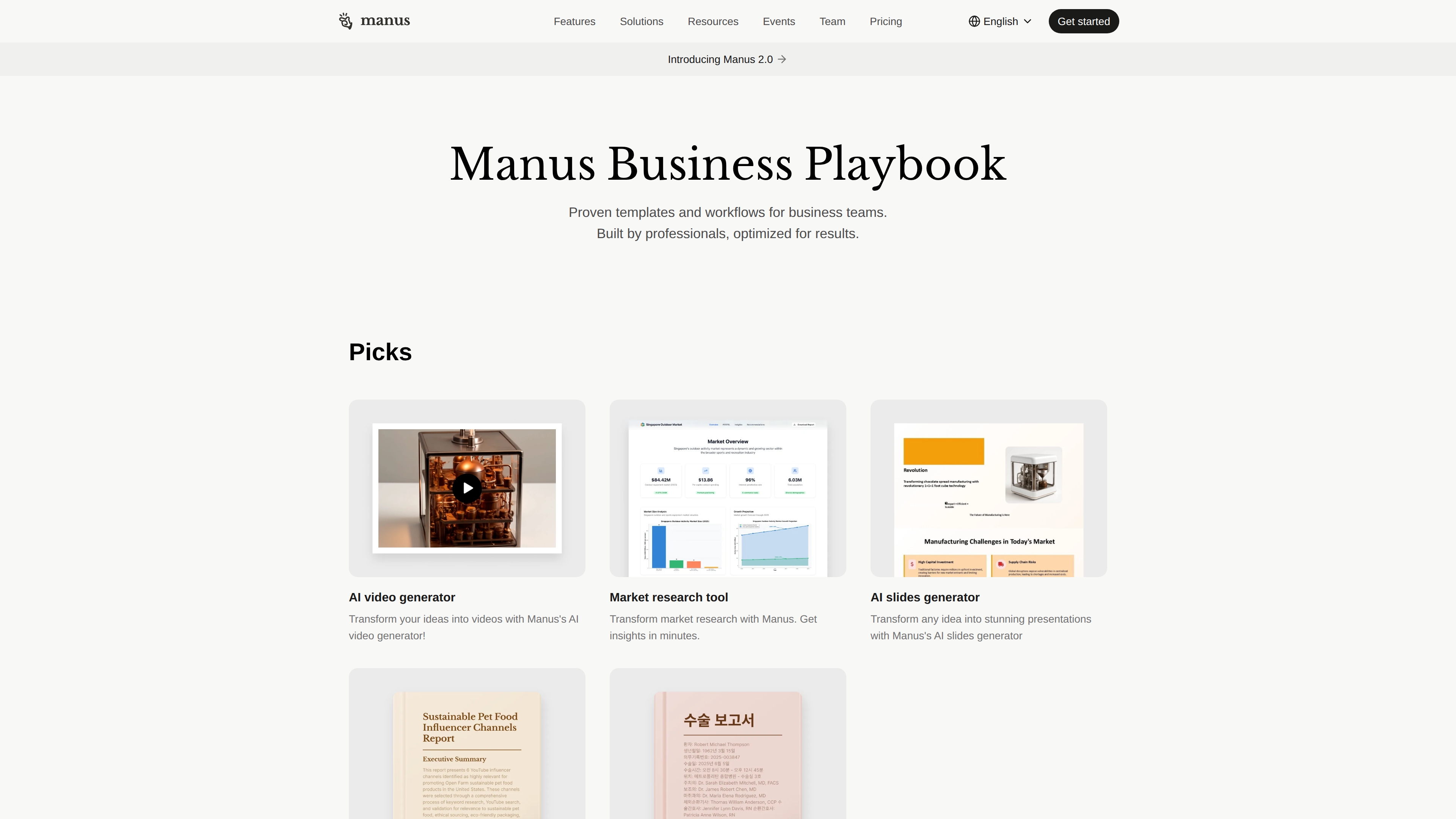
The Business Playbook offers ready-made templates — market research, competitor analysis, SWOT, cover letters, pitch decks — and is a practical entry point for understanding what to delegate.
Accounts and pricing
Sign-up supports Google, Apple, or Microsoft accounts (no phone verification), email (phone verification required), and passkeys (official Help Center and the live login page, checked 2026-10-02).
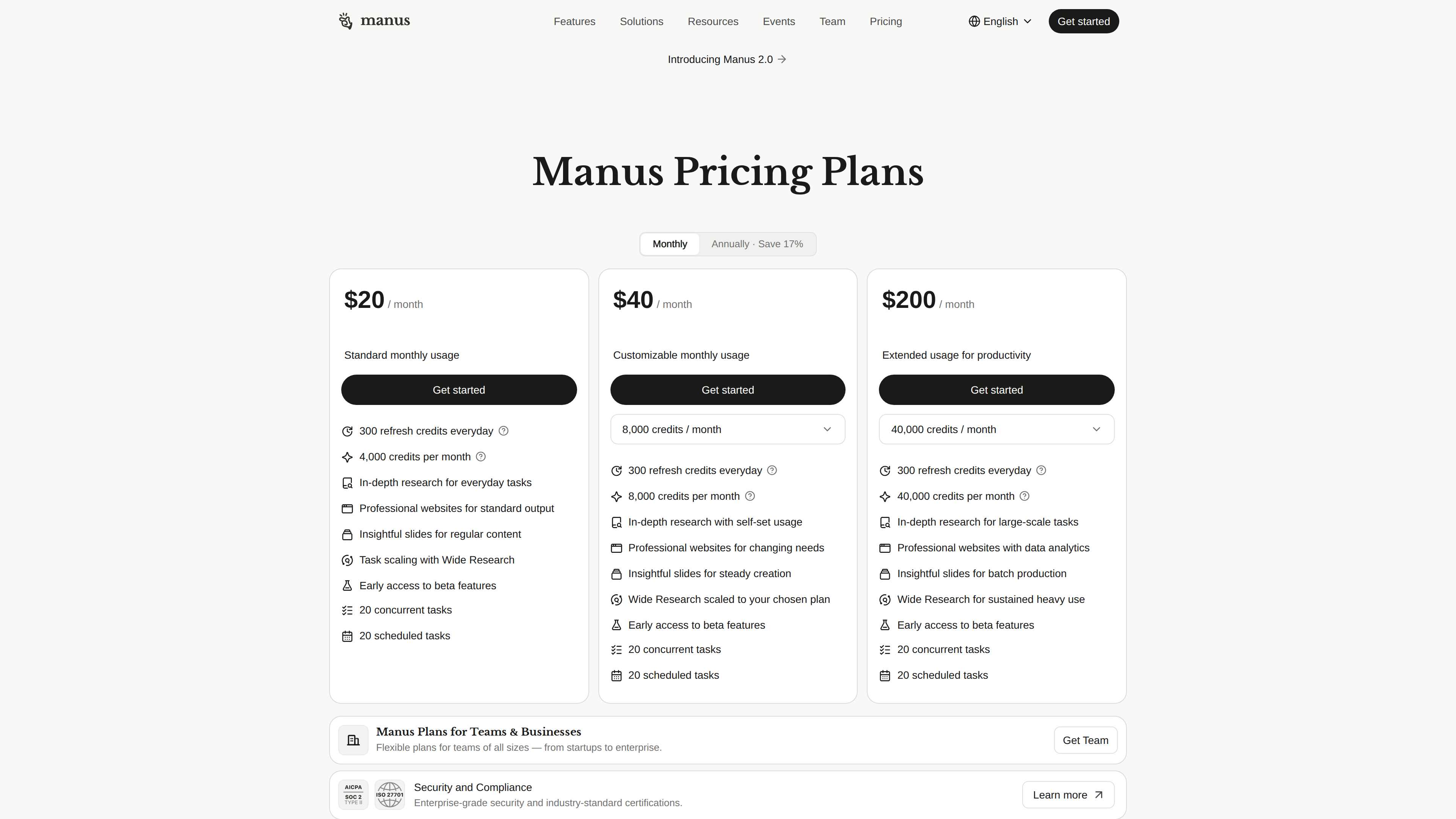
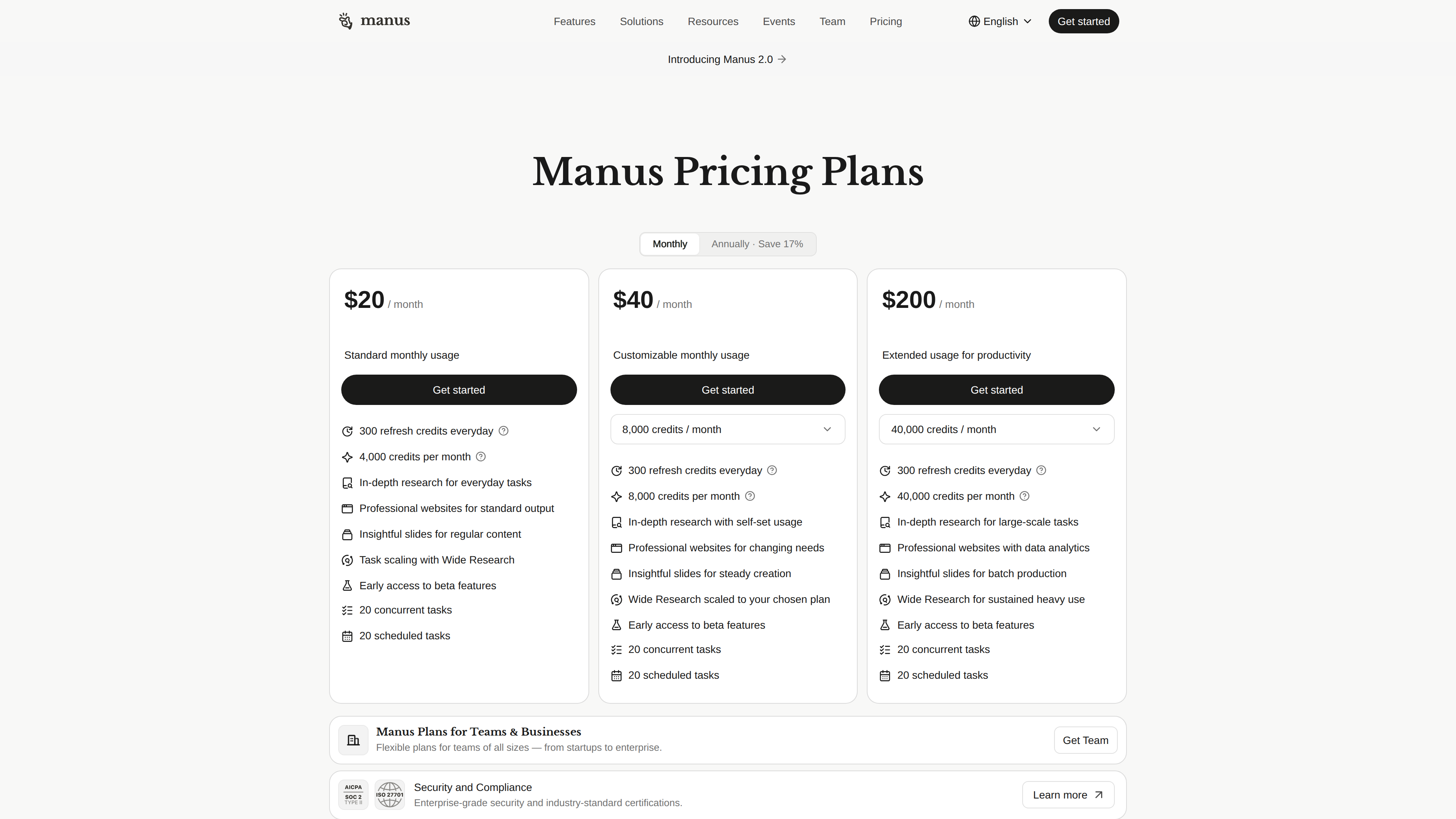
Manus is credit-based: consumption per task depends on complexity, covering LLM tokens, virtual machine time, and third-party API calls; tasks that fail due to the platform's own technical issues are fully refunded; monthly subscription credits do not roll over (credit rules). As of 2026-10-02, the pricing page and Help Center list:
| Plan | Price (monthly billing) | Allowance and limits |
|---|---|---|
| Free | $0 | 300 daily refresh credits (reset at 00:00 UTC, no rollover; free users capped at 1,500 per month, usable only with Manus 2.0 Lite); Chat Mode plus Agent Mode on 2.0 Lite; 1 concurrent task, 2 scheduled automations |
| Pro | from $20/mo | from 4,000 credits/month; 300 daily refresh credits; 20 concurrent tasks, 20 scheduled tasks; early access to beta features |
| Pro (mid) | from $40/mo | from 8,000 credits/month, adjustable upward; 7-day free trial; otherwise as above |
| Pro (top) | $200/mo | 40,000 credits/month (shown on the pricing page; not listed in the Help Center article) |
| Team | from $20/seat/mo | Everything in Pro plus SSO, a data-training opt-out, team usage analytics, access controls, and shared templates |
Annual billing saves about 17% (the page shows the equivalent of 34/$167 per month). The pricing page also displays SOC 2 Type II and ISO 27701 compliance badges.
Good fits
- Knowledge work where you want a finished deliverable: market research, competitor analysis, industry reports, data dashboards.
- Non-developers shipping websites, landing pages, small tools, or prototypes directly to production.
- Batch content production: slide decks, short videos, multilingual documents.
- Teams standardizing recurring workflows with Playbook templates and the Team plan.
Limitations and caveats
- Hard-to-predict costs: credit consumption scales with task complexity; deep research and video generation burn credits quickly, monthly subscription credits do not roll over, and heavy usage can push real monthly spend into the hundreds of dollars.
- Limited free tier: Manus 2.0 Lite only, one concurrent task, and a monthly cap on daily refresh credits — enough to evaluate the product, not to run ongoing production work.
- Outputs need verification: early third-party testing (TechCrunch, March 2025) hit factual errors and endless loops; the company itself acknowledged the early version was "costly and slow," claiming it later doubled speed and cut costs fivefold within three months (official blog). Complex outputs still warrant review.
- Privacy and data use: the privacy policy (updated 2026-09-28) identifies Butterfly Effect, incorporated in Singapore, as the data controller; user data may be used to improve its models, and data is stored in the United States and Singapore (official FAQ). The Team plan offers an opt-out from data training.
- Corporate uncertainty: after the Meta deal was blocked, Manus returned to independence in September 2026; during the transition, some user data was deleted to meet regulatory requirements and access was briefly interrupted for affected users. New fundraising and a possible restructuring are reportedly still in progress, so teams with high continuity requirements should watch its governance. A Meta spokesperson also told Nikkei Asia in December 2025 that Manus would cease operating in China after the acquisition; its current availability in mainland China has not been officially addressed since the separation.
- Opaque model stack: beyond launch-era reporting about Claude and Qwen, the current underlying model mix is not disclosed.
References
- Official: About / Pricing / Documentation / Privacy policy
- Official blog: $100M ARR update (2025-12-17), Joining Meta (2025-12-29), A note to our users (2026-08-11), Resuming independent operations (2026-09-01), Introducing Manus 2.0 (2026-09-28)
- Help Center: Membership pricing / Credit rules / Sign-up and phone verification
- Press: TechCrunch launch-era review (2025-03-09), Meta acquisition (2025-12-29), China blocks the deal (2026-04-27), Unwinding progress (2026-06-13), New funding reports (2026-09-18)