Lunch Money (lunchmoney.app) is a web-first personal finance and budgeting app that does two things well: it pulls your accounts, transactions and assets into one clear picture, and it gives you a flexible system for budgeting day-to-day spending. What sets it apart from most North American budgeting apps is that it is global by design — more than 160 currencies converted at historical daily rates, crypto wallet tracking, and bank syncing that covers the US, Canada and much of Europe. Its users now span 30+ countries (homepage, About, checked 2026-10-02).
It is also a distinctly independent product: Canadian developer Jen Yip built it alone and ran it as a one-person company for five years. There are no ads, no investors and no data sales — subscriptions are the only revenue. The pricing itself is unusual: a pay-what-you-want annual plan combined with a lifetime price-lock guarantee.
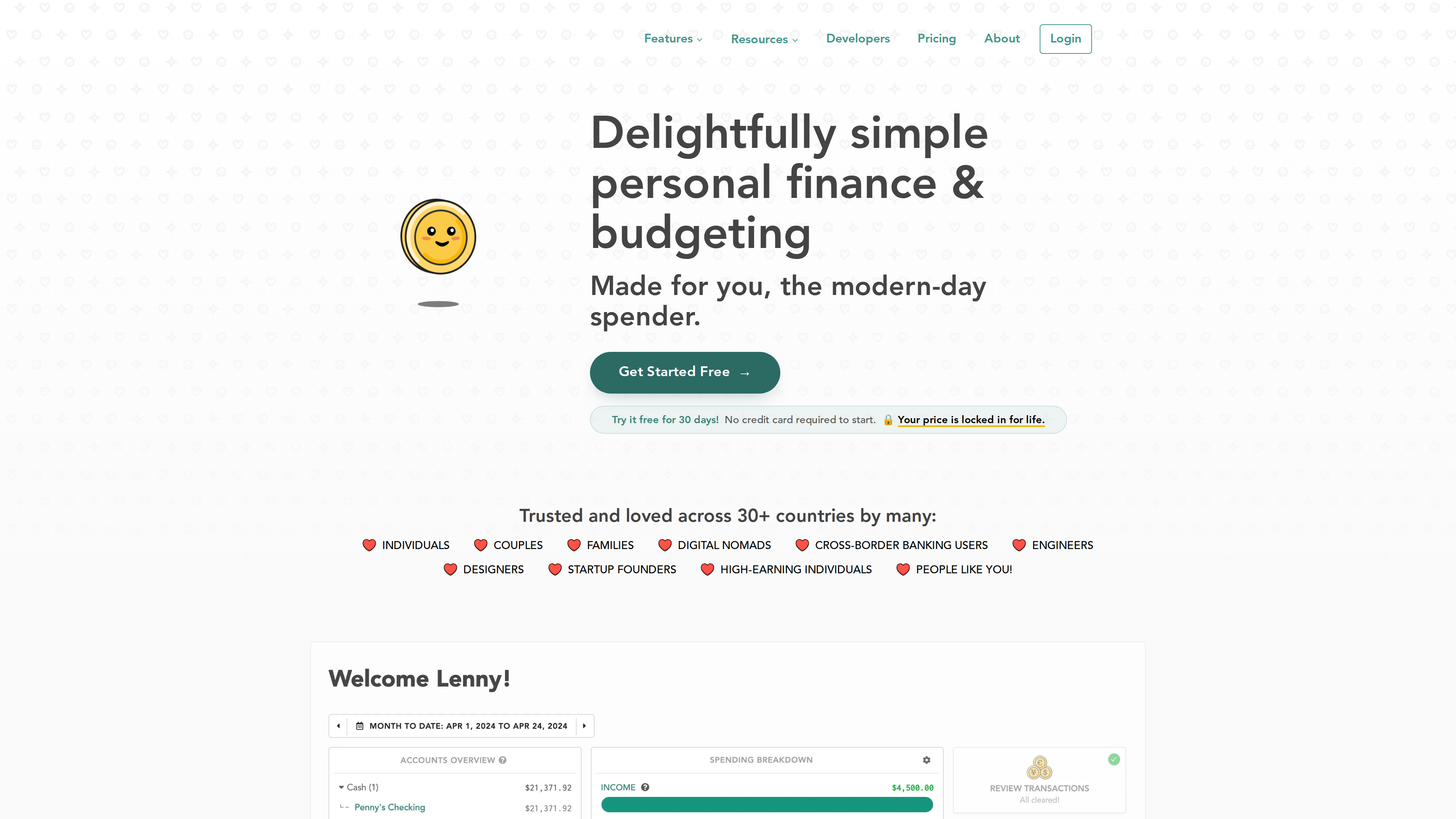
The homepage (screenshot from 2026-10-02) leads with "30 days free, no credit card, price locked in for life," and explicitly names digital nomads and cross-border banking users among its audiences.
At a Glance
| Item | Details |
|---|---|
| URL | https://lunchmoney.app/ |
| Type | Personal finance & budgeting tool (web-first, with iOS/Android companion apps) |
| Pricing | 30-day free trial, no credit card; then US60–100), price locked for life (pricing, as of 2026-10-02) |
| Sign-up | Name, email, password; choose a primary currency and billing currency (USD/CAD/EUR and more) |
| Interface language | English (date and number formats adjustable per locale) |
| Bank sync | Plaid, covering the US, Canada and 11 European countries; CSV/PDF import and an open API for everywhere else |
| Launched | Public launch August 2019 (open beta late July 2019) |
| Operator | Lunchbag Labs, Inc. (headquartered in Toronto, Canada), 100% bootstrapped |
Background
- A product grown out of a multi-currency spreadsheet: Founder Jen (Jennifer) Yip studied Computer Engineering at the University of Waterloo, worked as a software engineer at Twitter, and co-founded a startup that went through the Y Combinator Fellowship and 500 Startups. After burning out in 2018, she traveled across Europe and Asia, meticulously tracking every dollar, euro and yen in a multi-currency Google Sheet. A year and a half later she turned that spreadsheet into an app — multi-currency was a core design decision from day one, not an afterthought (media kit, founder's origin story).
- Five months in Fukuoka and an overnight launch: She wrote the first version while living in Fukuoka, Japan in early 2019, opened the beta in late July 2019, and hit the Hacker News front page in August — over 1,000 signups overnight turned the side project into a full-time business (The New Era blog post).
- One-person company for five years, then a small team: Jen handled engineering, design, support and marketing alone for the first five years, growing mostly by word of mouth. Since 2024 she has built a lean, globally distributed team — five core members plus contractors — still 100% bootstrapped with no outside investors (About, media kit).
- Scale and reputation: The company reports 13k+ paying members across 30+ countries, an NPS of 57 and an 8.4/10 average satisfaction score in its 2025 user survey (n=1,170). Lunch Money won the 2020 Jamstack Conf "Web App of the Year," ranked #3 Product of the Day on Product Hunt (April 7, 2020), and was named a best budgeting app for desktop budgeting by Forbes (media kit).
Core Capabilities
- Bank sync and flexible imports: Automatic transaction and balance syncing via Plaid in 13 countries — the US, Canada, the Netherlands, France, Spain, Ireland, Germany, Belgium, Denmark, Italy, Portugal, Sweden and Poland. CSV and PDF uploads, manual entry and a Mint migration tool are built in; third-party tools like Lunch Flow and Synci cover regions Plaid does not, such as the UK (import feature page).
- Native multi-currency: Pick primary and secondary currencies from 160+ options; every transaction converts at the historical exchange rate of its own date and rolls up into your primary currency. Date and number formats follow your locale (multi-currency page).
- Crypto portfolio tracking: Connect exchanges and wallets such as Coinbase, Ethereum and Kraken (read-only), or track manually from 1,000+ coins with rates updated every minute; holdings feed into your net worth (crypto tracker page).
- Flexible budgeting: Budget weekly, bi-weekly, twice a month or from custom start dates; per-category rollover rules; one-click presets (fixed amount, last period's budget, or a 3-period average); supports both envelope and zero-based budgeting styles (budgeting page).
- Transaction management: Split, group, tag and categorize with custom categories and category groups; a rules engine automates the busywork; recurring expenses are auto-detected and managed on their own page, answering "what does it cost just to get through the month?"
- Reports and insight: A calendar view of daily cash flow, Stats & Trends monthly charts, an analytics query tool, and month-over-month net-worth tracking.
- Household collaboration: Invite unlimited collaborators — a partner, roommate, family member or financial coach — each with their own login. Billing is per budget, not per person: only the budget admin needs a subscription (collaboration page).
- Open API: An OpenAPI-first public API (v2) with free access tokens, plus a community ecosystem of SDKs, import tools and automations (the Awesome Lunch Money list). Data is exportable at any time — "your financial data belongs to you" (developers page).
- Security and privacy stance: AES-256 encryption at rest, two-factor authentication, read-only bank access with no stored bank credentials, and an explicit promise never to sell user data or run ads (security page).
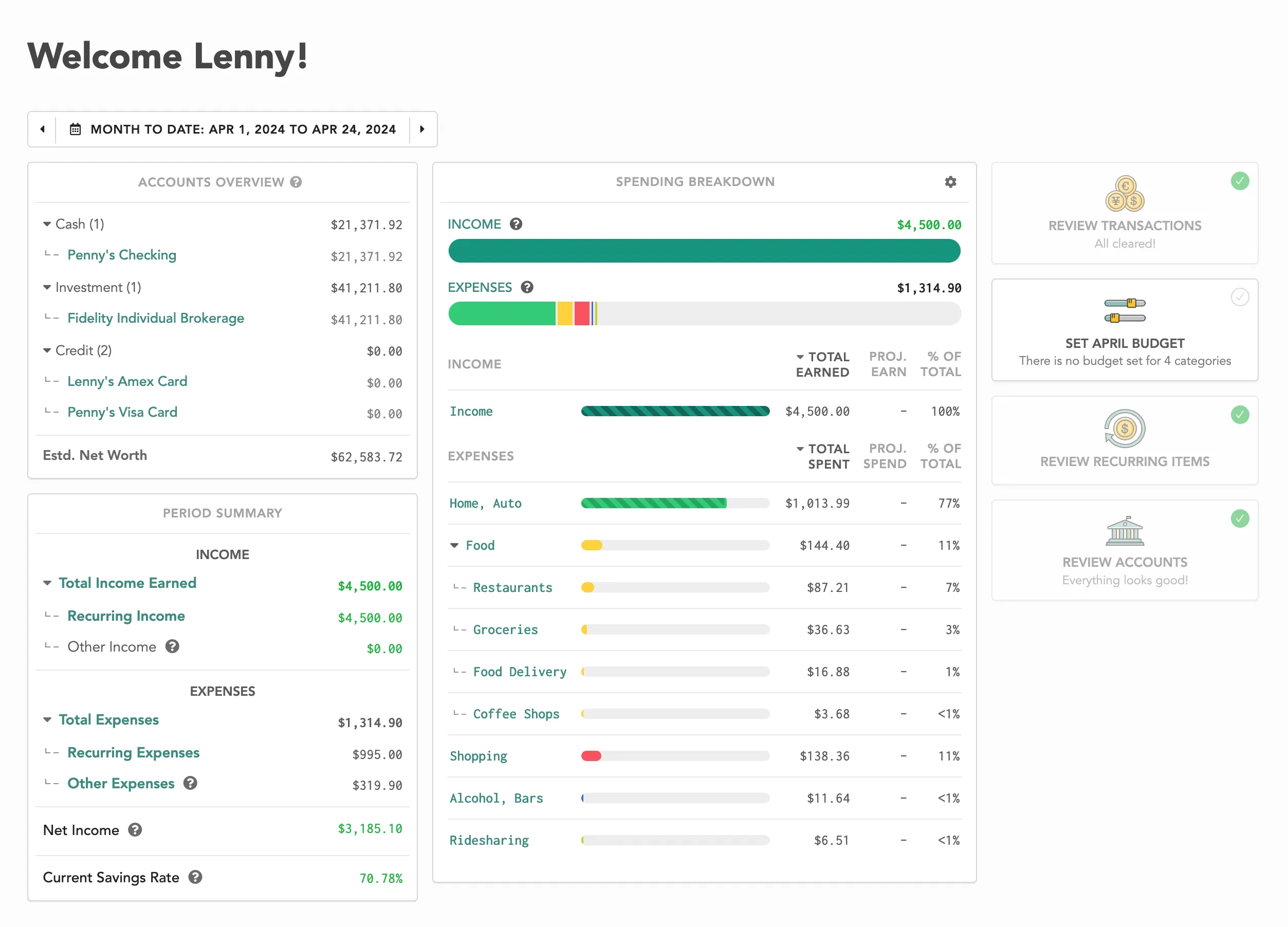
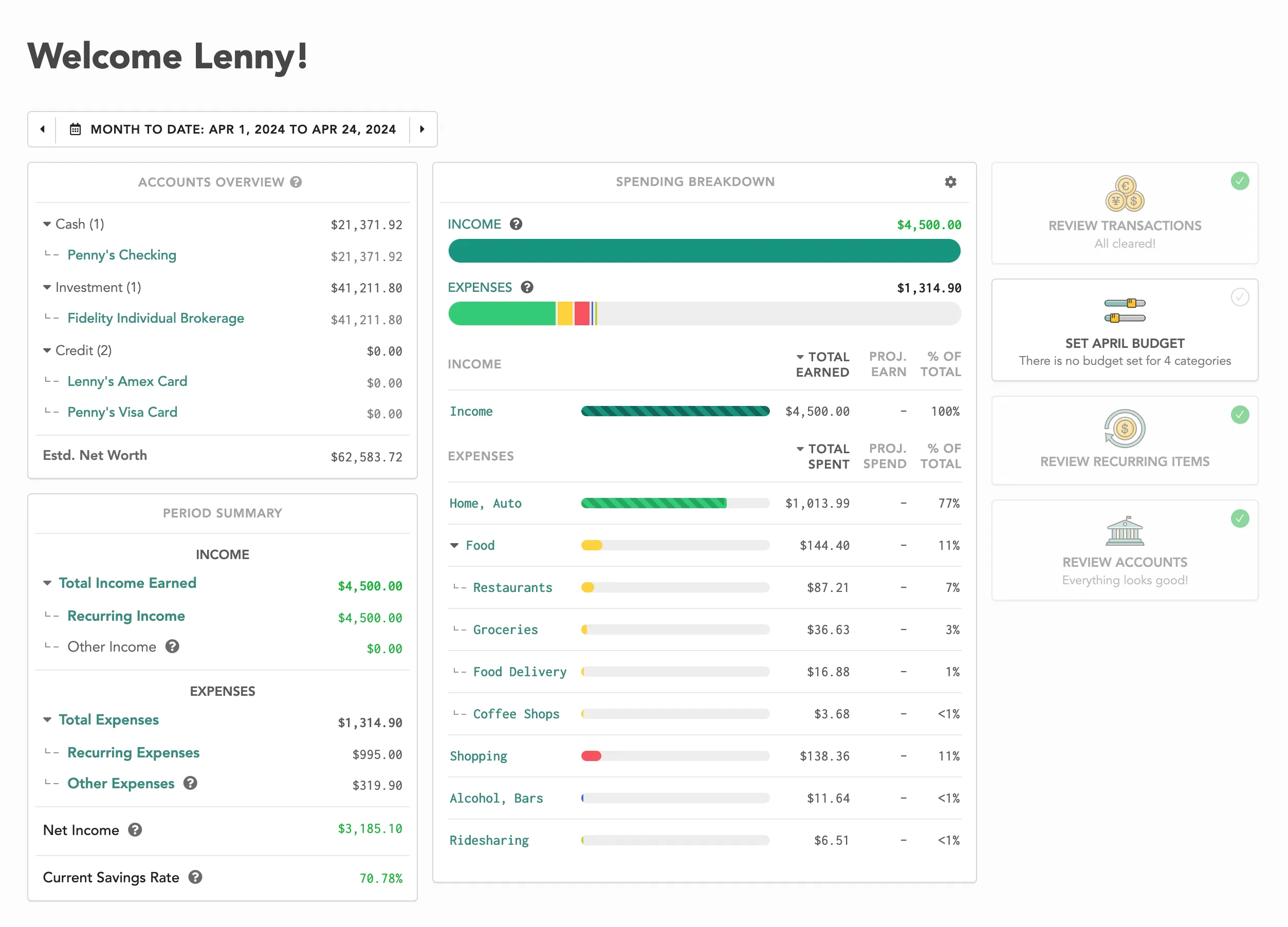
The web dashboard (official media-kit demo screenshot, demo account data) shows the product's web-first density: accounts overview, spending breakdown, period summary and to-dos on one screen.
Pricing (as of 2026-10-02)
From the pricing page (listed in USD; CAD/EUR views available):
| Plan | Price | Notes |
|---|---|---|
| Free trial | 30 days, no credit card | All features included |
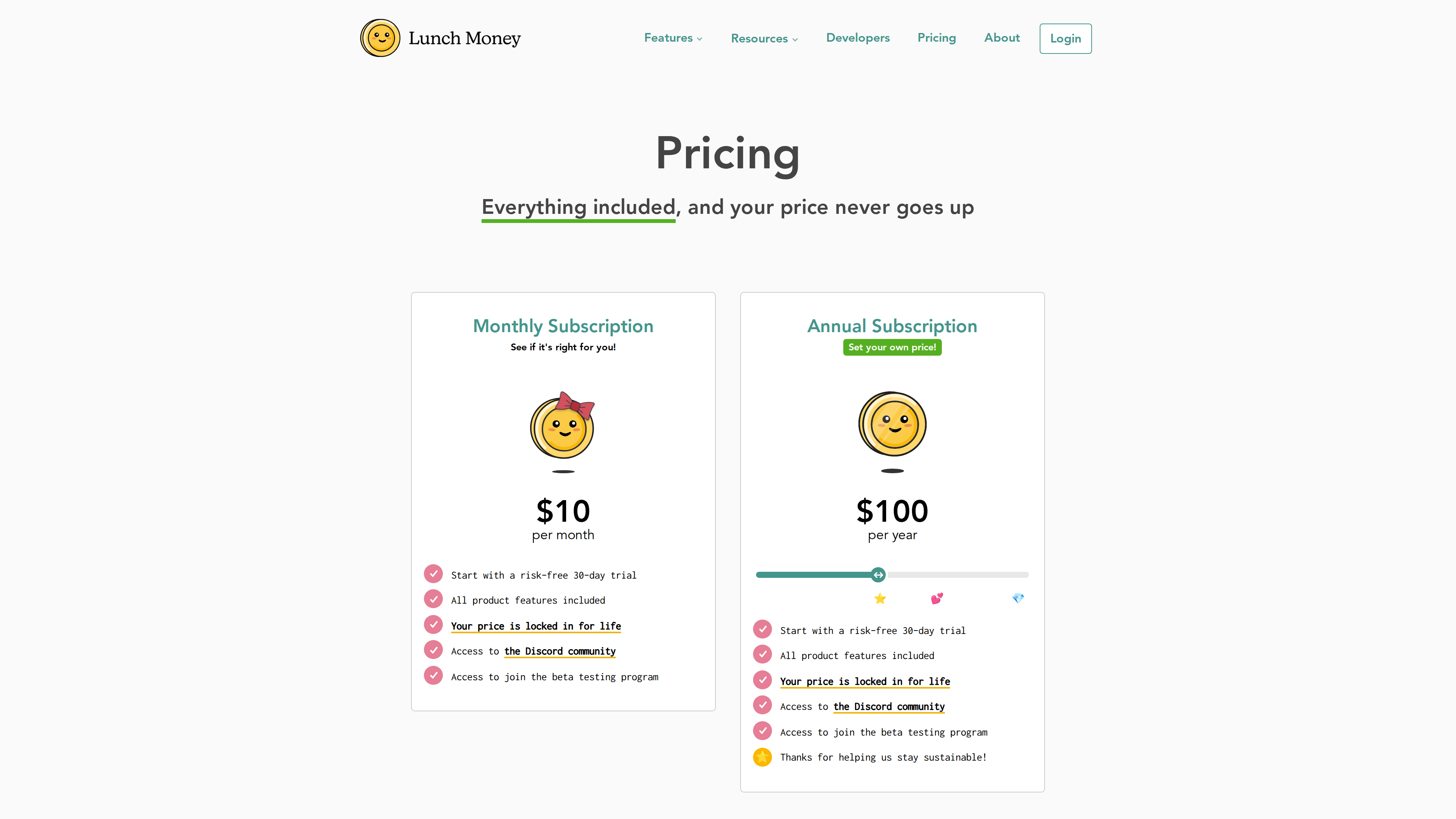
| Monthly | US$10/month | All features, Discord community, beta testing program |
| Annual | US150/year via a "set your own price" slider, default $100 | Same benefits; higher tiers add anniversary thank-you gifts (💕 first year, 💎 second) |
Two pricing policies worth knowing:
- Price-lock guarantee: If the company adjusts pricing, it only affects new customers — your rate stays locked forever at whatever you signed up with or last selected.
- Where pay-what-you-want came from: The app launched in 2019 at 29/year), settled at 100/year) in January 2021, then — at the height of inflation in summer 2023 — moved annual plans to pay-what-you-want (then 150), prioritizing accessibility over profit maximization. The founder reports growth did not slow and revenue nearly doubled afterwards (pricing retrospective; current tiers per the live pricing page).
- Subscriptions can be paused indefinitely with credit for unused time; your data is not deleted.
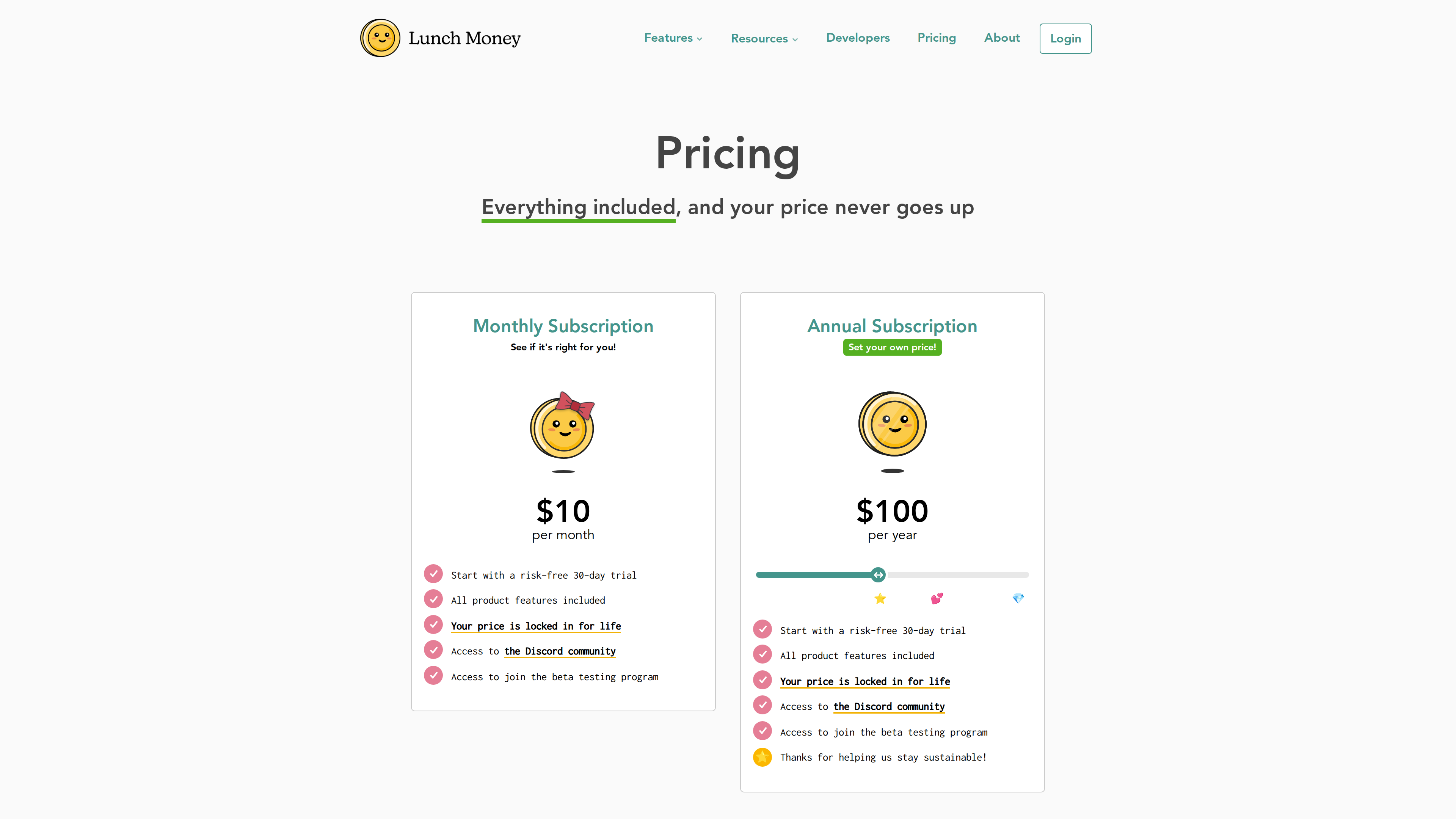
The pricing page (screenshot from 2026-10-02): monthly at 100 default; ⭐️💕💎 mark the thank-you and anniversary-gift tiers.
Who It's For
- Cross-border lives and multi-currency households: digital nomads, expats and cross-border workers whose accounts and income span countries and currencies.
- Crypto holders who want their coins in the same net-worth view as traditional accounts.
- Former Mint users: a one-click Mint migration tool plus official comparison pages against Mint, YNAB, Monarch, Simplifi and others.
- Developers and tinkerers who want full control of their financial data via API and CSV export.
- Partners and families sharing a budget: collaborators are free with separate logins.
Limitations
- No permanent free plan: after the 30-day trial, a paid subscription is required; the site does not state what happens to your data if you let the trial lapse.
- Bank-sync coverage is limited: Plaid syncing officially covers only the US, Canada and 11 European countries. The UK is notably absent (paid third-party tools like Lunch Flow or Synci are the workaround), and users in Asia, Oceania or Latin America will mostly rely on CSV/PDF or the API.
- Web-first means mobile is a companion: New features ship on the web first; the mobile app is positioned for on-the-go review and quick entry, which may disappoint mobile-first users (web-first explainer).
- English only: The interface and documentation are English; localization is limited to date and number formats (observation).
- A tracker, not an advisor: It aggregates accounts read-only and offers no investment advice, asset management or payment/transfer capabilities.
Alternatives & Comparisons
Among the personal finance tools in this collection, Monarch Money, Copilot Money and Simplifi lean more toward the North American banking ecosystem; Actual Budget and Maybe take the open-source, self-hostable route; Lunch Money's differentiator is its multi-currency, global-user focus. The site maintains official comparison pages — vs. YNAB, vs. Monarch, vs. Mint — useful as input, keeping in mind they are written by Lunch Money itself.
References
- Lunch Money homepage, pricing, About, media kit (checked 2026-10-02)
- Feature pages: import transactions, multi-currency, crypto tracker, budgeting, collaboration, web-first, security, developers
- Founder's blog: Life in Fukuoka: Building an app (2019-07-31), Lunch Money: The New Era (2024-05-21), Why we lowered our pricing (2024-07-16)