Luma Dream Machine (lumalabs.ai) is an AI creative platform run by the US company Luma AI: feed it text, images, or existing footage, and it generates or modifies video and images. The original pitch was "make films without a film crew," but the current positioning has clearly shifted toward professional production — the company describes its in-house Ray3 as "the world's first reasoning video model," and its verifiable differentiators include frame-level control with up to 16 keyframes per clip, generations up to 20 seconds at 1080p, native HDR with 16-bit EXR export (suitable for Resolve or Nuke pipelines), and a single platform that also aggregates third-party models such as Veo, Kling, and Seedance. After OpenAI shut down Sora's web and app experiences in April 2026, demand moved to independent video-generation platforms still operating; Luma is consistently listed among the alternatives in third-party reviews (a reasonable inference — Luma itself has made no "beneficiary" claim).
At a glance
- URL: https://lumalabs.ai (the Dream Machine product page at https://lumalabs.ai/dream-machine redirects to lumalabs.ai/app)
- Type: AI video/image generation platform (in-house Ray video models and Uni image models + third-party model aggregation) with a developer API
- Cost: free trial credits (the exact amount is not stated on public pages); Plus 300/year), Pro 300/month; Team and Enterprise are quote-based — see the official pricing page (as of 2026-09-17)
- Account required: browsing the site, news, pricing, and API docs needs no account; generating content requires sign-up (email, Google, or Apple; SSO exists in the auth configuration for businesses). Users must be 18+, or 13–18 with a parent or guardian's consent, per the Terms of Service
- Interface language: English; on 2026-09-02 the company announced a fully localized Arabic interface later this year — its first non-English UI (official announcement). Prompts can be written in other languages, including Chinese
- Launched: Dream Machine went public on June 12, 2024 (Wikipedia and the June 2024 Tom's Guide and TechRadar coverage it cites)
Background
Luma AI was founded in California in 2021 by Amit Jain (CEO) and Alex Yu (CTO). Jain previously worked at Apple on Vision Pro multimedia experiences and the computer vision team (a16z investment announcement, Jan 2024); Yu was an AI researcher at UC Berkeley known for NeRF and Plenoxels work on 3D reconstruction (TechCrunch, Jan 2024, via Yahoo Finance). The company is headquartered in Palo Alto; as of May 2026 it had raised roughly 4 billion (CNBC Disruptor 50, 2026, citing PitchBook).
Luma's first product was Genie (2023), a text-to-3D generator. After a $43M Series B led by a16z in January 2024, it launched Dream Machine that June, pivoting from 3D to video generation. Key milestones since (all from official announcements):
- September 18, 2025: Ray3 introduced reasoning capabilities and a Draft Mode, and was the first to generate 10/12/16-bit HDR in ACES2065-1 EXR; Adobe Firefly became the first external platform to ship it.
- November 19, 2025: a $900M Series C led by HUMAIN with significant AMD participation, plus Project Halo, a 2GW compute cluster built with HUMAIN (deployment starting Q1 2026); the team was over 130 people at the time.
- December 18, 2025: Ray3 Modify — video modification (wardrobe swaps, environment swaps, relighting, virtual product placement) with first-ever start/end frame control and character references.
- January 26, 2026: Ray3.14 — native 1080p, billed as 4x faster and 3x cheaper than Ray3 (at 720p).
- June 9, 2026: Ray3.2 and the first full API release.
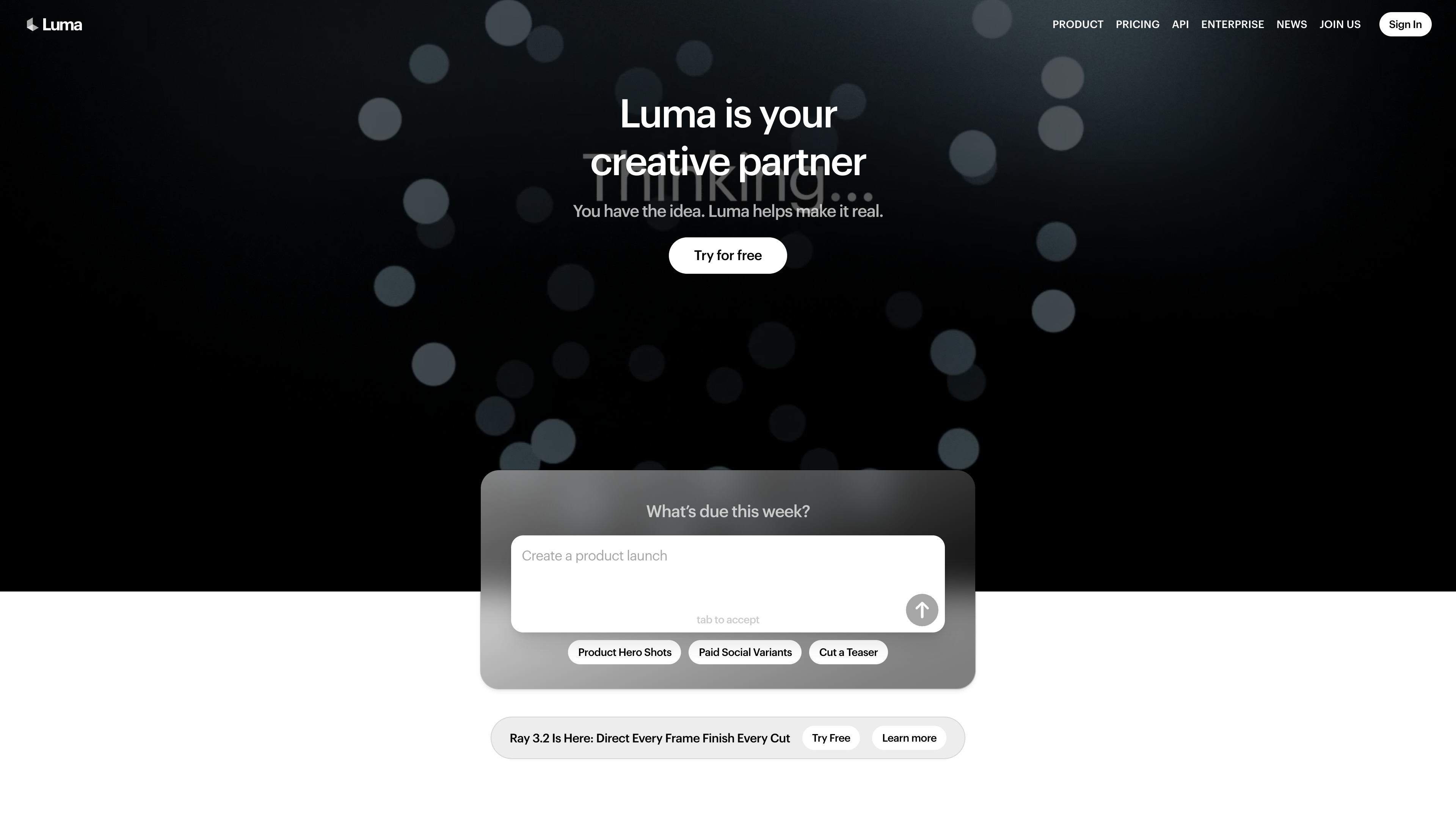
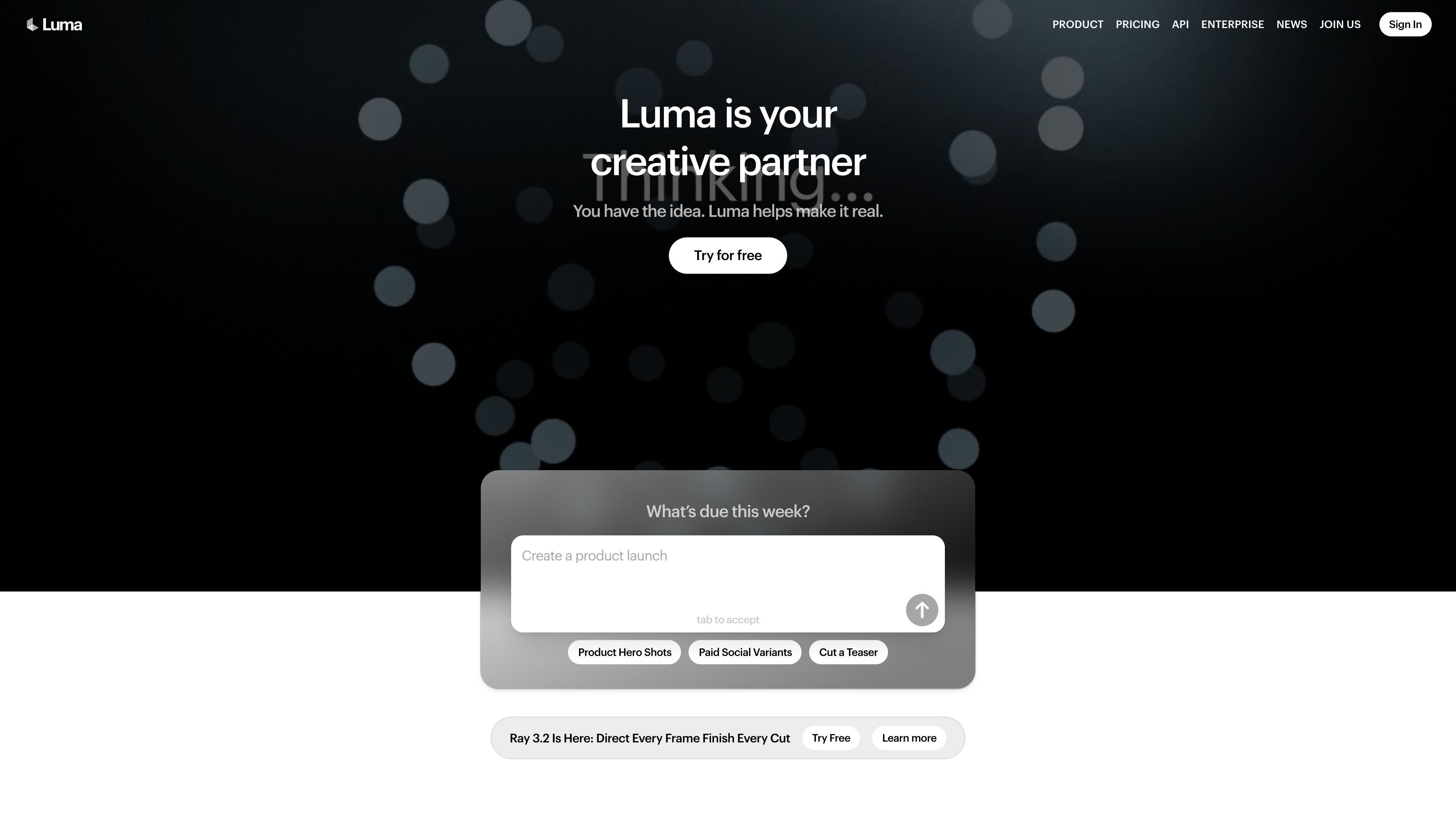
The homepage is the product in miniature: its centerpiece is a prompt panel ("What's due this week?") where you state the deliverable and the platform's agents take it from there.
Core capabilities: from prompt to pipeline-ready footage
As of 2026-09-17, the platform (web, with iOS and Android apps referenced in the Terms) offers these verifiable capabilities:
- Video generation: text-to-video and image-to-video. Alongside its own Ray3.2 / Ray3.14, the platform aggregates third-party models — Veo 3.1, Kling 3.0, Seedance 2.0/2.5, Minimax H3, and others — each metered in credits by model and resolution (pricing page rate table).
- Frame-level direction (Ray3.2): up to 16 keyframes in a single clip to control pacing, camera paths, and visual progression; Performance Tracking follows the expressions and motion of up to eight faces at once; clips run up to 20 seconds at 1080p (Ray3.2 announcement).
- Video modification (Modify) and Reframe: wardrobe swaps, environment swaps, relighting, and virtual placements on existing footage; Reframe changes aspect ratio, extends the frame, or replaces the background after the fact while preserving the original lighting.
- Professional output: native HDR generation and 16-bit EXR export, aimed at color grading and compositing pipelines rather than social clips alone.
- Image and audio: the in-house Uni-1/Uni-1.1 image models (pitched on brand consistency), plus aggregated image models (GPT Image, Nano Banana, Seedream) and audio capabilities from ElevenLabs (speech, SFX, music) and lip sync.
- Reusable workflows: Luma Skills (June 2026) saves a creative workflow as a repeatable "skill"; connectors integrate Frame.io, Figma, and Google Ads Console.
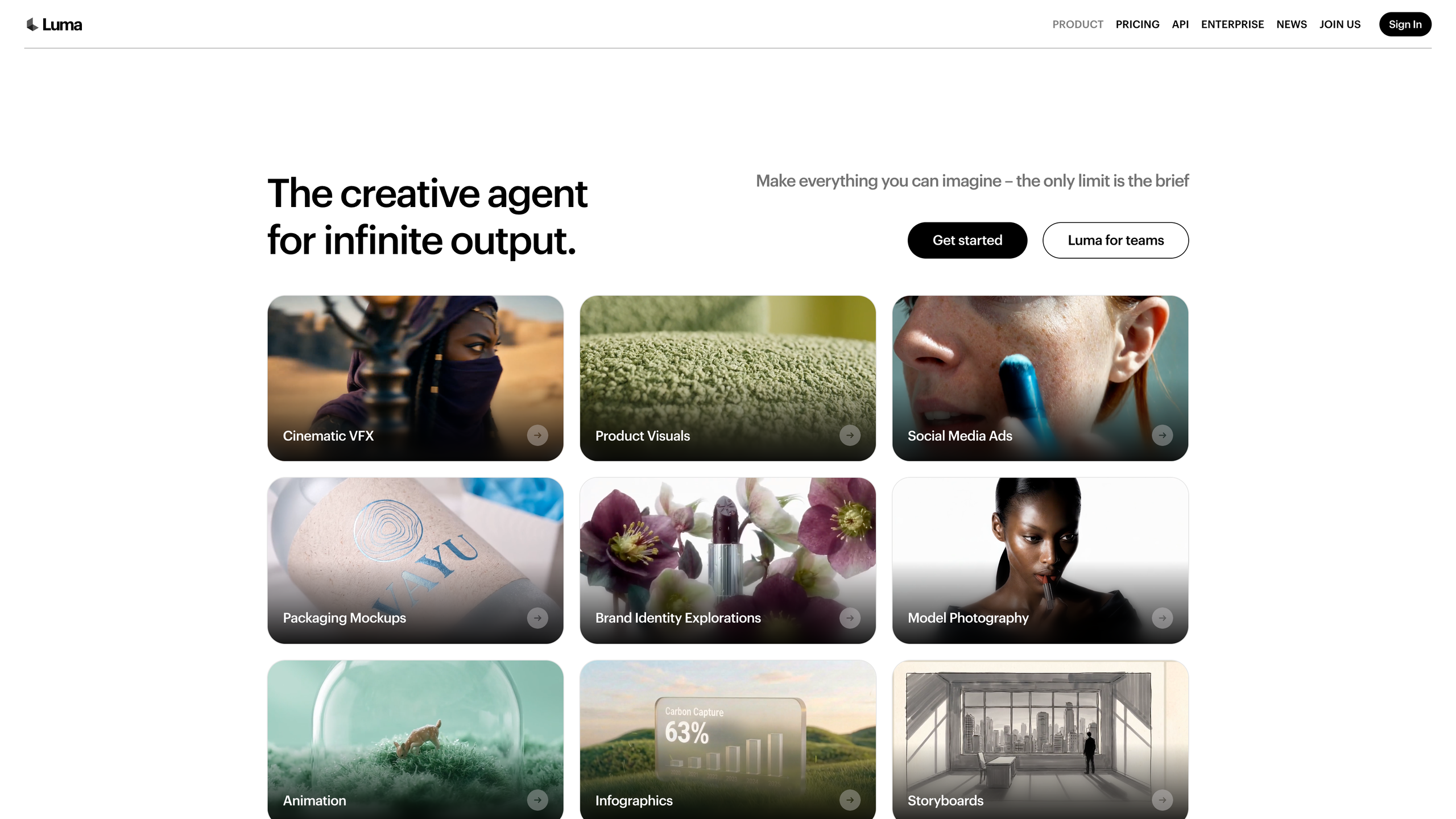
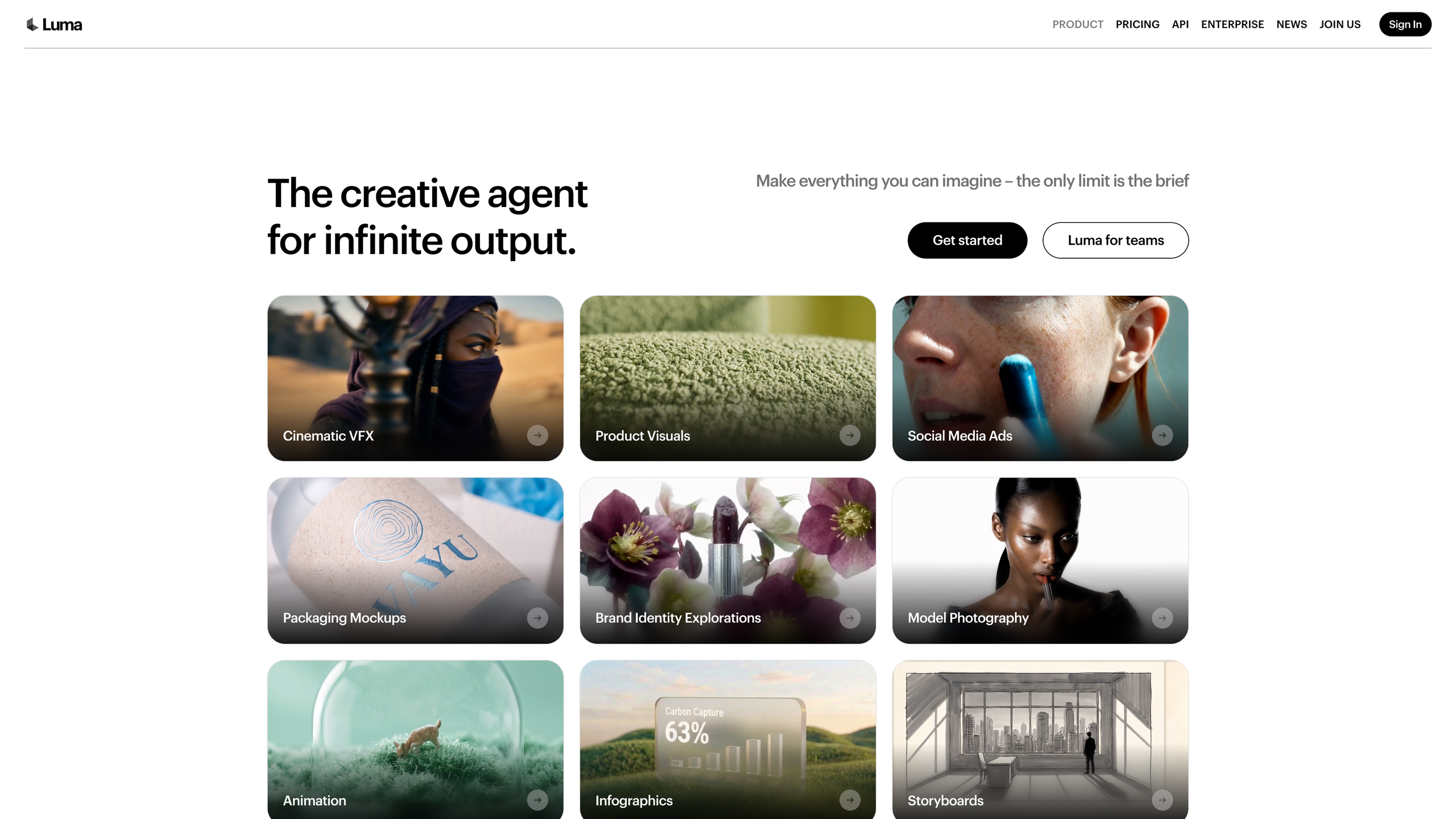
The product page (lumalabs.ai/app) organizes entry points by use case: cinematic VFX, e-commerce product visuals, social ads, packaging mockups, brand identity, model photography, animation, infographics, and storyboards — each opening a prebuilt workflow.
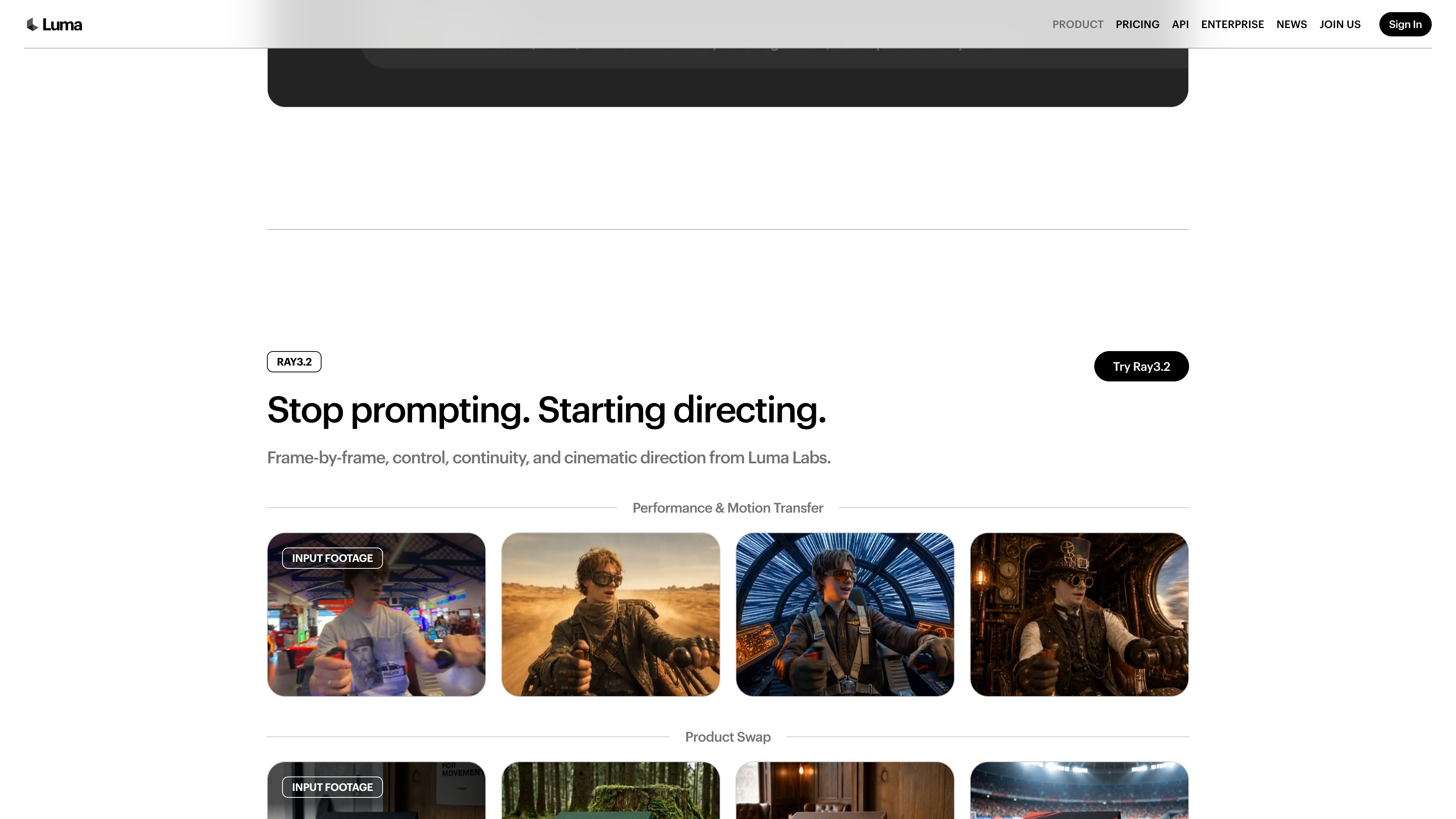
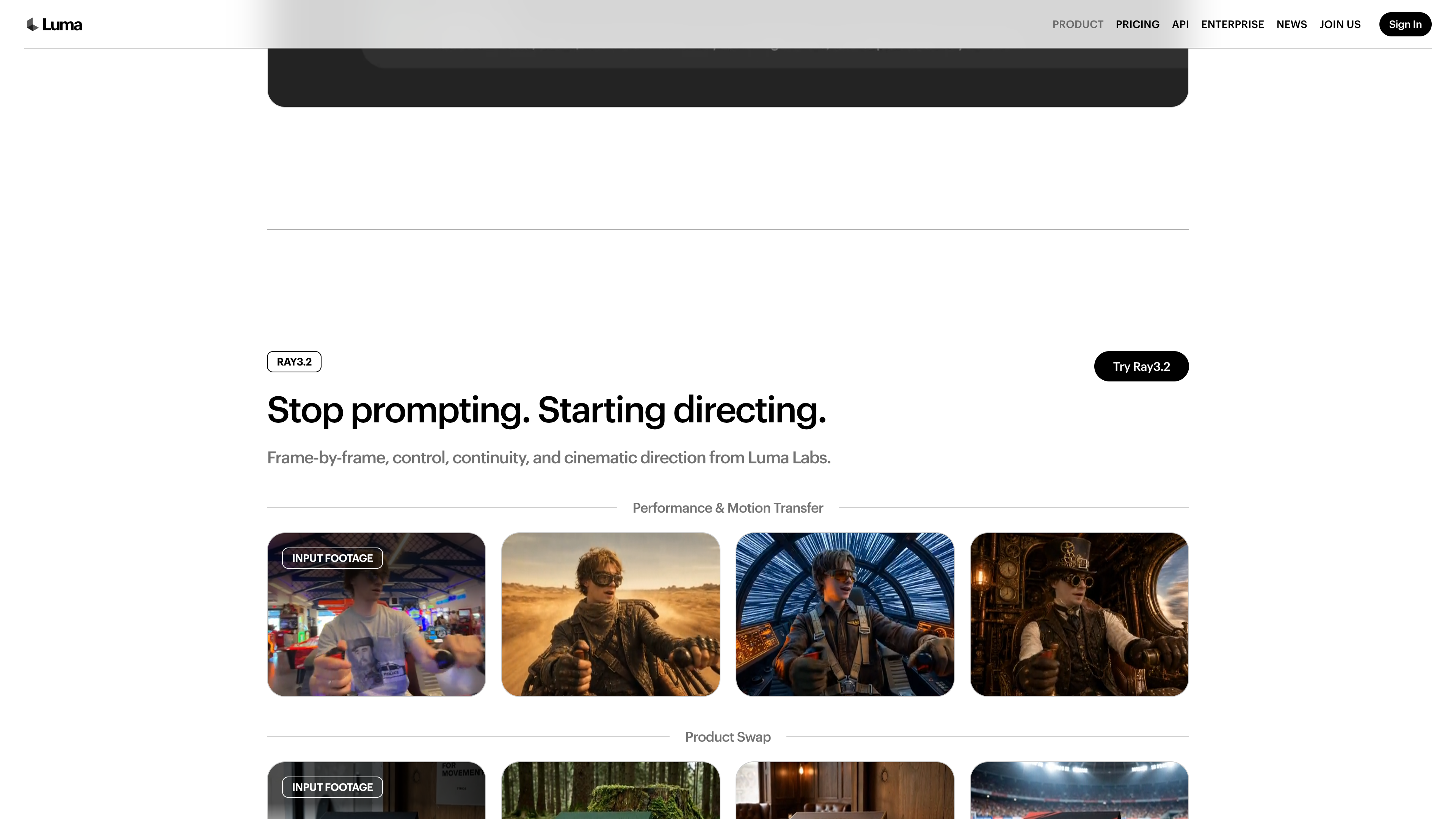
The Ray3.2 showcase demonstrates the flagship pitch directly: the INPUT FOOTAGE tile is the source material, and the tiles to its right show the same performance transferred into different scenes, characters, and styles — the concrete meaning of "directing, not gambling on prompts."
Accounts and openness
Sign-up supports email, Google, and Apple accounts (observed on auth.lumalabs.ai on 2026-09-17); the Team plan adds member management, shared credits, and SSO.
For developers, Luma runs a publicly documented API (as of 2026-09-17): the Ray3.2 video API is pay-per-use with no minimum commitment — 5-second text/image-to-video costs 1.20 (1080p), 10 seconds 3.60; video-to-video modification is 2.16 for 5 seconds; Reframe is 0.36 per second; HDR output costs 2x the SDR price and HDR+EXR 3x. Teams needing guaranteed throughput can buy dedicated Scale capacity (with an SLA and a no-training-on-customer-data guarantee). The Uni-1.1 image API is available as well. The API FAQ retains an entry on "migrating from the legacy Dream Machine video API," showing the developer interface predates 2026 and has been replaced across model generations.
Pricing: subscription credits plus metered API
As of 2026-09-17, the official pricing page lists:
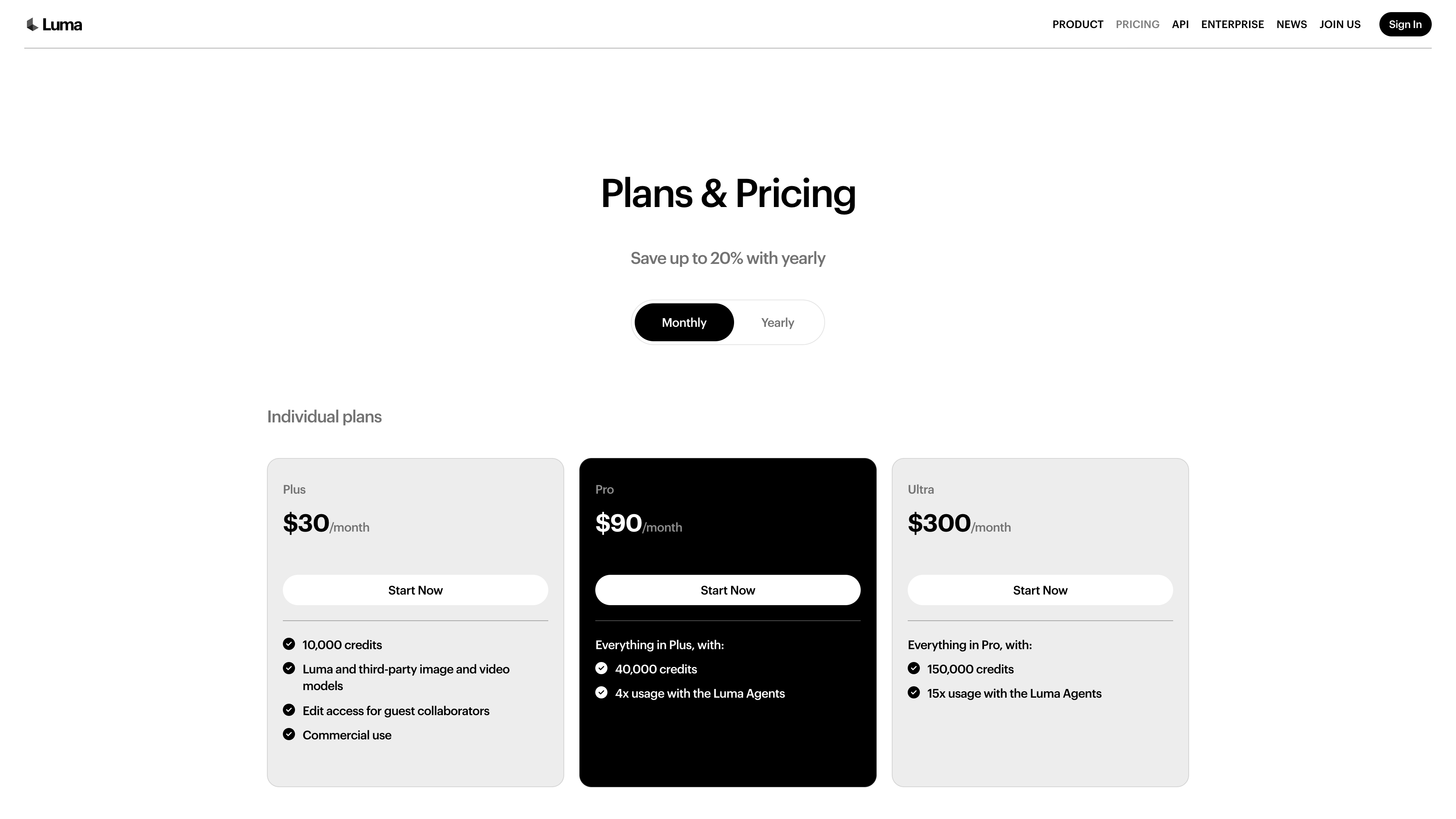
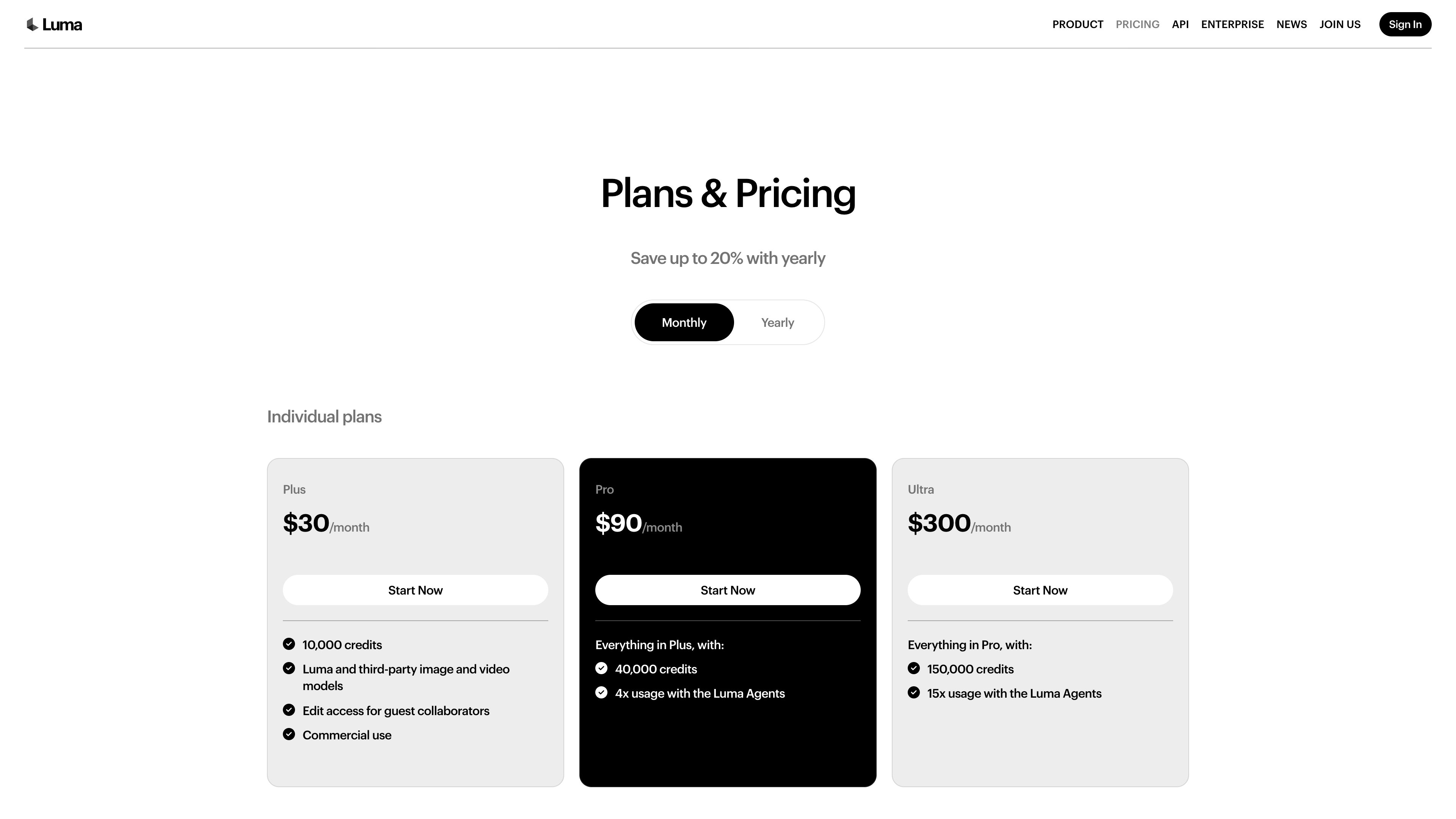
| Plan | Price (monthly) | Monthly credits | Key differences |
|---|---|---|---|
| Free trial | $0 | not publicly stated | The site offers "Try for free"; the pricing page notes all individual plans include free trial credits and commercial use |
| Plus | 300/year) | 10,000 | Luma and third-party image/video models, edit access for guest collaborators, commercial use |
| Pro | 900/year) | 40,000 | 4x usage with Luma Agents |
| Ultra | 3,000/year) | 150,000 | 15x usage with Luma Agents |
| Team / Enterprise | contact sales | shared | Member management, usage analytics, SSO; Enterprise adds custom fine-tuning and training |
Credit consumption is quantifiable: Ray3.2 at 1080p costs 400 credits per 5 seconds (20 credits per 5 seconds in Draft mode), so a month's Plus allowance works out to roughly 25 five-second 1080p Ray3.2 finished clips — or many more low-resolution drafts. Yearly billing saves about 20%.
Copyright and content policy
As an AI content platform, its terms deserve a close read (Terms of Service, updated 2026-05-14):
- You own the output, but commercial use is tied to an active subscription: to the greatest extent permitted by law, output rights are assigned to the customer — however, output may be used commercially only if it was produced during an active paid subscription that allows commercial use.
- Watermarks and provenance: Luma reserves the right to embed watermarks, content credentials, or provenance metadata in output, and users may not remove them. Output that identifies or resembles a real person must be publicly identified as AI-generated.
- Broad license over inputs: users grant Luma a license that includes training and improving models on their input; during free use, the license expands further to public display, reproduction, adaptation, and distribution. Using the output to train competing models is prohibited.
- No storage commitment: the service may set storage and retention limits at any time and assumes no liability for deleted inputs or outputs — keep your own backups of anything important.
- Platform-favorable dispute terms: binding individual arbitration with a jury and class-action waiver (with limited exceptions); the contracting entity is the US company Luma AI, Inc.
Where it fits
- Advertising and brand teams: batch-produce one brand asset across formats and markets; Ray3.2's keyframe control and Reframe map to "client feedback without a reshoot."
- Film and post-production studios: HDR/EXR output drops into grading and compositing pipelines — suited to previsualization, concept shots, and VFX elements rather than final delivery.
- E-commerce and product visuals: multi-angle product shots, on-model photography, and packaging mockups have dedicated entry points.
- Developers and tool builders: metered API access to video generation inside their own products, with migration docs for the legacy Dream Machine API.
- Individual creators testing the water: the free trial is enough to evaluate quality, but anything commercial requires an active paid subscription.
Limitations
- Opaque free allowance, commercial use gated by subscription: the exact trial credit amount is not published, and per the Terms, content generated during free use may not be used commercially — output from a "try before you buy" phase cannot go straight into a commercial project.
- Output quality still needs human review: official demos are plainly curated; the Ray3.14 notes concede limits (no character references, no HDR/EXR in Modify), and long-form narrative coherence remains a category-wide weakness.
- Opaque training data: since Dream Machine's 2024 launch, outside observers have noted that Luma does not disclose its training data (The Verge and TechRadar commentary collected in the Wikipedia article) — a risk copyright-sensitive projects must evaluate themselves.
- Costs scale linearly with usage: 1080p finished clips start at 400 credits each, and HDR/EXR multiplies that two to three times; high-output teams will quickly approach Ultra territory or beyond.
- No Chinese UI: the interface is English-only for now (Arabic arrives later in 2026), a friction point for Chinese-speaking teams, though prompts themselves can be written in Chinese.
- Broad input licensing: under the default terms, uploaded material is licensed to the platform for model training; teams with strict confidentiality needs should look at Enterprise arrangements (the API Scale tier carries a no-train guarantee).
Alternatives
- Runway: the veteran AI video platform, strong on editing and control; the closest peer to Luma.
- Kling AI: Kuaishou's video model, with comparatively generous free daily credits; its models are also aggregated inside Luma.
- Google Veo: Google's video model, offered via Gemini/Flow; Veo 3.1 is likewise callable in Luma on credits.
Sources
- Luma homepage (checked 2026-09-17)
- Luma pricing (checked 2026-09-17)
- Luma API (checked 2026-09-17)
- Terms of Service - Luma (updated 2026-05-14) (checked 2026-09-17)
- Luma AI launches Ray3 (checked 2026-09-17)
- Ray3 Modify (checked 2026-09-17)
- Ray3.14 (checked 2026-09-17)
- Luma Introduces Ray3.2 Model & API (checked 2026-09-17)
- AGI is multimodal and reality is the dataset of AGI (Series C announcement) (checked 2026-09-17)
- Luma AI to Launch Native Arabic-Language Interface (checked 2026-09-17)
- Investing in Luma AI - Andreessen Horowitz (checked 2026-09-17)
- Luma raises $43M to build AI that crafts 3D models - TechCrunch (via Yahoo Finance) (checked 2026-09-17)
- Luma AI - CNBC Disruptor 50 (2026) (checked 2026-09-17)
- Dream Machine (text-to-video model) - Wikipedia (checked 2026-09-17)
- OpenAI Sora Discontinuation - Futurum Group (checked 2026-09-17)