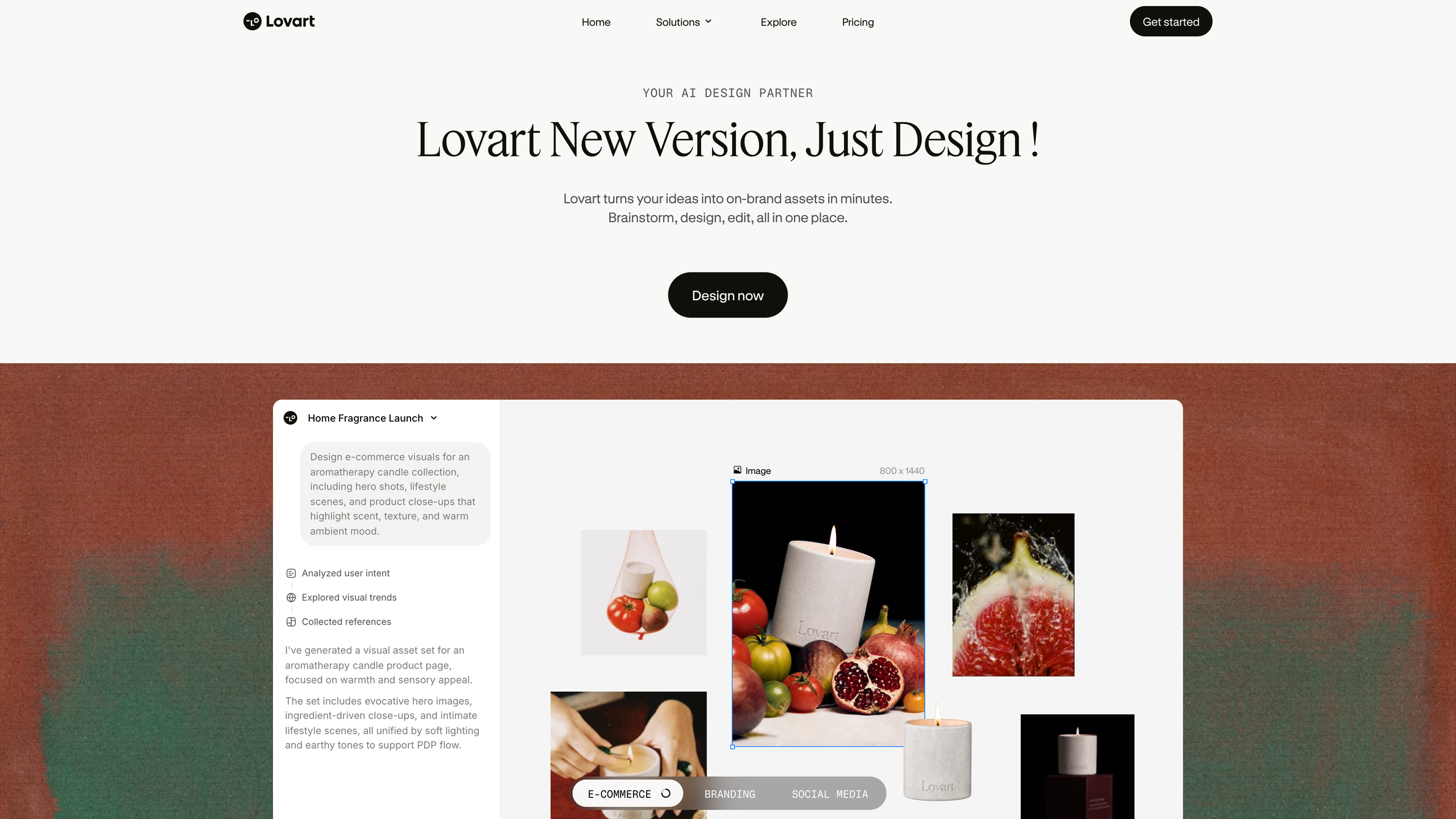
Lovart (lovart.ai) is an AI design platform that markets itself as "the world's first design agent": you describe what you need in one sentence — optionally attaching reference images or brand assets — and it decomposes the request, gathers references, picks models, and then produces a whole set of editable assets on an infinite canvas: logos, posters, packaging, social graphics, video ads. The problem it attacks is collapsing "get a design job done" from a round trip across half a dozen tools into a single conversation. Its verifiable difference from point generators like Midjourney: Lovart does not train its own foundation models but orchestrates 30+ third-party image and video models, routing each task automatically, and the output lands on a layered canvas you can export as PSD, SVG, or PPTX. As of 2026-09-17, the homepage claims 30 million marketers, business owners, and creators use it worldwide.
At a glance
- URL: https://www.lovart.ai
- Type: AI design agent (brand/graphic/video generation + canvas editing)
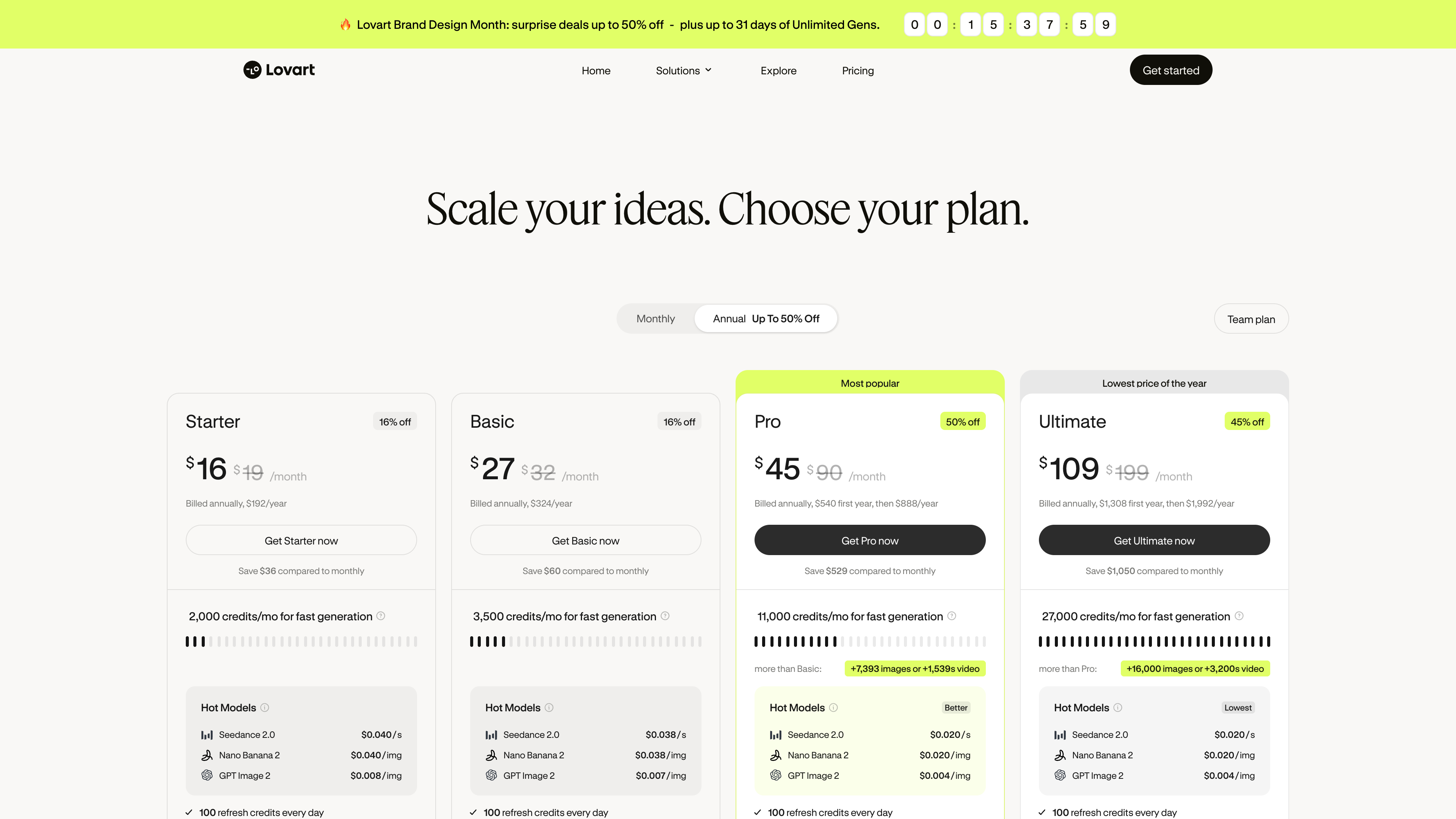
- Cost: Free plan at 19/month, Basic 90/month, Ultimate $199/month, annual discounts and a Team plan available — see the pricing page (as of 2026-09-17)
- Sign-up: Browsing the site, docs, and case studies needs no account; generating designs requires one (Google, Apple, or email verification code); users must be 13 or older, with parental consent for minors, per the Terms of Use
- Interface languages: the site ships in 11 locales — English, Simplified and Traditional Chinese, Japanese, Korean, German, French, Spanish, Portuguese, Italian, Russian
- Launched: beta on May 13, 2025; general availability on July 23, 2025
Background
Lovart was co-founded by CEO Melvin Chen and CTO Haofan Wang, an AI researcher trained at Carnegie Mellon University (Forbes, July 2025). Chen, born in 1992, previously led global commercialization for ByteDance's CapCut/Jianying. In May 2023 he founded Beijing Qidian Xingyu Technology, the company behind the AI image platform LiblibAI; Lovart was released by its overseas subsidiary in May 2025, and an official Chinese edition, Xingliu Agent (星流 Agent), followed on July 3, 2025 (Securities Times, PEdaily).
Key milestones, each from official announcements or first-hand reporting:
- May 13, 2025: beta launch — 20,000 people applied on day one and invite codes were resold; the waitlist passed 100,000 across 70+ countries within five days (36Kr).
- July 23, 2025: exited beta worldwide with roughly 800,000 waitlisted users, topping Product Hunt on launch day; the official announcement says more than 300,000 early users had already created with it during beta (PR Newswire, official launch post).
- October 2025: LiblibAI closed a 30M in annualized revenue (Securities Times).
- June 2026: parent company Evoken (formerly Liblib) raised nearly 2B, co-led by Granite Asia, Tencent, and Shunwei Capital; ARR reached $300M in May 2026 (36Kr, TMTPost).
- August 2026: Bloomberg reported Evoken is considering a Hong Kong IPO, with talks still at an early stage (via Asia Tech Review).
Legally, the Terms of Use (updated July 9, 2026) are contracted with Resonate International INC, a Delaware corporation, while the company's press materials describe Lovart as San Francisco-based.
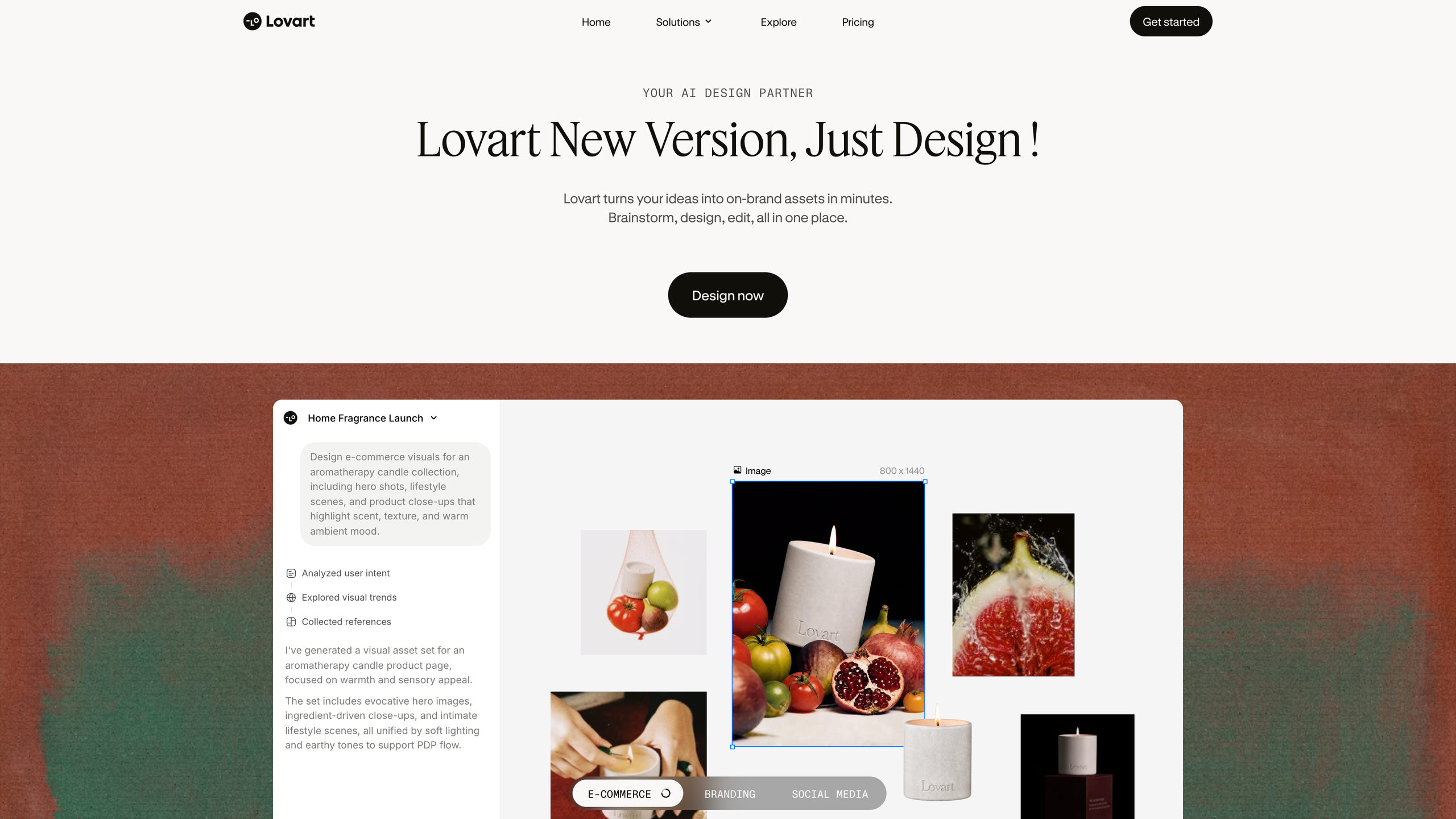
The homepage doubles as a demo of how it works: type a brief such as "design e-commerce visuals for an aromatherapy candle collection," and the agent visibly walks through analyzing intent, collecting references, and generating a full asset set straight onto the canvas.
Core capabilities: from one sentence to a full brand kit
The basic workflow, per the official docs:
- Describe the job: enter a prompt, optionally with reference files or a configured Brand Kit.
- Autonomous execution: the agent breaks the task down and routes it across 30+ image and video models — as of 2026-09-17 the pricing page lists GPT Image 2/2.5, Nano Banana 2/Pro, Seedream 4.0–5.0, Flux 2 Pro/Kontext, Seedance 1.5/2.0, Kling 2.5–3.0, Veo 3/3.1, Wan 2.6, Hailuo 02/2.3, and more; manual model selection is also possible.
- Canvas delivery: results land on the infinite canvas (ChatCanvas) where every element stays editable; export formats cover PNG/JPEG, MP4, PDF/PPTX, HTML, SVG, and batch PSD (export docs).
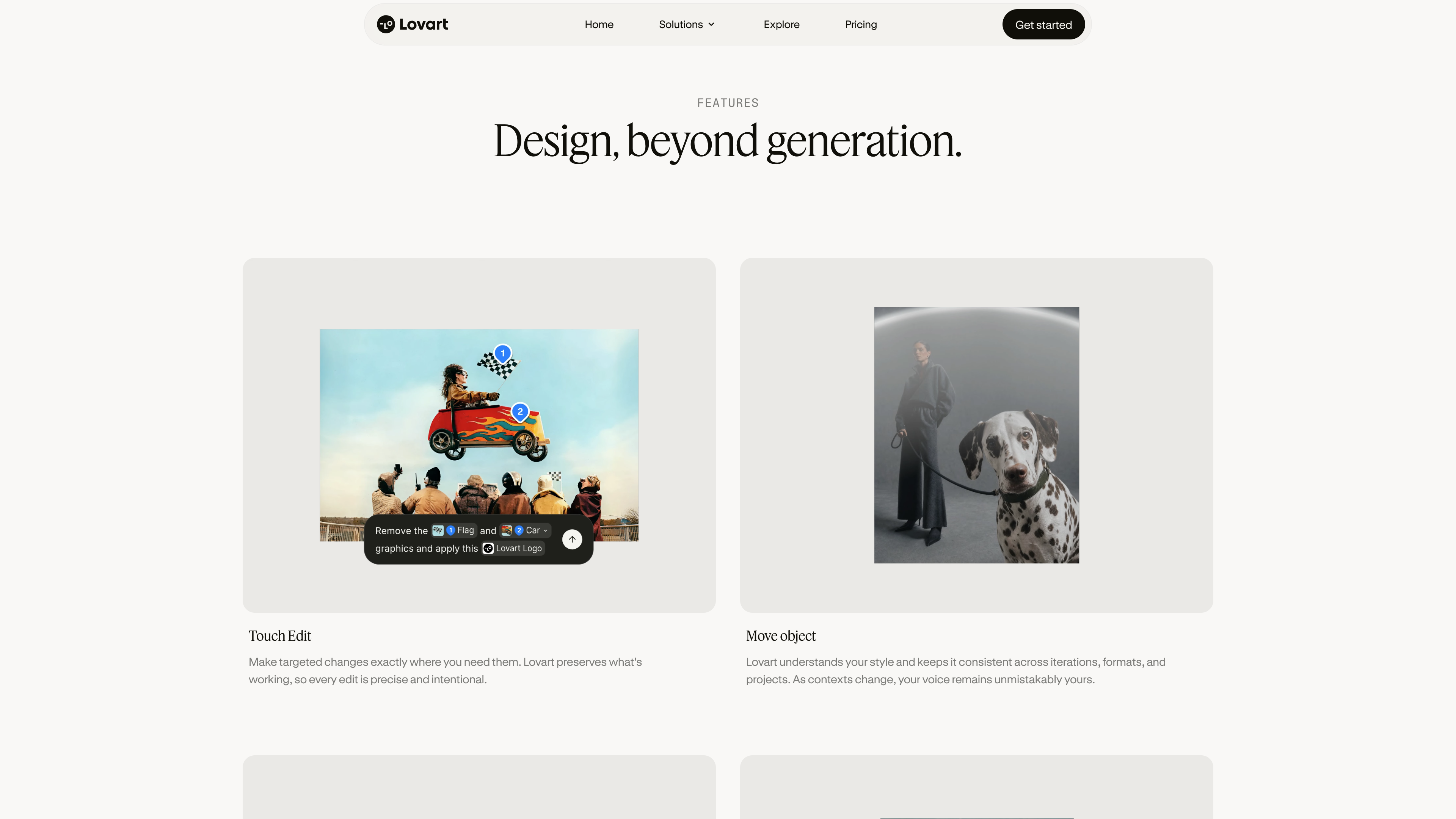
In its July 2025 launch materials, Lovart described the orchestration layer as a proprietary creative-reasoning engine called MCoT (Mind Chain of Thought) with multiple collaborating agents. Built-in canvas editing includes Touch Edit (point-and-edit regions), Text Edit (typography as editable layers), element layer separation, background removal, Expand, Upscale, multi-angle generation, raster-to-SVG vectorization, a custom font generator, reusable workflow Skills, and a Brand Kit for colors, fonts, and logos (homepage feature list and changelog). Since April 2026, Lovart can also be invoked inside chat tools such as Feishu, Slack, and Discord via OpenClaw.
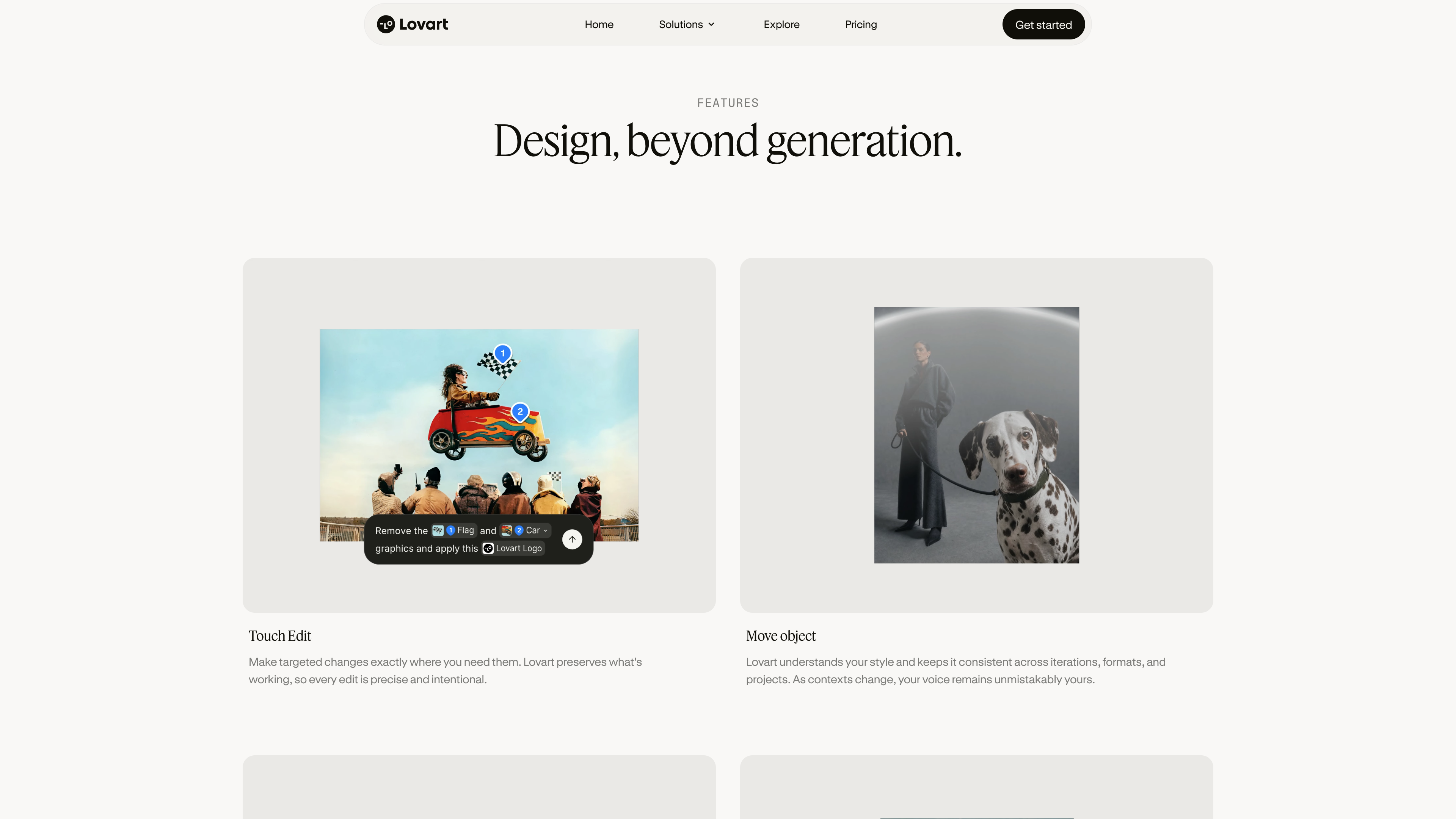
A set of interactive demos shows the editing model: Touch Edit, for example, lets you circle an object in the image and repaint just that region instead of regenerating the whole picture.
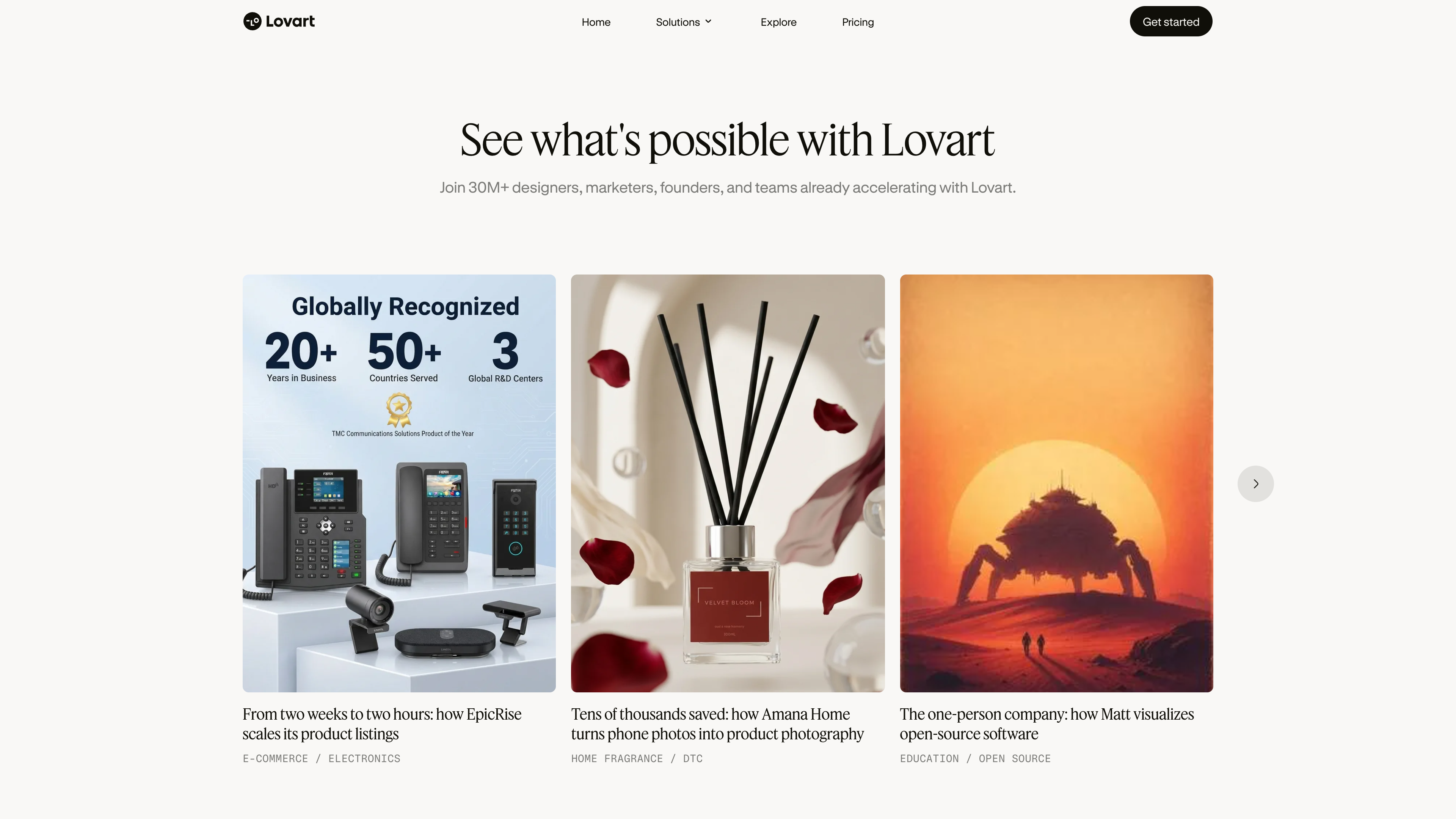
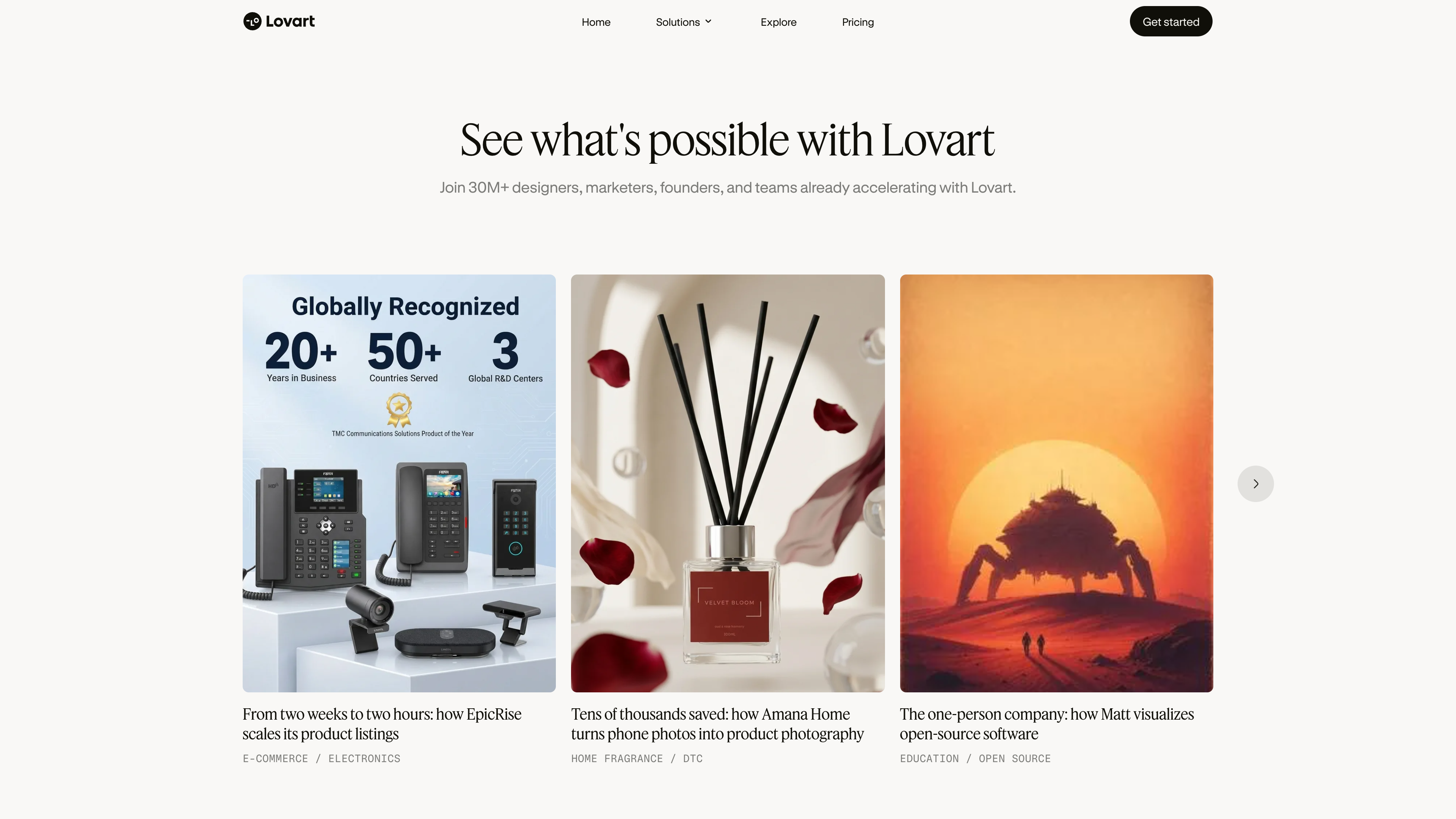
The public Explore page collects customer stories and a "Made with Lovart" gallery — an electronics seller turning phone photos into product photography, a one-person company using it as its entire design department — useful as public samples for judging output quality.
Pricing: everything metered in credits
As of 2026-09-17, the pricing page is running a "Brand Design Month" promotion (up to 50% off annual billing). The regular tiers:
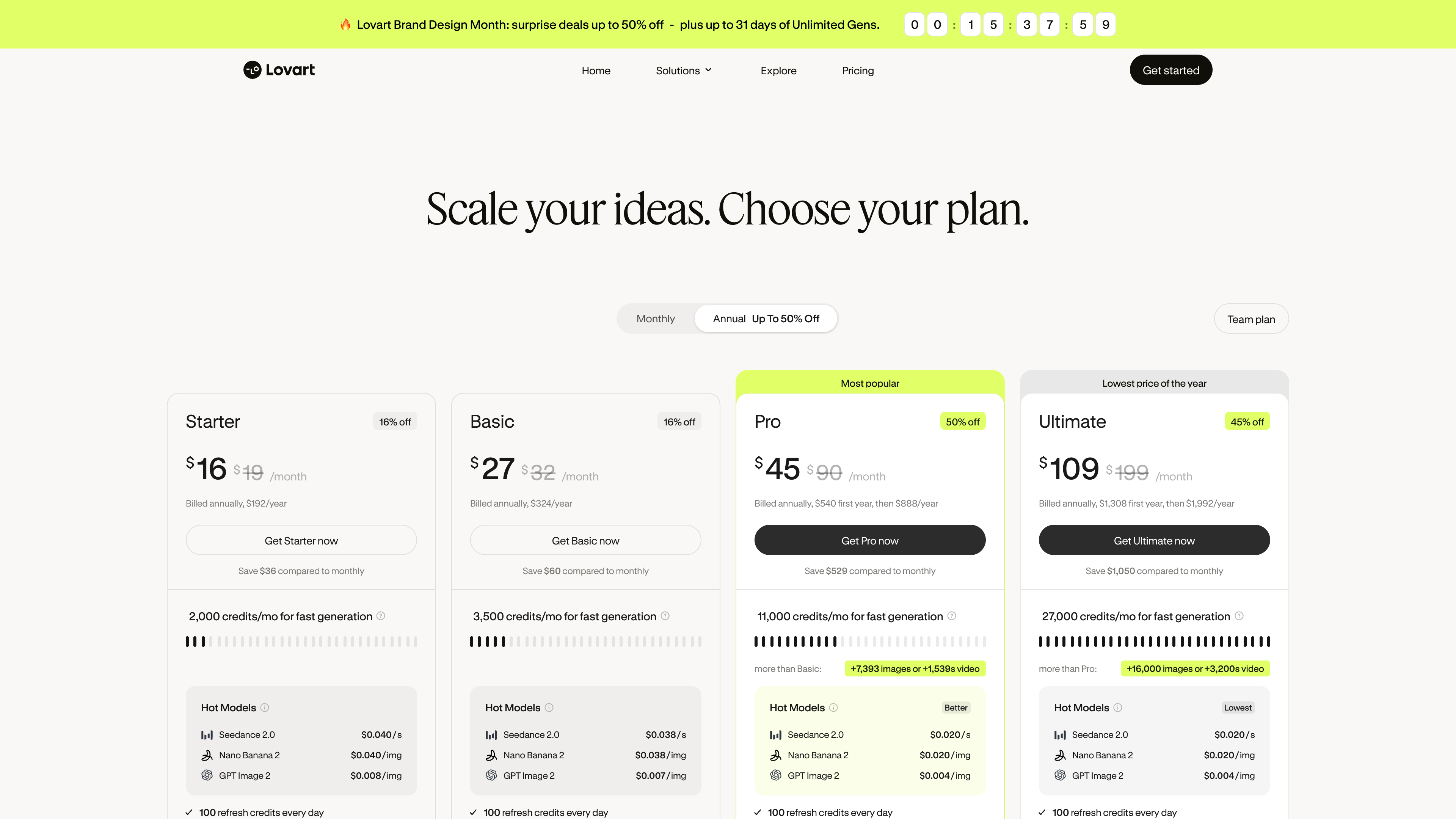
| Tier | Monthly | Annual (per month) | Monthly fast credits | Key differences |
|---|---|---|---|---|
| Free | $0 | — | 30 refresh credits/day | limited models, 1 concurrent task, no full video-model access, no commercial license |
| Starter | $19 | $16 | 2,000 | 2 concurrent tasks, 5 brand kits, commercial license |
| Basic | $32 | $27 | 3,500 | 4 concurrent tasks, 10 brand kits |
| Pro | $90 | $45 (first year, promo) | 11,000 | 8 concurrent tasks, 30 brand kits, 10% off credit refills |
| Ultimate | $199 | $109 (first year, promo) | 27,000 | 10 concurrent tasks, 100 brand kits |
Paid tiers also include 100 refresh credits per day. Sample consumption: GPT Image 2.5 at 1K costs 3 credits per image, Nano Banana 2 at 1K costs 8, and a 5-second Seedance 2.0 480p clip costs 40. Subscription credits expire at the end of each billing cycle and do not roll over; separately purchased credit packs stay valid for 366 days. Subscribers can also run Unlimited Relax Generation on designated models — queued, slower jobs that don't consume fast credits. Multi-user use requires the Team plan, which has its own entry on the pricing page.
Rights and content policy
As an AI-content platform, the fine print matters (Terms of Use, updated July 9, 2026; Privacy Policy, updated July 23, 2025):
- You own the output: users keep rights to their input; generated output belongs to the user, and Lovart assigns to you whatever rights it might hold in it.
- Commercial use depends on the plan: the pricing comparison table includes a commercial license only in paid tiers — the free plan is excluded; the site FAQ says the same.
- Broad license granted to the platform: worldwide, royalty-free, sublicensable, irrevocable, and perpetual — but scoped to operating and improving the service, security, and legal compliance.
- Output responsibility sits with the user: accuracy is not guaranteed; you must evaluate outputs yourself, and they may not be used for high-stakes decisions such as medical, legal, or employment calls.
- Strict refunds: virtual goods are generally non-refundable after 7 days or once used; subscriptions auto-renew and can be cancelled anytime.
- Disputes: governed by California law with exclusive jurisdiction in San Francisco County courts; jury trial and class actions waived; liability capped at the fees paid in the last 12 months or $50, whichever is higher.
Where it fits
- Marketing and ops teams: batch-produce on-brand assets for every channel (social, ads, email), with Brand Kit keeping output consistent across projects.
- E-commerce sellers: product shots, lifestyle scenes, listing visuals, and multi-angle variants without a photo shoot.
- Solo founders and small teams: one conversation yields a kit from logo and brand book to launch assets — a subscription in the tens of dollars instead of a design agency.
- Designers for ideation and first drafts: explore directions and mockups quickly, then export PSD/SVG for refinement in professional tools.
- Short-video and ad creative: Seedance, Kling, and Veo models in the same project, from storyboard to finished clip.
Limitations
- Everything burns credits: monthly credits don't roll over, and heavy use gets expensive; the free plan's 30 daily credits, limited models, and lack of a commercial license make it mostly a trial.
- Precision editing is still the weak spot: Forbes' reviewer found it excellent for ideation but faster to finish precise edits in Photoshop (Forbes).
- CJK text rendering is unreliable: a July 2025 36Kr hands-on found misspelled characters in Lovart-generated Chinese posters — a category-wide issue, so proofread before production use (36Kr).
- Individual accounts only: tasks can run on up to 2 desktop web + 1 mobile web sessions at once, and account sharing is explicitly banned; teams need the Team plan.
- Platform-friendly terms: a short refund window, a low liability cap, and disputes must be settled in California.
- Output quality is bounded by third-party models: Lovart doesn't train its own generators, so the ceiling depends on the integrated models, and uniqueness or accuracy of output is not guaranteed.
Alternatives
- Canva: the online design platform whose Magic Studio integrates AI generation; a much thicker template ecosystem, but less agentic than Lovart.
- Adobe Firefly: Adobe's AI generator, deeply integrated with Creative Cloud — a natural fit for designers already in that ecosystem.
- Midjourney: the benchmark point tool for image quality, without canvas orchestration or multi-model routing.
- Recraft: design-oriented AI generation with strong vector and brand controls.
- Xingliu Agent: the same team's official Chinese edition, which connects to a different set of models than Lovart.
Sources
- Lovart homepage (checked 2026-09-17)
- Lovart pricing (checked 2026-09-17)
- How Lovart Works - Lovart Docs (checked 2026-09-17)
- Export Formats - Lovart Docs (checked 2026-09-17)
- Lovart Changelog (checked 2026-09-17)
- Lovart Explore (customer stories) (checked 2026-09-17)
- Terms of Use - Lovart (updated 2026-07-09) (checked 2026-09-17)
- Privacy Policy - Lovart (updated 2025-07-23) (checked 2026-09-17)
- Lovart Exits Beta, Launches Public Design Agent with ChatCanvas - Lovart News (checked 2026-09-17)
- Lovart Launches Globally: End-to-End Design Agent Exits Beta - PR Newswire (2025-07-23) (checked 2026-09-17)
- Lovart AI Launches Globally, Promising Agency-Grade Design For $90 A Month - Forbes (2025-07-23) (checked 2026-09-17)
- 20,000 people queued for this overseas design Agent - 36Kr (2025-07-08) (checked 2026-09-17)
- A single funding round bigger than Manus's: this AI company aims global - Securities Times (2025-10-23) (checked 2026-09-17)
- LiblibAI launches Xingliu Agent, the Chinese edition of Lovart - PEdaily (2025-07-03) (checked 2026-09-17)
- Liblib breaks China's AI application-layer funding record - 36Kr (2026-06-17) (checked 2026-09-17)
- Evoken Raises Nearly 2 Billion Valuation - TMTPost (2026-06-18) (checked 2026-09-17)
- Asia Tech Review (August 2026, citing Bloomberg on the IPO consideration) (checked 2026-09-17)