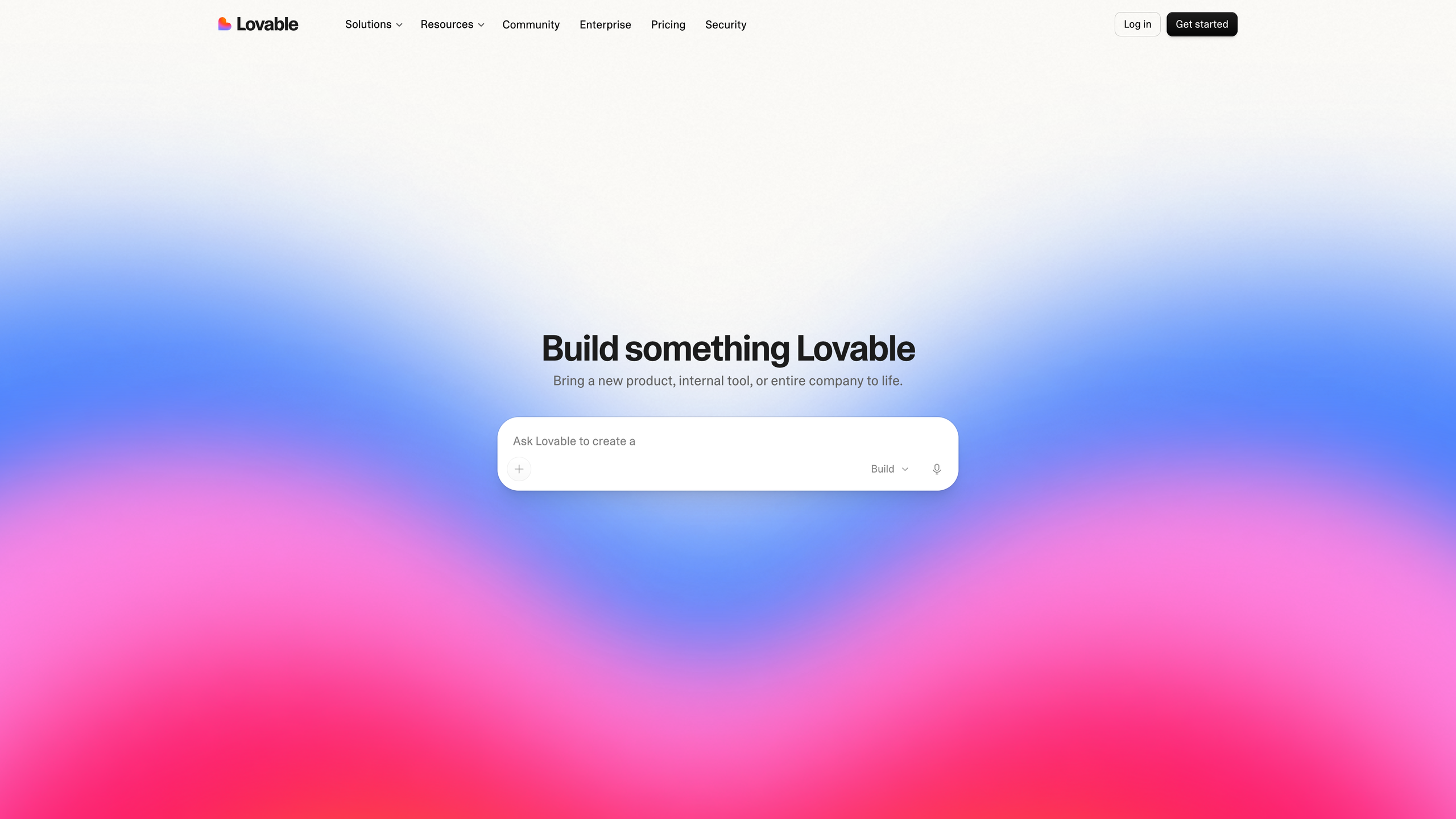
Lovable (lovable.dev) is an AI app-building platform run by Sweden's Lovable Labs and one of the flagship products of the "vibe coding" wave: you describe what you want in a chat box, and it generates a complete web application — frontend, database, authentication, and hosting — that can be published straight away. The problem it targets is letting people who can't code ship working software rather than static mockups. Its verifiable differences from most peers: the output is a standard Vite + React codebase that you own and can sync to your own Git repository, and the platform bundles hosting, backend, and payments infrastructure into a single credit-metered subscription. As of 2026-09-12, the homepage claims 1.2 million new projects per week, more than 60 million projects created in total, and roughly 900 million monthly visits to Lovable-built apps.
At a glance
- URL: https://lovable.dev
- Type: AI app builder (vibe coding) + hosting and built-in backend (Lovable Cloud)
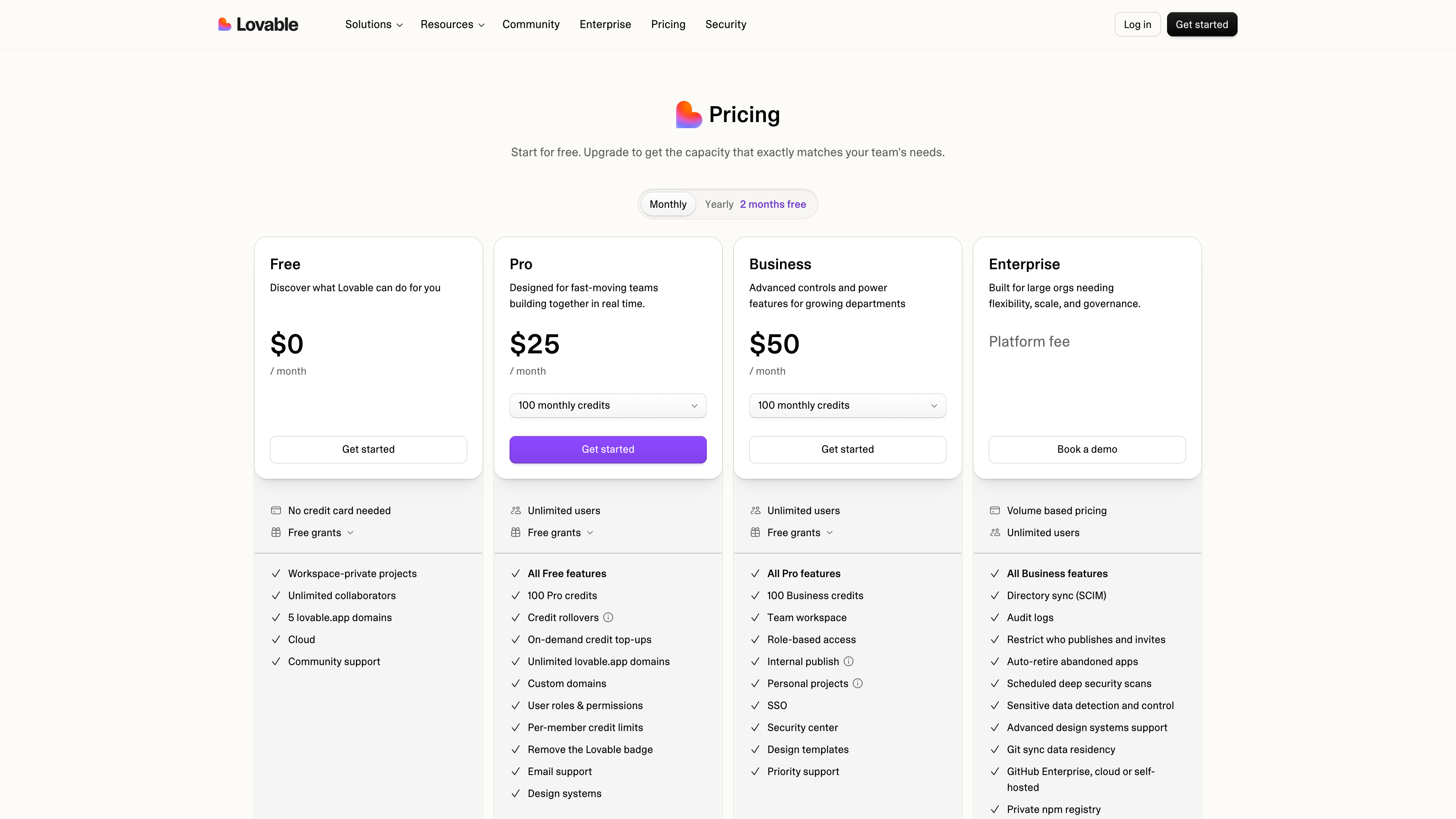
- Cost: Free plan at 25/month (100 monthly credits, 50/month; Enterprise priced as a platform fee plus usage — see the official pricing page (as of 2026-09-12)
- Account required: Browsing the site, docs, and template gallery needs no account; building requires sign-up (email, Google, GitHub, or Apple — you can also type a prompt on the homepage first and register when submitting). Users must be 18 or older, or have a parent/guardian's permission, per the Terms of Service
- Interface language: The editor and documentation are primarily in English; some marketing content is localized (e.g., Japanese). Prompts themselves can be written in any language
- Launched: November 2024 (per the company's own blog; previously GPT Engineer App)
Background
Lovable was founded in Stockholm by Anton Osika (CEO) and Fabian Hedin (CTO). It grew out of GPT Engineer, an open-source CLI for generating code from natural language that Osika released in 2023 (MIT-licensed, ~55k stars as of 2026-09-12, now archived, its README describing it as the precursor to Lovable). The two commercialized it as GPT Engineer App, renamed it Lovable, and opened it to the public in late 2024 (Wikipedia). Osika previously worked at CERN, Sana Labs, and YC-backed Depict.ai; Hedin's past work includes the interface of Stephen Hawking's computer (TechCrunch, Feb 2025).
The company's growth rate is why it keeps making headlines. Key milestones, all from first-hand reporting or official announcements:
- October 2024: €6.8M pre-seed led by Hummingbird Ventures and byFounders.
- February 2025: 17M ARR (TechCrunch).
- July 2025: 1.8B valuation led by Accel, eight months after launch — one of Europe's fastest unicorns; 2.3M active users, 180k paying subscribers, $75M ARR, and only 45 full-time employees (TechCrunch).
- December 2025: 6.6B valuation led by CapitalG and Menlo Ventures; ARR had passed 200M four months later (TechCrunch).
- February 2026: ARR reached $400M with 146 full-time employees (TechCrunch, Mar 2026).
- August 2026: 13.3B valuation, led by Menlo Ventures and co-led by the EQT-managed Scaleup Europe Fund, with Tencent, Balderton, and others participating. The company said employees at half of the Fortune 500 used Lovable within its first year — now nearly two-thirds — and that it plans to grow to roughly 450 people in 2026 (official announcement).
The contracting entity in the Terms of Service is a US company, Lovable Labs Incorporated (governed by Delaware law), while the Privacy Policy states its main establishment is Stockholm, Sweden, with Lovable Labs Sweden AB as the data controller in jurisdictions such as Brazil. One episode worth noting: in November 2025 the company was called out for not charging EU customers VAT; the CEO acknowledged it publicly and promised to fix it (TechCrunch).
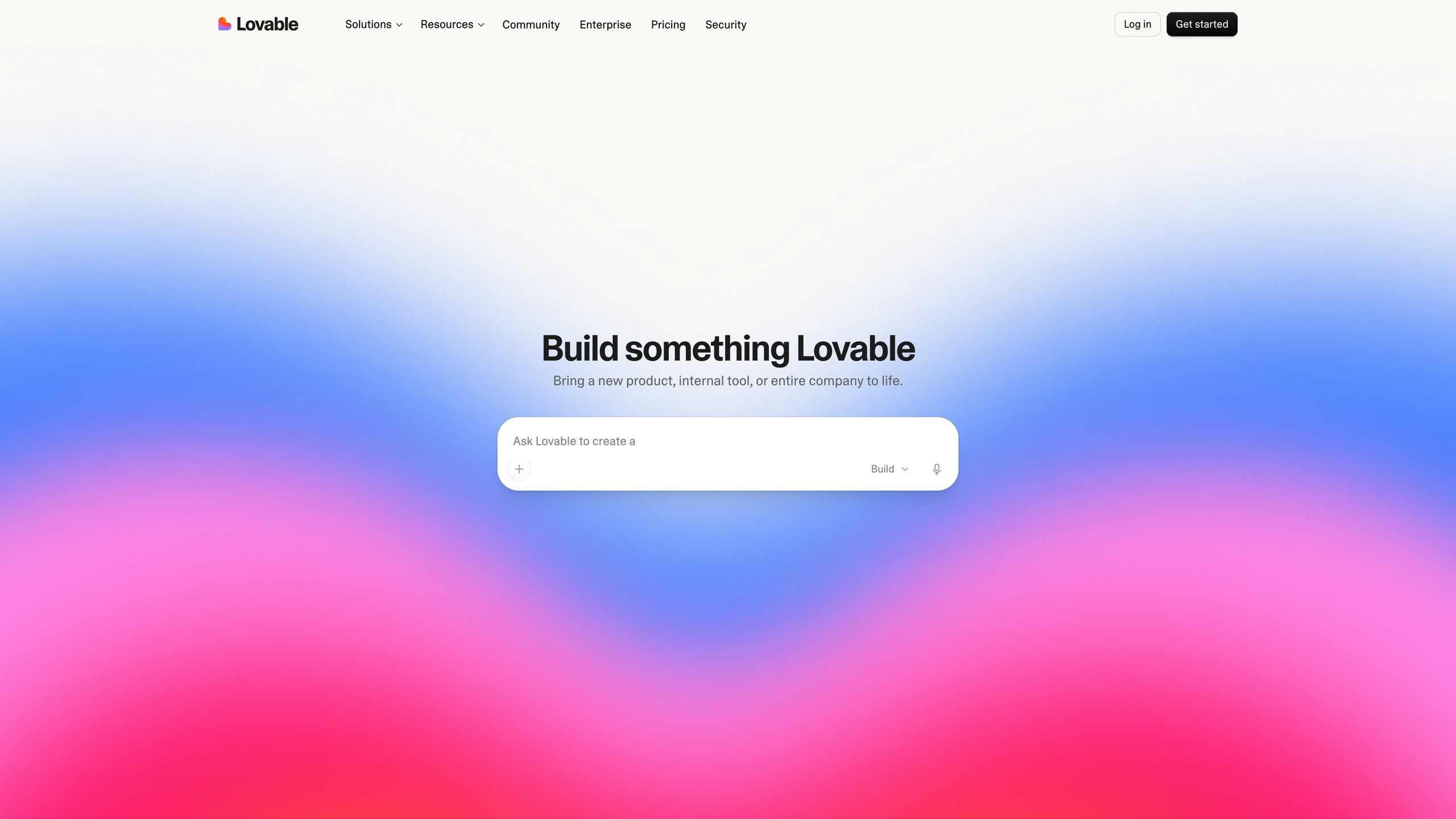
The homepage is the product in miniature: the central element of the page is a single prompt box — "Ask Lovable to create…".
Core capabilities: from one sentence to a live app
The basic workflow, per the official quick start:
- Describe what you want: write a prompt in any language, optionally attaching mockups or screenshots as visual references, or start by remixing a template.
- Generate and iterate: an AI agent writes real code and builds in real time; the editor shows the chat on the left and a live preview on the right. Small tweaks can be made by pointing at elements in the preview. Every step is saved as a restorable version. The chat has two modes: Plan mode for thinking through an approach (from 1 credit per message) and Build mode for direct code changes (priced by work done).
- Publish: one click deploys to a lovable.app subdomain (five included on the free plan). Paid plans add custom domains and remove the "Edit with Lovable" badge. Note that the live site is a snapshot — later changes go live only when you publish again.
Behind the app, Lovable bundles infrastructure that would otherwise require separate setup (Lovable Cloud docs):
- Built-in backend (Cloud): a managed backend on Supabase's open-source foundation — PostgreSQL database, user authentication (email, phone, Google/Apple/Microsoft, SAML SSO), file storage, edge functions, scheduled jobs, secrets, and logs, all configured through conversation. Alternatively, you can connect your own Supabase project. Hosting regions cover the Americas, Europe, and Asia Pacific, but cannot be changed after creation.
- Built-in AI (Lovable AI): add AI features to your app (chatbots, summarization, image generation) without obtaining model API keys yourself; usage is billed in credits.
- Security scanning: a built-in Basic scan (RLS policy linting, database schema review, dependency audits) and a Deep scan (agentic code review) run automatically before publishing, and neither scans nor one-click fixes consume credits. The platform holds SOC 2 Type II and ISO 27001 certifications (security docs).
- Other surfaces: beyond the browser there are desktop and mobile apps, Slack/Telegram/ChatGPT entry points, an MCP server, and the Lovable API.
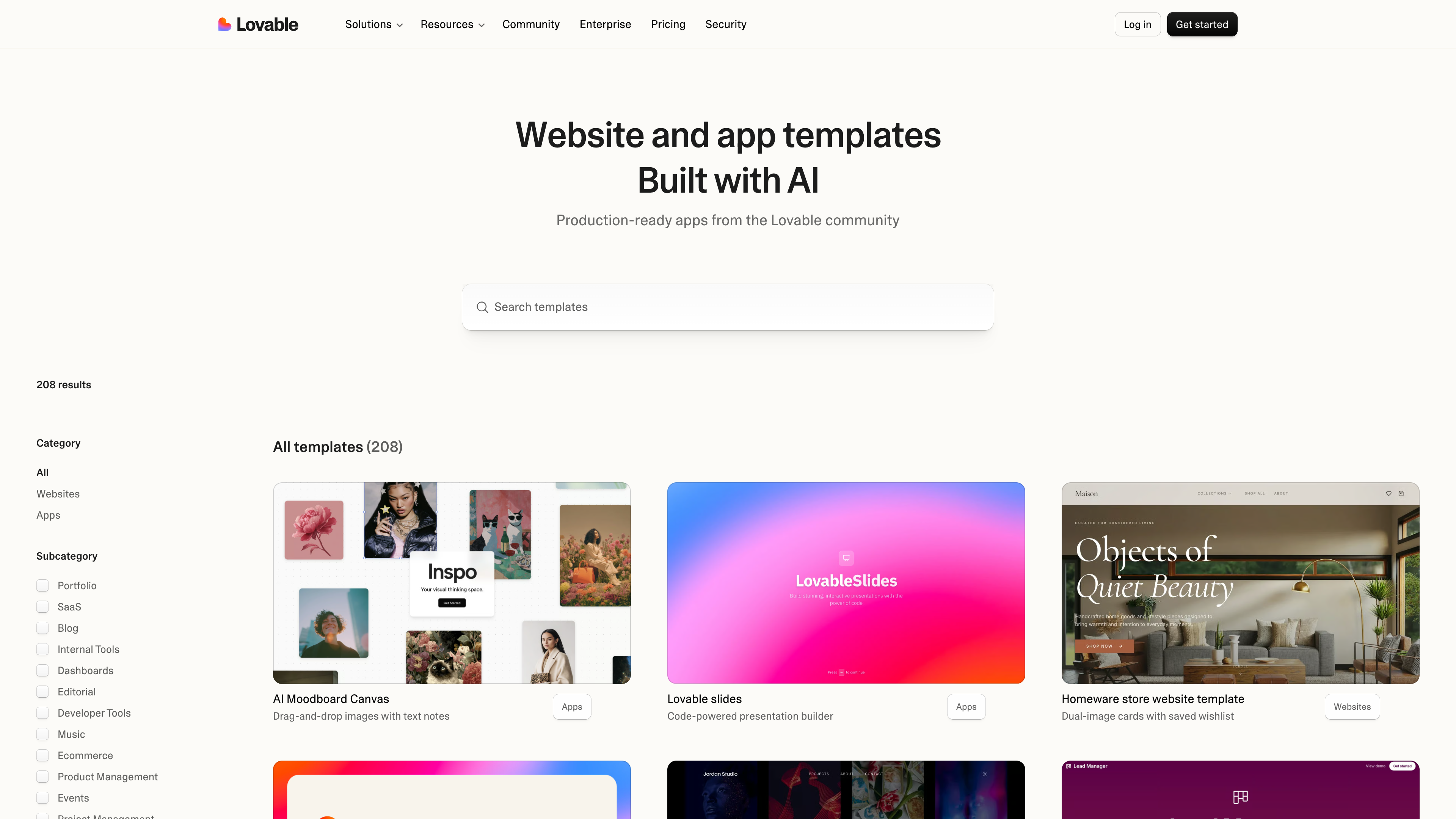
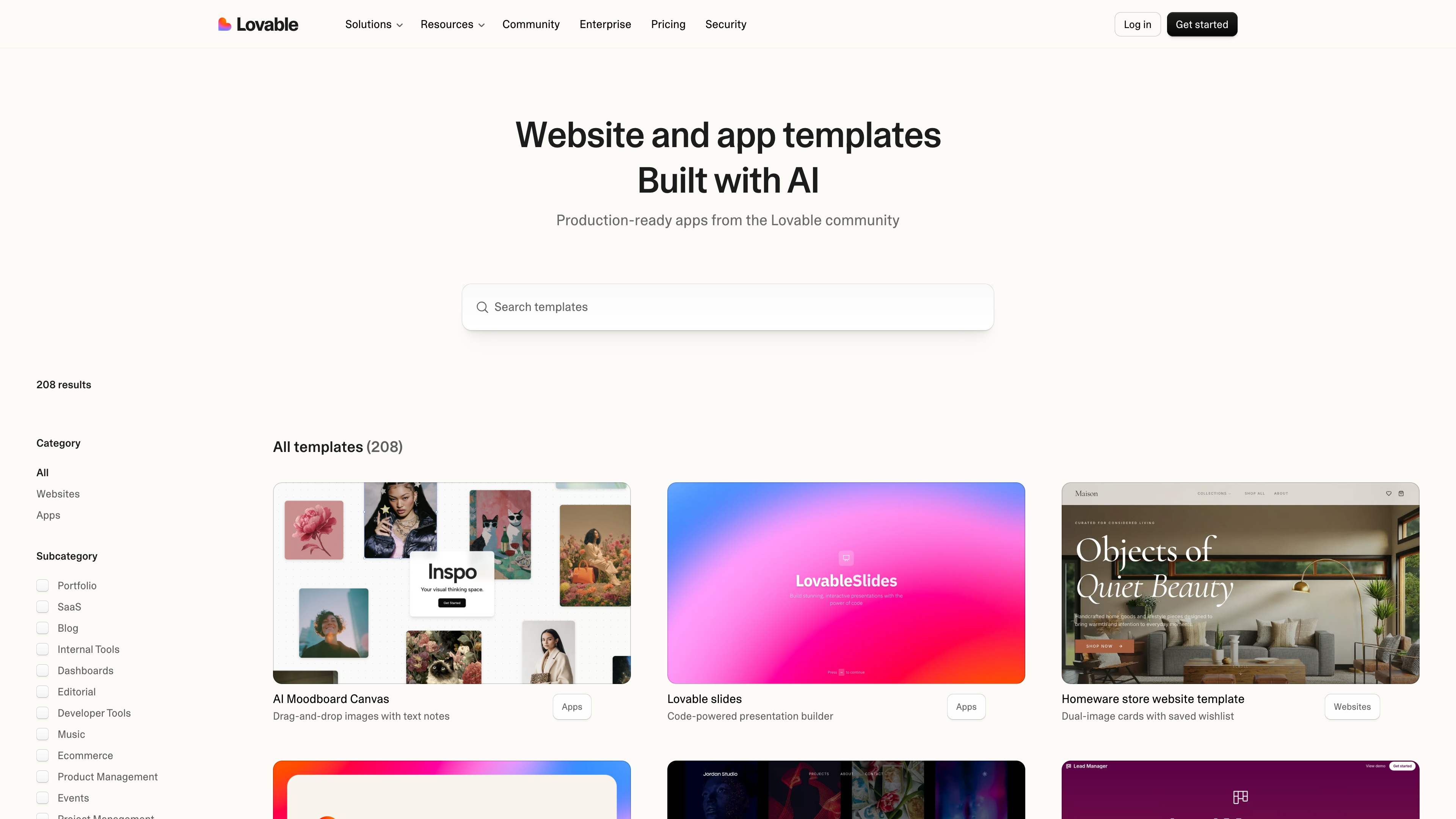
As of 2026-09-12, the public template gallery lists 208 templates, billed as "production-ready apps from the Lovable community"; anyone on any plan can remix a copy.
Openness and code ownership
For users who want the output inside a normal engineering workflow, Lovable documents several exit ramps (ownership & deployment docs, Git sync docs):
- You own the code: projects are standard Vite + React apps with no proprietary framework; paid plans can download the codebase directly.
- Git sync (all plans): two-way sync with your own GitHub, GitLab, or Bitbucket repository — edits in Lovable are committed automatically, and pushed commits flow back. Limitations: export only (you can't import an existing repository), one repository per project, one synced branch at a time.
- Data portability: database migration files travel with the code and data can be exported; migrating to managed or self-hosted Supabase is officially supported. But apps rely on Supabase-specific services (auth, storage, realtime), so moving to plain PostgreSQL means rebuilding equivalents yourself.
- Connector ecosystem: a built-in catalog covers Slack, Notion, HubSpot, Google Workspace, Stripe payments, and more; anything missing can be added as a custom REST API connector or a custom MCP server.
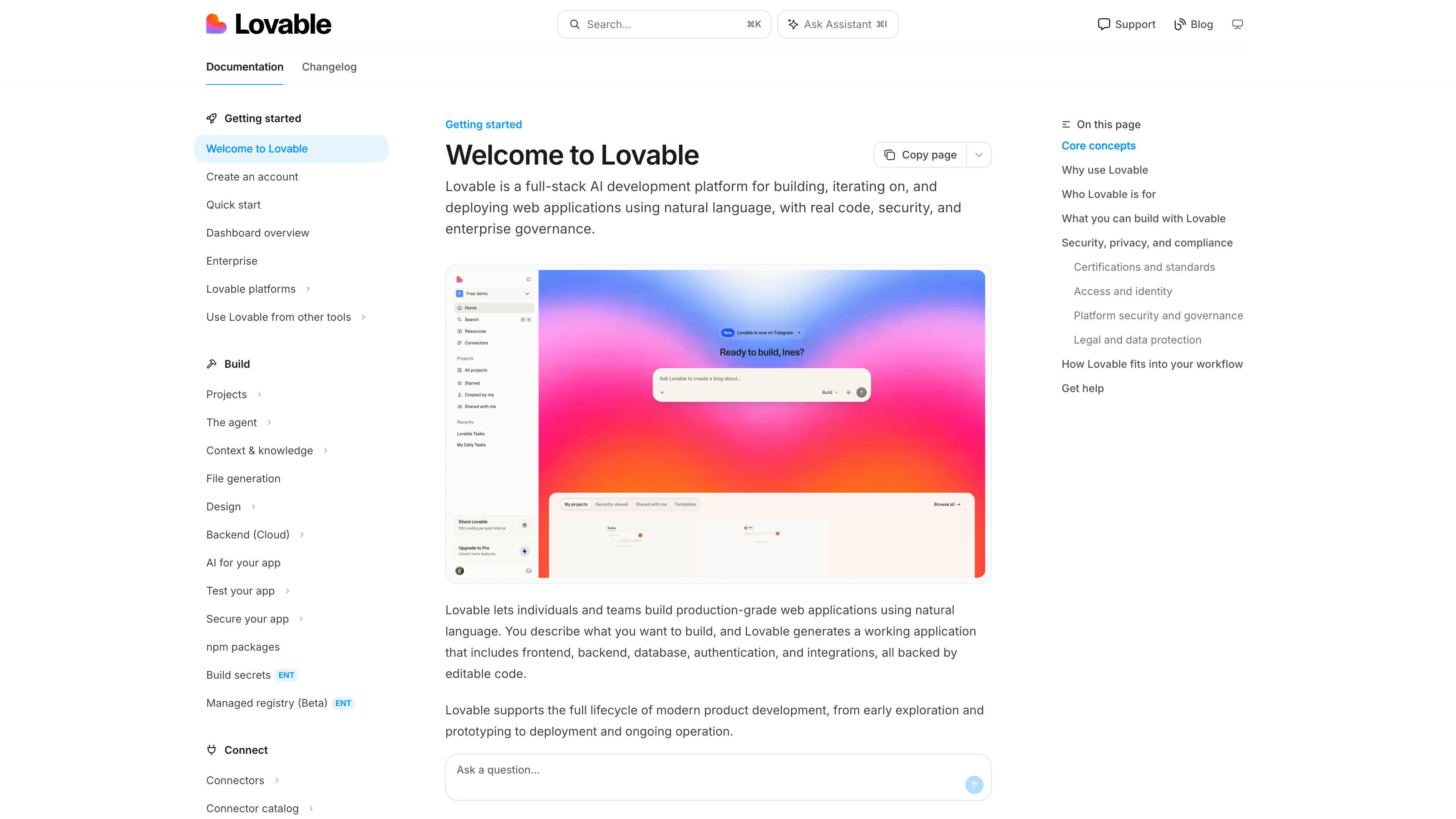
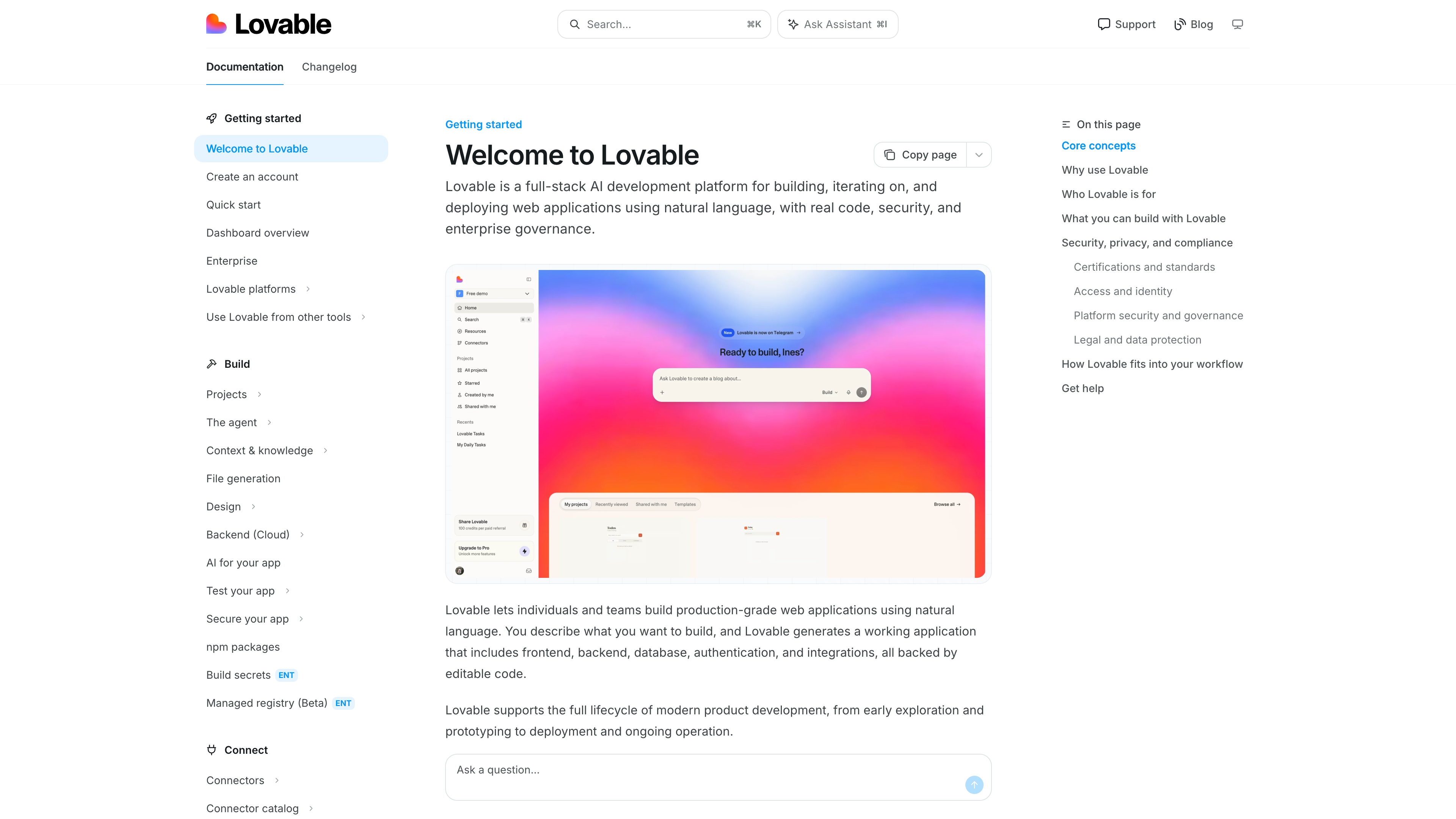
The documentation site (docs.lovable.dev) is genuinely detailed — quick start, credit-billing rules, and security best practices are all public without an account.
Pricing: everything metered in credits
Lovable doesn't charge per seat or per project; almost all usage draws from one credit balance (pricing page and credits docs, as of 2026-09-12):
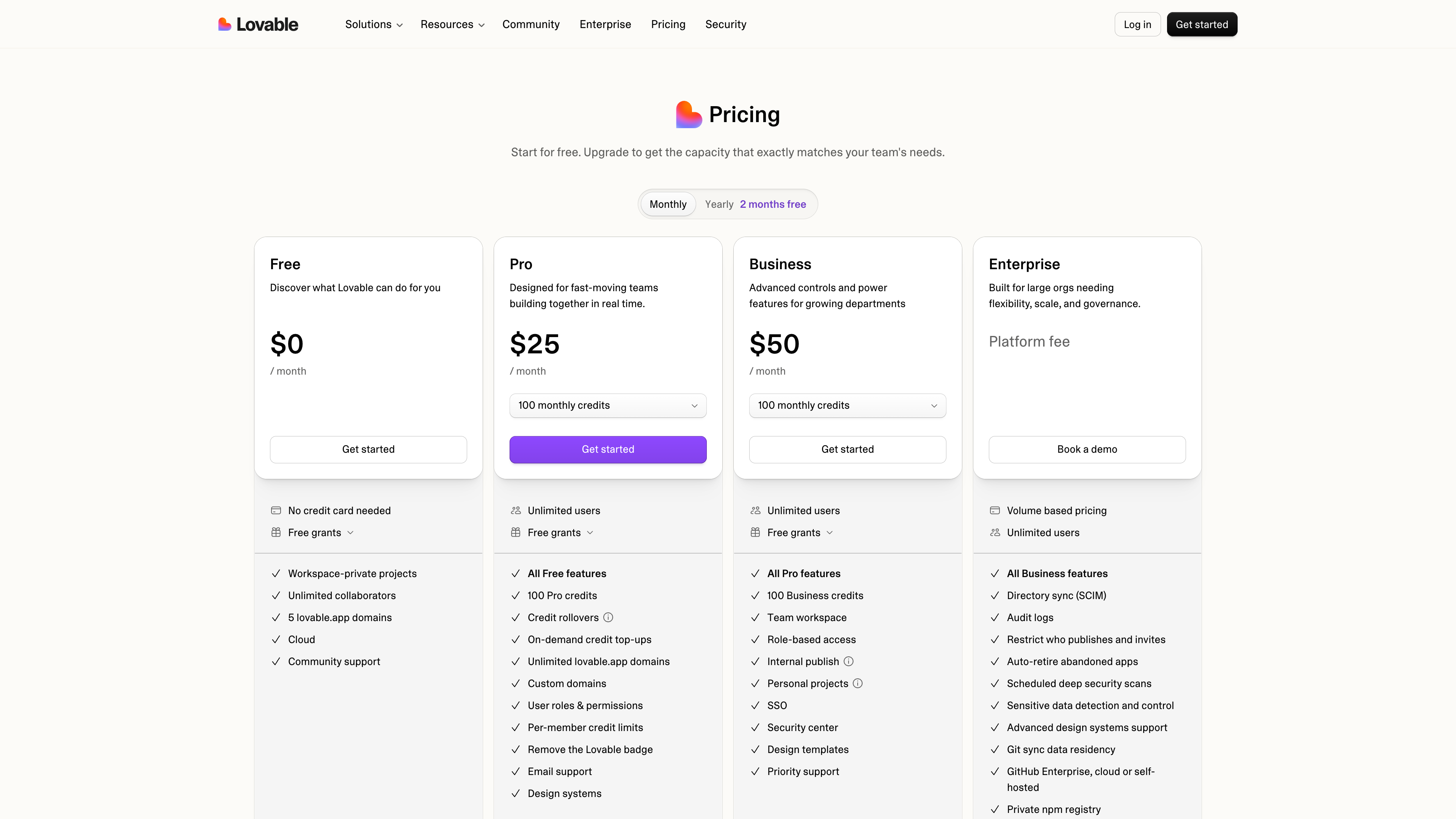
| Plan | Monthly price | Monthly credits | Key differences |
|---|---|---|---|
| Free | $0 | 5 build credits/day (capped at 30/month) | Workspace-private projects, unlimited collaborators, 5 lovable.app domains, Cloud included; no code editing/download, no custom domains, no rollover |
| Pro | from $25 | from 100 (up to 10,000 at $2,250/mo) | Edit and download code, custom domains, badge removal, credit rollover, top-ups ($15/50 credits), email support |
| Business | from $50 | from 100 (up to 10,000 at $4,300/mo) | Team workspace, role-based access, SSO, security center, internal publish, personal projects, priority support |
| Enterprise | platform fee + usage | contractual | SCIM, audit logs, scheduled security scans, publishing controls, GitHub Enterprise, private npm registry, custom SLA |
Annual billing knocks off roughly two months. Verified students and teachers get 50% off Pro for up to 12 months. The important part to understand is how credits burn: since 2026, building (Build), hosting and backend runtime (Cloud), and AI calls made by deployed apps (AI gateway) all draw from the same balance — restyling a button costs a fraction of a credit, adding authentication about 1.2 (official examples), while runtime costs scale with traffic. Monthly credits on monthly plans expire after two months and can roll over within that window; top-ups last 12 months; daily build credits expire the same day. At zero balance, building stops, app AI features fail, and the built-in backend pauses (data is retained, and published static pages stay online). Billing runs through Stripe, and the terms state subscriptions and credits are non-refundable in principle; downgrading to Free freezes unused subscription credits.
Ownership and content policy
For a platform built on AI-generated output, the terms deserve a careful read (Terms of Service, effective 2026-08-15; Privacy Policy, updated 2026-08-05):
- Ownership: you own your Customer Data (including the apps you build), and you own AI Output generated for you — subject to third-party rights in the underlying models and training data. Uniqueness is not guaranteed (similar prompts may yield similar output), nor is freedom from third-party claims.
- A broad license back to Lovable: users grant Lovable a worldwide, perpetual, royalty-free license to use Customer Data for its business purposes, including training AI/ML models. Anyone can opt out at no charge, honored prospectively; Business and Enterprise workspaces are excluded from training by default. De-identified or aggregated data may be used perpetually.
- AI output is your responsibility: the terms require you to review and test AI output, prohibit relying on it for high-risk uses (medical, legal, financial) without safeguards, forbid passing it off as human-generated where that could deceive or harm, and ban using the service to train competing models. Credits are consumed by work performed and are not refunded for erroneous output.
- Subdomains belong to Lovable: lovable.app subdomains remain Lovable's property and can be reclaimed without compensation; custom domains are unaffected.
- Privacy highlights: pseudonymized identifiers are shared with ad platforms such as Meta and Google (consent-based in Europe and Brazil; US users can opt out via the "Do Not Sell or Share" link or a GPC signal); data from messaging/collaboration integrations is not used for training; third-party model providers are contractually barred from training on customer content. The main establishment is in Sweden, and data is transferred internationally (including to the US) under mechanisms such as SCCs.
- Also of note: Delaware law governs disputes, with exclusive jurisdiction in Delaware courts, a jury-trial waiver, and individual-only claims; liability is capped at fees paid in the prior 12 months; a DMCA policy handles copyright complaints.
Where it fits
- Non-technical founders validating an idea: ship an MVP with sign-up, login, and payments for a $25/month subscription instead of a development team.
- Product, design, and ops teams prototyping: closer to the real thing than static mockups, with complete flows to demo — engineers can later take over through Git sync.
- Internal tools: teams build their own dashboards, approval flows, and operational utilities; the Business tier adds SSO, a security center, and internal publishing.
- Students and coursework: the free plan covers class-sized projects, with a 50% student discount on top.
- Developer scaffolding: generate a project skeleton with AI, sync it to your repository, and continue in your own IDE.
Limitations
- Everything burns credits: building, hosting, backend, and AI calls share one balance, so runtime costs for a popular app grow with traffic, and a zero balance pauses backend services. The free tier's 30 build credits per month are enough for evaluation, not real work.
- Inconsistent output quality is a category-wide trait: AI output can be wrong, and Lovable explicitly doesn't guarantee results; complex or highly customized products still need technical review. The terms put responsibility for AI output on the user.
- Stack lock-in: the frontend is fixed to Vite + React; the backend is tied to Supabase's stack, so moving to another database or plain PostgreSQL means rebuilding auth, storage, and similar layers; Git sync is export-only. The Lovable platform itself (editor and agent) cannot be self-hosted.
- A blemished security record: in May 2025, security researchers scanning 1,645 public Lovable-built apps found 170 exposing user data through misconfigured Supabase row-level security (CVE-2025-48757, reported by Semafor, corroborated via Wikipedia). Lovable has since added automated checks, but its own documentation stresses that scanning is no substitute for a full security review — apps handling sensitive data still warrant professional assessment.
- Hosting region is locked at creation, with no way to migrate an existing project between regions.
- Terms favor the platform: subscriptions and credits are non-refundable in principle; lovable.app subdomains can be reclaimed; disputes go to Delaware courts on an individual basis.
- No Chinese-language interface: the editor, docs, and support channels are English-first (prompts themselves may be written in Chinese).
Alternatives
- Bolt.new: StackBlitz's take on the same idea — AI-built full-stack apps in the browser, and the closest peer in positioning.
- v0: Vercel's AI generator, strongest on UI and frontend pages, deeply tied to the Next.js/Vercel deployment ecosystem.
- Replit: an online IDE at origin whose Agent feature covers similar "describe it, get an app" ground while keeping a full cloud development environment.
References
- Lovable homepage (checked 2026-09-12)
- Lovable pricing (checked 2026-09-12)
- Terms of Service - Lovable (effective 2026-08-15) (checked 2026-09-12)
- Privacy Policy - Lovable (updated 2026-08-05) (checked 2026-09-12)
- We just raised $400M in Series C funding - Lovable Blog (checked 2026-09-12)
- Welcome to Lovable - Lovable Documentation (checked 2026-09-12)
- Quick start - Lovable Documentation (checked 2026-09-12)
- Subscription plans - Lovable Documentation (checked 2026-09-12)
- Plans and credits - Lovable Documentation (checked 2026-09-12)
- Lovable Cloud - Lovable Documentation (checked 2026-09-12)
- Git sync - Lovable Documentation (checked 2026-09-12)
- Security overview - Lovable Documentation (checked 2026-09-12)
- Deployment, hosting, and ownership options - Lovable Documentation (checked 2026-09-12)
- Sweden's Lovable rakes in $15M after spectacular growth - TechCrunch (checked 2026-09-12)
- Lovable becomes a unicorn with $200M Series A - TechCrunch (checked 2026-09-12)
- Vibe-coding startup Lovable raises 6.6B valuation - TechCrunch (checked 2026-09-12)
- Lovable says it added $100M in revenue last month alone - TechCrunch (checked 2026-09-12)
- Lovable (company) - Wikipedia (checked 2026-09-12)
- The hottest new vibe coding startup may be a sitting duck for hackers - Semafor (checked 2026-09-12)
- AntonOsika/gpt-engineer - GitHub (checked 2026-09-12)