Logseq (logseq.com) is an open-source, privacy-first outlining and knowledge-management tool, self-described as "a privacy-first, open-source platform for knowledge management and collaboration." Everything you write is a collapsible block in an outliner, with [[bidirectional links]], block references, daily journals, task management, spaced-repetition flashcards, and PDF annotation built in. Notes live as plain-text Markdown or Org-mode files on the user's own device, with no cloud account required. The most verifiable differences from similar tools: the entire codebase is AGPL-3.0 open source (GitHub repository), and the project names Roam Research, Org Mode, TiddlyWiki, and Workflowy as its inspirations (README).
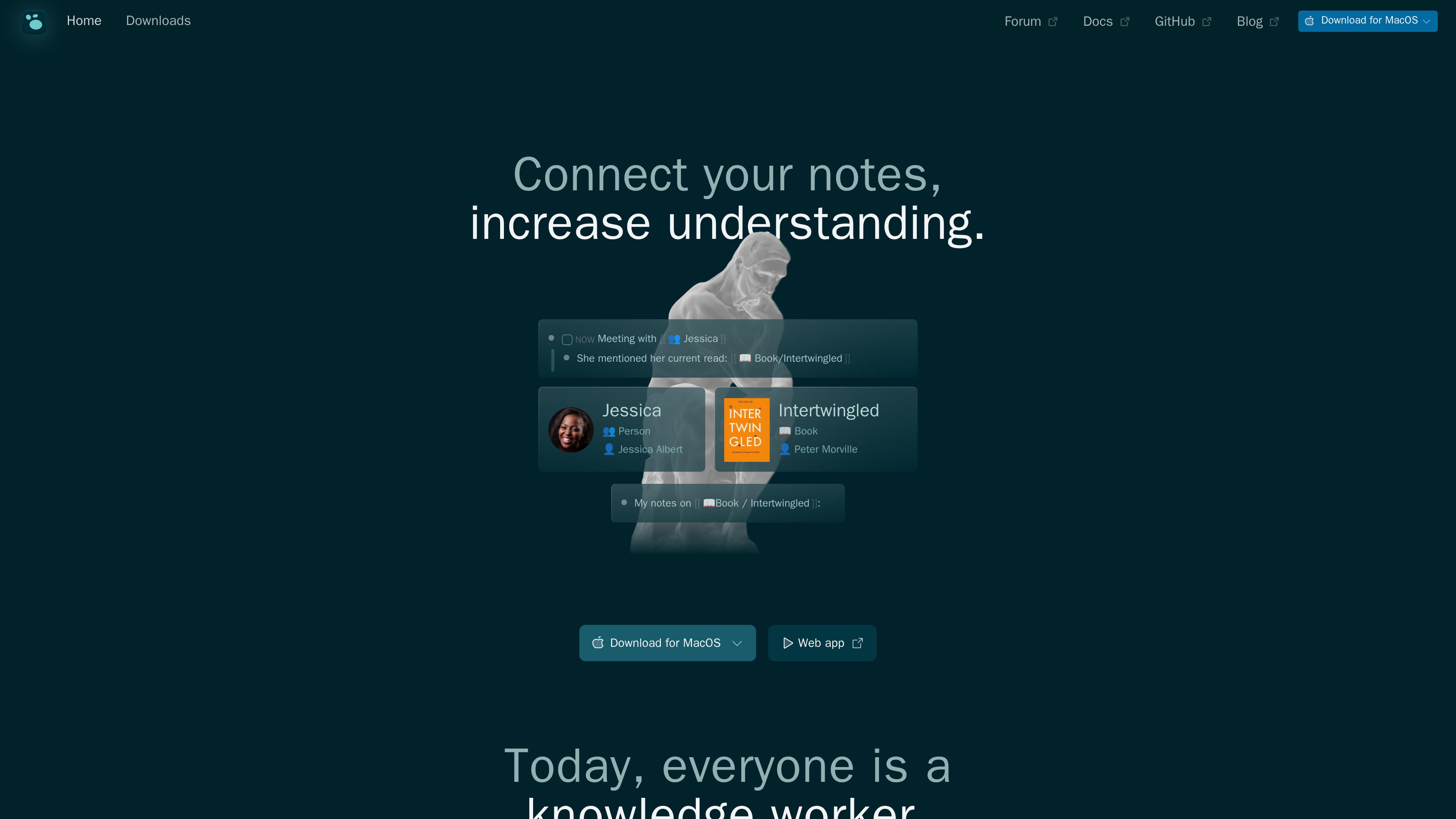
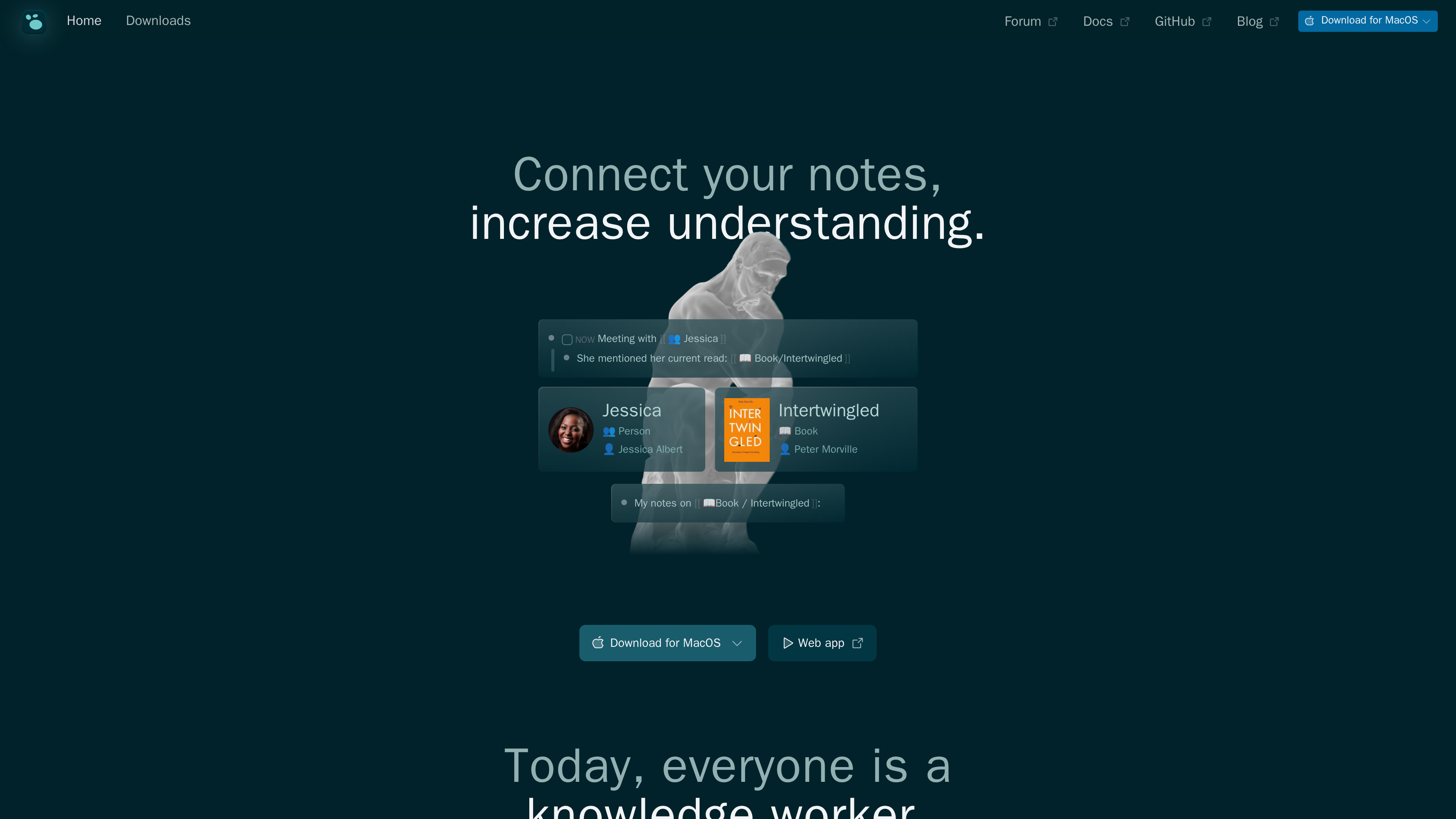
The screenshot above shows the Logseq homepage: the hero headline "Connect your notes, increase understanding." sits above a live-style demo in which an outline block links a meeting note to person and book pages via [[ ]]. The header offers a macOS desktop download and a link to the web app.
At a Glance
| Item | Details |
|---|---|
| URL | https://logseq.com/ |
| Type | Open-source outliner / personal knowledge management (PKM) |
| Cost | The app is free and open source (AGPL-3.0) — "Free forever for personal use" per the homepage; the official Logseq Sync service is an optional paid extra (see "Pricing and Sync") |
| Sign-up | No account needed for local use; an account is only required for cloud features such as the official sync (Sync docs) |
| Platforms | Windows, macOS, Linux desktops; iOS (App Store) and Android (APK); web app at app.logseq.com |
| UI languages | English source strings plus community translations for about 24 languages, including Simplified and Traditional Chinese (translation dictionaries, as of 2026-10-01) |
| License | AGPL-3.0 (LICENSE.md) |
Background
- The project was started by Tienson Qin (based in Hangzhou); the GitHub repository was created on May 23, 2020. The operating entity is Logseq, Inc., a Delaware corporation (Terms of Use).
- According to a May 2022 TechCrunch report, Logseq raised a $4.1 million seed round led by Stripe CEO Patrick Collison, Shopify CEO Tobias Lütke, and former GitHub CEO Nat Friedman, with Day One Ventures, Craft Ventures, Matrix Partners, and Andreessen Horowitz participating (TechCrunch).
- The project also runs on community donations: its Open Collective page shows roughly 12,000 backers and about $245k in yearly income, with public expenses (Open Collective, as of 2026-10-01).
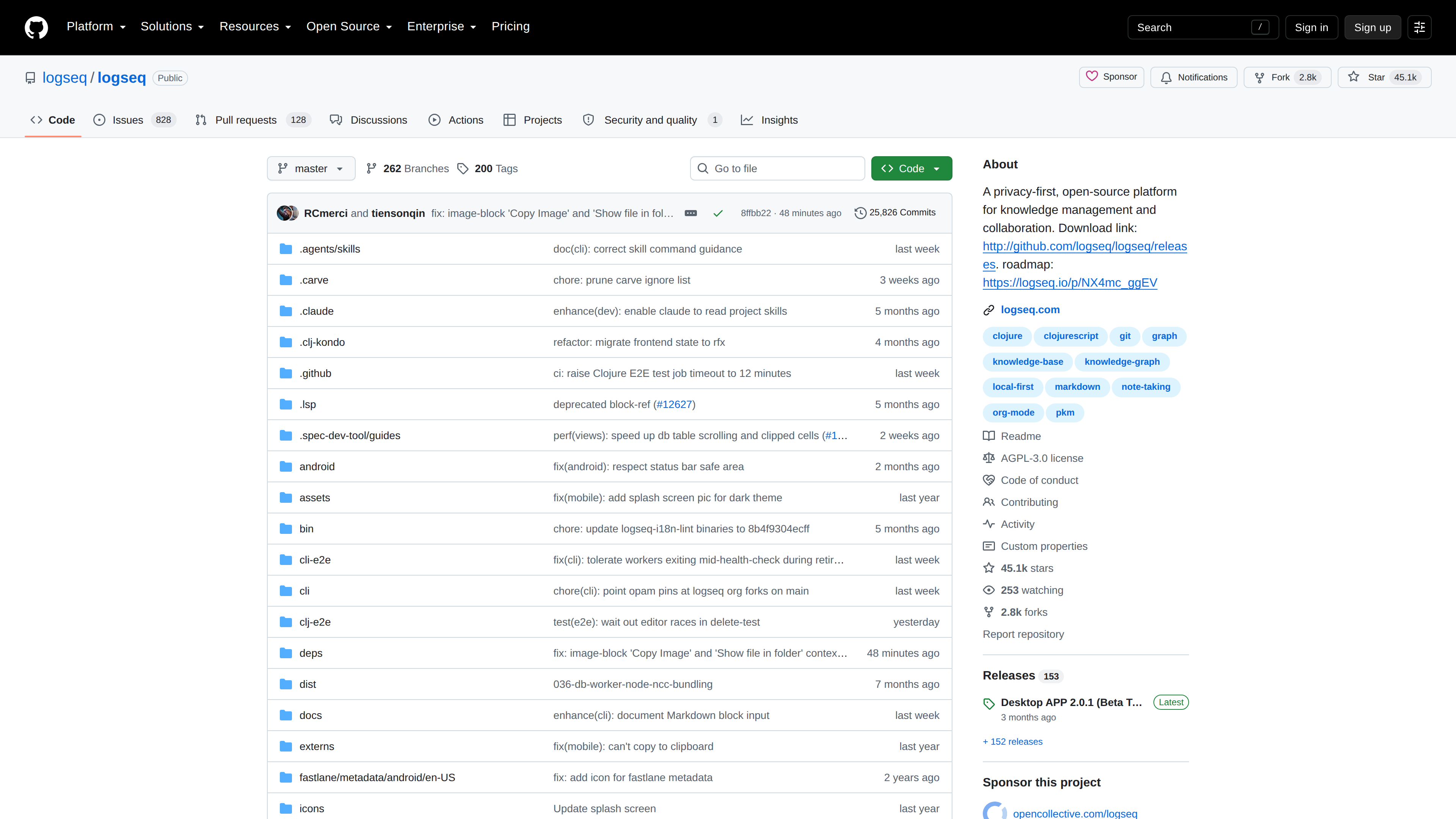
- Development is active: as of 2026-10-01 the repository has about 45.1k stars and 2.8k forks, is written mainly in Clojure/ClojureScript, and received commits on the day of review.
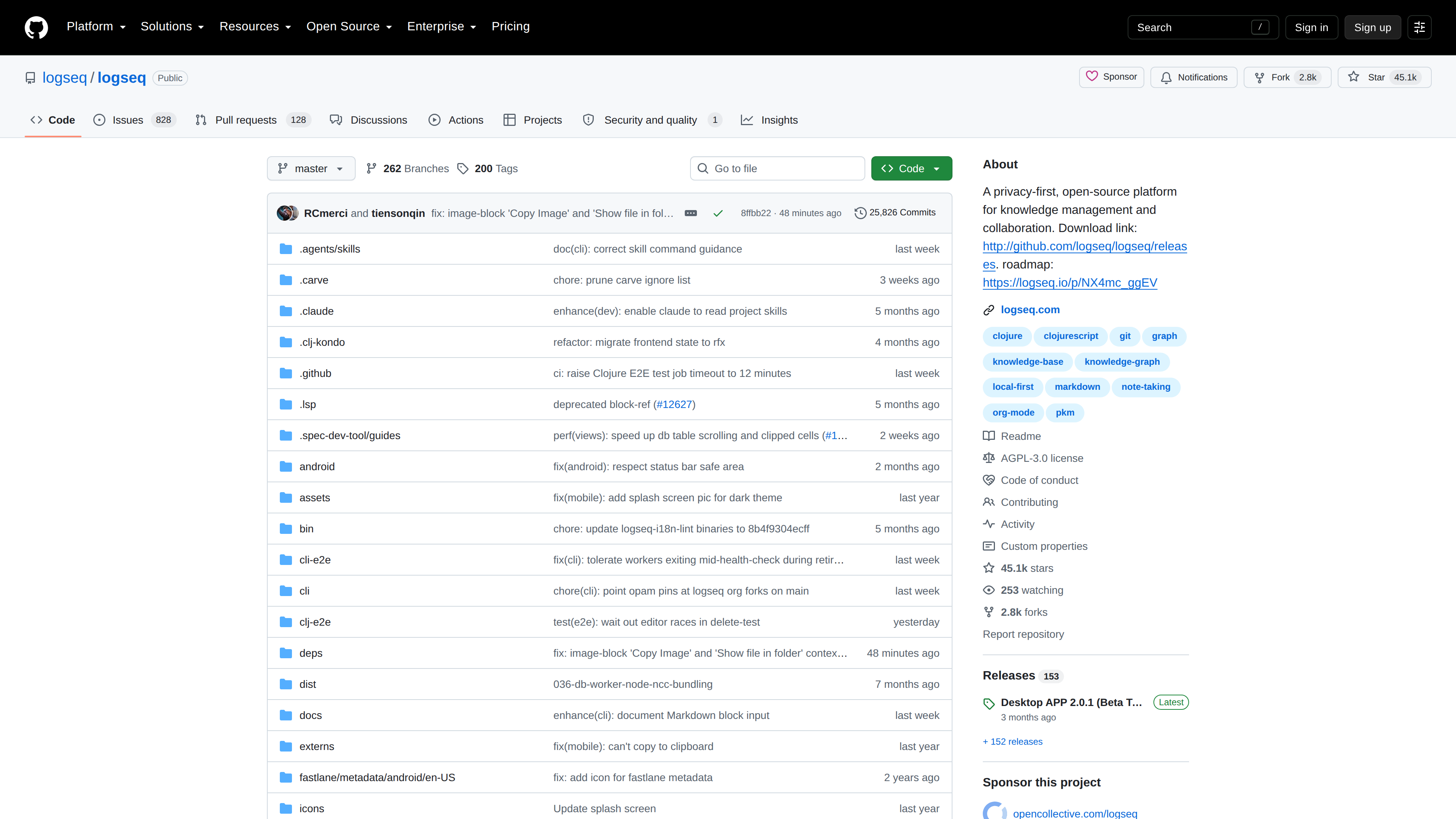
The screenshot above shows the GitHub repository: the About sidebar lists the AGPL-3.0 license, 45.1k stars and 2.8k forks, and "Desktop APP 2.0.1 (Beta)" as the latest release; the file listing shows commits from hours earlier.
Core Capabilities: Outlines, Links, and an Extension Ecosystem
- Outliner editing: every piece of content is an indentable, collapsible block; blocks can be
((referenced)), embedded, or reused across pages, with edits reflected everywhere. - Bidirectional links and queries:
[[page links]]automatically generate backlinks (Linked References); simple queries and Datalog-based advanced queries aggregate content by properties, task state, and more. - Journals and workflows: the app opens to a daily Journals page; task management (TODO/DOING, scheduling, deadlines), spaced-repetition flashcards, PDF reading with highlight annotation, and whiteboards are built in.
- Plugins and themes: a documented plugin API (developer docs) and an official marketplace whose live catalog lists roughly 480 plugins and themes (Marketplace catalog, as of 2026-10-01); desktop users install add-ons from within the app.
- Publishing and export: graphs can be published as static websites (Logseq Publish — the official documentation site is itself a published Logseq graph), and pages or whole graphs can be exported.
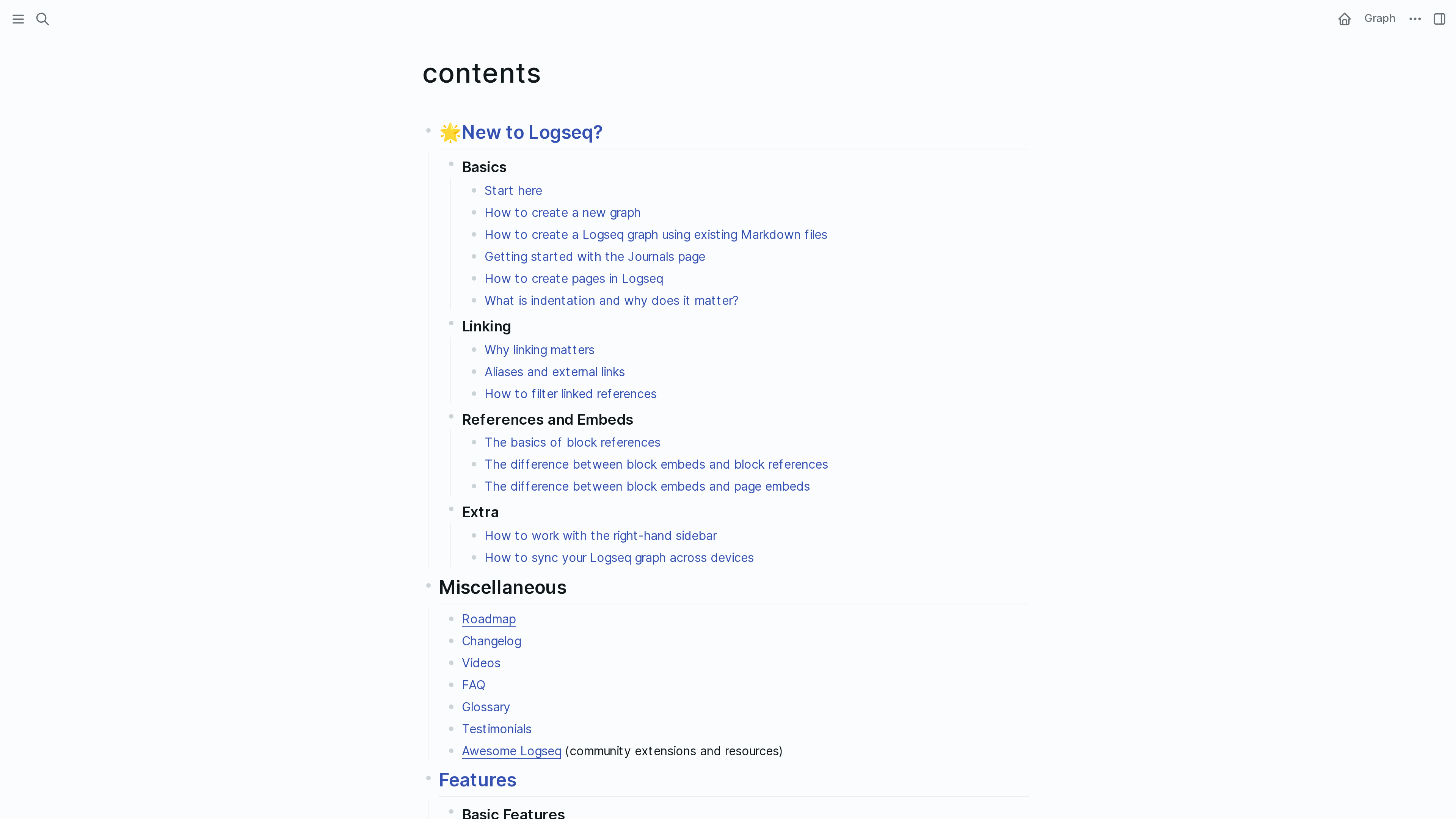
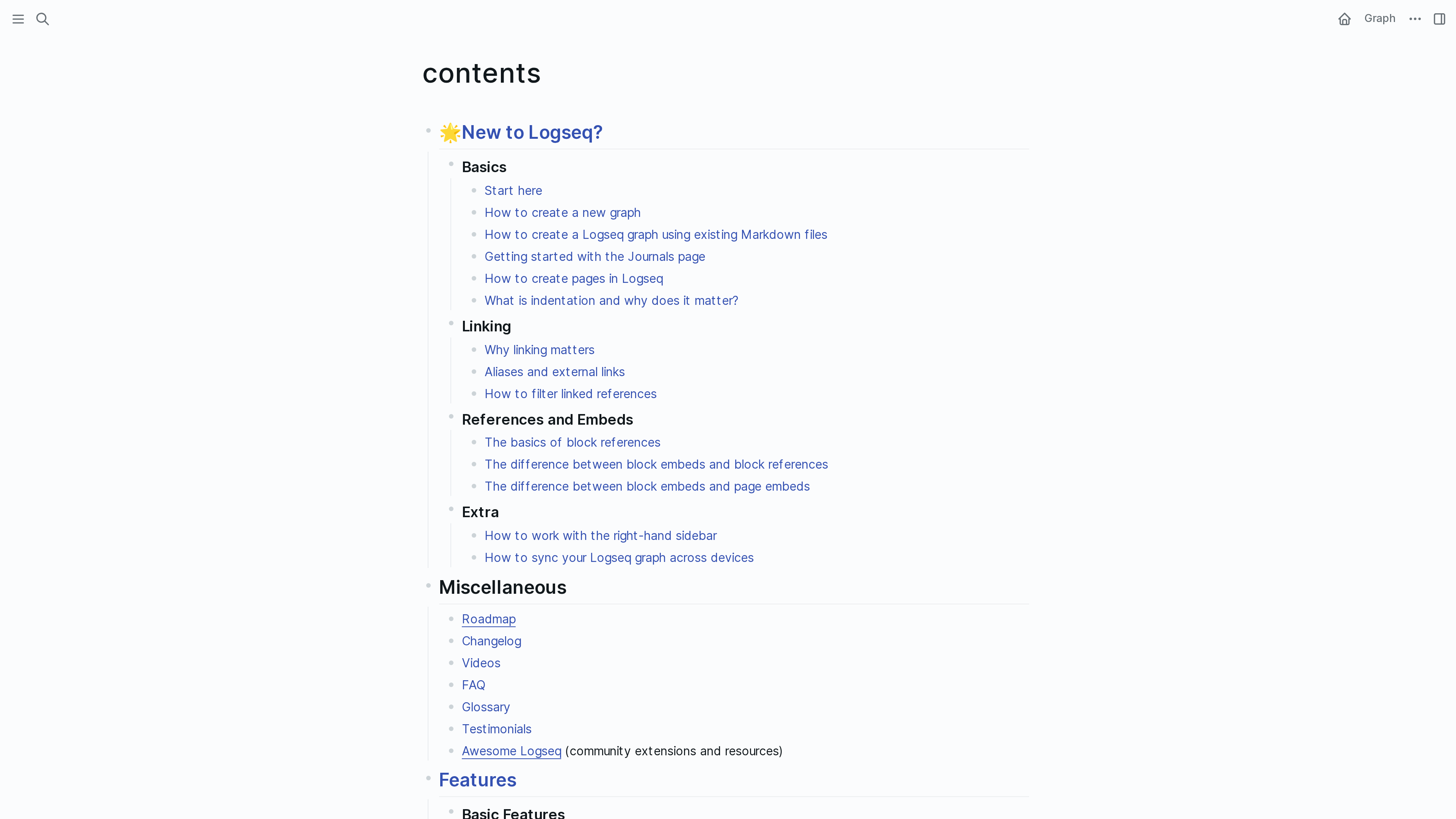
The screenshot above shows docs.logseq.com: the entire site is a publicly published Logseq graph, so it doubles as a real-world demo of collapsible outlines and [[link]] navigation — and of the static-site publishing feature.
Data Storage and Privacy
- Local-first: notes are plain-text files (Markdown or Org-mode) in a local folder. The official FAQ states that the whole app, including planned advanced features, "will be open-sourced forever," and explains that the local-first architecture exists for privacy and performance — only sync and collaboration require servers (FAQ).
- Bring your own sync: because data is ordinary files, users can sync with iCloud, Syncthing, Git, and similar tools (the docs warn against combining these with Logseq Sync).
- Privacy policy caveat: the privacy policy page at logseq.com/privacy failed to render its content when checked on 2026-10-01, so this profile makes no claims about its specific terms; the statements above rest on the app's architecture and official documentation.
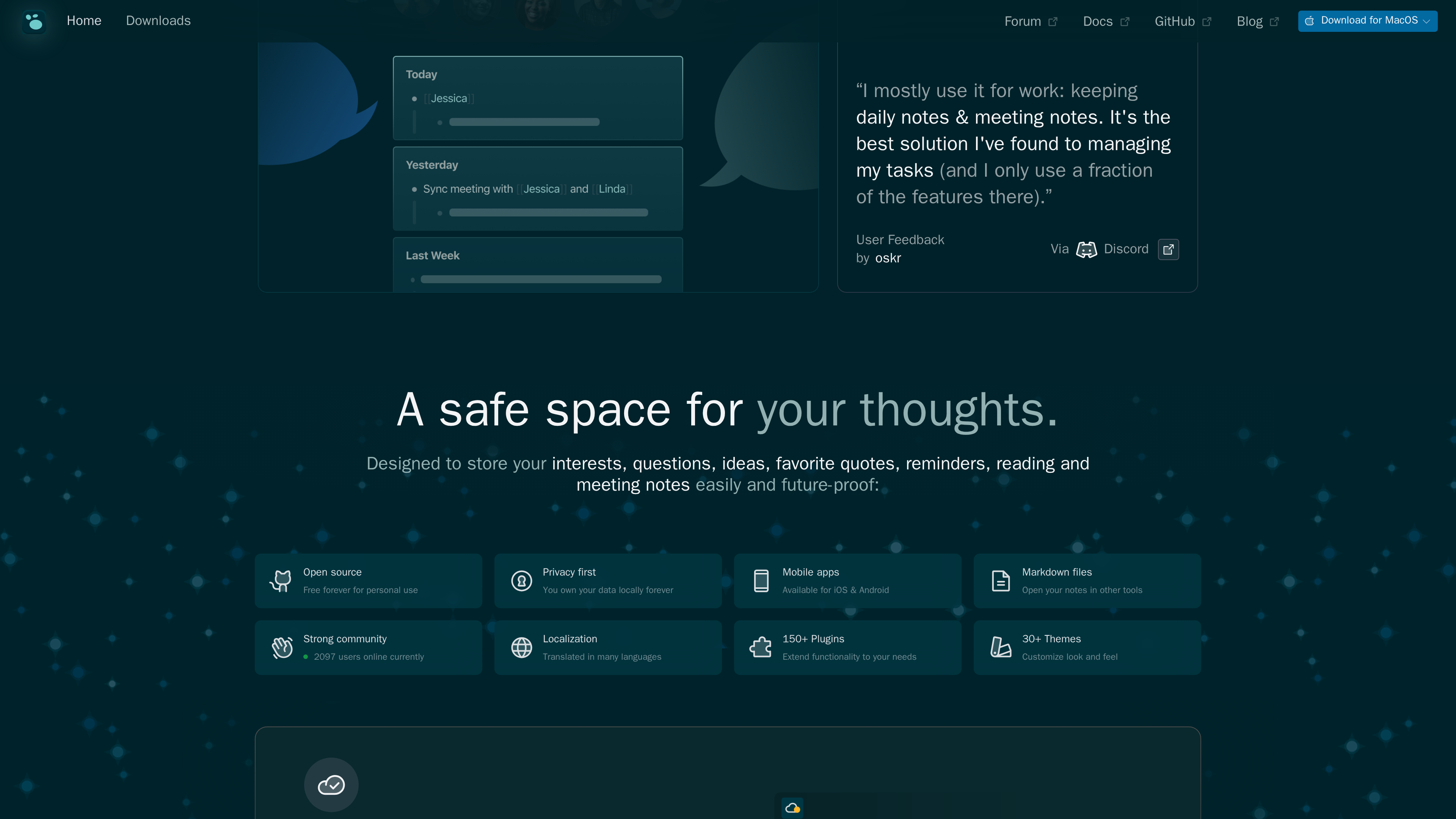
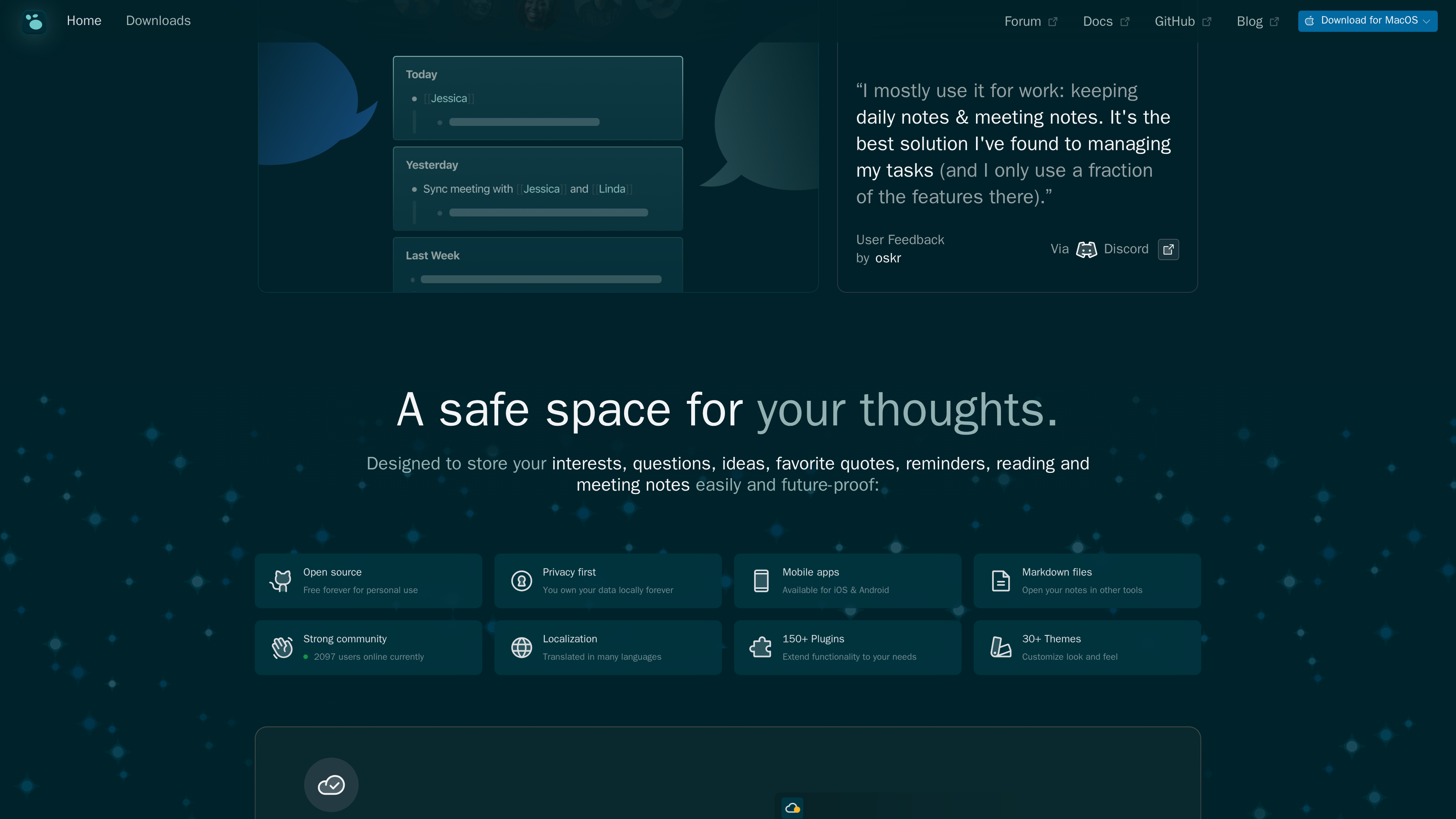
The screenshot above shows the homepage feature grid — open source ("free forever for personal use"), privacy first ("you own your data locally forever"), mobile apps, Markdown files, community, localization, plugins, and themes — which summarizes the project's own positioning. Note that the "150+ Plugins / 30+ Themes" figures are long-standing homepage copy and differ from the live marketplace catalog (about 480 entries, themes included).
Pricing and Sync
- The app itself: free and open source, with a homepage promise of "free forever for personal use" (homepage).
- Logseq Sync (file-graph version): the official end-to-end-encrypted sync (built on age encryption, encrypting file contents and names), syncing up to 10 graphs across desktop, Android, and iOS. As of 2026-10-01 it is in beta and available to active Open Collective contributors at 15 per month (Sync docs).
- Database-version sync (RTC): the DB version's new sync supports real-time, Google-Docs-style collaboration. The official docs label it a paid feature currently open by invitation only, with a self-hosting option for the sync server (DB version docs).
- Donations: recurring support via Open Collective.
Two Product Lines: Logseq OG and the Database Version
On April 24, 2026, the team announced that Logseq is splitting into two products (official announcement):
- Logseq OG: the familiar file-based graph (Markdown files), moved to github.com/logseq/og. It will keep receiving security and Electron upgrades but no new features; existing users are not forced to migrate.
- Logseq (database version, "DB version"): the main line going forward. Notes move from plain-text files into a local database (SQLite), promising better performance, sync, and real-time collaboration. The first public beta, 2.0.1, shipped on July 13, 2026 (release notes); the public roadmap lists the status as "Beta testing" (roadmap).
Notable DB-version changes (official changelog): pages and blocks are unified as "nodes," the property and tag systems are rebuilt, and tasks and flashcards are re-implemented; only Markdown is supported — Org-mode is dropped; slides, whiteboards, Excalidraw, and the Zotero integration are no longer built in. The team warns that data loss is possible during the beta and recommends automated backups. The DB version's new iOS app is in invite-only alpha, and the new Android app had not opened for testing as of 2026-10-01.
Who It's For
- Writers, students, and researchers who think in outlines and want to build knowledge bottom-up through linked notes.
- Users who care about data ownership and portability — notes remain local plain text that any other tool can read.
- People who want journaling, tasks, PDF reading notes, and spaced repetition in a single tool.
- Developers and power users who can exploit the plugin API, Datalog queries, and Git-based versioning for custom workflows.
Limitations
- Paid, gated sync: local use is free, but the official sync is limited to donors or invitees; free alternatives (iCloud/Syncthing/Git) require manual setup and must not be combined with Logseq Sync (docs).
- Mobile trails desktop: the mobile apps cover only most of the desktop feature set, and the DB version's new mobile apps remain in alpha or closed testing (README, as of 2026-10-01).
- Transition-period uncertainty: the 0.x file version no longer gets new features, while the DB version is still beta with an explicit data-loss warning — and it drops Org-mode and several built-in features, so migration has a cost.
- Learning curve: the outliner-block model and query syntax take adjustment for users accustomed to document-style note apps.
Comparable Tools
- Roam Research: the pioneer of linked outliner notes that Logseq cites as inspiration; Roam is a closed-source, subscription web app.
- Obsidian: also built around local Markdown files; the verifiable differences are that Obsidian is closed-source commercial software organized around documents, while Logseq is AGPL-3.0 open source organized around outline blocks.
References
- Logseq homepage and official documentation (checked 2026-10-01)
- GitHub repository logseq/logseq, LICENSE.md, Releases (checked 2026-10-01)
- Official announcement: Big update: Logseq is splitting into two versions (2026-04-24)
- DB version feature docs and DB version changes
- TechCrunch: Logseq is helping rethink knowledge management (2022-05-05)
- Open Collective: Logseq (checked 2026-10-01)