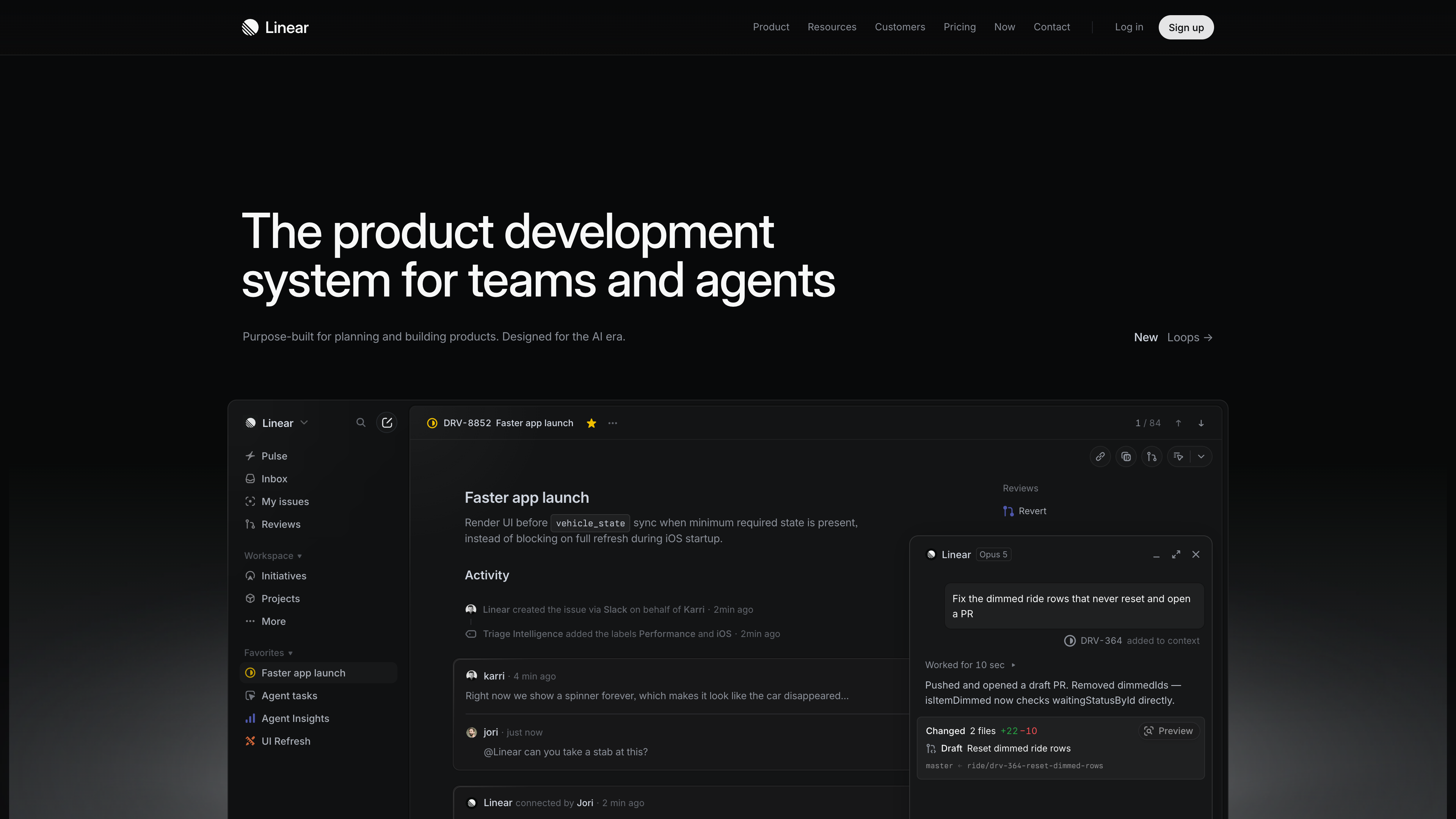
Linear (linear.app) is a cloud-based product development system from Linear Orbit, Inc., a San Francisco company. At its core it gives software teams issue tracking and iteration planning: work is captured as Issues inside a workspace, grouped into time-boxed Cycles, and rolled up into cross-team Projects and Initiatives. It exists because incumbent project management tools — Jira being the canonical example — are widely criticized as slow and bloated. Linear's verifiable differences: interface speed and keyboard operation as first-order design goals (a ⌘K command menu plus dozens of single-key shortcuts), a deliberately small, fixed set of concepts instead of unlimited customization, and, since 2025, AI agents as first-class workspace members that can be assigned and delegated work like colleagues. As of August 2026, the company says more than 40,000 businesses pay for Linear.
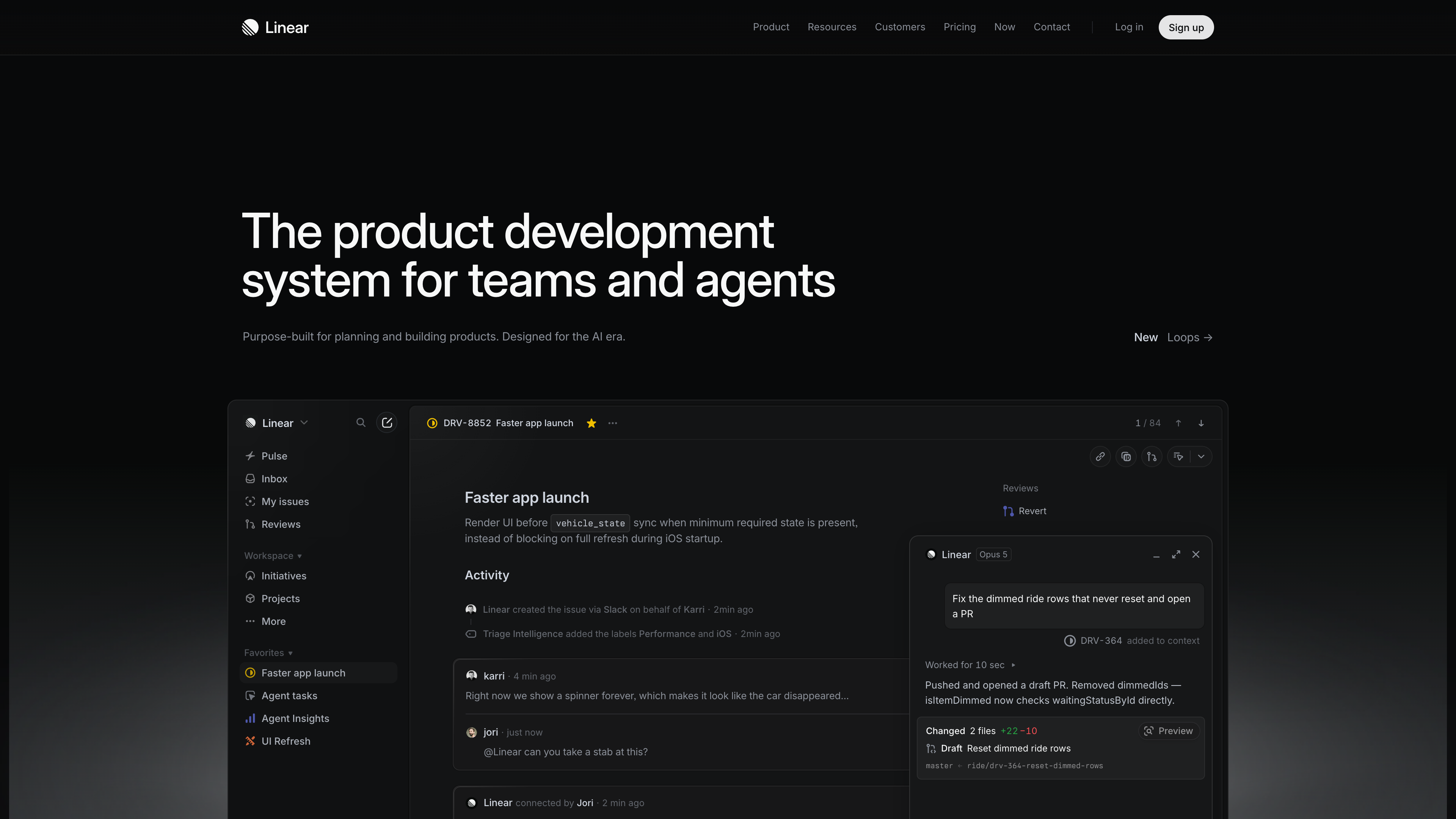
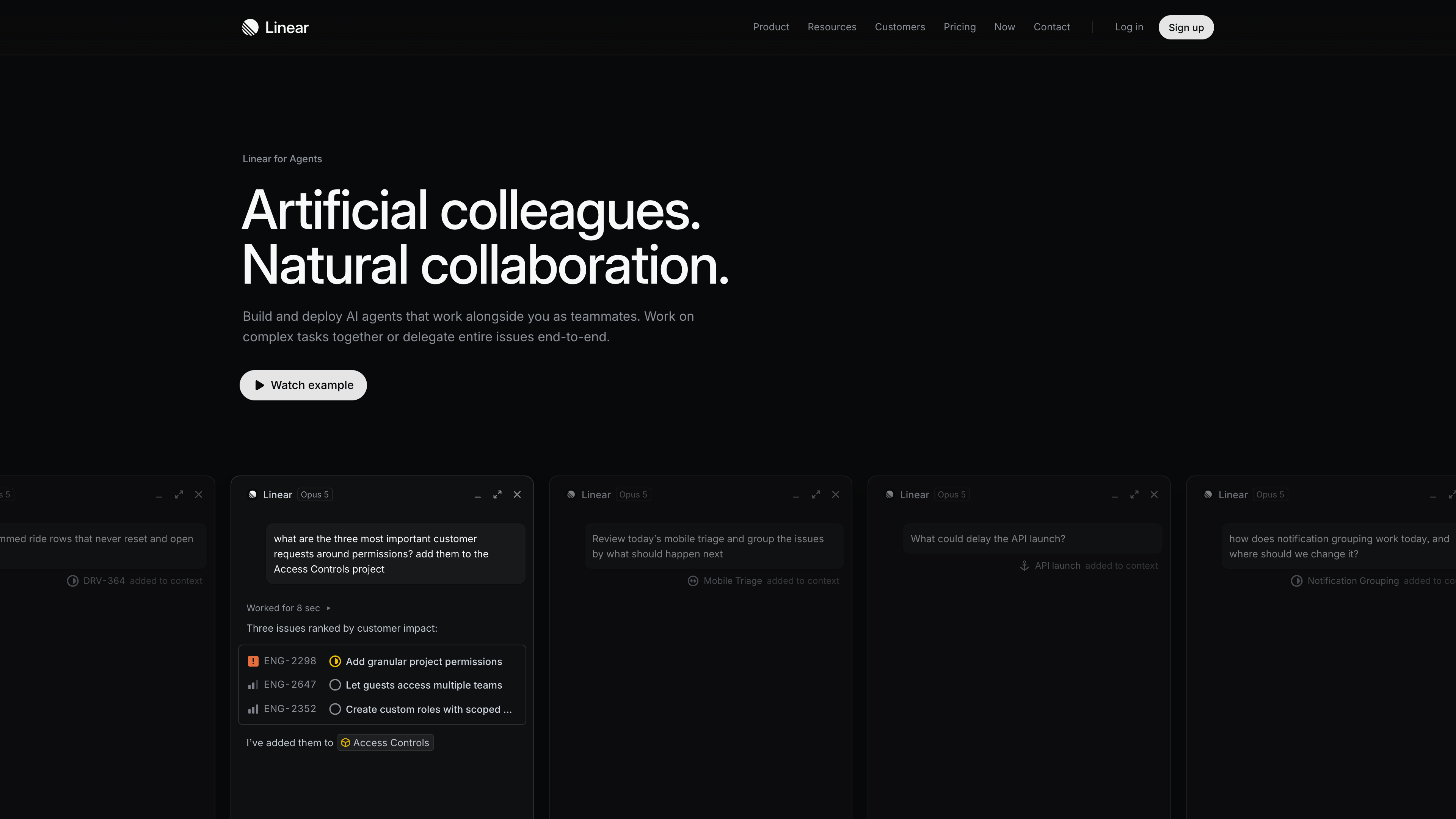
The homepage above states Linear's current positioning directly — a product development system "for teams and agents" — and the hero mockup already shows an agent participating in an issue's workflow as a workspace member.
At a glance
- URL: https://linear.app
- Type: Cloud issue tracking + product development SaaS (B2B)
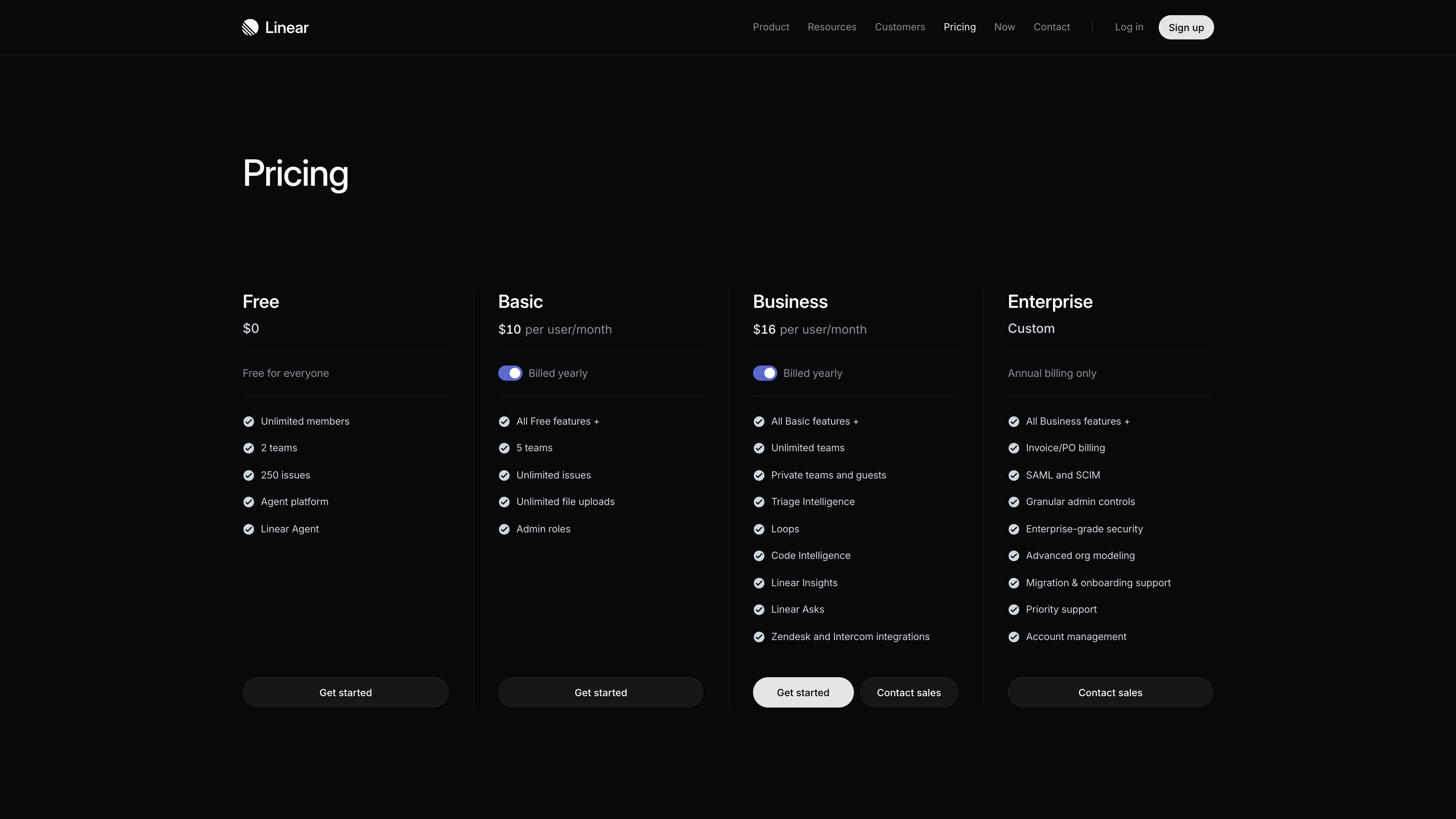
- Cost: Free plan at 10/user/month and Business $16/user/month, both billed yearly; Enterprise custom pricing (per the official pricing page as of 2026-09-12)
- Sign-up: Browsing the website and docs requires no account; using the product requires an account and creating or joining a workspace (Google SSO or email login); users must be 13 or older
- Interface language: English only — no language switcher exists as of 2026-09-12
- Clients: Web, macOS, Windows, iOS, Android (download page)
- Launched: Company incorporated January 2019; waitlist opened April 2019
Background
Linear was founded by three Finns: Karri Saarinen (CEO, previously Principal Designer and design systems lead at Airbnb and an early design lead at Coinbase), Jori Lallo (CPO, formerly Coinbase), and Tuomas Artman (CTO, formerly Uber). In his April 2019 founding post, Saarinen described the motivation: every company eventually ends up on a tool like Jira that feels "not designed for humans" — at Airbnb he had even written a Chrome extension to improve Jira's interface, which about 100 colleagues ended up using. Linear Orbit, Inc. was incorporated in San Francisco on January 10, 2019, and opened its waitlist that April.
Funding history (primary reporting or official announcements):
- November 2019: 13M Series A led by Sequoia (VentureBeat).
- September 2023: 400M valuation (Bloomberg, via Techmeme).
- June 2025: 1.25B valuation, bringing total funding to $134.2M; the company then cited 15,000+ customers and a team of roughly 80 (TechCrunch).
- August 2026: a 2.5B valuation, with Accel, 01A, and new investors Salesforce Ventures and S32 participating (official announcement).
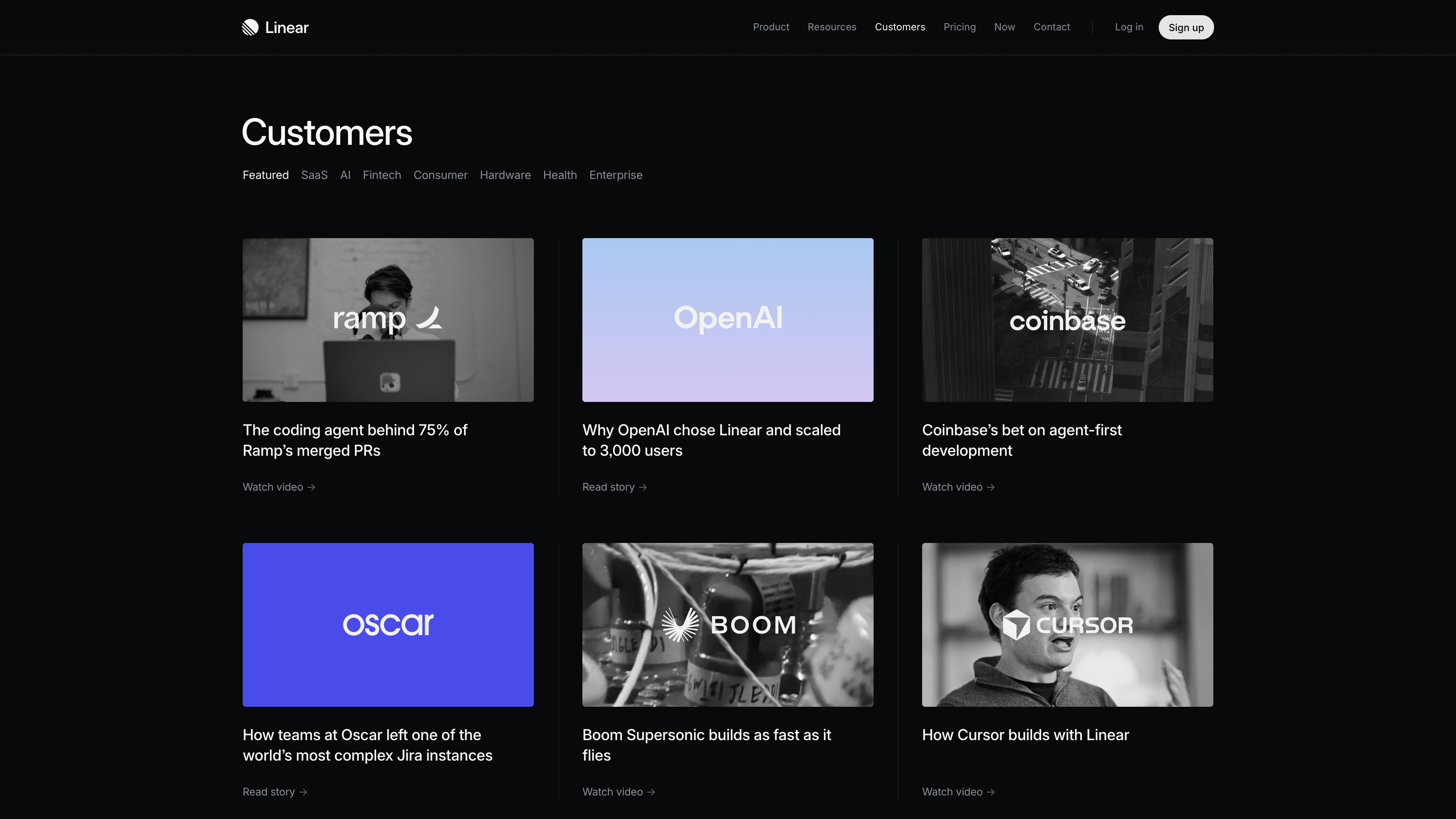
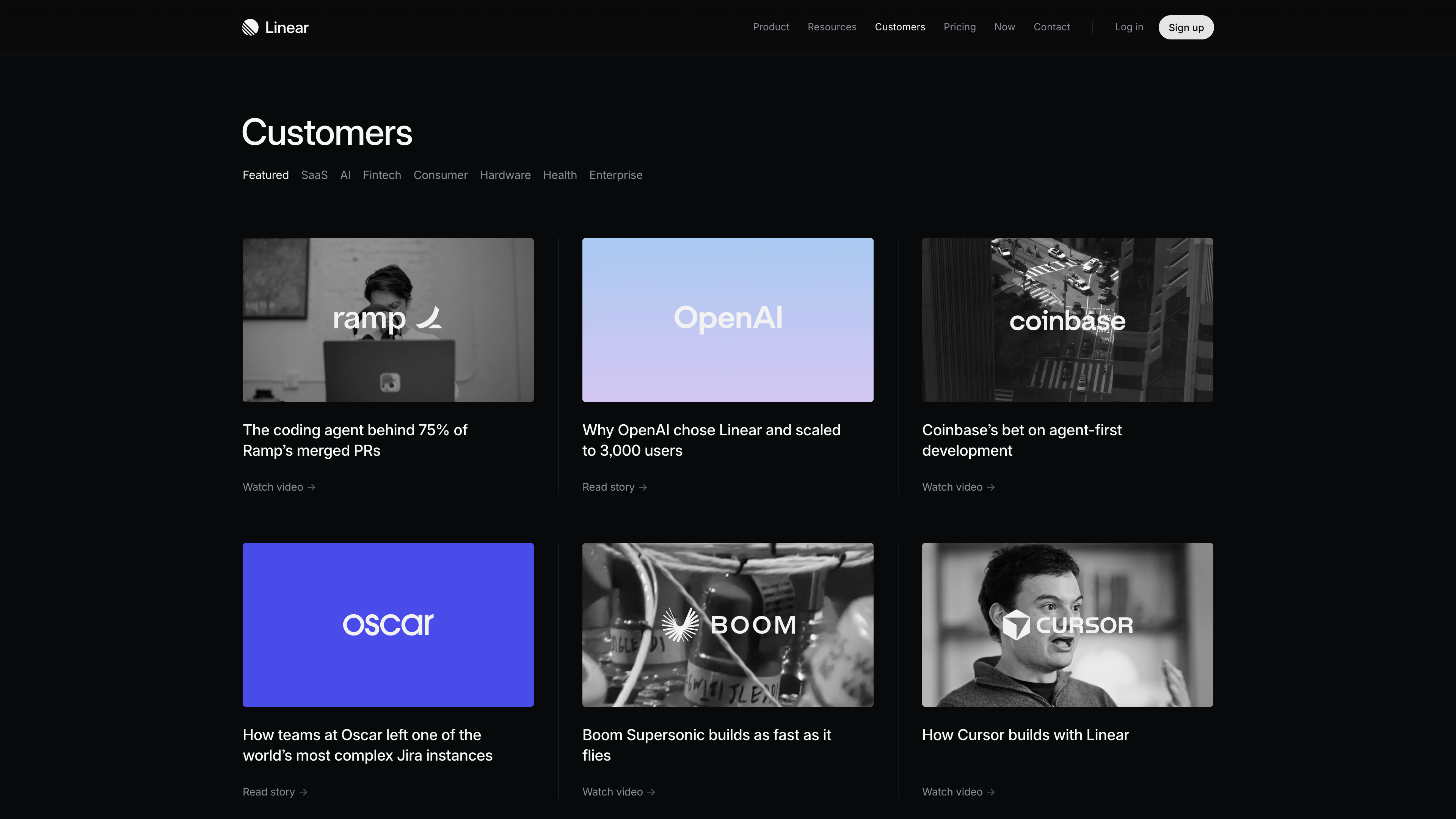
The same announcement disclosed operating metrics: ARR passed $100M in early 2026; paying customers exceed 40,000; net revenue retention is 177%; the company is cash-flow positive with more cash on hand than it has ever raised. Named customers include OpenAI, Coinbase, and Ramp; Salesforce and Figma reportedly became customers in 2026, alongside AI companies such as Cursor, Cognition, Harvey, Physical Intelligence, Legora, and Baseten. Below is the Featured section of Linear's customer page, with story cards such as Ramp's "the coding agent behind 75% of merged PRs" and OpenAI's "scaled to 3,000 users" (vendor-reported figures).
Core concepts: Issues, Cycles, Triage, and Projects
A Linear workspace contains one or more teams, and work is organized into a fixed set of concepts — there is no Jira-style free-form modeling:
- Issues are the atomic unit of work, with team-prefixed identifiers (e.g., DRV-364), status, priority, assignee, and labels, plus sub-issues and blocked/related/duplicate relations.
- Cycles are time-boxed periods of one to eight weeks. Linear creates them automatically on a repeating schedule (up to 15 future cycles), with an optional cooldown after each cycle. The docs stress that "unlike sprints, cycles are not tied to releases" (Cycles docs).
- Triage is a special team inbox: issues created through integrations (Slack, Sentry, etc.) or by workspace members outside your team land here first, and are accepted, marked as duplicate, declined, or snoozed before entering the team's workflow. Paid tiers add Triage Rules (condition-based automation), Triage Intelligence (an LLM suggests properties and flags likely duplicates based on workspace history), and Triage Responsibility (rotation) (Triage docs).
- Projects and Initiatives: a Project is a unit of work with a clear outcome or target date (such as a feature launch), shareable across teams, with milestones, documents, and progress graphs; an issue can belong to only one project at a time. Initiatives (renamed from Roadmaps) group projects for higher-level planning (Projects docs).
Speed is treated as a product principle throughout. The ⌘K command menu can perform nearly any action, and navigation and issue operations lean on single- or double-key shortcuts (G then T opens Triage, I self-assigns an issue, C creates one). This is documented across Linear's guides and is the main experiential gap versus comparable tools.
AI and agents: from issue tracking to "context into execution"
In March 2026 Linear published a signed essay, "Issue tracking is dead", arguing that traditional issue trackers were designed for a handoff-based development model, and that agents are compressing the distance between planning, implementation, and code review. Linear's stated new direction is to be "the shared product system that turns context into execution." Capabilities already shipped around this thesis include:
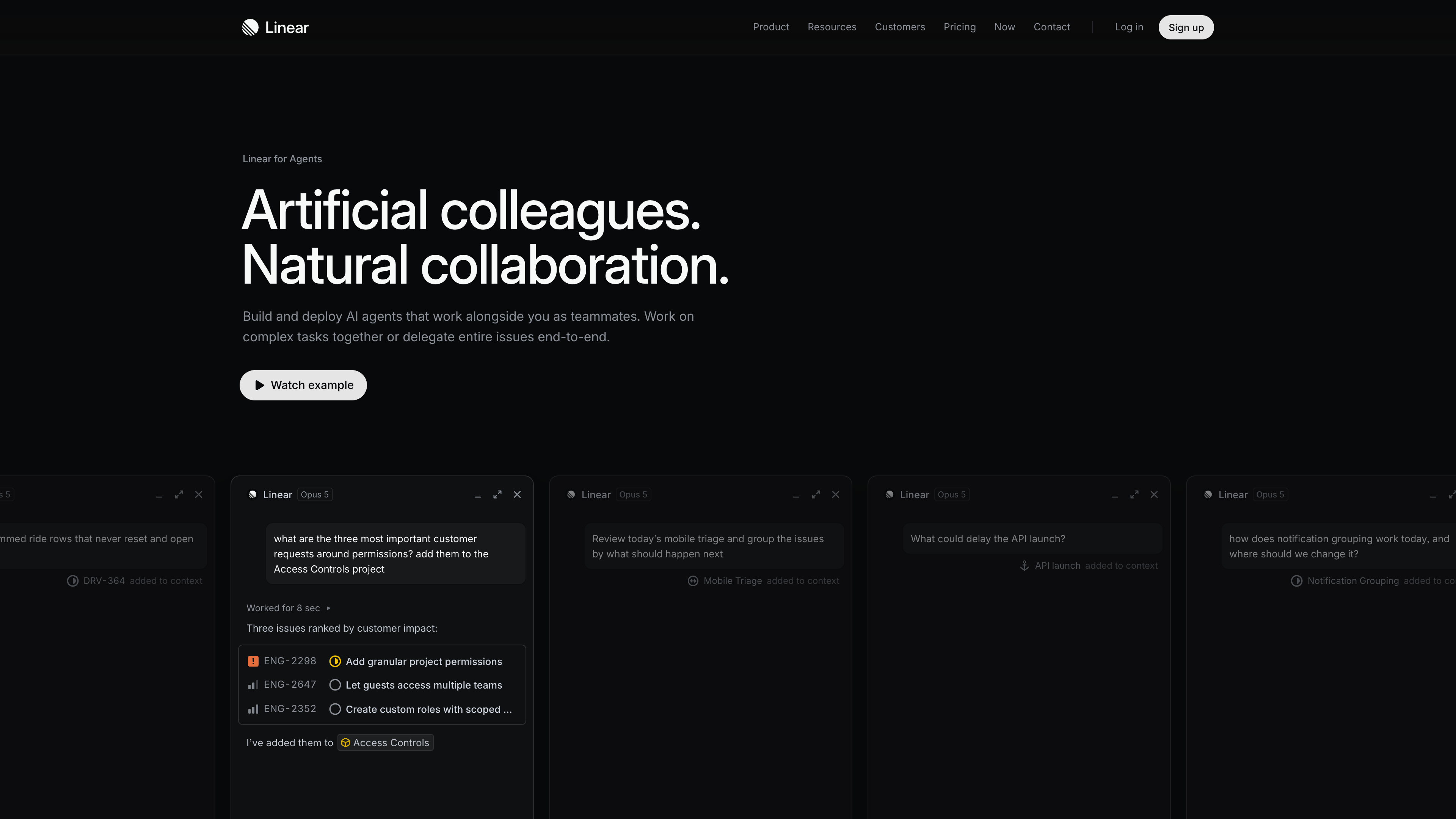
- Linear Agent: agents are full workspace members that can be assigned issues, added to projects, and @-mentioned in comments. The stated design principle is "delegate issues, but not accountability" — the human user remains the primary assignee while the agent contributes, and every change it makes can be inspected (Linear for Agents).
- Coding Sessions: the agent can set up, run, and test code against an issue before handing work back; code changes can be reviewed from the mobile app as well (changelog, August 2026).
- Skills and Automations: reusable workflows codified as skills (triggered via slash commands or applied automatically), and agent workflows that fire the moment an issue enters Triage or similar stages.
- Loops, Code Intelligence, and Diffs: recurring agent workflows, codebase Q&A, and a code-review interface built for human–agent iteration; the latter two sit in the Business tier alongside Triage Intelligence and Linear Insights.
- The platform supports MCP, and customers including Ramp and Coinbase have integrated their own coding agents deeply into Linear.
Vendor-reported adoption figures (August 2026): agents are installed in 95% of paid workspaces, and the share of work created by agents grew from 3% a year earlier to 50%.
Platforms, integrations, and openness
Linear ships Web, macOS, and Windows desktop apps plus iOS and Android mobile apps. For developers, it exposes the same GraphQL API its own apps use (API keys or OAuth2, webhooks, and an official TypeScript SDK), so a common pattern is to treat Linear as the "product development database" and build custom tooling around it.
The official integration directory includes GitHub (PR status automation and code linking), GitLab, Slack, Figma, Sentry, Zendesk, Intercom, Salesforce (sold as an add-on), Zapier, and Raycast. For migration, Linear offers dedicated importers for Jira, GitHub Issues, Asana, and Shortcut plus a CLI import tool, with control over what to import, user mapping, and a limited window to delete an import in bulk (import docs).
Pricing
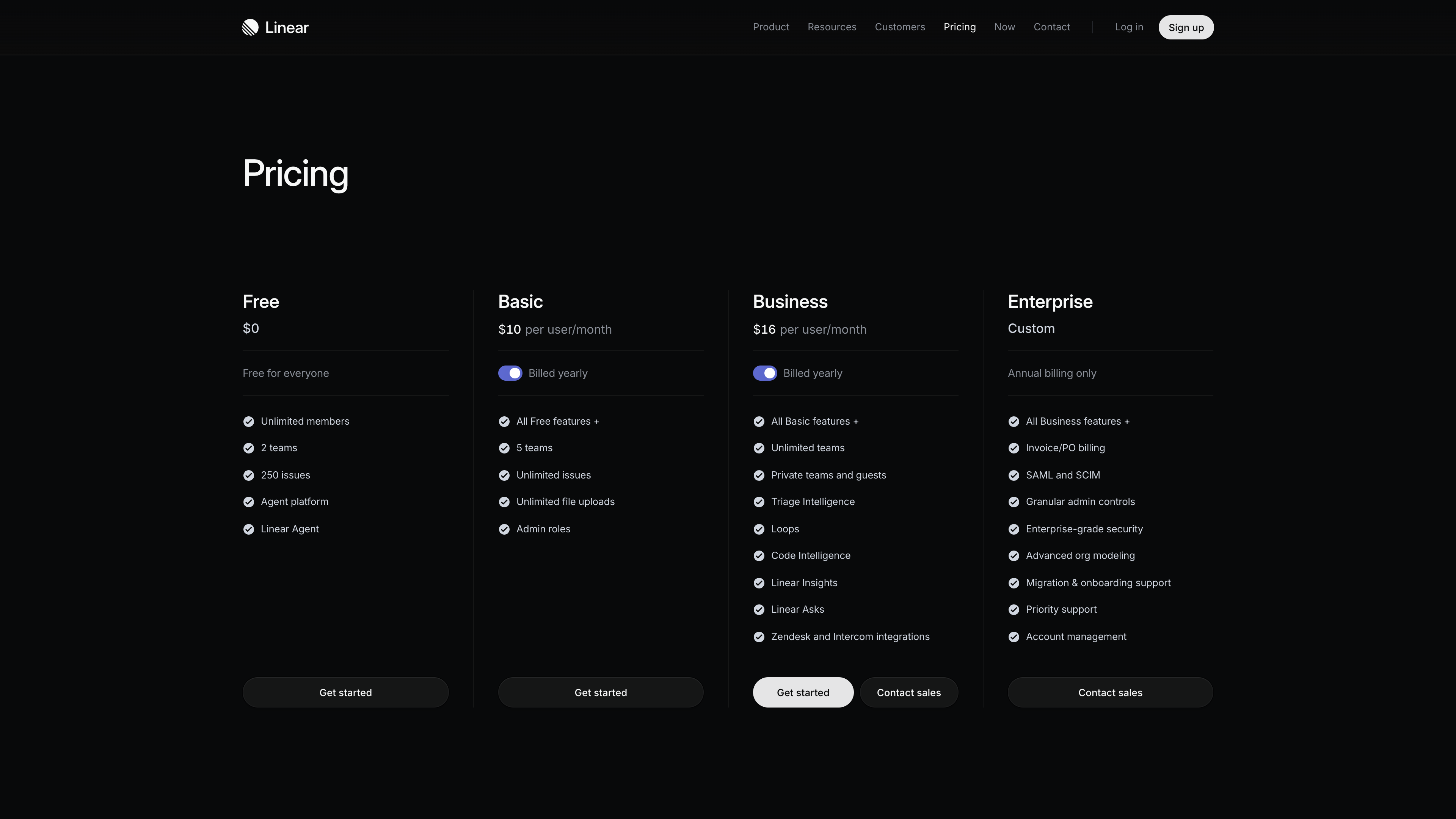
As of 2026-09-12, the official pricing page lists only annual-billing tiers:
| Tier | Price | Key limits and features |
|---|---|---|
| Free | $0 | Unlimited members; 2 teams; 250 issues; 10MB per-file uploads; includes the Agent platform and Linear Agent |
| Basic | $10/user/month | 5 teams; unlimited issues and file uploads; admin roles |
| Business | $16/user/month | Unlimited teams; private teams and guest accounts; Triage Intelligence, Loops, Code Intelligence, Linear Insights, Linear Asks; Zendesk/Intercom integrations |
| Enterprise | Custom (annual only) | SAML/SCIM, audit log, IP restrictions, HIPAA compliance, uptime SLA, migration and onboarding support, account management |
Two caveats: no monthly billing prices are published, and Coding Sessions and Loops carry asterisks in the pricing table — under the Terms of Service, AI services are governed by a separate AI Addendum that allows usage-based billing (tokens, API calls, compute units).
Security and terms
Linear's security page lists SOC 2 Type II audits, ISO/IEC 27001:2022 certification, GDPR compliance, and HIPAA (BAA available). Data is encrypted in transit with TLS 1.2 and at rest with AES-256, and new workspaces can choose EU or US data residency. The Enterprise tier adds SAML, SCIM, IP restrictions, and an audit log covering the last three months of events.
The Terms of Service (current version dated 2026-06-09) follow a typical B2B SaaS structure: customers retain all rights to their data (User Submissions) and grant Linear only the license needed to operate the service; Linear may freely use aggregated, anonymized service-operations data (Service Data) as long as it does not identify the customer. Data processing is covered by a separate DPA, and AI features by the AI Addendum. Two clauses worth noting: canceling a paid subscription downgrades the workspace to a feature-limited free version, and Linear may delete data from free accounts inactive for a year. The terms are governed by Delaware law and include a jury-trial waiver. The Privacy Policy (2025-03-17) states the service is not for children under 13, payments are processed by Stripe, and EU residents hold GDPR rights.
Good fits
- Software teams that find Jira slow and heavy and want issue tracking and iteration planning in one system; migrating from Jira is well-trodden, with an official importer and published case studies (Oscar's, for example).
- Teams that want customer feedback and support tickets flowing directly into engineering work (Linear Asks, Zendesk/Intercom integrations).
- Teams adopting coding agents that want agent assignment, review, and tracking in the same system as human work.
- Teams building their own toolchain around a central API (GraphQL, webhooks, MCP).
Limitations
- Low free-tier ceiling: 250 issues and 2 teams is enough for evaluation, but real usage quickly requires payment; the free plan also caps uploads at 10MB per file.
- Annual billing only: Basic and Business are both marked "billed yearly," with no published monthly option; AI coding features may additionally be metered per use under the AI Addendum.
- Fixed conceptual model: Linear deliberately trades flexibility for speed and consistency. Teams used to deeply customized workflows, fields, and permission schemes (typical of Jira deployments) will find less room to maneuver, and complex enterprise process orchestration is not a design goal.
- Built for software development: the state machine, cycles, and code integrations all assume an engineering organization; general-purpose project management for marketing, HR, and similar teams means borrowing concepts that don't quite fit.
- Closed-source, cloud-only SaaS: no self-hosted option, and the terms make clear customers never receive the software itself; availability depends on the vendor (an uptime SLA exists only on Enterprise).
- English only: the website, apps, and documentation offer no other language.
- Account required for everything: nothing inside a workspace is publicly viewable, and there is no open demo environment; the efficiency figures published on the site ("3.3x faster issue resolution," "50% of issues authored by agents") are vendor-reported and not independently verified.
Alternatives
- Jira: Atlassian's enterprise standard, extremely customizable but frequently criticized as slow and complex; many of Linear's published customer stories are Jira migrations.
- GitHub Issues / Projects: free and colocated with the codebase, a natural fit for open-source and lightweight teams, but weaker on planning and cross-team structure.
- Shortcut: one of the closest-positioned software project management tools, likewise built around lean structure and iterations.
References
- Linear homepage (checked 2026-09-12)
- About - Linear (checked 2026-09-12)
- Pricing - Linear (checked 2026-09-12)
- Customers - Linear (checked 2026-09-12)
- Linear for Agents (checked 2026-09-12)
- Issue tracking is dead - Linear (checked 2026-09-12)
- Sharing Linear's growth with the people building it - Linear (checked 2026-09-12)
- Linear Changelog (checked 2026-09-12)
- Cycles - Linear Docs (checked 2026-09-12)
- Triage - Linear Docs (checked 2026-09-12)
- Projects - Linear Docs (checked 2026-09-12)
- Import issues - Linear Docs (checked 2026-09-12)
- Working with the GraphQL API - Linear Developers (checked 2026-09-12)
- Security - Linear (checked 2026-09-12)
- Terms of Service - Linear (checked 2026-09-12)
- Privacy Policy - Linear (checked 2026-09-12)
- Starting Linear - Karri Saarinen (checked 2026-09-12)
- Linear lines up $4.2M led by Sequoia - TechCrunch (checked 2026-09-12)
- Linear raises $13 million to streamline software development projects - VentureBeat (checked 2026-09-12)
- Atlassian rival Linear raises 1.25B valuation - TechCrunch (checked 2026-09-12)
- Linear raises $35M Series B led by Accel - Techmeme summary (checked 2026-09-12)
- Linear Orbit, Inc. - Wikipedia (cross-check only, checked 2026-09-12)