Lichess (lichess.org) is a free, ad-free, open-source online chess platform: you can play live games against opponents worldwide in a browser or the mobile apps, and train with tactical puzzles, engine analysis and collaborative studies. It is operated by a French non-profit charitable association, and every feature is free for everyone, forever — no advertising, no user tracking, no paywalls; the site runs entirely on donations (About, Features). Its verifiable difference from freemium commercial platforms is that nothing — from rated play to server-side engine analysis — is locked behind payment, and the source code that powers the site is published under the AGPL license.
At a Glance
- URL: https://lichess.org/
- Type: Online chess server (play, training, analysis, spectating)
- Cost: All features free, with no ads and no tracking; donors ("Patrons") receive only a profile icon and trophy, and unlock no additional features (Features, Terms of Service)
- Sign-up: Entirely optional — anonymous users can play, though some features are limited; registration is free and requires being at least 15 and of legal age for digital contracts, or a kid account created by a parent or teacher (Terms of Service)
- Interface languages: 140+ on the website (including Simplified and Traditional Chinese), 100+ in the official mobile apps, translated by the community via Crowdin (Features, About)
Background
In 2010, French programmer Thibault Duplessis started Lichess as a hobby project; the early site did not even check whether moves were legal. He made it open source, and a volunteer team gradually assembled to build and maintain it (About). The name combines live/light/libre with chess and is pronounced "lee-chess"; the main codebase is called lila, short for "lichess in Scala", because the server is written mostly in Scala (FAQ).
The operating entity, Lichess.org, is a charitable organization registered under the French Associations Law of 1901, based in La Mure near Grenoble, France (Terms of Service, Privacy Policy). According to the project's own account, users play more than five million games every day, making Lichess one of the most popular chess websites in the world (About).
The project is also actively maintained open-source software: the main repository lichess-org/lila is published under the AGPL-3.0 (or later) and had 18,694 stars and 2,779 forks as of 2026-09-01, with new commits landing the same day. The governance documents are maintained as well: the Terms of Service were last modified on 2026-08-01, and the privacy policy on 2022-03-16.
What You Can Do
Play and Compete
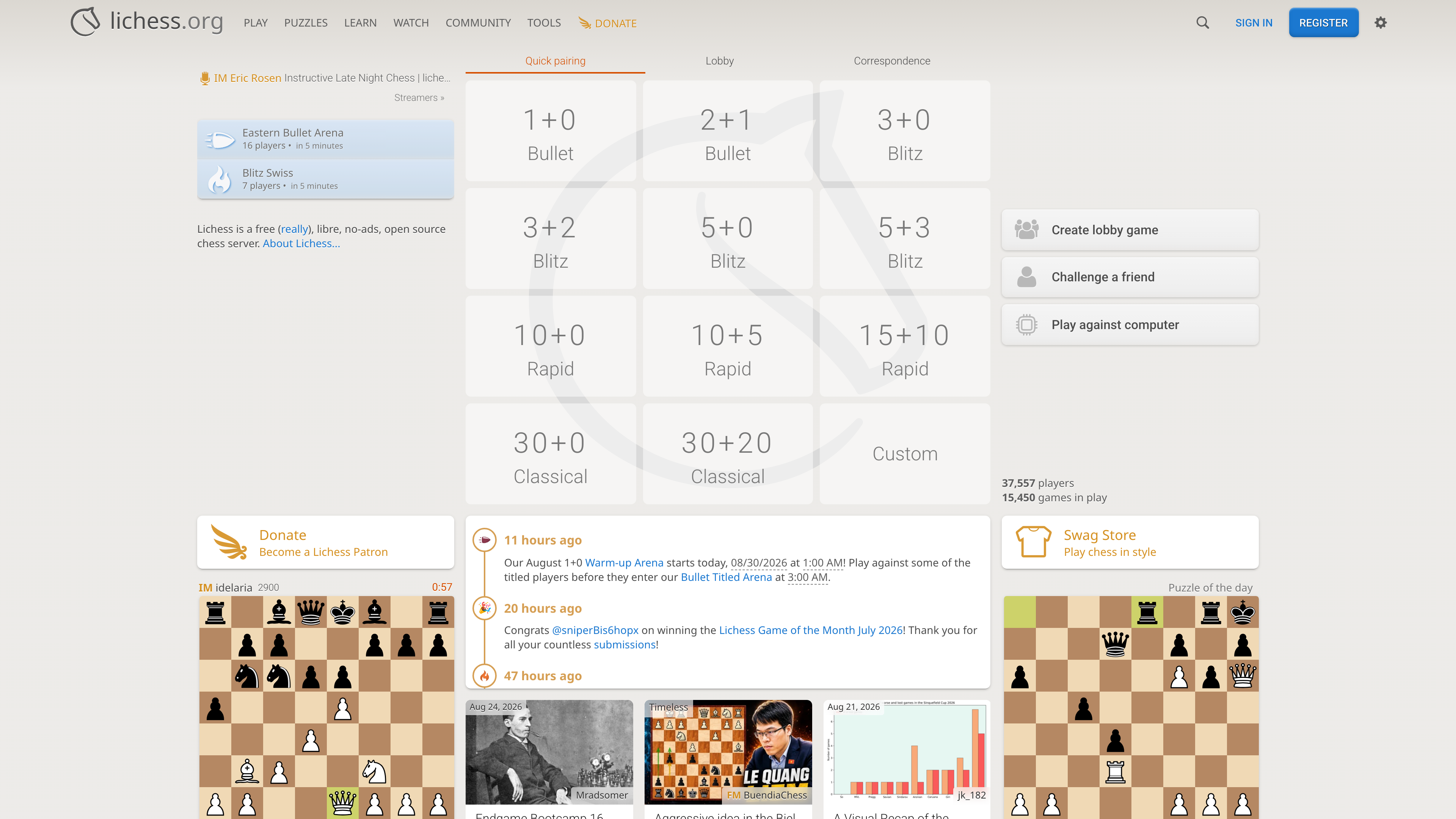
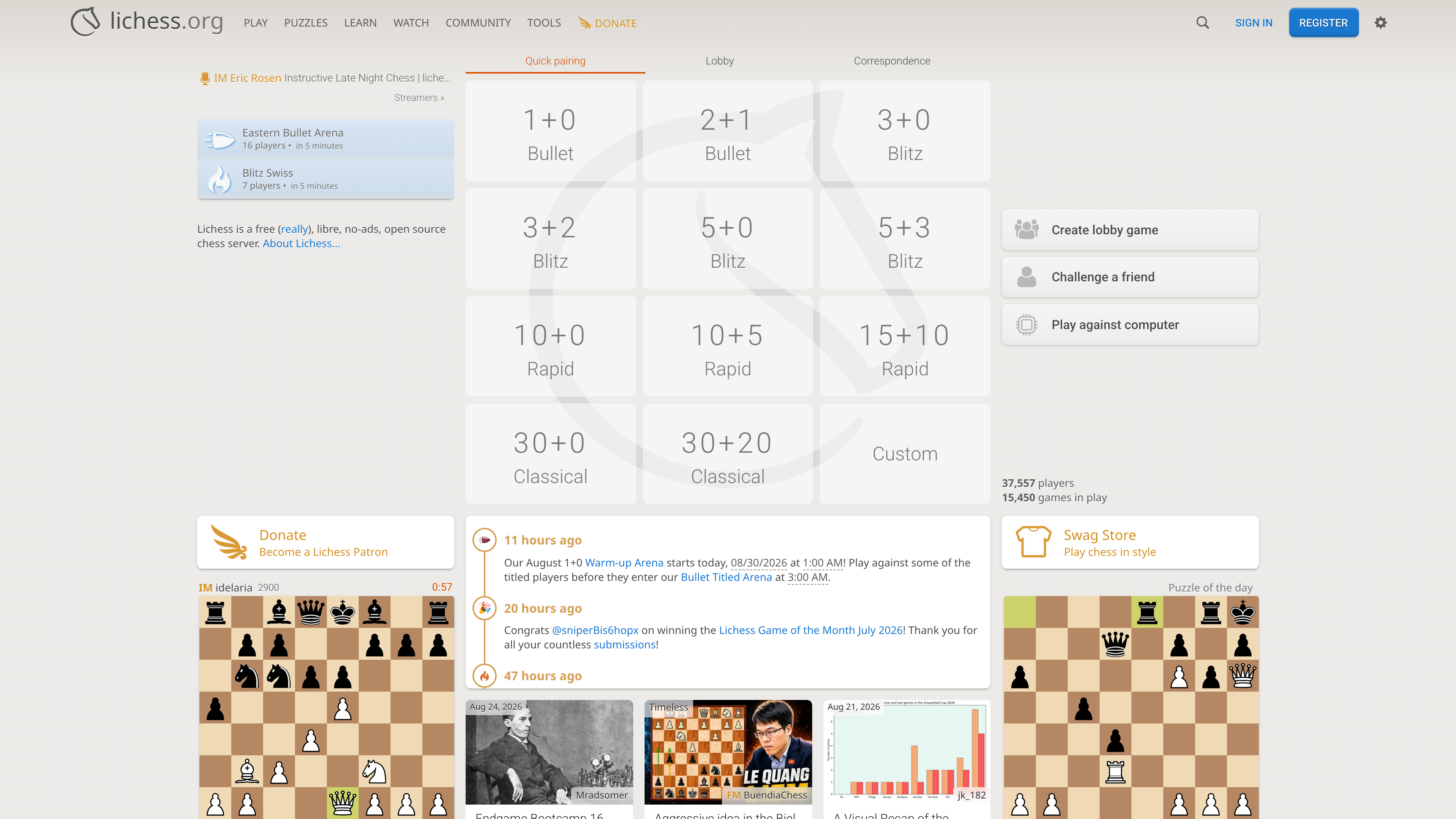
Time controls are classified by estimated game duration (initial time plus 40 times the increment): up to 29 seconds is UltraBullet, then Bullet, Blitz and Rapid, with 1500 seconds or more counting as Classical; correspondence chess without a live clock is also supported, with conditional premoves (FAQ, Features). The homepage's quick-pairing grid offers the common presets from 1+0 to 30+20, next to a live counter of players online and the puzzle of the day:
Beyond standard chess, the site ships 8 variants: Crazyhouse (captured pieces can be dropped back on the board), Chess960 (randomized back rank), King of the Hill (win by bringing your king to the center), Three-Check (win by giving check three times), Antichess (win by losing all your pieces), Atomic (win by "nuking" the enemy king), Horde (one side fields a mass of pawns against a regular army) and Racing Kings (race your king to the far side) (variants page).
Competitive formats include Arena tournaments, Swiss tournaments and simultaneous exhibitions, all free to create and join; players with verified FIDE titles (GM, IM, FM and others) can additionally enter the titled-only Titled Arena events (Features, FAQ). Ratings use the Glicko-2 system, starting at 1500 for new accounts; the project stresses that ratings are relative figures and cannot be compared with FIDE or USCF numbers (FAQ).
Puzzles and Learning
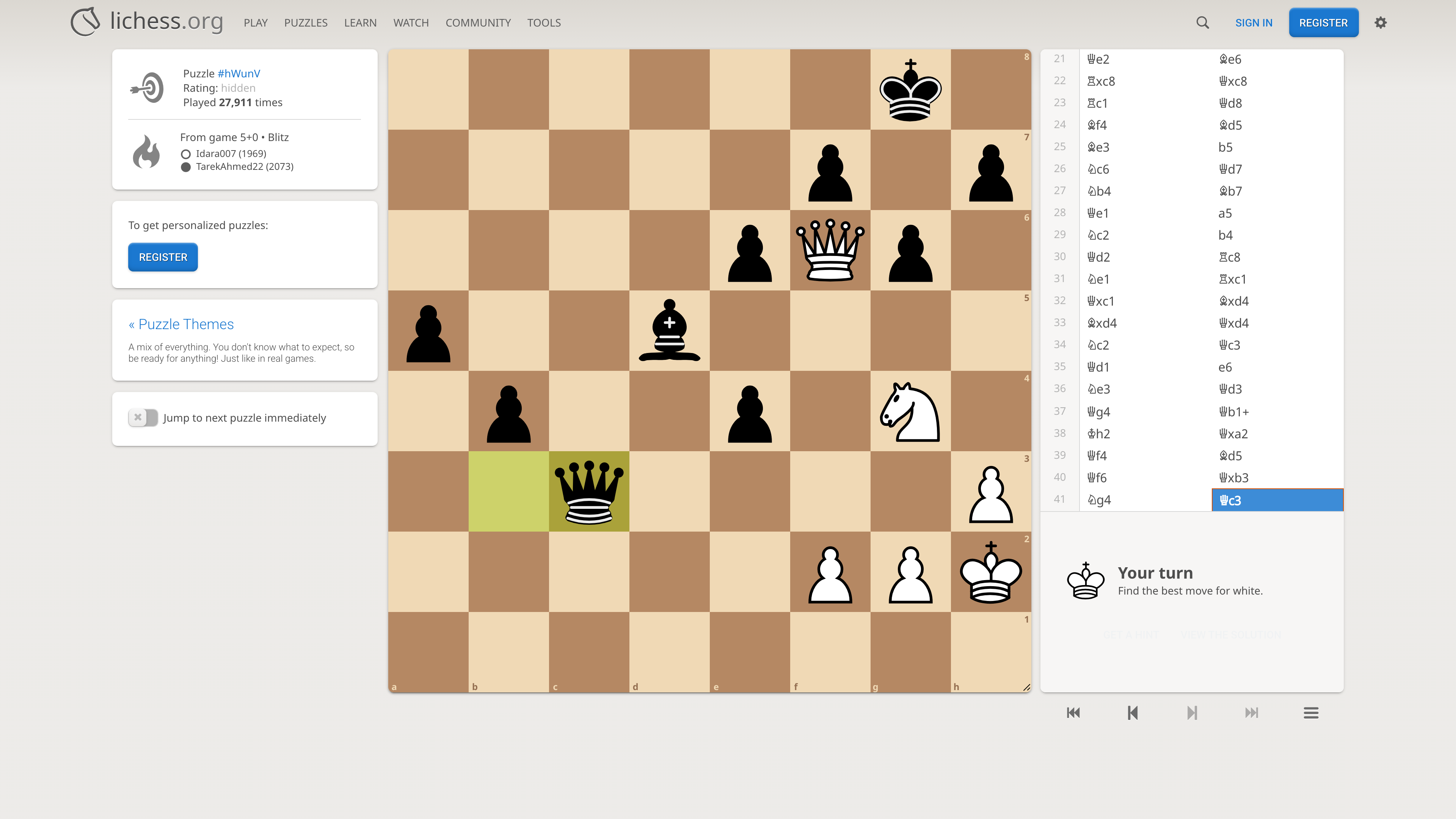
Puzzles are mined from real games played on the site and carry ratings and theme tags; the official open dataset already contains 6,057,356 puzzles (data file updated 2026-08-02, see the lichess.org open database). Beyond solving one by one, there are Puzzle Streak (consecutive correct answers), Puzzle Storm (a timed sprint) and Puzzle Racer (head-to-head racing) modes (Features). The puzzle page shows the source game and solve count on the left, with the full move list on the right:
For learning, the site offers free interactive lessons covering the basics of chess, a "Learn from your mistakes" review flow after each game, and shareable, collaborative "studies" for saving games, positions and annotated variations with live chat; players who want structured improvement can also hire a coach through the site (Features, About).
Engine Analysis
After any game you can request a deep server-side analysis with Stockfish 18, capped at 40 games per account per day; the board editor and analysis board run Stockfish 16+ NNUE in the browser with no limit, and cloud engine analysis is available as well. The opening explorer draws on roughly 6 billion games, a personal opening explorer works on any player's repertoire, and a 7-piece endgame tablebase is built in (Features).
Watching and Broadcasts
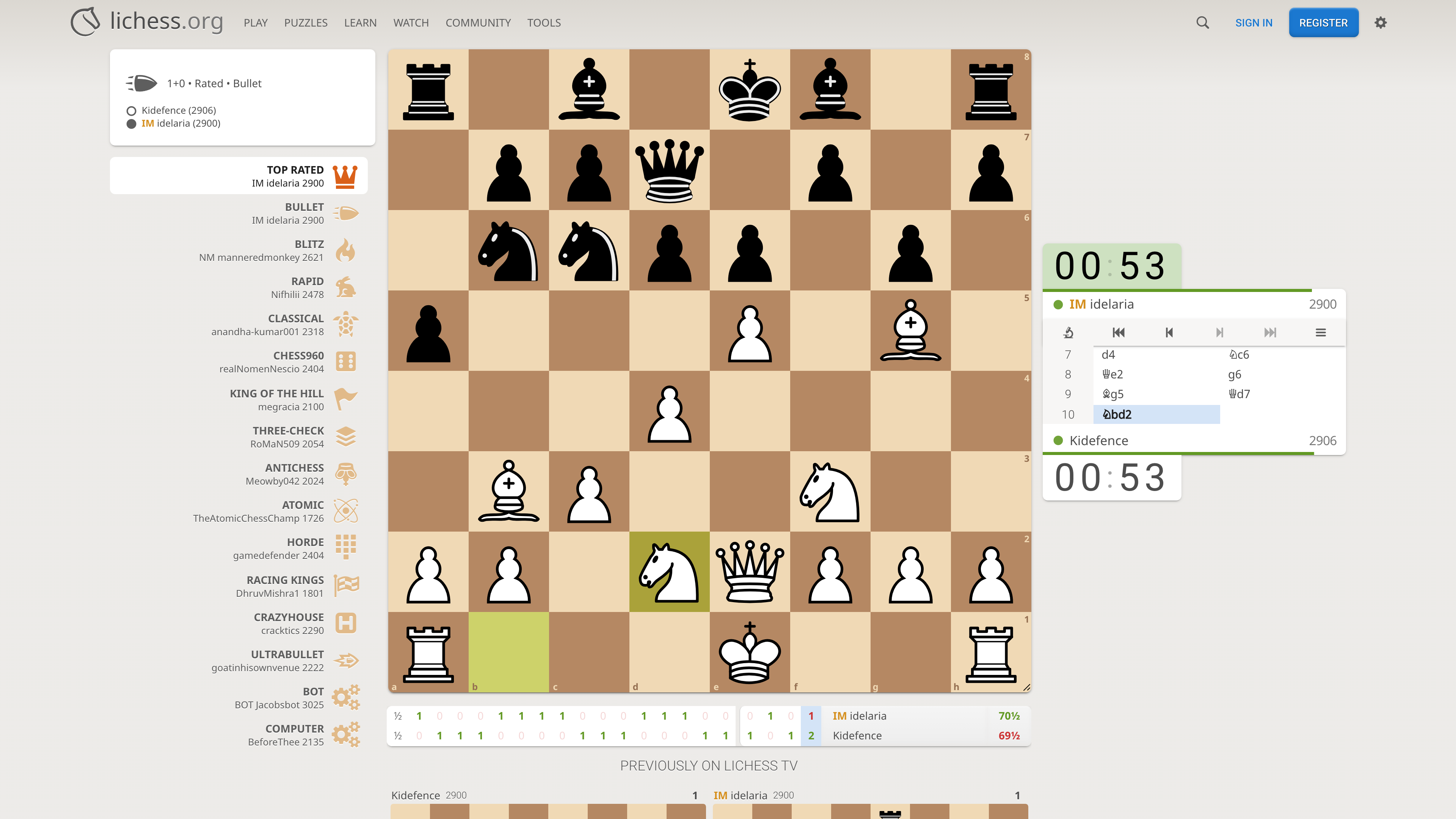
Lichess TV streams the top ongoing game in each time control and variant live, while the Broadcasts channel follows major over-the-board tournaments with live move relay; spectators can compare positions against a database of masters' games (Features, About). Below, Lichess TV is relaying a rated 1+0 Bullet game between two leaderboard players, with the per-category leaderboards on the left and the live move list and clocks on the right:
Accounts, Mobile and Open Access
Accounts are optional and free, with optional two-factor authentication; under-age users can be given "kid accounts" by a teacher, parent or guardian, which enforce protections such as disabling public chats (Terms of Service). Official iPhone/iPad and Android apps are available and, like the website, are free, ad-free, tracker-free and entirely open source (official mobile page).
For developers, the site provides a full REST API: the documentation is published in OpenAPI 3.1 format, all requests are rate-limited, and authentication supports personal access tokens and an OAuth2 authorization-code flow with PKCE; community-maintained client libraries exist for Python, JavaScript/TypeScript, Rust and more (API reference). On the data side, the lichess.org open database is free to download: 8,038,784,095 standard rated games in PGN format (split into monthly, non-cumulative files; the page shows the files were last updated on 2026-08-02), plus the puzzle database, more than 390 million Stockfish-evaluated positions and broadcast game records.
Fair Play and Community Rules
Using engines, opening books, endgame tablebases or outside help during a game is prohibited; the only exception is correspondence chess, where opening books and databases are allowed but engines remain banned (Terms of Service, FAQ). Accounts caught cheating receive a public mark, and their recent opponents get rating refunds (computed from the marked player's last 40 rated games within 5 days, capped at 150 points); repeatedly abandoning games, rating manipulation, sandbagging and unauthorized multiple accounts are also sanctioned. Penalized users can appeal, but the moderation team does not disclose its evidence (FAQ, Terms of Service).
Licensing and Privacy
The lila codebase is AGPL-3.0+; individual components such as fonts, designs and piece sets carry their own licenses, and the terms ask anyone reusing them to do their own due diligence (Terms of Service, GitHub repository). Users keep the rights to content they post (annotations, blogs, studies), but grant Lichess a worldwide, non-exclusive, royalty-free, sub-licensable license on submission (Terms of Service).
On privacy, the site promises no advertising and no tracking, using only the session cookie that keeps you logged in; the data controller is the Lichess.org association, data is hosted on servers in the European Union, and connection logs (including IP addresses) are kept for one year. The privacy policy is written against the GDPR and lists access, rectification, erasure and portability rights with instructions for exercising them (Privacy Policy, last updated 2022-03-16).
Who It's For
- Everyday play: quick matchmaking at any time control and any level, with no payment and no ads.
- Post-game review and targeted training: engine analysis, puzzle theme tags and the opening explorer cover beginners through advanced players.
- Teaching and clubs: studies, Swiss tournaments and kid accounts fit classrooms and community groups.
- Developers and researchers: the open API and the 8-billion-game database support tooling, statistics and machine-learning work.
Limitations
- Ratings are Glicko-2 relative figures and are not comparable with FIDE, USCF or other platforms' numbers (FAQ).
- Server-side deep analysis is capped at 40 games per account per day; bulk analysis requires the API or a local engine (Features).
- Fair-play decisions are made unilaterally and the evidence is not disclosed; the only recourse against a mistaken mark is the appeal process (Terms of Service).
- The service is provided "as is" with no availability or accuracy guarantees, and the free model depends on donations (Terms of Service).
- Registration requires being at least 15 and of legal age in your jurisdiction; younger players need a parent or teacher to set up a kid account (Terms of Service).
- Although the interface comes in many languages, translations are contributed by community volunteers, so coverage and consistency vary by language (About).
Alternatives
- Chess.com: the largest commercial chess platform, run on a freemium model — the free tier shows ads, while paid memberships remove ads and unlock unlimited game review, puzzles and lessons; a clear contrast with Lichess's everything-free approach.
- Online-Go.com (OGS): a similarly minded online server for Go (baduk) — free, browser-based play with an open-source web client — for readers interested in Go rather than chess.
References
- About Lichess (checked 2026-09-01)
- Lichess Features (checked 2026-09-01)
- Lichess Terms of Service (last modified 2026-08-01; checked 2026-09-01)
- Lichess Privacy Policy (last updated 2022-03-16; checked 2026-09-01)
- Lichess FAQ (checked 2026-09-01)
- Chess variants (checked 2026-09-01)
- Lichess API reference (checked 2026-09-01)
- Lichess official mobile app (checked 2026-09-01)
- lichess.org open database (checked 2026-09-01; data files shown as updated 2026-08-02)
- lichess-org/lila - GitHub (stars and license checked 2026-09-01)
- Chess.com Membership (checked 2026-09-01)