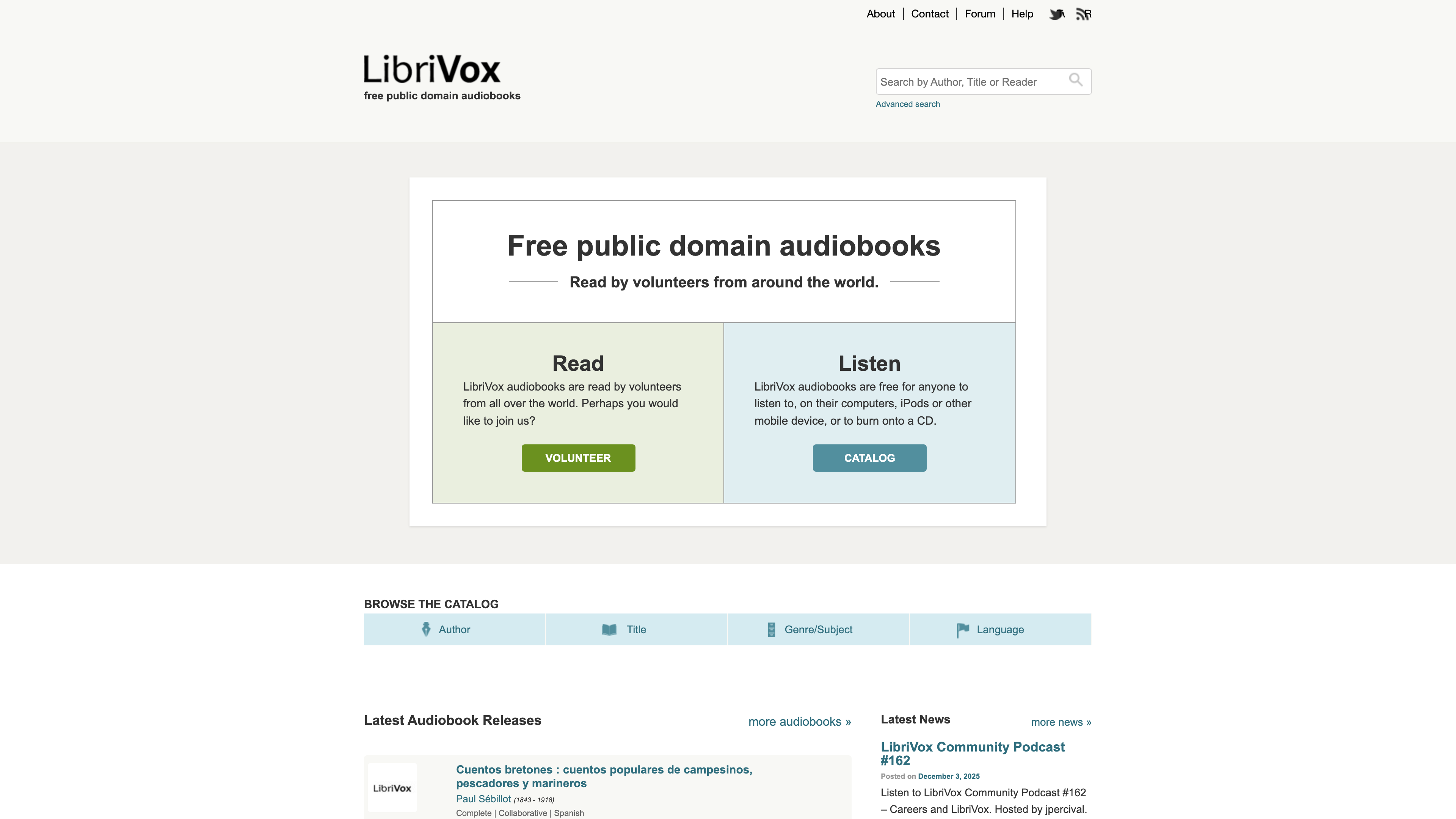
LibriVox (librivox.org) is a library of audiobooks narrated by volunteers and published for free, with the stated goal "to make all books in the public domain available, narrated by real people and distributed for free, in audio format on the internet" (About LibriVox). Its verifiable distinguishing traits: the project is non-commercial, non-profit and ad-free; every recording is dedicated to the public domain in the United States, so anyone may use it for any purpose, including resale and derivative works; and all narrators are volunteers accepted without auditions. No account is needed to listen or download. As of 2026-09-01, paginating through its public API returns about 22.3 thousand completed, cataloged audiobook projects (API documentation), and the catalog's language browse lists recordings in more than 100 languages, dominated by English.
At a Glance
- URL: https://librivox.org/
- Type: Volunteer-recorded public domain audiobook library
- Cost: Free and ad-free; the donations page states that LibriVox is not accepting donations at present and directs donors to the Internet Archive, which hosts the project
- Registration: None required for listening or downloading; volunteering requires a forum account
- Interface language: English; recordings span 100+ languages
Background
LibriVox was founded by Hugh McGuire in August 2005. Its direct inspiration was AKMA's volunteer audio project that recorded Lawrence Lessig's book Free Culture; the project also cites Wikipedia, the free software movement, Project Gutenberg, Creative Commons and the Internet Archive as influences (About LibriVox). From the start it committed to a short list of principles: non-commercial, non-profit and ad-free; recordings donated to the public domain; powered by volunteers; a loose and open structure; and volunteers welcomed "from across the globe, in all languages."
Source texts come mostly from Project Gutenberg, which performs the US public domain verification, while the audio files, forum and catalog pages are hosted for free by the Internet Archive (About, Donate). In August 2025 the project marked its 20th anniversary: the official post counted 20,648 completed titles and 14,276 forum volunteers at that time, and noted that one of the most downloaded LibriVox books is The Art of War (Happy 20th Anniversary, LibriVox!).
Catalog Size and Composition
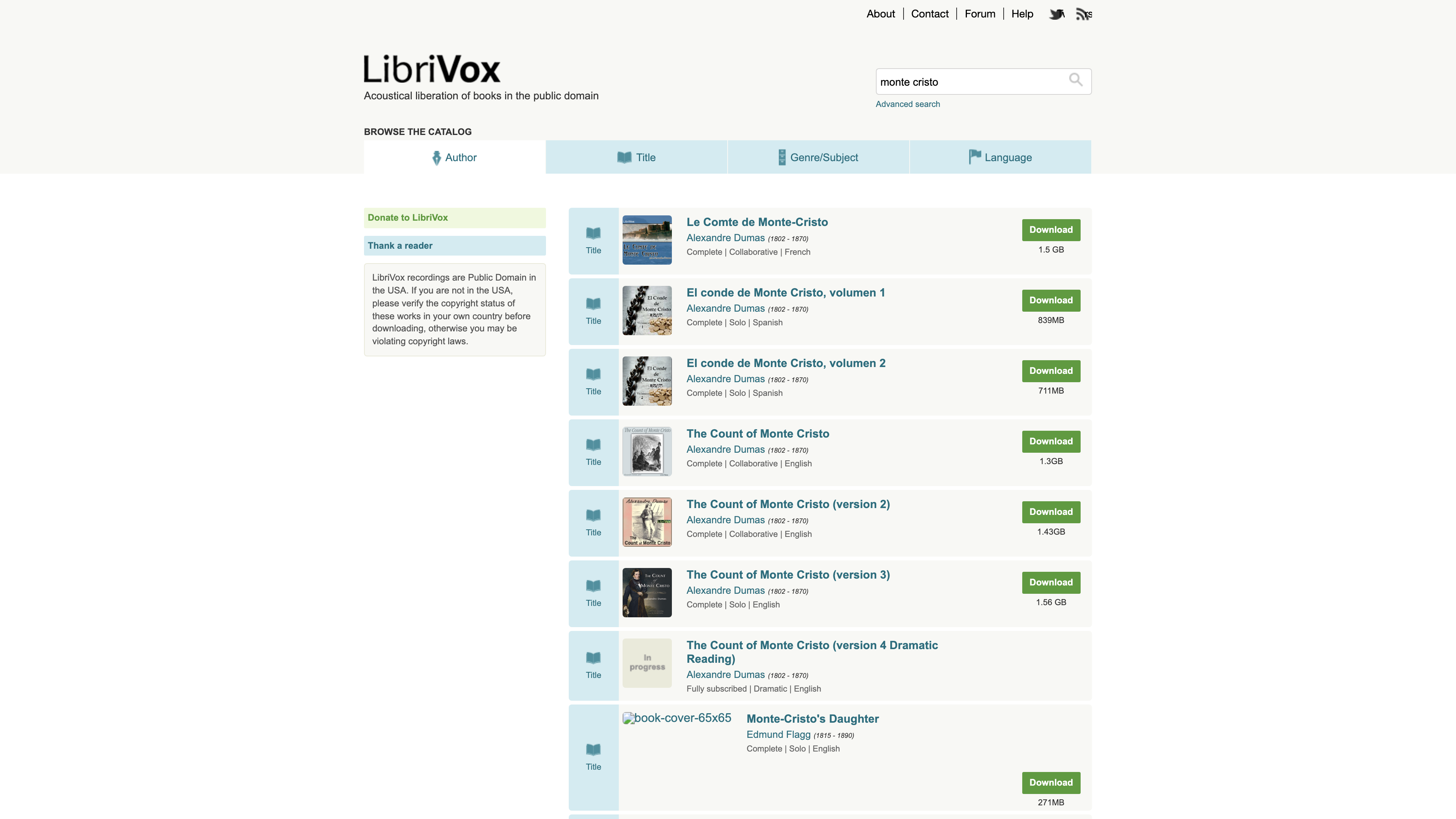
As of 2026-09-01, a full pagination of the public API returns 22,321 completed, cataloged audiobook projects — roughly a thousand more than the 20,648 titles reported in the anniversary post a year earlier, and the catalog continues to grow. Because LibriVox may only record texts that are in the public domain under US law — applied in practice as works "published 95 full years ago or longer" (Volunteer for LibriVox) — the catalog consists of older classics: fiction, non-fiction, poetry, short-work collections, and "dramatic readings" performed by full casts. Many books exist in several versions, labeled Solo (one narrator), Collaborative (chapter-by-chapter) or Dramatic, with completion status shown.
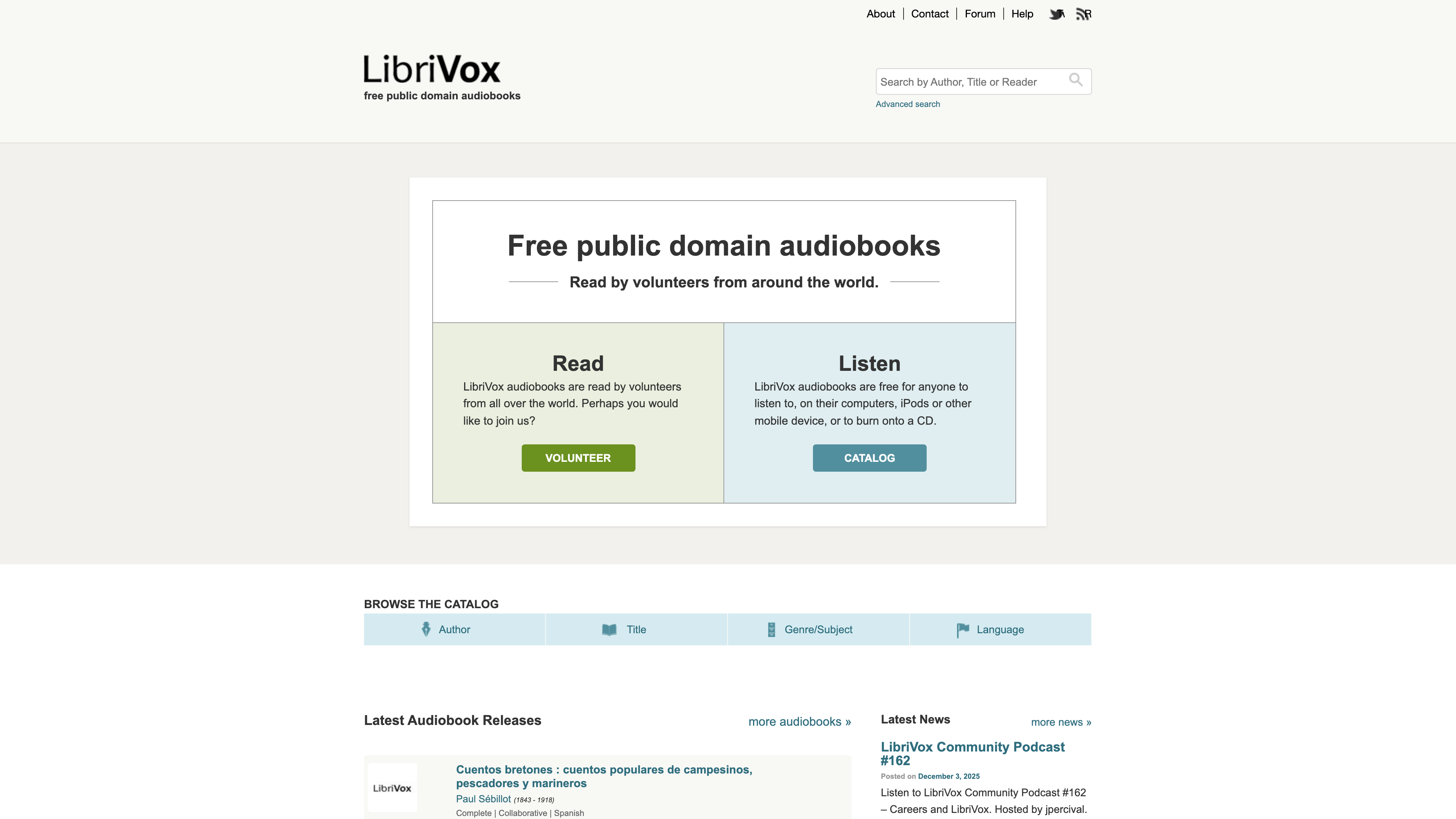
Browsing the catalog by language lists more than 100 languages; English accounts for the large majority, followed by German, French, Spanish, Chinese and others (per the catalog's language browse at the time of checking). Discovery options include browsing by author, title, genre or language, a combined search across author, title and reader names, and an advanced search that combines criteria such as language, completion status and project type (Help). Note that the help page itself warns that genre counts are not accurate and some genres still show zero books, so searching is the more reliable way to find a title.
Listening and Downloading
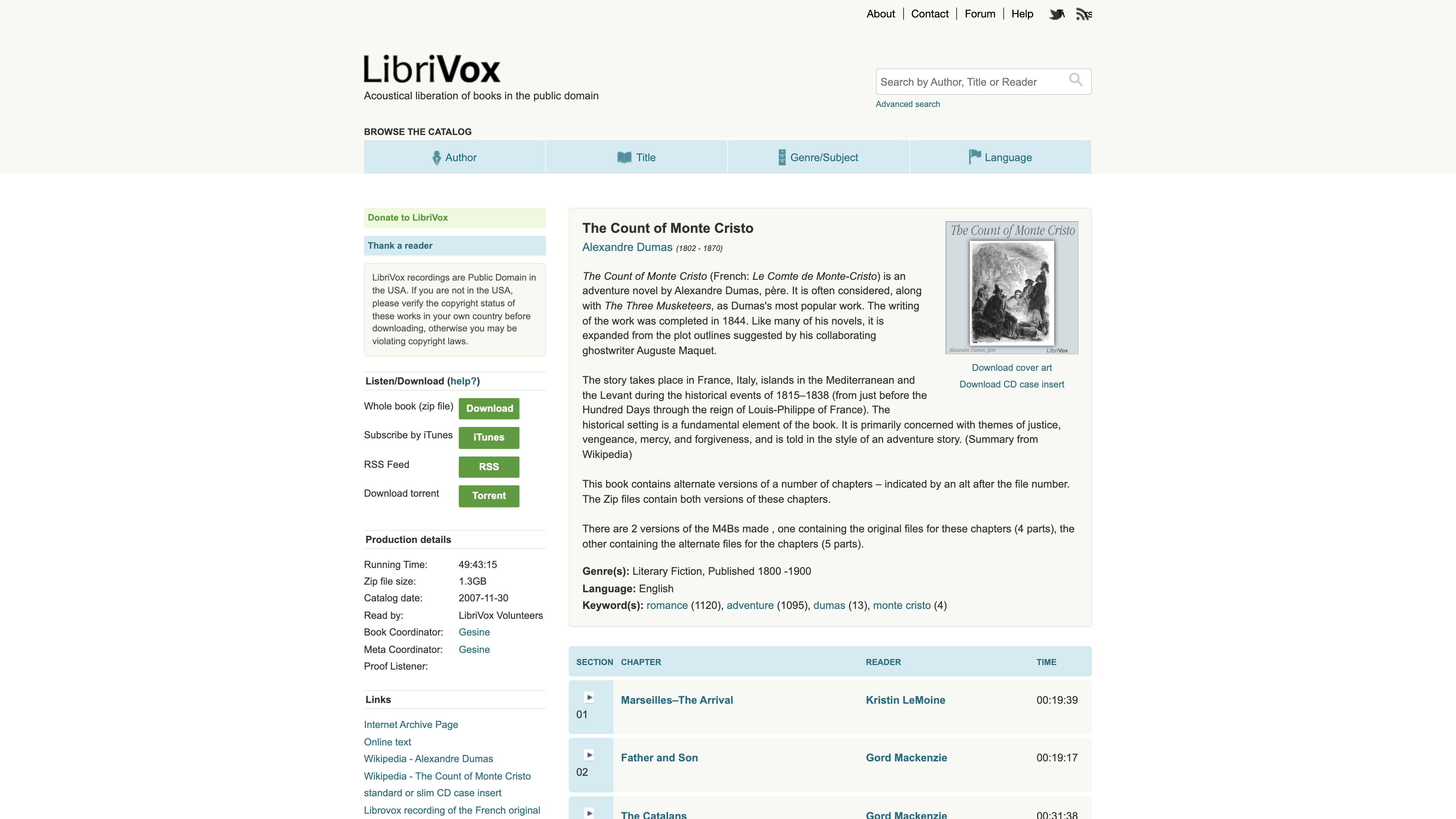
Each book's catalog page offers several ways to listen or obtain the audio (Help):
- Per-chapter streaming in the browser (64kbps MP3); clicking a chapter title switches to the 128kbps version;
- A zip of the whole book in 64kbps MP3 (ranging from under 100 MB to over 1 GB);
- An iTunes button, an RSS feed and a BitTorrent download;
- M4B files with chapter markers for most books;
- Additional Ogg and VBR MP3 files plus a streaming player on each book's Internet Archive page.
Recordings are produced as mono 128kbps MP3 (About Recording). There is no official mobile app; because the recordings are public domain and the catalog has a public API, several third-party LibriVox apps exist in app stores, but none is endorsed on the official pages, so quality and maintenance vary.
Open Access and Reuse
LibriVox runs a public read-only API (API Info) with three endpoints — audiobooks, audiotracks and authors — supporting queries by ID, cataloging time (since), author, title and genre. Responses default to XML with JSON and other formats available; the documentation requires no key or registration. More significant is the reuse policy: recordings, book summaries, cover art and other catalog material are all in the public domain, so anyone may listen, copy, broadcast, remix, build derivative works or even sell them without permission or mandatory attribution (the project says it prefers a credit). This is what allows third-party apps and podcasts to redistribute the content legally.
Volunteering
Becoming a narrator requires no experience and no audition — just a computer, a microphone and free recording software (most volunteers use Audacity), plus a suggested 1-minute test recording to check the setup (About Recording). Production is organized on the forum: a book coordinator (BC) launches a project, readers claim chapters, proof-listeners (PL/DPL) flag obvious errors, and a meta coordinator (MC) completes the cataloging (Volunteer for LibriVox). Project types include collaborative readings, solos, short works and poetry, dramatic productions, and projects in languages other than English. Contributors should note that submitted recordings are likewise donated to the public domain, meaning anyone may use them for any purpose.
Copyright and Content Policy
LibriVox records only texts that are in the public domain in the United States and states that all of its recordings are definitively public domain there. It follows US law for practical reasons: the domain is registered in the US, the site and audio are hosted there, and its main text source, Project Gutenberg, performs the US legal review (Public Domain). Two details matter directly to users:
- Recordings are not necessarily public domain outside the US; the project recommends that users elsewhere verify a work's copyright status in their own country before downloading.
- A translation counts as a new work, so its status is determined by the translation's publication year, not the original's.
On content, the project warns that many recorded books are very old and "may contain language or express notions that are antiquated at best, offending at worst," and keeps them unchanged in its role as a library (About LibriVox).
Who It's For
- Listening to classic literature and public domain books for free — commutes, chores, bedtime.
- Subscribing to whole books via RSS in a podcast app, or using M4B in players that support bookmarks for long works.
- Language learners looking for narration in many languages, or comparing recordings of the same work across languages.
- Anyone needing audio material that is free to reuse, including commercially — video voice-overs, remixes or derivative projects — subject to a local copyright check outside the US.
- People who want to practice narration and recording or join a volunteer production community.
Limitations
- No recent books: the recordable range is effectively limited to works published 95 or more full years ago, so bestsellers and contemporary titles are absent.
- Variable narration and production quality: readers are untrained volunteers with no screening, so accents, delivery and recording conditions differ widely; collaborative versions change voice every chapter; and mono 128kbps MP3 is a modest technical standard.
- The interface is English-only and dated; there is no official mobile app, no user accounts and no listening-progress sync.
- Genre counts are admittedly inaccurate, so category browsing can miss titles.
- The public domain status is determined under US law; users in other countries must verify their local situation themselves.
Similar Sites
- Project Gutenberg: LibriVox's main source of texts, focused on public domain ebooks; much of its own audiobook section comes from LibriVox.
- Internet Archive: hosts LibriVox's audio, forum and catalog, and also aggregates audiobooks and broadcast recordings from many other sources.
- Commercial audiobook platforms (e.g., Audible): professionally narrated new releases under paid models — a complement to LibriVox's public domain, free, volunteer-read approach.
References
- LibriVox homepage (checked 2026-09-01)
- About LibriVox (mission, principles, history, partners) (checked 2026-09-01)
- Public Domain (copyright policy) (checked 2026-09-01)
- Volunteer for LibriVox (process and the 95-year rule) (checked 2026-09-01)
- About Recording (technical recording standard) (checked 2026-09-01)
- Help (listening, downloading and search) (checked 2026-09-01)
- LibriVox API Info (public API documentation) (checked 2026-09-01)
- Donate (donations currently suspended) (checked 2026-09-01)
- Happy 20th Anniversary, LibriVox! (official anniversary post) (checked 2026-09-01)