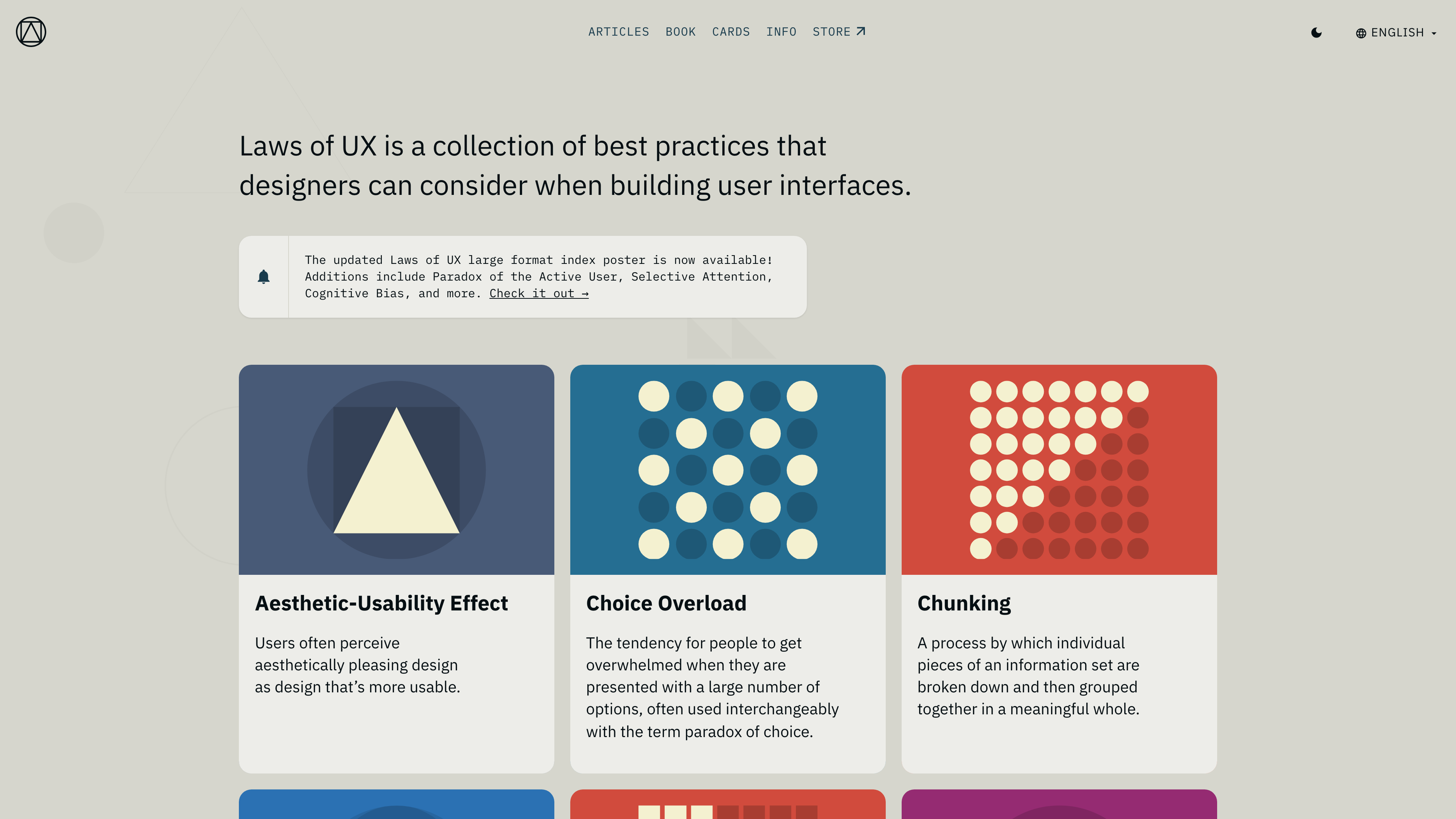
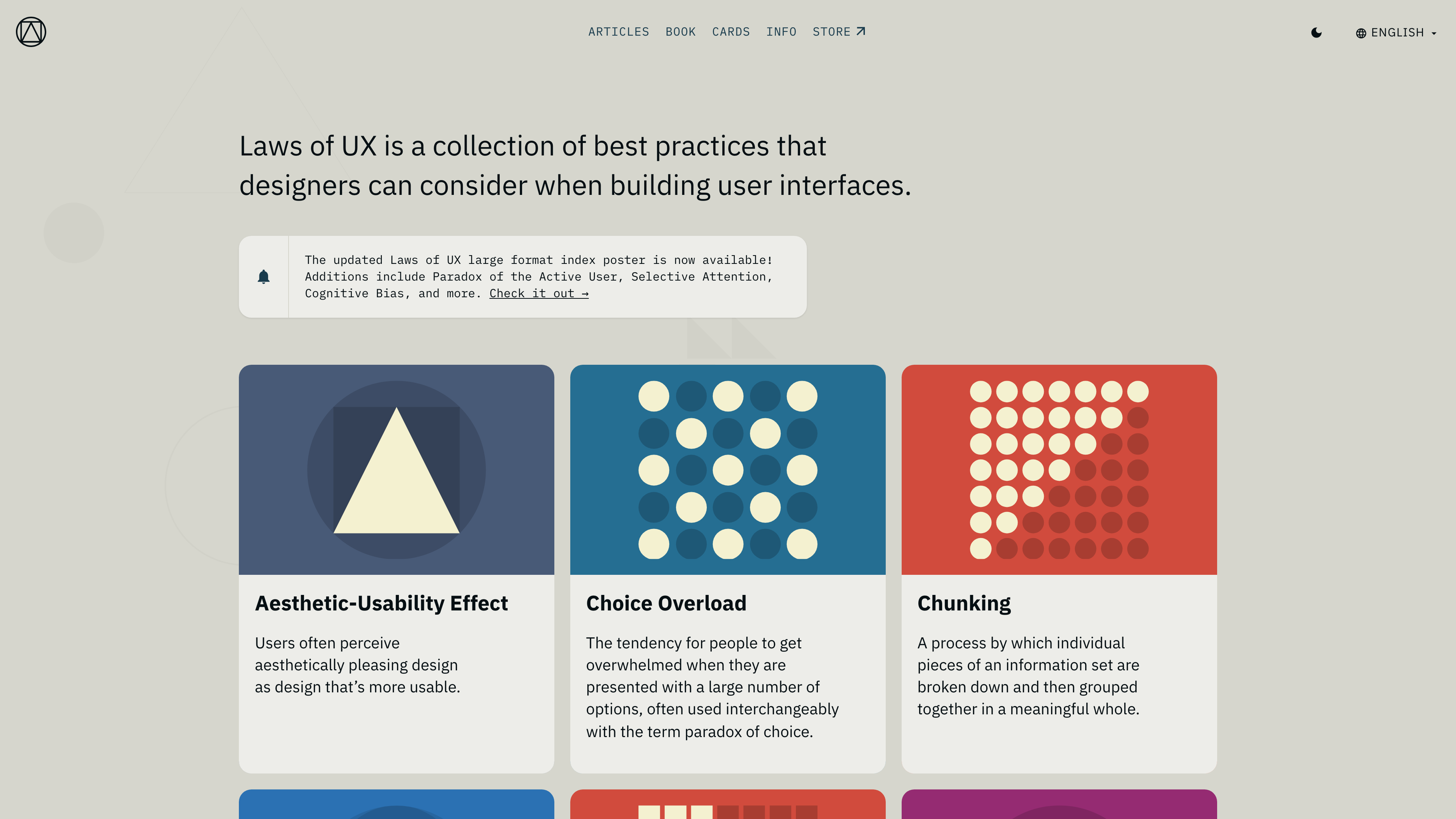
Laws of UX is a reference site that brings psychology into interface design decisions: it curates laws and concepts from psychology that matter to user experience and presents each one as a visually striking card with clear explanations. The goal is to help designers understand the cognitive mechanisms behind user behavior and argue for design decisions on more than taste. The site was created in 2018 by product designer Jon Yablonski, who still maintains it; everything is free to read with no sign-up. Unlike generic "design principle" listicles, every entry ships with practical takeaways, examples drawn from well-known products, and traceable academic sources.
At a glance
- URL: https://lawsofux.com/
- Type: Design reference / psychology knowledge base (independent, single-maintainer site)
- Cost: Free, with no paid content; books, posters, and a card deck are sold separately
- Registration: None required; the site has no account system
- Languages: English, Spanish, French, Arabic, and Persian (as of 2026-09-21; no Chinese version)
Background
Laws of UX was created by Detroit-based designer Jon Yablonski. In an April 2018 interview with the Adobe blog, he said the site launched in mid-January 2018 with ten laws. The idea grew out of his automotive HMI work at the time: while researching cognitive principles to justify simplifying complex vehicle interfaces, he found few designer-friendly resources on the subject, so he built one. The visual identity pays homage to vintage Penguin psychology book covers.
Yablonski is currently a Senior Product Designer at Mixpanel (as of 2026-09-21) and also runs the design-ethics project Humane by Design. Notably, he is explicit that the word "law" is used loosely — these principles are rules of thumb, not substitutes for project-specific user research and testing.
What the collection looks like
As of 2026-09-21, the homepage lists 30 laws and concepts. They range from classic HCI laws (Hick's Law, Fitts's Law, Miller's Law) through Gestalt principles (proximity, similarity, common region) to broader cognitive and behavioral concepts (Peak-End Rule, Zeigarnik Effect, Selective Attention), plus newer additions tied to the book's second edition such as Flow and Choice Overload.
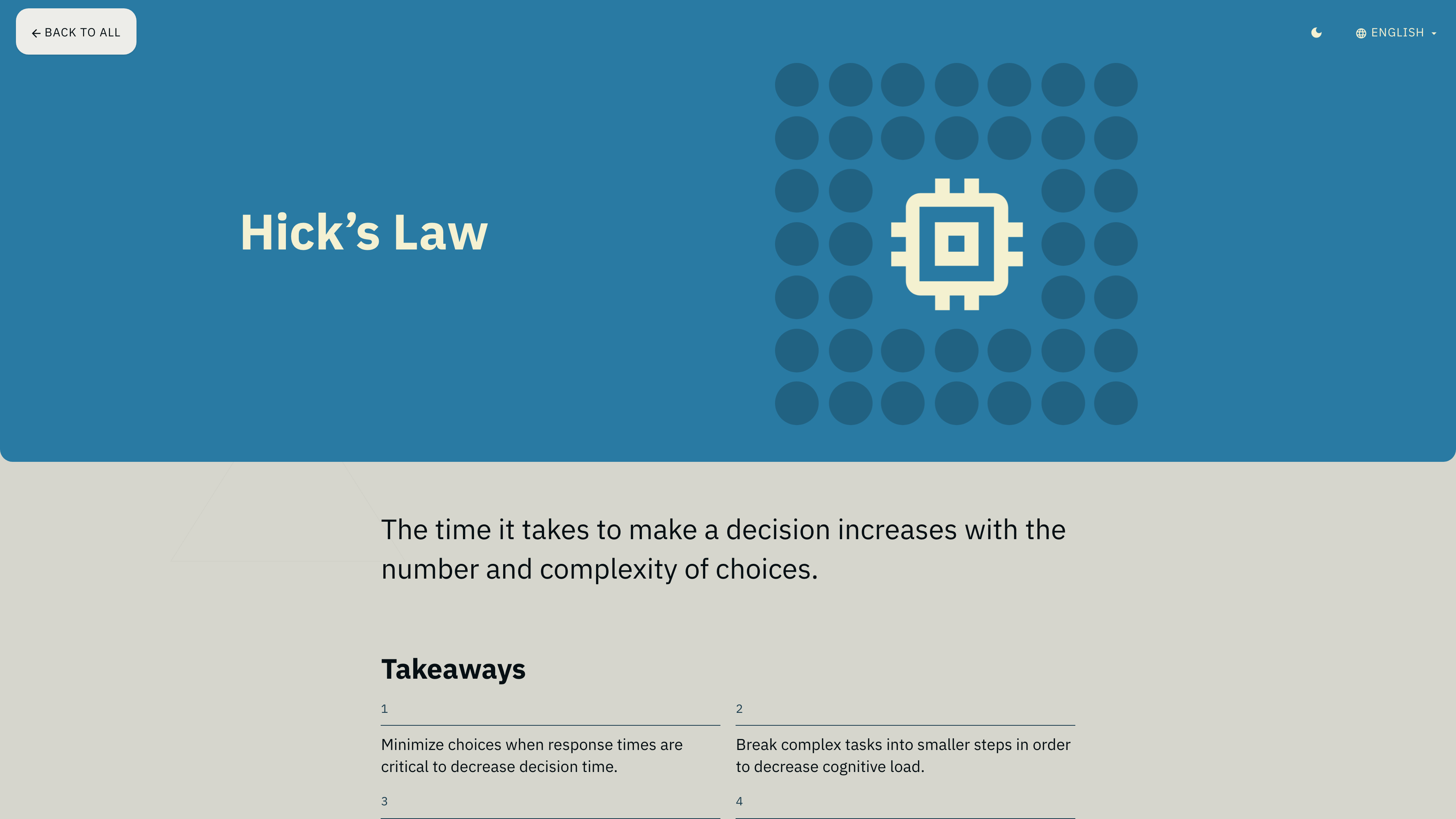
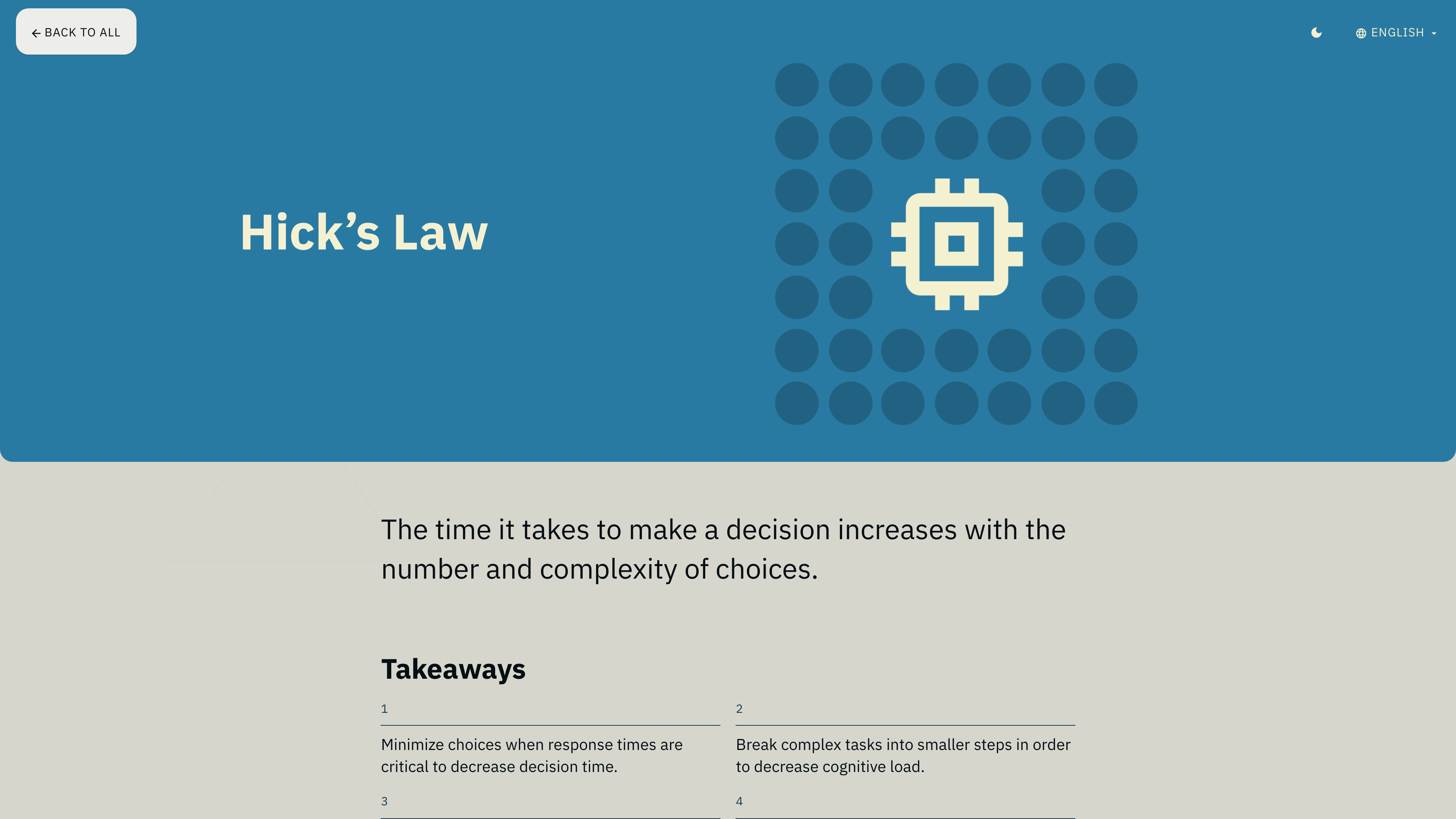
Every law page follows the same structure — Hick's Law is a representative example:
- One-line definition stating the core claim;
- Takeaways: actionable guidance for design work, such as "minimize choices when response times are critical";
- Examples: annotated screenshots from real products, e.g., the Google homepage, the Apple TV remote, and Slack's progressive onboarding;
- Origins: the academic history with linked sources — Hick's Law traces back to the 1952 experiments of William Edmund Hick and Ray Hyman;
- Further reading and a free poster: links to source material, plus a downloadable poster for the law (hosted on Dropbox).
Beyond the law entries, the Articles section holds a small set of long-form pieces on the intersection of psychology and UX (five as of 2026-09-21), including "Familiar vs Novel," which examines when designing for novelty is acceptable.
The book and spin-off products
The site has been expanded into an O'Reilly book, Laws of UX: Using Psychology to Design Better Products & Services. According to the official book page, the first edition appeared in 2020, and a second edition followed in February 2024 (ISBN 9781098146962). The second edition adds three concepts (Paradox of Choice, Complexity Bias, Flow), new considerations (accessibility, personalization, and others), new research techniques (contextual inquiry, user interviews, eye-tracking), and updated examples throughout. Both editions have licensed translations: the first edition is available in Chinese, Japanese, Korean, Spanish, German, Portuguese, Polish, Russian, Thai, and Mongolian; second-edition translations in Portuguese, Bulgarian, Korean, and German are listed.

Other spin-offs:
- Posters: a free digital poster is offered for every law; printed versions are sold through the author's Big Cartel store — individual law posters at 60 (prices as of 2026-09-21). A homepage notice announces that the index poster was recently updated to include newer entries such as Paradox of the Active User, Selective Attention, and Cognitive Bias.
- Card deck: a physical deck made with Pip Decks containing 54 psychological principles and UX methods, pitched as a tool for design reviews and stakeholder buy-in.
Licensing and reuse
Per the site's info page, all website content is published under the Creative Commons BY-NC-ND 4.0 license. In practice: you may share (copy and redistribute) the content with attribution, but commercial use is barred, and derivative works — including publishing your own translations or adaptations — are not permitted. Quoting or resharing a law in a class or talk is generally fine; folding the posters or entries into commercial courseware, internal training material, or published translations requires the author's permission. The book and physical products are not covered by this CC license and follow their own publishing and sales terms.
Privacy and data collection
The site's privacy policy (marked as last reviewed in August 2026) states that it uses Mixpanel for analytics and records a random 5% of sessions for usability research, with data kept in the browser's localStorage rather than tracking cookies; the light/dark theme preference stays on the device; and the contact form is handled by Netlify Forms. For a personal site this is a fairly restrained setup, and reading the laws requires no personal information at all.
Who it's for
- Designers who need citable psychological grounding in design reviews, documentation, or stakeholder presentations;
- Newer designers building a working vocabulary of user behavior and cognitive principles, with concrete examples attached;
- Teams looking for ready-made workshop or training material (keeping the ND clause's limits on adaptation in mind);
- Non-designers — product managers, engineers — who want a low-barrier introduction to common UX principles.
Limitations
- Introductory depth: each law gets a single page aimed at awareness, not rigorous treatment; deeper study requires the book or the original literature cited at the bottom of each entry.
- Single maintainer, irregular cadence: entries have been added gradually (from 10 in 2018 to 30 today), the Articles section is small, and there is no stated update schedule.
- No Chinese version of the site: readers who need Chinese content are limited to the translated first edition of the book.
- Restrictive license: BY-NC-ND rules out commercial use and derivatives, so the free posters cannot be adapted or used in commercial training without permission.
- Examples skew toward major Western products: the Examples sections lean on products like Google, Apple, and Slack, with limited coverage of other regional contexts.
References
- Laws of UX homepage (law catalog)
- Info - Laws of UX (project notes, license, colophon)
- Why All UX Designers Need to Check Out the Laws of UX - Adobe Blog
- Book - Laws of UX (editions and translations)
- Cards - Laws of UX (Pip Decks collaboration)
- Jon Yablonski's Big Cartel store (posters)
- Privacy - Laws of UX
- Jon Yablonski's personal site