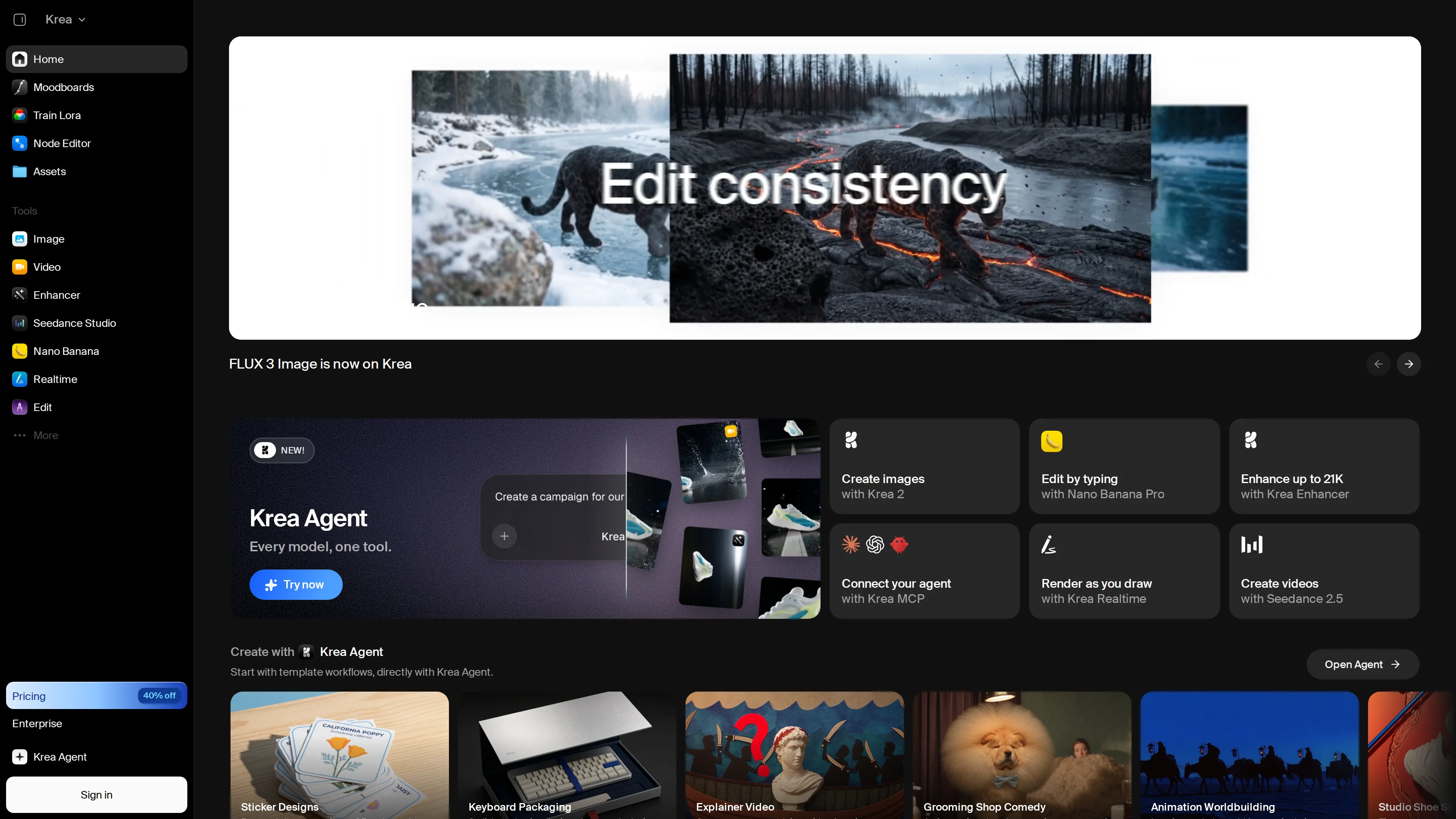
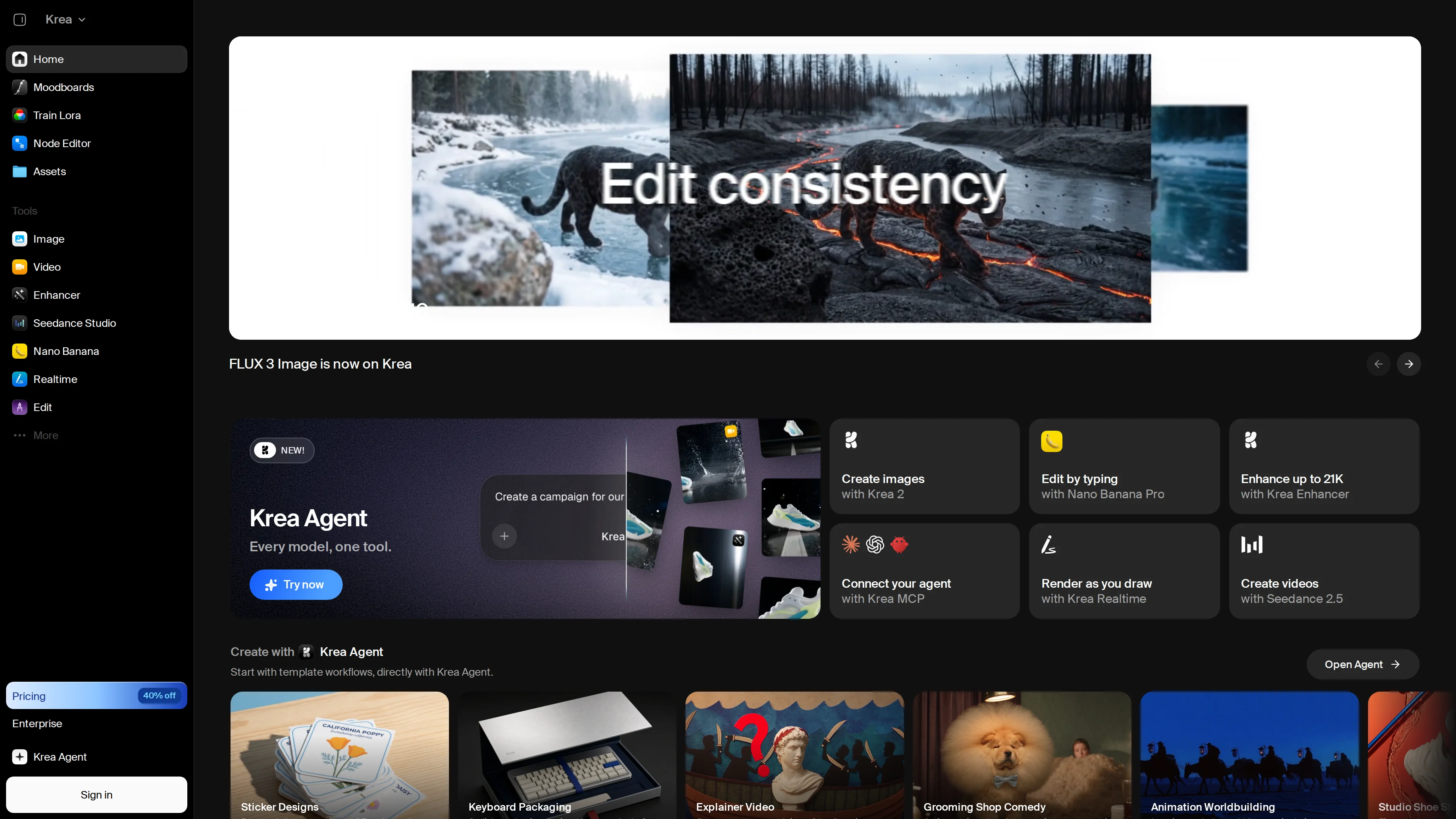
Krea is a browser-based AI visual creation platform (self-described as an "AI creative suite"). Its core idea is to aggregate first-party and third-party models into a single workspace: with one subscription, users can run Krea's own Krea 2 and Krea Realtime alongside models from Google (Veo, Imagen, Nano Banana), OpenAI (GPT Image, Sora), Runway, Kling, Seedance (ByteDance), Hailuo (MiniMax), Wan (Alibaba), Ideogram, and FLUX (Black Forest Labs). The toolset spans image generation, video generation, realtime rendering, upscaling and enhancement, canvas editing, 3D generation, and custom LoRA training. The company says more than 150 models are available (Press Kit). Compared with single-model services, Krea differentiates itself through this combination of multi-model aggregation, realtime generation, and model training.
Quick Facts
- URL: https://www.krea.ai
- Type: AI image/video generation and editing platform
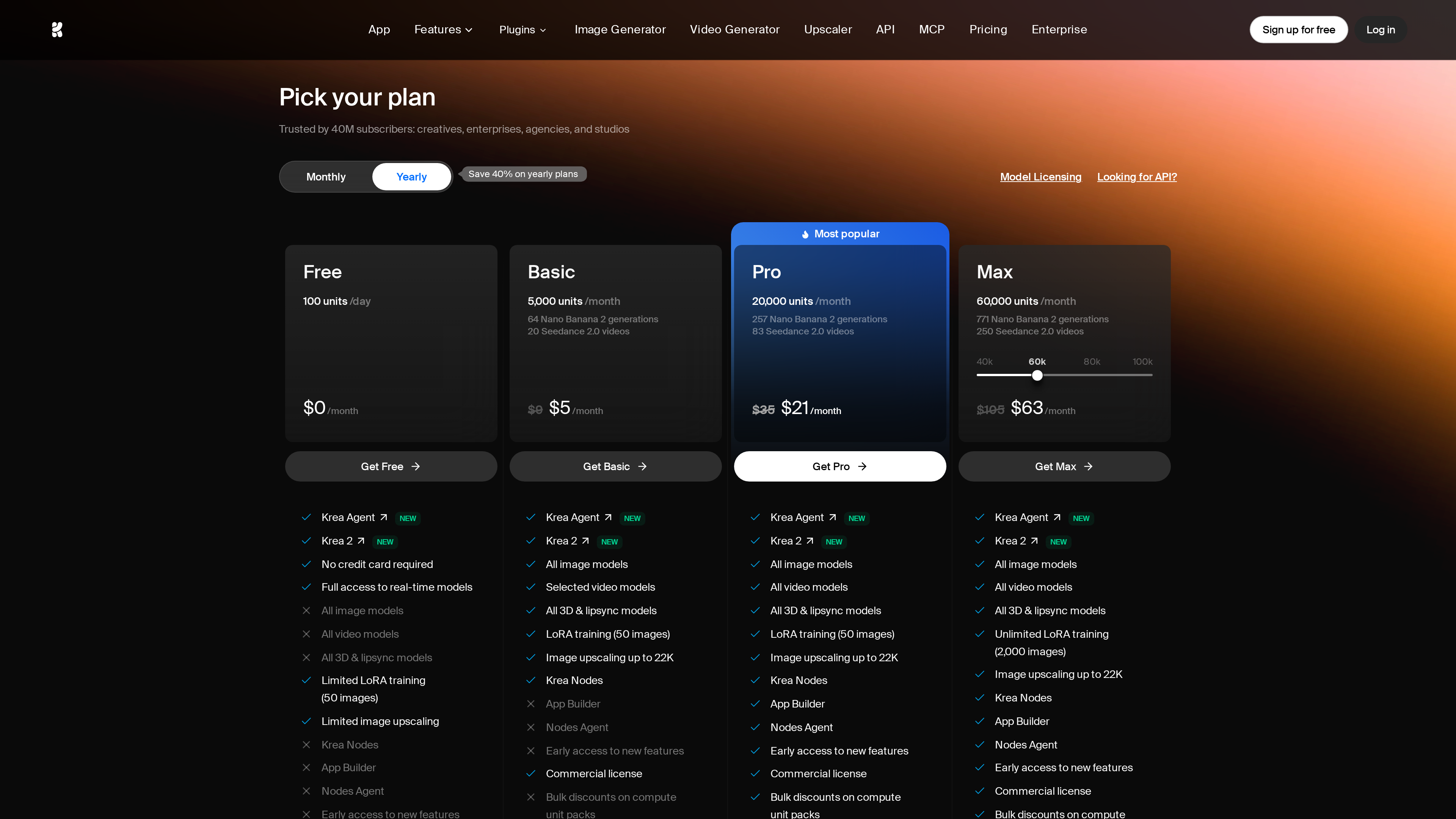
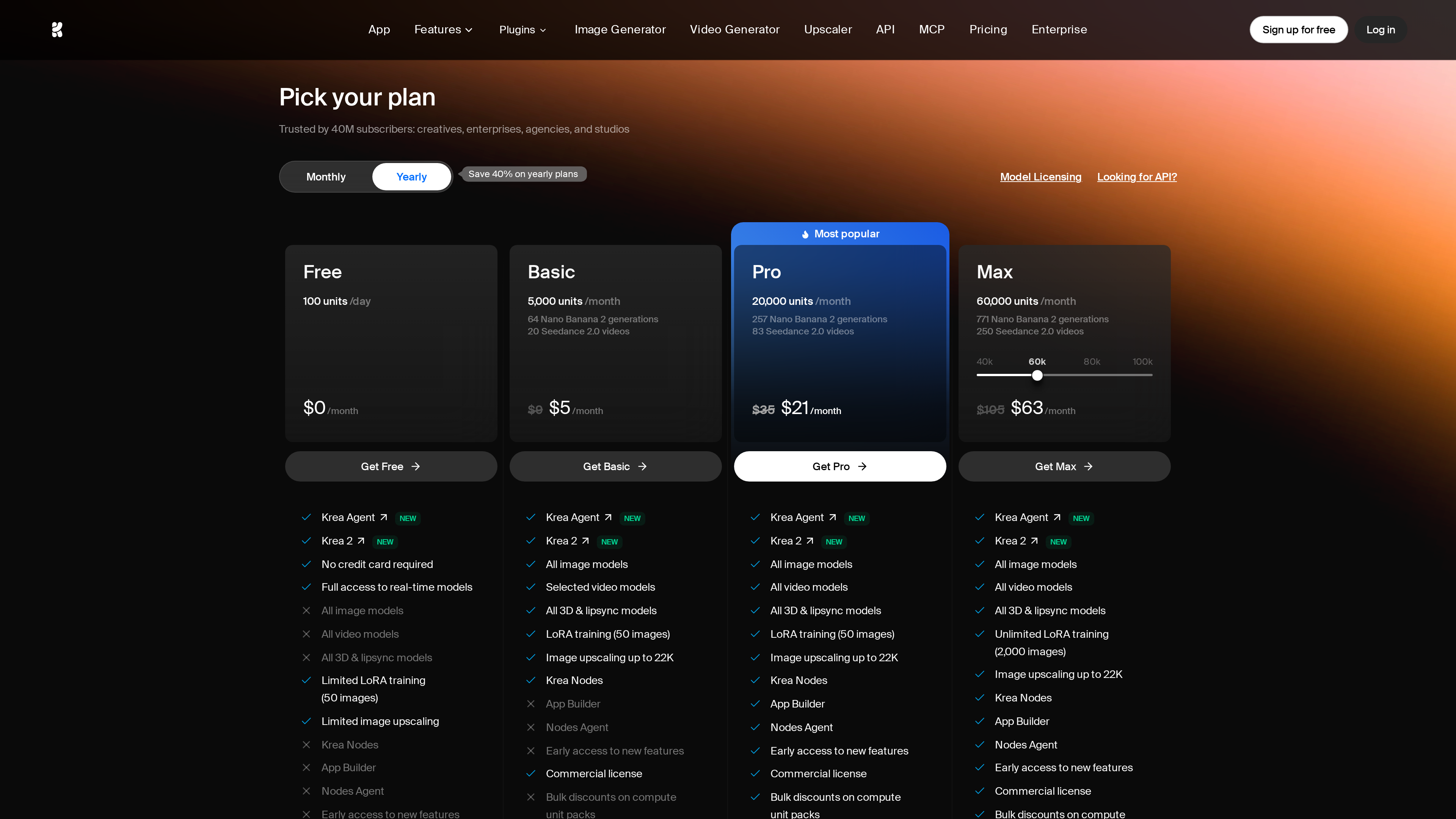
- Pricing: Free tier with 100 compute units/day; paid plans from 5/month billed yearly); team and enterprise tiers available (as of 2026-10-02, pricing page)
- Sign-up: Required (Google, Apple, or email); no credit card for the free tier; SAML SSO on enterprise plans
- Interface language: English (documentation is localized into multiple languages, including Chinese); desktop Chrome recommended
- Mobile: An iOS app is offered (download link in the site footer)
Background
Krea is operated by KREA.AI, INC., headquartered in San Francisco, California. According to its Forbes company profile (updated April 2026), Krea launched in 2022, was co-founded by Victor Perez (CEO) and Diego Rodriguez Prado, has raised 500 million, and employs about 40 people; Forbes names Shopify and Perplexity among its enterprise customers. The pricing page claims "40M subscribers" (the company's own marketing figure, as of 2026-10-02).
Documented milestones in Krea's own model development:
- Krea 1: its first flagship in-house image model, designed to avoid a generic "AI look."
- FLUX.1 Krea [dev]: an open-weights model released with Black Forest Labs on July 31, 2025, fully compatible with the FLUX.1-dev ecosystem, with weights published on Hugging Face (official release note).
- Krea 2: described by the company as its first foundation image model trained entirely from scratch, focused on aesthetic control, with a style-transfer system that reads reference images, adjusts their influence, and combines multiple styles (Press Kit).
- Krea Agent: a creative-production agent launched on September 10, 2026, which plans jobs in a chat, picks models, and generates, reviews, and edits images, video, and audio (Press Kit).
Core Capabilities
Image and Video Generation
The image tool offers text-to-image with a model picker, style references, aspect-ratio controls, and post-generation editing. The video tool supports text-to-video and image-to-video with start/end frames and prompt-driven camera movement (official docs). As of 2026-10-02, the homepage lists dozens of video models including Veo 3.1, Sora 2, Kling, Seedance, Hailuo, Wan, LTX, Ray, and Grok Imagine, plus image models such as the Krea 2 family, FLUX, Nano Banana, GPT Image, and Ideogram; the roster changes frequently.
Realtime Generation
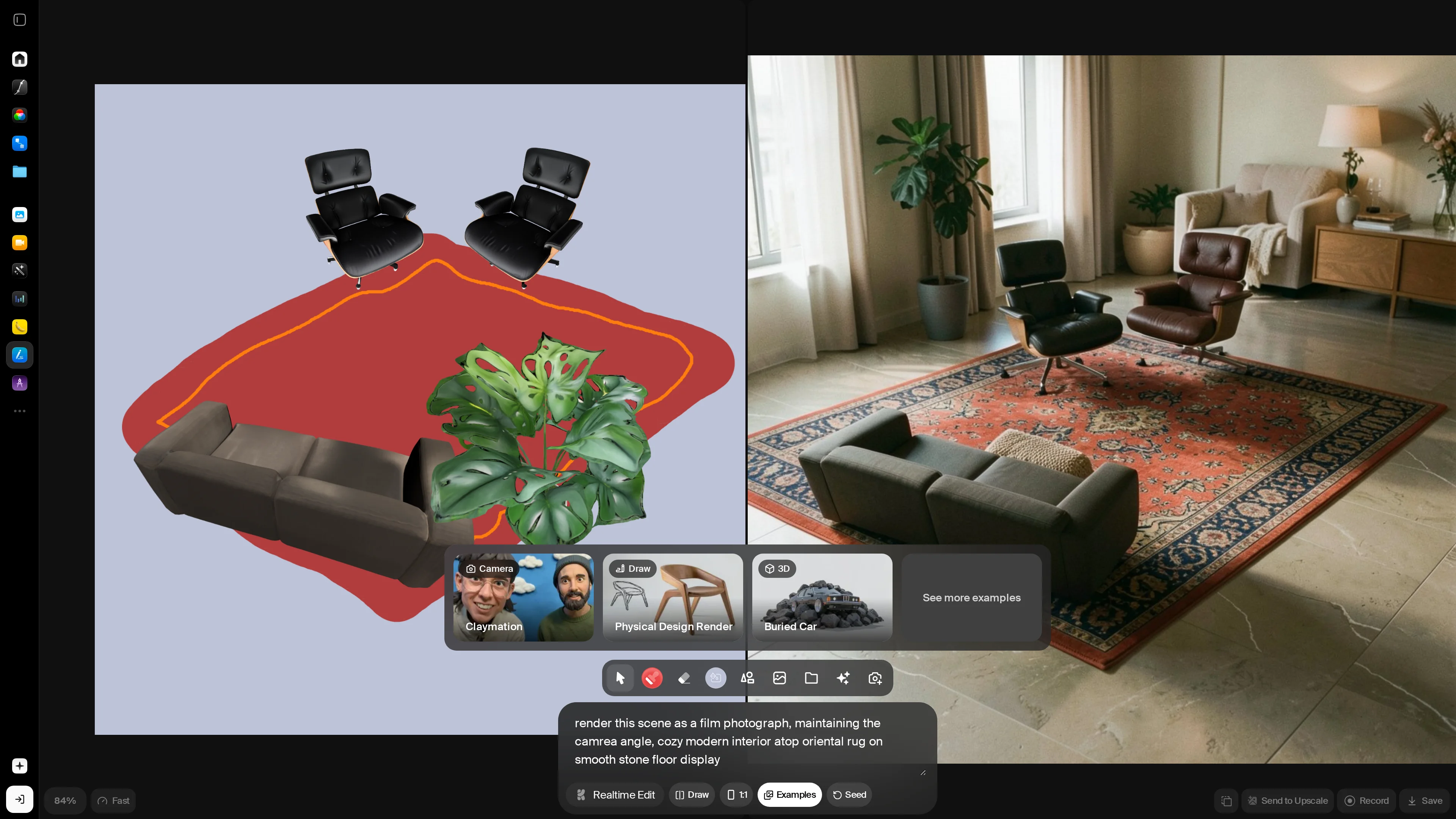
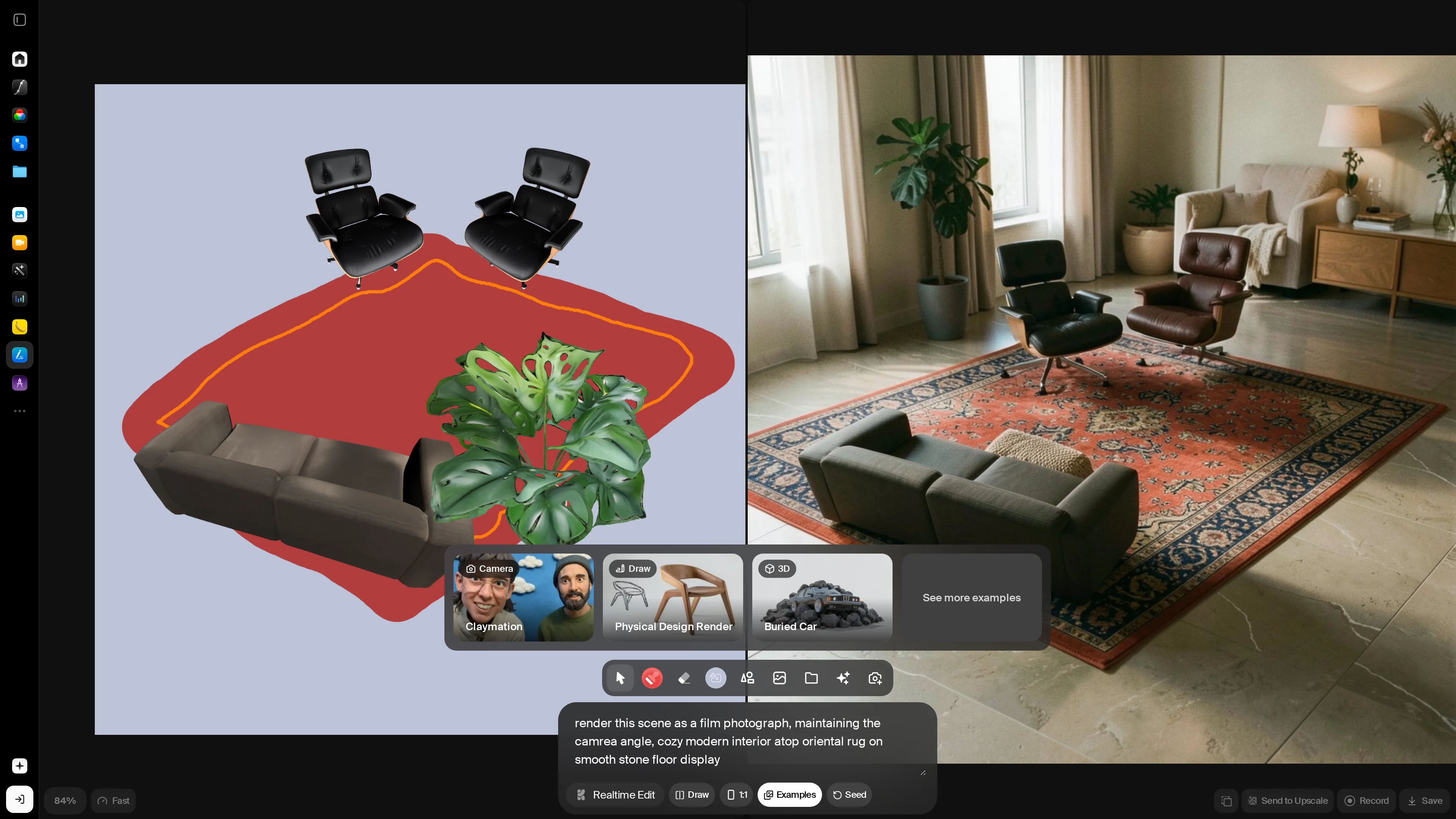
Realtime is the feature Krea itself highlights most: as you type a prompt, move shapes, or draw on the canvas, the output updates instantly instead of waiting for a full generation; webcam input can map your gestures onto the result. It is built for rapid exploration of composition and style (Realtime docs).
Enhancement, Editing, and 3D
The Enhancer upscales images to higher resolution, sharpens detail, adjusts lighting, and reduces noise, and works on images brought in from outside the platform. Edit is a canvas-based tool for regional modification, object removal, outpainting, and camera-angle or lighting changes. Additional tools include background removal, video upscaling and style transfer, text-to-3D and image-to-3D, lip sync, and motion transfer (official docs and site navigation).
Custom Model Training (LoRA)
Users can train image or video LoRAs on their own datasets to capture characters, styles, or products as reusable models, with LoRA sharing supported. Training dataset size is capped by plan: 50 images on Free, Basic, and Pro; 2,000 images on Max (pricing page, as of 2026-10-02).
Workflows and Open Integrations
Krea Nodes is a visual node editor that chains models, prompts, and processing steps into workflows; App Builder turns those workflows into reusable, shareable apps; a Nodes Agent helps build workflows with natural language. For integrations, Krea provides a REST API, MCP, a ChatGPT plugin, and an After Effects plugin; audio generation (music, voiceovers, sound effects) is available inside node workflows via ElevenLabs, Qwen TTS, and others (docs index).
Pricing and Free Allowance
Krea bills in "compute units," with consumption varying by model and quality settings (for example, the homepage lists roughly 35 units per Wan 2.1 video versus about 1,900 for Veo 2). Monthly allowances on individual plans do not roll over; one-time compute packs are valid for 90 days (Compute Units guide). Plans as of 2026-10-02 (pricing page; yearly billing is about 40% off):
| Plan | Monthly | Effective monthly (yearly) | Compute allowance | Notes |
|---|---|---|---|---|
| Free | $0 | — | 100 units/day | No credit card; full access to realtime models; 1 image / 0 video concurrency; LoRA training capped at 50 images; upscaling up to 2K |
| Basic | $9 | ~$5 | 5,000 units/mo | All image models, selected video models; 4 image / 2 video concurrency; upscaling up to 22K |
| Pro | $35 | ~$21 | 20,000 units/mo | All video models; 8 image / 4 video concurrency |
| Max | from $105 | from ~$63 | 60,000 units/mo (40k–100k selectable) | LoRA training up to 2,000 images; unlimited image concurrency |
| Business | from $200 | from ~$160 | from 80k units/mo (up to 1.5M) | Up to 50 seats at no per-seat cost; credits roll over; roles and model-access controls |
| Enterprise | Custom | Custom | Custom | SAML SSO, audit logs (marked "soon"), custom compute packages, IP indemnification |
On the free tier, once the daily allowance is used up you wait for the next day's refill or upgrade; some paid plans allow continued low-priority "relaxed" generations with in-house models after units are exhausted.
Copyright and Content Policy
- Your uploads: Users keep ownership of their User Submissions, but the Terms of Use grant Krea and other users a broad license to them (including for promoting the service, surviving account termination).
- Generated content: Krea grants users a license to access and use generated content, but the Terms state that rights to use, reproduce, modify, distribute, or store content depend on the subscription tier.
- Commercial use: The pricing comparison table shows no commercial license on the Free tier; Basic, Pro, Max, Business, and Enterprise include one, and the official FAQ says paid tiers may use generated content for marketing, products, and client work (as of 2026-10-02).
- Business terms: Business and above include clauses such as no training on customer content; Enterprise adds indemnification against IP claims on generated content, subject to the agreement.
- A DMCA notice-and-counter-notice process is in place. The Terms and Privacy Policy pages were last updated on May 20, 2024; disputes go to binding JAMS arbitration in San Francisco County with a class-action waiver.
Who It Suits
- Designers, marketers, and ad teams who want to compare outputs across many frontier models in one place;
- Creatives who explore composition and style on a live canvas (concept sketches, interior previews, storyboard exploration);
- Studios that need to train private LoRAs of brand characters, products, or styles and reuse them at scale;
- Teams that want to wire generation into existing pipelines via API, MCP, or the ChatGPT/After Effects plugins;
- Individuals on a budget who only need a small daily amount of multi-model generation (free tier).
Limitations
- Restrictive free tier: 100 units/day, zero video concurrency (video jobs can't be queued), one image job at a time, upscaling capped at 2K, LoRA training limited to 50 images, and no commercial license (as of 2026-10-02).
- No rollover on individual plans: unused monthly units on Basic/Pro/Max expire; consumption varies widely by model, making it hard to predict how many generations a monthly allowance buys.
- English-only app interface: only the documentation site is localized.
- Legal terms: the platform takes a broad license to user submissions; Terms and Privacy Policy have not been republished since May 2024; email login is case-sensitive (called out in the official docs).
- Shifting model roster: third-party model availability and per-generation costs change over time; the models and prices cited here reflect the site on 2026-10-02.
References
- Krea homepage and pricing page (checked 2026-10-02)
- Krea documentation: What is Krea?, Compute Units, Realtime
- Terms of Use / Privacy Policy (last updated 2024-05-20)
- Krea Press Kit
- Releasing Open Weights for FLUX.1 Krea (2025-07-31)
- Forbes company profile: Krea (updated April 2026)