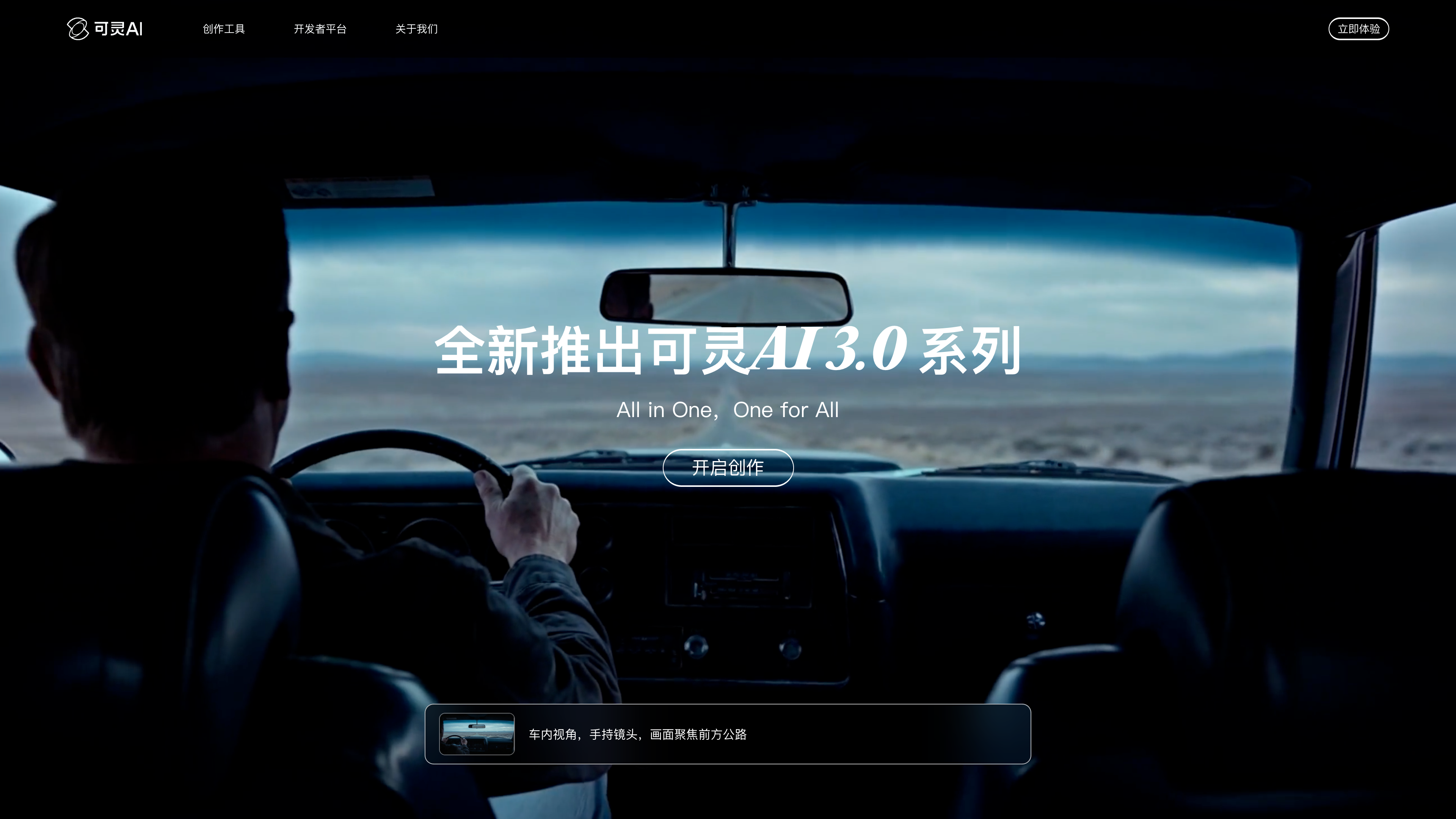
Kling AI (klingai.com) is an AI video and image generation platform developed by Kuaishou, the Beijing-based company behind China's second-largest short-video app. Give it a text prompt or an image and it produces video clips of up to 15 seconds at up to native 4K, with companion tools for motion transfer, talking digital humans and an agent-driven canvas, while the same model family is exposed to developers through a per-second-billed API. In short, it turns shots that used to require filming and post-production into cloud generation tasks metered in "inspiration credits." Against Western rivals such as OpenAI's Sora and Google's Veo, Kling's verifiable distinctions are its roots in Kuaishou's short-video ecosystem, a "free tier + tiered membership + API" monetization model that made it the first Chinese video-generation product to reach a nine-figure-dollar annualized revenue run rate, and a 2026 spin-off from Kuaishou backed by Tencent, Alibaba and Baidu. As of June 2026, the company reported more than 100 million users across 224 countries and regions.
At a Glance
- URL: https://klingai.com/ (Chinese); the international English site is https://kling.ai/ — as of 2026-09-16, a banner on klingai.com announces that the global website has officially migrated to kling.ai. The creation workspace lives at app.klingai.com (China version at /cn/, international version at /global/)
- Type: AI video/image generation platform + creator community + developer API
- Cost: free tier with 66 daily credits (watermarked); China memberships roughly ¥58–¥1,149/month across four tiers on auto-renew; API billed per second at roughly ¥0.3–¥3.0 depending on model and resolution (as of 2026-09-16)
- Registration: public pages need no account; generation requires sign-in. Accounts ride on Kuaishou's unified account system — in China that means phone-number verification, and some features (including API purchases) require real-name verification per the privacy policy. Minors under 18 need guardian consent
- Interface languages: separate Chinese and English sites; iOS and Android apps plus a Kuaishou mini-program
- Launched: applications opened June 6, 2024; full web beta opened late July 2024 (official Kuaishou press release)
Background
Kling AI was built by Beijing Kuaishou Technology and opened for applications on June 6, 2024 — more than half a year before Sora became publicly available, which is why Kuaishou calls it "the world's first photorealistic video-generation model available to ordinary users." Within five weeks, over one million people had applied and 300,000 had received access (Kuaishou press release, July 2024). Technically, Kling uses a diffusion transformer (DiT) with a self-developed 3D VAE for spatiotemporal compression and a 3D spatiotemporal joint attention mechanism (cross-checked against the Wikipedia entry); its generative models are registered with Chinese regulators (Kling: Beijing-KeLing-202409250032; KeTu image model: Beijing-KeTu-202404280003, see §6 of the privacy policy).
The model line has iterated roughly once per quarter: 1.6 (December 2024) → 2.0/2.1 (spring 2025) → 2.5 Turbo → O1 (December 2025, billed as the first unified multimodal video model, folding text-to-video, image-to-video and video editing into one semantic-control workflow) → 2.6 (December 2025, generating synchronized audio — dialogue, sound effects and ambience — in a single pass) → the 3.0 series (globally launched February 5, 2026: Video 3.0, Video 3.0 Omni and Image 3.0, which Kuaishou describes as the first native-4K video model, with up to 15-second continuous generation and intelligent storyboarding) (Sina Finance, The Paper). In Q2 2026 the 3.0 line added direct native-4K output, and Kling shipped an MCP server and CLI so AI agents can drive batch generation programmatically (Q2 2026 earnings coverage).
Kling is unusually transparent about its commercial trajectory, because parent company Kuaishou reports it (all figures from earnings or official disclosures):
- March 2025: ten months after launch, annualized revenue run rate (ARR) passed 20M, a 300M (Shanghai Securities News via Sohu, China Energy News).
- Full-year 2025 revenue exceeded ¥1B RMB; Q2 2026 alone brought in over ¥850M, up more than 200% year over year, with roughly ¥1.5B in the first half (Caixin). Paid memberships contribute nearly 70% of revenue, per Yilan Business.
- Second anniversary, June 6, 2026: 100M+ users globally (up ~67% from 60M at the end of 2025) and nearly 50,000 enterprise customers (Tide News).
- July 2, 2026: Kuaishou announced Kling's independent spin-off financing — a $15B pre-money valuation, up to 18B post-money, with Tencent, Alibaba and Baidu among the investors (Caijing, Cyzone). Kuaishou remains the controlling shareholder.
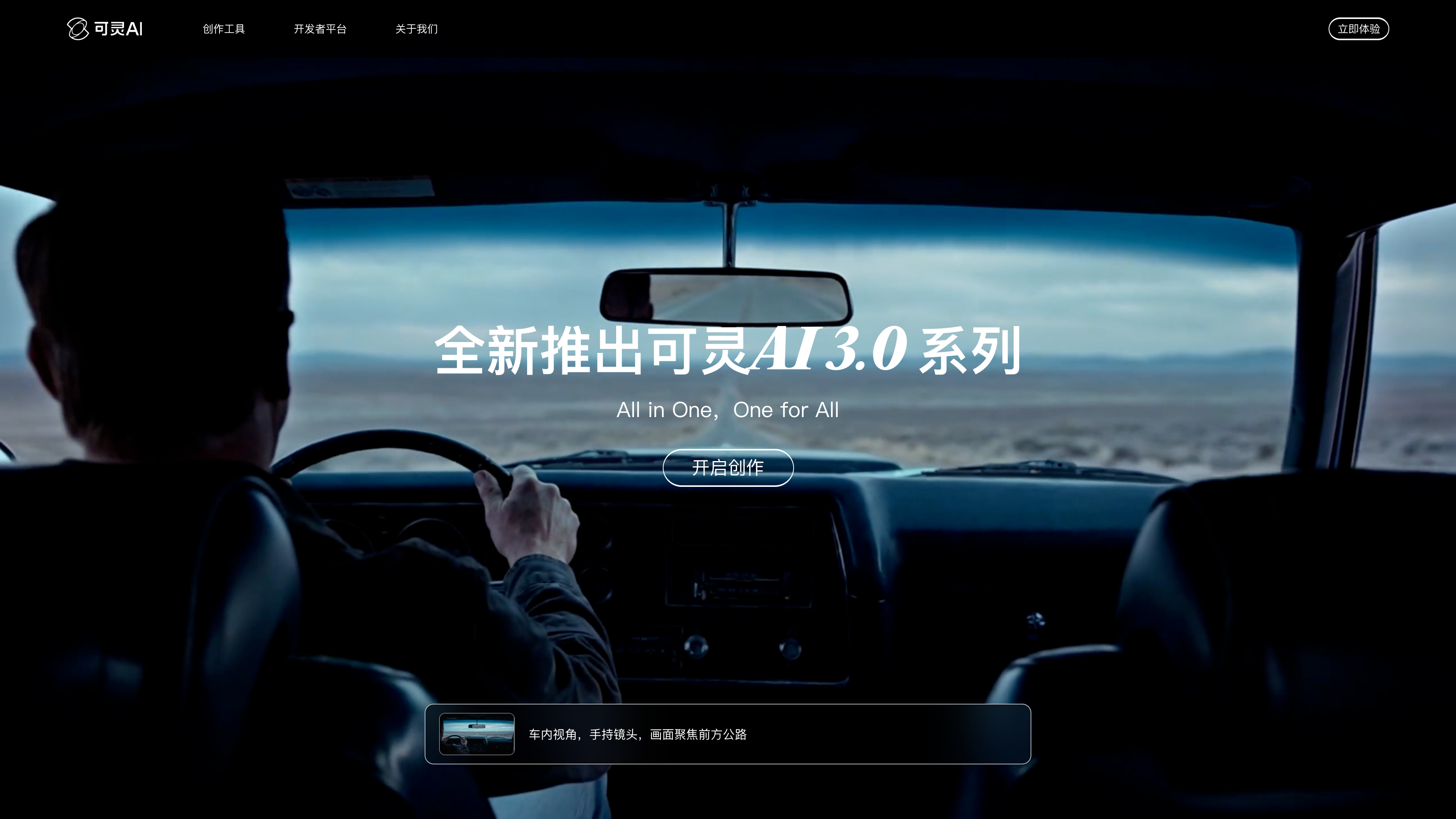
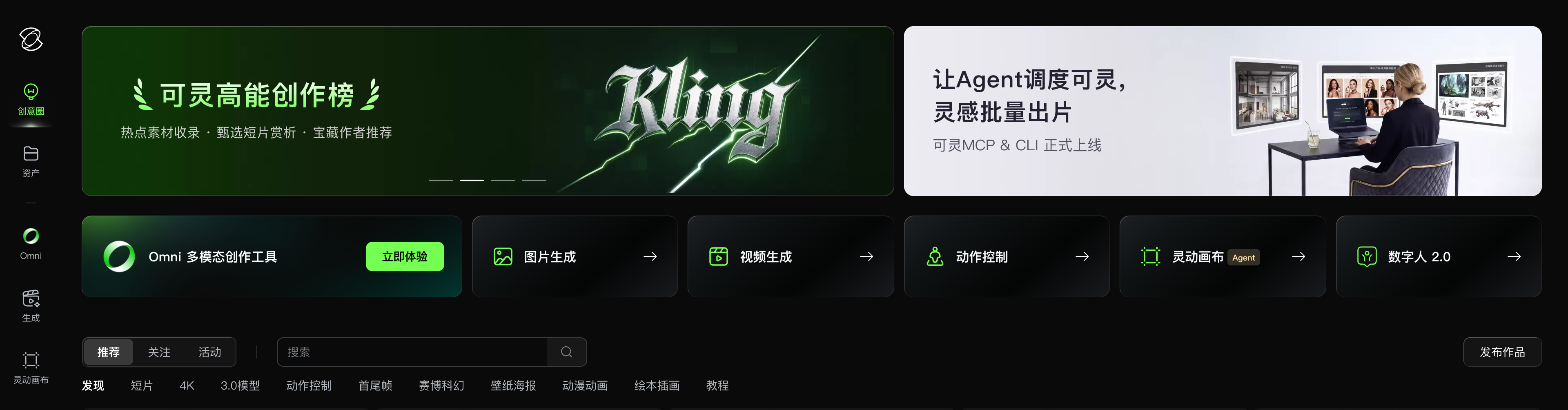
Above is Kling's Chinese homepage (captured 2026-09-16): the hero plays a 3.0-generated sample clip alongside the prompt that produced it. Note the migration banner that was live at the time — Kuaishou is splitting its Chinese and global web presences across klingai.com and kling.ai.
Core Capabilities: the 3.0 Family and an All-in-One Studio
As of 2026-09-16, the web workspace (app.klingai.com) presents six creation entry points on its first screen:
- Omni multimodal studio: the unified front end for the 3.0 Omni model, mixing text, images, video clips and reference subjects in one instruction; Omni accepts a reference video to lock a character's appearance and voice across shots.
- Video generation: text-to-video and image-to-video with first/last-frame control, smart frame interpolation, protagonist reference and custom camera moves; 3.0 generates up to 15-second clips at up to native 4K, optionally with synchronized multilingual dialogue and lip-sync.
- Image generation: Image 3.0 and 3.0 Omni, with 2K/4K output and multi-image sets.
- Motion Control: upload a real performance video and transfer its motion and expressions onto any character — billed as a separate capability in the official API docs.
- Canvas Agent: a conversational canvas where an agent breaks a script into shots and dispatches batch generation (the same automation direction as the MCP/CLI shipped in Q2 2026).
- Digital Human 2.0: one character image plus text or audio yields a presentation video of up to 5 minutes with precise lip-sync and hand gestures, across multiple character types and languages including Chinese, English, Japanese and Korean (ITHome).
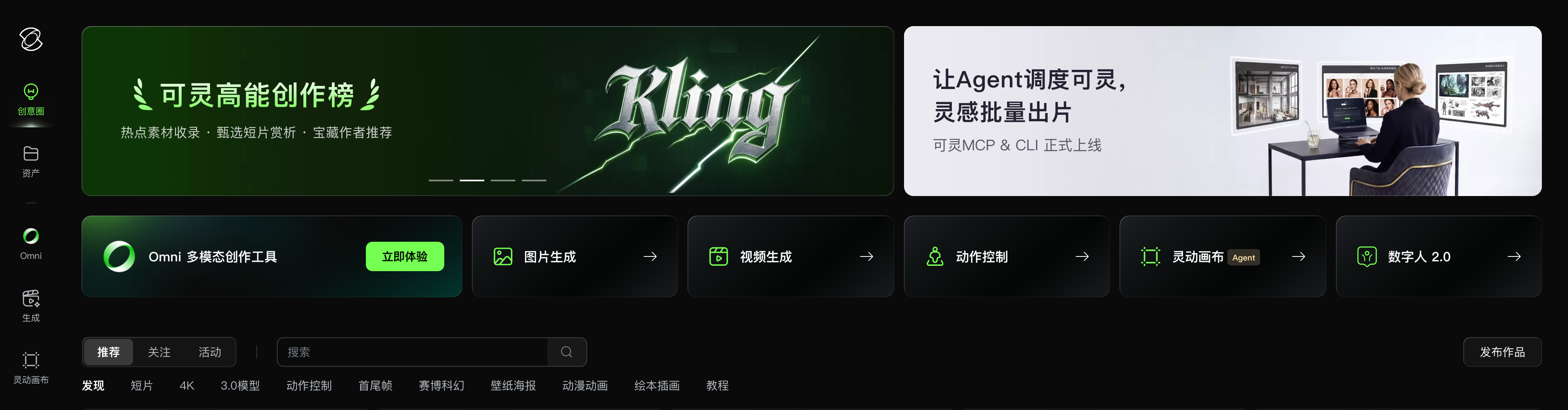
Around the studio sits the "Explore" community: published works are browsable by tags such as short film, 4K, motion control, cyberpunk and picture-book illustration, with prompts inspectable in one click. Be aware that under §10.4 of the Terms of Service, anything you publish can be reused by other users as a reference image or prompt for derivative "make it like this" generations — avoid publishing anything you want to keep exclusive.
Accounts, Pricing and the Open Platform
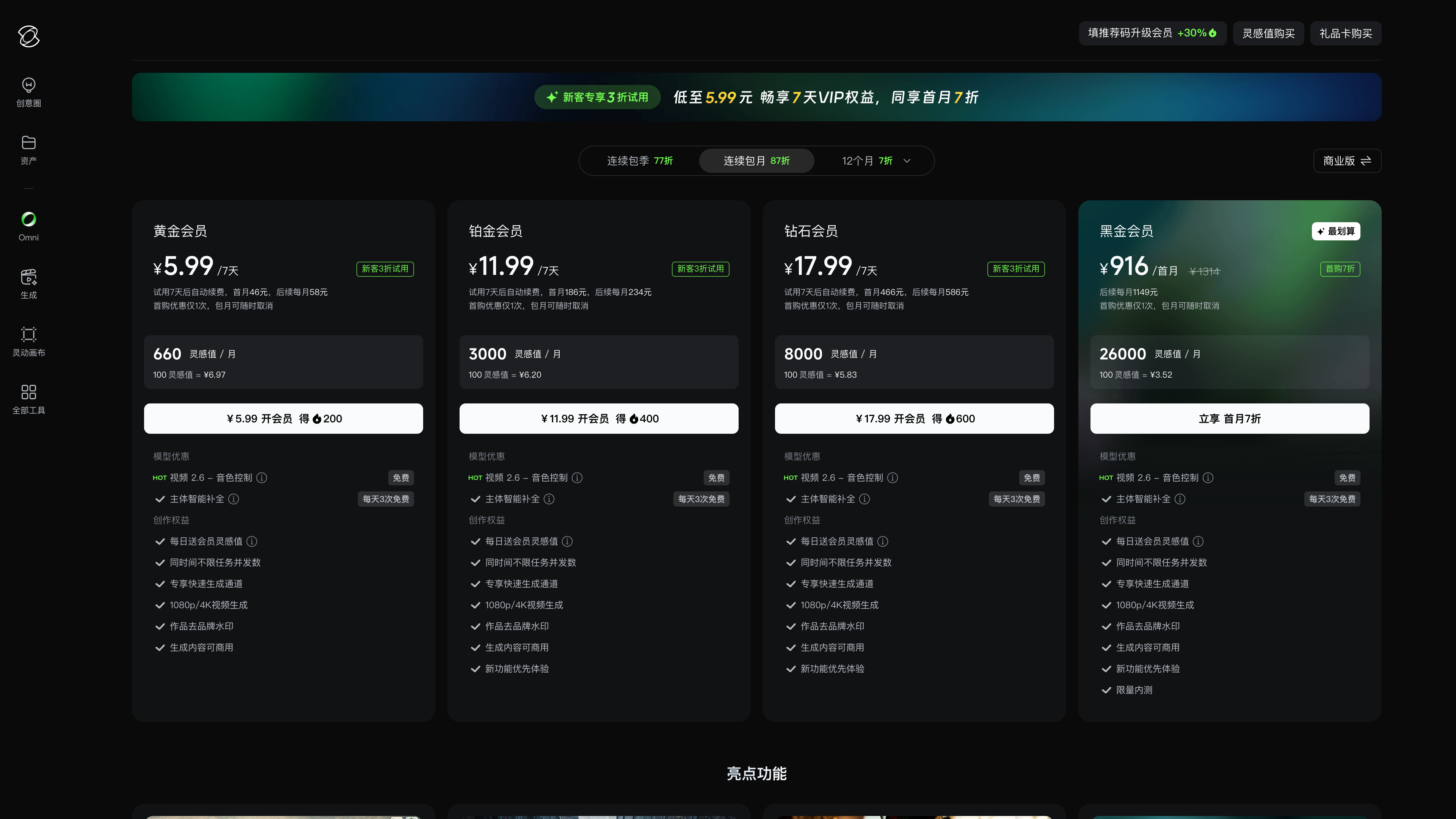
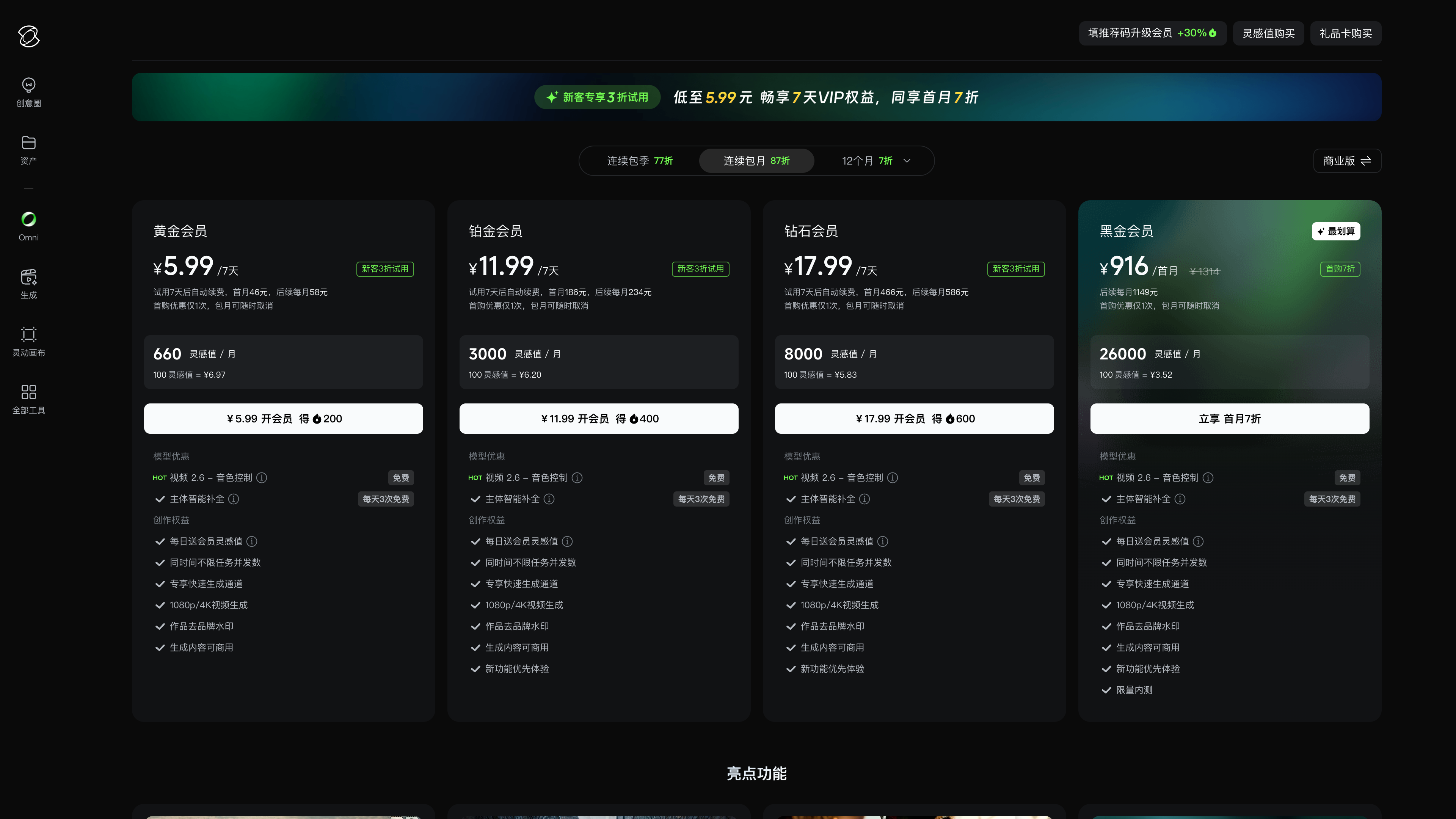
Kling meters everything in "inspiration credits," with rates varying by model and resolution. As of 2026-09-16, the China membership page lists four tiers (auto-renew prices shown; new users get a 7-day trial at 70% off, with further discounts for quarterly and annual billing):
| Tier | Renewal price/month | Monthly credits | Effective rate | Key differences |
|---|---|---|---|---|
| Free | ¥0 | 66 per daily login | — | Watermarked output; 30 saved subjects; one video per generation |
| Gold | ¥58 (first month ¥46) | 660 | ~¥6.97/100 | No watermark, commercial use, 1080p/4K, fast lane, unlimited concurrency |
| Platinum | ¥234 (first month ¥186) | 3,000 | ~¥6.20/100 | Early access to new features |
| Diamond | ¥586 (first month ¥466) | 8,000 | ~¥5.83/100 | Higher volume, lower unit price |
| Black Gold | ¥1,149 (first month ¥916 promo) | 26,000 | ~¥3.52/100 | Limited beta access; 500 saved subjects |
The international site bills in US dollars and advertises "plans from 10/92 per month across three tiers (Tide News). The 66 free daily credits covered about six standard videos in the 1.x era (per the official press release) — against today's 3.0/4K models they only stretch to a few test renders, so treat the free tier as a demo.
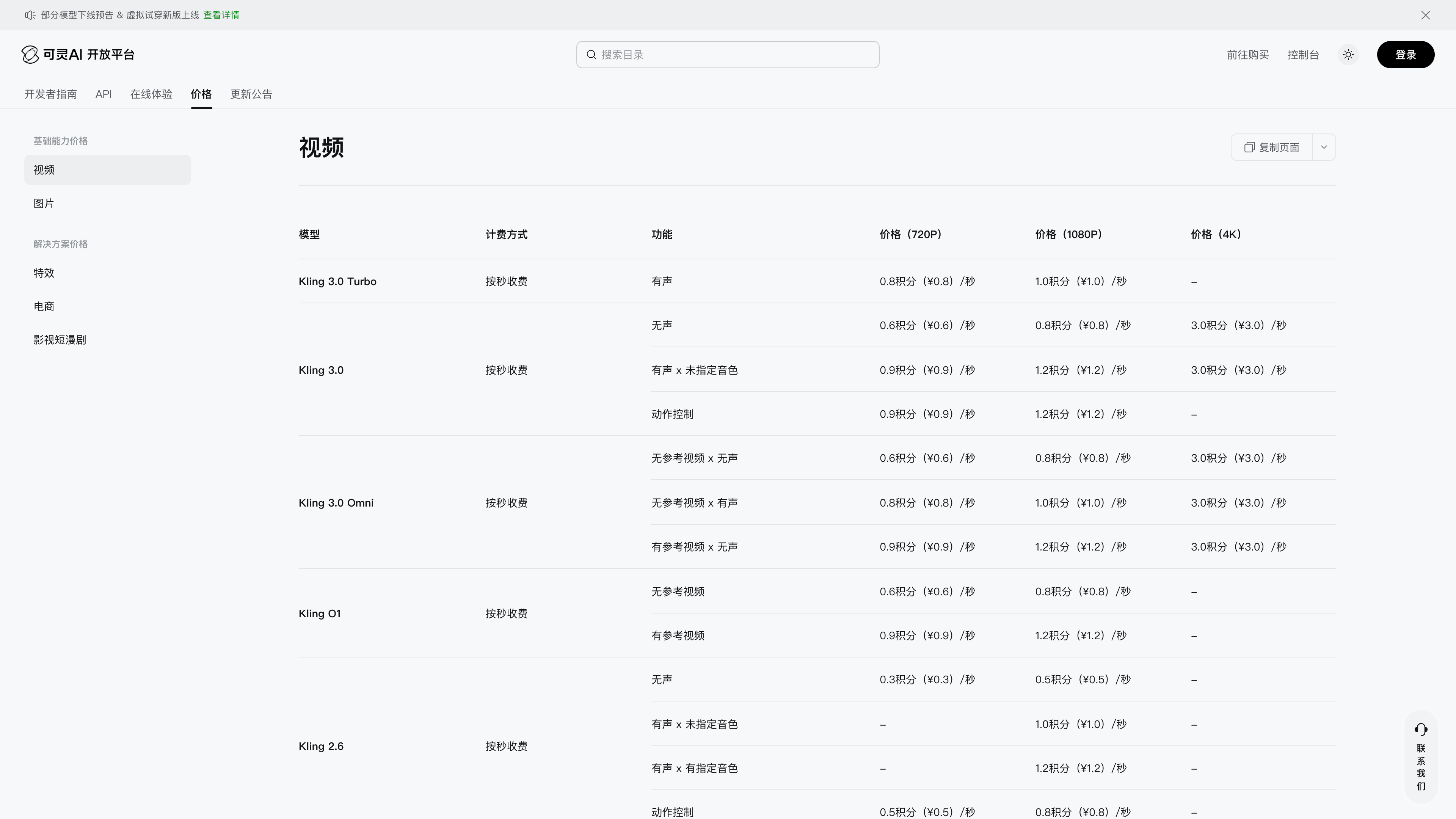
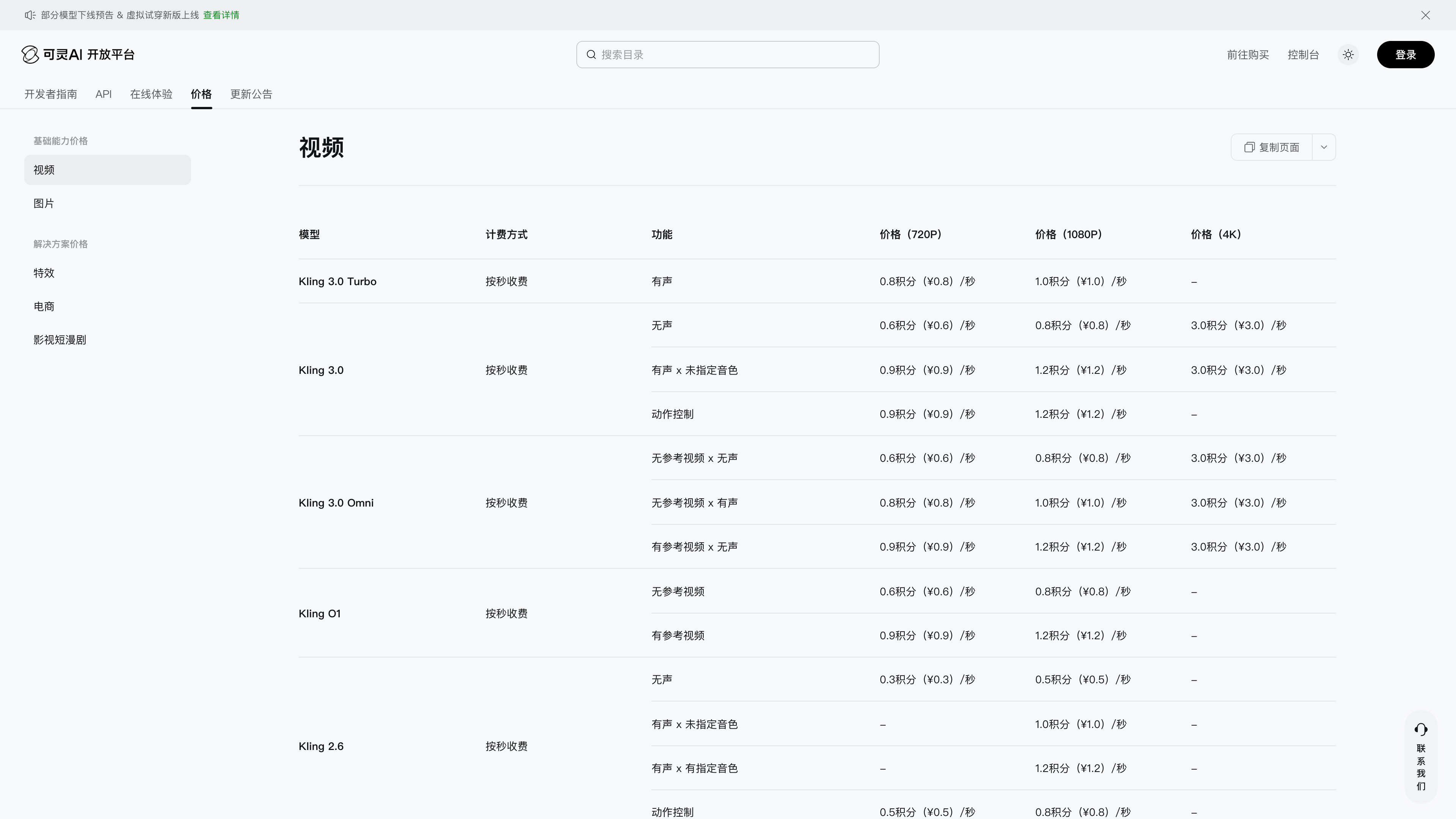
For developers, the Kling open platform bills the API per second in RMB credits (1 credit = ¥1), as of 2026-09-16: Kling 3.0 Turbo (with audio) ¥0.8–1.0/sec; Kling 3.0 silent ¥0.6/0.8/3.0 per second (720p/1080p/4K), audio or motion control ¥0.9/1.2; Kling 3.0 Omni ¥0.6–1.2/sec; the older Kling 2.6 silent ¥0.3/0.5; digital humans ¥0.4/0.8/sec, lip-sync ¥0.5 per 5 seconds. An English-language API platform serves overseas developers (app.klingai.com/global/dev), and an enterprise membership offers centralized verification, top-ups and quota allocation. Note that Kuaishou retired Kling 1.0–2.1, the early image models, the virtual try-on API and 122 effect templates on September 15, 2026 — existing integrations must migrate (official docs announcement).
Copyright and Content Policy
Kling operates under characteristically strong platform rules. Key points from its Terms of Service (effective 2025-12-05) and Privacy Policy (effective 2025-12-16):
- Ownership of output: to the extent permitted by law, IP in generated content belongs to the user or the relevant rights holder (§10.1.2). Commercial use is tied to membership — member benefits explicitly include commercial-use rights, while the general clause §8.4.2 says output should not be used commercially without written permission. Free-tier commercial use sits in a gray zone; a paid plan or written consent is the safe route.
- License back to the platform: §10.1.4–10.1.5 grant Kuaishou and its affiliates a royalty-free license to use your inputs, uploads and generated content (reproduction, adaptation, compilation, network distribution, derivative works) across Kuaishou-family apps, AcFun and partner platforms, including for promotion and product research. You can revoke this by emailing support.cn@klingai.com (§10.1.6) — worth knowing before feeding confidential client material into the platform.
- Watermark and AI labeling: non-members may not remove the Kling watermark and must otherwise credit Kling prominently (§10.5). The platform attaches explicit and implicit AI-generated-content labels as required by Chinese regulation, and users who obtain unlabeled output must label it themselves (§8.3.4–8.3.6).
- Content moderation: inputs and outputs are subject to technical and human review (§8.4.1), and the prohibited-content list mirrors Chinese law (§8.2.2 — politically sensitive material, pornography, violence, infringement, etc.). TechCrunch's July 2024 test confirmed refusals on politically sensitive topics — a hard product constraint, not a toggle.
- Privacy: face and voice material is used only to produce the requested generation, not to identify individuals; de-identified data may be used for model optimization (revocable by email); personal information is stored in mainland China; sign-up uses the unified Kuaishou account with phone verification, and API purchases require real-name verification.
- Security note: in May 2025, malicious actors ran fake Kling AI sites and ads to distribute infostealer malware (The Hacker News, via Wikipedia) — stick to klingai.com, kling.ai and app.klingai.com.
Who It's For
- E-commerce and ad creatives: with nearly 50,000 enterprise customers, marketing and e-commerce are the scenarios Kuaishou's earnings reports emphasize; motion control and protagonist reference keep products and models consistent.
- Short-drama previsualization: 3.0's intelligent storyboarding and 15-second ceiling suit rapid shot tests; the open platform even carries a dedicated pricing page for film/short-drama solutions.
- Digital-human presentations: version 2.0's 5-minute, lip-synced output works for course narration and product explainers.
- Social shorts and remixes: the community's one-click-remix culture lowers the barrier, and the free tier is enough to experiment.
- Developer integration: the per-second API plus MCP and CLI fit products or pipelines that need programmatic video generation.
Limitations
- Clip length is still short: the flagship 3.0 tops out at 15 seconds per generation, and 2.6's audio-sync mode at 10; minute-scale narratives require stitching and extension, and long-take consistency remains an industry-wide problem.
- The free tier is a demo: 66 daily credits, a watermark and no commercial rights; 3.0/4K rates (¥3/sec for 4K on the API) mean serious work is paid work.
- Content censorship: moderation aligned with Chinese law applies to both inputs and outputs, and politically sensitive subjects are refused — a hard constraint rather than an optional filter.
- The platform's license to your content: by default Kuaishou-family platforms can use your inputs and outputs royalty-free (revocable by email) — a real concern for confidential commercial material.
- Data and account regime: accounts sit inside Kuaishou's system, data is stored in mainland China, and some features demand real-name verification — extra compliance homework for overseas teams. International and China versions also differ in pricing and feature roll-out timing.
- Non-determinism: like all generative video, the same prompt yields different results, so polished deliverables mean repeated rolls — and corresponding credit burn.
Alternatives
- Runway: the US incumbent (also featured on this site), with a deeper editing suite and Hollywood partnerships; Gen-4.5 trades wins with Kling 3.0 on third-party leaderboards, while Kling undercuts it on price and Chinese-language support.
- OpenAI Sora: OpenAI's video model, with Sora 2 pushing audio-visual sync and social distribution; Kling opened to the public more than half a year earlier.
- Google Veo: Google DeepMind's video line via Gemini and Flow, competing directly with Kling 3.0 on 4K and native audio.
- Jimeng (Seedance): ByteDance's CapCut-family AI studio; Seedance 2.0 sits in the same 2026 top tier and is the most direct alternative for Chinese creators.
References
- Kling AI official site (checked 2026-09-16)
- Kling AI international site, kling.ai (checked 2026-09-16)
- Kling AI opens global beta - Kuaishou Technology Investor Relations (checked 2026-09-16)
- Kling AI membership plans (checked 2026-09-16)
- Kling AI open platform API pricing (checked 2026-09-16)
- Kling AI enterprise membership (checked 2026-09-16)
- Kling AI Terms of Service (effective 2025-12-05, checked 2026-09-16)
- Kling AI Privacy Policy (effective 2025-12-16, checked 2026-09-16)
- Kling 3.0 series launch - Sina Finance (checked 2026-09-16)
- Kling Digital Human 2.0 full rollout - ITHome (checked 2026-09-16)
- Kling AI passes 100M users, ~50K enterprise customers - Tide News (checked 2026-09-16)
- Kling AI Q2 revenue above ¥850M; MCP and CLI shipped - 36Kr (checked 2026-09-16)
- Kling H1 revenue ¥1.5B - Caixin (checked 2026-09-16)
- Kling raises $3B with Tencent, Alibaba, Baidu participating - Caijing (checked 2026-09-16)
- Kling AI December 2025 revenue tops $20M - Shanghai Securities News (via Sohu) (checked 2026-09-16)
- Kling AI - Wikipedia (checked 2026-09-16)
- Kling AI launches global membership - Tide News (checked 2026-09-16)