Khan Academy is a free online learning platform operated by a US 501(c)(3) nonprofit whose stated mission is "a free, world-class education for anyone, anywhere." It offers courses from pre-K through early college — strongest in math and science, with computing, arts and humanities, economics and finance, and reading and language arts alongside — all free of charge, with no third-party advertising on the site, funded by donations. It is also the College Board's only official SAT prep partner and hosts free official LSAT and MCAT prep built with LSAC and the AAMC. For readers who want structured self-study in foundational subjects, free test prep from official sources, or an ad-free learning app for young children, it is one of the most frequently cited reference sites.
At a glance
- URL: https://www.khanacademy.org/ (Chinese-language site: https://zh.khanacademy.org/ )
- Type: Nonprofit online education platform (video lessons + interactive practice)
- Cost: Core courses entirely free; the Khanmigo AI assistant is free for teachers and 44/year for learners and parents; the Khan Academy Districts program for school districts is quote-based
- Sign-up: Videos and practice are accessible without an account; a free account saves progress
- Interface languages: 55+ per Khan Academy, including Simplified Chinese; non-English content is translated and coverage varies by language
- Mobile: iOS and Android apps available
Background
Founder Salman (Sal) Khan, an MIT and Harvard graduate, was working as a hedge fund analyst when he began tutoring his cousin in math remotely in August 2004. As word spread among family members, he started recording lessons and posting them on YouTube in 2006 so learners could watch at their own pace. The project was incorporated as a 501(c)(3) nonprofit in 2008, and Khan left his job in fall 2009 to work on it full time. After roughly nine months living off savings, he received a first significant donation from Ann Doerr; major grants from Google (2 million) and the Bill & Melinda Gates Foundation (1.5 million) followed in September 2010, funding the organization's build-out.
The platform is still funded primarily by donations. Listed founding partners include Ann and John Doerr, the Gates Foundation, Google, Reed Hastings, Fundação Lemann, Fundación Carlos Slim, and Tata Trusts. Sal Khan remains founder and CEO; Ann Doerr chairs the board.
Scale, per the official About page (as of 2026-08-30): learners in 190+ countries, content in 55+ languages, 227 million registered users and 75 billion learning minutes accumulated; 104.9 million learners used the platform in the 2024–2025 school year, and the catalog holds 840+ free courses.
What it offers
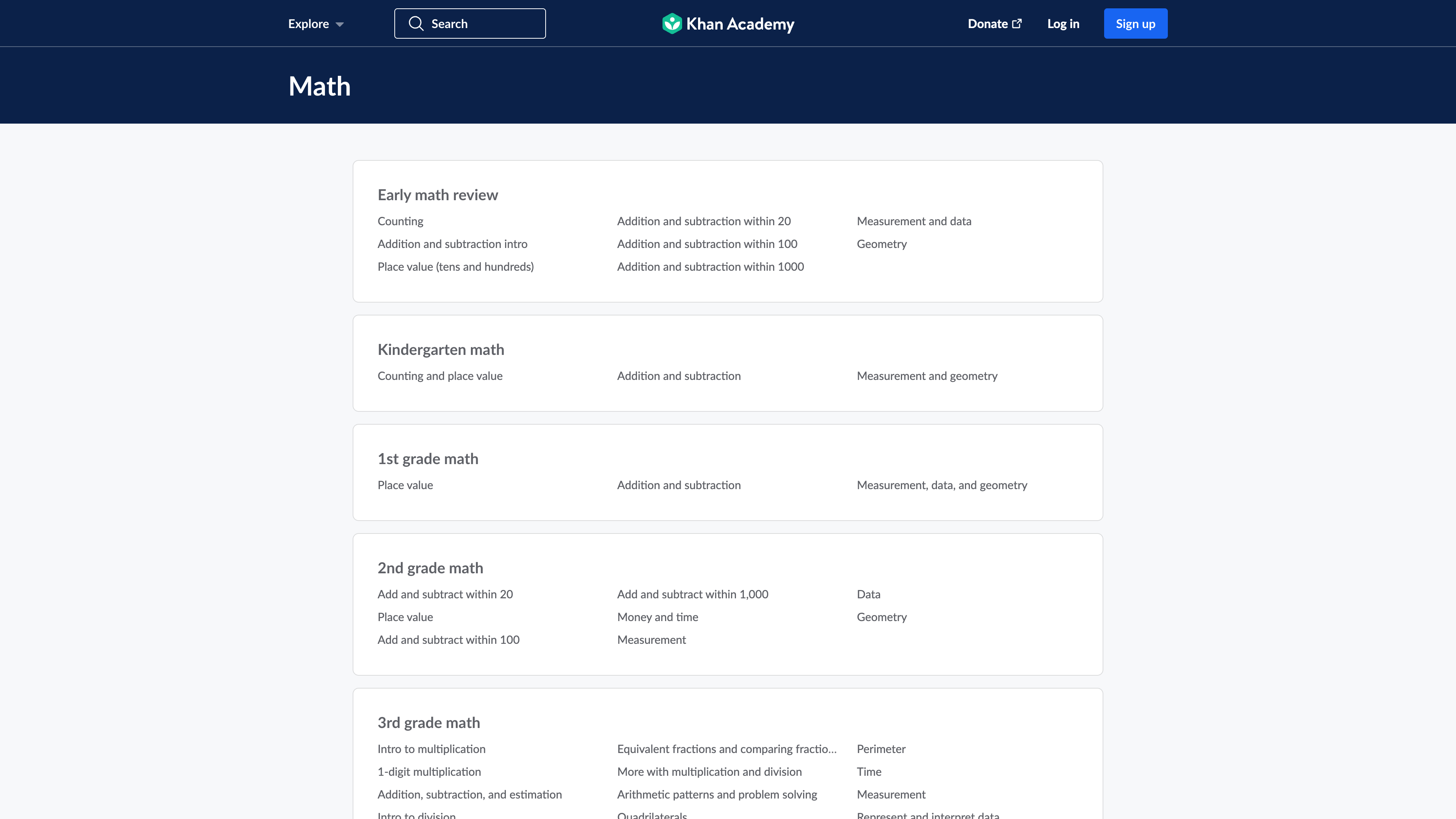
Subject courses. The catalog is organized around mastery learning: each concept pairs a short video lesson with interactive exercises, the system adapts the learning path based on practice performance, and progress is tracked with points and badges. Math is the traditional strength, spanning pre-K counting through calculus and statistics; science (physics, chemistry, biology), computing, arts and humanities, economics and finance, and reading and language arts are similarly structured. Verified by direct access: course catalogs, videos, and exercises open without signing in.
Official test prep. This is what sets Khan Academy apart from generic lecture sites:
- SAT: the College Board's only official SAT prep partner (the partnership dates to 2015), now offering free Official Digital SAT Prep for the digital format.
- LSAT: free Official LSAT Prep built with the Law School Admission Council (LSAC).
- MCAT: a free MCAT collection created with the Association of American Medical Colleges (AAMC) — about 1,100 videos and 3,000 review questions per AAMC.
Khan Academy Kids. A separate free app for children ages 2–8 with no ads and no subscriptions, developed with learning experts at Stanford and aligned to the Head Start Early Learning Outcomes Framework and Common Core.
Khanmigo (AI assistant). A large-language-model tutor and teaching assistant that guides students with questions rather than handing over answers, and gives teachers lesson-planning, rubric, and content-generation tools. Pricing as of 2026-08-30: free for teachers (via a Microsoft partnership that began in May 2024 for US K-12 educators and later expanded to more English-language markets); 44/year for learners and parents (sales tax not included); a district tier with Clever/ClassLink SSO is quote-based.
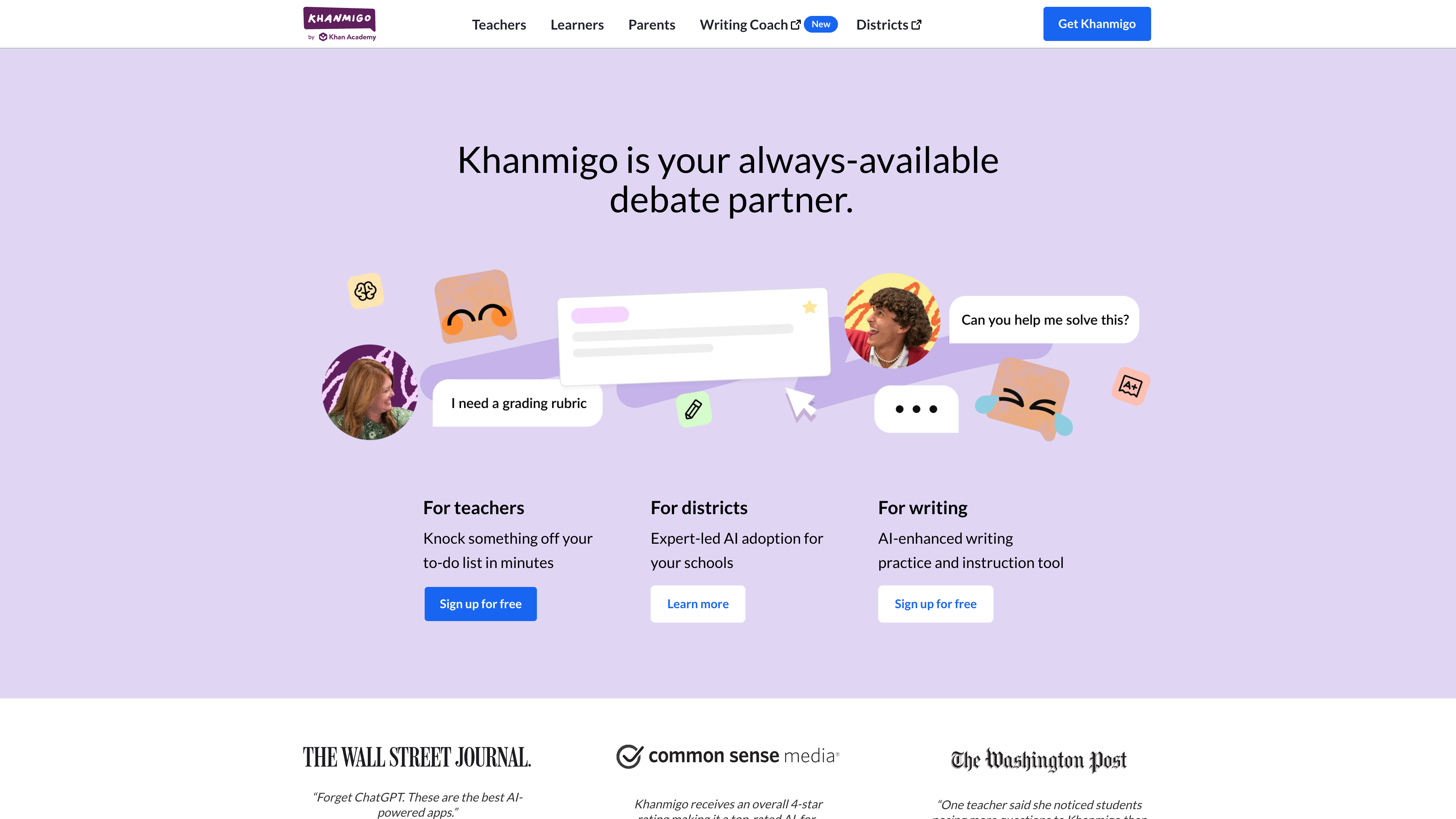
Teacher and district tools. Teachers can assign practice and monitor class progress for free. Khan Academy Districts, aimed at district administrators, is a paid program (quote-based). Khan Academy cites a PNAS-published study of 200,000+ students linking skills mastered on the platform to higher state math scores, and says district-partner students are about six times more likely to reach recommended practice levels — these effectiveness figures come from official channels and should be read as the organization's own reporting.
Accounts and privacy
Registration is free, with student, parent, and teacher roles; browsing works without an account. Children under 13 are covered by a dedicated Children's Privacy Notice, and child accounts automatically disable features that could post personal information; parents can link to a child's account to follow progress. The privacy policy states that Khan Academy does not display third-party advertising and avoids tracking students for advertising purposes.
Content policy and licensing
Content is produced in-house or with partner institutions (some courses are labeled partner content); it is not a user-generated-content community. Videos and exercises are released under a Creative Commons CC BY-NC-SA license: reuse and adaptation are allowed for non-commercial purposes with attribution and share-alike; the Khan Academy name and logo are governed by a separate trademark and brand policy.
Good fits
- K-12 students catching up, previewing, or reinforcing class material at their own pace
- SAT, LSAT, and MCAT candidates looking for free official prep
- Teachers assigning standards-aligned practice and tracking progress
- Parents looking for an ad-free early-learning app (Khan Academy Kids)
- Adults self-studying math, science, and other foundational subjects
Limitations
- Depth stops at early college; there are no advanced professional or vocational tracks. Progress is recorded as mastery levels and badges — Khan Academy is not an accredited school and courses carry no formal certificate or credit.
- The curriculum is aligned to US frameworks (Common Core, AP, SAT), with limited adaptation to other national curricula.
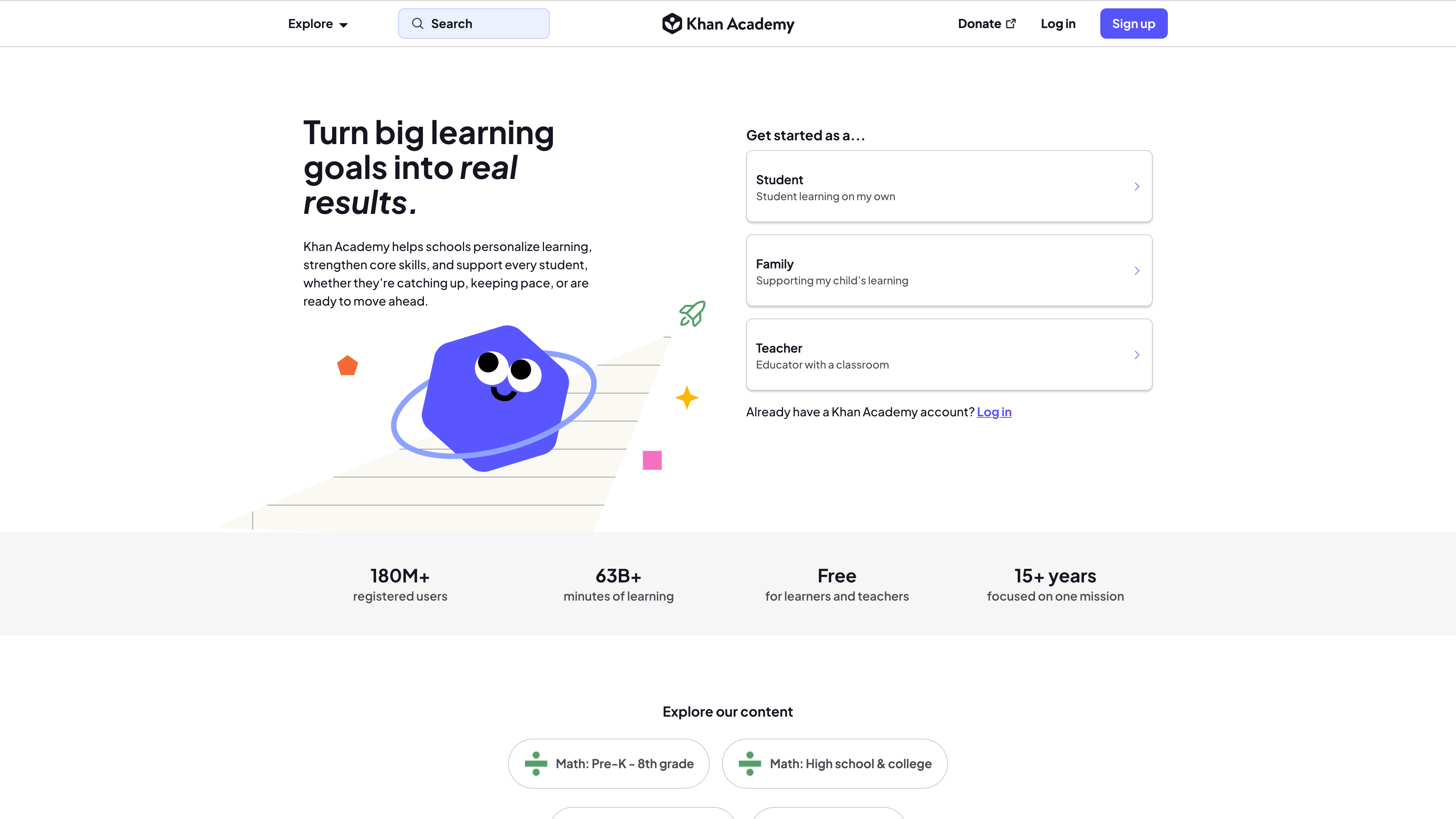
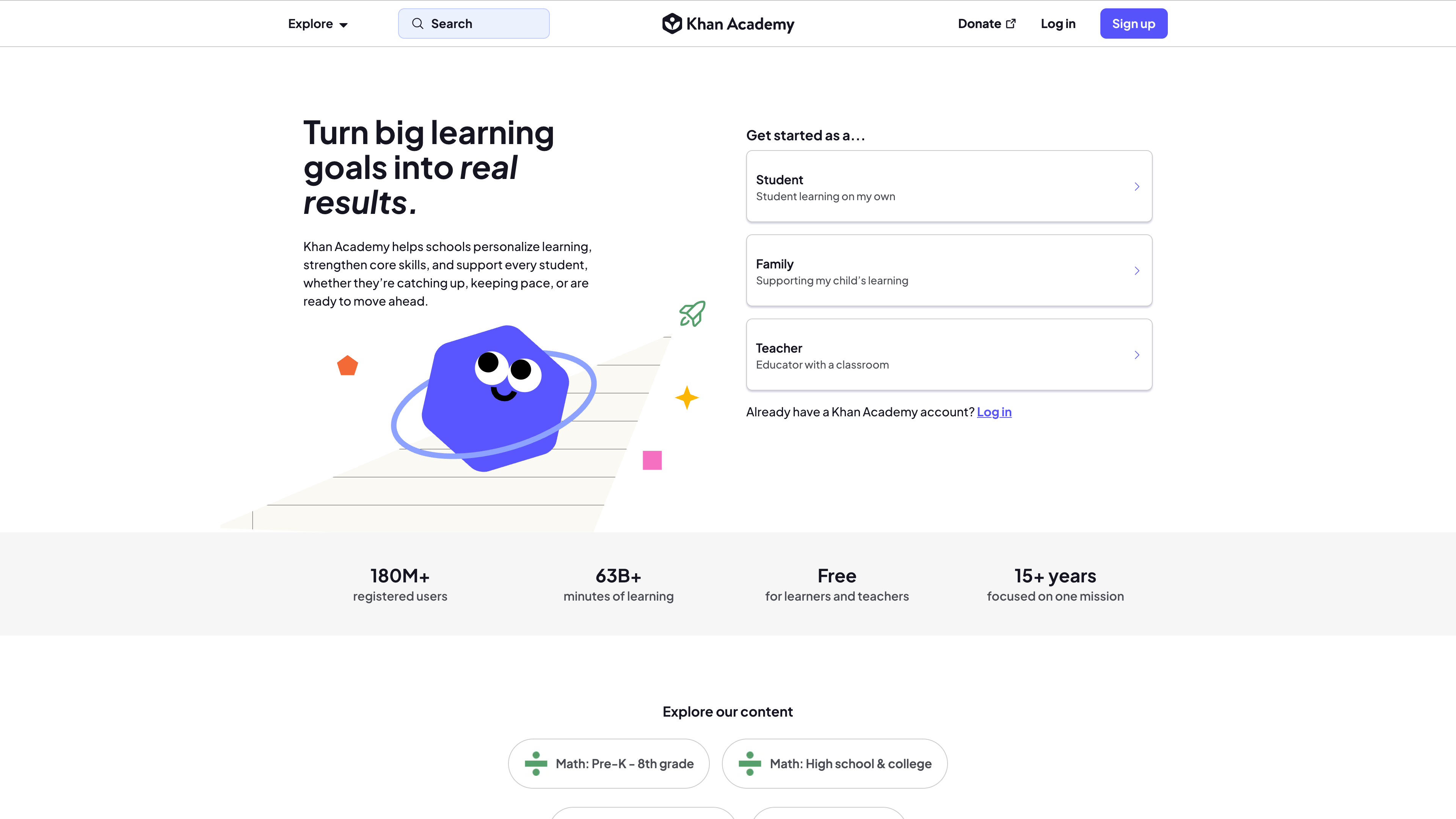
- Non-English content depends on translation programs and coverage varies by language. Statistics are also inconsistent across the site: the homepage banner still shows 180M+ registered users and 63B+ learning minutes (in both English and Chinese) while the About page reports 227M and 75B — all observed as of 2026-08-30.
- Khanmigo costs money for individual learners, so "everything is free" applies only to the core course platform.
- Learning is built around videos and objective exercises, with no live teacher interaction; deeper help comes from Khanmigo or self-study.
- Effectiveness claims for the district program (6× practice attainment, score gains) originate from Khan Academy or studies it participates in, with limited independent evaluation.
Alternatives
- freeCodeCamp: also a free nonprofit, focused on programming and development skills, with free certifications.
- Coursera / edX: commercial MOOC platforms centered on university courses and paid certificates, deeper but mostly paid.
- MIT OpenCourseWare: free university-level course materials and recordings for advanced self-study.
References
- Khan Academy About (mission, scale, course count): https://www.khanacademy.org/about
- Khan Academy Impact (efficacy research, self-reported): https://www.khanacademy.org/about/impact
- Khan Academy Help Center: What is the history of Khan Academy? https://support.khanacademy.org/hc/en-us/articles/202483180-What-is-the-history-of-Khan-Academy
- Khan Academy Supporters (founding partners): https://www.khanacademy.org/about/supporters
- Khan Academy Leadership: https://www.khanacademy.org/about/leadership
- Khanmigo pricing: https://www.khanmigo.ai/pricing
- Khan Academy blog: Khanmigo for Teachers free for US teachers (Microsoft partnership): https://blog.khanacademy.org/khanmigo-for-teachers-is-free-for-all-us-teachers-thanks-to-support-from-microsoft/
- Khan Academy Kids: https://www.khanacademy.org/kids
- Khan Academy Districts ("the College Board's only official SAT partner"): https://www.khanacademy.org/schools
- College Board blog (partnership since 2015): https://blog.collegeboard.org/college-board-khan-academy-for-better-sat-prep
- Khan Academy blog: free Official LSAT Prep with LSAC: https://blog.khanacademy.org/khan-academy-launches-free-official-lsat-prep/
- AAMC: Khan Academy MCAT course overview: https://cloud.email.aamc.org/mcat-khan-academy
- Khan Academy Help Center: content reuse and the CC BY-NC-SA license: https://support.khanacademy.org/hc/en-us/articles/202262954-Can-I-use-Khan-Academy-s-videos-name-materials-links-in-my-project
- Khan Academy Privacy Policy: https://www.khanacademy.org/about/privacy-policy
- Chinese-language site (可汗学院): https://zh.khanacademy.org/