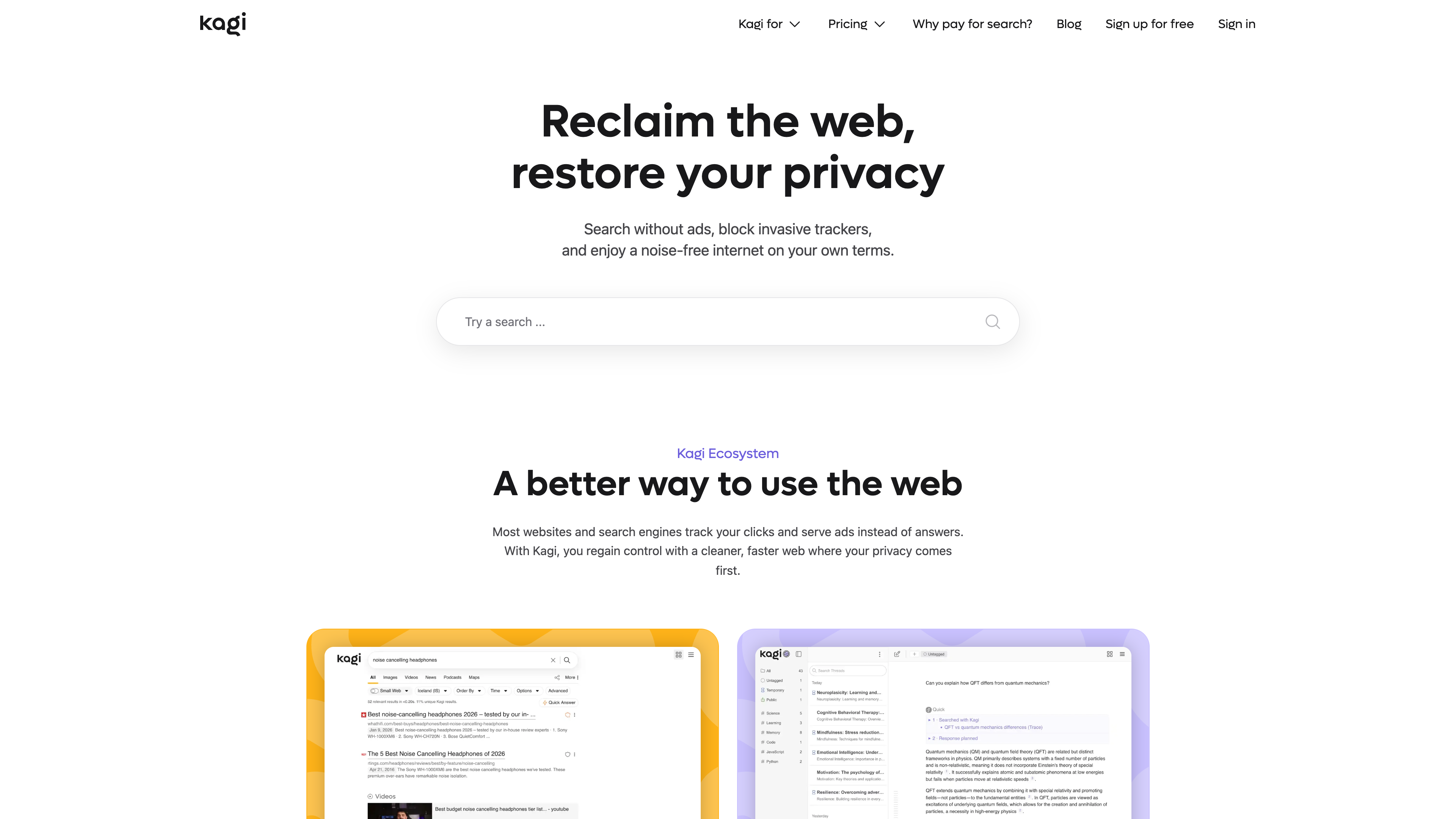
Kagi (kagi.com) is a paid search engine run by Kagi Inc. in the United States: no ads, no sponsored results, and — by the company's own policy — no user tracking, with revenue coming entirely from subscriptions. It targets the structural problem of free search engines: when advertisers are the customers, ad slots, SEO spam, and click tracking push result quality down. Against fellow privacy search engine DuckDuckGo, the verifiable difference is that DuckDuckGo still runs on advertising, while Kagi carries no ads at all and charges a subscription. Against Google, besides dropping ads and tracking, Kagi adds manual control over ranking (promote, demote, or block domains) and topic-scoped Lenses. The trade-off is equally direct: search itself costs money, and the free tier is only a 100-search trial.
At a Glance
- URL: https://kagi.com
- Type: Paid search engine, bundled with an AI assistant (Kagi Assistant), the Orion browser, and free side products such as Translate and News
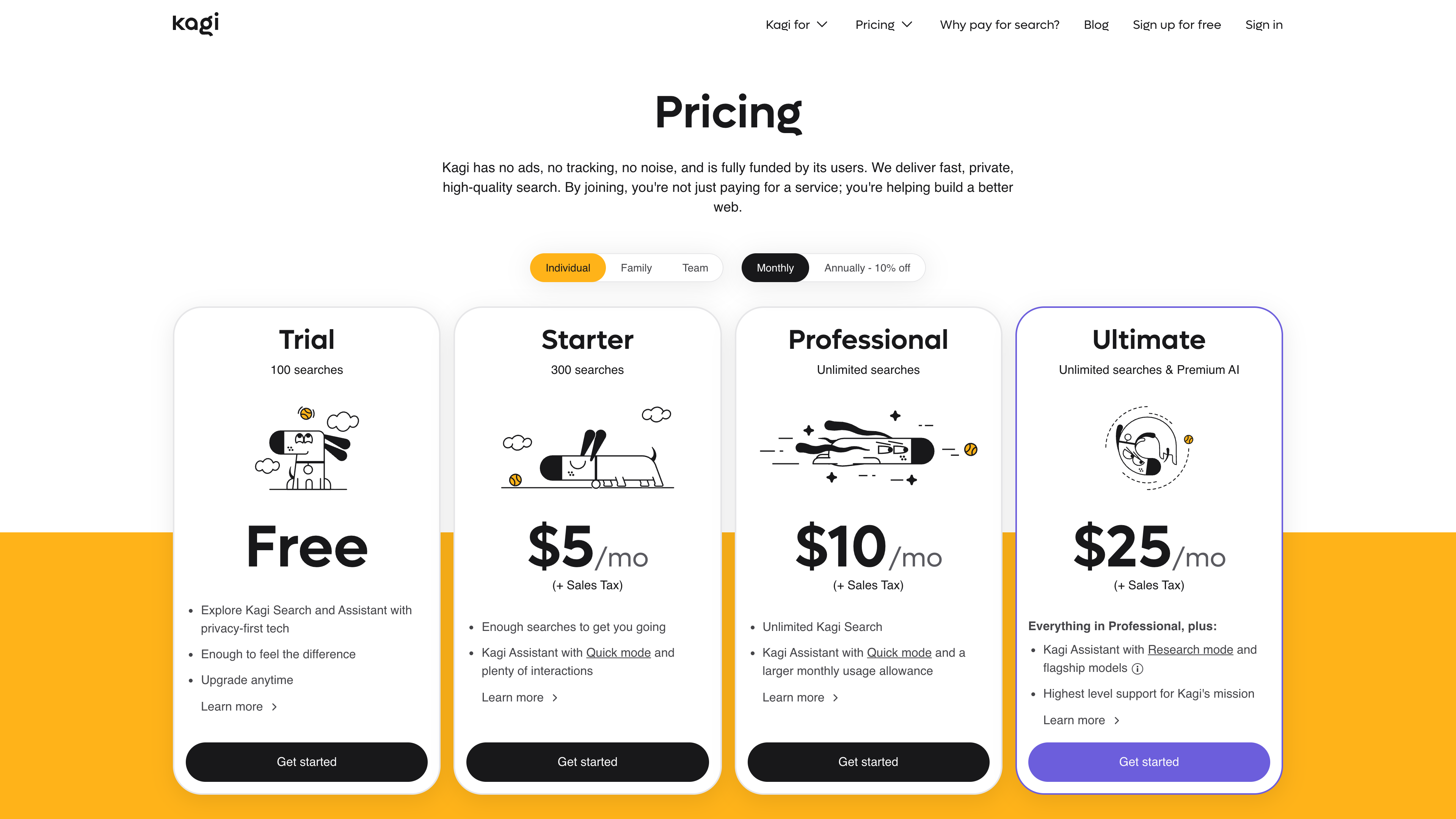
- Pricing: Trial is free (100 searches + 100 Assistant interactions); individual plans Starter 10/mo (unlimited searches), Ultimate 14/mo (2 people), Family $20/mo (up to 6 members); annual billing takes 10% off. As of 2026-09-12, per the official pricing page and plan documentation
- Registration: Searching requires an account (an email address is enough); Kagi Translate, Kagi News, and Kagi Small Web are free without an account
- Interface language: A language setting exists (translations are community-contributed); English is the default
- Launched: June 2022 (company founded in 2018)
Background
Kagi was founded in 2018 by Vladimir Prelovac in Palo Alto, California, and opened to the public in June 2022; the name comes from the Japanese word for "key" (鍵) (official company page). The company was bootstrapped with roughly 2.5M from around 93 angel investors drawn from its user community in 2023–2024. In early 2024 it converted to a Delaware Public Benefit Corporation, with a charter committing it to "a more human-centric and sustainable web." Its advisory board includes Stephen Wolfram and Rory Sutherland.
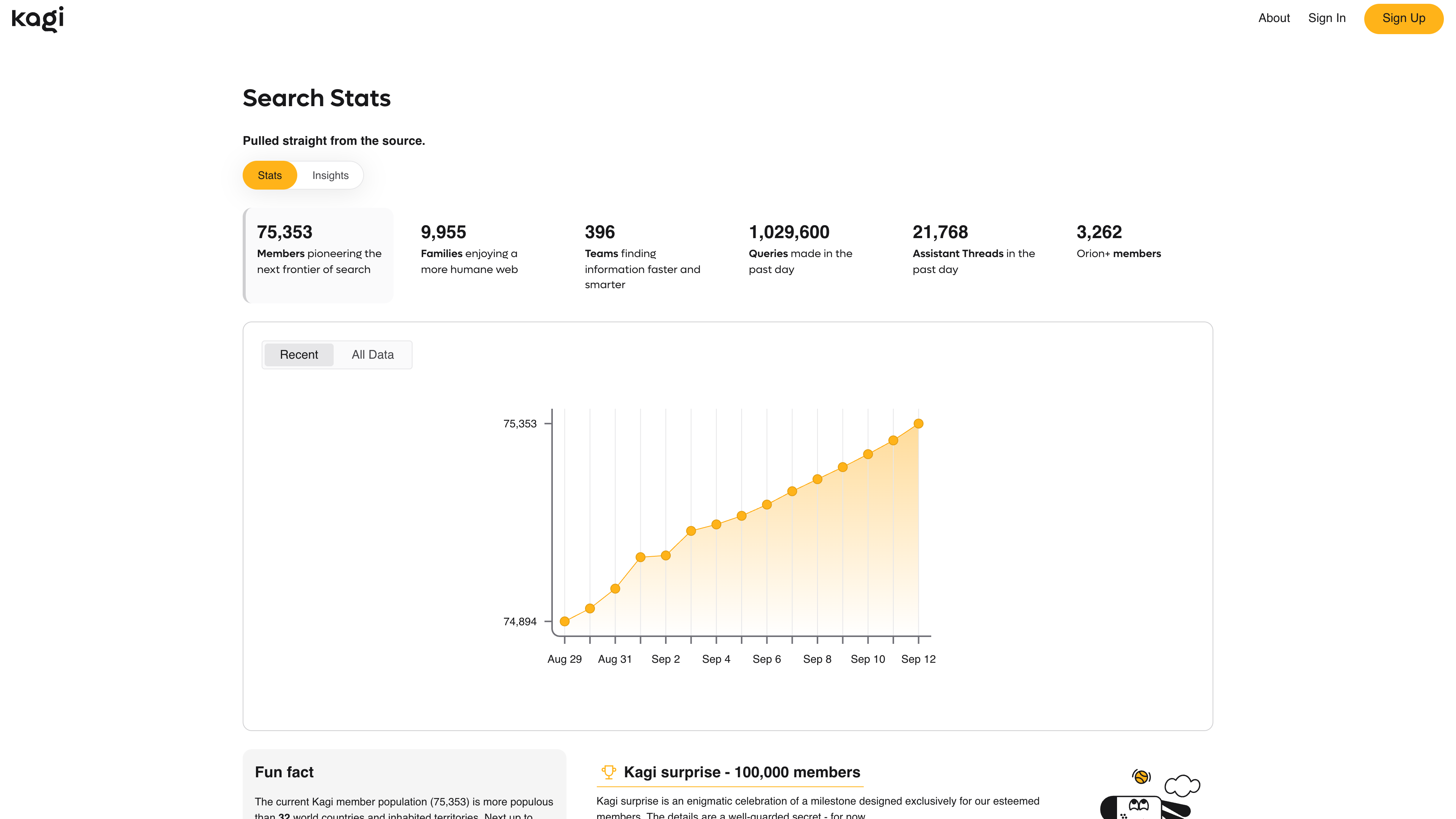
On scale, Kagi maintains a live stats page: as of 2026-09-12 it showed 75,353 members, 9,955 family accounts, and 396 teams, with 1,029,600 queries and 21,768 Assistant threads in the past day. For context, Wikipedia cites Kagi's own stats putting paying members at roughly 50,000 in June 2025 (Kagi - Wikipedia).
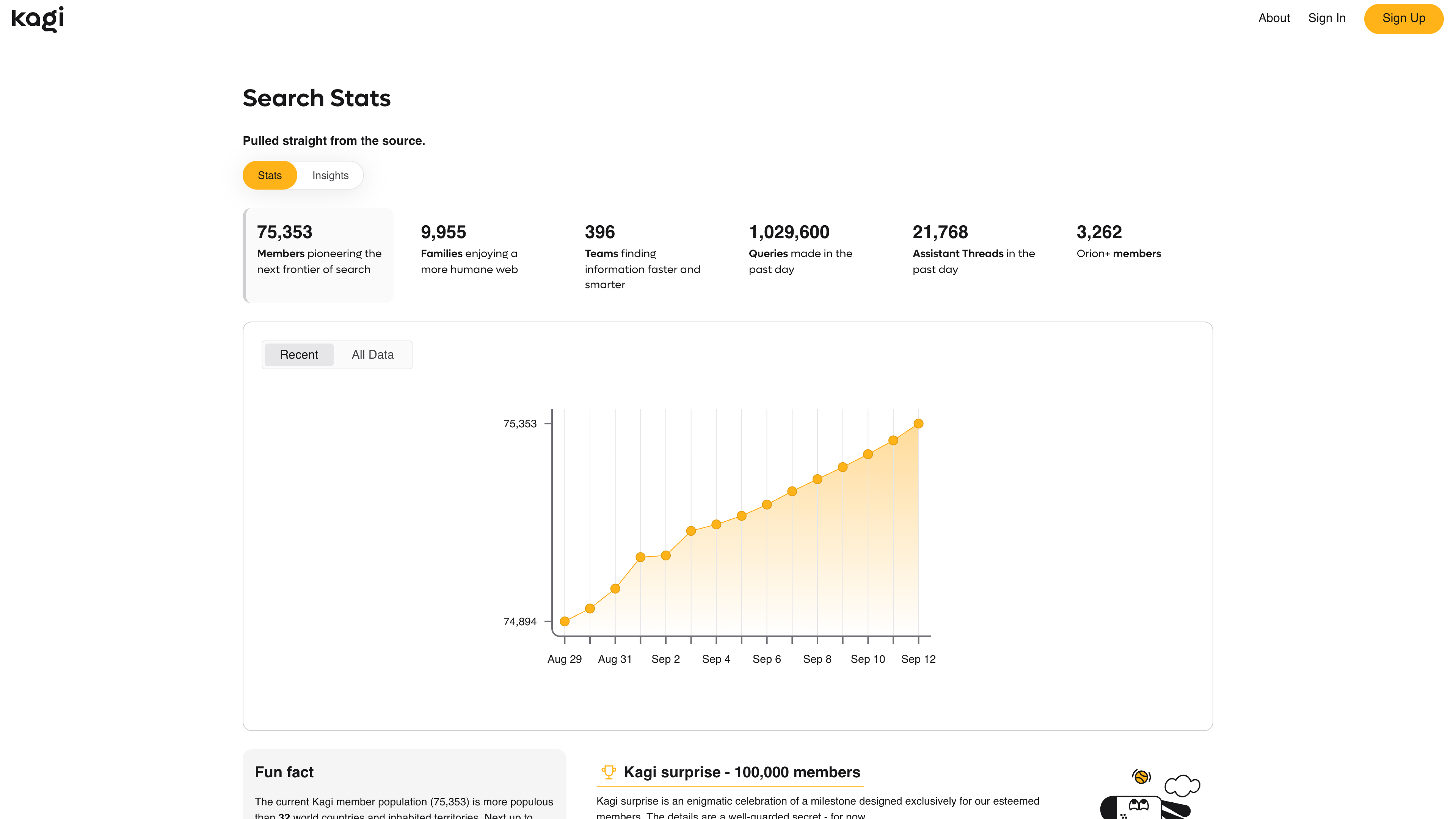
The screenshot above is Kagi's first-party live dashboard, so member, family, team, and daily query figures come straight from the company's own systems.
Where the Results Come From
Kagi is a hybrid of its own indexes and aggregation (official documentation):
- In-house indexes: the Teclis web index and the TinyGem news index, which emphasize non-commercial sites and the "small web" of personal blogs and independent pages — the main source of results that feel different from mainstream engines.
- External sources: anonymized API calls to major search providers (Kagi's listed sources as of April 2024 included Google, Brave Search, Mojeek, and Yandex, per the Wikipedia entry), independent engines such as Marginalia, and vertical data providers including Wolfram Alpha (calculations, unit conversion), Apple, Wikipedia, Yelp, TripAdvisor, and Open Meteo (weather). Kagi says a typical query fans out to a dozen or so sources in parallel.
- Ranking policy: the company says pages heavy on ads and trackers are down-ranked (it correlates ad load with poor content quality), while independent, ad-free sites get a boost.
So Kagi is not a fully independent index: coverage still leans partly on outside APIs. What subscribers pay for is the ad-free ranking, filtering, and privacy layer on top.
Personalization, Lenses, and Bangs
The feature long-time users praise most is control over results:
- Domain personalization: a shield icon beside each result lets you block, lower, keep, raise, or pin that site, stored in your account and applied everywhere; anonymized aggregate rankings feed a public domain leaderboard. The info panel also shows how many ads and trackers were detected on the site, whether it uses HTTPS, and how fast it responds (documentation).
- Lenses: restrict searches to a set of sites or rules — prebuilt options include Forums, Programming, Academic (.edu domains), PDFs, and Small Web. Custom lenses support up to 10 included and 10 excluded sites, 5 included and 5 excluded keywords, plus region, file type, and date filters, and can be shared via a link. Lenses do not yet cover image or video search (documentation).
- Bangs: typing
!w monty pythonjumps straight to Wikipedia's search,!ytto YouTube, and so on; bangs that redirect to external sites never count against your search quota. The bang repository is open source, and custom bangs, no-exclamation "quick bangs," and regex parameters are supported (documentation).
The results page also bundles maps (Apple Maps plus Kagi's own Mapbox/OSM-based maps), an opt-in LLM Quick Answer with cited sources, and per-page summaries that even work on YouTube videos.
Assistant and Side Products
The subscription covers an ecosystem beyond search:
- Kagi Assistant: launched September 4, 2024 and opened to all members in April 2025 (Wikipedia entry), it aggregates models from OpenAI, Anthropic, Google, Meta, Mistral, Alibaba, DeepSeek, and others, with optional web access grounded in Kagi Search results. It supports file uploads, custom assistants, and switching models mid-thread. Kagi states conversations are never used for training and account details are not shared with model providers; threads auto-delete after 24 hours by default. Flagship models are Ultimate-only, and AI usage is metered by token value under a Fair Use Policy (a 25 of token value, with a 20% margin for operating costs) (documentation).
- Orion browser: a zero-telemetry WebKit browser with built-in ad and tracker blocking, which Kagi calls the only browser supporting Safari, Chrome, and Firefox extensions. It is available on macOS and iOS/iPadOS, in beta on Linux, and in alpha development for Windows. The browser itself is free; an optional Orion+ tier (50/yr, or $150 lifetime) funds development but does not include search. Kagi says the iOS version has 4 million users (Orion site, Orion+ documentation).
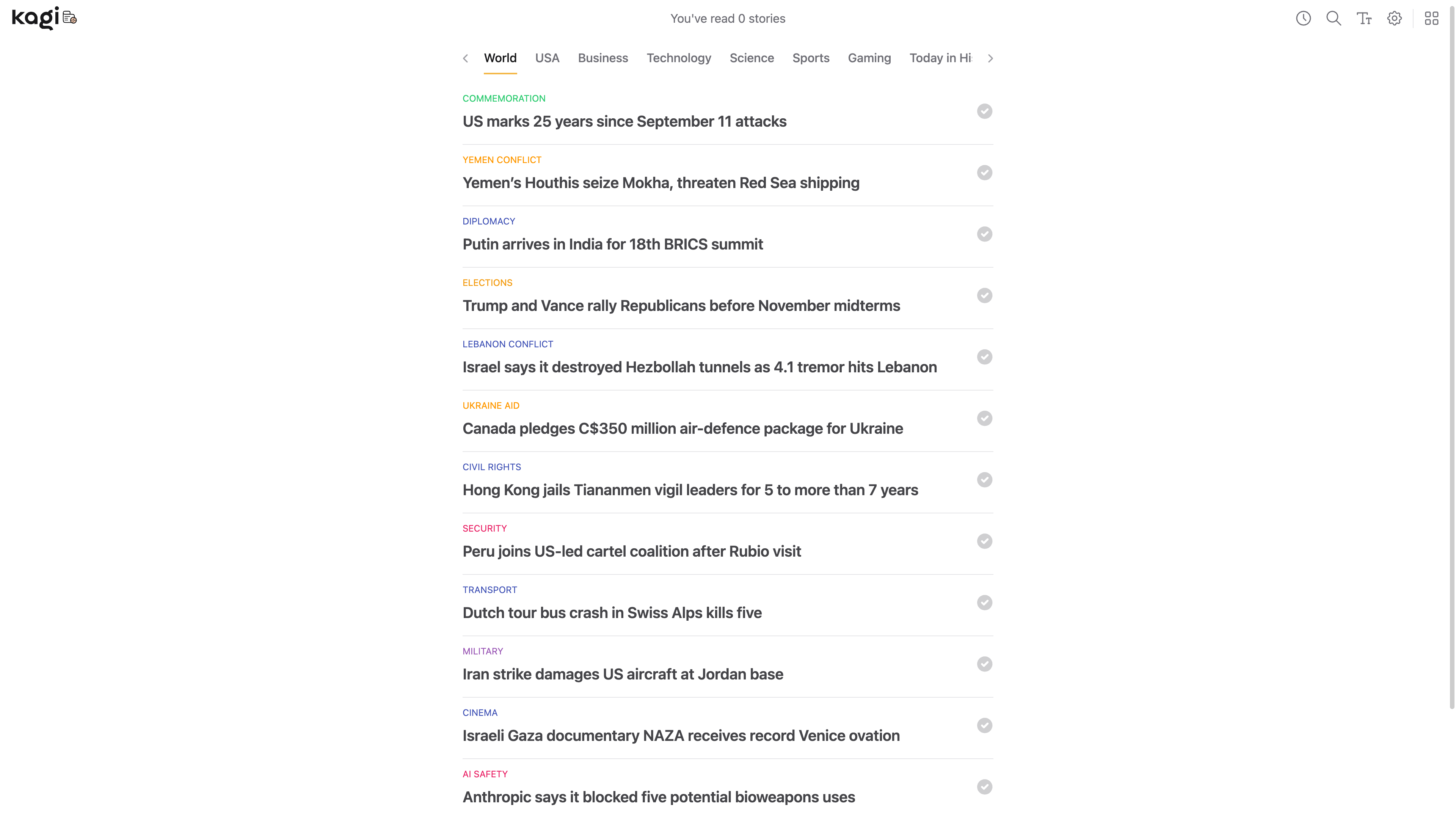
- Free products: Kagi Translate (248+ languages, per the official docs), Kagi News (a once-daily AI news digest launched September 30, 2025 that needs no account, per the Wikipedia entry), Kagi Small Web (a curated directory of non-commercial sites), Universal Summarizer, and FastGPT are all free to use.
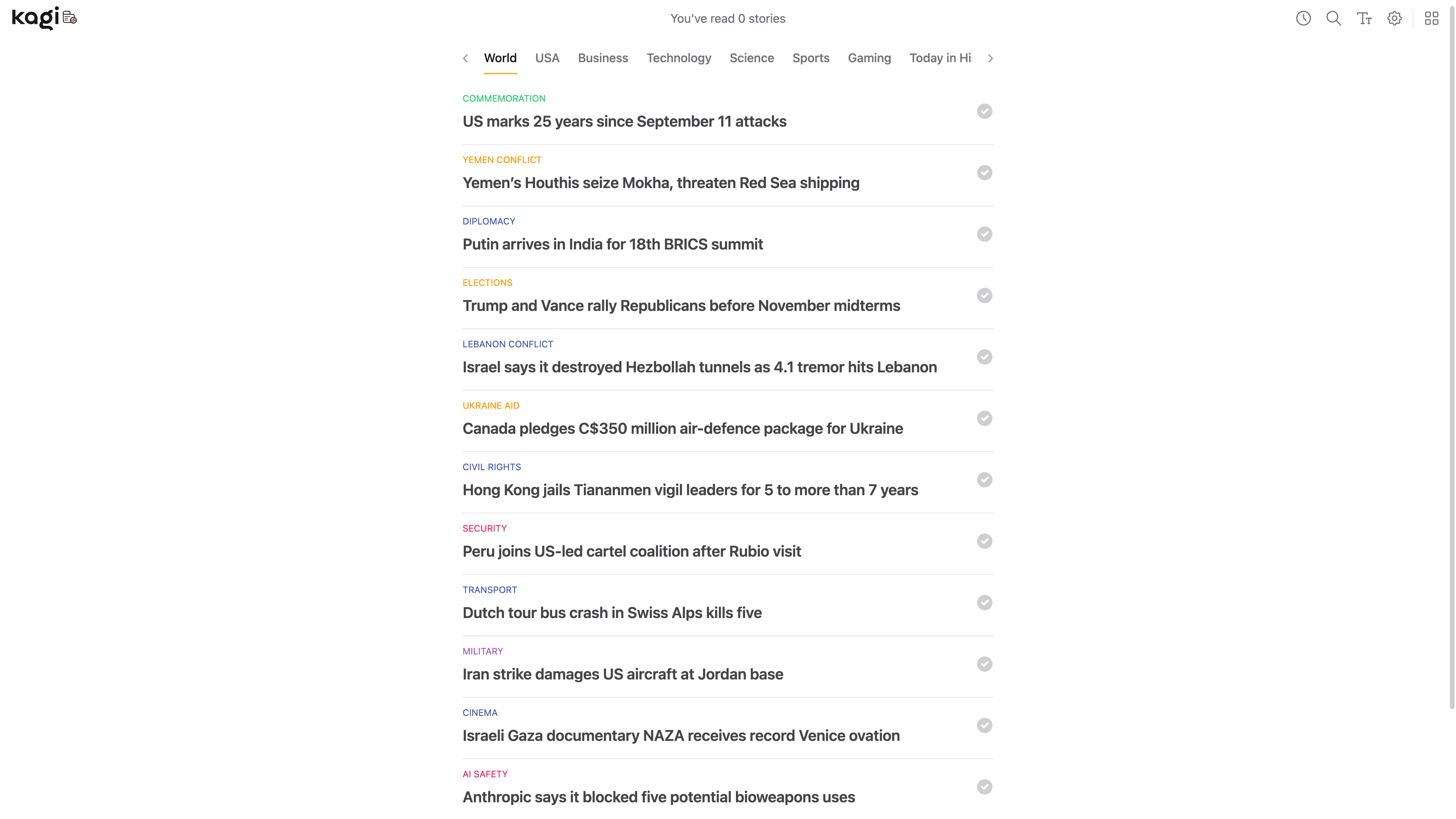
Kagi News, shown above, is one of the free products that require no subscription.
- Developer APIs: a Search API (currently invite-only), an Enrichment API exposing the Teclis/TinyGem indexes, plus Universal Summarizer and FastGPT APIs, all pay-per-use, with an MCP server and Python/Go/Rust/TypeScript clients (API documentation).
Pricing and the Privacy Model
Below is the official pricing page as of 2026-09-12 (individual plans, monthly billing, plus sales tax):
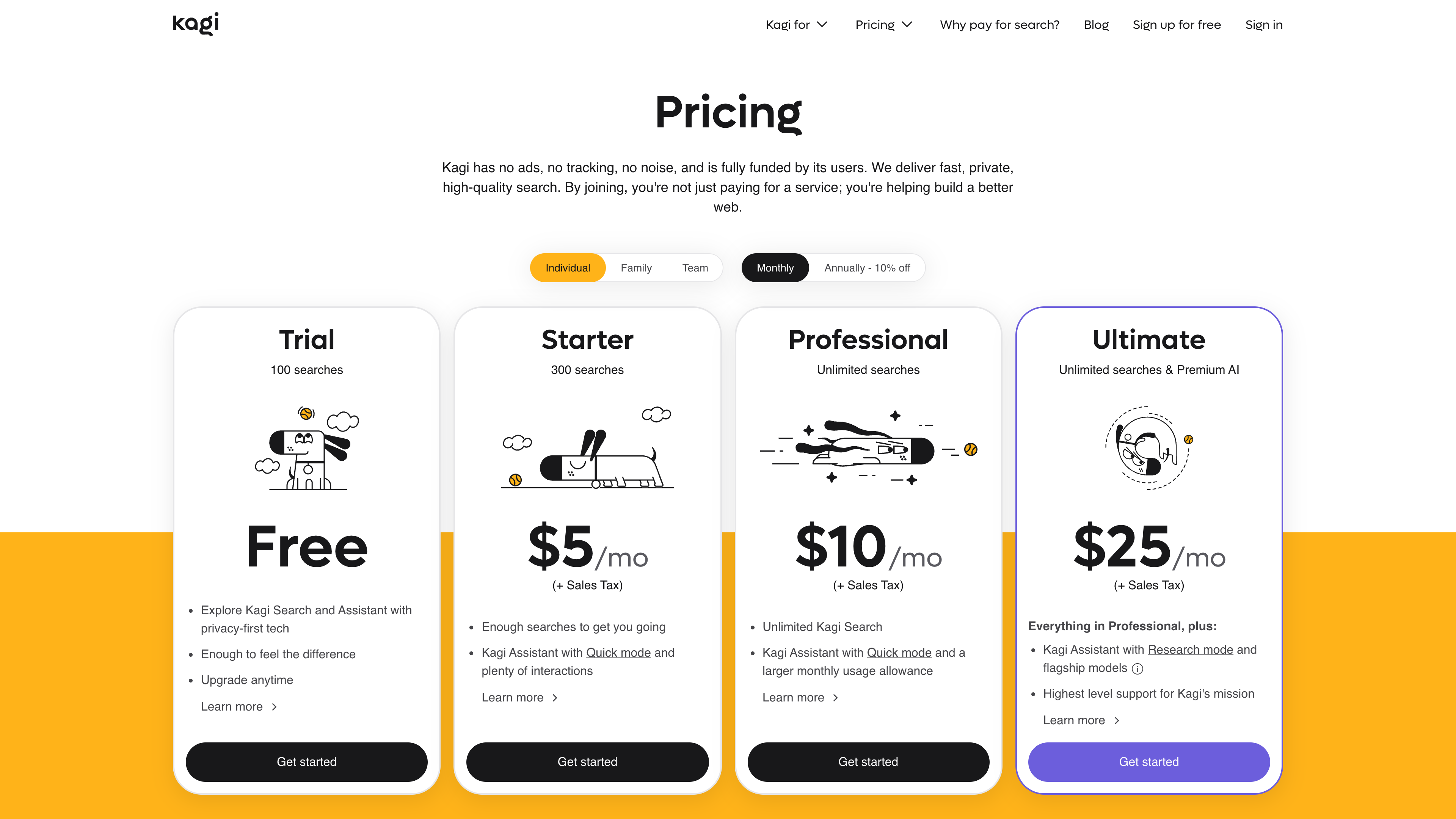
Billing details worth knowing:
- Fair Pricing: in any month with zero usage (no searches, no AI interactions), the month's fee converts to a full credit, so the next month is effectively free; annual plans work the same way over the year.
- How Starter searches are counted: external-site bangs and search suggestions never count; re-running the same search within about two minutes doesn't count; but switching lenses, switching content types (images, news), or loading more results each counts as a new search. Quotas do not roll over (plan documentation).
- Payment methods: Stripe, PayPal, and OpenNode (Bitcoin). The latter two don't create an auto-renewing subscription; instead you top up account credit.
On privacy, the privacy policy (current version includes the 2026-02-17 update) makes these core commitments: no analytics or telemetry scripts; no tracking of which results you click; image, video, and other media results, as well as Assistant traffic, are proxied through Kagi's servers; only minimal session and CSRF cookies are stored; server-side debugging logs are kept 7 days (load balancer and VM) and sampled error reports 90 days (Sentry), none linked to accounts. Users who want stronger anonymity can register with a pseudonymous email, pay in cryptocurrency, connect over Tor, and authenticate via the Privacy Pass protocol — proving they are paying users without being identifiable. The policy also includes a warrant canary stating the company has received zero National Security Letters, zero gag orders, and zero warrants.
Terms worth noting: front-end AI products like the Universal Summarizer are licensed for non-commercial use only (commercial use requires the API or a separate license); services are provided "as is," with liability capped at $500 under Delaware law.
Who It's For
- Heavy search users (researchers, developers, writers) who care about result quality enough to pay for an ad-free, tracking-free environment.
- People who want search "tuned to their shape": permanently blocking content farms, boosting trusted documentation sites, or using Lenses for vertical search.
- Users who want one subscription covering both search and a multi-model AI assistant with strong conversation privacy.
- Families: the Family plan includes Kagi for Kids, with strict content filters, parental controls, and a whitelist-only mode.
- Anonymity-conscious users: pseudonymous email + crypto payment + Tor + Privacy Pass is a combination rarely offered by mainstream search services.
Limitations
- Search costs money, and the free tier is just a trial: once the 100-search Trial is exhausted, a subscription is mandatory; for light users, $5/month is a hard barrier compared with free alternatives.
- Account-bound: searching requires signing in; there is no genuinely anonymous free search (Privacy Pass anonymizes paid status, it doesn't remove the paywall).
- Not a fully independent index: coverage still relies partly on external APIs such as Google's, with the in-house indexes mainly strengthening long-tail and small-web content.
- The entry quota runs out fast: Starter's 300 searches per month are consumed quicker than expected because lens switches, content-type switches, and pagination each count separately.
- Short default AI retention: Assistant threads are deleted after 24 hours unless you change the setting or export them.
- Feature gaps: Lenses don't cover image/video search; domain blocking lacks path wildcards; the Team plan comes only as Ultimate and bills monthly only.
- Limited localization: interface translations are community-maintained with no official coverage guarantee; documentation and support are primarily in English.
Alternatives
- DuckDuckGo: a free privacy search engine funded by (non-personalized) ads, usable without an account — same privacy stance, opposite business model.
- Brave Search: a free engine built on its own independent index, with optional ads, a paid API, and premium tiers.
- Startpage: a free service that proxies Google results anonymously, for users who want Google's index without Google's tracking.
References
- Kagi homepage (checked 2026-09-12)
- Kagi pricing page (checked 2026-09-12)
- Plan Types - Kagi's Docs (checked 2026-09-12)
- About Kagi - Kagi's Docs (checked 2026-09-12)
- Kagi Search Stats (checked 2026-09-12)
- Search Sources - Kagi's Docs (checked 2026-09-12)
- Lenses - Kagi's Docs (checked 2026-09-12)
- Bangs - Kagi's Docs (checked 2026-09-12)
- Website Info & Personalized Results - Kagi's Docs (checked 2026-09-12)
- Kagi Assistant - Kagi's Docs (checked 2026-09-12)
- Kagi Privacy Policy (incl. 2026-02-17 update) (checked 2026-09-12)
- Family Plan - Kagi's Docs (checked 2026-09-12)
- Orion Browser official site (checked 2026-09-12)
- Orion+ - Kagi's Docs (checked 2026-09-12)
- API Portal - Kagi's Docs (checked 2026-09-12)
- Kagi - Wikipedia (checked 2026-09-12; cross-verification only)