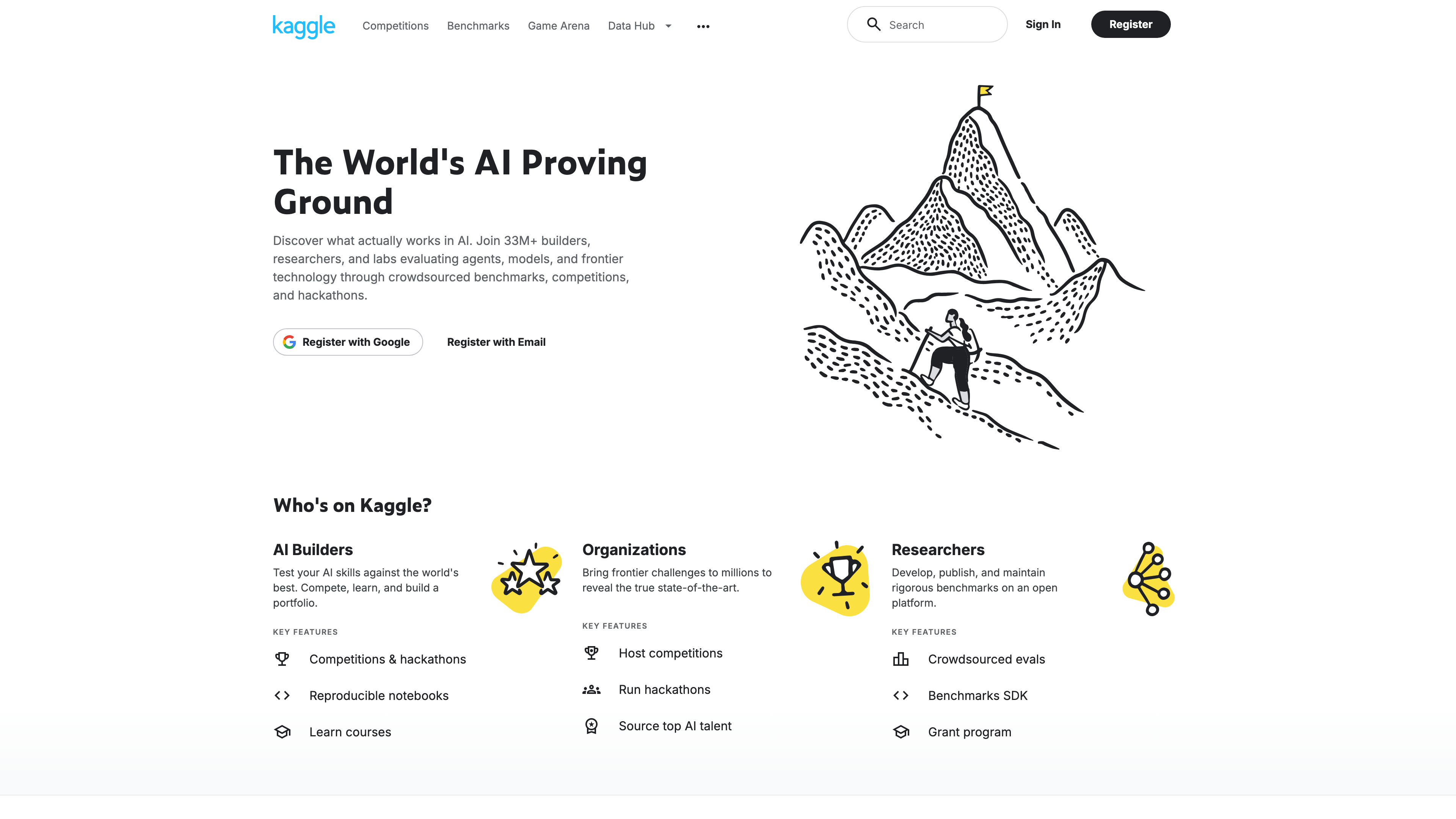
Kaggle is a data science and machine learning competition platform: companies and research organizations publish real problems and data as competitions, participants submit model predictions ranked on a live leaderboard, and winning solutions can earn prize money. Beyond competitions it offers a public dataset repository, a free cloud Jupyter environment (Notebooks), a pre-trained model hub (Models) and beginner courses with certificates (Learn), all operated by Google.
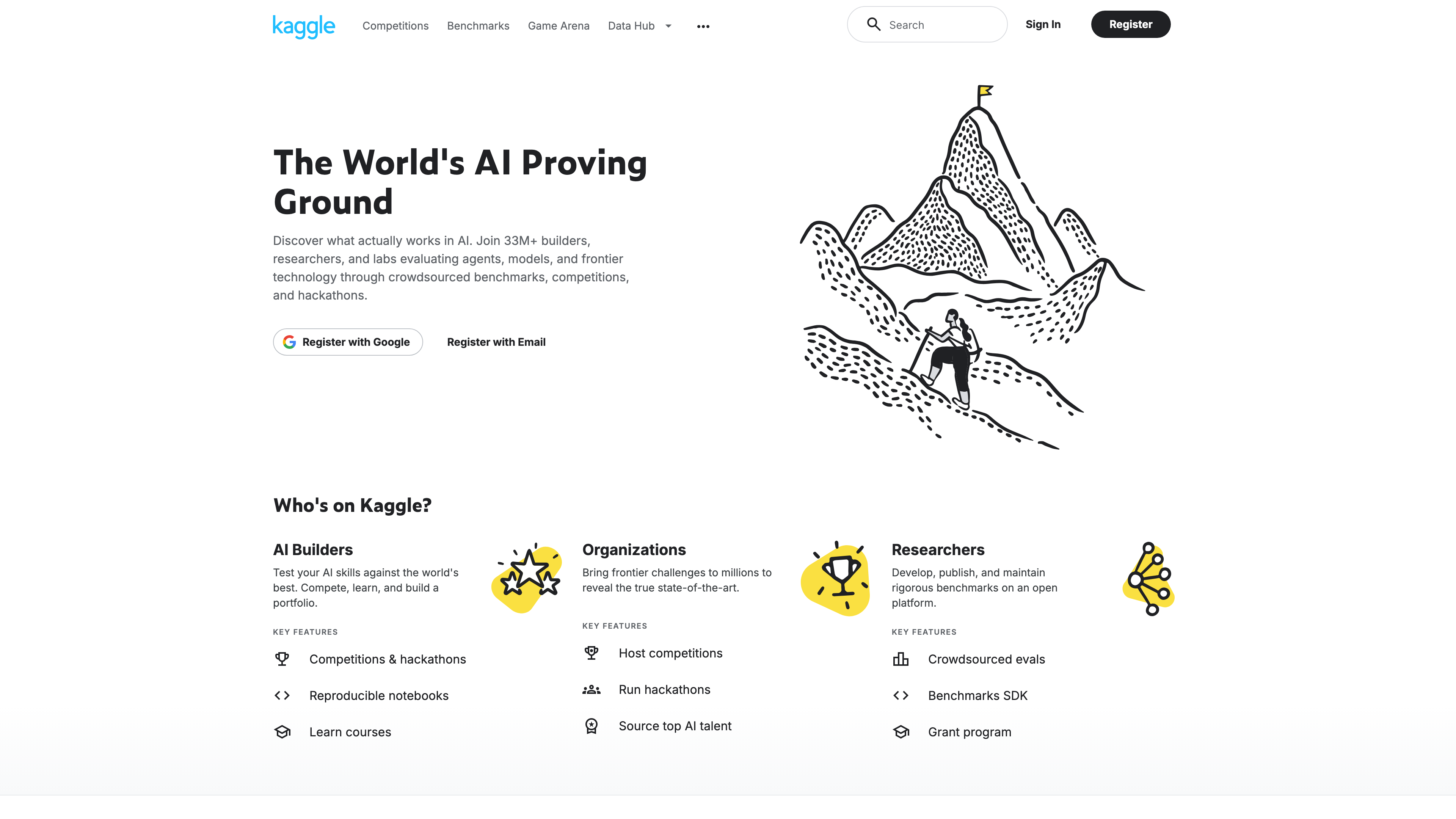 Browsing competition listings, datasets and public notebooks requires no account; competing, publishing, running notebooks and commenting do (Google sign-in is supported). The homepage currently claims "33M+ builders, researchers, and labs" (site copy as of 2026-09-02).
At a glance
- URL: https://www.kaggle.com
- Type: Data science / machine learning competition platform and community (owned by Google)
- Cost: Free (competitions, datasets, notebooks and courses are not charged to users)
- Registration: Not needed for browsing public content; required for competing, publishing and running code
- Interface language: English
Background
Kaggle was founded by Anthony Goldbloom in San Francisco in April 2010; early members included Jeremy Howard, later of fast.ai, who joined in November 2010 as President and Chief Scientist. Google announced its acquisition of Kaggle on 8 March 2017 at Google Cloud Next. Official figures put registered users above 1 million in June 2017 and above 15 million across 194 countries by October 2023. In 2022 Goldbloom and co-founder Ben Hamner stepped down and D. Sculley became CEO. The platform later added Models (a pre-trained model hub, February 2023) and, in April 2025, announced an open-data partnership with the Wikimedia Foundation.
What the platform offers
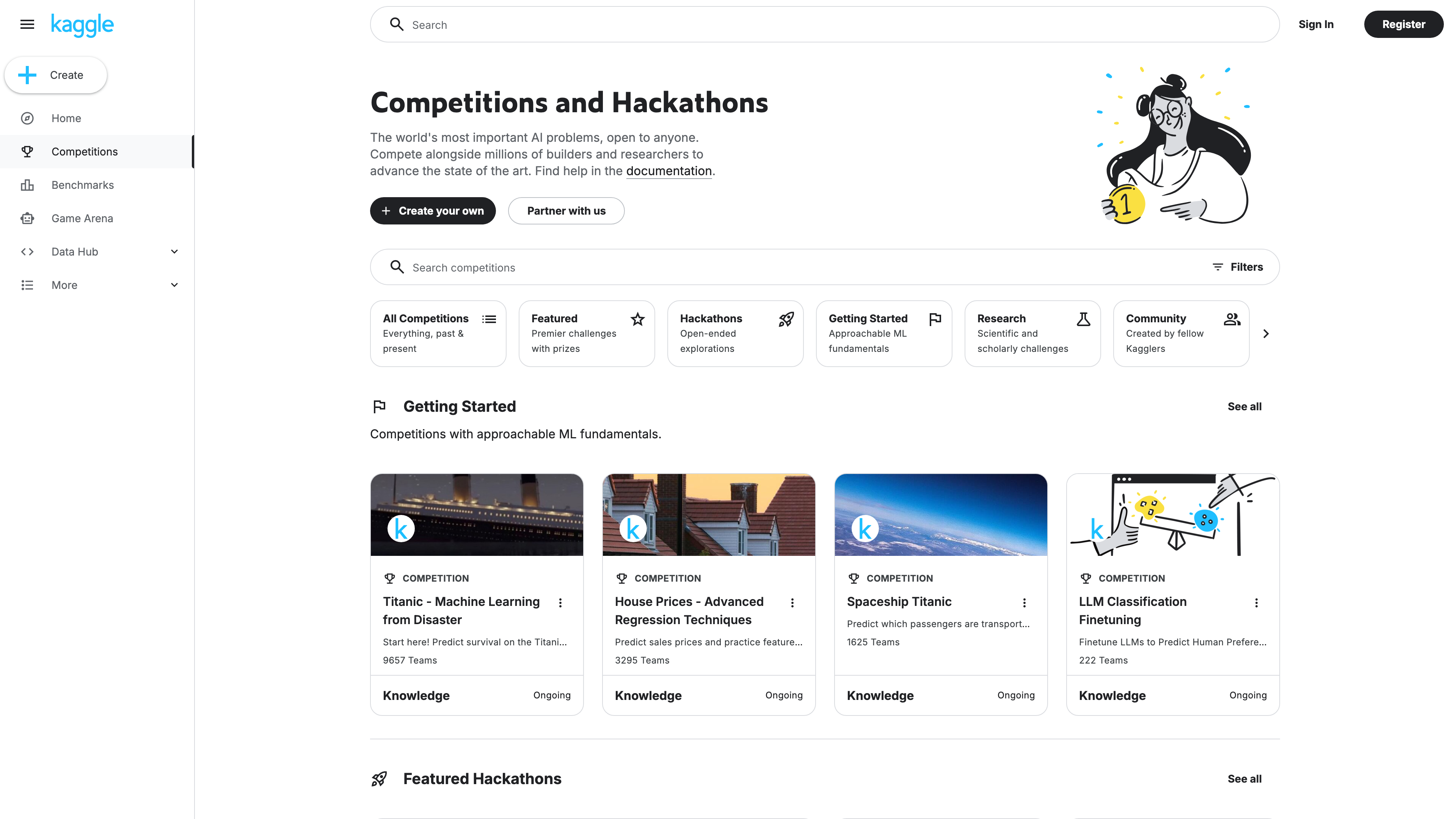
Competitions: The core section. The host prepares the data and the problem statement and decides whether to offer prize money; submissions are scored immediately against a hidden solution file and ranked on a live leaderboard. The competitions listing organizes events into Featured (premier, usually with prizes), Research (scientific and scholarly challenges), Getting Started (approachable fundamentals such as the classic Titanic survival prediction), Community (created by fellow Kagglers) and Hackathons.
Prize mechanism: After a paid competition closes, the host pays the prize in exchange for a "worldwide, perpetual, irrevocable and royalty-free" license to the winning entry, per the competition terms (non-exclusive unless otherwise specified). Notable past competitions include CERN's Higgs boson search, Two Sigma's trading algorithm challenge and Merck's molecular activity prediction (won by Geoffrey Hinton and George Dahl with deep neural networks).
Datasets: Users publish datasets under a license of their choice; others can search, download, or mount them directly in notebooks.
Notebooks: A free in-browser Jupyter environment supporting Python and R, with CPU, GPU or TPU compute, commonly used for competition submissions, teaching and exploratory analysis.
Models: A hub for discovering and using pre-trained models, integrated with the rest of the platform (launched 2023).
Learn: Free, short hands-on courses (Python, Pandas, Intro to Machine Learning, Intro to Deep Learning and more) with exercises in browser notebooks; Kaggle states the courses cost nothing and award completion certificates.
Discussions: Forums organized by competition and topic, with a tradition of winners publicly writing up their solutions.
The progression system
Kaggle signals user standing through a progression system: across four categories — Competitions, Datasets, Notebooks and Discussion — there are five tiers (Novice, Contributor, Expert, Master, Grandmaster), earned through medals and achievements, with the highest tier shown on the profile. The official progression page documents the criteria; reaching Contributor requires completing one's profile and verifying a phone number. Because the competition track is the hardest, Competitions Grandmaster is widely treated as an informal credential — according to Kaggle's own "Kaggle in Numbers" (2 April 2025, cited via Wikipedia), only 2,973 of 23.29 million accounts held Master status and just 612 were Grandmasters.
Open API
Kaggle maintains an official public API and command-line tool for listing and downloading datasets, enumerating competitions, submitting entries, and managing notebooks and models, making it practical to script data pulls and submissions.
Copyright and data policy
- Datasets carry licenses chosen by their uploaders (a license is set at creation time); check each dataset's page before reuse.
- Each competition has its own rules covering prize conditions, permitted data use and the licensing of winning entries — read them before entering.
- Provenance deserves caution: the platform relies on uploaders to self-report metadata and provenance, and between late 2025 and 2026 several medical-research datasets on Kaggle were reported to have sourcing and consent problems, contributing to dozens of paper retractions. Verify a dataset's origin and licensing before using it in research or production.
When it fits
- Practicing and benchmarking machine learning skills on real problems, with a public track record
- Finding public datasets for experiments, teaching or prototyping
- Running experiments on free GPU/TPU notebooks when local compute is unavailable
- Structured introductions to Python, data analysis and machine learning via Learn
- Organizations sourcing solutions through competitions, including self-hosted community competitions
Limitations
- The interface and almost all content are English-only.
- Leaderboards invite overfitting to the public test split; rank does not fully reflect practical ability, and winning solutions still need engineering before deployment.
- Dataset quality, licensing and provenance depend on uploader diligence, with the reliability risks described above.
- Free notebooks have compute and runtime quotas; heavy training requires your own resources.
- Registration and progression require steps such as phone verification, and Google services may be unreachable in some network environments.
Alternatives
Alibaba's Tianchi is a large Chinese-language competition community; DrivenData runs data science competitions for social good; Hugging Face overlaps with Kaggle on model and dataset hosting.
Sources
- Kaggle homepage (current positioning and the "33M+" figure; checked 2026-09-02)
- Kaggle competitions listing (competition categories and card details; checked 2026-09-02)
- Kaggle Progression (five tiers across four categories; checked 2026-09-02)
- Kaggle Learn (free courses and certificates; checked 2026-09-02)
- GitHub: Kaggle/kaggle-api (official API and CLI; checked 2026-09-02)
- Kaggle Terms (winning-entry license terms; verified via citation in Wikipedia; checked 2026-09-02)
- Wikipedia: Kaggle (2010 founding, 2017 Google acquisition, user counts, Grandmaster statistics, dataset provenance controversies; checked 2026-09-02)