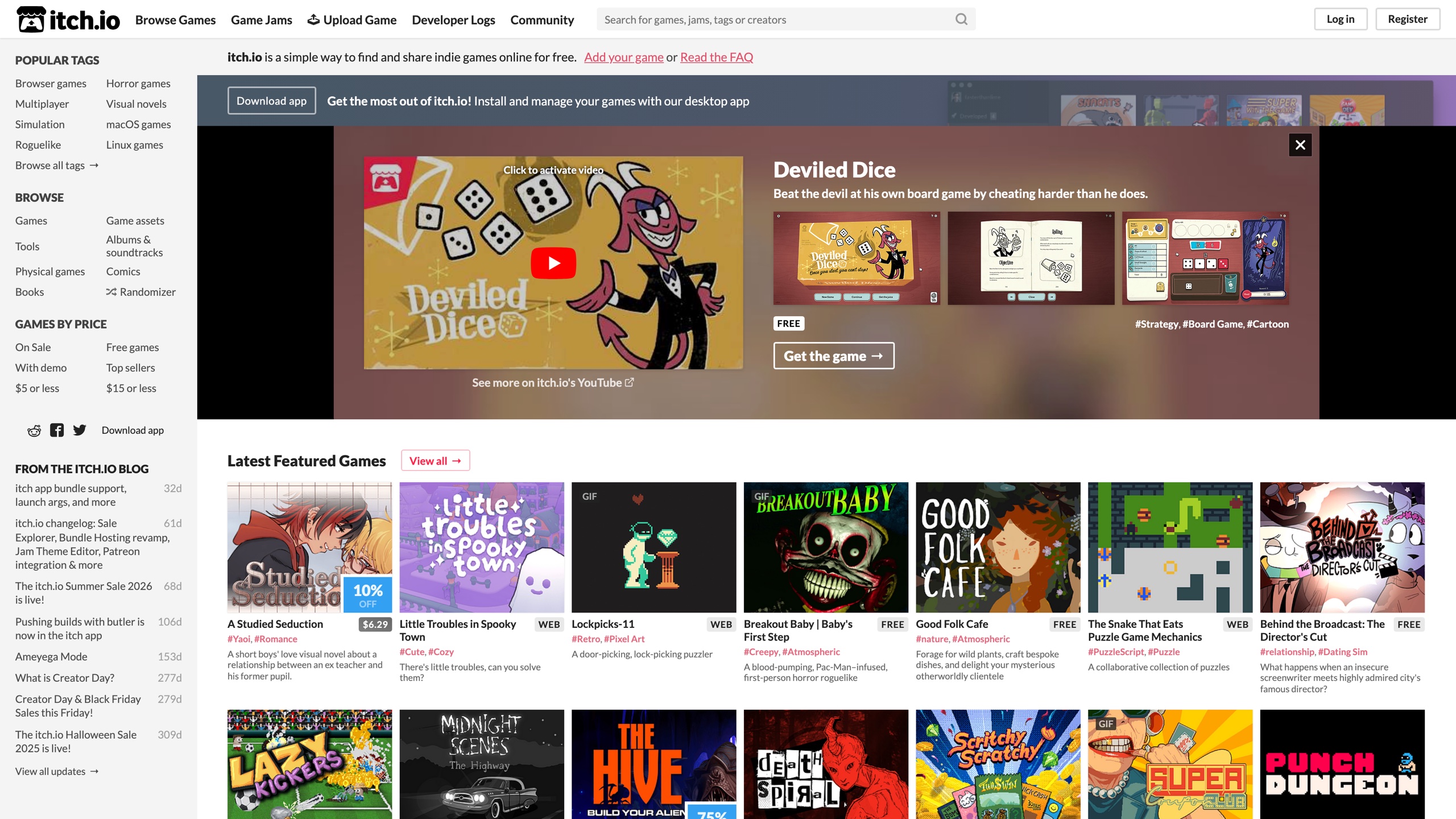
itch.io is an open digital marketplace for independent creators, focused on indie video games but also hosting tabletop RPGs, game assets, comics, and music. Its defining difference from stores like Steam is the absence of gatekeeping: anyone can publish after registering, and the official About page states it is "never necessary to get votes, likes, or follows to get your content approved." Creators control their own pages, pricing, and sales.
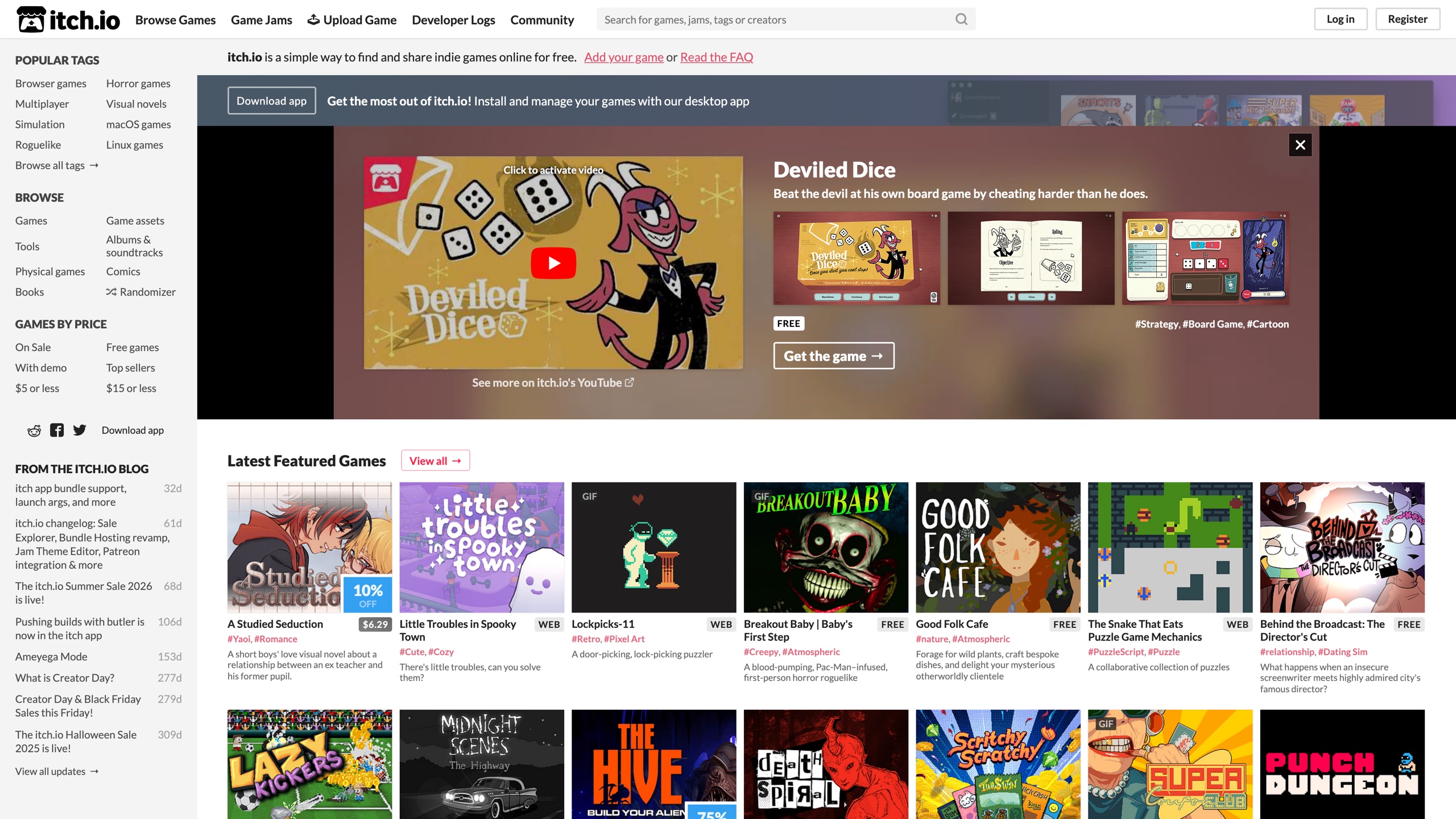 Browsing and downloading free content needs no account; publishing, commenting, and joining game jams do. The catalog passed one million products as of November 2024.
At a glance
- URL: https://itch.io/
- Type: Open digital marketplace centered on indie games, owned by founder Leaf Corcoran
- Cost: Browsing and free content are free; paid titles are priced by creators, who also choose the platform's revenue share (default 10%)
- Registration: Optional for browsing and free downloads; required for publishing, commenting, and jams
- Interface language: English
- Desktop: Official open-source app, itch (Windows/macOS/Linux)
Background
itch.io was built by American hobbyist programmer Leaf Corcoran and launched on March 3, 2013. In interviews he has explained that he created the MoonScript language in 2012, made games with it, and had nowhere to distribute them — Steam still admitted games through the Greenlight community vote — so he coded a marketplace modeled on Bandcamp and put it on an unused domain he owned. The site first drew attention by hosting game jams such as Ludum Dare, and the 2014 Flappy Jam pulled in hundreds of entries and press coverage. By 2015 it was established as a go-to platform for indie developers; the desktop app arrived in early 2016. The catalog exceeded one million products by November 2024, and an official announcement in July 2025 put the number of product pages above two million. On September 2, 2026 the games browse page alone listed 1,537,636 results.
Publishing and selling
- No approval queue: No admission votes or human pre-review; upload and you are live, and distribution terms can be changed at any time.
- Customizable pages: Store pages can be restyled down to custom CSS; itch.io pledges they carry no ads, banners, or links to other creators' work.
- Flexible pricing: Much of the catalog is free; paid titles have a creator-set minimum that buyers can exceed under pay-what-you-want, and HTML5 games run directly in the browser.
- Distribution tools: Download keys, embeddable widgets, limited-quantity sales, password-protected pages, and the "Refinery" early-access toolkit introduced in 2016.
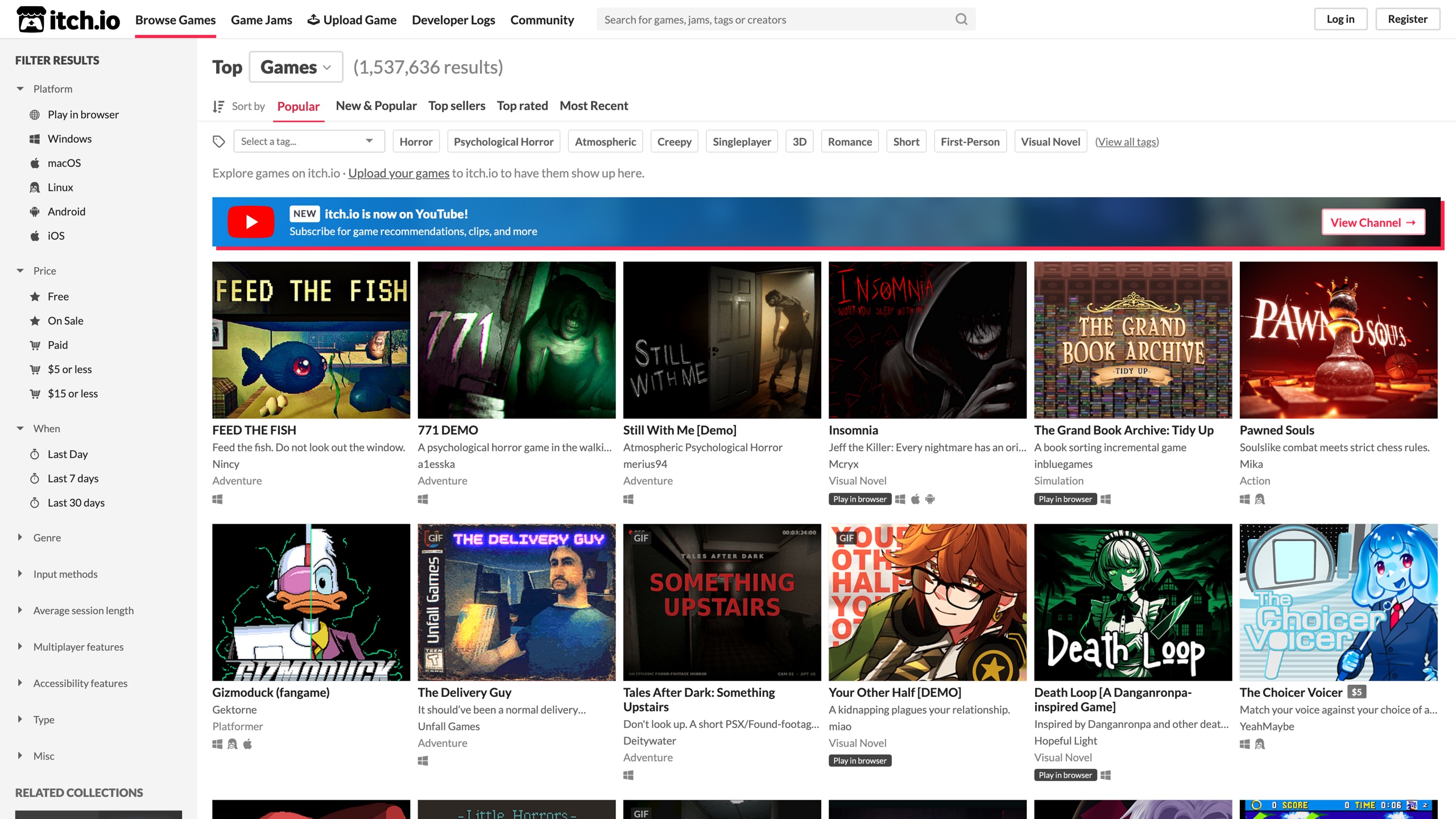 The browse view above can be filtered by platform, price, and genre. The mix of free and paid, heavily experimental work is typical of the catalog.
Open Revenue Sharing
Since March 2015 the platform has run what it calls Open Revenue Sharing: each creator sets the percentage of their sales that goes to itch.io, anywhere from 0% to 100%, with a 10% default — against an industry norm of 30% at the time. Payments run through PayPal or Stripe (card numbers never touch itch.io's servers), and the processor fee is generally $0.30 + 2.9% per transaction, borne by the seller. itch.io also runs occasional "Creator Days" (May 14, 2021 was one) on which it waives its share entirely.
Game jams and community
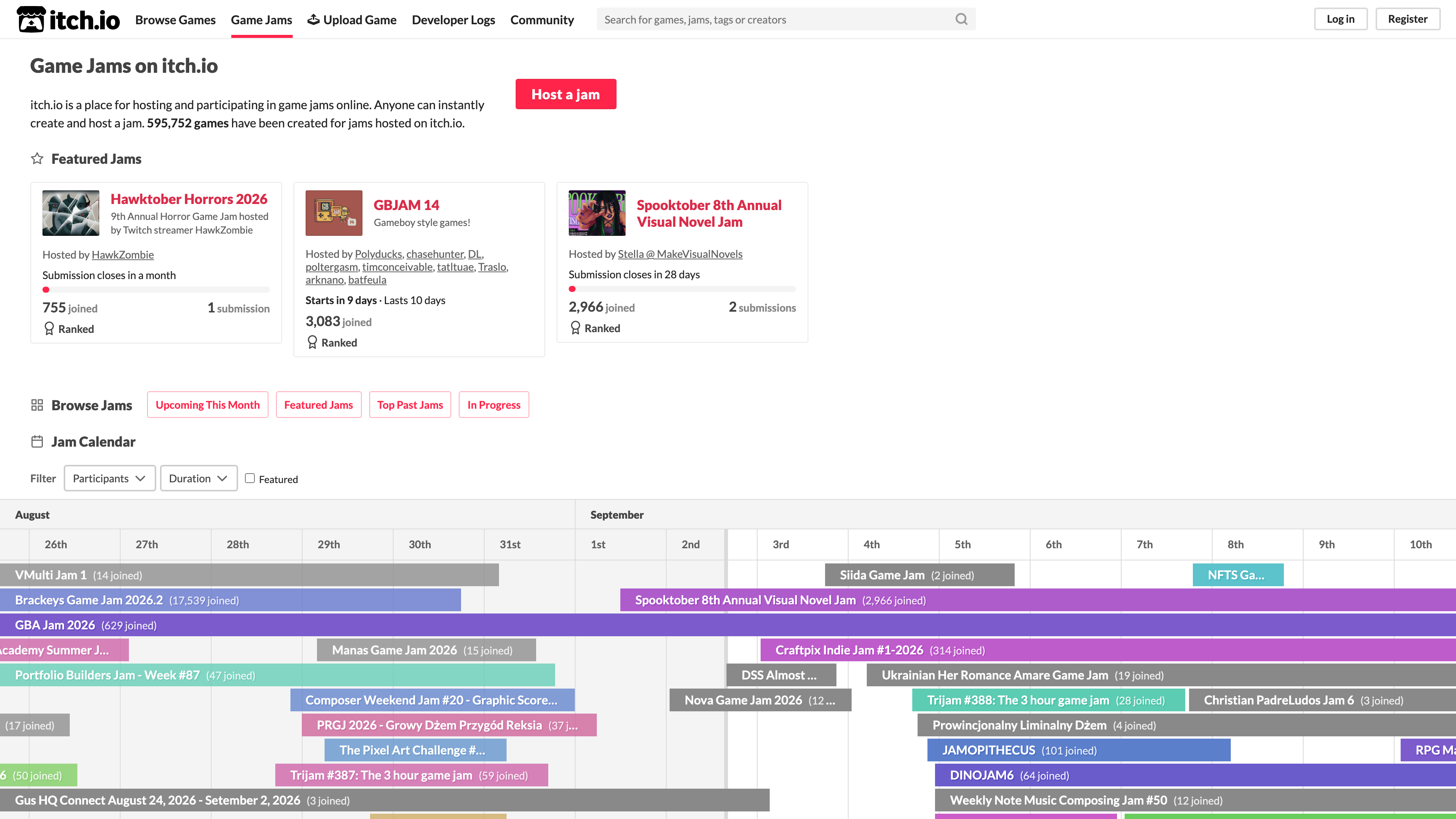
Hosting game jams — timed creation events — is itch.io's signature feature, and anyone can start one. As of September 2, 2026, the jams page reports that 595,752 games have been created for jams hosted on the site.
 The community also runs frequent charity bundles: the Bundle for Racial Justice and Equality in June 2020 gathered more than 1,500 works and raised $8.1 million in eleven days, followed by bundles for Ukraine, abortion funds, and other causes. Bundle proceeds can be split among participants in any proportions.
Desktop app and open tooling
The official desktop app itch, released in early 2016, installs, updates, and launches purchased games, and its source is MIT-licensed (an Electron shell over a Go daemon called butler). Developers also get OAuth, a server-side API, and a JavaScript API through the integration docs.
Copyright and content policy
Creators keep their copyrights; itch.io provides hosting and a storefront. With no pre-publication review, governance relies on tagging, after-the-fact moderation, and payment compliance. The limits of that model surfaced in July 2025: over a game called No Mercy (already banned from the platform that April), the Australian group Collective Shout campaigned to Steam's and itch.io's payment processors, and on July 24 itch.io announced it was "deindexing" all adult NSFW content from browse and search pending a page-by-page review. Reindexing resumed on July 31 once creators confirmed compliance, while some pages were removed permanently. In the announcement Corcoran explained that itch.io is a small company with limited ability to "push back" against payment partners, and that the step was taken to protect the payment rails every creator depends on. Some non-adult titles were caught up as well, feeding a wider debate about payment companies indirectly censoring creative work, covered by The Guardian and Wired among others. Under the UK Online Safety Act, UK visitors must verify their age for NSFW pages since July 25, 2025. Separately, in December 2024 the domain was briefly suspended by its registrar over an automatically generated phishing complaint and restored the same day.
When it is useful
- Publishing a first game, prototype, or experiment at near-zero cost
- Finding short, experimental, or retro-styled games for free or cheap (low-poly horror is a signature niche)
- Entering or organizing a game jam and showcasing the result
- Selling tabletop RPG books and assets — itch.io is a major channel for indie TTRPG publishing
- Grabbing charity bundles to get hundreds of works while funding a cause
Limitations
- The catalog is extremely long-tail: much of it is experimental and rough, discovery takes patience, and ratings/recommendations are simpler than Steam's.
- English-only interface, and community content is predominantly English.
- No pre-publication review means content policy is exposed to payment-processor pressure, as the July 2025 adult-content deindexing showed; category availability can change abruptly.
- Commercial scale is far below Steam's; visibility depends heavily on jams, bundles, and off-platform promotion.
- Since July 2025 some adult content requires age verification in the UK, and local law may affect payments or visibility elsewhere.
Alternatives
Steam is the largest PC game store (a $100 fee and review per title); Game Jolt targets a similar indie and free-game community; GOG curates commercial DRM-free games — the opposite of itch.io's open long tail.
Sources
- itch.io official site and About page (checked 2026-09-02)
- itch.io docs: Accepting Payments and Getting Paid (Open Revenue Sharing 0–100%, 10% default, processor fees; checked 2026-09-02)
- itch.io game jams page (595,752 jam games; checked 2026-09-02)
- itch.io official announcement: Update on NSFW content (2025-07-24, with the 2M+ product-page figure and the July 31 reindexing update; checked 2026-09-02)
- GitHub: itchio/itch (desktop app, MIT license; checked 2026-09-02)
- Wikipedia: itch.io (March 3, 2013 launch, Leaf Corcoran, 1M+ products by November 2024, charity bundles, July 2025 adult-content deindexing, December 2024 domain incident; checked 2026-09-02)
- The Guardian: Mastercard and Visa face backlash after hundreds of adult games removed from online stores Steam and Itch.io (2025-07)
- Wired: Steam and Itch.io Are Pulling 'Porn' Games. Critics Say It's a Slippery Slope to More Censorship (2025-07)