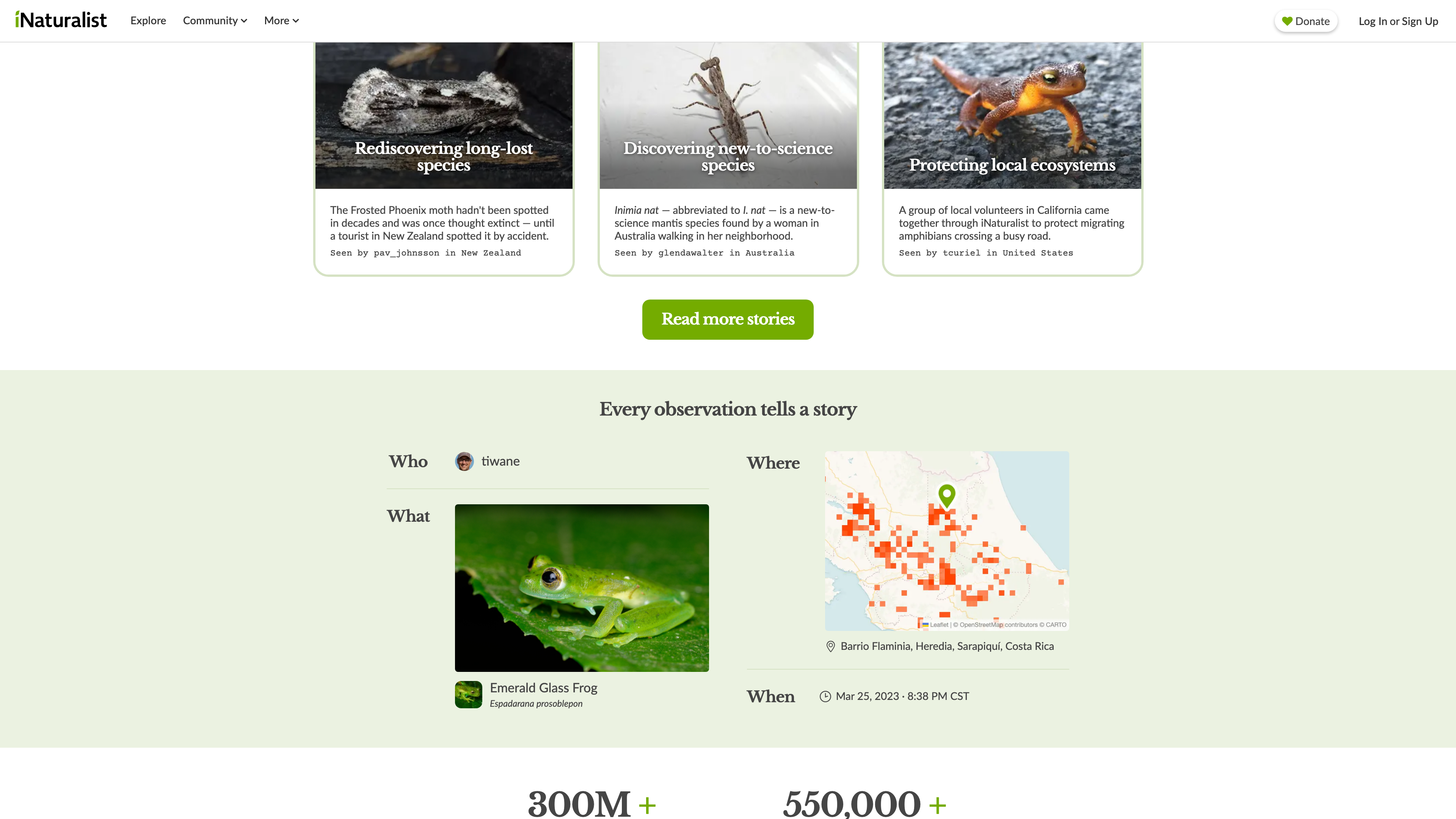
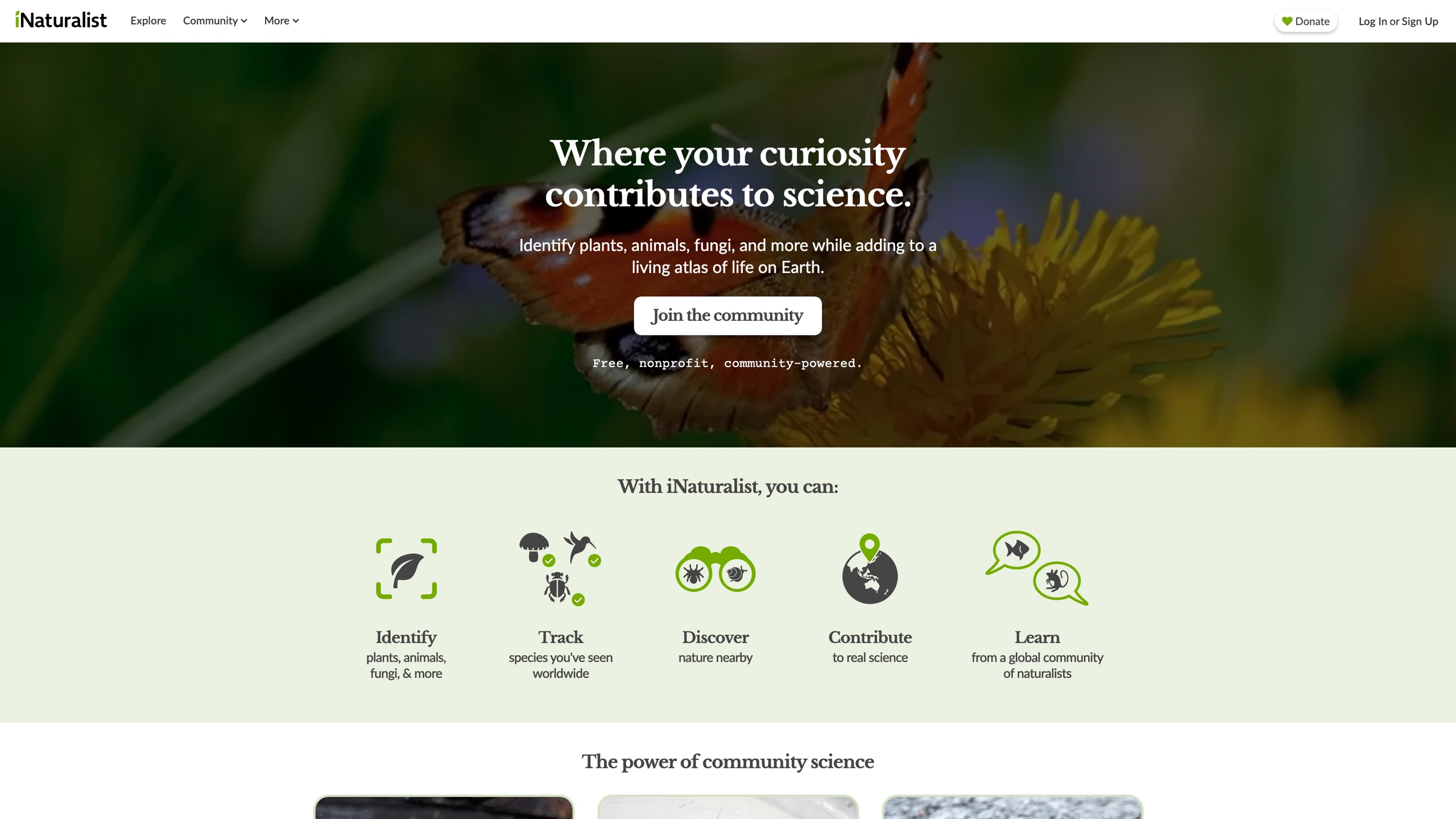
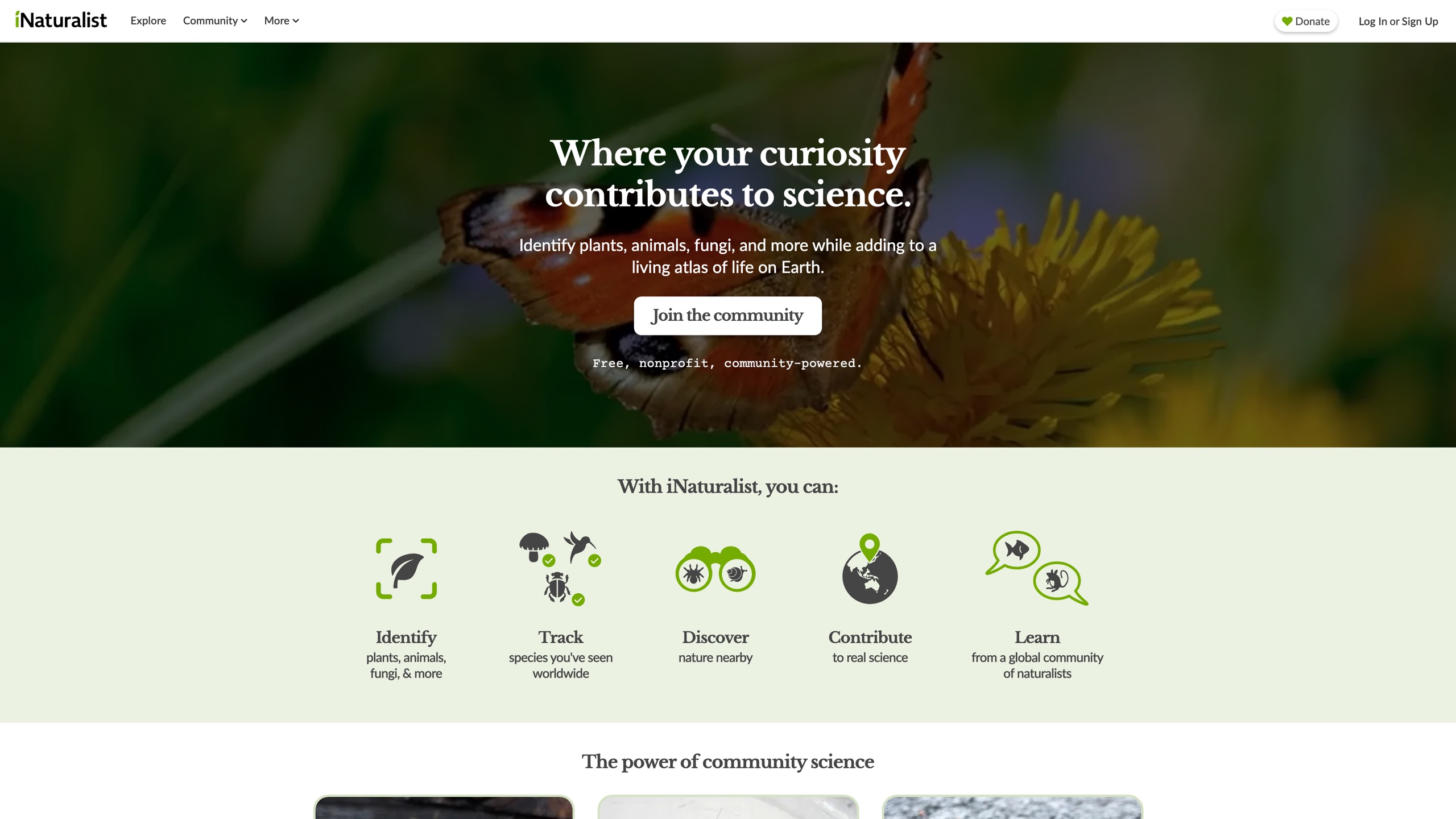
iNaturalist (inaturalist.org) is a public biodiversity observation network. You photograph a wild plant, animal, fungus, or other organism and upload it; a computer vision model offers identification suggestions, and a worldwide community of naturalists helps confirm or refine the ID. What sets it apart from plain "identify-this-flower" apps is what happens next: every observation carries a date, a location, and evidence photos or sounds, and once it reaches "Research Grade" it is shared with scientific databases such as GBIF, becoming real species-distribution data used in published research. The platform is operated by an independent nonprofit and is free to use.
At a Glance
- URL: https://www.inaturalist.org/
- Type: Citizen science observation network / species identification platform (web plus iOS/Android apps)
- Cost: Free; nonprofit-run and donation-supported
- Registration: Browsing public content needs no account; posting observations or identifications requires a free account (email + username + password). Users must be at least 13, or have parental permission; the site steers under-13s to the Seek app
- Interface languages: Multilingual UI, including Simplified and Traditional Chinese (footer switcher; both verified working on 2026-09-02)
- Mobile: Official iOS and Android apps, plus Seek for kids and privacy-conscious use (verified by direct visit on 2026-09-02)
Background
iNaturalist launched in 2008 as a Master's final project at UC Berkeley's School of Information (Ken-ichi Ueda, Nate Agrin, and Jessica Kline), became a company in 2011, joined the California Academy of Sciences in 2014, and operated as a joint initiative of the Academy and the National Geographic Society from 2017. In July 2023 it spun off as an independent 501(c)(3) nonprofit based in California (EIN 92-1296468) — see the official About page and the announcement post.
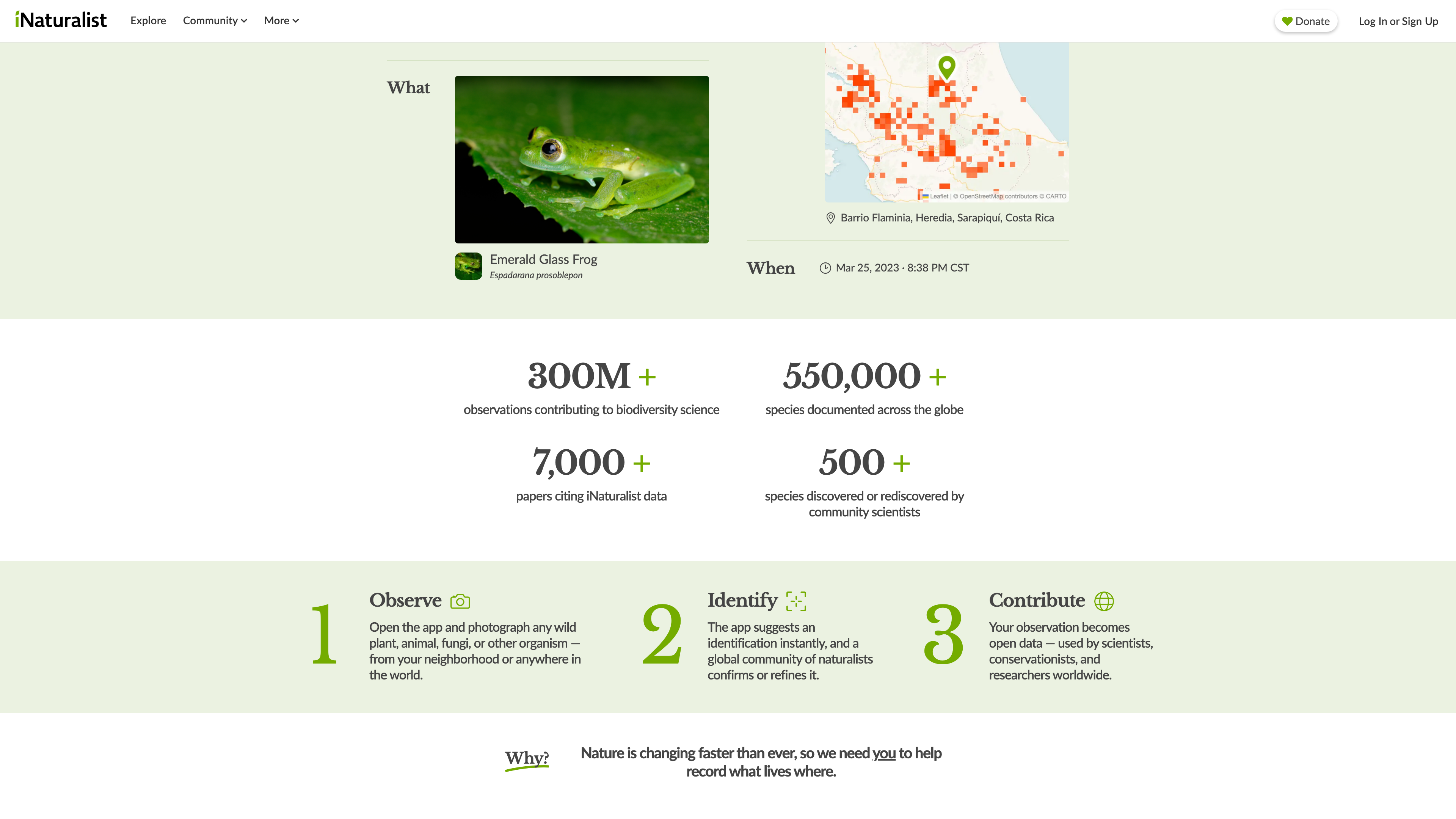
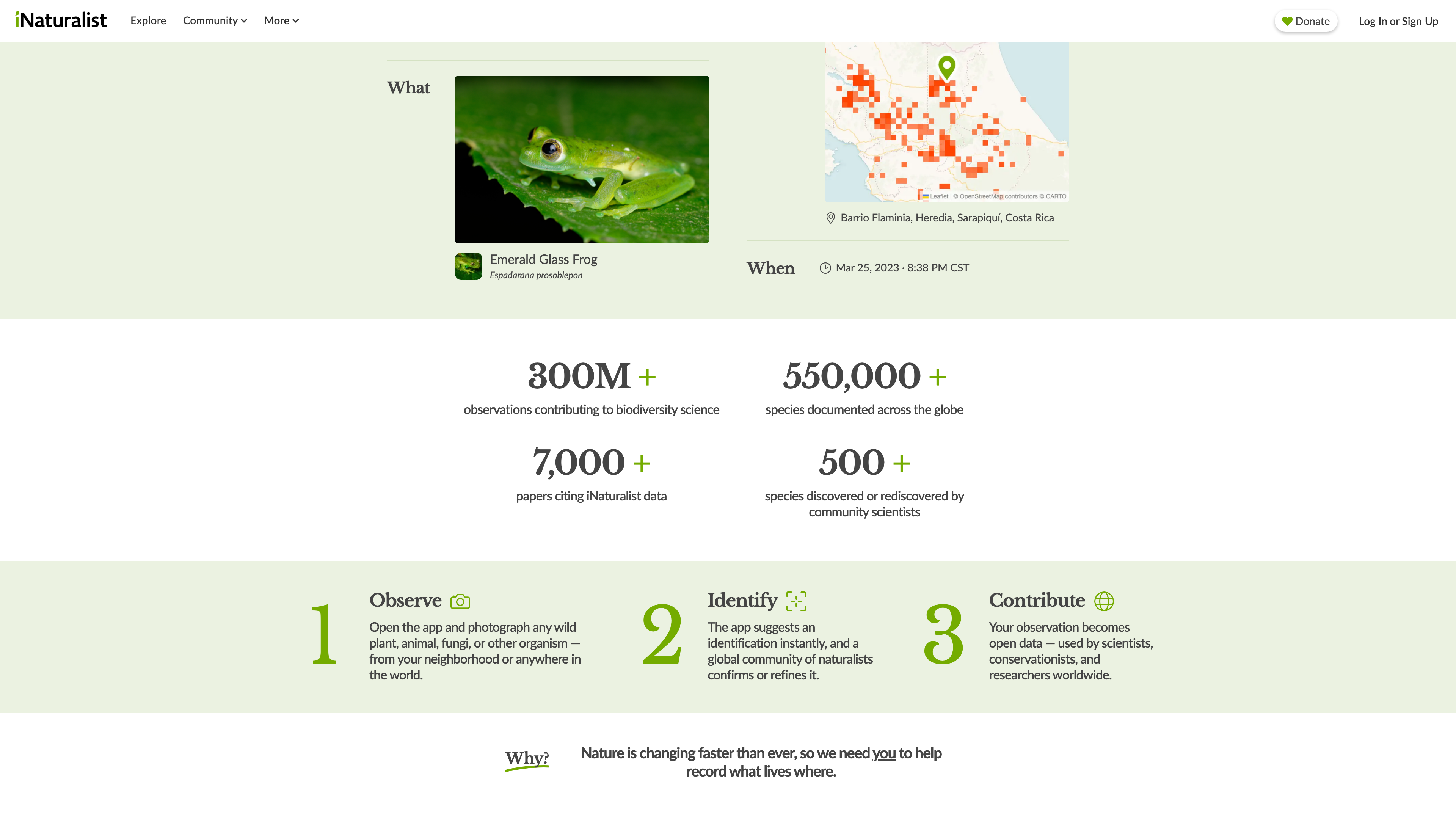
Scale, per the homepage as visited on 2026-09-02: over 300 million observations, about 550,000 species documented, more than 7,000 papers citing iNaturalist data, and over 500 species discovered or rediscovered by community scientists. The official blog marked 250 million "verifiable" observations in June 2025.
Photo Identification and the Computer Vision Model
When you upload a photo, the suggestions come from a computer vision model trained on the community's observation photos. A taxon (usually a species) enters the training set only after roughly 100 photos across 60 observations have accumulated; version 2.29, released in March 2026, covers 115,899 taxa and is retrained every month or two (model update post). Since 2023, visual similarity has been combined with a Geomodel that weighs suggestions by where and when the observation was made, flagging species as "Expected Nearby."
The computer vision explainer is explicit about scope: the model learns what typical iNaturalist photos look like — smartphones shooting wild organisms in situ — so it performs poorly on atypical images such as pinned specimens. Suggestions are candidates, not verdicts; the community makes the final call.
Community Review and Research Grade Data
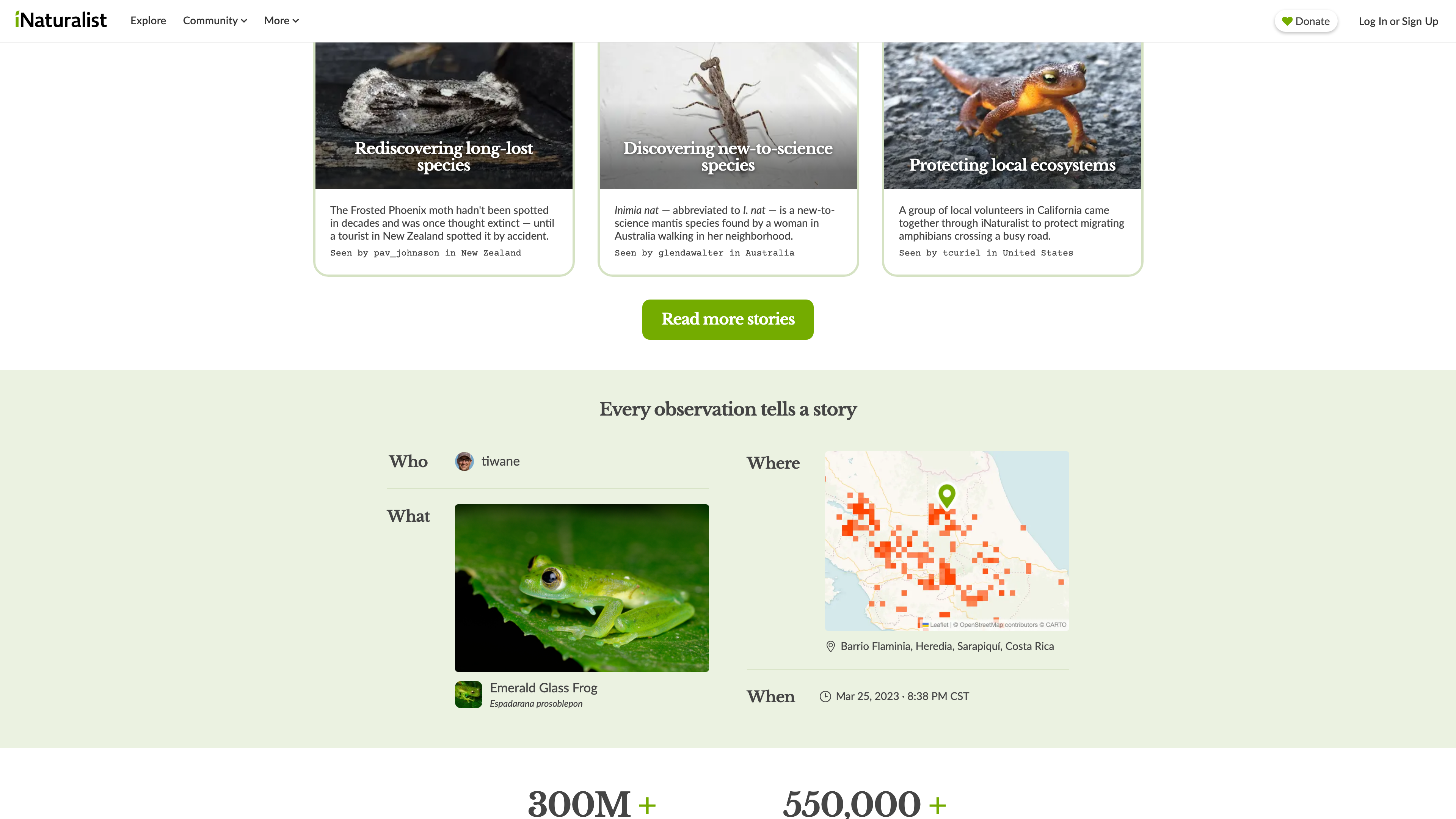
An observation that has a date, coordinates, photo or sound evidence, and is not of a captive or cultivated organism counts as "verifiable" and enters the "Needs ID" pool. It becomes Research Grade when more than two-thirds of identifiers agree on a species-level (or lower) taxon. Through the Data Quality Assessment, the community can also vote problematic records down to "Casual" — for instance when the date or location looks wrong, the organism isn't wild, or no real evidence is presented (rules documented in the official FAQ archive).
Research Grade observations licensed CC0, CC BY, or CC BY-NC are shared with GBIF, the Global Biodiversity Information Facility (GBIF dataset description); the Terms of Use also note that data is repackaged in machine-readable form for GBIF and the AWS Open Data Sponsorship Program. This pipeline is the core difference from a consumer identification app: a casual snapshot can end up in the scientific record.
Copyright and Content Policy
- Default license: at signup, a recommended checkbox reads "license my photos, sounds, and observations so scientists can use my data," which applies CC BY-NC to your content. In account settings you can switch to CC0, CC BY, or all rights reserved (Terms of Use, §02; signup page verified 2026-09-02).
- Ownership: you keep the copyright in what you post; the iNaturalist name and bird logo are registered trademarks.
- AI training: §07 of the Terms explicitly prohibits using iNaturalist data to train AI or machine-learning models for commercial purposes.
- Privacy and coordinates: observations are public by default. Coordinates are obscured automatically for threatened species or at the observer's choice (geoprivacy). Local institutions in the iNaturalist Network can access the true coordinates of obscured records in their own country for conservation work.
How Seek Differs
Seek by iNaturalist is a separate app from the same team, first released in March 2018 (per the official community forum), with real-time camera identification added in version 2.0 (April 2019). The two complement each other:
- Seek: no registration and no user data collection; identification runs on-device; your precise location is never stored or sent; badges and challenges make it kid-safe and family-oriented. Observations stay on your device by default.
- iNaturalist proper: account-based; observations go into a public database where community review turns them into research-usable records.
In April 2025 iNaturalist shipped a redesigned iPhone app that brings Seek-style instant, offline-capable identification into the main app's camera — but the fundamental split remains: Seek keeps data private, iNaturalist shares it for science.
Good Use Cases
- Getting a quick lead on a wild plant, animal, or fungus you can't name;
- Keeping a lifelong, map-based record of the species you've encountered;
- Joining event-style surveys such as the City Nature Challenge and contributing distribution data to research and conservation;
- Accessing crowdsourced occurrence data via GBIF as a researcher or practitioner.
Limitations
- Suggestions are not determinations: the model covers roughly 116,000 taxa, a small slice of the ~2 million described species; rare or long-tail organisms often only get coarse genus- or family-level suggestions.
- Weak on atypical photos: trained on in-situ smartphone shots, the model is unreliable for specimens, pets, or potted plants — and captive/cultivated observations can't reach Research Grade anyway.
- Community review takes time, and Research Grade is community consensus rather than expert certification; misidentifications still occur.
- Everything is public by default: coordinates are visible to anyone unless you obscure them, so it's the wrong tool for locations you want kept private; it's also not a photo backup service (uploads are resized and reprocessed).
- The default CC BY-NC license blocks commercial reuse, and photos under it can't be used on platforms like Wikipedia unless you change your licensing settings.
Comparable Services
- Seek by iNaturalist: same team; no account, on-device identification, no uploads — built for kids and privacy.
- Pl@ntNet: plant-focused identification and citizen science.
- Merlin Bird ID and eBird: bird identification and checklist-based recording from the Cornell Lab of Ornithology.
References
- iNaturalist homepage, About, and Terms of Use (checked 2026-09-02)
- Spreading Our Wings: iNaturalist is Now an Independent Nonprofit (official blog, 2023-07)
- We've reached 250 million verifiable observations! (official blog, 2025-06)
- Updated computer vision model and geomodel (official blog, 2026-03, model v2.29) and the Computer Vision explainer
- GBIF: iNaturalist Research-grade Observations dataset
- Seek by iNaturalist official page
- New iNaturalist app for iPhone (official blog, 2025-04)
- Official FAQ archive (Research Grade and geoprivacy rules)