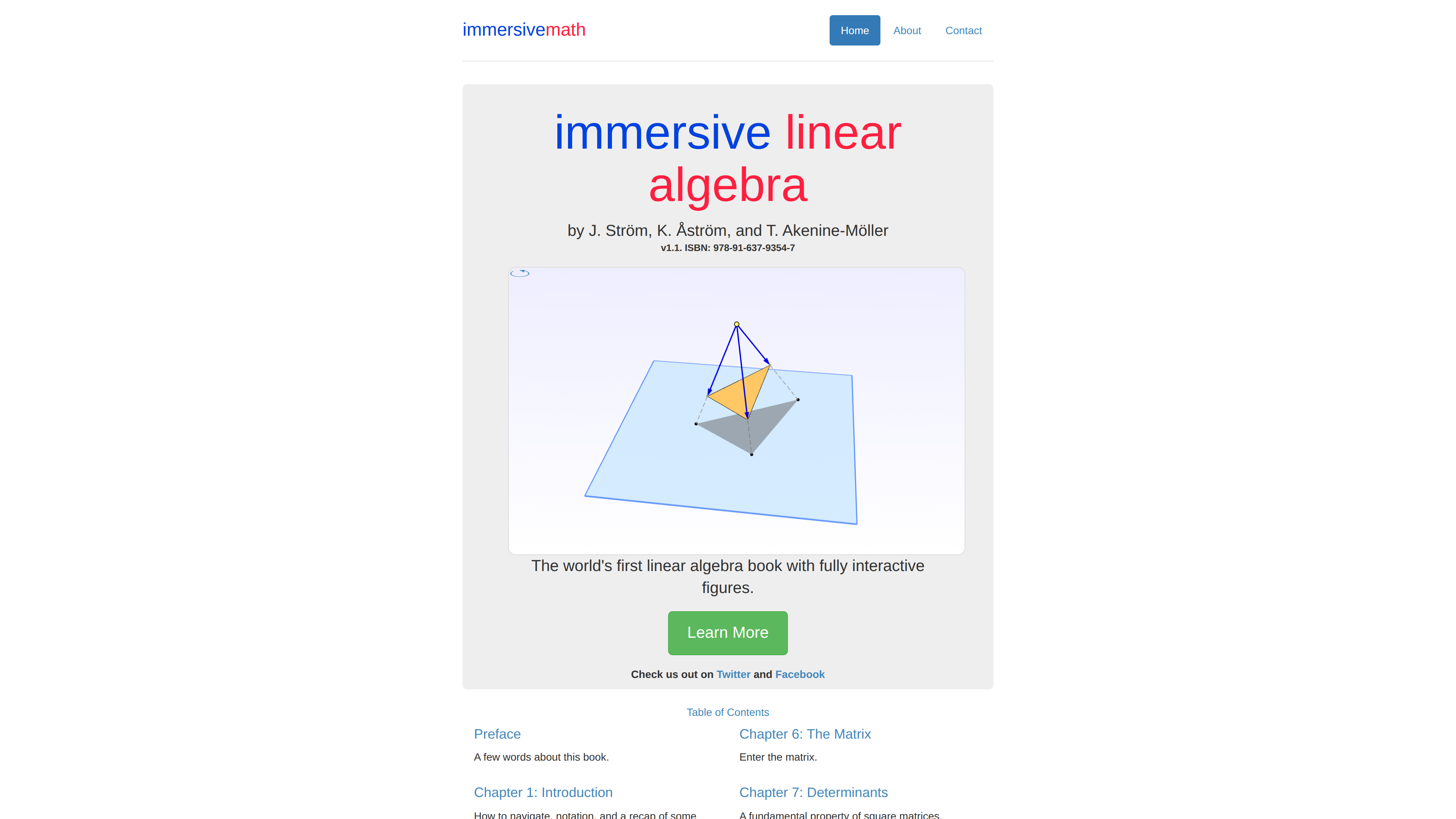
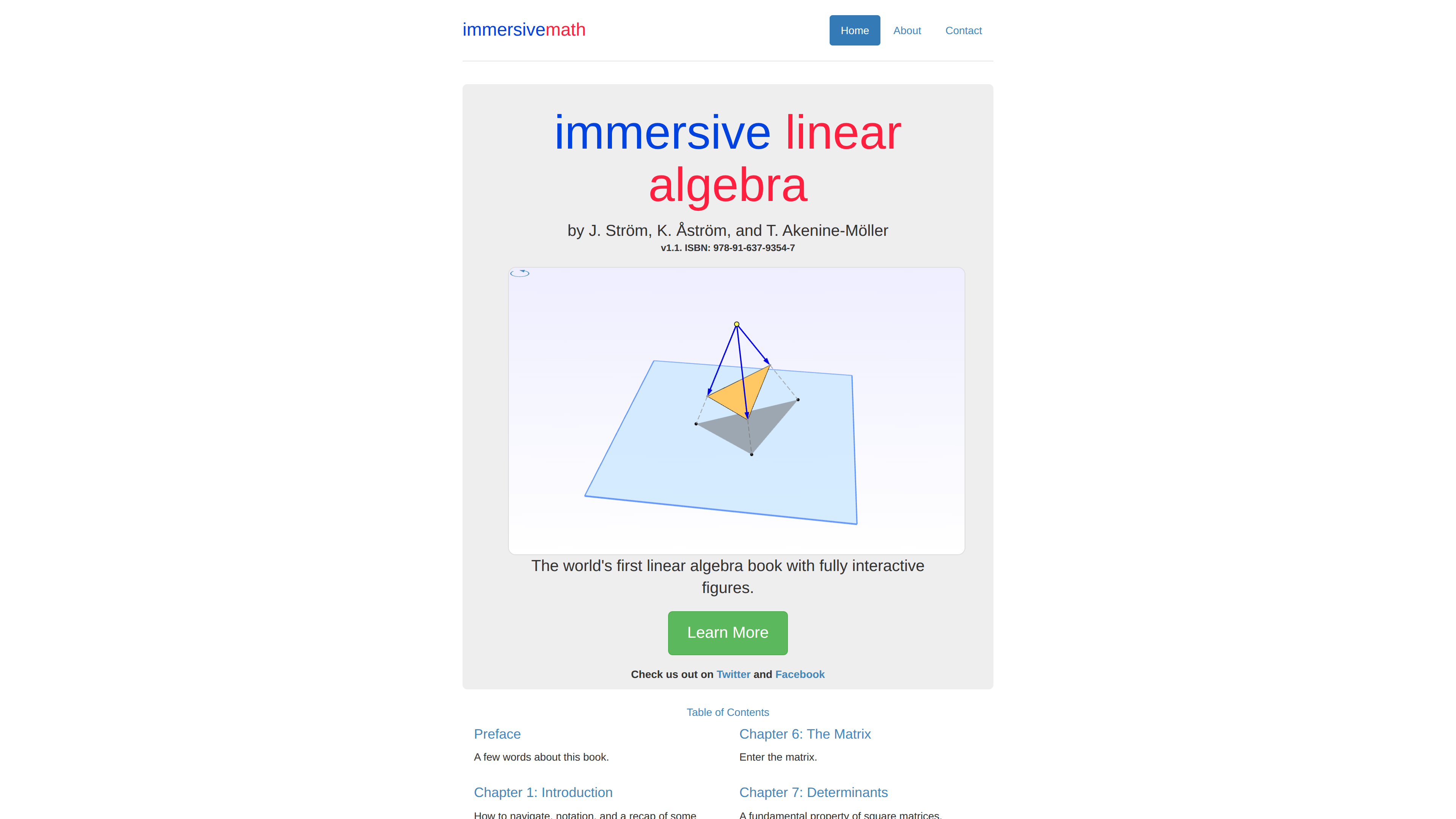
Immersive Math currently hosts a single work, but a distinctive one: Immersive Linear Algebra, a fully online linear algebra textbook. Its authors call it "the world's first linear algebra book with fully interactive figures" — illustrations here are not static images but real-time 3D scenes you can rotate, zoom and parameterize. The book is written by Jakob O Ström, Karl Åström and Tomas Akenine-Möller of Lund University; the Lund University research portal records it as published in 2015 with electronic ISBN 978-91-637-9354-7.
At a Glance
| Item | Details (as of 2026-09-30) |
|---|---|
| URL | immersivemath.com (book content under /ila/) |
| Type | Interactive online textbook (linear algebra) |
| Cost | Free |
| Account | None required |
| Language | English only |
Background
All three authors are affiliated with Lund University: Ström and Akenine-Möller with the Department of Computer Science (Akenine-Möller is a well-known real-time rendering researcher and co-author of Real-Time Rendering), Åström with the Faculty of Engineering's mathematics division; the portal lists the book as an output of ELLIIT, the Linköping–Lund initiative on IT and mobile communication. The preface explains the motivation: if a picture is worth a thousand words, an interactive illustration is worth more — so the whole book is built around them. Copyright notices show revisions through 2015–2020; the current version is v1.1.
Chapters and Interactivity
Ten chapters: introduction, vectors, the dot product, the vector product, Gaussian elimination, matrices, determinants, rank, linear mappings, and eigenvalues/eigenvectors.
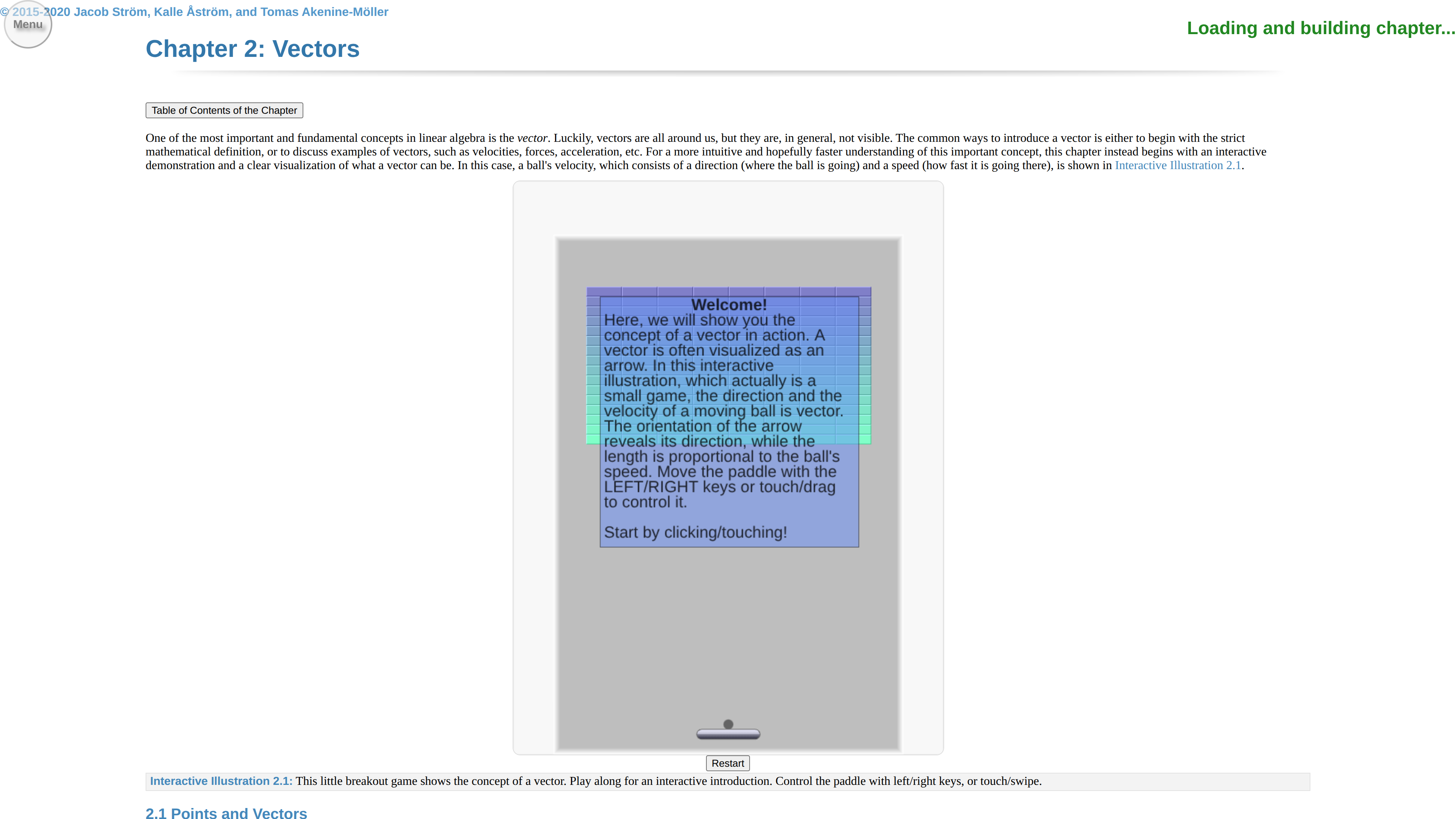
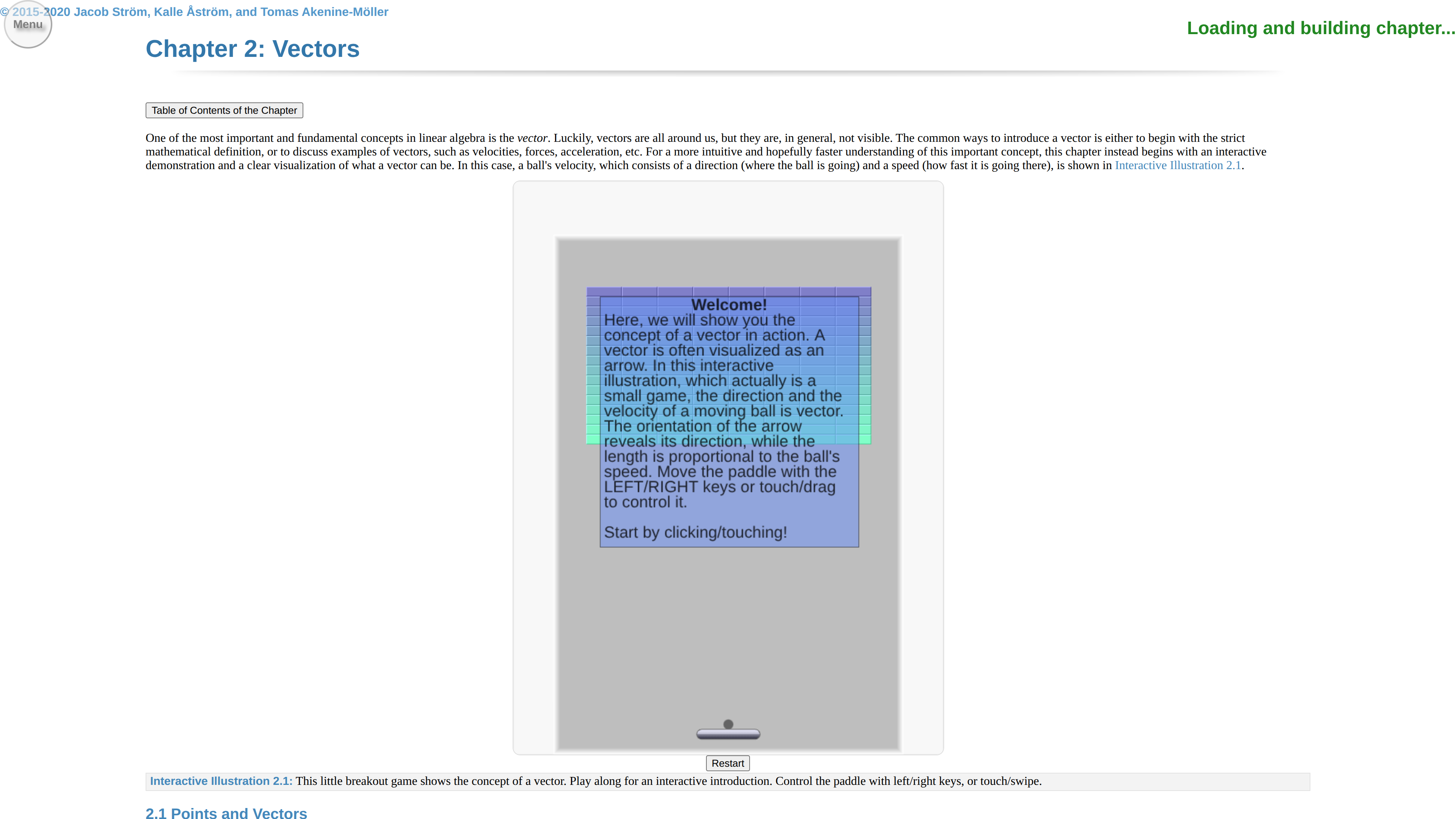
Interactive figures run throughout, in varied forms. Chapter 2 introduces vectors with a breakout mini-game — the ball's direction and speed are the vector. Later chapters embed 3D figures you can drag to rotate, examining planes, mappings and the geometry of determinants. For readers who prefer geometric intuition before algebraic derivation, this ordering is far friendlier than a conventional textbook.
Good For
- Students taking linear algebra who need geometric intuition;
- Graphics and game-development learners filling in math foundations (the authors' background keeps the material close to graphics applications);
- Teachers projecting abstract concepts in class.
Limitations
- English only, with standard textbook terminology that may challenge non-native readers.
- Frozen at v1.1 (copyright notices end in 2020) — not for readers expecting ongoing updates.
- The 3D figures require WebGL; very old browsers or locked-down environments may not render them.
- One subject only: despite the name Immersive Math, no other branches of mathematics are covered.