Ideogram (ideogram.ai) is a generative image platform operated by Ideogram AI, Inc. in Toronto: you type a prompt and get an image, and its verifiable differentiator is rendering accurate, readable text inside the image — headlines, taglines, and packaging copy arrive as part of the picture. That makes it a frequent pick for posters, logo concepts, layout-heavy design, and e-commerce visuals. As of September 2026, the site positions itself as "AI apps and models in one platform": a single account covers a creative workspace (Ideogram Creative), a developer API, and an MCP integration for agent workflows. Ideogram 4.0, released on June 3, 2026, is the company's first open-weight model — 9.3B parameters, runnable on your own hardware. Why it's listed here: text rendering has long been a weak spot of text-to-image models, Ideogram has made it the core capability since its 2023 launch, and 4.0's open weights plus structured JSON prompting set it apart from closed-only rivals.
At a glance
- URL: https://ideogram.ai/
- Type: AI text-to-image platform (web app + iOS app + developer API + open-weight model)
- Pricing: Free tier 20/month (60/month (30/user/month ($20 annually, 2 seats minimum); Enterprise custom. As of 2026-09-19, see the official pricing page
- Sign-up: Generating requires a free account; sign-in via Apple, Google, or Facebook. The Terms of Service require users to be at least 13
- Interface language: English only; no other language options observed
Background
Ideogram AI was founded in Toronto in 2022. The founding team — Mohammad Norouzi (CEO), William Chan, Jonathan Ho, and Chitwan Saharia — are former Google Brain researchers whose past work, per the company's own account, includes Google's Imagen text-to-image system, Imagen Video, and denoising diffusion models (official launch announcement). Timeline:
- August 22, 2023: Formation announced alongside a $16.5M seed round led by a16z and Index Ventures; the text-to-image product opened publicly the same month with model 0.1 and drew attention for "getting words right" in images.
- February 2024: $80M Series A led by a16z (VentureBeat).
- June 3, 2026: Ideogram 4.0 released — the first model with open weights (official technical blog).
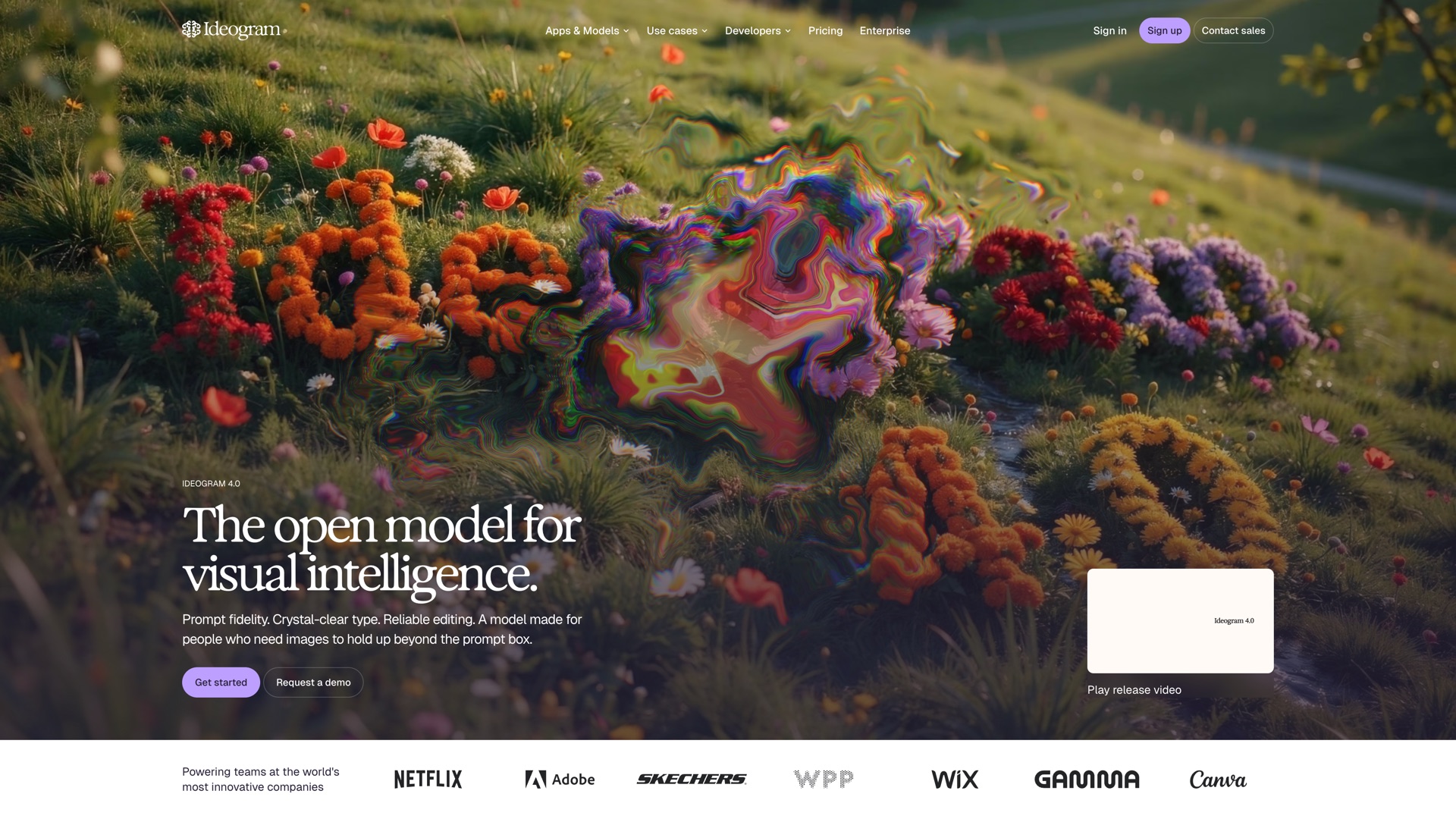
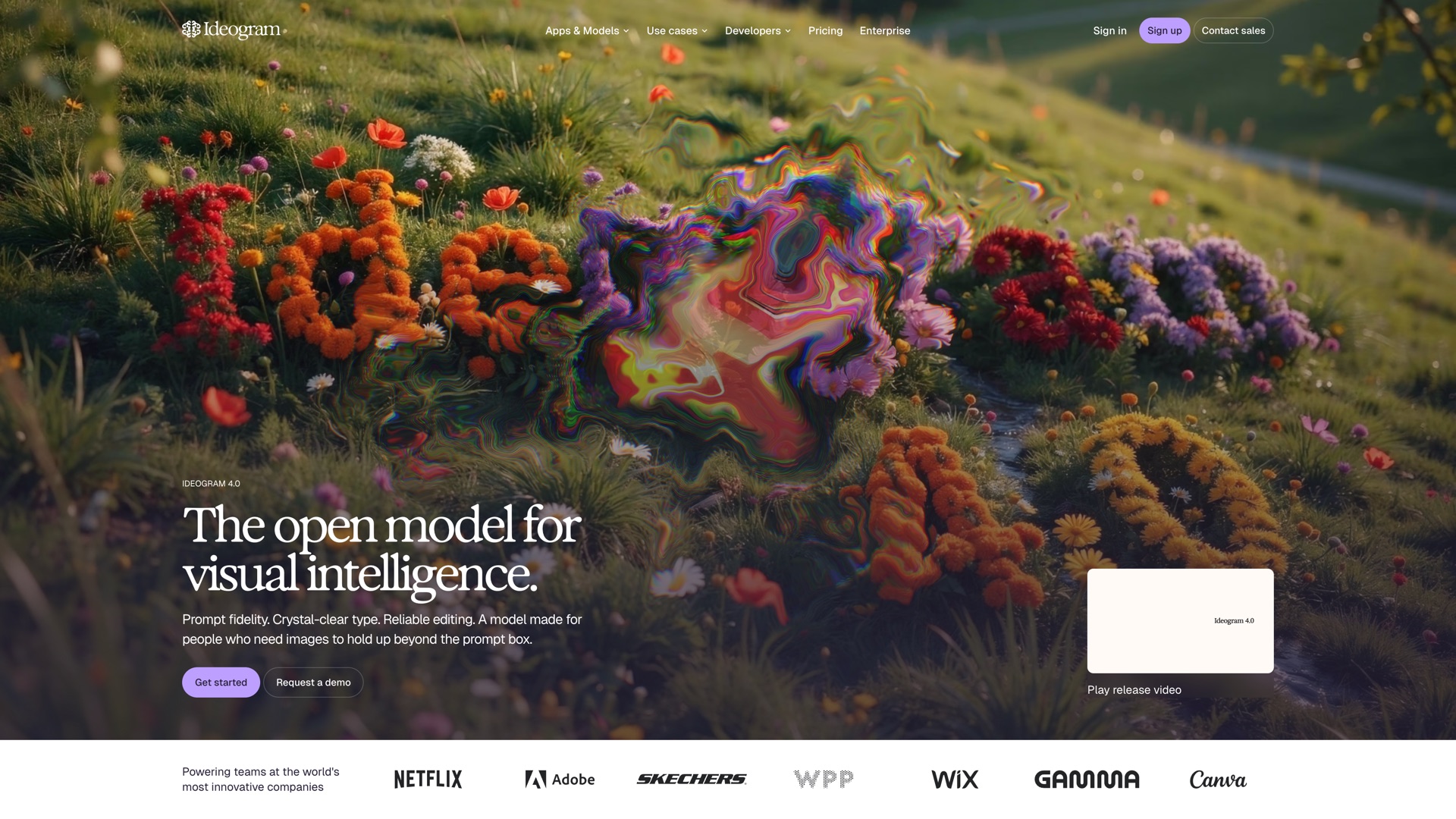
The screenshot below is the homepage as of 2026-09-19. The hero image is itself a generation spelling "IDEOGRAM" in flowers — a direct nod to the text-rendering pitch. Customer logos along the bottom include Netflix, Adobe, Skechers, WPP, Wix, Gamma, and Canva; Skechers has a published case study:
Core capabilities: from legible text to open weights
In-image text rendering. This is Ideogram's foundation. On the company's X-Omni English OCR benchmark, 4.0 scores 0.97 for in-image text accuracy — which Ideogram calls the best of any open-weight model (technical blog); in a ContraLabs blind evaluation by professional designers cited in the official README, Ideogram 4 led with a 47.9% first-place win rate (GitHub README). The official docs name logos, branding, print-on-demand, and layout design as typical uses.
Structured JSON prompting. 4.0 was trained exclusively on structured JSON captions: you can pin elements to bounding boxes (normalized 0–1000 coordinates), set color palettes of up to 16 hex values, and define typed text elements that pair the literal string with a styling description — the mechanism behind multi-line, multi-font in-image typography. Casual users can still write plain-language prompts; Magic Prompt expands them into the structured format the model expects (official docs).
A full editing and production toolchain. The web app includes a Canvas editor (Magic Fill, Extend outpainting, a text tool), Remix, Describe (image-to-prompt), and Upscale, plus a set of single-task apps: Background Remover, Object Remover, Ad Resizer, Colorways, and Material Swap. Paid features add character consistency, batch generation, and custom models trained on your brand assets (docs, homepage).
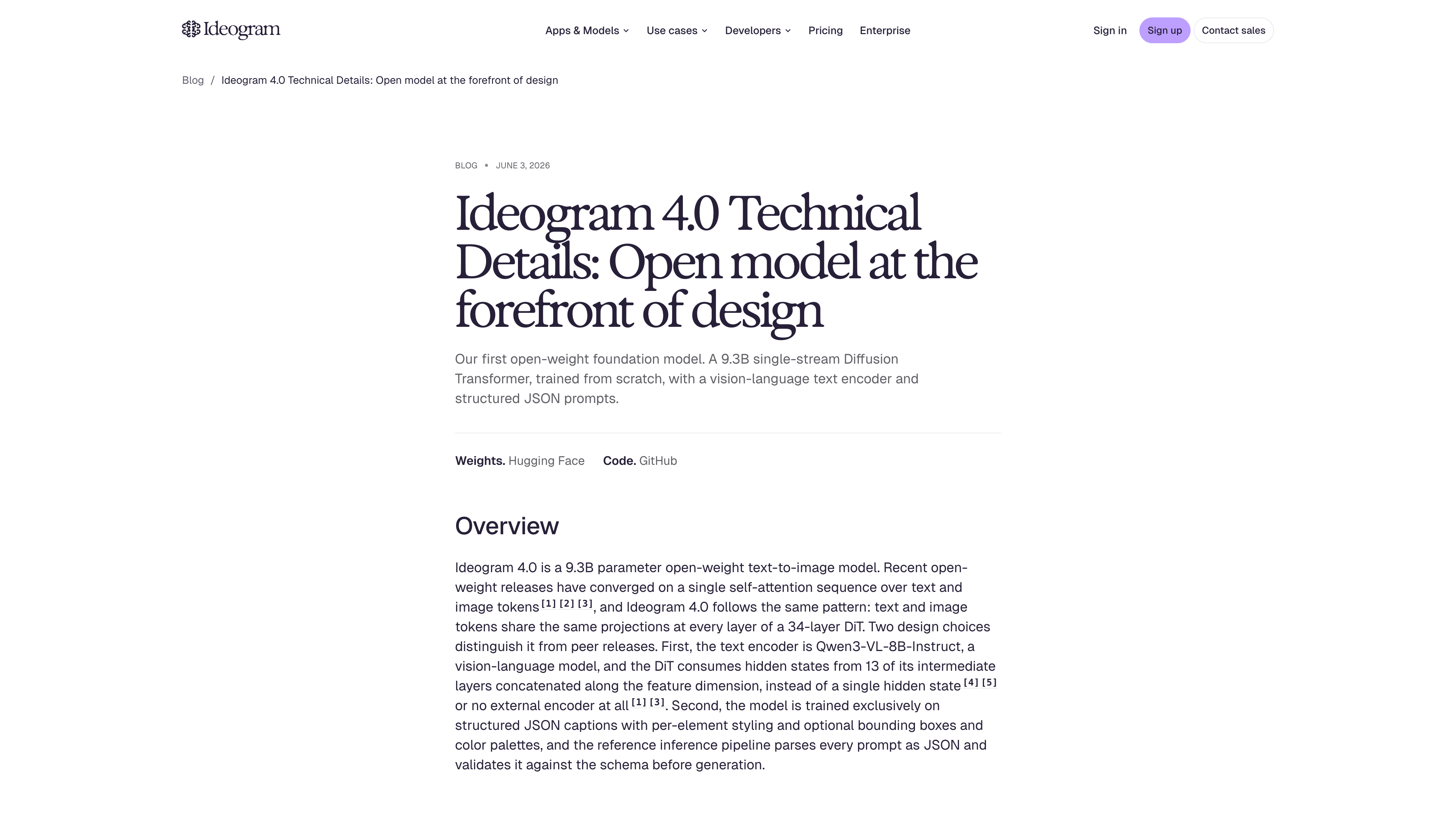
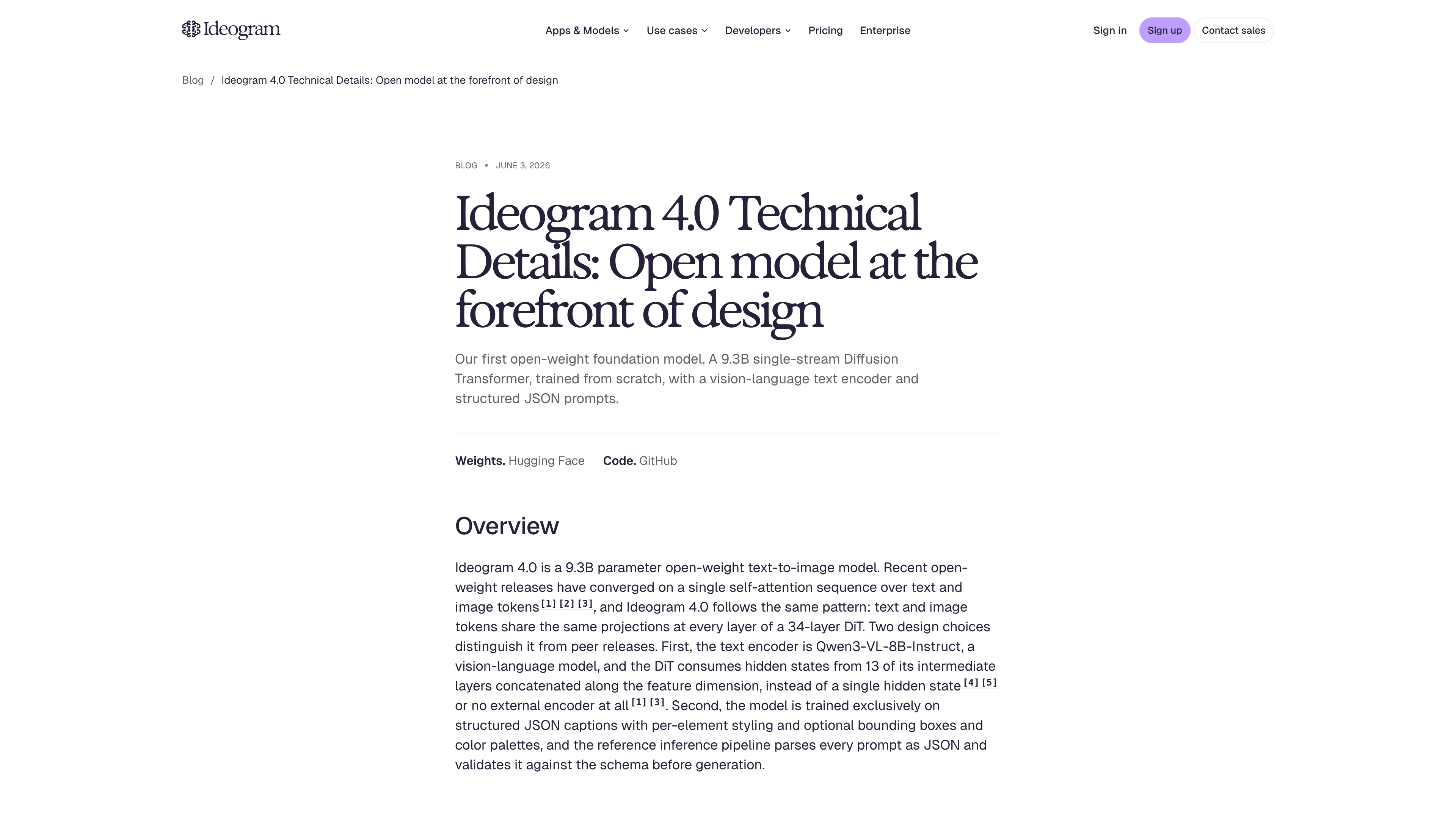
Open weights and self-hosting. 4.0 weights are published on Hugging Face in nf4 and fp8 quantizations — the nf4 build runs on a single 24GB GPU — and the inference code is Apache-2.0 on GitHub (ideogram-oss/ideogram4, roughly 2,800 stars as of 2026-09-19); the reference pipeline includes Hive content moderation. The screenshot below shows the official 4.0 announcement, which discloses the architecture: a 9.3B single-stream Diffusion Transformer with Qwen3-VL-8B as the text encoder:
Pricing, accounts, and openness
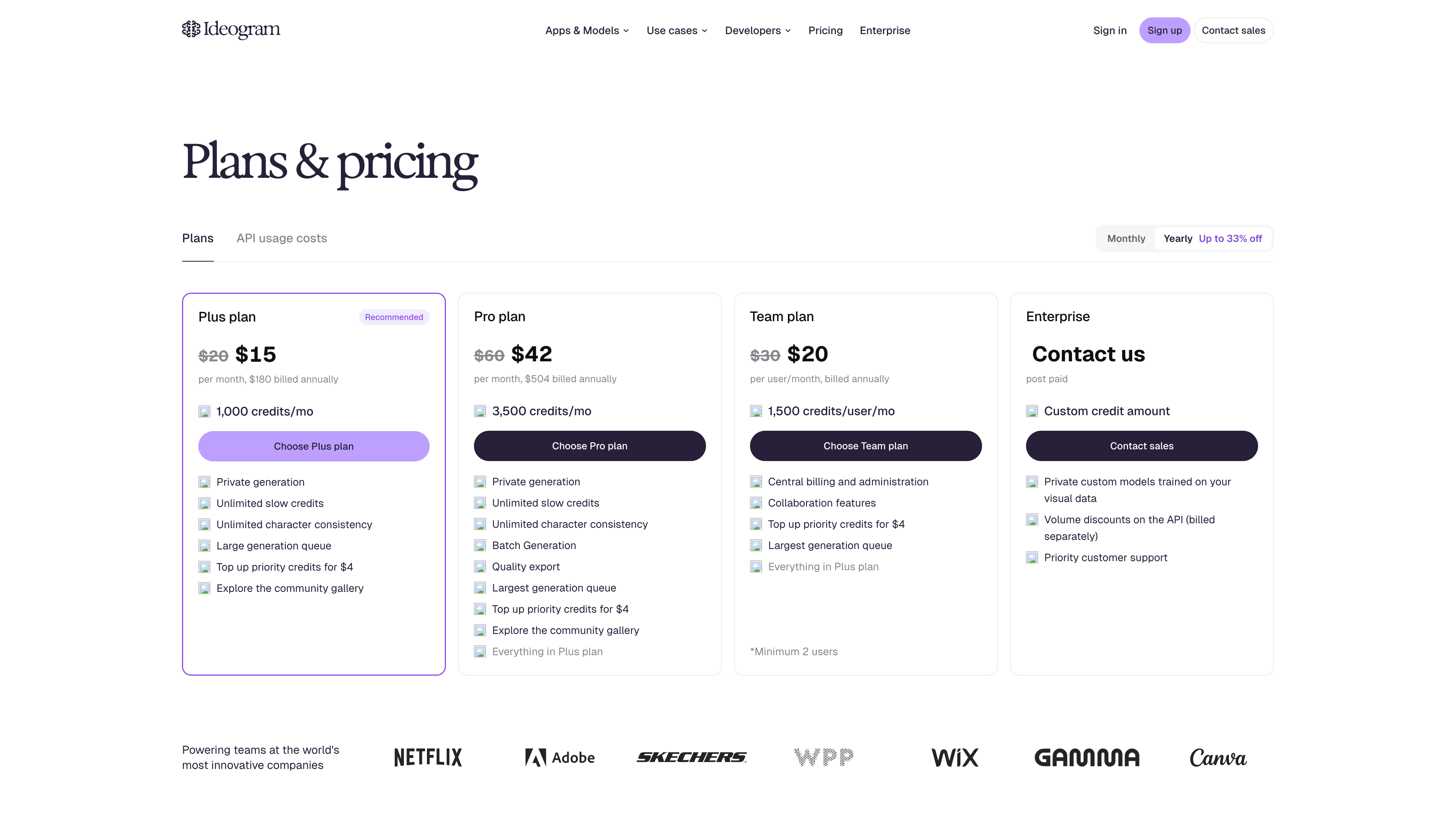
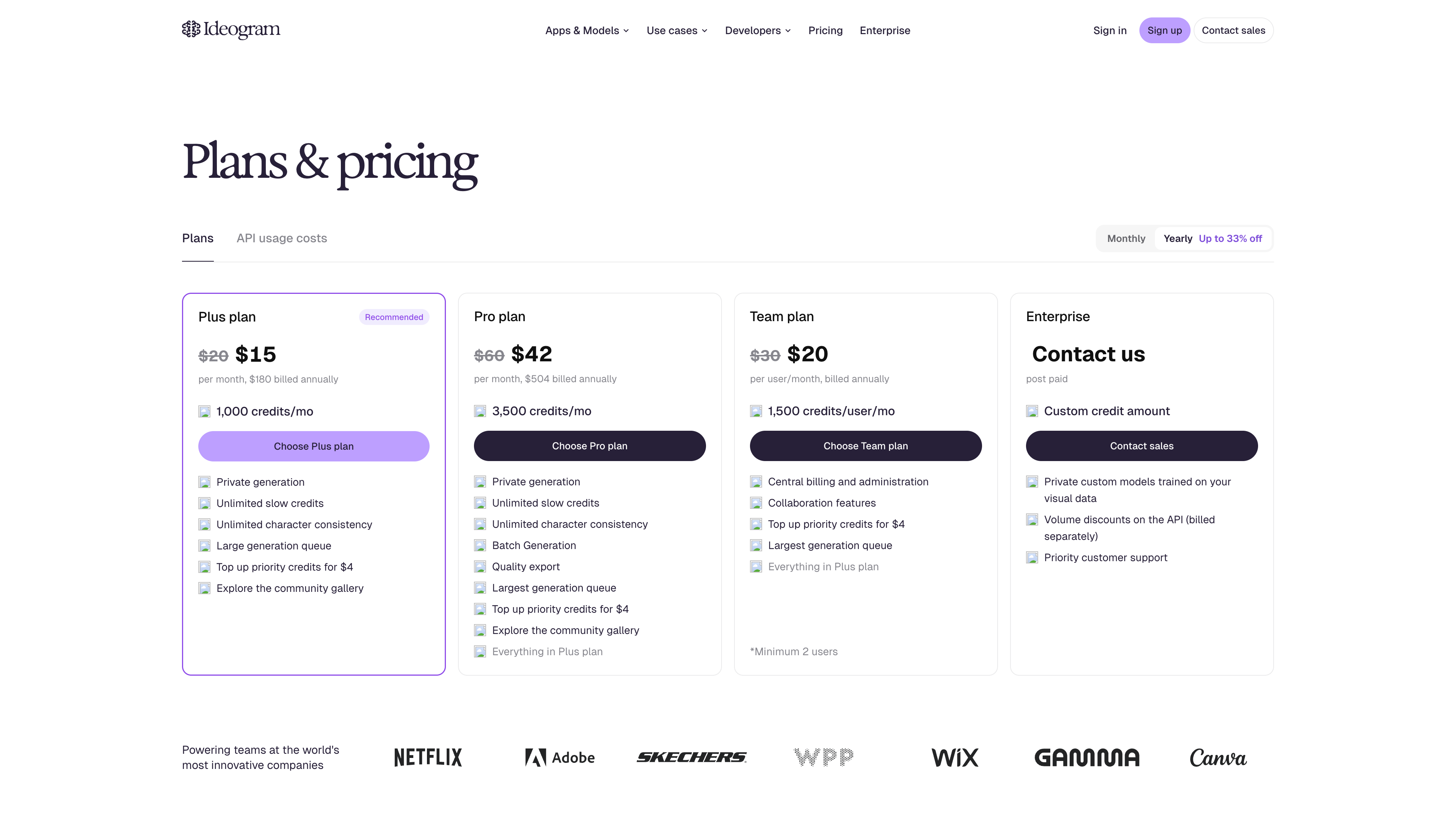
The screenshot below shows the official pricing page as of 2026-09-19 (annual-billing view):
The platform uses a credit system with a priority queue and a slow queue (official docs):
- Free ($0): weekly slow credits for eligible accounts, one running generation at a time, and no private generation — your work goes to the public community gallery.
- Plus (180/year): 1,000 priority credits per month, private generation, unlimited slow credits, unlimited character consistency, and credit top-ups from $4.
- Pro (504/year): 3,500 priority credits per month, plus batch generation and quality export.
- Team (20/user/month annually, 2 seats minimum): 1,500 credits per user per month, with central billing and collaboration features.
- Enterprise (custom, post-paid): private custom models trained on your visual data, volume API discounts, and priority support.
Top-up credits stay valid for 12 months from purchase and roll over month to month; monthly priority credits do not carry over (docs). The docs explicitly warn that prices and credit amounts follow the live pricing page and are not maintained as static tables.
API and MCP. The developer API (developer.ideogram.ai) is billed separately from subscriptions, via prepaid credits on Stripe; a free account is enough to create an API key (a payment method is required). Endpoints cover generation with 4.0/3.0, editing, Remix, inpainting, Describe, Upscale, background removal/replacement, product color and material changes, ad resizing, and custom model training. Note that image URLs returned by the API expire — you must download and store results yourself. An official MCP server brings generation, editing, and training into Claude Code, Cursor, and similar agent workflows. The homepage also claims the unified API covers "image and video models through one endpoint," but as of 2026-09-19 the developer documentation lists image endpoints only; video capabilities are not detailed there.
Mobile. An official iPhone/iPad app exists (App Store); no Android version was observed.
Copyright and content policy
- Output ownership: the Terms of Service state that Ideogram claims no ownership of your generated output (User Output), assigns you whatever rights it might acquire, and does not restrict your use — including commercial use. It also notes that identical prompts may yield similar outputs for other users, and you are responsible for third-party rights when using output commercially.
- Public by default, remixable: free-tier work is public, and other users may remix or regenerate public content; private generation is a paid feature.
- Weights license: the public weights ship under the Ideogram Non-Commercial Model Agreement (June 3, 2026); commercial self-hosted use requires a separate license, and any redistributed deployment must carry equivalent or stronger content filtering.
- Moderation: training data is filtered for NSFW content, the reference inference pipeline screens prompts and outputs through Hive, the platform reserves the right to remove violating content, and a DMCA process exists.
- Age requirement: users must be at least 13.
Where it fits
- Designs that need words in the picture: event posters, album/podcast covers, logo and brand concept drafts, packaging copy mockups — text accuracy is Ideogram's verifiable edge over most rivals.
- E-commerce and marketing visuals: single-task apps for product recoloring, material swaps, and ad resizing target SKU-level variant production; Team and Enterprise plans support brand-specific custom models.
- Developers and agent workflows: the API is prepaid per-use and decoupled from subscriptions, and MCP lets Claude Code or Cursor call generation and editing directly.
- Self-hosting and research: the nf4 quantized weights run locally on a single 24GB GPU, suited to research and non-commercial use.
Limitations
- Tight free tier: weekly slow credits, one concurrent generation, and all work is public and remixable — the free tier is a poor fit for unpublished commercial drafts.
- The text advantage is verified mainly for English: the 0.97 OCR benchmark is an English test. The README claims multilingual text rendering, but no official accuracy data exists for Chinese or other CJK scripts — test your own typography before committing.
- Open weights are not open for commercial use: weights are licensed non-commercially, so commercial deployment needs a separate paid license; running locally also means wiring up Hive moderation (or an equivalent), and the inference code, weights, and moderation each come from different sources.
- API image URLs expire: generation links are not permanent storage — the docs explicitly require downloading results, so integrations need their own storage.
- Pricing and credits shift with the product: the docs defer to the live page, so the figures here reflect 2026-09-19 only; API usage is billed separately and not included in subscriptions.
- English-only interface (observed), and no Android app; feature parity between the iOS app and the web app was not verified item by item.
Alternatives
- Midjourney: a closed text-to-image service known for aesthetics and community; no open weights.
- GPT Image (OpenAI): closed models that rank ahead of Ideogram 4 in several third-party and internal evaluations cited by Ideogram itself.
- FLUX.2 (Black Forest Labs): also available with open weights (32B parameters) — the direct open-weight comparison point for Ideogram 4.
Sources
- Ideogram homepage (checked 2026-09-19)
- Ideogram pricing page (checked 2026-09-19)
- Ideogram 4.0 Technical Details: Open model at the forefront of design (2026-06-03, checked 2026-09-19)
- Announcing the formation of Ideogram (2023-08-22, checked 2026-09-19)
- Ideogram documentation: Welcome / FAQ / Available Plans (checked 2026-09-19)
- Ideogram Developer API documentation (checked 2026-09-19)
- GitHub: ideogram-oss/ideogram4 (Apache-2.0 inference code, non-commercial weights license) (checked 2026-09-19)
- Hugging Face: ideogram-ai organization (checked 2026-09-19)
- Ideogram Terms of Service (checked 2026-09-19)
- VentureBeat: Midjourney rival Ideogram gets $80M in Series A led by Andreessen Horowitz (2024-02-28, checked 2026-09-19)