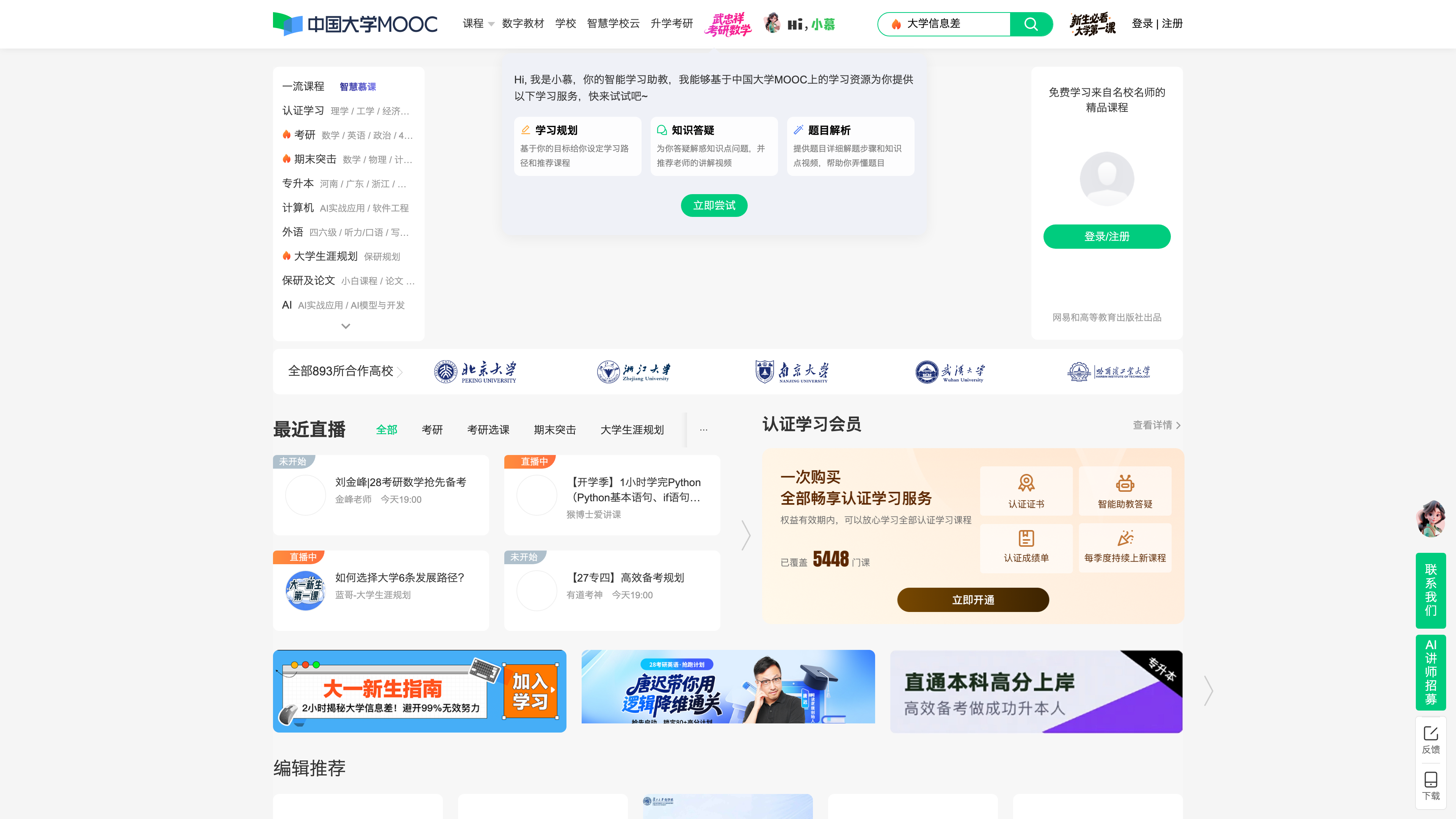
China University MOOC (中国大学MOOC, icourse163.org) is a Chinese-language MOOC platform jointly launched in 2014 by Higher Education Press (through its icourse platform) and NetEase: universities across China put their real courses online in semester-based runs with video, assignments, discussion forums and final exams, and anyone can study them for free. In its own words, the platform "carries out the Ministry of Education's national elite open-course program" so that "anyone willing to improve themselves can access better higher education for free" (official About page). Its verifiable distinctions versus international MOOC platforms: every course is administered by a university's academic affairs office, instructors must be real-name verified with Higher Education Press, and studying is free. Note there is no English interface — it is documented here for readers who can navigate a Chinese UI or want a reference on Chinese online higher education.
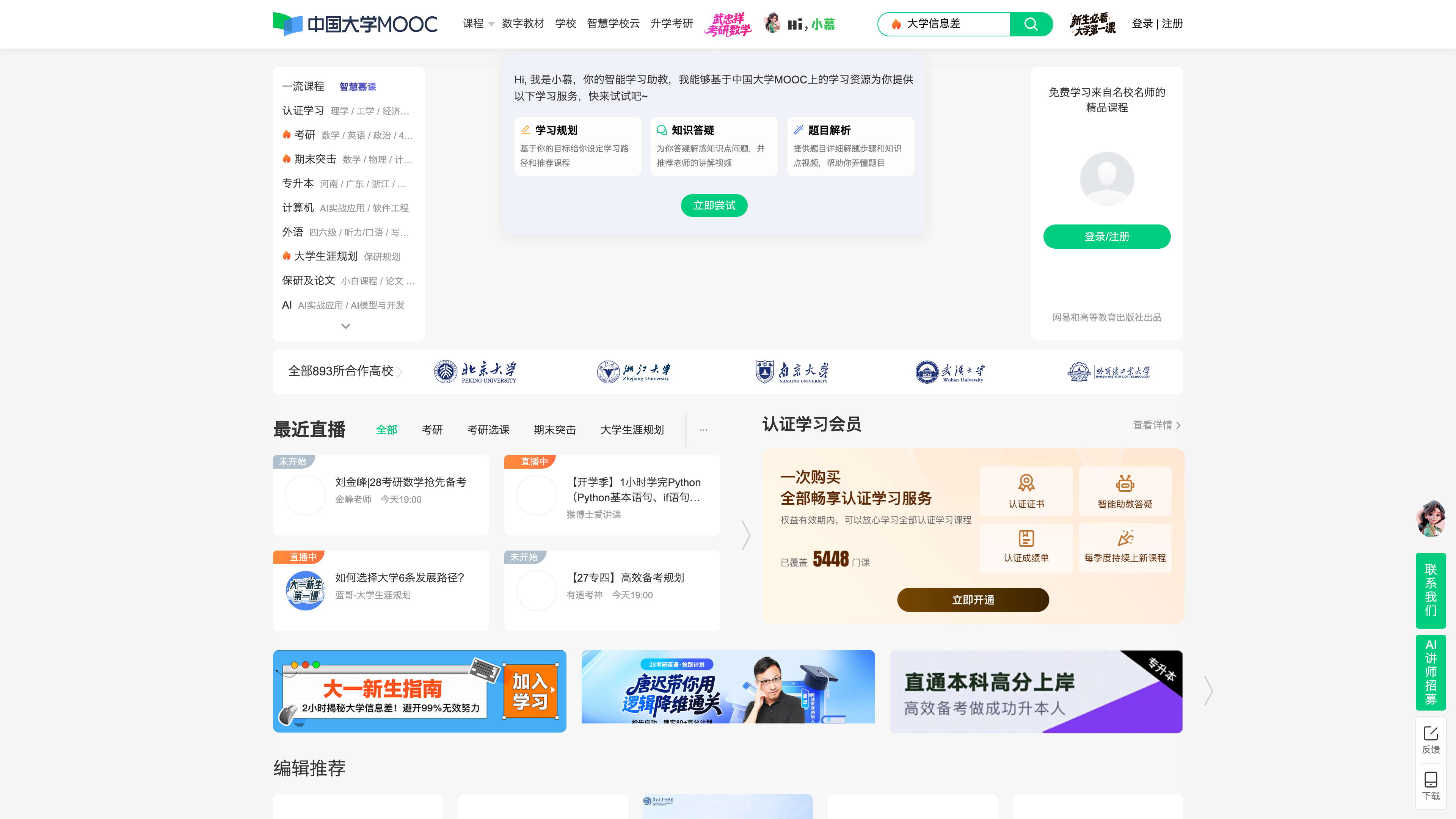 Course introduction pages are readable without logging in; actually taking a course requires a free account (Chinese mobile number or NetEase email). The homepage shows 893 partner universities as of 2026-09-02.
At a glance
- URL: https://www.icourse163.org/
- Type: Chinese-language MOOC platform (operated jointly by Higher Education Press's icourse and NetEase)
- Cost: Courses free to study; verified certificates require a paid application (amounts shown on the platform); an optional "verified learning membership" subscription also exists
- Account: Not needed to browse course pages; free registration required to study
- Interface language: Simplified Chinese only
- Mobile: iOS and Android apps (among the first batch of educational apps filed with the Ministry of Education in December 2019, under Higher Education Press Co., Ltd.)
Background
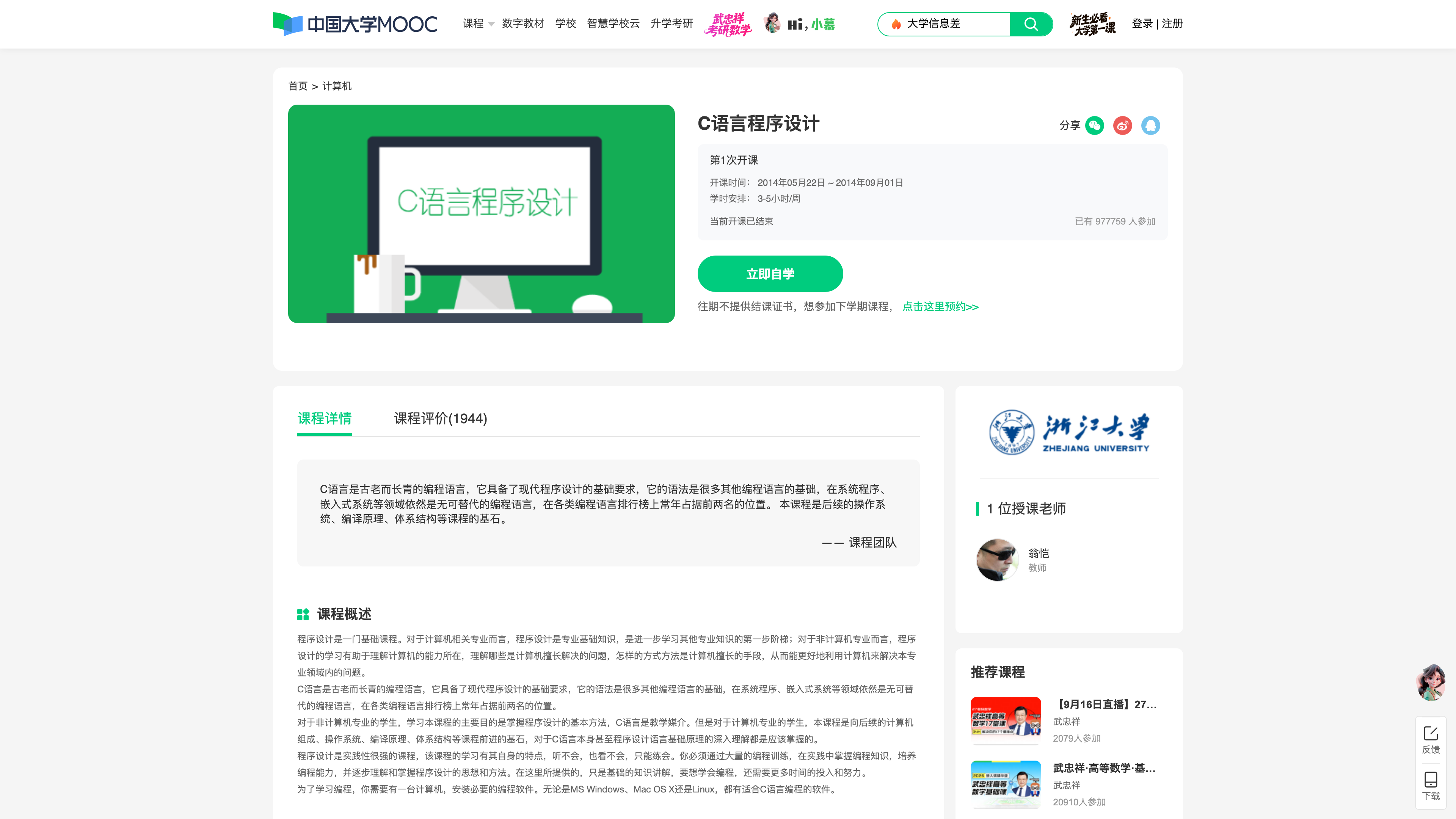
The platform sits at the end of a decade-long national course-building effort: the Ministry of Education launched the National Elite Courses project in 2003, followed by Elite Video Open Courses (2012) and Elite Resource-sharing Courses (2013), with China University MOOC going live in 2014 to carry that accumulated catalog forward (official About page). The parent icourse platform itself is a higher-education resource-sharing project supported by the Ministry of Education and Ministry of Finance under the 12th Five-Year undergraduate teaching program, which partnered with NetEase in 2014 to launch the MOOC platform (Higher Education Press product brochure, PDF). Third-party reports pin the launch date to May 8, 2014; consistent with that, one of the platform's long-running courses — Zhejiang University's C Programming by Weng Kai — shows its first run starting May 22, 2014 (observed on the course page).
Coverage of China's "985" universities reached nearly 90% in the platform's early years (Shandong University media, 2018). During the 2020 pandemic the platform provided emergency teaching support to universities nationwide, and an international sister platform, iCourse, grew out of that effort (Sina Tech, 2020).
Its relationship with the National Smart Education Platform for higher education (higher.smartedu.cn) is worth stating precisely: that national platform, launched by the Ministry of Education in March 2022, aggregates selected courses from multiple providers, and China University MOOC is one of its source platforms — university notices describe courses as "accessed via the icourse (China University MOOC) platform" (e.g. Beijing University of Chemical Technology notice, reposted), and the MOOC homepage links to "智慧高教" (Smart Higher Ed). The two are content source and aggregator, not the same platform.
Courses and the learning experience
Semester-based runs: each course has a fixed term; learning follows short videos, quizzes, homework, forum participation and a final exam, with grading criteria set by the teaching team.
Subject coverage: primarily undergraduate courses (science, engineering, economics and management, foreign languages, humanities and law, medicine, computer science), plus vocational college courses and a China Advanced Placement (CAP) program for high school students (CAP page, launched with the Chinese Society of Education and Higher Education Press in 2016, exclusive to this platform).
A representative course: Zhejiang University's C Programming shows 977,000+ cumulative enrollments (page figure as of 2026-09-02), illustrating the reach of the platform's early catalog.
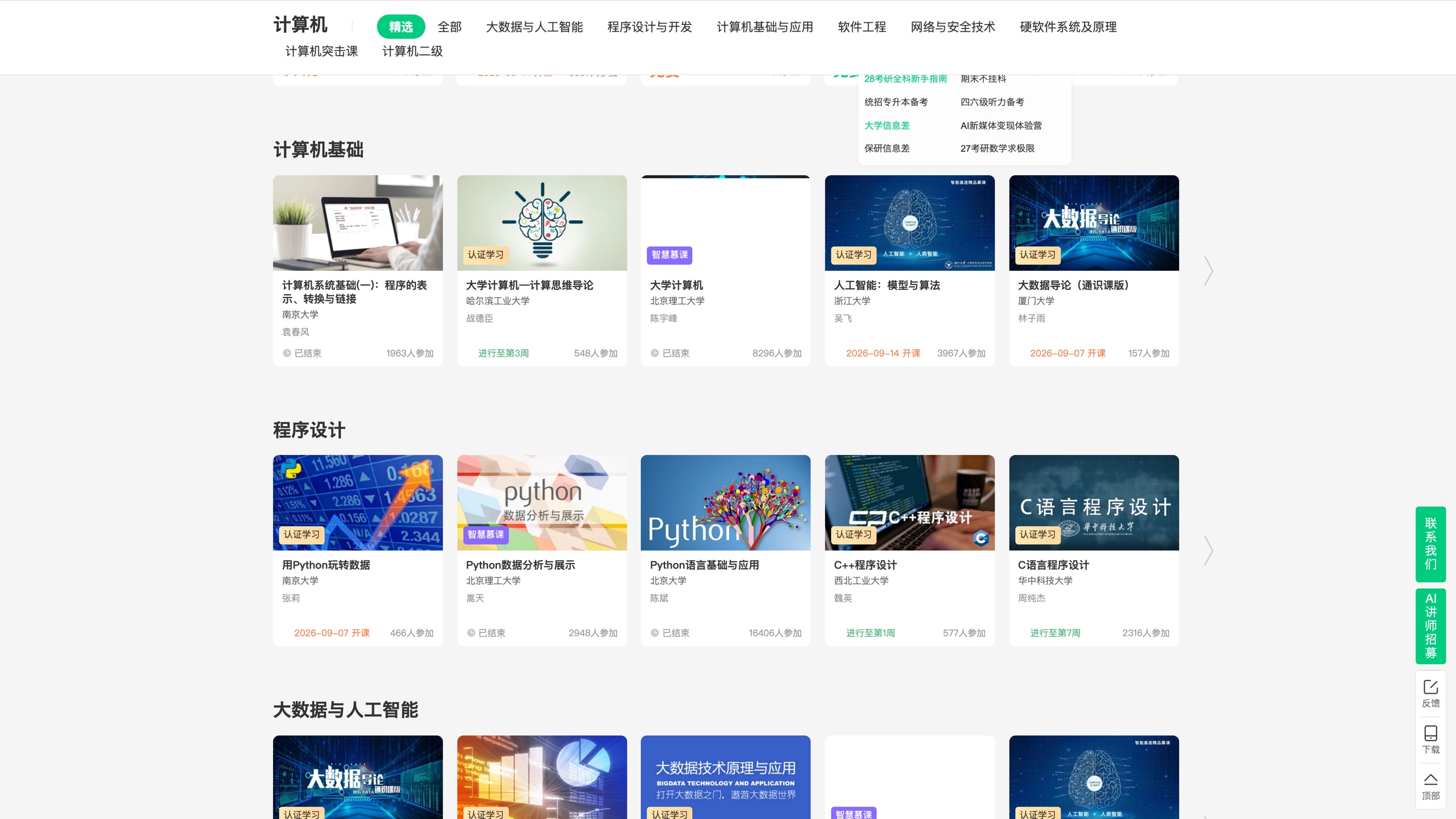
School Cloud (SPOC): universities can run private, campus-only courses on the platform (School Cloud entry).
Certificates and pricing
Studying is free. Learners whose final grade meets the teaching team's bar can apply for a verified certificate: it carries the instructor's e-signature and the university logo, is bound to the learner's verified real identity (ID number and name uniqueness are checked), and can be validated by certificate number or QR code (official About page). Two caveats: the certificate requires a paid application (amounts are shown on the platform), and since 2023 paper certificates have been discontinued in favor of electronic-only versions (stated in an official course announcement). According to a teaching-research paper, the platform also stopped issuing the free e-certificates it once offered, starting October 2019 (Zhejiang education research institute, PDF).
The homepage now also promotes a "verified learning membership" subscription ("one purchase, enjoy all verified learning services", shown covering 5,448 courses as of 2026-09-02), alongside test-prep content for the postgraduate entrance exam, CET-4/6, and other exams with live-streamed classes — an observed shift from pure university open courses toward paid exam-prep services.
Good for
- Enrolled students previewing or reviewing their major's courses, or sampling elite-university teaching across schools
- Working professionals systematically taking a university course (CS, business, languages)
- High school students trying university-level CAP courses early
- Anyone who wants an instructor-signed, QR-verifiable proof of study (not a degree)
Limitations
- Courses run on fixed terms: once a term ends you cannot join that run, past runs issue no completion certificates, and you may only reserve a seat for the next run (per the notice observed on the C Programming course page).
- Verified certificates attest to study, not academic degrees; employers judge their weight themselves.
- Chinese-only interface and content; the platform is not designed for overseas learners.
- Some newer courses, live classes and exam-prep content have moved behind payments or membership, and the update cadence of free open courses varies by university (reasonable inference).
Alternatives
XuetangX is Tsinghua University's MOOC platform and the closest domestic peer; the National Smart Education Platform for higher education is the Ministry of Education's aggregator drawing courses from multiple platforms including this one; for international catalogs, see Coursera.
Sources
- China University MOOC official site and About page (operator, course mechanics, certificate rules; checked 2026-09-02)
- Higher Education Press product brochure (PDF) (icourse background; 2014 NetEase partnership)
- Shandong University media, 2018 (May 2014 launch; 985-university coverage)
- Sina Tech, 2020 (pandemic support; international iCourse platform)
- Beijing University of Chemical Technology notice (reposted) (course access relationship with the national smart education platform)
- Official course announcement: paper certificates discontinued (electronic-only since 2023)
- CAP program official page (exclusive since 2016)
- Zhejiang education research institute paper (PDF) (free e-certificates ended October 2019)
- Partner university count (893), membership course coverage (5,448) and C Programming enrollment (977k) are page observations dated 2026-09-02