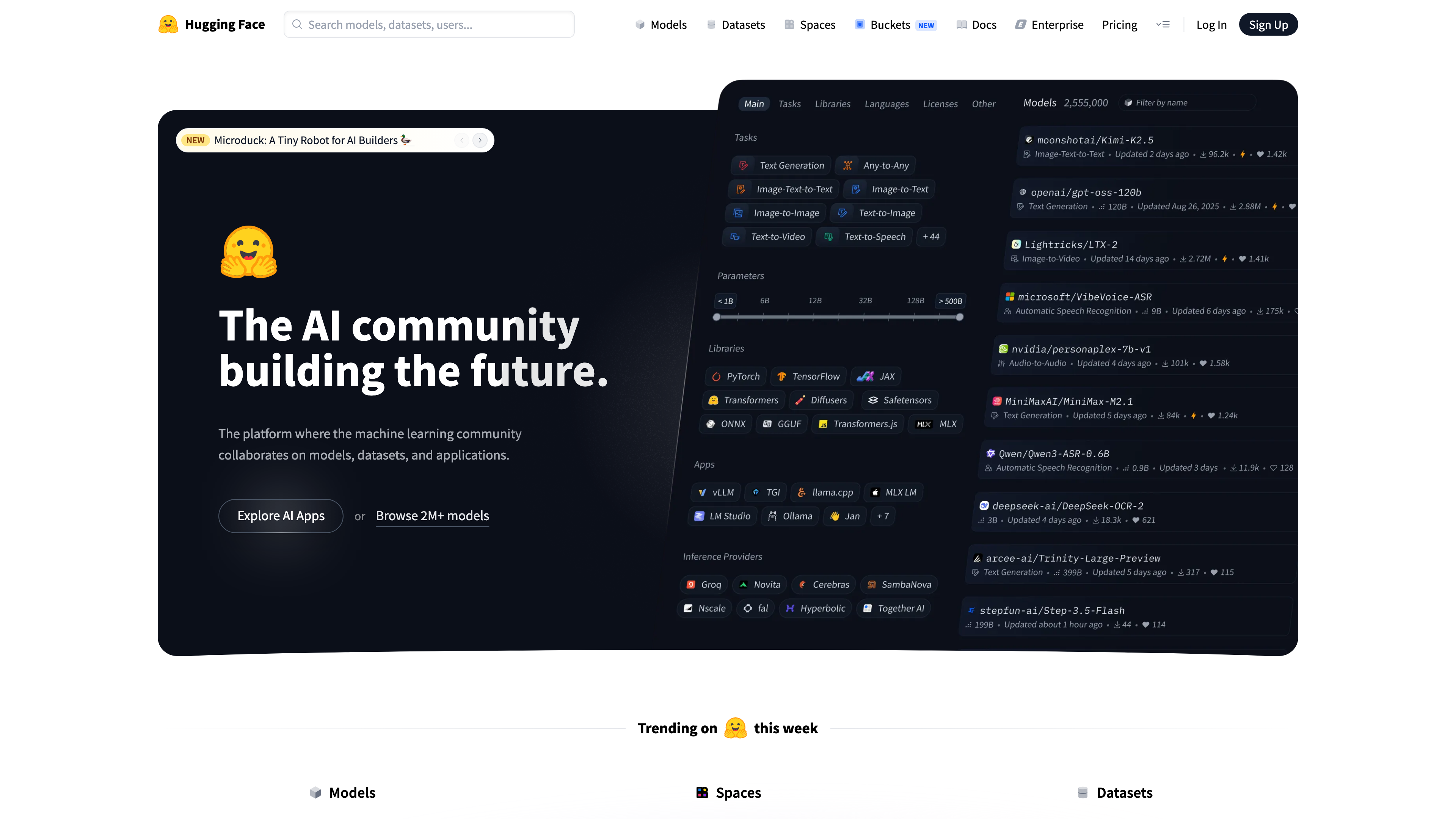
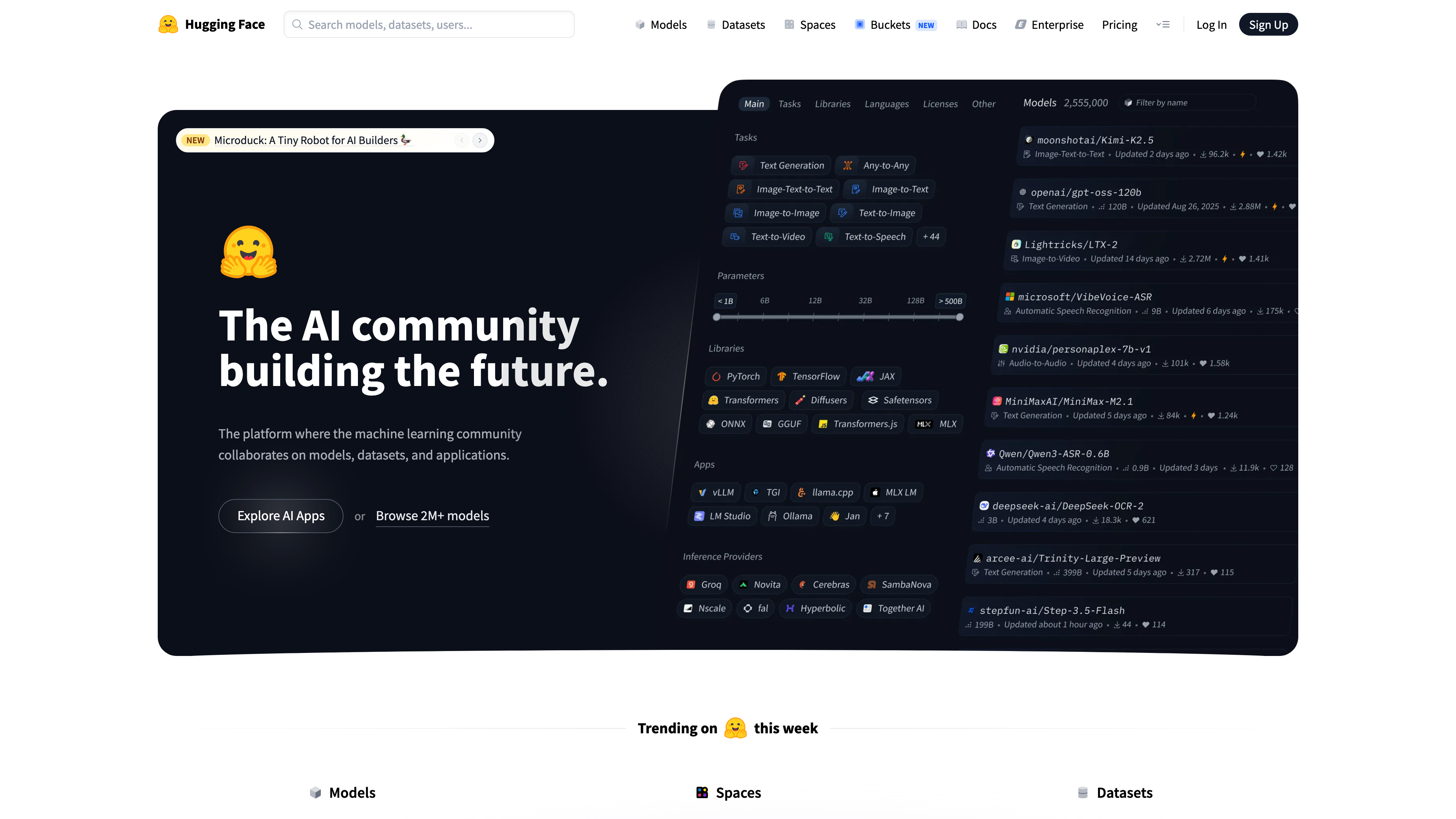
Hugging Face is a hosting and collaboration platform for the machine learning community. It solves a concrete problem: finding, testing, sharing, and deploying AI models, datasets, and demo applications in one place. As of 2026-08-30, its live listing pages count roughly 3.03 million public model repositories, 1.03 million datasets, and 1.46 million demo apps (Spaces), making it the largest distribution channel for open-weight models — releases from Meta, Google, Microsoft, Alibaba, and most other labs typically appear here first. Unlike generic code hosting, it adds ML-specific tooling around the repositories: browser-based model trials, a unified inference API, dataset preview, and GPU deployment.
At a Glance
- URL: https://huggingface.co/
- Type: AI model, dataset, and app hosting community (user-generated content)
- Cost: Browsing and downloading public content is free with no account; hosting public repositories is free. Paid options include the PRO plan at 20/user/month, Enterprise at $50/user/month, plus metered storage, GPU, and dedicated inference instances (pricing page, prices as of 2026-08-30)
- Sign-up: Only needed to publish content, comment, or use paid services (registration page includes a human-verification step)
- Interface language: English only (no language switcher; some documentation is translated)
- Access note: The domain is not directly reachable from mainland China networks (verified 2026-08-30)
Background
Hugging Face was founded in New York in 2016 by Clément Delangue, Julien Chaumond, and Thomas Wolf, and operates as Hugging Face, Inc., a Delaware corporation (Terms of Service). The company started with a chatbot app and pivoted to a model community platform after open-sourcing the Transformers library around 2018 — that repository was created in October 2018 and has over 164,000 stars as of 2026-08-30.
In August 2023, the company raised a 4.5 billion valuation, led by Salesforce Ventures with participation from Google, Amazon, NVIDIA, Intel, AMD, Qualcomm, and IBM. Worth noting: in late August 2026, media reported that Hugging Face had been approached about an acquisition valuing it above $13 billion; as of 2026-08-30 neither side has confirmed anything and the talks could still fall apart (TechCrunch, 2026-08-24). The company's stated mission is to "advance and democratize artificial intelligence through open source and open science," and it says more than 50,000 organizations use the platform.
Core Capabilities
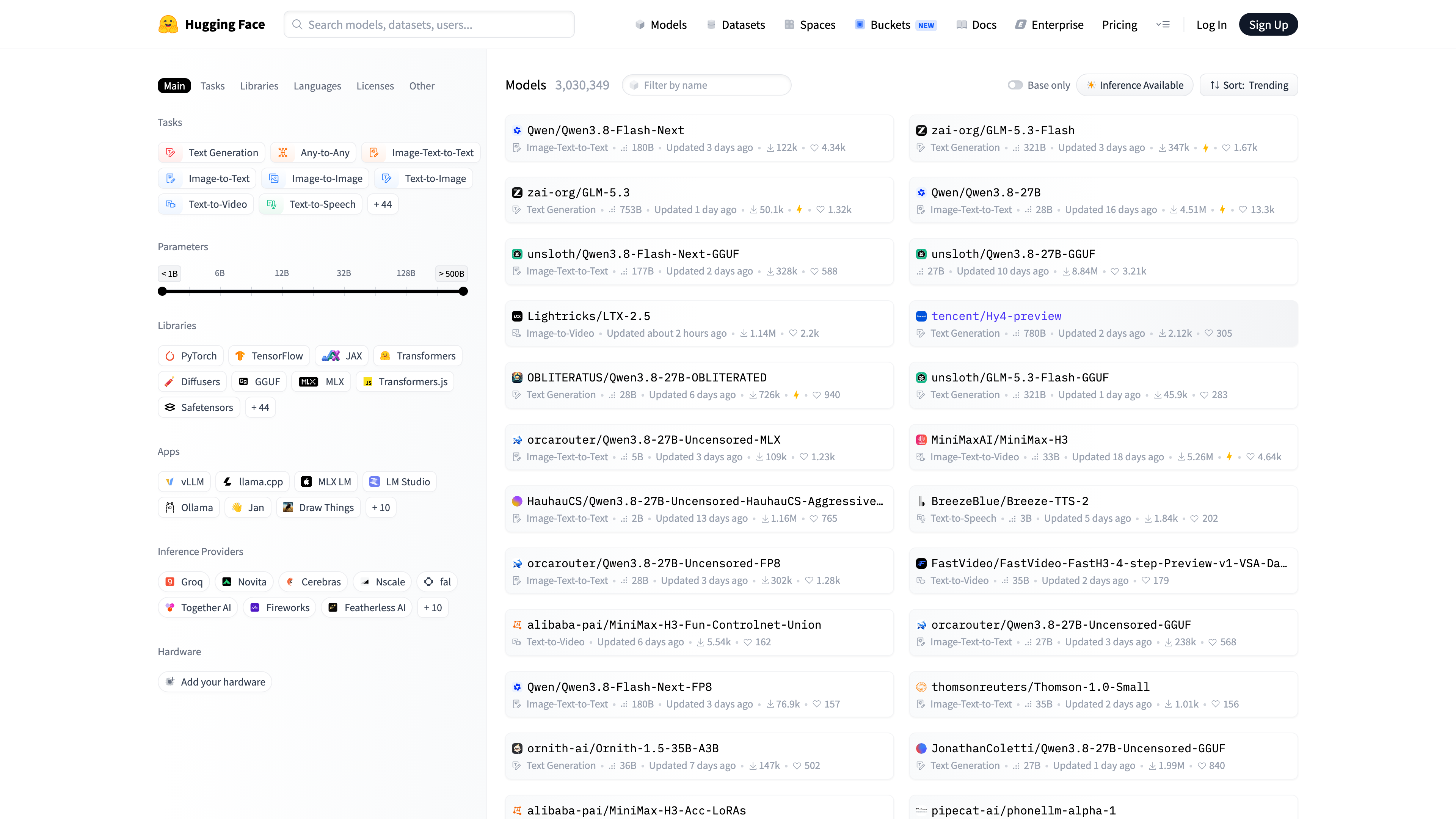
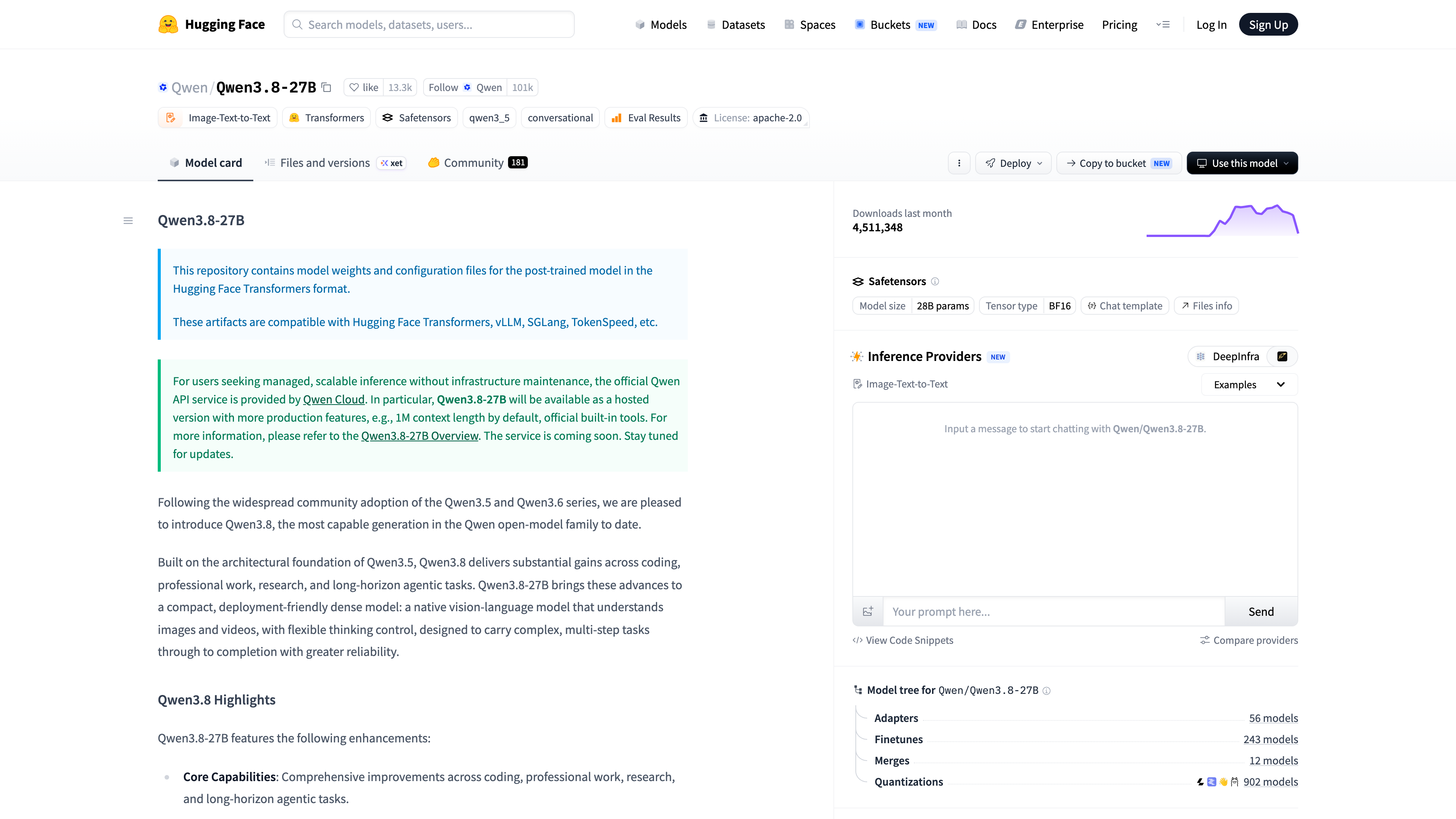
Model Hub. The heart of the platform: about 3.03 million public model repositories (live listing count as of 2026-08-30) spanning text generation, image, video, speech, and 3D tasks. Each repository is a Git repo containing weights, configuration, and a Model Card readme, with versioning, download stats, and community discussions. The listing page filters by task, framework (PyTorch, GGUF, MLX, and more), parameter count, and license.
Datasets. About 1.03 million public datasets, many with an online Dataset Viewer that previews samples in Parquet and other formats without downloading.
Spaces. About 1.46 million interactive AI demo apps built with Gradio, Streamlit, Docker, or static pages. A free account can create Spaces running on basic CPU instances, upgrade to GPUs billed hourly (T4 instances from $0.40/hour as of 2026-08-30), or use a free dynamic ZeroGPU allocation.
Inference and deployment. For users who do not want to self-host:
- Inference Providers: a unified, OpenAI-compatible API that routes to 18 listed providers (Groq, Cerebras, Together AI, Fireworks AI, Replicate, and others) serving tens of thousands of models, with no markup claimed by Hugging Face;
- Inference Endpoints: dedicated autoscaling instances on AWS, Azure, or GCP, with CPU instances from $0.033/hour, aimed at production workloads;
- Jobs and AutoTrain: metered training and batch-processing tasks.
Community and learning. The platform also runs HuggingChat, a free chat assistant powered by open models (its Omni mode picks a model automatically), the Daily Papers research feed, free courses, a forum, and a Discord community.
Open-Source Ecosystem
Hugging Face maintains a set of Apache-2.0-licensed libraries that form the platform's technical foundation (star counts via the GitHub API as of 2026-08-30):
- transformers (~165k stars): a unified interface to pretrained models in PyTorch and other frameworks;
- diffusers (~34k stars): diffusion model toolbox;
- datasets (22k stars), [tokenizers](https://github.com/huggingface/tokenizers) (11k stars), trl (~19k stars, RL fine-tuning), and others;
- safetensors: a safe weight-serialization format that avoids pickle's code-execution risks.
These libraries integrate directly with Hub repositories: most models load in a few lines of Python, and the huggingface_hub library plus a public REST API expose repositories programmatically.
Accounts and Open Access
Most public models and datasets can be browsed and downloaded without an account. A free account unlocks unlimited public repositories, private repositories, Spaces publishing, and community features such as discussions and likes. Paid tiers per the pricing page: PRO (20/user/month) adds SAML/OIDC SSO, audit logs, resource-group access control, and storage regions; Enterprise (12/TB/month and private from 8/TB/month above 500TB.
For integration, the platform offers a full Hub REST API, Python and JavaScript clients, webhooks, and GitHub Actions. Some models are gated, requiring sign-in and acceptance of the publisher's terms before download. On security and compliance, the documentation lists two-factor authentication, GPG commit signing, malware scanning, pickle scanning, and secrets scanning, and states that the company is SOC 2 Type 2 certified and GDPR compliant (Hub security docs).
Copyright and Content Policy
As a user-generated-content platform, Hugging Face's key copyright rules (per the Terms of Service, effective 2022-09-15) are:
- Uploaders keep ownership of their content; the company states it will not sell it;
- Setting a repository to public grants every user a "perpetual, irrevocable, worldwide, royalty-free, non-exclusive license" to use, display, and distribute that content through platform features;
- License notices attached to a repository (Apache-2.0, MIT, or model-specific agreements) remain in force and may not be removed — so each model's actual terms of use are set by its own license, and you must check the License tag on every model card before commercial use;
- The company honors DMCA complaints via dmca@huggingface.co;
- Anything you download from the platform is used at your own risk.
Content moderation follows the Content Policy effective 2025-04-10 and a code of conduct; the platform may remove content at its discretion.
Good For
- Finding and trying open-weight models — from Llama, Qwen, and Gemma releases to countless fine-tunes — usually with an in-browser trial;
- Evaluating datasets with sample previews before committing to a download;
- Building shareable AI demos without running your own infrastructure (Spaces);
- Calling model inference through one unified API instead of standing up GPU clusters;
- Following research via Daily Papers and learning from free courses.
Limitations
- English-only interface, and model card quality varies widely — many repositories have sparse documentation.
- Not directly accessible from mainland China (verified 2026-08-30); downloading large weights also depends on international bandwidth.
- License fragmentation: the platform is a host, not a licensor. Different repos of the "same" model (official, quantized, fine-tuned) can carry different licenses, so each must be checked individually.
- Free quotas are limited: free inference API calls are rate-limited, and ZeroGPU or free CPU instances queue at peak times — serious workloads end up paid.
- Use at your own risk: among millions of repos are low-quality or potentially unsafe models; the terms place download risk on the user, and platform malware scanning does not replace your own review.
- Ownership uncertainty: the August 2026 acquisition reports are unresolved, so the platform's long-term independence is an open question.
Alternatives
- GitHub: general-purpose code hosting; Git LFS can store model files, but there is no model trial widget, dataset viewer, or other ML-specific tooling;
- Kaggle: Google's data-science community, strong on datasets and competitions, also hosts models;
- ModelScope: a model community run by Alibaba with a Chinese interface, directly accessible in mainland China, focused on Chinese vendors' models;
- Replicate: model inference API service, also one of Hugging Face's Inference Providers.
References
- Hugging Face homepage (positioning, scale figures, open-source showcase; checked 2026-08-30)
- Models, Datasets, and Spaces listing pages (live repository counts)
- Pricing page (subscription tiers, storage and compute rates)
- Terms of Service, Content Policy, Hub security documentation
- Hub API documentation
- TechCrunch: Hugging Face raises $235M (2023-08-24)
- TechCrunch: reported acquisition talks (2026-08-24)
- GitHub: huggingface/transformers (stars and license verified via GitHub API)