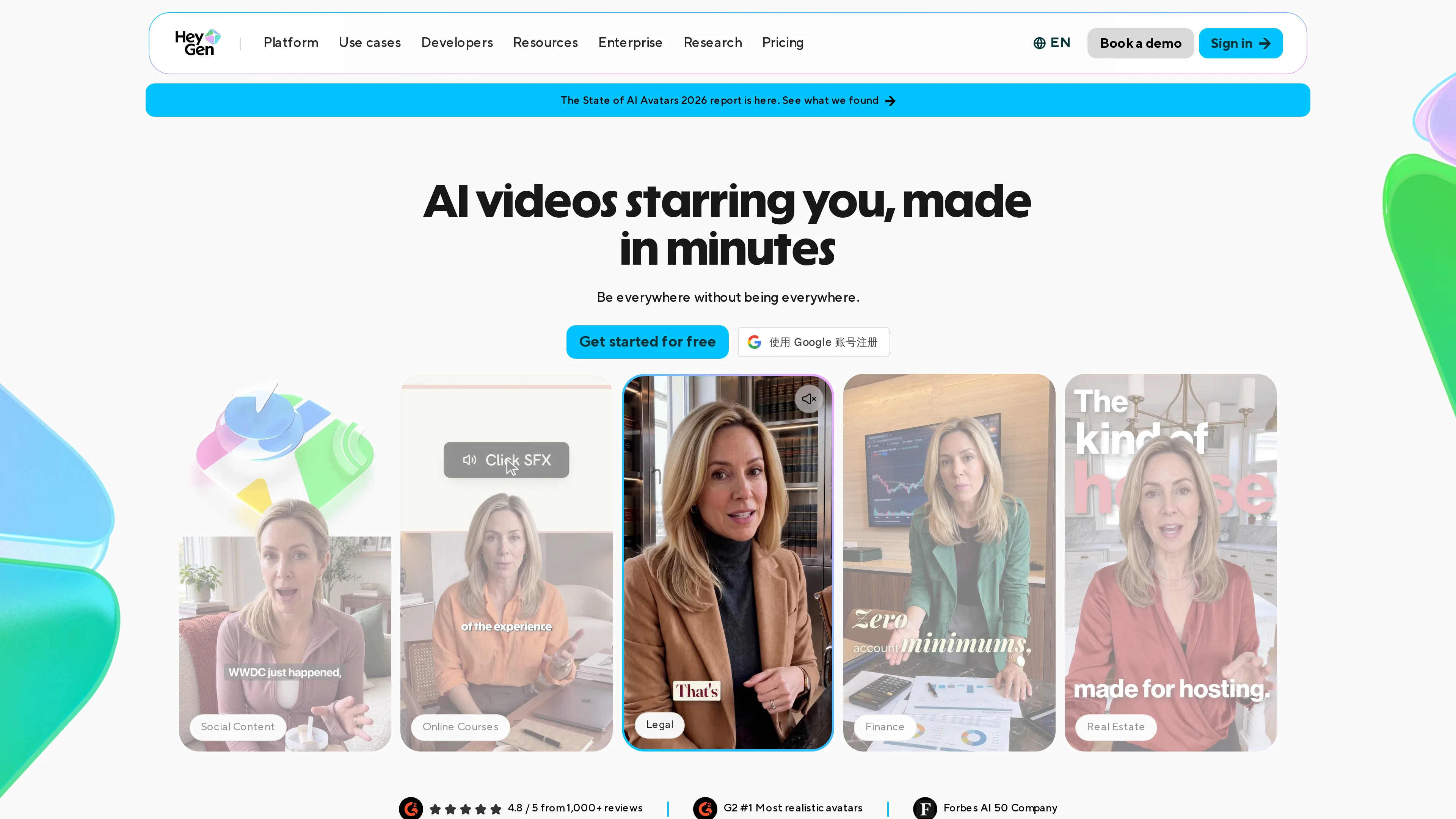
HeyGen is an AI avatar video generation platform: you type a script, and it produces a video of a lifelike digital presenter — your own digital twin, a photo-based avatar, or one of hundreds of stock avatars — with no camera or actors required. Beyond avatar videos, the platform covers video translation and dubbing that preserves the speaker's voice and syncs lip movements, a real-time interactive avatar API, and developer APIs, targeting marketing, training, and localization workflows. It stands out among AI video tools for enforcing on-camera identity verification before any custom avatar can be created, backed by a comparatively detailed moderation policy.
At a Glance
- URL: https://www.heygen.com
- Type: AI avatar video generation, video translation/dubbing, interactive avatar API
- Cost: Free plan at 29/month (as of 2026-10-02)
- Sign-up: Email or Google account; no credit card required for the free plan
- Languages: The marketing site is localized into 20+ languages including Traditional Chinese; the help center is in English
Background
HeyGen was founded in 2020 by Joshua Xu and Wayne Liang. Originally named Surreal, then Movio, it became HeyGen and established its Los Angeles headquarters in 2022; the app launched in September 2022. According to the company's About page, Xu previously worked as an engineer at Snap on Snapchat Ads and the AI camera, where he concluded that "most people hate being on camera" — the insight behind removing cameras from video production.
On funding, early backers included Sequoia China (now HongShan) and ZhenFund. In November 2023 the company raised 60 million Series A](https://www.heygen.com/blog/announcing-our-series-a) led by Benchmark, with participation from Thrive Capital, BOND, and SV Angel. The official announcement states that annualized recurring revenue grew from 35 million in just over a year, that the company turned profitable in Q2 2023, and that the round valued it at more than $500 million — a figure echoed by Bloomberg's June 20, 2024 report. HeyGen lists offices in Los Angeles, San Francisco, Palo Alto, and Toronto.
Live counters on the About page show (as of 2026-10-02) over 168 million videos generated, 145 million avatars created, and 24 million videos translated, with the company claiming more than 100,000 business customers. In 2024, Argentine president Javier Milei's World Economic Forum speech was translated and lip-synced with HeyGen — one of the technology's most visible mainstream moments.
Core Capabilities
Avatars and video generation
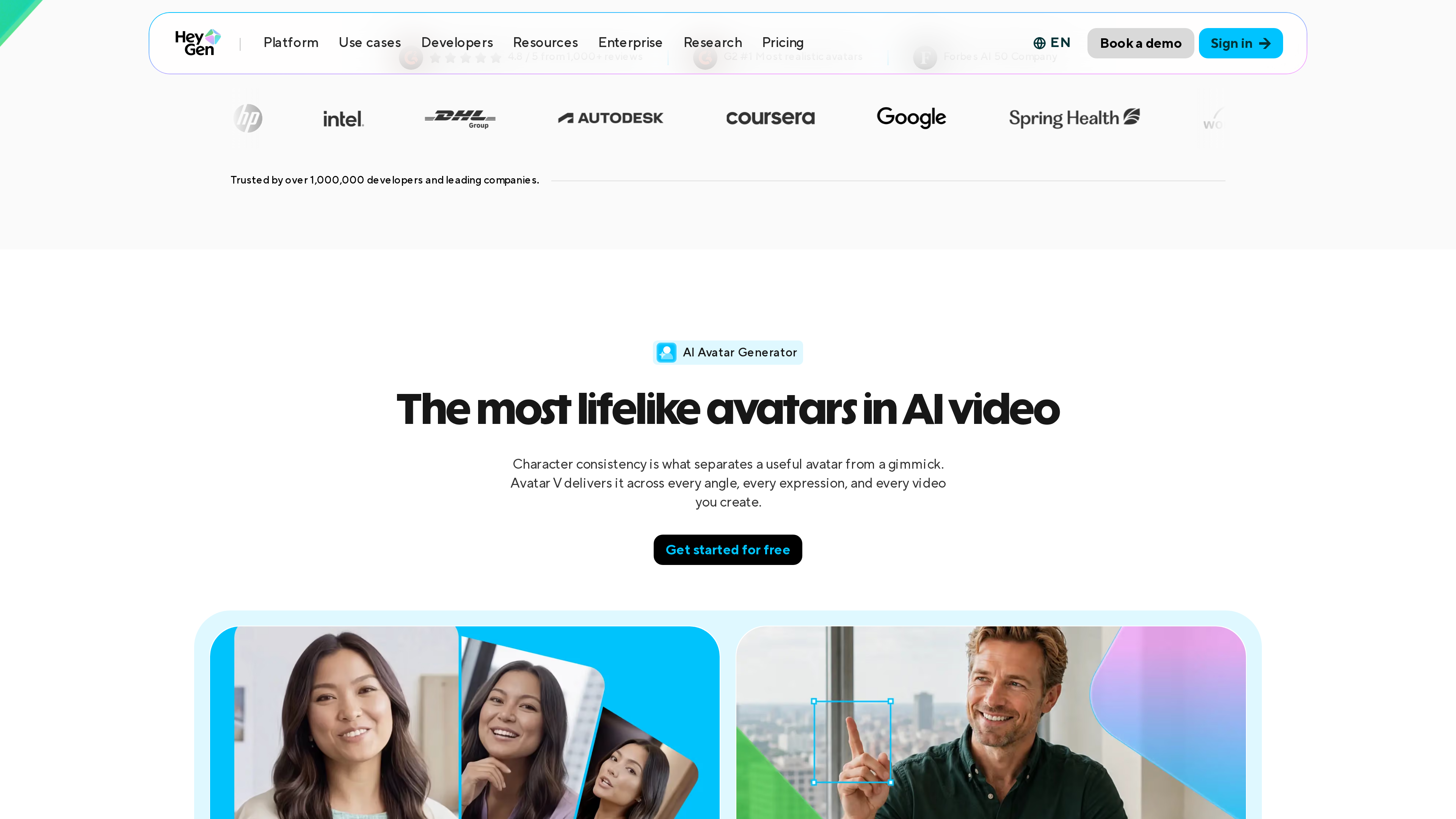
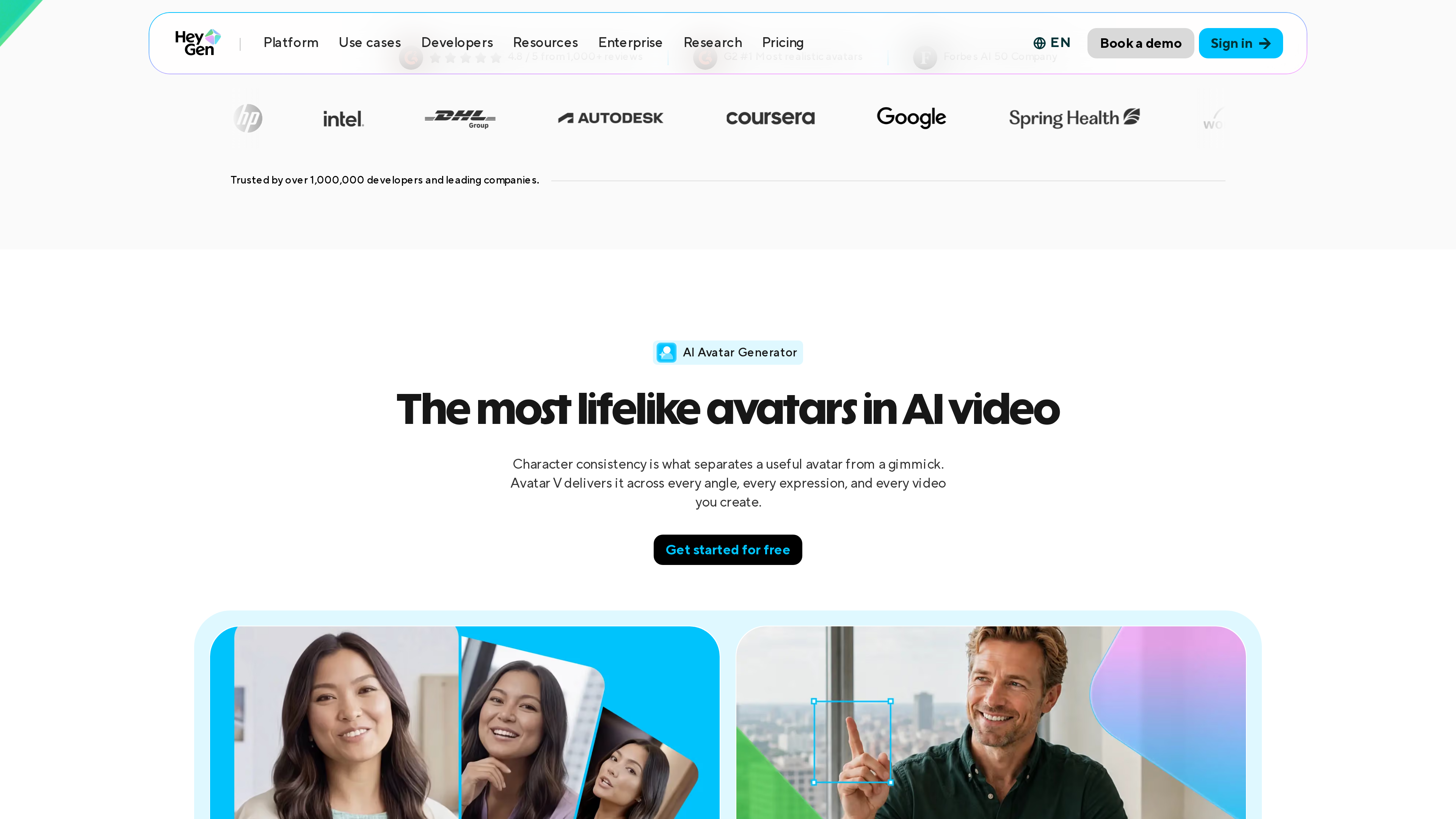
As of 2026-10-02, the flagship model promoted on the homepage is Avatar V, which emphasizes character consistency across videos (no facial drift), multiple camera angles, phoneme-level lip sync, and voice-synced emotion and gesture. Users have three avatar sources: a stock library of 500+ (free) to 700+ (paid) video avatars; a Custom Video Avatar trained on footage of yourself (one included on the free plan); and photo-based avatars powered by Avatar IV, which animates a single image — including cartoons and non-human faces — from a script or audio file.
Around the avatar engine sits a broader toolkit: Video Agent, which turns a single prompt into a finished, still-editable video with presenter A-roll, motion graphics, and B-roll; AI Studio, a text-driven editor with Voice Director, Voice Mirroring, Gesture Control, brand kits, and team collaboration; plus Text/Image/Audio-to-Video, PPT/PDF-to-video, and AI voice cloning tools.
Video translation and dubbing
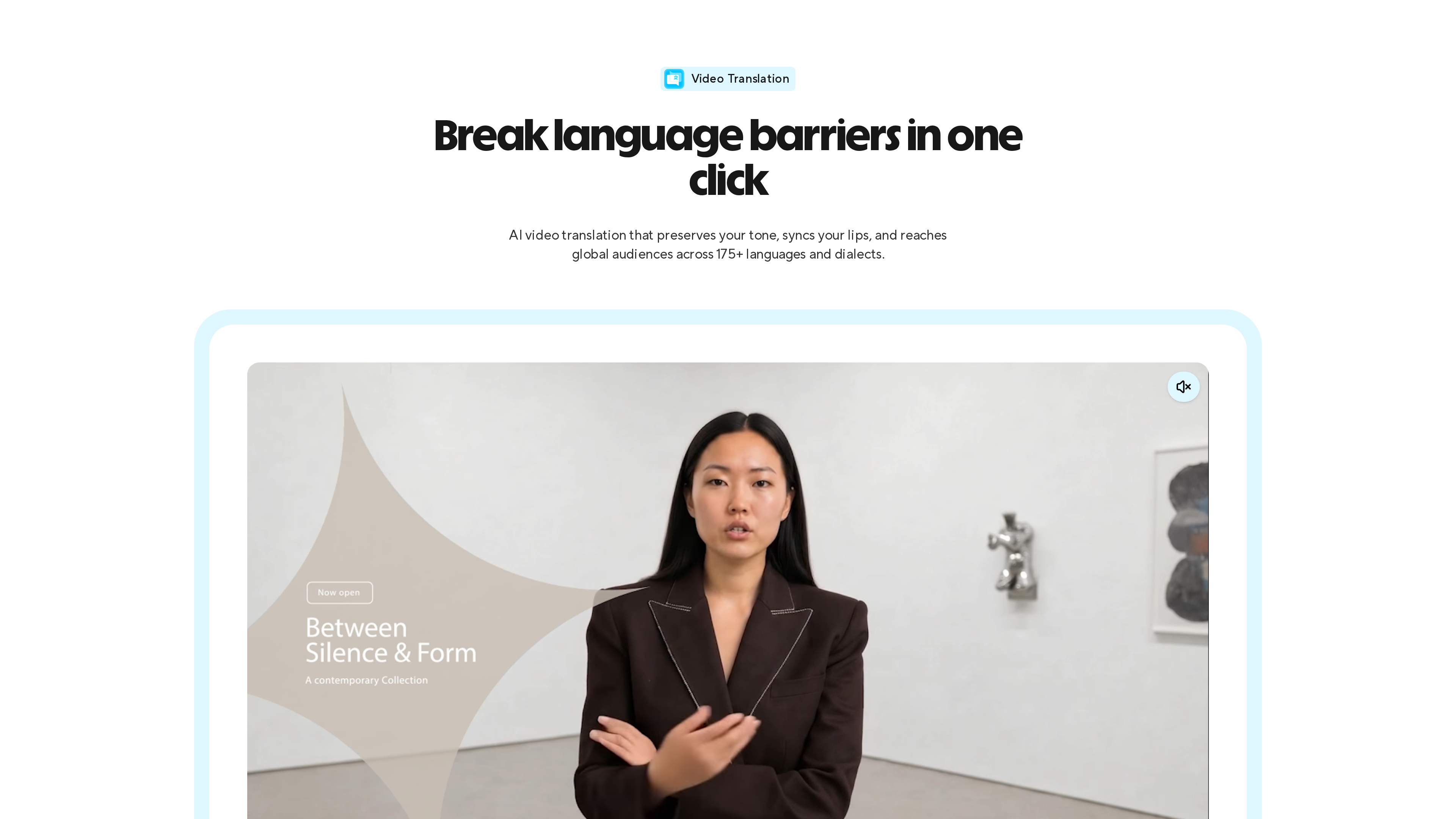
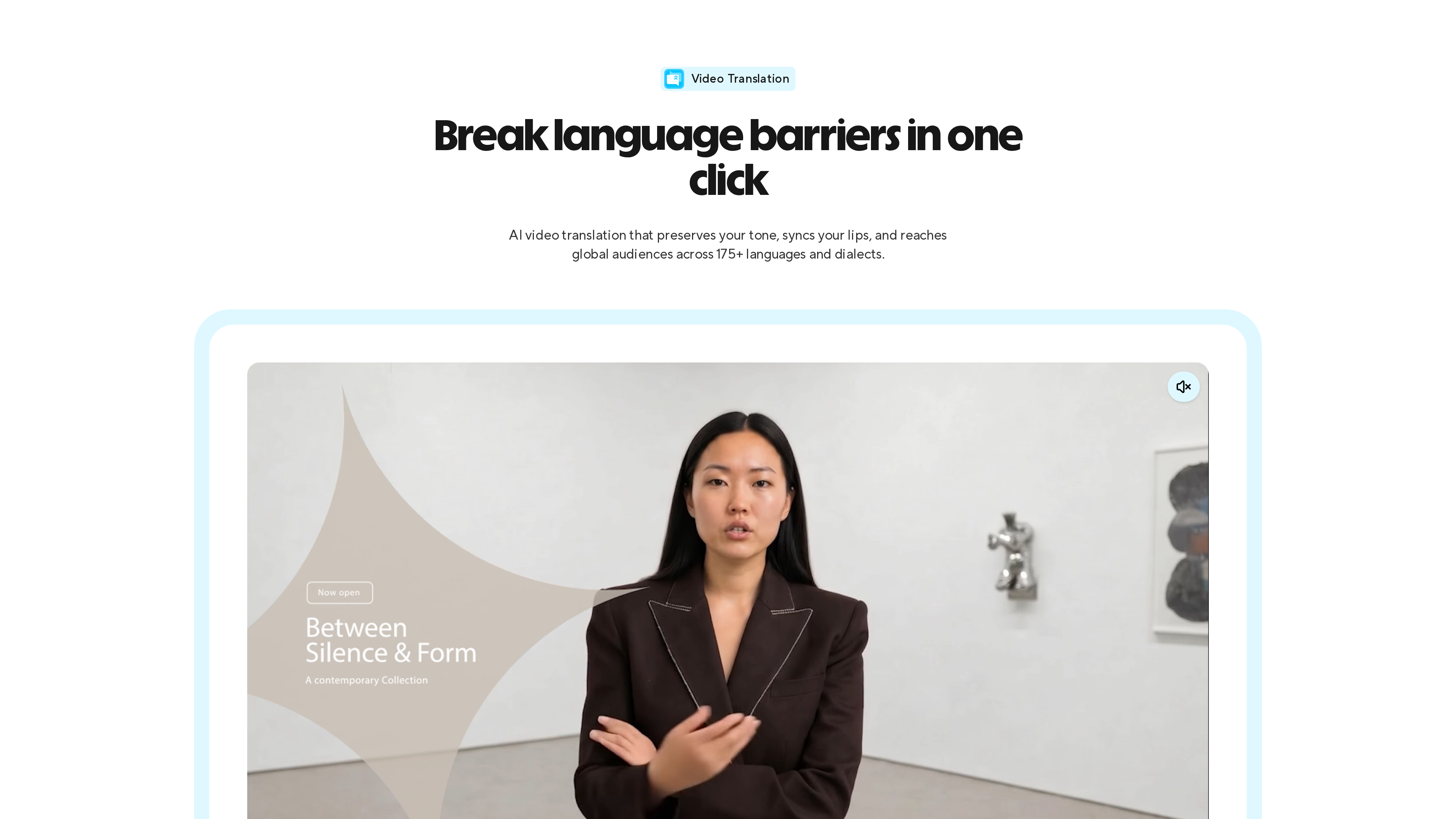
The video translator accepts an uploaded file or a YouTube link and dubs the footage into 175+ languages and dialects (30+ on the free plan), cloning the original speaker's voice and re-syncing lip movements. Pro plans and above add transcript proofreading and a brand glossary.
Interactive avatars and developer APIs
LiveAvatar is HeyGen's real-time interactive avatar service: 1080p streaming, a stated median time-to-first-frame under 300 ms, 100+ preset avatars, unlimited concurrency, and pricing down to $0.01 per minute at volume — aimed at customer support, guided onboarding, and language-tutoring use cases. The developer portal at developers.heygen.com exposes APIs for Avatar III/IV/V, voices, Video Agent, translation, and lip sync, with webhook delivery and a separate API pricing page. HeyGen also ships a ChatGPT plugin and a mobile app, and the Business plan integrates with n8n, Make, HubSpot, and Zapier.
Pricing and Free Tier
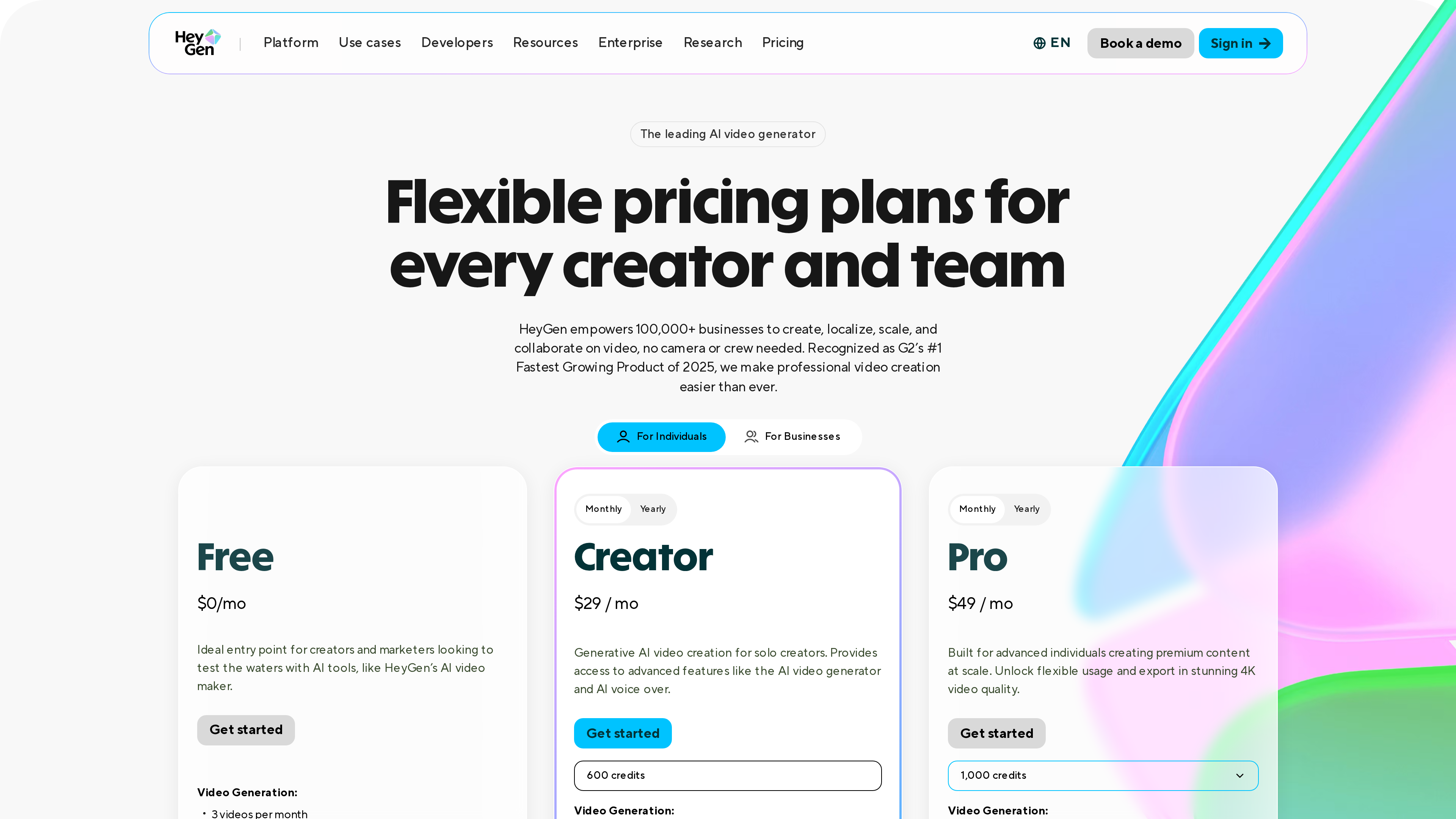
Listed monthly prices from the official pricing page (as of 2026-10-02):
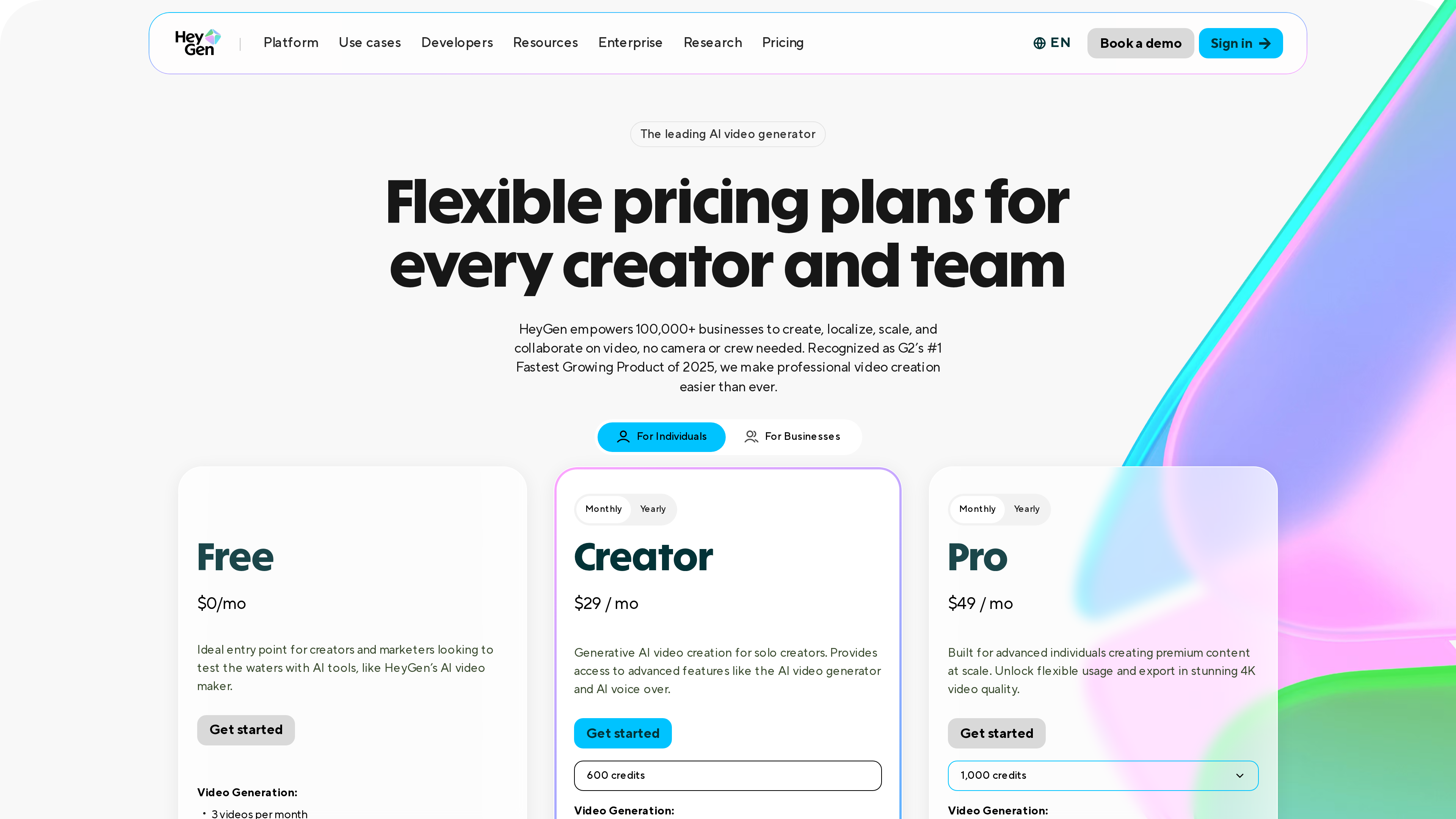
- Free — $0/month: 3 videos per month, up to 1 minute each; 500+ stock avatars, 1 custom video avatar, 30+ languages; no credit card required.
- Creator — $29/month ($24/month billed annually): 600 credits/month, videos up to 30 minutes, 1080p export, watermark removal, voice cloning, 175+ languages.
- Pro — from $49/month: 1,000 credits/month, 4K export, access to all advanced AI models; tiers scale to 100,000 credits/month at $4,300/month.
- Business — 20 per seat/month: 1,500 credits/month, videos up to 60 minutes, SAML/SSO, team workspaces, SCORM export, and integrations.
- Enterprise: custom pricing, no duration cap, SCIM provisioning, dedicated support.
Credits are the single currency across features; consumption varies with the model used, video duration, and generation complexity. Unused credits roll over one month on monthly billing, accumulate until renewal on annual billing, and expire after cancellation. Bottom line on the free tier: you can genuinely generate videos, but only three per month at one minute each, and free-plan videos carry a HeyGen watermark that cannot be removed — watermark removal is standard on every paid plan.
Content Policy and Likeness Rights
For an avatar product, consent and misuse safeguards are central to evaluation, and HeyGen's are relatively thorough:
- Consent and verification: Creating a custom avatar requires the explicit consent of the person depicted (the "Actor" in policy language). The company states that every custom avatar requires on-camera identity verification from that person — "No verification, no avatar." Avatars of people under 18 are banned, as are avatars of any real person, including celebrities and public figures, without their explicit consent.
- Right of removal: Depicted individuals can request removal of their likeness at any time via moderation@heygen.com, and users are obligated to honor removal requests for content they have published.
- Prohibited content: The Content Moderation Policy (effective July 25, 2024) bans violence and crime, fraud and scams, restricted goods, bullying and harassment, child-safety violations, suicide and self-harm, sexual content, misinformation and disinformation (including election-related content), hate speech, political campaigning and lobbying, and intellectual-property infringement. Educational mature content and respectful religious content are conditionally allowed with custom avatars only and must be clearly labeled.
- Enforcement: Machine-learning scanning flags content at generation time, human reviewers handle edge cases, and both a reporting channel and an appeals process exist.
- Privacy: User inputs may be used to train and improve models, with an opt-out available on request; facial and biometric data are processed for avatar creation and anti-fraud verification under a separate Biometric Information Privacy Notice, with explicit consent as the GDPR legal basis. The company reports SOC 2 Type II certification and alignment with GDPR, CCPA, the Data Privacy Framework, and the EU AI Act.
Who It's For
- Marketing and social teams: batch-produce product explainers, ads, and short-form clips without a production crew.
- Localization and global content: dub existing videos into dozens of languages with matching lip movements — useful for go-to-market campaigns and course distribution.
- Corporate training and L&D: convert PPT/PDF decks into narrated videos and distribute them via SCORM export and LMS integrations.
- Sales and customer communication: personalized outreach videos, product walkthroughs, and onboarding.
- Developers and product teams: generate videos at scale through the API, or embed real-time conversational avatars into support, guide, or coaching applications via LiveAvatar.
Limitations
- The free tier is a trial, not a workflow: three 1-minute watermarked videos per month and 30+ translation languages; serious use effectively starts at the Creator plan.
- Credit-based pricing takes planning: consumption varies by model and duration, making costs less predictable than per-video pricing, and leftover credits expire when you cancel.
- Political content is off-limits: the policy explicitly bans political campaigning, lobbying, and advocacy content, which rules out newsroom, civic, and campaign use cases.
- Documented misuse risk: reporting by outlets including The Washington Post (March 2024) and the Financial Times (April 2024), along with analysis from security firm Group-IB, has documented HeyGen being used for scams and impersonation deepfakes. The platform counters with identity verification and moderation, but buyers should run their own compliance and ethics review.
- Unverifiable details: current headcount and any funding or valuation changes after the 2024 Series A have no official confirmation, and this article makes no claims about them.
References
- HeyGen homepage and About page
- Pricing and API pricing
- Official blog: $60M Series A announcement
- Content Moderation Policy, Privacy Policy, Trust & Safety
- Help Center: How to Remove the HeyGen Watermark, Avatar IV Complete Guide
- Developer docs, LiveAvatar
- Wikipedia: HeyGen (index of primary coverage including Bloomberg and Forbes)