Heptabase (heptabase.com) is a visual note-taking and personal knowledge management (PKM) app developed by Hepta Platforms, Inc., founded in Taiwan in 2021. The problem it targets is deep learning of complex topics: instead of stacking notes as linear documents, Heptabase turns every note into a card that can be placed on whiteboards, grouped into sections, connected, and nested — making the structure of knowledge spatial and visible. Among whiteboard-style tools, its verifiable distinction is a complete product around the "collect → think → create" learning loop: PDF annotation, a web clipper, YouTube transcripts, Readwise sync, and tag databases are all built in, and since 2025 it has added AI chat, an AI Tutor, and a CLI plus MCP integration that let external AI agents read and write your knowledge base. It is also worth listing for its transparent business model: paid subscriptions only, no ads, a public statement on the company's finances, and a pledge to open-source the product if the company ever shuts down.
At a glance
- URL: https://heptabase.com/
- Type: Visual note-taking / personal knowledge management app (whiteboards + card box), with desktop and mobile clients plus a web app
- Pricing: Paid subscription only. As of 2026-09-19, the official pricing page lists Pro at 17.99/month, and Premium+ at 11.99 / 71.99. New users get a 7-day free trial; there is no regular free tier
- Sign-up: An account is required; the Terms of Service (updated 2025-12-01) require users to be at least 18
- Platforms: macOS (Intel and Apple Silicon), Windows, Linux, iOS, Android, a web app, and a browser Web Clipper (official download page)
- Interface language: English (observed: the App Store listing declares English; the help center offers Traditional Chinese documentation, and support handles Chinese and English)
Background
Heptabase was co-founded by Alan Chan, Ethan Wu, and Yeefun Lin, with the team based in Taiwan. According to the founder's public AMA and the company's self-description on its official wiki, development began in May 2021 under the name project-meta; the company was formally founded in September 2021 and renamed Heptabase after the Heptapods, the aliens in the sci-fi story "Story of Your Life" who communicate in a visual language.
Product and funding timeline:
- Early 2022: Joined Y Combinator's W22 batch and raised nearly $1.7 million in seed funding from YC, HOF Capital, Kleiner Perkins, Moving Capital, and others (official statement). A June 2022 interview reported paying users across 61 countries (Meet Global interview with the three co-founders).
- 2022–2023: After eight months of closed alpha and eighteen months of public beta, with more than three hundred iterations, Heptabase 1.0 launched on August 31, 2023 (official 1.0 announcement).
- Finances (official self-report): The company says it has been cash-flow positive since its first year, with revenue growing at least threefold annually, 95% of it organic, and no investor money spent; it has pledged to open-source Heptabase and maintain it with the community if the company ever shuts down (official statement — the page is undated, so treat the figures as the company's own account).
- Still actively developed: The official changelog shows desktop v1.111.0 on September 16, 2026 and mobile v1.39.2 on September 17, 2026 (checked 2026-09-19).
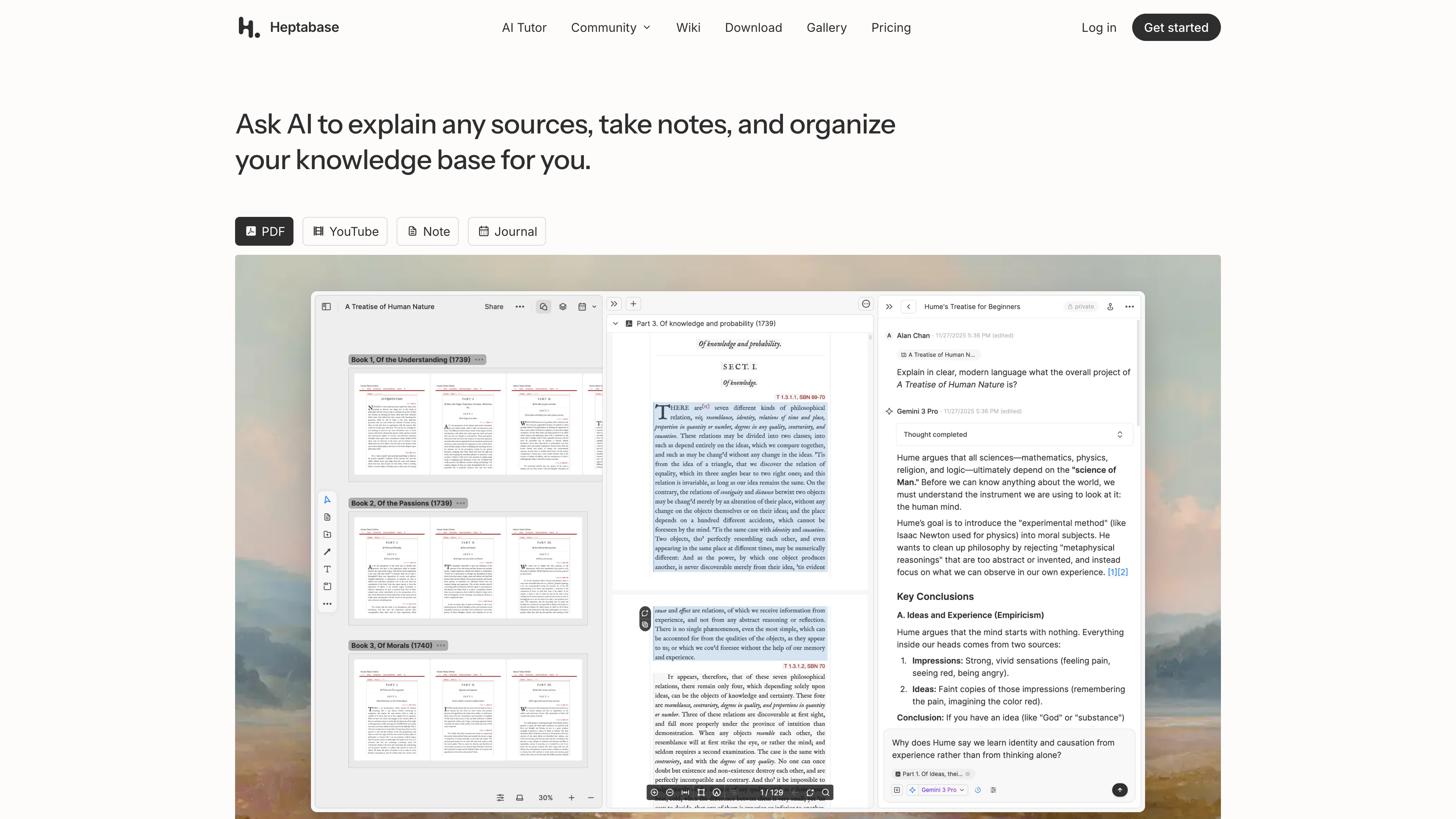
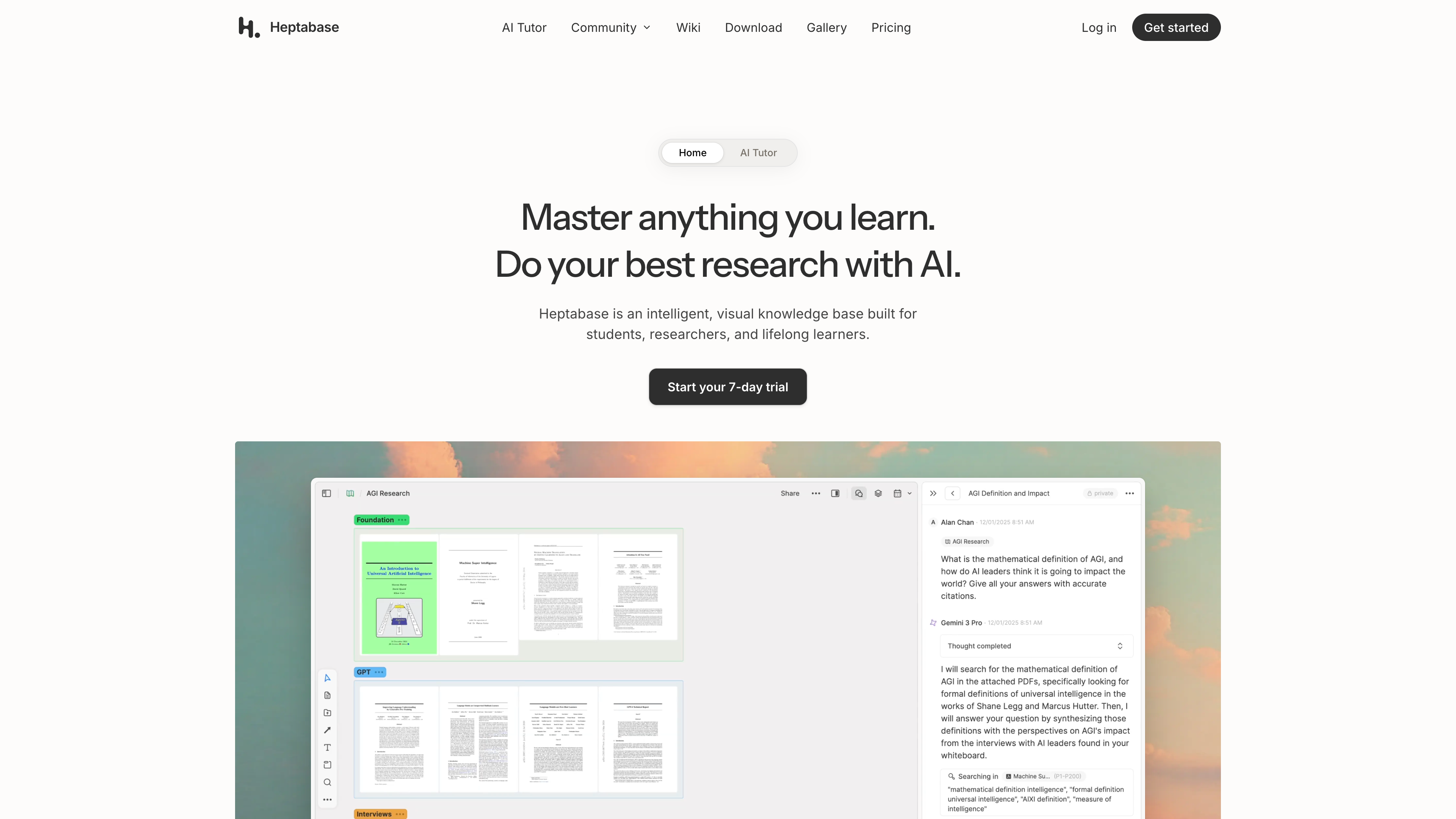
Below is the homepage as of 2026-09-19. The tagline "Master anything you learn. Do your best research with AI." states the current positioning directly — an AI-enabled visual knowledge base for students, researchers, and lifelong learners:
The homepage also displays an investor strip (Y Combinator, Kleiner Perkins, HOF Capital, Moving Capital), consistent with the funding statement above.
Core capabilities: whiteboards, cards, and AI in one learning loop
Whiteboards and cards. The basic unit in Heptabase is the card: a block-based editor supports to-dos, tables, images, audio, video, files, math formulas, and code blocks, and cards can be bidirectionally linked to other cards, dates, and whiteboards. The same card can be reused on multiple whiteboards — edit once and it updates everywhere. Whiteboards support nesting, sections, auto-layout mindmaps, and custom arrows, plus a set of spatial algorithms (Card Space-out, Section Auto-grow, Tidy Up, keyboard navigation) to reduce manual layout work (official 1.0 announcement). Tags and properties turn homogeneous data — literature, meetings, contacts — into databases with table and kanban views.
Reading and capture. PDFs can be imported and read directly on a whiteboard, where highlights and annotations become standalone Highlight cards. Paid plans include unlimited PDF parsing (OCR, based on MinerU under the AGPL-3.0 license; see section 27 of the Terms of Service), which lets the AI read scanned documents. Other capture paths include YouTube transcripts, a browser Web Clipper, Readwise highlight sync (official Readwise sync guide), a Journal, and an Inbox. In 2026 the mobile apps also gained PDF highlighting and annotation (official newsletter, 2026-05-29).
AI features. The AI section of the homepage (shown below) demonstrates asking AI to explain PDF sources, take notes, and organize the knowledge base:
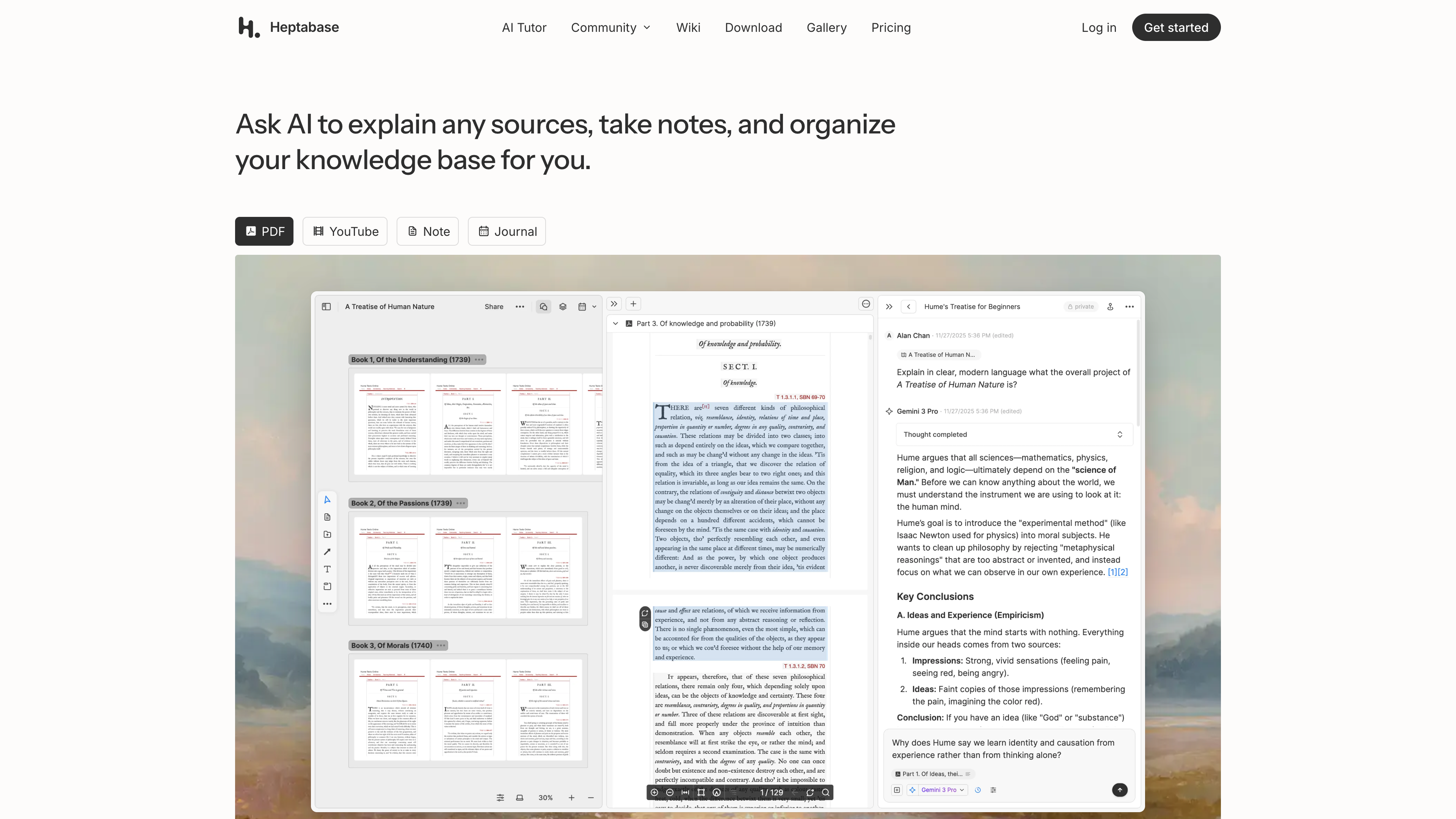
As of 2026-09-19, AI capabilities include an AI Chat that reads your whole knowledge base, an Agent Mode (launched May 2026) that can edit and create cards and explore sub-whiteboards, an AI Tutor that generates structured courses, voice notes, and audio/video transcription (official pricing FAQ, newsletter). AI usage is metered in credits: the Pro tier is limited to Gemini models, while Premium and above can use GPT, Claude, and Gemini; on-demand usage can be enabled beyond the included quota, and BYOK (your own API keys) is supported (section 9.6 of the Terms of Service).
Collaboration, sharing, and openness. Paid users can invite unlimited collaborators to co-edit a space; whiteboards can be shared as public links, and since May 2026 individual cards can be published as public pages too. For developers, Heptabase launched an official CLI and MCP integration in 2026, letting terminal AI agents such as Claude Code, Codex, and Cursor read and write the knowledge base (commands return JSON), with official CLI Skills published alongside (official CLI documentation). There is no public REST API; the CLI and MCP are the current official integration paths.
Pricing and accounts
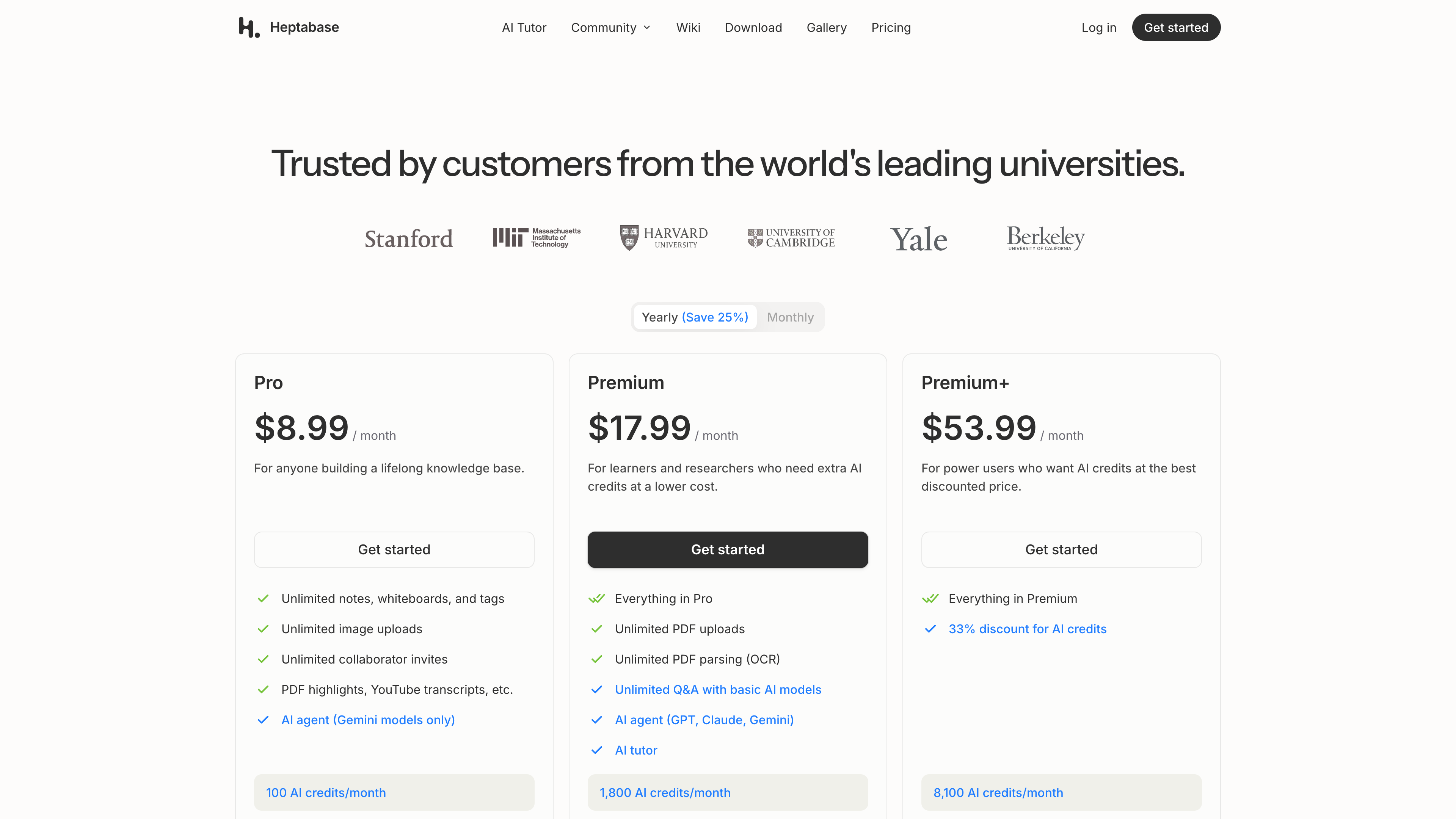
Below is the official pricing page as of 2026-09-19 (yearly billing; the header reads "Trusted by customers from the world's leading universities"; yearly billing saves 25% over monthly):
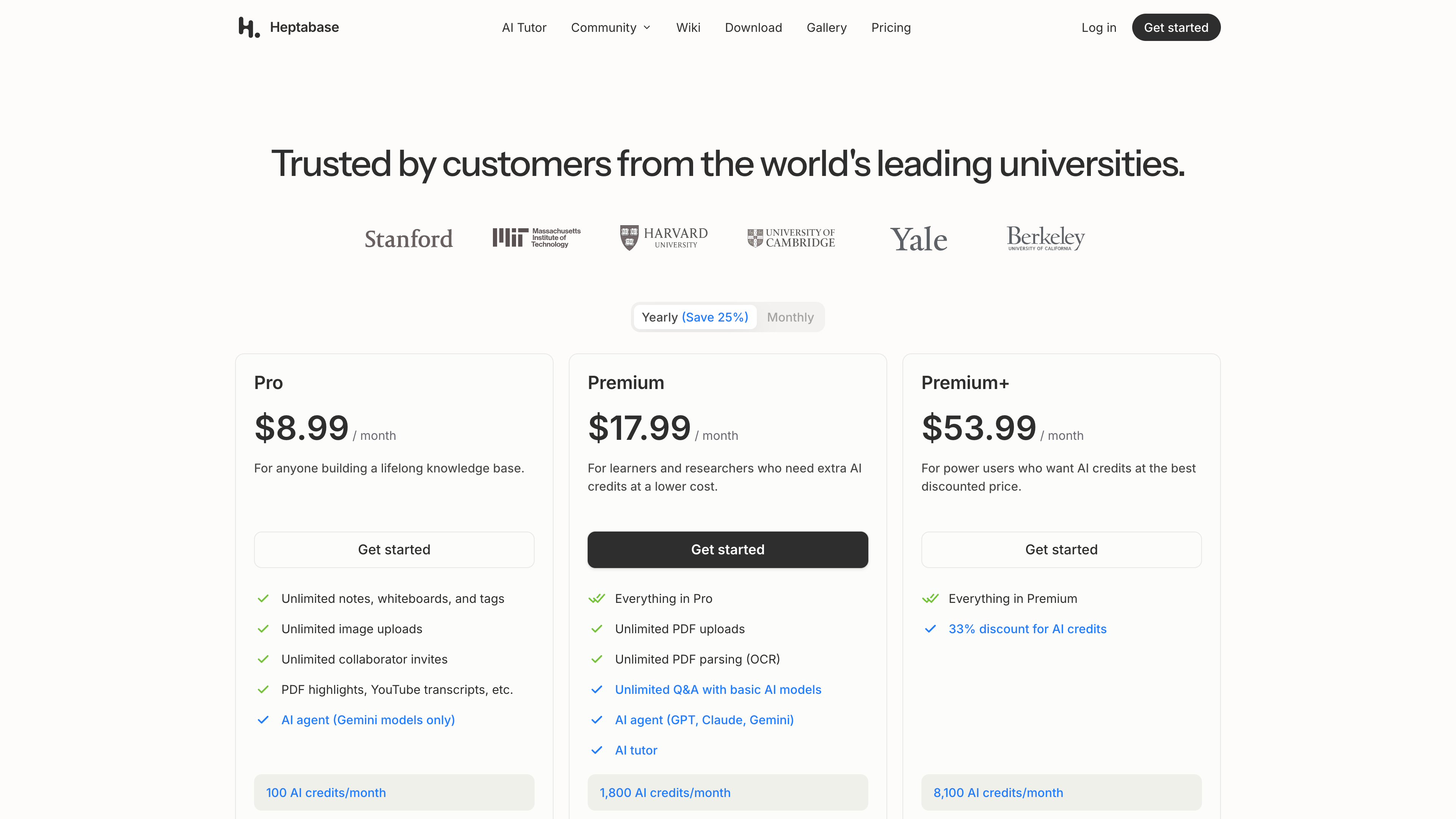
What each tier includes (official pricing page and pricing FAQ, as of 2026-09-19):
- Pro (11.99 monthly): unlimited notes, whiteboards, and tags; unlimited image uploads and collaborator invites; PDF highlights and YouTube transcripts; AI agent limited to Gemini models; 100 AI credits per month.
- Premium (23.99 monthly): everything in Pro plus unlimited PDF uploads and OCR parsing, unlimited Q&A with basic AI models, the AI agent on GPT/Claude/Gemini, and the AI Tutor; 1,800 AI credits per month.
- Premium+ (71.99 monthly): everything in Premium plus a 33% discount on extra AI credits and 8,100 credits per month, aimed at heavy AI users.
Trial and free access: new users get a 7-day free trial, during which any plan tier grants Premium-level allowances (including unlimited PDF uploads and parsing). Heptabase has no regular free tier — the only free entry is collaboration: users who registered after February 7, 2025 can use a limited free plan when invited as collaborators by a paying user (official free-plan explainer). The company explicitly states it does not offer an educational discount.
Two billing details are worth noting. First, section 7 of the Terms of Service makes purchases on or after September 1, 2023 non-refundable, with no credits for partially used periods. Second, after a subscription or trial ends, existing content remains accessible and exportable indefinitely, but creating or editing requires renewing (official note, updated 2026-08-10).
Data and privacy
- Works offline: The desktop app stores your full dataset locally, so you can keep working offline and sync when reconnected (official help center). That said, the product is "local cache plus cloud sync," not a local plain-text vault like Obsidian.
- Export freedom: Settings → Backup & Sync → Export Now exports all notes as Markdown (official statement).
- AI data handling: AI Chat, transcription, and voice notes send the relevant content to models from OpenAI, Google, and Anthropic; PDF parsing and AI Suggestions run on self-hosted models (on Runpod infrastructure) and do not go to third parties. The company pledges not to train its own models on user content and says its third-party agreements bar training of foundation models; third parties may retain data for about 30 days for abuse monitoring. Under BYOK, data handling is governed by your own agreement with the provider (section 9 of the Terms of Service, updated 2025-12-01).
- Analytics: The product uses PostHog and Firebase for usage analytics, and Intercom for support (sections 11 and 17 of the Terms of Service).
- Age and jurisdiction: 18+ only; the terms are governed by the laws of the State of Delaware.
Who it's for
- Researchers and graduate students: importing literature PDFs onto whiteboards, turning highlights into cards, and linking across papers is the core use case in the official positioning.
- Students and self-learners: course notes and reading highlights (via Readwise sync) plus the AI Tutor's structured courses suit systematic learning of new fields.
- Knowledge workers and creators: market research, investment theses, and writing material — anywhere fragmented information needs to be consolidated into structure.
- AI workflow tinkerers: users who want agents like Claude Code or Cursor to read and write their knowledge base directly through the CLI/MCP.
Limitations
- Paid-only, no regular free tier: The 7-day trial is short, purchases after September 2023 are non-refundable, and an expired subscription leaves your notes read-only — viewable and exportable, but not editable. There is no student discount, and the 18+ age requirement raises the barrier for the student audience the product otherwise targets.
- AI is neither cheap nor simple: AI usage is metered in credits; the Pro tier includes only 100 credits per month and Gemini models. Heavy AI use effectively means $17.99–53.99/month (billed yearly), with on-demand charges beyond the quota.
- Not local-first: Data lives primarily in the cloud with a local cache; the storage format is not a plain-text Markdown vault, and migration depends on manual export. The company does not publicly document SOC 2, ISO 27001, or similar certifications (none found in this review, as of 2026-09-19) — organizations with compliance requirements should confirm directly with the vendor.
- English-only interface: The app UI is English (per the App Store listing); Chinese-speaking users rely on Traditional Chinese help docs and bilingual support — a hurdle for learners who struggle with English reading (observation).
- No public API: Openness currently means the CLI and MCP launched in 2026; there is no general public REST API, so automation options are relatively narrow.
- The whiteboard model cuts both ways: Spatial organization requires actively maintaining layout, which costs more effort and discipline than an outliner for users who only need quick capture (a reasoned inference from the product's design).
Alternatives
- Obsidian: a local-first Markdown knowledge base whose Canvas feature covers whiteboards; data ownership is more complete, but PDF reading and AI workflows must be assembled yourself.
- Scrintal: a Swedish tool built on the same cards-plus-whiteboard model for researchers — the closest in positioning to Heptabase.
- Notion: a general-purpose collaborative workspace with stronger databases and team features; visual sense-making is not its focus.
References
- Heptabase homepage (checked 2026-09-19)
- Heptabase pricing (checked 2026-09-19)
- Heptabase download page (checked 2026-09-19)
- Official wiki home (vision and documentation index) (checked 2026-09-19)
- Official wiki: Heptabase 1.0 announcement (2023-08-31; checked 2026-09-19)
- Official wiki: company sustainability statement (founding, funding, open-source pledge, export) (checked 2026-09-19)
- Official wiki: version changelog (latest entries 2026-09-17; checked 2026-09-19)
- Official wiki: 2026-05-29 newsletter (Agent Mode, CLI, public card links, mobile PDF annotation) (checked 2026-09-19)
- Help center: Pro, Premium and Premium+ pricing FAQ (checked 2026-09-19)
- Help center: does Heptabase offer a free plan? (checked 2026-09-19)
- Help center: what happens to notes after a subscription or trial ends (updated 2026-08-10; checked 2026-09-19)
- Help center: educational discount (checked 2026-09-19)
- Help center: local storage note (desktop works offline) (checked 2026-09-19)
- Help center: Readwise sync Q&A (checked 2026-09-19)
- Help center: Heptabase CLI documentation (checked 2026-09-19)
- Terms of Service (updated 2025-12-01) (checked 2026-09-19)
- Privacy Policy (updated 2021-12-17) (checked 2026-09-19)
- Founder's Reddit AMA (renaming origin, development start, user numbers) (2023-10; checked 2026-09-19)
- Meet Global: how YC-backed Heptabase is carving a niche in the note-taking market (interview with the three co-founders) (2022-06-06; checked 2026-09-19)