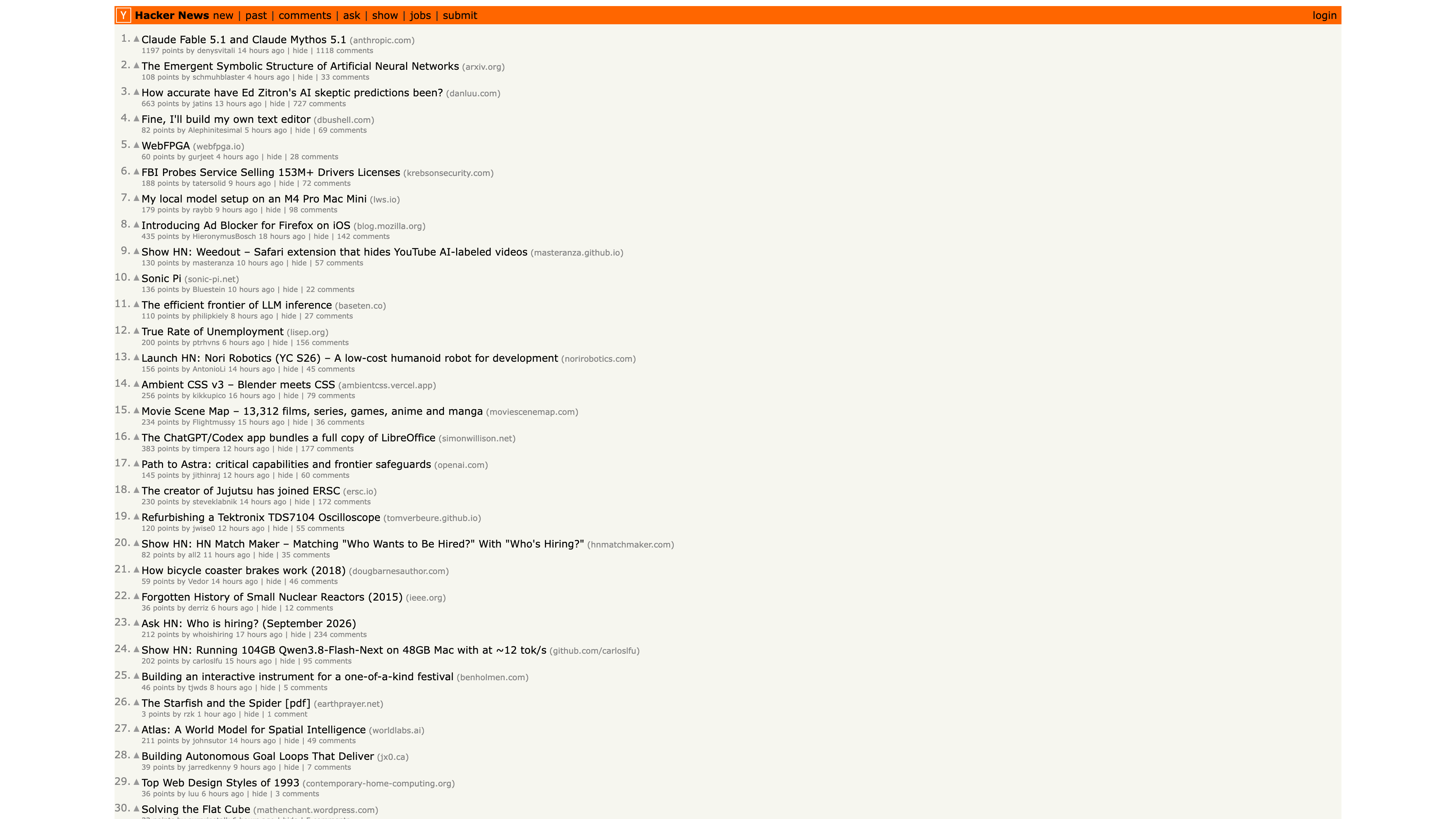
Hacker News (usually shortened to HN) is a social news site about computer science, entrepreneurship and, in its own words, "anything that gratifies one's intellectual curiosity": registered users submit links or text posts, others vote, and the front page is ranked by votes combined with time decay. It is owned and funded by the startup accelerator Y Combinator, has kept a plain-text minimalist interface since 2007, and can be read without any account.
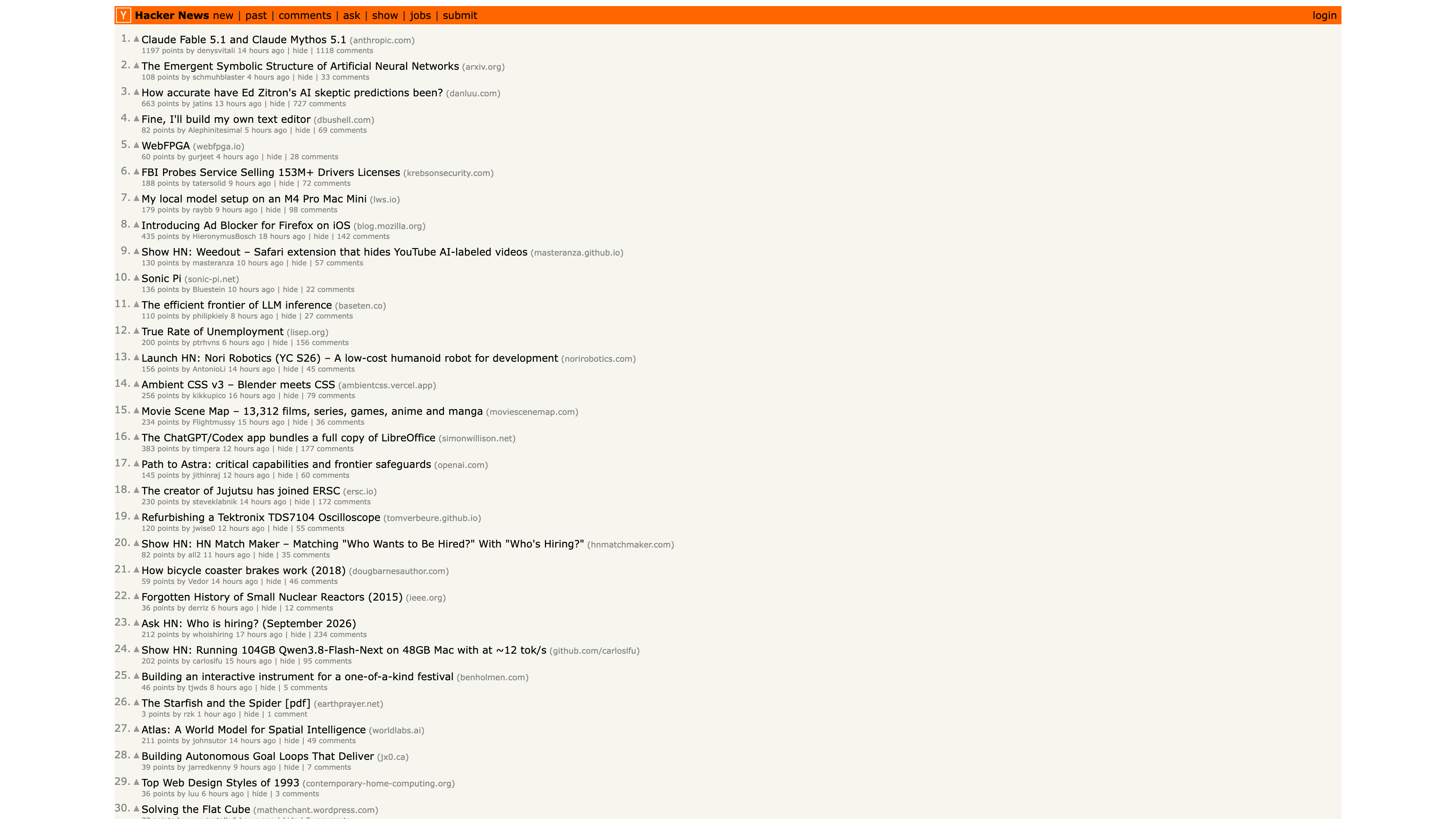 The front page lists 30 submissions, each showing its score, submitter, age and comment count; the top bar leads to new (latest), past (front-page history by day), comments (latest comments), ask, show and jobs. The screenshot also shows the monthly "Ask HN: Who is hiring?" thread and a Launch HN post from a YC startup — two special content types explained below.
At a glance
- URL: https://news.ycombinator.com
- Type: Tech news aggregation and discussion community (owned by Y Combinator)
- Cost: Free, with no conventional advertising
- Registration: Not required for reading; required for posting, voting and commenting
- Interface language: English
Background
Hacker News was created by Y Combinator co-founder Paul Graham, launching on 19 February 2007 as Startup News and taking its current name on 14 August 2007; it also served as a real-world testbed for Arc, the programming language Graham co-designed. After Graham stepped back from daily operations in March 2014, the site has been run by a small staff team — currently the public moderators Daniel Gackle (dang) and Tom Howard (tomhow), the latter announced in April 2025. On its relationship with YC, the official FAQ states: "Y Combinator owns and funds HN. The HN team is editorially independent." In return YC gets three placement privileges: job posts and Launch HN announcements from YC startups appear on the front page, and YC founders' usernames display in orange to other YC alumni.
Ranking and community mechanics
Front-page rank is not a simple vote count. Per the official FAQ, the basic algorithm divides points by a power of the time since submission (so stories decay with age), and comments are ranked the same way within threads; user flags, anti-abuse software, software that demotes overheated discussions, account or site weighting, and moderator action also affect rank. Around this sits a seniority system:
- Karma: Roughly a user's upvotes minus downvotes; new accounts show green usernames.
- Downvotes and flags: Stories can only be upvoted, never downvoted; comment downvote arrows appear only after a karma threshold and never on direct replies to you. Flagging and vouching (restoring wrongly killed posts) each carry their own karma thresholds.
- Post lifecycle: Posts can be marked [flagged] or killed ([dead]) by software, user flags or moderators; dead items are hidden by default but visible with the showdead profile setting, and threads close to new comments after two weeks.
- Anti-addiction: The optional noprocrast profile setting limits each visit (20 minutes on, 3 hours off by default).
Sections and conventions
- Ask HN: The section for questions and text-only discussion; the FAQ notes that text submissions cannot carry links — links must be submitted as such.
- Show HN: For sharing your own work (products, projects, tools) under special rules; new posts need a small number of points to move from shownew onto the show page.
- Launch HN and job ads: YC startups' launches and job posts appear directly on the front page (job posts have no vote arrows or comments); all other hiring belongs in the monthly "Who Is Hiring?" thread posted by an official account on the first weekday of each month.
- jobs / past / comments: Respectively, the full list of YC job ads, front-page history by day, and the latest comment stream.
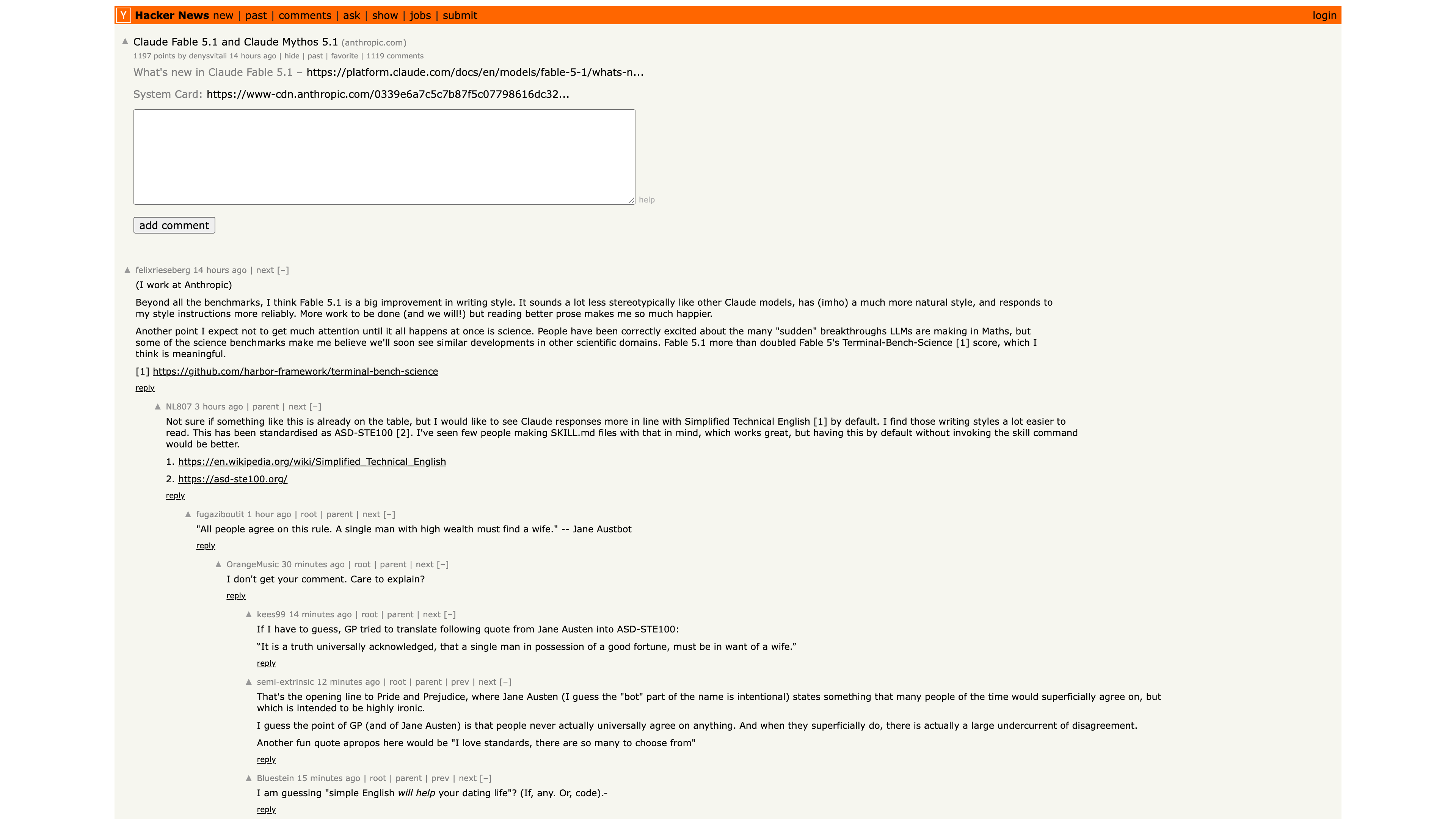 A discussion page (the screenshot shows the thread of an AI model announcement) illustrates HN's other half: the link is only a starting point, and the nested comment tree is often the real content — high-signal technical discussion is the community's core asset.
Rules and culture
The community guidelines set explicit expectations for both submissions and comments, enforced jointly by software and moderators:
- Submit the original source with the original title — no sensationalizing or clickbait (listicle-style numbers in titles are asked to be cropped); reposts are acceptable in small numbers if a story has had no significant attention in about a year.
- Never ask others to upvote or comment; violations are penalized or banned. Posting your own work occasionally is fine, but it must not be the account's primary use.
- Comments should respond to the argument rather than the person, assume good faith, and avoid political or ideological battle; the guidelines also explicitly prohibit AI-generated or AI-edited text ("HN is for conversation between humans").
- Throwaway accounts are acceptable for sensitive information, but routinely creating accounts is discouraged.
Open APIs
HN provides an official API (Firebase-based, mirroring all items and comments in near real time; over 13k GitHub stars as of 2026-09-02), and Algolia hosts HN Search with full-text search endpoints. Together they power most third-party clients and analytics tools.
Operating model
HN carries no conventional advertising, subscriptions or paywall; operating costs are covered by Y Combinator ("owns and funds" in the FAQ's wording). The only commercial placements on the site are YC startups' job and launch posts plus the monthly hiring thread, none of which are sold per click. The model ties HN's continuity to YC's brand rather than to traffic monetization.
When it fits
- Tracking daily discourse in the English-speaking tech and startup world — programming languages, infrastructure, AI and founder topics in particular
- Watching how indie developers launch and get feedback through Show HN
- Reading long threads for first-hand engineering experience and well-argued disagreement
- Pulling data via the API for research on attention, propagation or community dynamics
Limitations
- Content is entirely in English and skews toward the US tech industry; other regions and industries get limited coverage.
- The minimalist interface has no tags, subscriptions, private messages or rich media, and built-in search is weak (most people use Algolia or third-party clients).
- New accounts face restrictions (no downvotes, flag thresholds), so participating fully takes time and karma.
- Discussion quality is high on average but the community has visible in-group biases toward and against particular companies and stacks.
- Stories decay quickly — most submissions sink within hours, so it is a poor venue for content meant to last.
Alternatives
Lobsters is a similar link community with an invitation system and a smaller, quieter culture; Slashdot is the genre's older predecessor; Reddit's r/programming covers overlapping topics with a very different community culture.
Sources
- Hacker News FAQ (ranking algorithm, karma, Ask/Show HN, job ads, YC relationship; checked 2026-09-02)
- Hacker News Guidelines (submission and commenting rules; checked 2026-09-02)
- Hacker News front page and discussion pages (interface and section structure, observed via screenshots 2026-09-02)
- GitHub: HackerNews/API (official API, star count checked 2026-09-02)
- HN Search (Algolia) (full-text search service; checked 2026-09-02)
- Wikipedia: Hacker News (2007-02-19 launch, renaming date, Arc background, moderator history; checked 2026-09-02)