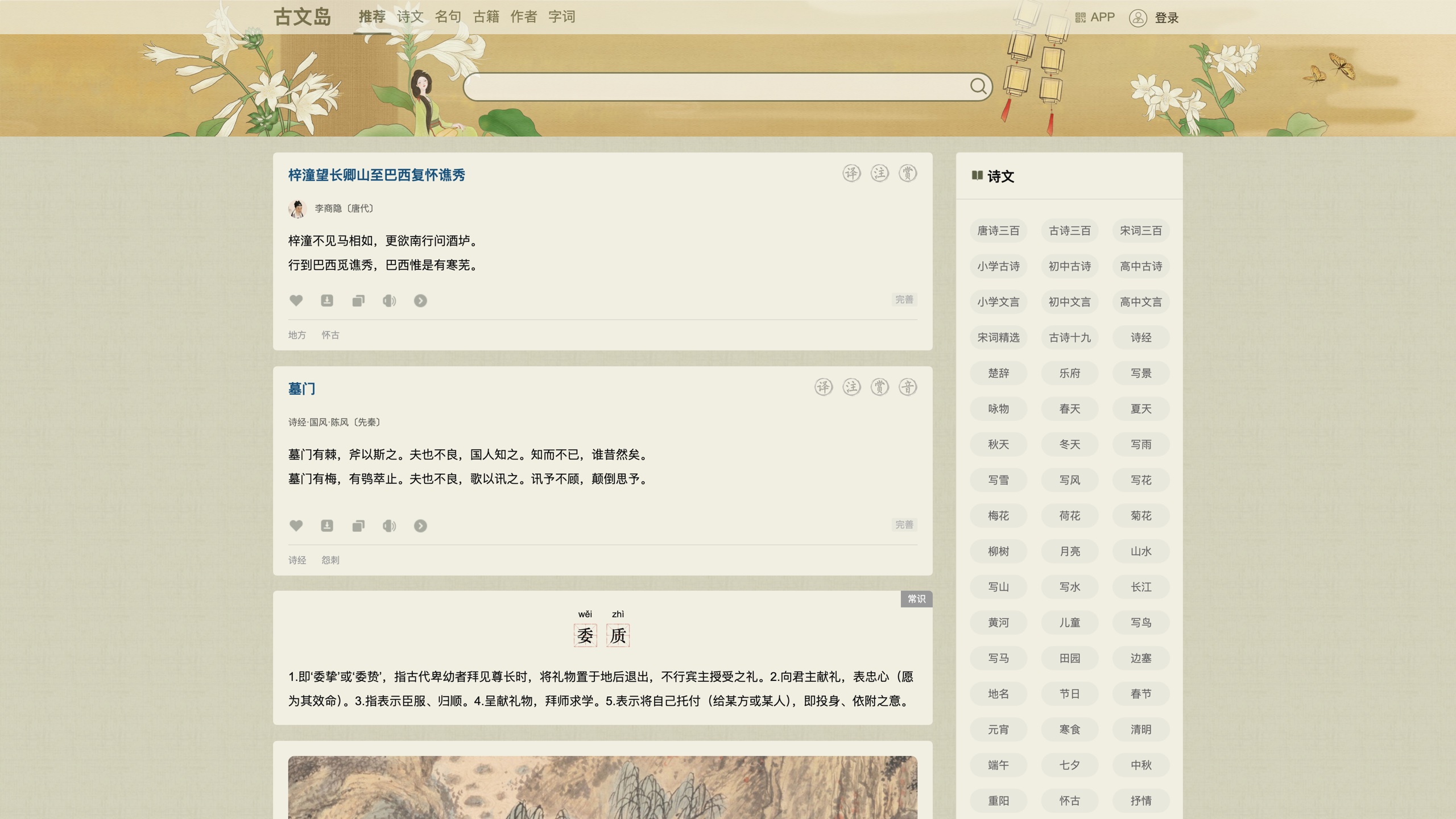
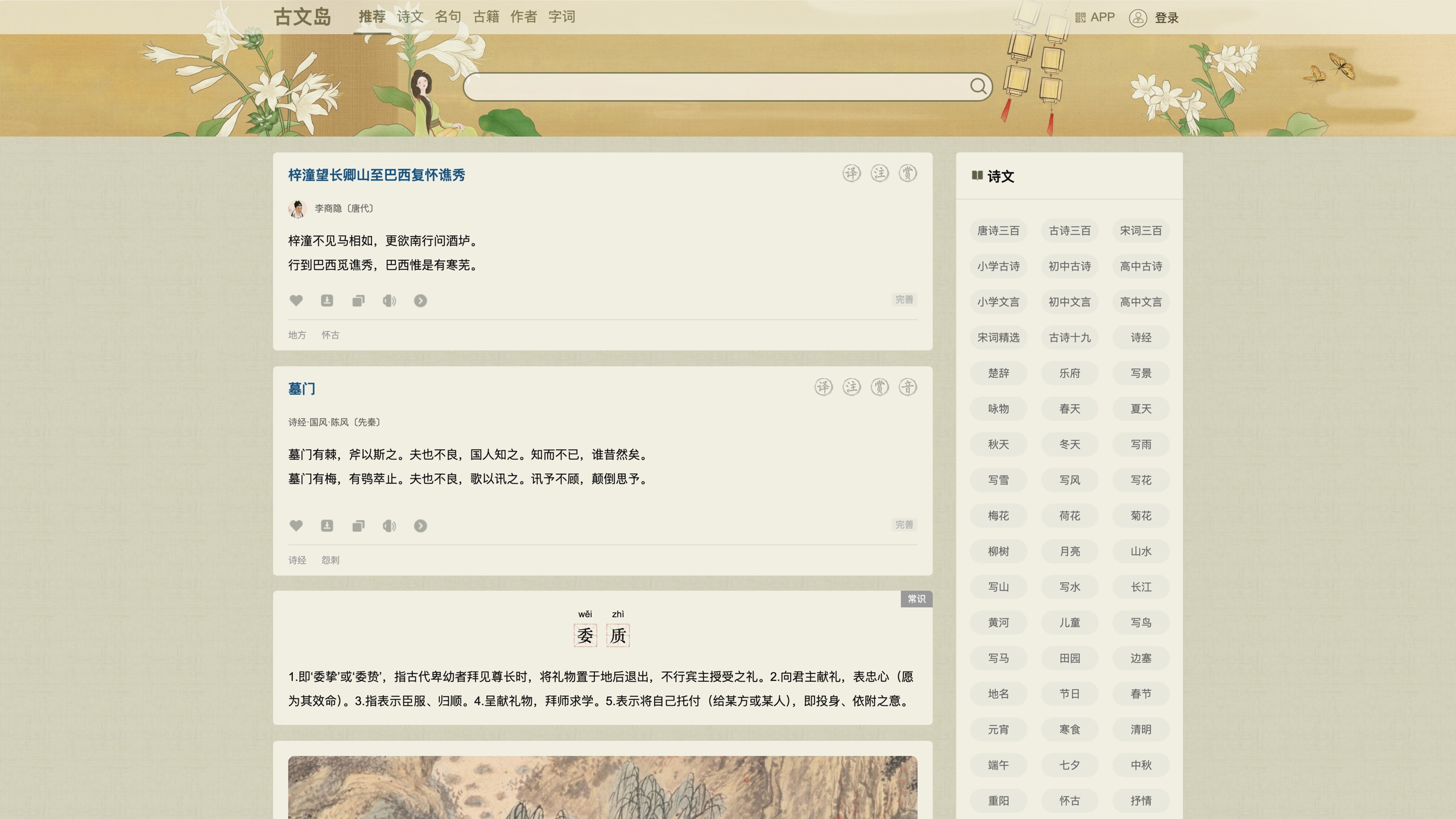
Guwendao (formerly Gushiwen, gushiwen.cn) is a reference site for classical Chinese literature: it collects poems, ci lyrics, prose, ancient books, and famous lines from the pre-Qin era to the Qing dynasty, and every work page carries the original text plus a modern-Chinese translation, annotations, background, and an appreciation essay — all free to read on the web without an account. Two verifiable traits set it apart: content is cross-indexed across five channels (works, famous lines, ancient books, authors, and a classical dictionary), and annotations cite the printed reference books they draw on. Founded in 2011, the site was renamed "Guwendao" (古文岛) around late 2025, with the header noting "formerly Gushiwen"; both domains (gushiwen.cn and guwendao.net) currently serve the same site.
A note for non-Chinese readers: the site and all of its content are in Simplified Chinese only, with no English interface.
At a glance
- URL: https://www.gushiwen.cn/ (same site on the newer domain https://www.guwendao.net/)
- Type: classical Chinese literature reference site (web plus Android / iOS / HarmonyOS apps)
- Cost: all works and study notes are free to read on the web; no paywall observed (tested 2026-09-02)
- Registration: not required for reading; the user agreement shows registration via email or phone number, needed for favorites and contributing "improvements"
- Interface language: Simplified Chinese only
- Operator: a studio registered in Chongqing ("沙坪坝区来哟软件开发工作室", ICP filing 渝ICP备15011639号-3 for gushiwen.cn)
Background
The site's own description as archived by a third-party directory states that Gushiwen was founded in 2011 "as a site for passing on the classics" (Chinaz directory page), and its meta description frames the mission as letting poetry lovers "publish and access classical-poetry materials more conveniently." The registered operator is an individual studio in Chongqing, with contact email under the laiyo.com domain.
The rename is the most confusing aspect for returning visitors. According to Wayback Machine snapshots, the homepage title was still "古诗文网-古诗文经典传承" (Gushiwen) on October 1, 2025, and had become "古文岛-原古诗文网" (Guwendao, formerly Gushiwen) by January 1, 2026 — so the rename happened around late 2025. The gushiwen.cn footer still reads "© 2026 古诗文网," while guwendao.net shows "© 2026 古文岛" under a separate filing number; work links across the site now point to guwendao.net, and old bookmarks or search results for "Gushiwen" land on the same site.
Content channels and the reading experience
Content is organized into five channels:
- Works (诗文): the main library, filterable by genre (shi, ci, qu, classical prose), dynasty, themes (objects, snow, spring, and so on), and textbook level (elementary / middle / high school).
- Famous lines (名句): excerpt cards with source attribution, paired with classical paintings.
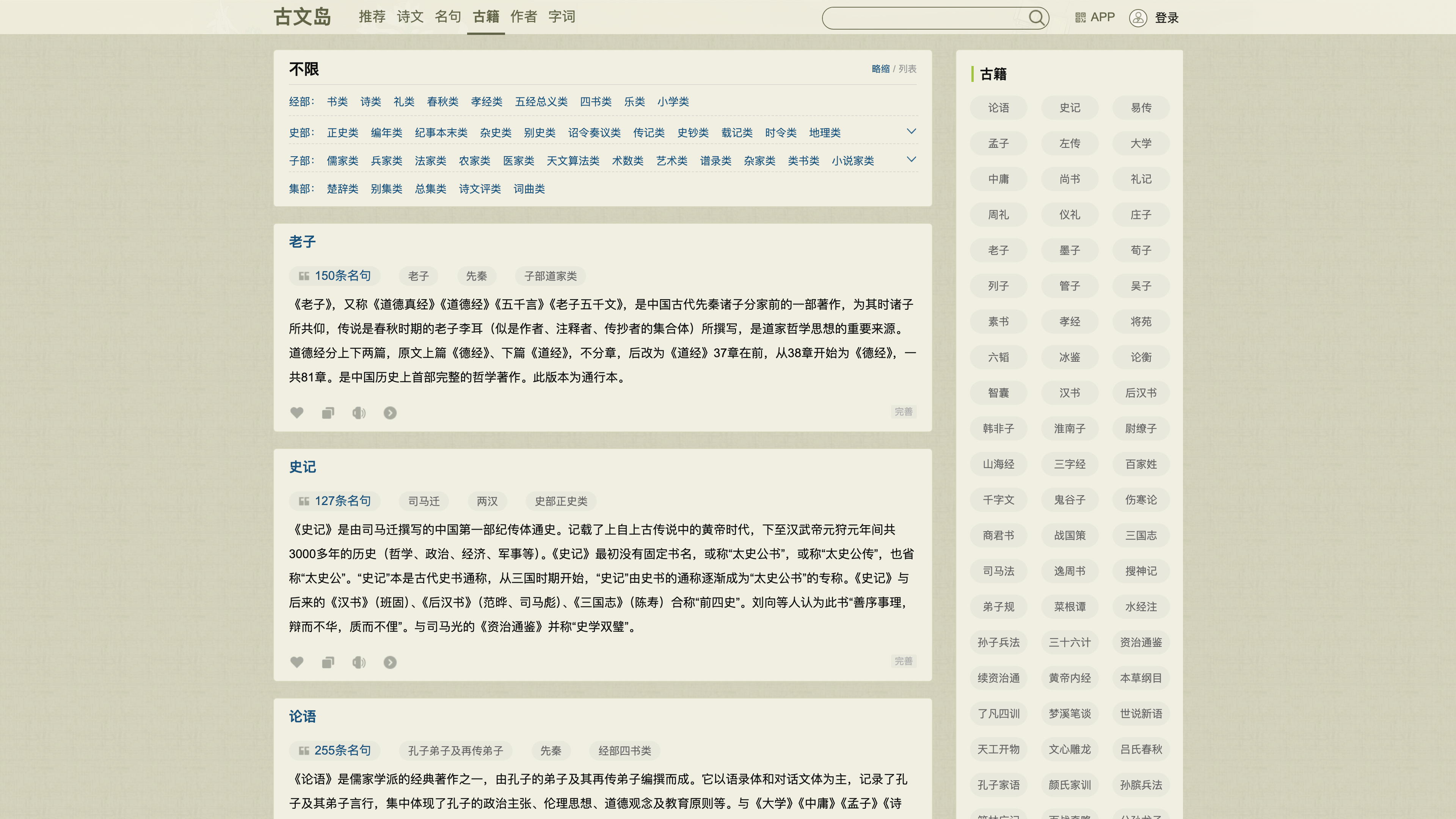
- Ancient books (古籍): arranged in the traditional four-part classification — classics, histories, masters, and collections (经史子集) — covering works such as the Laozi, Records of the Grand Historian, and the Analects, each with an introduction and a "N famous lines" count.
- Authors (作者): listed by dynasty from pre-Qin to Qing, each with a biography and work counts — Li Bai's page, for example, shows "1,126 works, 6,180 famous lines."
- Dictionary (字词): a classical Chinese dictionary with multi-sense entries for characters and words.
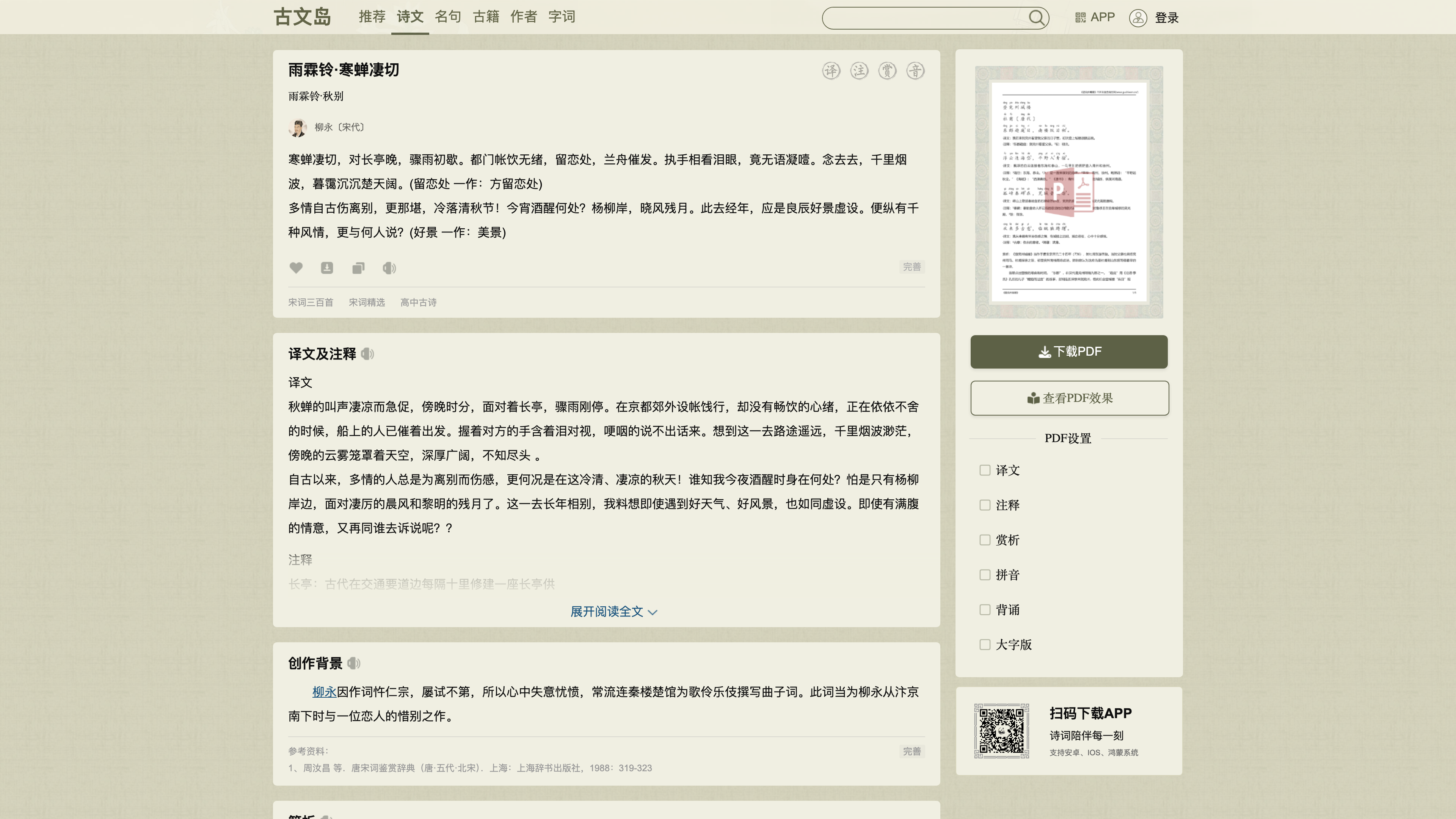
Each work page follows a fixed structure — tested on 2026-09-02 with Liu Yong's "Yu Lin Ling: Cicadas Chirping in the Cold" (《雨霖铃·寒蝉凄切》): the header gives the title, author, dynasty, and the original text with variant readings marked "一作" (also written as); then come the translation and annotations, composition background, a brief analysis, and a longer appreciation, with annotation entries citing printed sources (for example, the Tang-Song Ci Appreciation Dictionary from Shanghai Lexicographical Publishing House). A PDF panel on the right generates downloads with optional translation, annotations, appreciation, pinyin, a recitation (fill-in-the-blank) mode, and large type; an audio bar at the top plays a recitation credited to a named reader. Content blocks carry an "improve" button for registered users to submit revisions, plus a correction entry.
Accounts and content policy
Browsing, searching, and reading full translations and appreciations require no login. An account (email or phone) unlocks favorites and contributing "improvements"; the user agreement also states that accounts inactive for a full year may be deleted.
Two official documents define the content policy:
- The disclaimer states that "part of this site's content is submitted by users" and offers takedown on request — so not all content comes from an editorial team.
- Clause 10 of the user agreement requires uploaders to warrant they own the copyright (or hold authorization) and grants the site a "free, irrevocable, perpetual, sublicensable and transferable exclusive license" worldwide. Would-be contributors should read that exclusive grant carefully.
When it is useful
- Recovering the full text, source, and author of a poem from a half-remembered line
- Checking textbook pieces' translations, annotations, and appreciations when preparing lessons or self-studying
- Browsing the originals of ancient books via the four-part classification
- Looking up classical Chinese characters and words in the dictionary
- Printing PDF handouts with pinyin, translation, or a fill-in-the-blank recitation layout
Limitations
- Translations, annotations, and appreciations depend on editors and user contributions, and individual entries may diverge from other annotated editions; verify against the cited printed sources for academic writing.
- Simplified Chinese only — no Traditional Chinese or foreign-language interface.
- The site publishes no official totals, so the size of the collection can only be estimated indirectly from channel and author-page counters.
- Personal features such as favorites require registration, and the account terms allow deletion after one year of inactivity.
Similar services
Sou-yun (搜韵) focuses on poetry search plus tonal-pattern checking and other composition aids; the Chinese Text Project (中国哲学书电子化计划) offers full-text search of ancient books with edition and scanned-page comparison, better suited to research. The three complement one another.
References
- Guwendao (formerly Gushiwen) official site (homepage, channel structure, and work pages tested 2026-09-02)
- User agreement and disclaimer (registration, UGC licensing, and content sourcing; checked 2026-09-02)
- Chinaz directory: gushiwen.cn (secondary source for founding year and registrant)
- Wayback Machine snapshots: homepage title on 2025-10-01 was "古诗文网-古诗文经典传承" and on 2026-01-01 "古文岛-原古诗文网" (rename timeline)