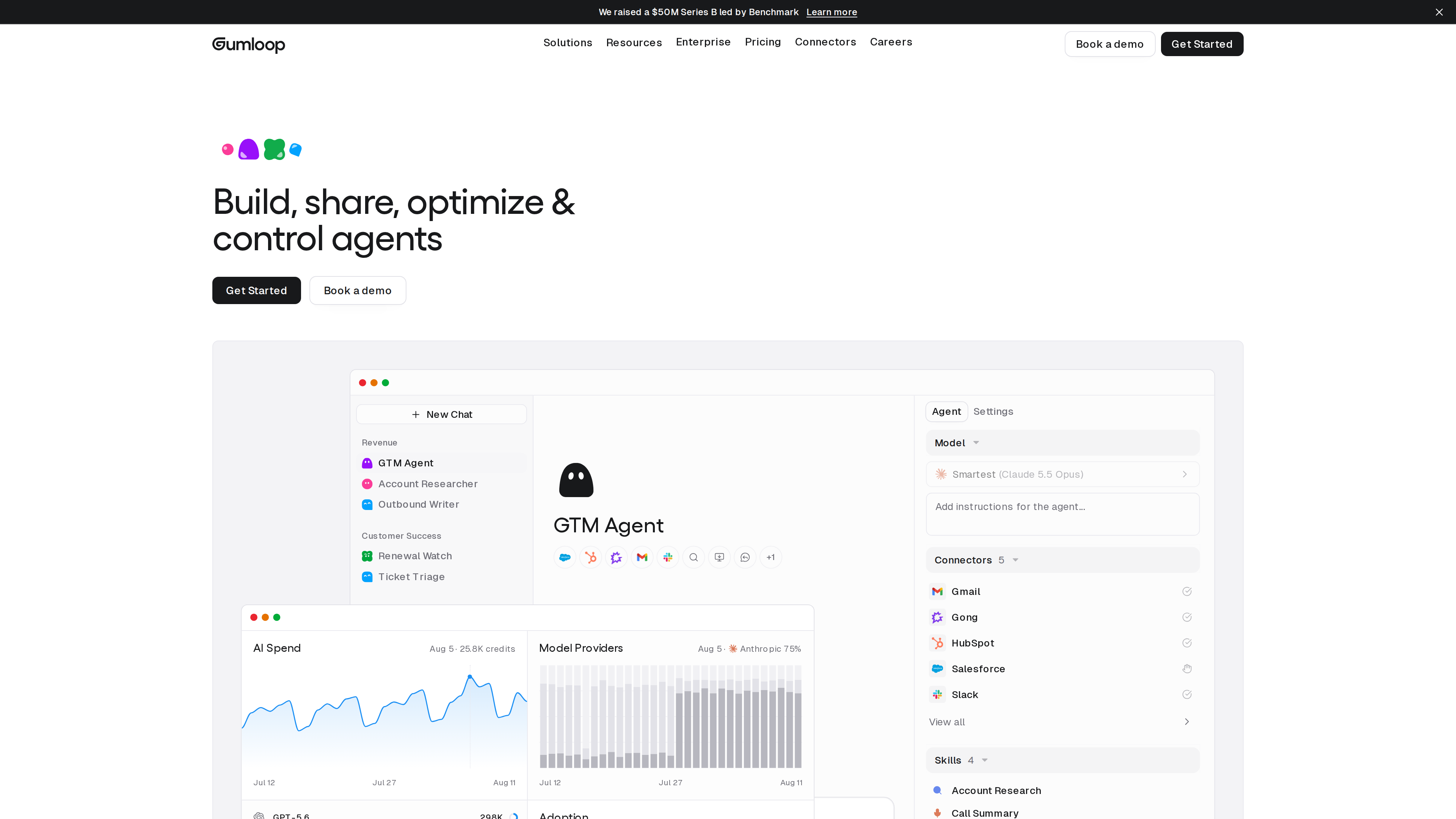
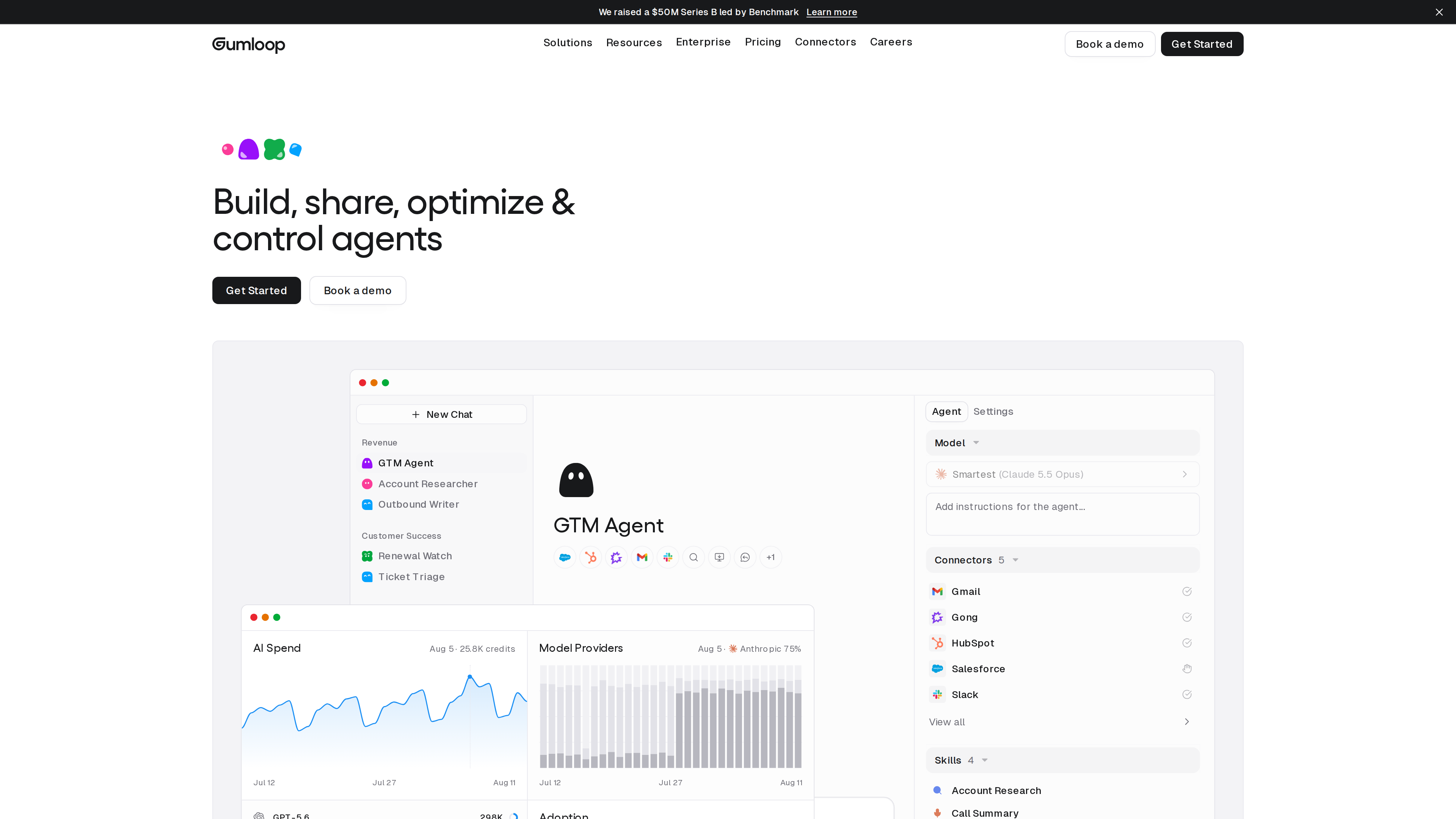
Gumloop is an AI agent building and workflow automation platform aimed primarily at employees without a programming background. A user describes a task in plain language, and the platform produces an agent that can act inside third-party apps; agents can run on schedules, app events, or webhooks, and can be embedded in Slack, Microsoft Teams, and email. The company started in 2023 as a drag-and-drop, node-based workflow tool, but as foundation models improved it repositioned itself as an agent builder — its Y Combinator profile states plainly, "Gumloop is not a visual workflow builder. It is an agent builder," and the pricing page now labels the original node canvas as "Workflows (Legacy)." As of 2026-10-02, the official connector directory lists 304 MCP connectors, and publicly named customers include Shopify, Instacart, Ramp, and Gusto.
At a glance
- URL: https://www.gumloop.com
- Type: AI agent builder / workflow automation (SaaS; optional VPC deployment on Enterprise)
- Cost: Pro from $37/month with a 14-day free trial; Enterprise custom pricing; usage metered in credits (as of 2026-10-02)
- Sign-up: account creation via Google or Microsoft (observed in the Get Started dialog on the homepage)
- Interface language: English; no official multilingual options observed
Background
Gumloop was co-founded in mid-2023 in Vancouver by Max Brodeur-Urbas, previously a software engineer at Microsoft, and Rahul Behal, previously a software developer at AWS. According to TechCrunch's January 2025 report, the project began as a wrapper around the open-source Auto-GPT, a bedroom side project meant to help a group of non-technical users in a Discord server automate repetitive work. The legal entity is AgentHub Inc., doing business as Gumloop (see the privacy policy). The company went through Y Combinator's Winter 2024 batch and later relocated from Vancouver to San Francisco (per the YC directory), though the site footer still reads "Made with ❤️ in Vancouver, Canada."
Funding, based on public disclosures: a 17M Series A announced January 2025, led by Nexus Venture Partners with First Round, Y Combinator, and angels Max Mullen (Instacart co-founder) and Reynold Xin (Databricks co-founder) participating (TechCrunch); and a $50M Series B announced March 12, 2026, led by Benchmark with Nexus VP, First Round, Y Combinator, Box Group, The Cannon Project, and Shopify Ventures participating (TechCrunch coverage). The three rounds total roughly $70.1M.
The Series B announcement names Shopify, Ramp, Gusto, Samsara, Instacart, and Opendoor as customers, and the Enterprise page carries testimonials from Instacart CEO Fidji Simo and Webflow co-founder Bryant Chou, among others.
Core capabilities
Building agents in natural language
Per the official documentation, you give an agent a goal and a set of tools, and it decides which tools to call and in what order, asking for confirmation when instructed. Each task is its own conversation. Agents can write and update their own instructions and reusable "skills," so corrections turn into lasting behavior. Models can be switched in the builder: the company advertises 35+ models (pricing page) from providers including Anthropic, OpenAI, Google, DeepSeek, MiniMax, and Z.ai (per the docs). An "Auto" router picks a model tier per message based on difficulty, and bringing your own API keys (BYOK) is supported.
Connectors and the MCP ecosystem
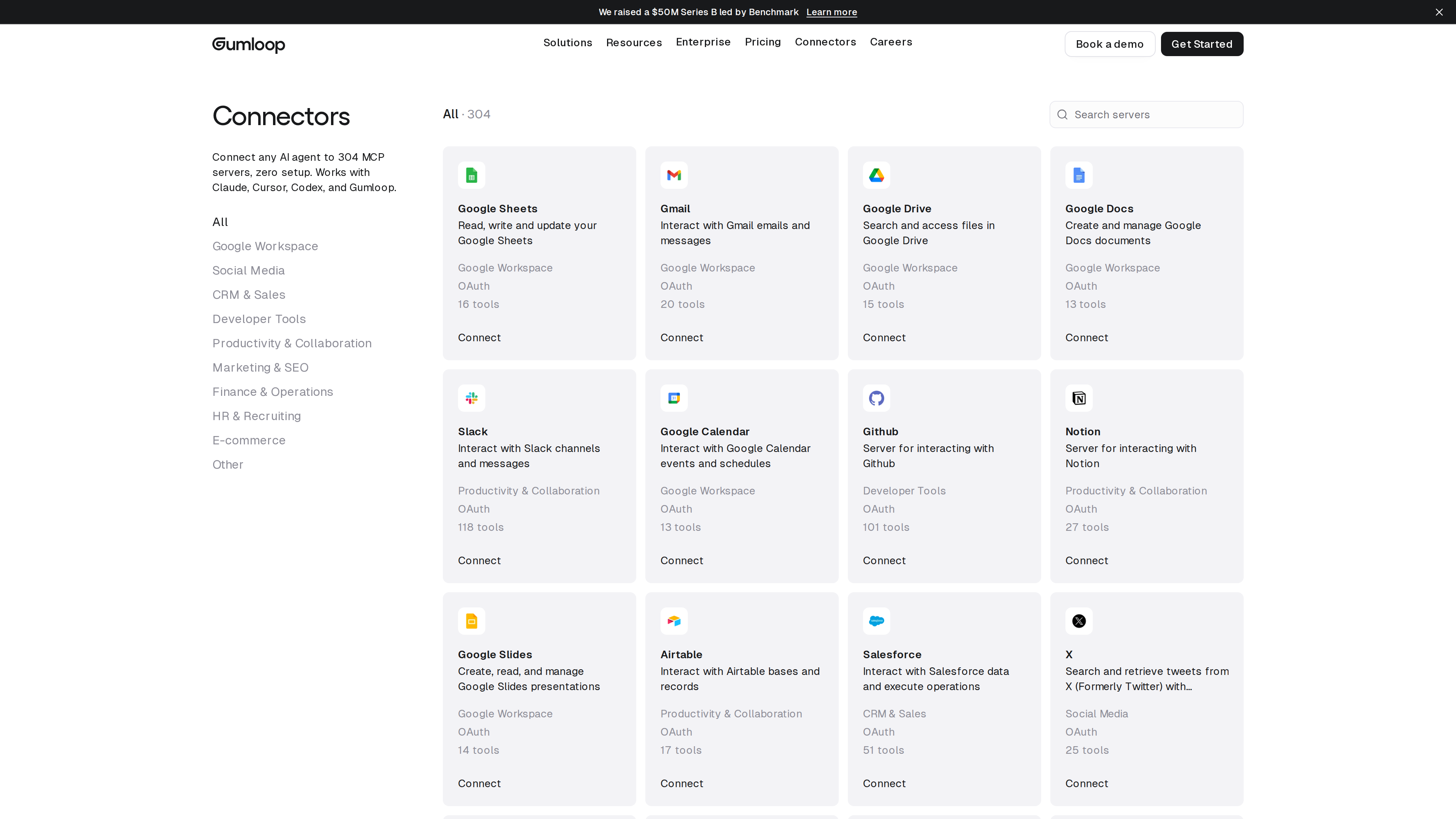
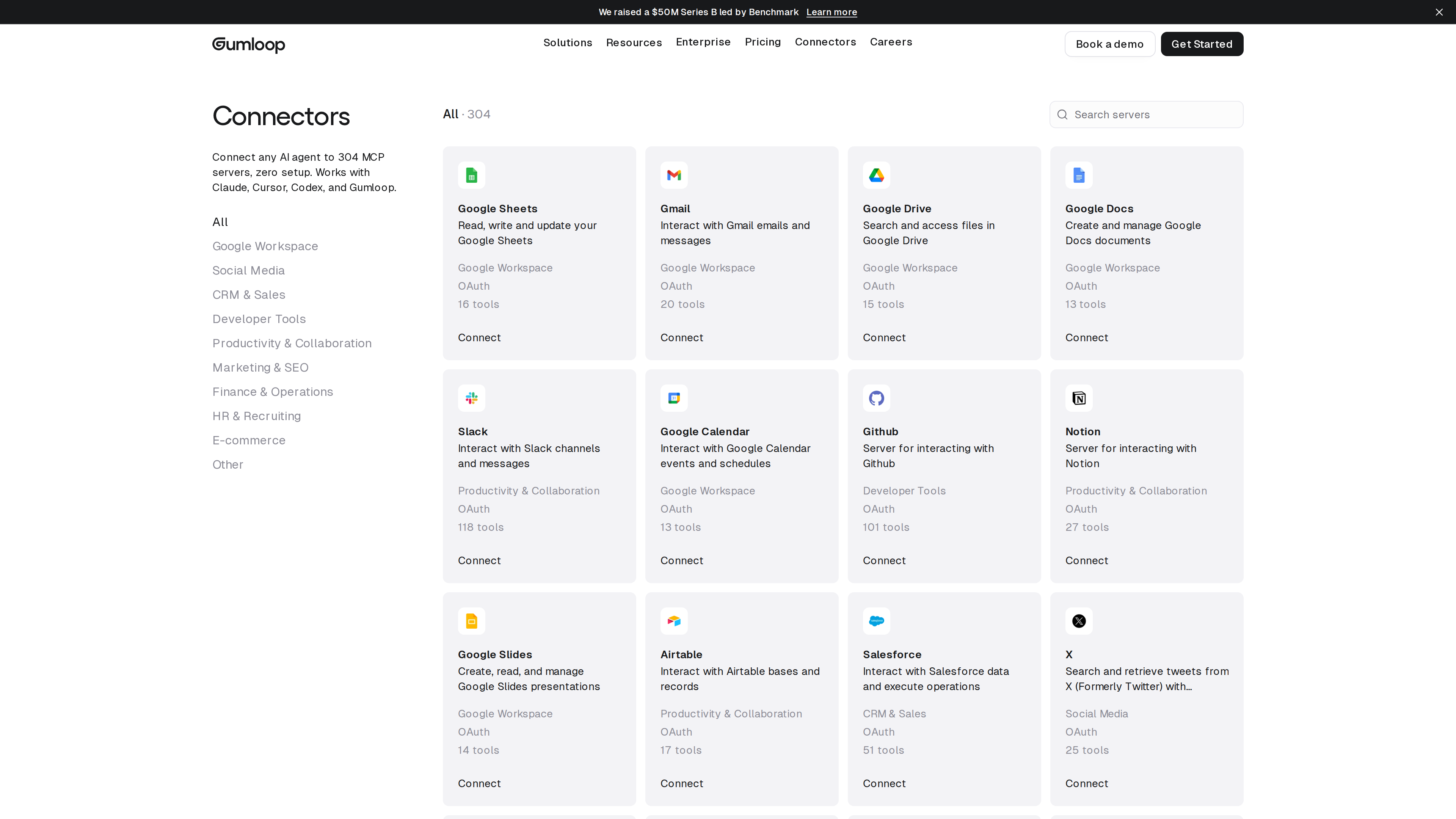
Connectors are the channel through which agents act in external apps, exposed as MCP servers. As of 2026-10-02, the connector directory lists 304 of them across categories such as Google Workspace, social media, CRM & sales, developer tools, productivity, marketing & SEO, finance & operations, HR, and e-commerce. Connections authenticate via OAuth and can be personal or shared with a team. The same connectors are advertised as zero-setup for external tools like Claude, Cursor, and Codex, and enterprises can attach external MCP servers or host custom ones from GitHub repositories.
Triggers and deployment channels
Agents can be driven manually in chat or run autonomously. Triggers include scheduled runs (cron, with expressions generated from plain language, minimum interval one minute), one-time runs, app events, webhooks, and AI-generated custom polling triggers; an agent can even create and manage its own schedules during a conversation. Deployment channels cover Slack (white-labeled), Microsoft Teams, a dedicated email address, hosted pages, the API, and MCP. For developers there is a REST API, Python and JavaScript SDKs, and a CLI.
Node workflows (Legacy) and the template community
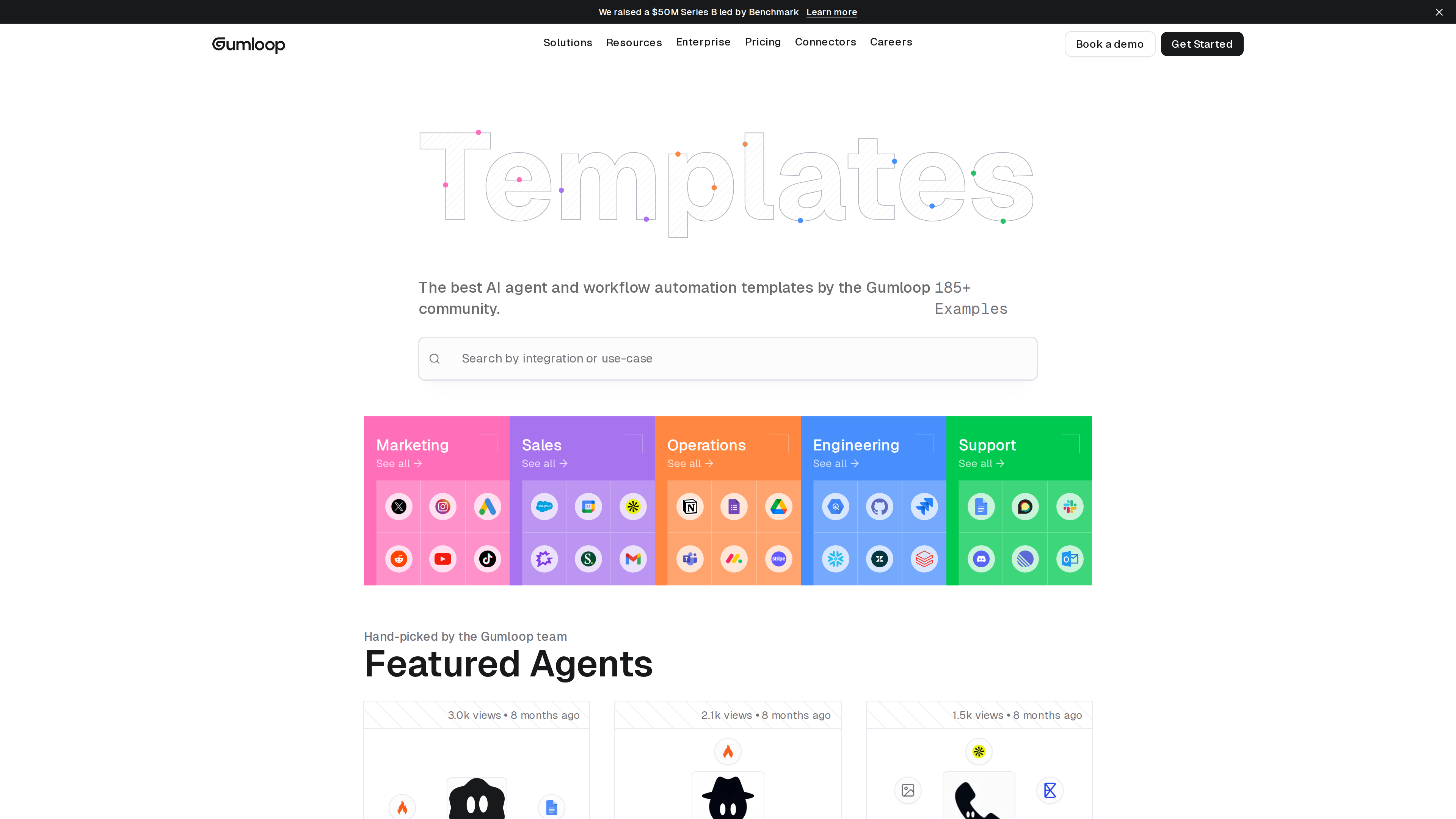
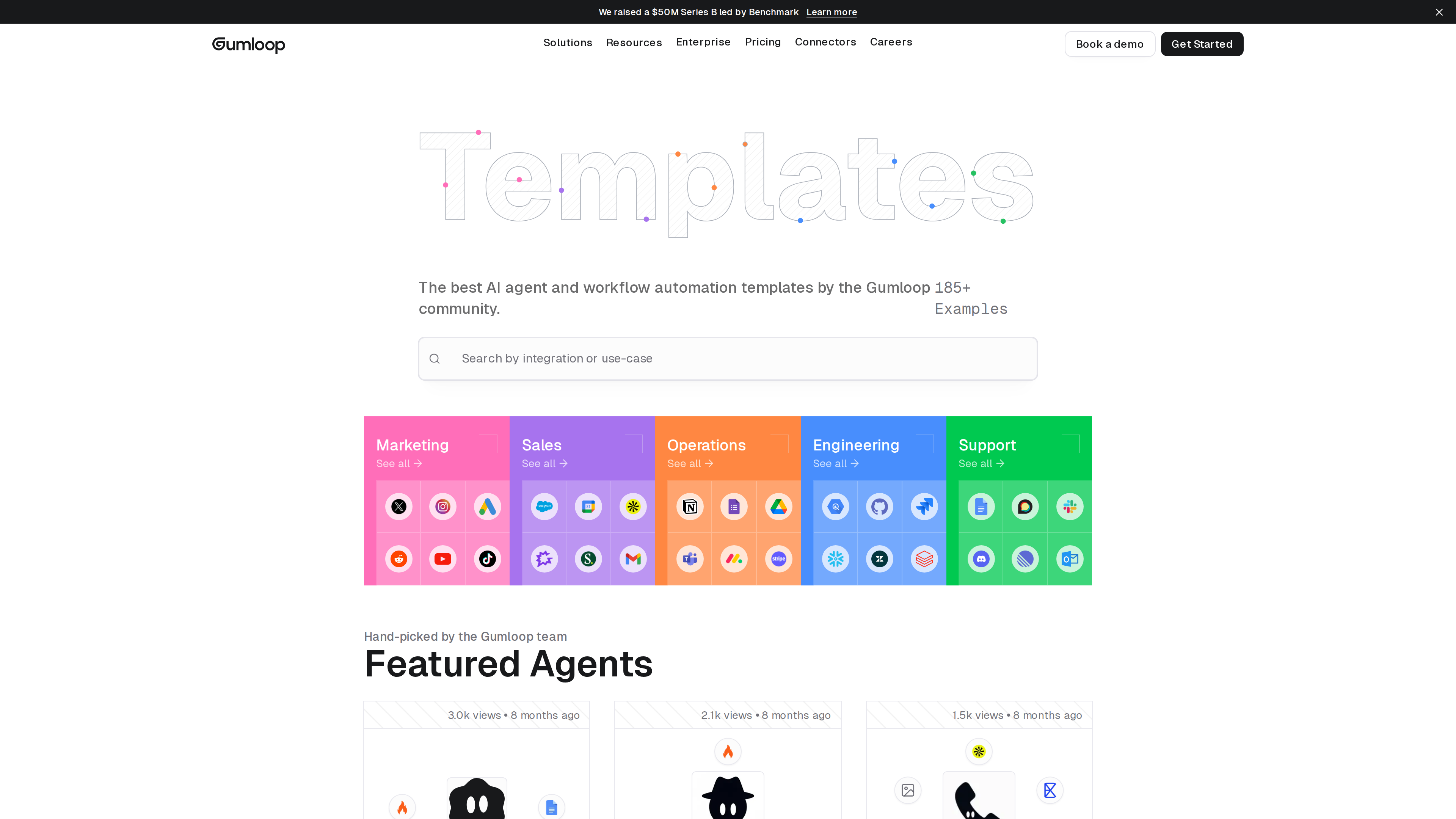
The original drag-and-drop node canvas is still available — the templates page still shows node-based Featured Workflows — but the pricing page labels it "Workflows (Legacy)," and the product narrative has moved on to agents. The template library offers 185+ community templates as of 2026-10-02, organized into Marketing, Sales, Operations, Engineering, and Support, plus Gumloop University video lessons, learning cohorts, a forum, and an expert marketplace.
Enterprise controls and compliance claims
For IT and security teams, the Enterprise tier offers role-based access control, audit logging, SAML SSO and SCIM, optional VPC deployment on AWS, Azure, or Google Cloud, custom data retention rules, model access restrictions, and app policies written in plain English that block, tag, or log specific actions. The Series B post also introduced Gumstack, a separate product line that tracks and audits tool calls from agents across an organization — including external ones like Claude Code, ChatGPT, and Cursor. On compliance, the Enterprise page claims SOC 2 Type II certification, GDPR compliance, and Zero Data Retention agreements with third-party model providers, and the privacy policy (effective 2026-06-26) commits to the EU-U.S. Data Privacy Framework. These are the company's own statements and have not been independently verified here.
Pricing and billing
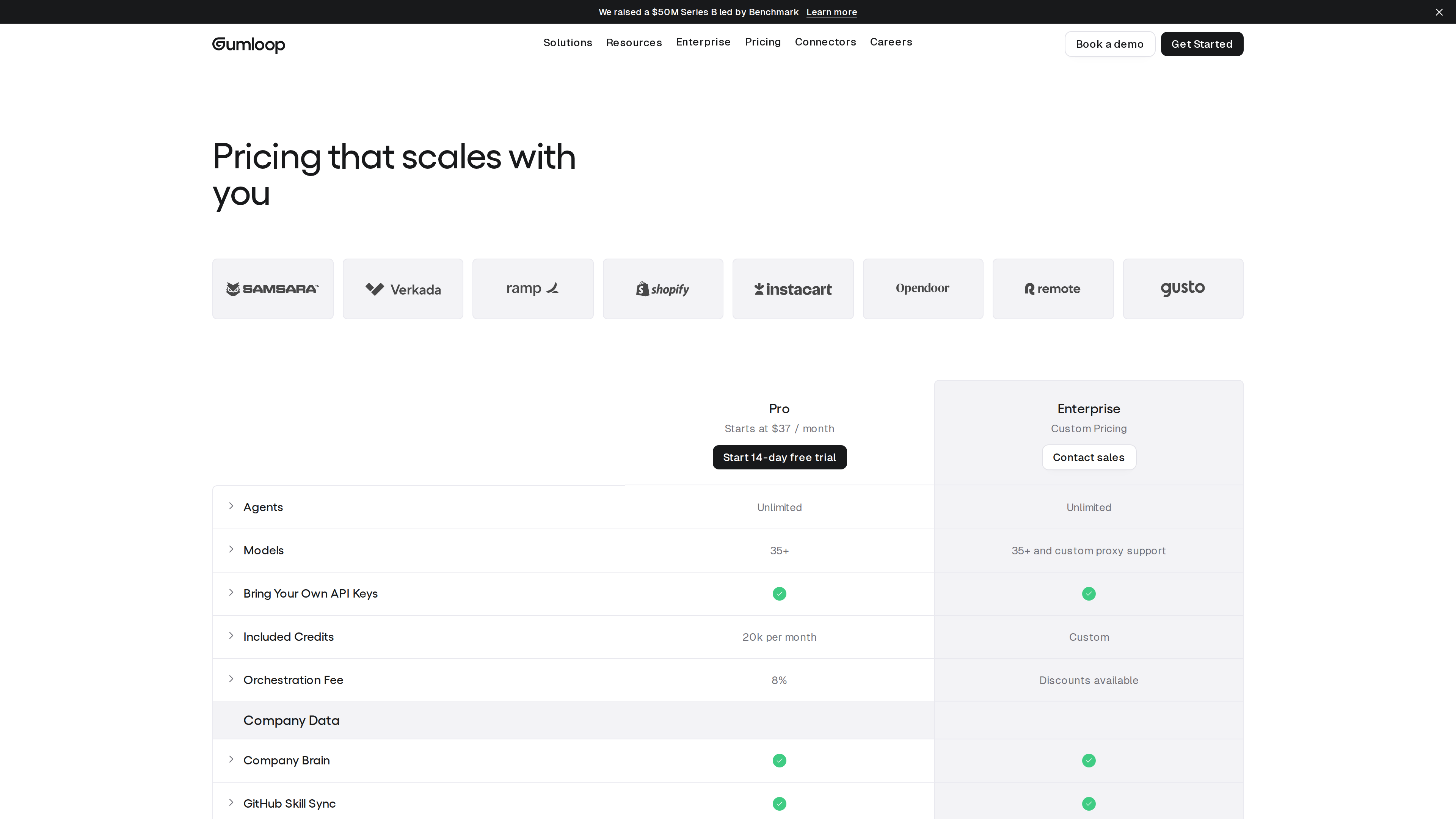
As of 2026-10-02, the pricing page shows two tiers and no permanent free plan (the "Free plan" in the page's structured data refers to the 14-day trial):
- Pro: from $37/month with a 14-day free trial. Includes 20,000 credits per month (7,400 base + 12,600 bonus, per the official FAQ); unlimited agents, seats, and teams; 25 concurrent agent chats.
- Enterprise: custom pricing, adding dedicated Slack support, an embedded expert, optional VPC, SCIM/SAML, audit logs, and more.
Usage is metered in credits: 1 credit = 0.005/credit) is enabled, which is off by default.
Where it fits
- Self-service automation for business teams: sales, marketing, operations, and support staff can hand off repetitive work — CRM updates, lead research, meeting prep, ticket triage, SEO audits — without waiting on engineers.
- Rolling out AI across a company: when IT needs control over agent permissions, data flows, and spend, the Enterprise tier's audit, policy, and budget features target exactly that governance problem.
- Working where the team already works: organizations that live in Slack, Teams, or email can interact with agents directly in those channels.
Limitations
- No permanent free tier, and costs vary widely: as of 2026-10-02 only a 14-day trial is offered. The docs themselves note that the same agent might cost 2 credits for a quick question and 200 for a deep research task, making monthly spend hard to predict; unused credits do not roll over.
- Layered billing: costs stack across model tokens, tool calls, compute, and an orchestration fee — and bringing your own keys raises that fee to 16%, which takes some effort to reason about.
- English only: the site and documentation are in English, with no multilingual options observed.
- Expectation gap from the repositioning: teams that need strictly deterministic, step-by-step auditable pipelines should note the node workflow builder is now a legacy feature. Gumloop's own comparison page concedes that n8n offers more prebuilt integrations (600+ vs. the 100+ figure in its table). Official pages are also inconsistent about the integration count (100+ in the comparison table, 150+ in the docs, 300+ on the About page, 304 in the live directory), so figures should be cited with care.
- Compliance claims are self-reported: SOC 2 Type II, GDPR, and zero-retention claims are official statements, not independently verified in this article.
References
- Gumloop homepage | About | Enterprise
- Pricing & FAQ | Connector directory | Templates
- Documentation: Agents, Triggers, Credits, AI Models
- Announcing Gumloop's $50M Series B (official blog, 2026-03-12)
- Gumloop | Y Combinator
- TechCrunch: Gumloop, founded in a bedroom in Vancouver (2025-01-10)
- TechCrunch: Gumloop lands $50M from Benchmark (2026-03-12)
- Privacy Policy | Gumloop vs n8n (official comparison) | Gumloop vs Zapier (official comparison)