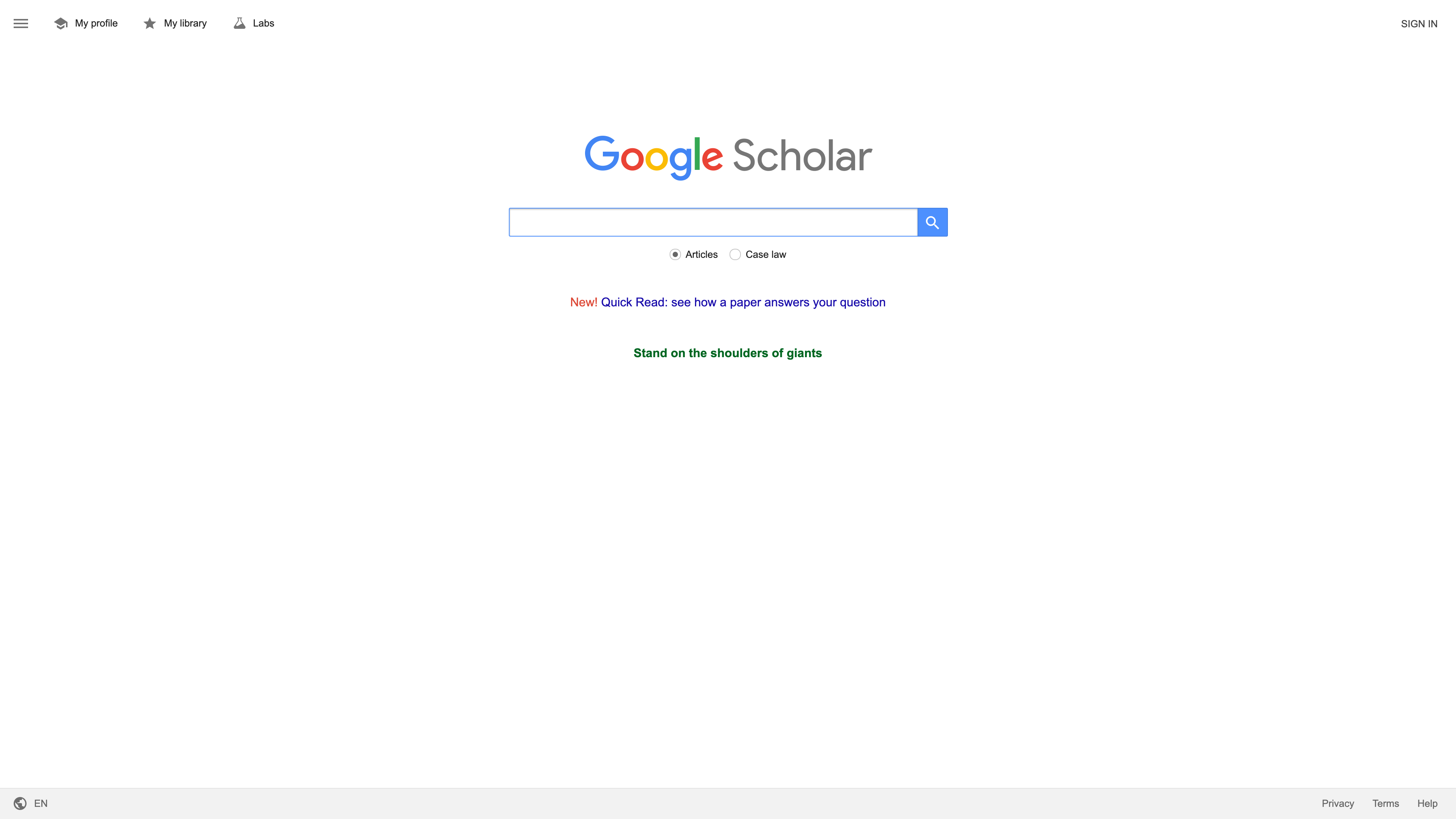
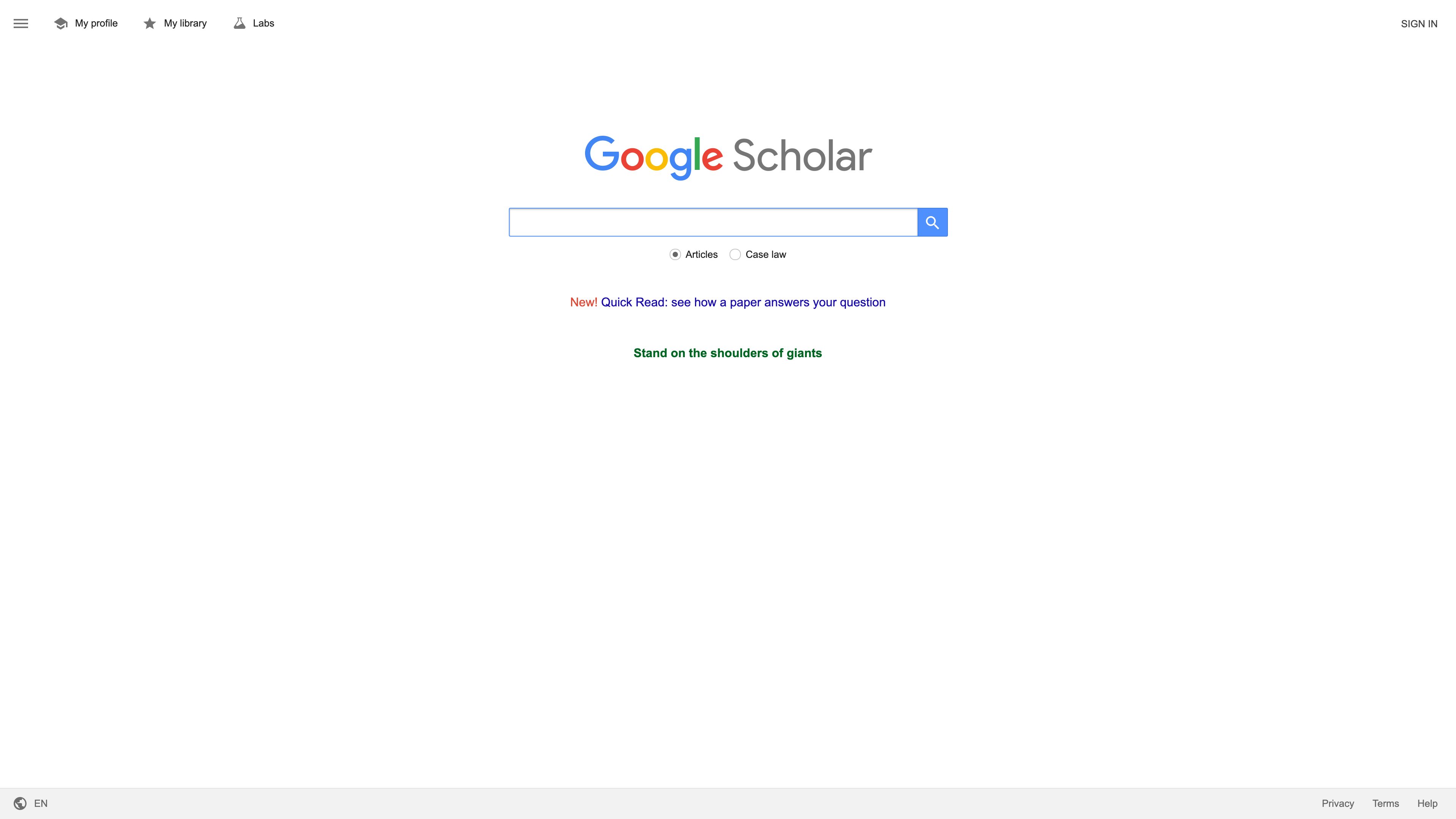
Google Scholar (scholar.google.com) is a free scholarly search engine launched by Google in November 2004. Its crawlers index scholarly literature across publishers — journal and conference papers, theses and dissertations, academic books, preprints, abstracts and technical reports, plus US court opinions and patents — so researchers can search, from a single box, material scattered across countless publisher sites, learned societies, university repositories and personal pages (official About page). Unlike commercial citation databases such as Scopus or Web of Science, whose sources are editorially selected, Google Scholar is free, requires no sign-in for searching, and includes content based on technical guidelines rather than content review. That trade-off — broader coverage in exchange for looser quality control and a wider citation count — is the single most important thing to keep in mind when using it.
At a Glance
- URL: https://scholar.google.com/
- Type: Scholarly search engine (cross-source citation index)
- Cost: All features are free; whether you can read the full text depends on the source site or a library subscription — Scholar itself sells nothing
- Sign-in: Search, email alerts (any address), public profiles and Metrics all work without an account; My library, author profiles, Scholar Labs and Quick Read require a Google account
- Interface languages: about 39, including Simplified and Traditional Chinese (settings)
- API: no official API and no bulk data access (Search Help)
Background
Google Scholar was created by Anurag Acharya and Alex Verstak, two engineers then working on Google's main web index. In the official 20th-anniversary post (November 18, 2024), they recall that the team started with just the two of them, spent about nine months building the service, and — because internet speeds were too slow — received early article data from publishers on physically shipped hard drives, an approach they nicknamed the "Sneakernet." The homepage motto, "Stand on the shoulders of giants," comes from the phrase popularized by Isaac Newton; the help pages explain it as a nod to the cumulative nature of research (Search Help).
Key milestones: author profiles (Google Scholar Citations) opened to everyone in November 2011 (official blog), Google Scholar Metrics for publications arrived in April 2012 (official blog), and the personal Scholar Library launched in November 2013 (official blog). The last two years have brought a clear shift toward AI: the Scholar PDF Reader Chrome extension gained AI-generated outlines; an experimental AI search mode, Scholar Labs, launched in November 2025 and was updated in June 2026 to run roughly ten times faster; and in August 2026 Google introduced Quick Read, which produces a short "Answers / Approach / Considerations" brief on a paper, tailored to your query (Scholar blog). The latter two require sign-in, and Quick Read is currently limited to English-language articles.
Google does not disclose the size of the index. A widely cited third-party estimate is Michael Gusenbauer's 2019 study in Scientometrics, which used query hit counts from January 2018 to estimate about 389 million records, calling Scholar the most comprehensive academic search engine at the time. The figure is dated and should be read as an order of magnitude only (checked 2026-09-03).
Search, Citation Trails and Full-Text Access
Results are ranked by relevance; Google says ranking weighs the full text of each document, where it was published, who wrote it, and how often and how recently it has been cited. The sidebar filters by "since year" or sorts by date; an advanced-search panel (author, title, publication, date range) lives in the side drawer, and author: plus quoted-title searches are supported. The homepage can be switched to "Case law" to search US court opinions.
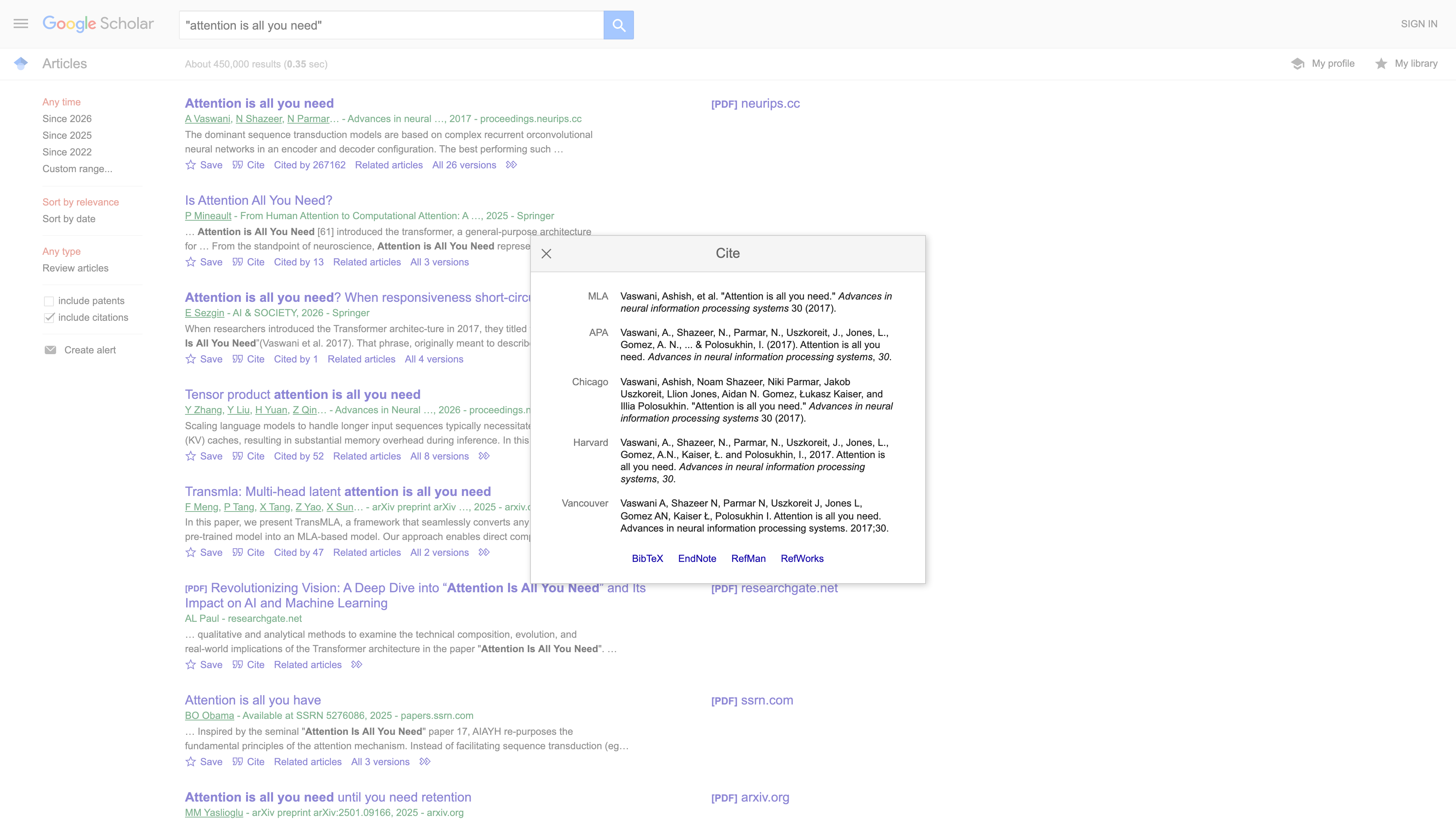
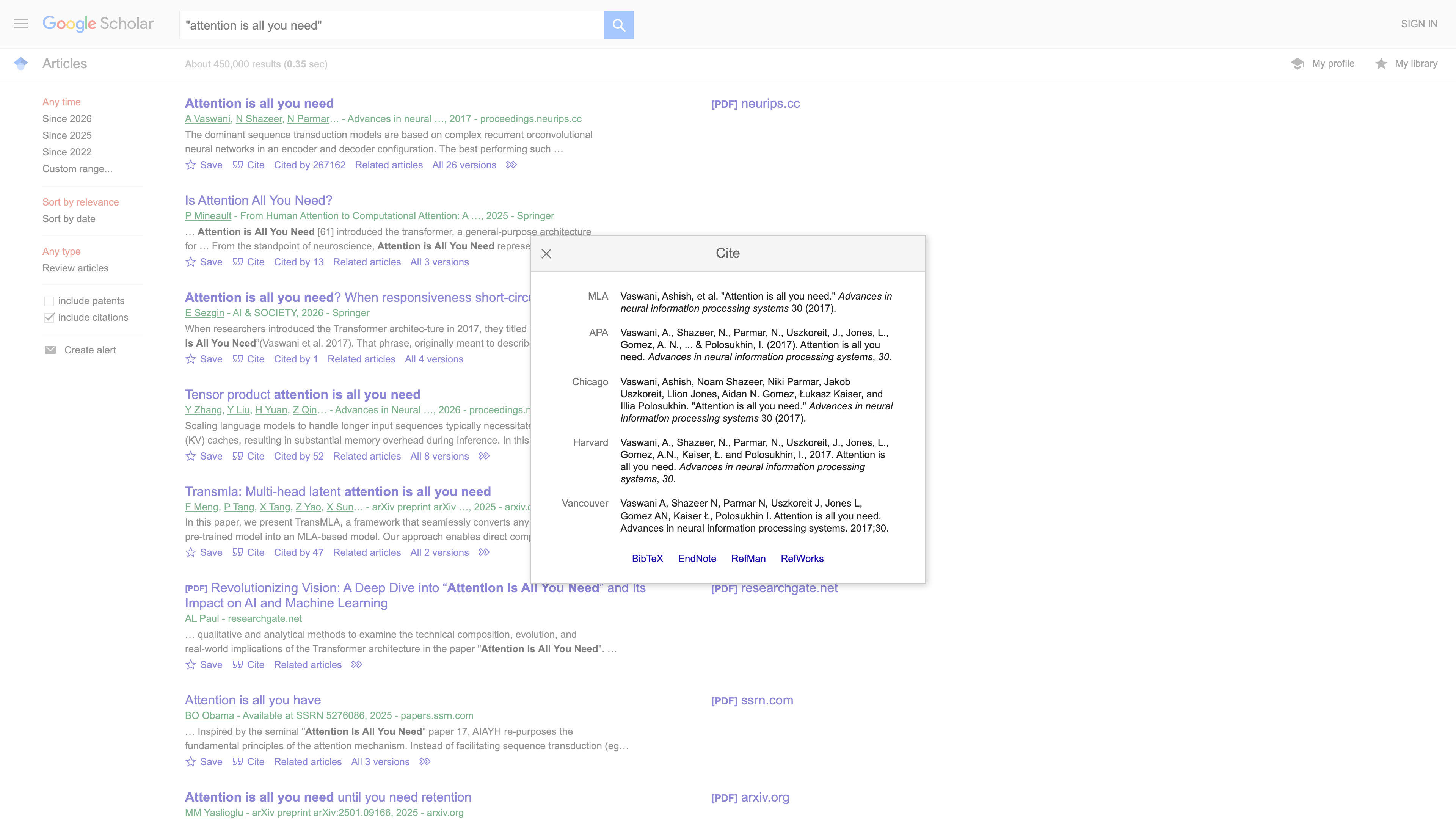
Beneath each result sits Scholar's most valuable cluster of links: Cited by (the citation count — click through to trace newer papers that cite it), Related articles, All versions (preprints, repository copies and other versions of the same work), and [PDF]/[HTML] full-text links on the right. As of 2026-09-03, the top result for the Transformer paper "Attention is all you need" shows 267,162 citations across 26 grouped versions; its "Cite" popup offers MLA, APA, Chicago, Harvard and Vancouver formats to copy, plus BibTeX, EndNote, RefMan and RefWorks export.
For full text, Scholar handles discovery and linking only: open-access versions appear as direct [PDF] links, while subscription articles route through "library links" (such as FindIt@Harvard). Libraries join via an OpenURL link resolver, users can pick up to five libraries in settings, links activate automatically on campus networks, and an off-campus access feature remembers your subscriptions for 30 days before deleting the record (Libraries support, Search Help).
Worth understanding is how inclusion works: any site that meets the technical inclusion guidelines — primarily scholarly content, with the full text or at least the complete abstract freely visible to users clicking through — gets crawled. Google states plainly that it indexes "papers, not journals," publishes no list of covered sources, and guarantees no uninterrupted coverage of any particular source. New papers are usually added several times a week, but corrections to existing records take 6–9 months, sometimes over a year.
Author Profiles and Venue Metrics
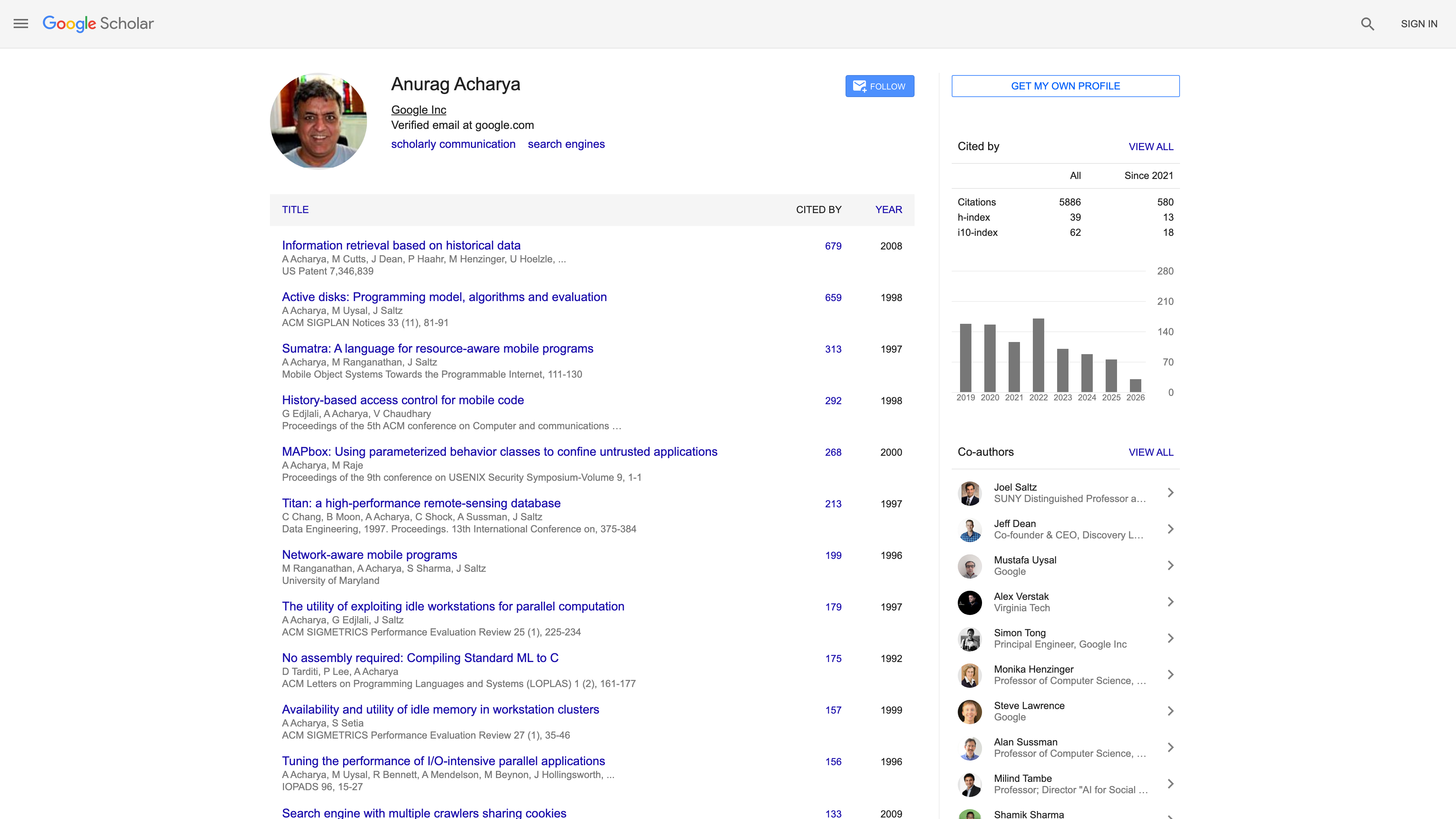
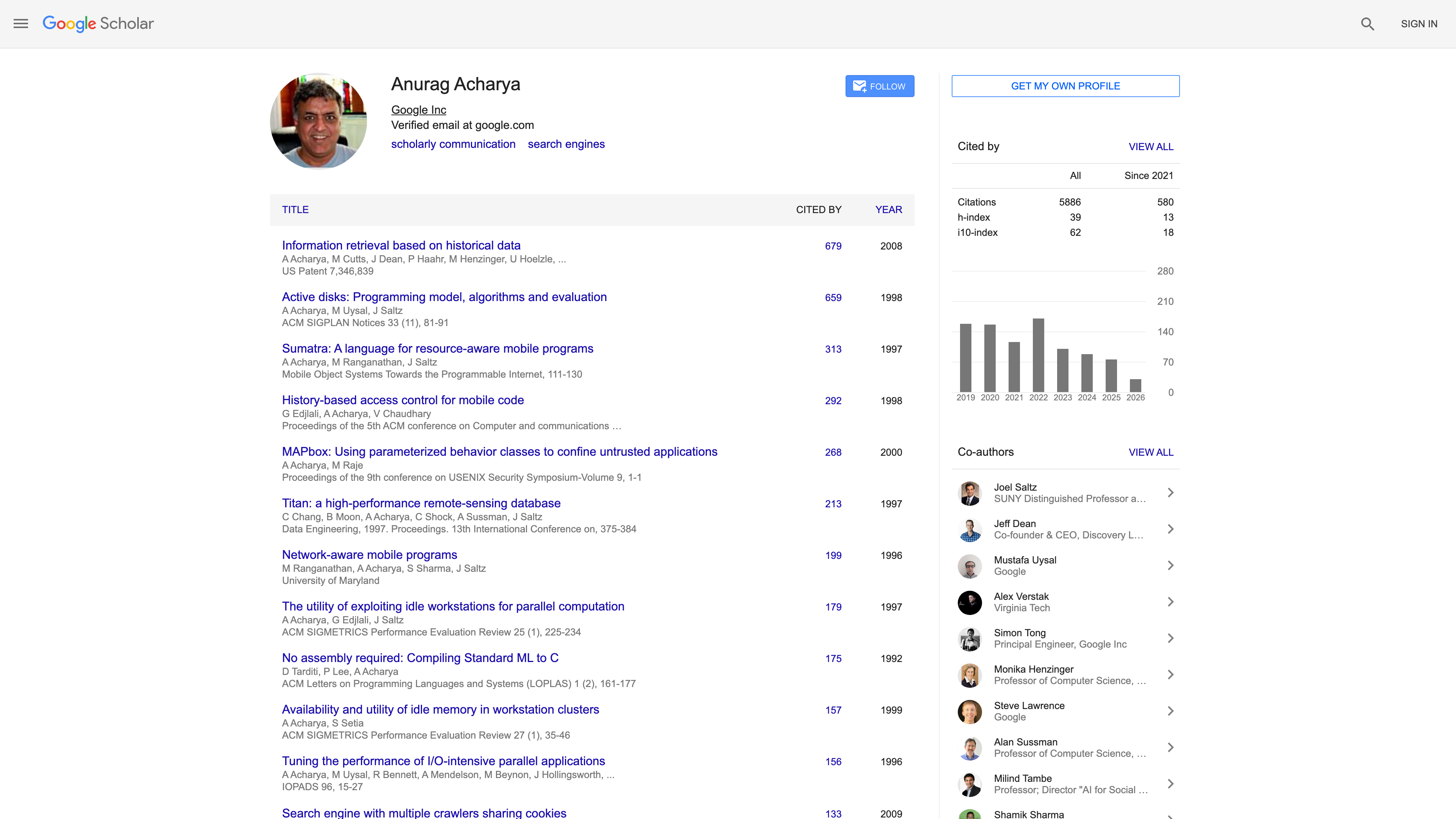
Any author can create a public profile for free (Profiles help) that presents their article list, a per-year citation graph, and three metrics — total citations, h-index and i10-index — each shown for "All" and the last five years. A profile that is public and backed by a verified institutional email address becomes eligible to appear in name searches. The article list can update automatically or be curated by hand. Following an author or a paper via the "Follow" button or envelope icon triggers email alerts for new articles or new citations — and alerts work with any email address, no Google account required.
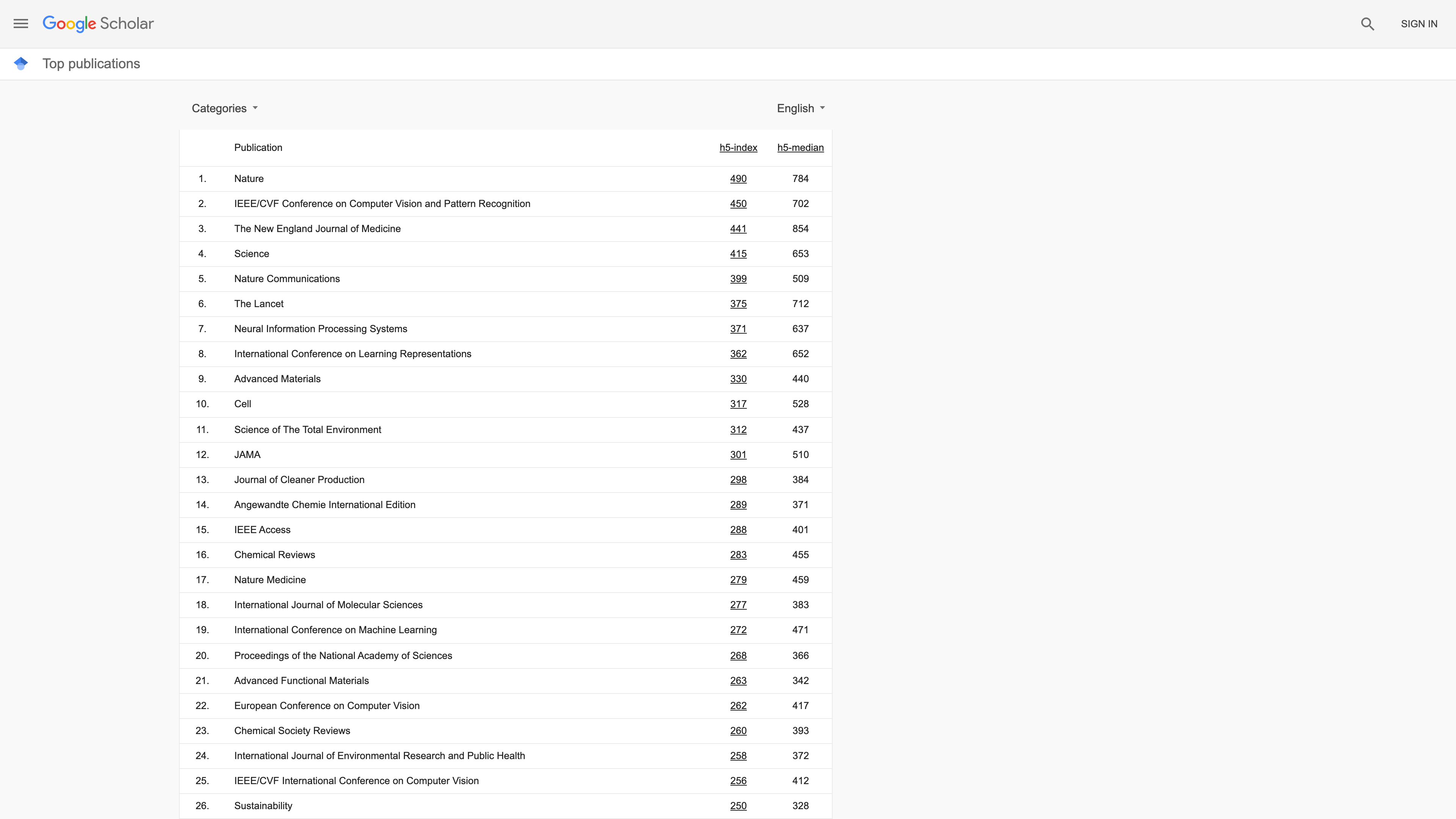
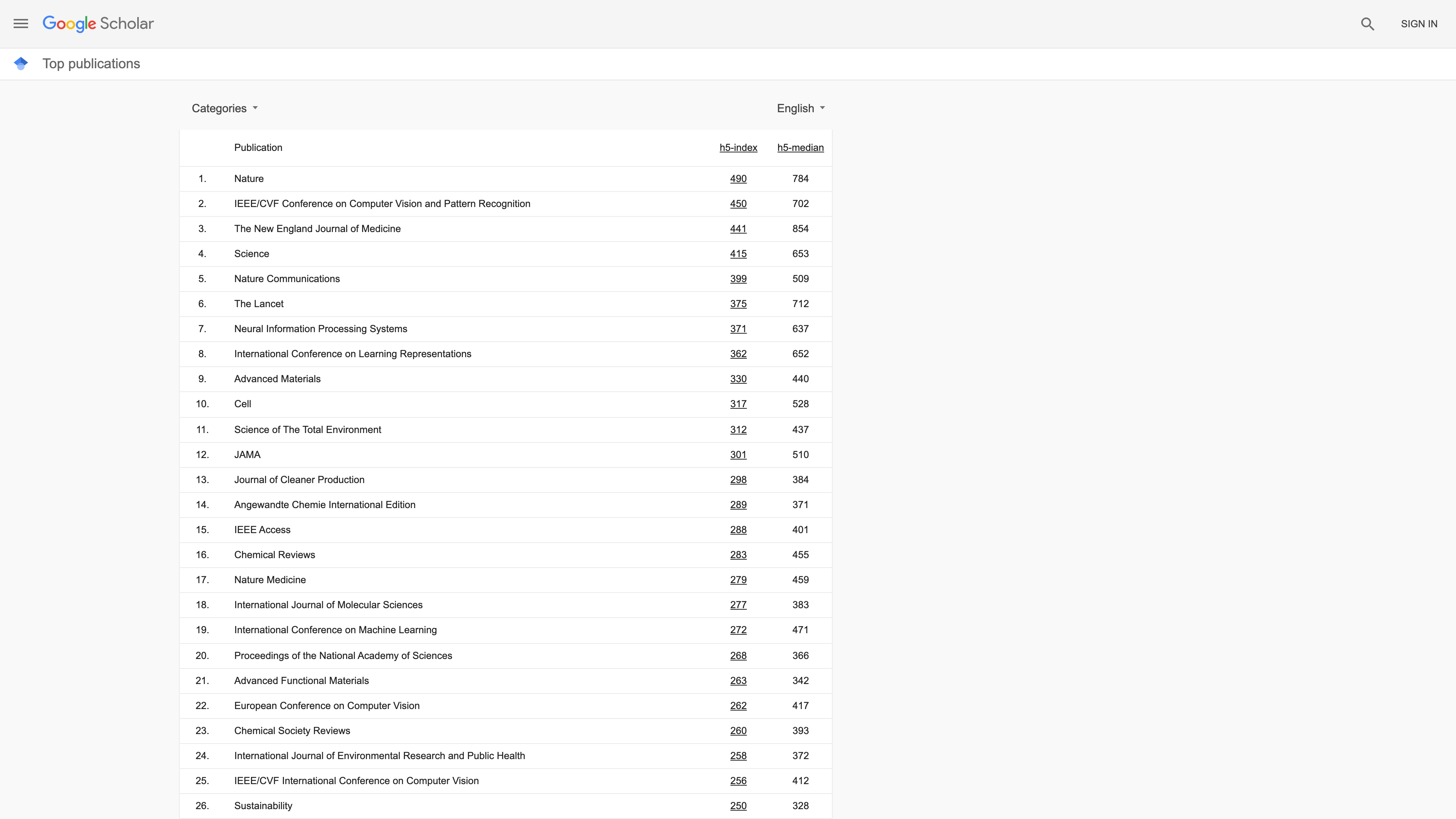
Google Scholar Metrics ranks journals and conferences by h5-index and h5-median: a top-100 list for each of several languages, plus browsing by research area (area browsing currently covers English-language publications only). As of 2026-09-03, the Metrics pages state that the current edition is based on the index as of July 2025 and covers articles published in 2020–2024, excluding court opinions, patents, books, dissertations and venues with fewer than 100 articles in that window. The current overall top five are Nature (h5 = 490), IEEE/CVF Conference on Computer Vision and Pattern Recognition (450), The New England Journal of Medicine (441), Science (415) and Nature Communications (399) — computer-vision conferences ranked alongside elite journals, a vivid illustration of how its methodology differs from JCR-style lists.
Accounts and Programmatic Access
Searching, browsing citation data and public profiles, and subscribing to alerts all work signed out. A Google account unlocks My library (save results, organize with labels, full-text search within your library), creating and maintaining an author profile, and the newer AI features such as Scholar Labs and Quick Read.
Programmatic access is the service's most obvious weak point: Google explicitly declines to provide bulk access, there is no public API, and the help pages acknowledge blocking computers that download results in bulk, asking automated clients to respect robots.txt — which disallows crawling search results — while the Google Terms of Service prohibit automated access that violates such machine-readable instructions (checked 2026-09-03). Search results are additionally capped at 1,000 per query. Anyone needing metadata at scale has to turn to the original sources or to open databases instead.
Good Use Cases
- Discovering literature on a topic across publishers, then tracing the research conversation through Cited by and Related articles.
- Checking citation counts, author h-indices and the rough influence of journals or conferences for free, without a commercial citation-database subscription.
- Monitoring keywords, authors or individual papers over time via email alerts.
- Reaching institutional subscriptions through library links, or finding an open-access version of the same paper.
- Searching US case law — federal and state courts, back to 1791 for the Supreme Court.
Limitations
- No editorial screening of sources: anything that meets the technical guidelines can be indexed, so quality control is weaker than in curated databases like Scopus or Web of Science, and predatory journals can slip in. A 2019 review in JMLA by Ross-White et al. states explicitly that Google Scholar does not provide the same level of quality control as other bibliographic databases; systematic reviewers must vet sources themselves.
- A broader citation count: a 2018 comparison across 252 subject categories by Martín-Martín et al. found Google Scholar captured 93%–96% of citations, far ahead of Scopus (35%–77%) and Web of Science (27%–73%), with the extra citations coming largely from theses, books, conference papers and informal publications. A paper's Scholar count is therefore systematically higher than elsewhere — do not mix metrics from different databases in formal evaluation contexts.
- Unreliable author disambiguation: Google itself concedes it has "no way of knowing which articles are really yours," so automatic grouping can misattribute papers; unclaimed, homonymous authors are especially prone to mix-ups. Treat unclaimed profile data with care.
- Slow metadata corrections: bibliographic errors introduced by automated extraction are fixed only after the source site corrects them, typically 6–9 months to a year later.
- Opaque coverage: no published source list, no guarantee of continued coverage for any source, and a 1,000-result cap per query.
- No API, scraping prohibited: systematic metadata collection is effectively off the table.
- Paywalls remain: Scholar is a search engine, not a full-text archive; subscription articles still require a subscription or purchase.
- New AI features gated: Scholar Labs and Quick Read require sign-in, Quick Read is English-only for now, and case-law search covers only the United States — with an explicit disclaimer that it is not legal advice.
Comparable Services
- Semantic Scholar: free, AI-driven scholarly search with an open API and open corpus — a better fit when you need programmatic access. Already listed on Liuhuo Stack.
- arXiv: the free open-access preprint archive, itself one of Google Scholar's key sources. Already listed on Liuhuo Stack.
- Scopus and Web of Science: commercial citation databases with curated sources, official APIs and export tools, whose counts are the usual basis for formal research evaluation.
References
- About Google Scholar (checked 2026-09-03)
- Google Scholar Search Help (checked 2026-09-03)
- Inclusion Guidelines for Webmasters (checked 2026-09-03)
- Google Scholar Profiles (help) (checked 2026-09-03)
- Google Scholar Metrics Help (checked 2026-09-03)
- 20 things you didn't know about Google Scholar - The Keyword (checked 2026-09-03)
- Google Scholar Blog (Scholar Labs and Quick Read announcements) (checked 2026-09-03)
- Gusenbauer (2019), Google Scholar to overshadow them all? - Scientometrics (checked 2026-09-03)
- Martín-Martín et al. (2018), Google Scholar, Web of Science, and Scopus: a systematic comparison of citations in 252 subject categories (checked 2026-09-03)
- Ross-White et al. (2019), Predatory publications in evidence syntheses - JMLA (checked 2026-09-03)