Goodreads is a book community built around tracking what you read: shelve books, rate and review them, then look at what friends and the wider community are reading to answer "what next?" Among similar cataloging tools it stands out for scale — officially more than 150 million members as of September 2023 — and for having belonged to Amazon since 2013, with hooks into the Kindle ecosystem.
Browsing book pages needs no account; shelves, ratings, and reviews require a free one.
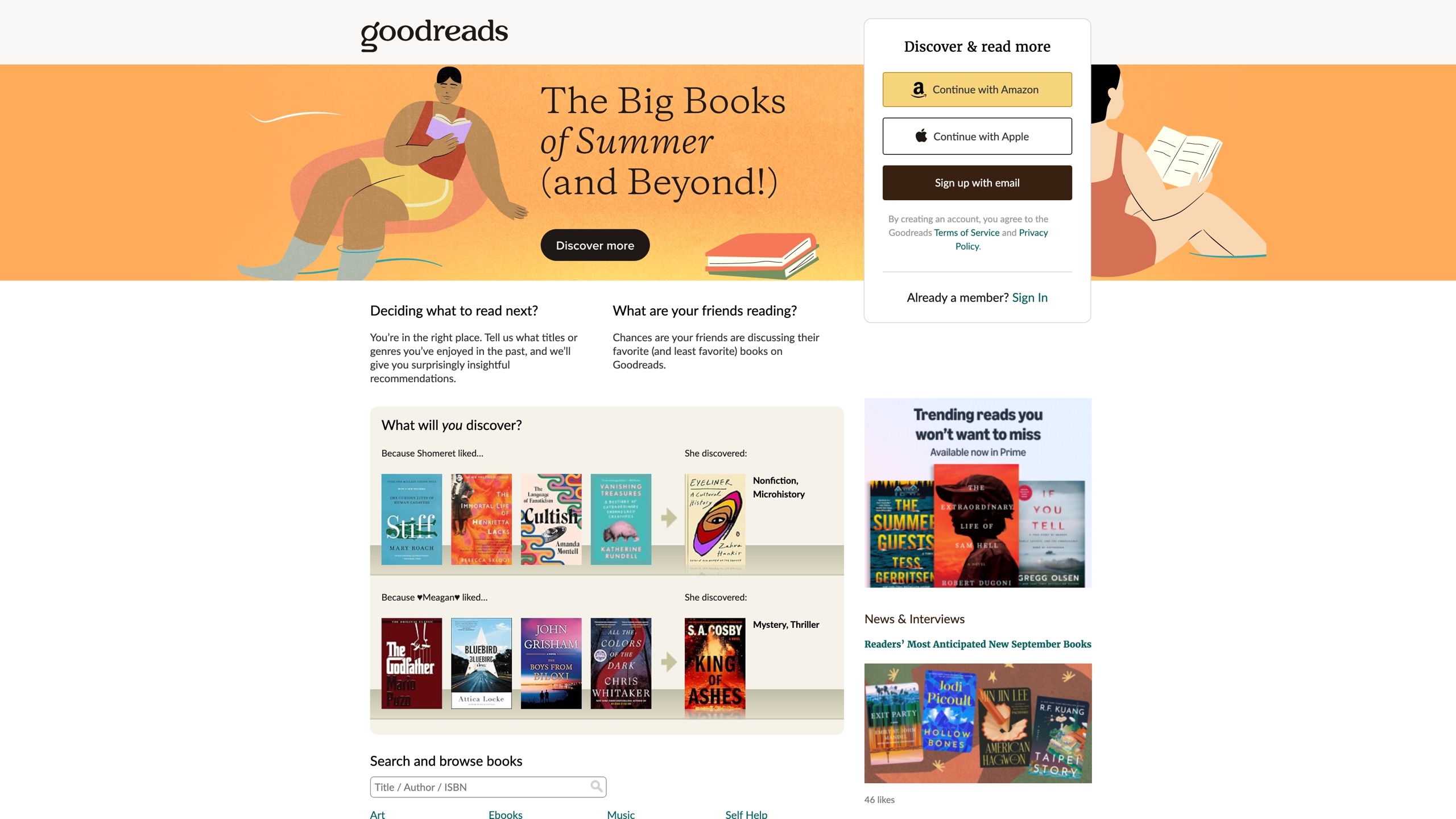
The homepage works without an account: recommendation rows are built around what individual members liked, the sidebar carries trending releases and interviews, and sign-up prompts frame the page — the site's "find your next book" loop in miniature.
At a glance
- URL: https://www.goodreads.com/
- Type: Social cataloging site for books, operated by Goodreads, Inc., an Amazon subsidiary based in San Francisco
- Cost: Free
- Registration: Optional for browsing; required for shelves, ratings, reviews, and groups
- Interface language: English
- Mobile: iOS and Android apps; a Goodreads button is built into some Kindle devices
Background
Goodreads was founded in December 2006 by Otis Chandler and Elizabeth Khuri Chandler and launched publicly in January 2007, inspired by the experience of browsing a friend's bookshelf. It reached 650,000 members by the end of 2007 and 10 million by July 2012. On March 28, 2013, Amazon announced it was acquiring Goodreads for an undisclosed sum. The deal startled the book world — the Authors Guild called it a "truly devastating act of vertical integration" — and the site then had about 16 million members. Chandler kept running it until 2019. By September 2023 the official member count exceeded 150 million.
Core features
Shelves and ratings: Default read / currently-reading / to-read shelves plus custom ones; five-star ratings with optional written reviews; friends' shelves and activity feeds.
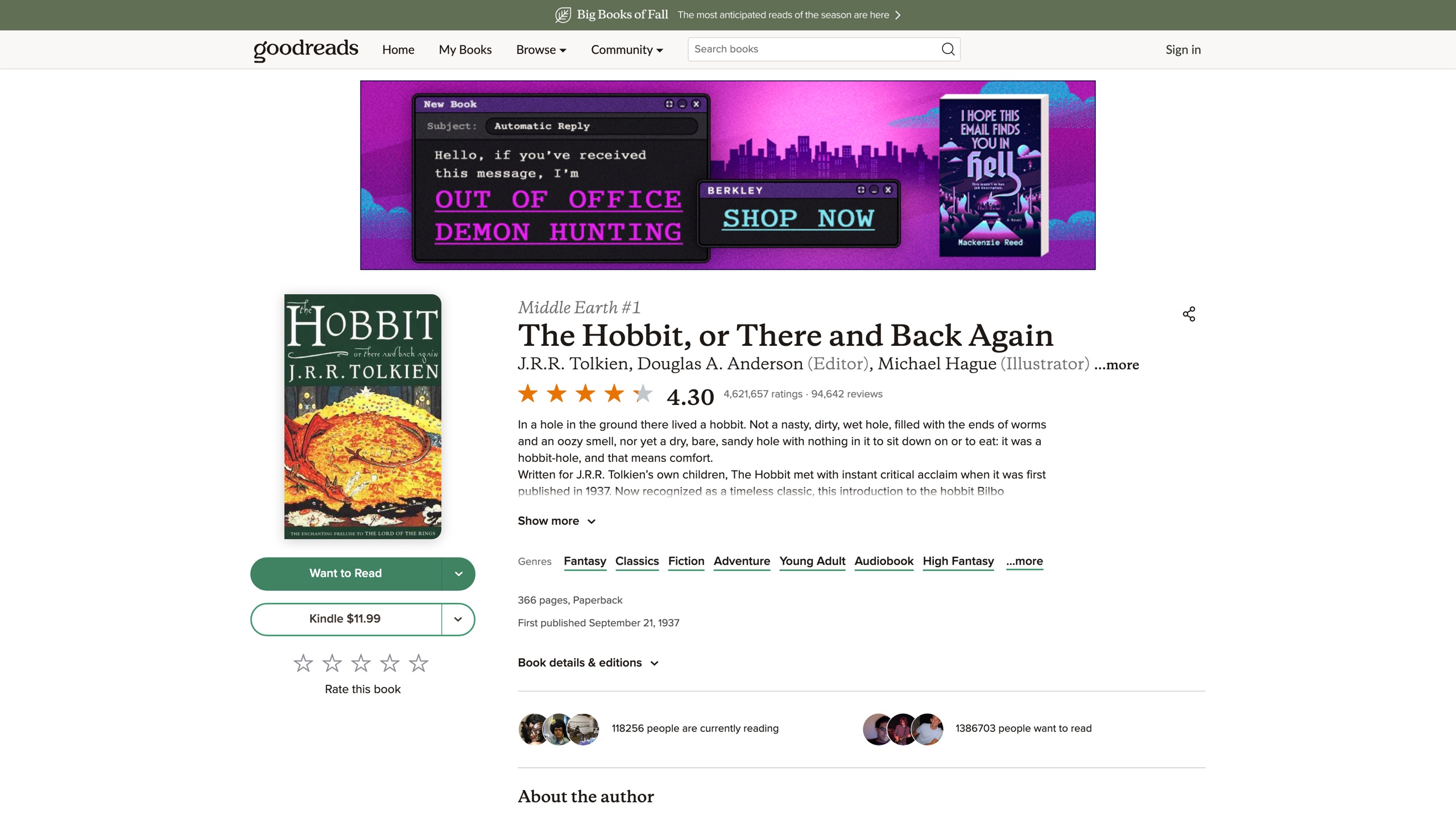
Recommendations: Personalized suggestions unlock after you rate 20 books, powered by the Discovereads engine acquired in 2011.
Reading Challenge: Pledge a number of books for the year and track progress — a popular annual ritual on the site.
My Year in Books: A yearly personal reading recap (books, pages, average rating), produced since 2014.
Goodreads Choice Awards: Annual reader-voted awards running since 2009, decided across 20 categories.
Groups and discussion: User-run book clubs, polls, and discussion boards, plus giveaways, quotes, and list features.
Kindle integration: The second-generation Kindle Paperwhite and Kindle Voyage ship with a Goodreads button, and many titles can be previewed on the site through Kindle Cloud Reader and Audible samples.
Accounts and openness
Registration is free. The catalog is not maintained by staff alone: members with at least 50 books shelved can apply to become volunteer "Goodreads Librarians" and correct book and author records. Metadata comes from publishers, Ingram, Amazon, WorldCat, and the Library of Congress.
Openness has narrowed sharply in recent years. A public API launched in October 2010, but in December 2020 Goodreads deactivated all API keys older than 30 days and stopped issuing new ones. Unlike open bibliography projects such as Open Library, Goodreads treats user data as proprietary under its terms and publishes no open dataset.
Copyright and content policy
Reviews and other user content are licensed to Goodreads under a worldwide, non-exclusive, sublicensable grant in its terms of use. Since September 2013 the site has applied a contested rule: reviews that focus on an author's behavior rather than the book are deleted. Moderation is manual and has a documented backlog. "Review bombing" is a recurring phenomenon — any registered user can rate a book before publication, and a 2023 New York Times report documented novels flooded with one-star ratings before release, while Time reported in 2021 on extortion schemes threatening authors with coordinated bad reviews. In August 2023, author Jane Friedman found AI-generated books fraudulently published under her name in the Amazon and Goodreads catalogs; they were removed only after her complaints went viral.
When it is useful
- Keeping a systematic record of your reading, with an automatic year-end recap
- Finding your next book through friends' feeds, lists, and groups
- Joining the annual Reading Challenge to sustain a reading habit
- For authors: maintaining a presence via the Author Program and talking to readers
- Syncing reading status on Kindle devices
Limitations
- Interface and features have evolved slowly: The Guardian (2021) and The Washington Post (2023) both criticized its primitive recommendations and stagnant design relative to Amazon's resources; New Statesman made the same argument in 2020.
- Ratings are gameable: pre-publication rating is allowed, review bombing and fake reviews are regularly reported, and manual moderation lags.
- Closed data: no new public API keys since 2020, and neither catalog nor user data is published openly.
- English-only interface. Access from mainland China depends on the local network; Iranian users were blocked by their government in 2010 and had accounts suspended by Goodreads in 2019 and again in June 2025 under U.S. sanctions rules, according to reports.
- Amazon ownership steers catalog links and purchase paths toward Amazon's ecosystem.
Alternatives
The StoryGraph, founded in 2019, sells itself on mood- and pace-based recommendations and independence from Amazon; LibraryThing is an older cataloging community; Open Library maintains book records as open data and makes a useful contrast.
Sources
- Goodreads official site (homepage and book pages opened and checked directly on 2026-09-02)
- Wikipedia: Goodreads (founding dates, member counts, acquisition, feature history; checked 2026-09-02)
- The New York Times: Amazon to Buy Social Site Dedicated to Sharing Books (2013-03 acquisition announcement)
- The Guardian: Why I am deleting Goodreads and maybe you should, too (2021-05)
- The Washington Post: Goodreads was the future of book reviews. Then Amazon bought it (2023-07)
- The New York Times: How Review-Bombing Can Tank a Book Before It's Published (2023-06)
- Time: How Extortion Scams and Review Bombing Trolls Turned Goodreads Into Many Authors' Worst Nightmare (2021-08)
- infoDOCKET / Library Journal: Goodreads Plans to Retire API Access, Disables Existing API Keys (2020-12)