Goblin Tools (goblin.tools) is a collection of small, single-purpose online tools whose core trick is using AI to make everyday things feel less overwhelming: type in "clean the garage" and Magic ToDo breaks it into a list of steps you can start on right away. Its stated mission is "to help neurodivergent people with tasks they find overwhelming or difficult" — ADHD and autistic users are the primary audience — but the tools are open to everyone (About page, checked 2026-10-01).
What distinguishes it from a general AI chatbot is immediacy: each tool does exactly one thing, needs no account and no prompt writing, and the web version is free forever with no ads. It went viral on TikTok and Reddit after launching in 2023, with dedicated coverage in outlets like PCMag.
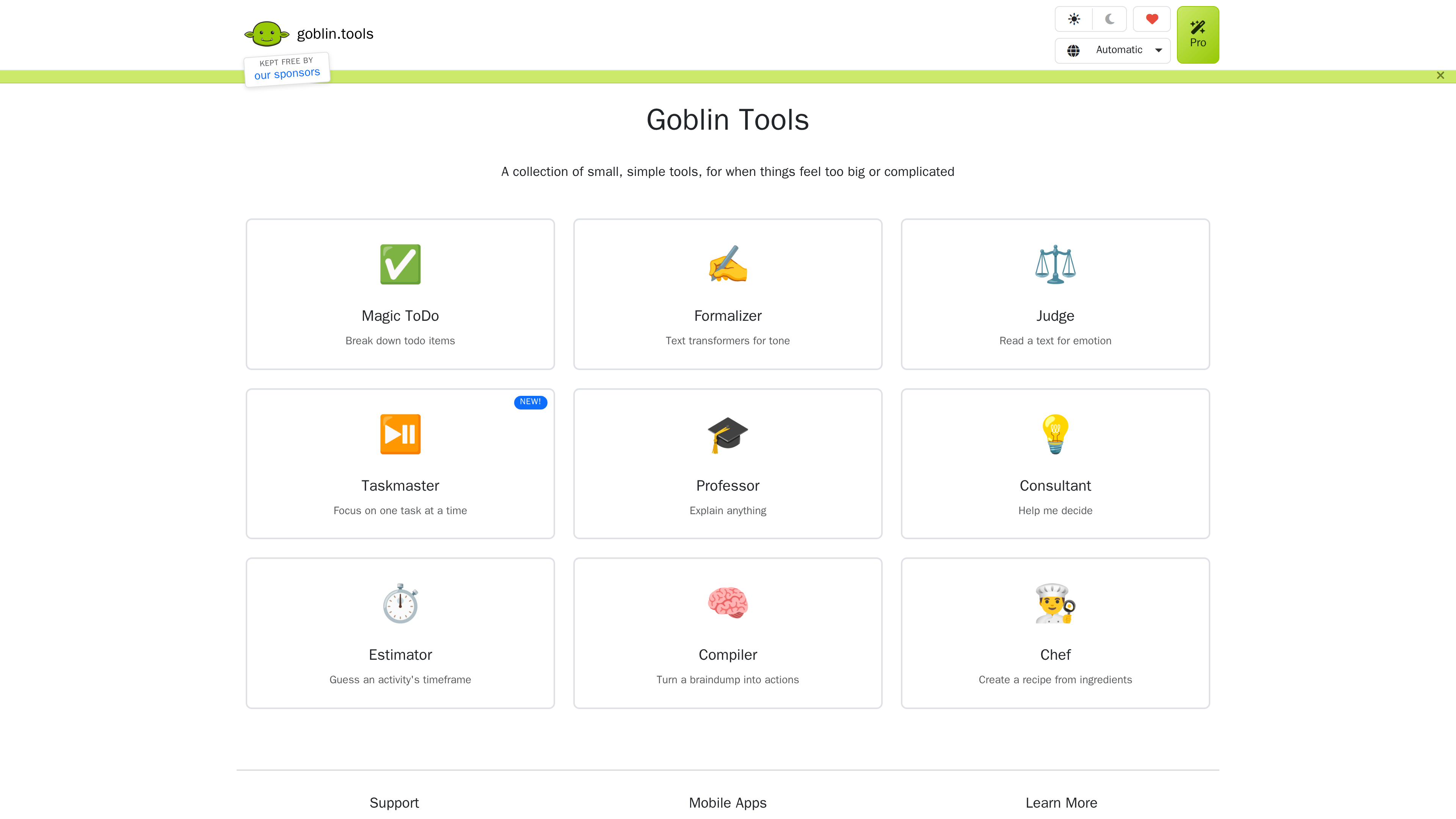
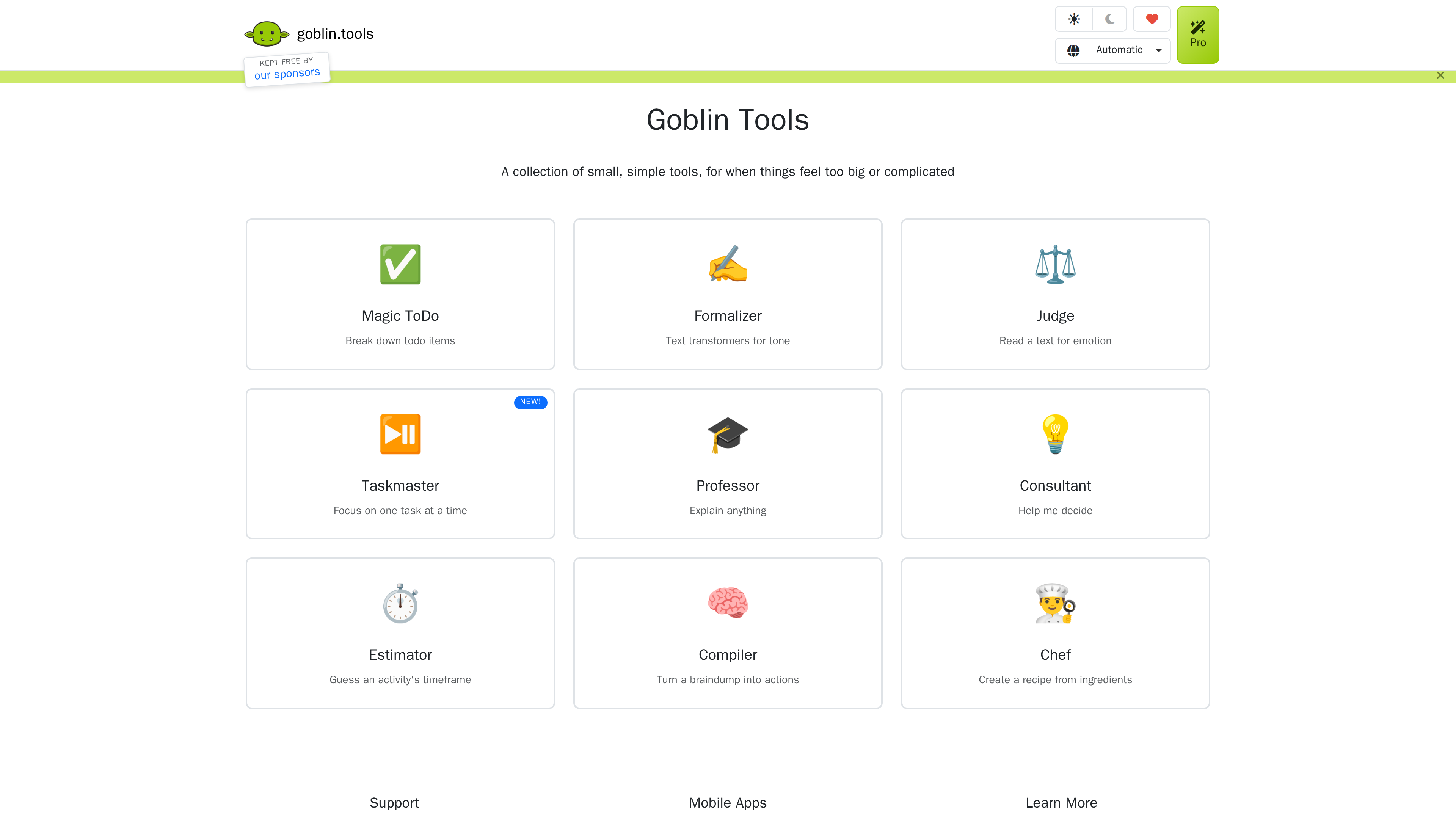
The homepage screenshot above (2026-10-01) shows the entry cards for all nine tools, each with a one-line description; the top-right corner toggles dark mode and the interface language.
At a Glance
| Item | Details |
|---|---|
| URL | https://goblin.tools/ |
| Type | Single-task AI mini-tool collection (web app, plus mobile apps) |
| Cost | Web version free forever, no ads; mobile apps sold at a low price; optional Pro subscription $3/€3/£3 per month (Pro page, About, as of 2026-10-01) |
| Sign-up | Core tools need no account; an optional account enables sync and sharing (username and email are both optional on signup) |
| Interface language | ~75 languages including Simplified and Traditional Chinese (community-translated, plus novelty languages like Klingon) |
| Clients | Any browser; paid Android and iOS apps |
| Launched | 2023 (mobile apps in May 2023); went viral on TikTok and Reddit the same year (AI Agents Wiki, Fangxiaofeng report) |
Background
- Creator: Goblin Tools is written and maintained by Bram De Buyser, a Belgian AI, software and data engineer who also founded the AI and data company Arcology (About page, LinkedIn).
- Going viral: after launching in 2023 it spread virally through ADHD communities on TikTok and Reddit; the developer reported 330k site visits in May 2023, with Magic ToDo used three times as much as the second-most-popular tool, Formalizer (Fangxiaofeng report, Hacker News thread).
- Press: PCMag's writer tested it against his own task paralysis and found Magic ToDo turned a daunting weekend list into executable steps (PCMag).
- How it's funded: the website pledges to stay "free without ads or paywalls"; running costs are covered by the low-priced mobile apps and an optional Pro subscription, with Patreon and Ko-Fi donation channels the site says it does not depend on (About page).
The Nine Tools
| Tool | What it does |
|---|---|
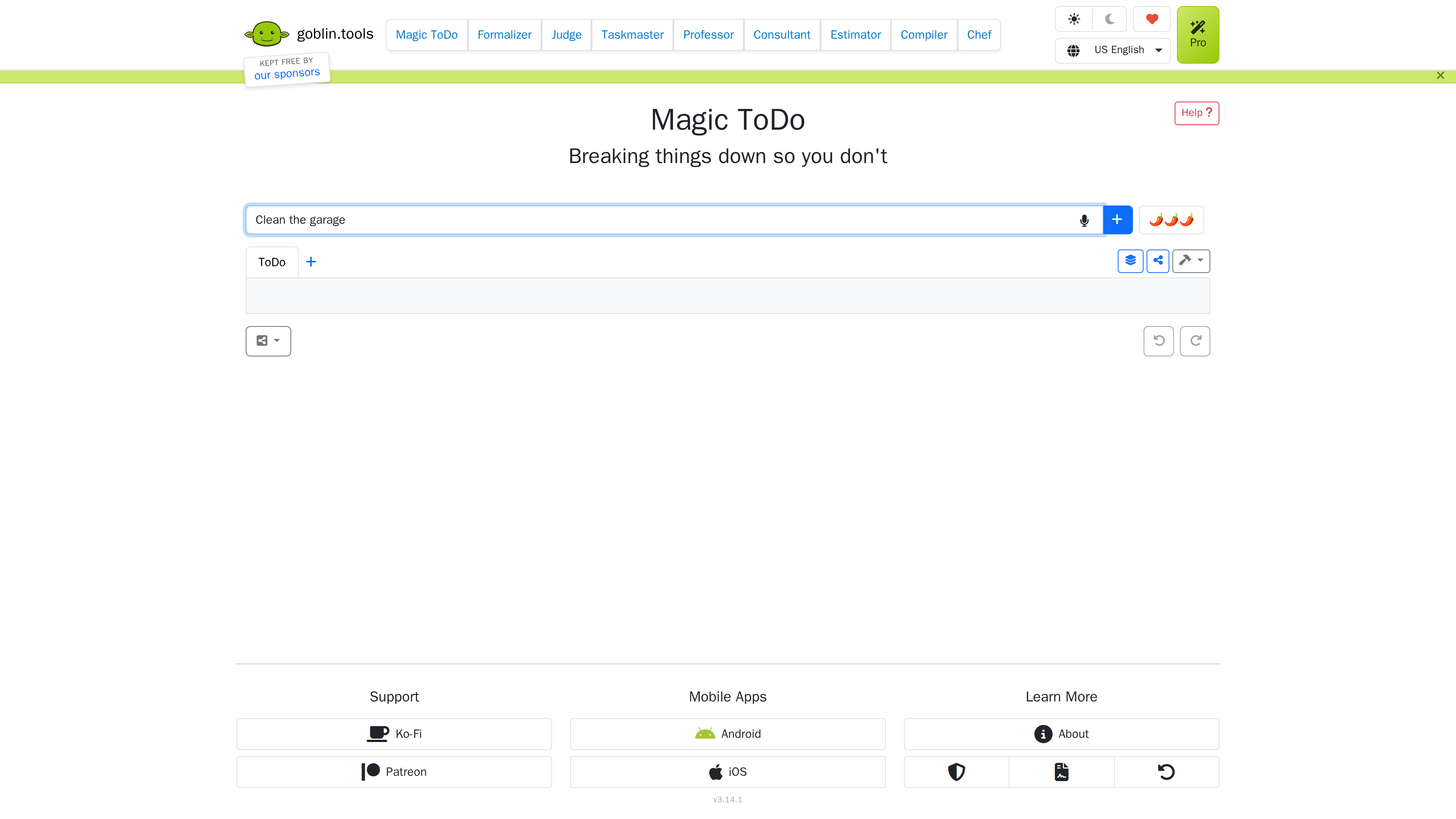
| Magic ToDo | The flagship: type a task and AI breaks it into steps. A 🌶 "spiciness" level from 1–5 hints how hard the task feels — spicier means finer-grained steps. Top-level tasks get an auto-assigned category emoji, and steps can be broken down further |
| Formalizer | Text transformers for tone: rewrite a passage to be more formal, casual, gentle and so on |
| Judge | Reads a text for emotion: tells you how your message is likely to come across |
| Taskmaster | A newer tool: focus on one task at a time with step-by-step guidance |
| Professor | Explains anything in plain language |
| Consultant | Decision aid: lays out pros and cons for your options |
| Estimator | Guesses how long an activity will take |
| Compiler | Turns a braindump of scattered thoughts into an action list |
| Chef | Creates a recipe from the ingredients you have |
(Feature descriptions from the homepage and individual tool pages, checked 2026-10-01)
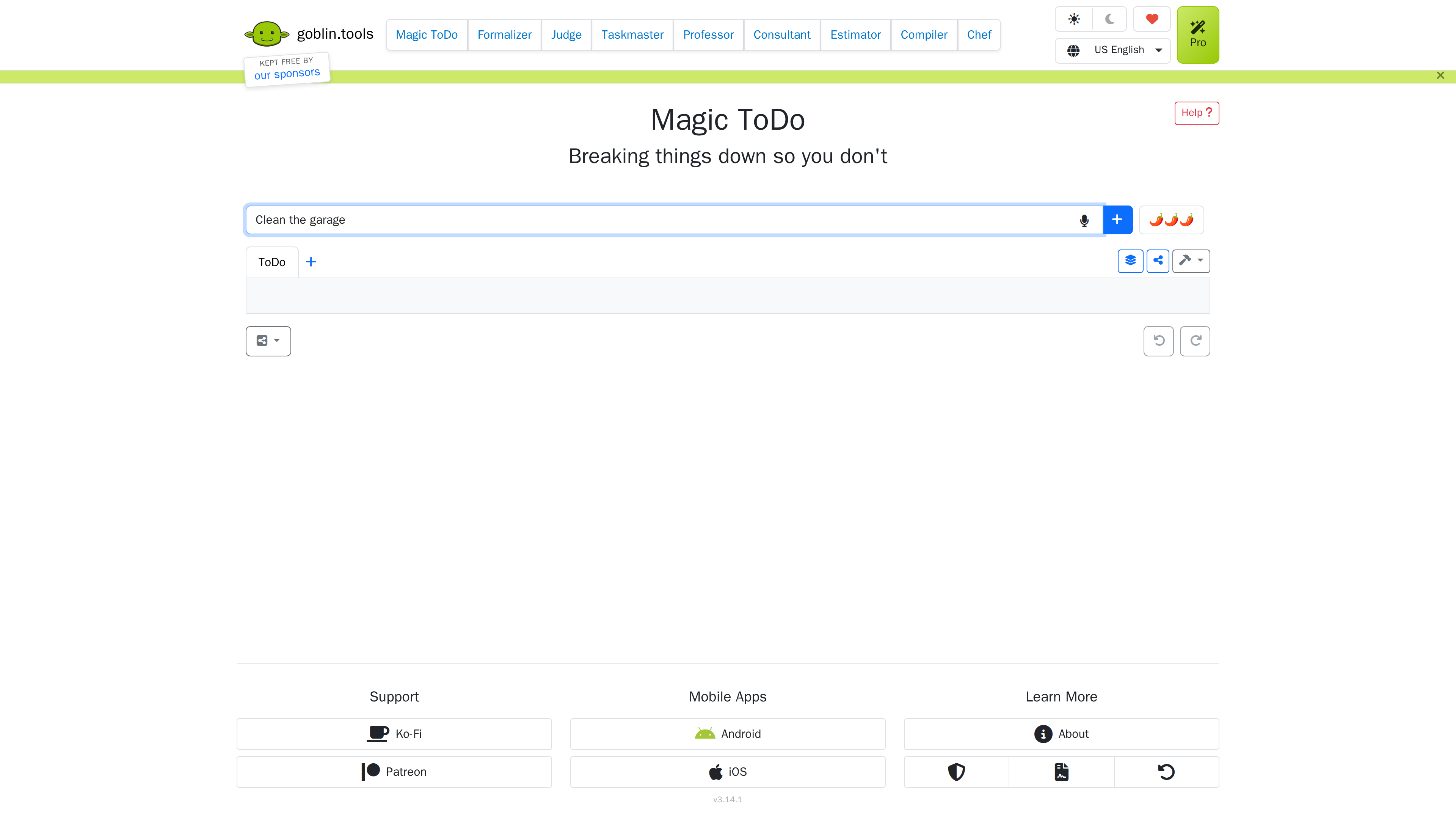
The Magic ToDo screenshot above (2026-10-01) shows the chili icons that control breakdown granularity (three shown here) and the wand that generates the steps; the page also offers subtasks, sharing and export buttons.
Free vs Paid
- Web version: all core features free; the site promises existing features will never move behind a paywall (About page).
- Mobile apps: Android and iOS versions sold at a low price, subsidizing the website (About page).
- Goblin Tools Pro: an optional $3/€3/£3-per-month subscription with a one-week free trial, adding only "the things that cost money to keep running" — cross-device sync, per-tool history, templates, shareable lists and custom instructions; payments are processed by Polar (Pro page, Terms).
- Accounts were added in 2026 ("Goblin Tools has accounts now" banner); they exist only for sync and sharing, and everything works without one.
AI and Content Policy
- The tools run on a mix of open- and closed-source AI models from different providers, with a commitment to "ethical models where possible" (About page).
- The official disclaimer is explicit: these are general-purpose models whose accuracy varies, and "nothing returned by any of the tools should be taken as a statement of truth, only guesswork" — treat the output as a starting point and judge it yourself (About page).
Who It's For
- People who freeze in front of tasks like "clean the house", "write that email" or "make a decision": Magic ToDo and Compiler turn the mental mess into a next step.
- Anyone unsure how their words will land: Formalizer rewrites, Judge pre-reads the recipient's likely reaction.
- Anyone who wants no-account, no-ads, low-friction mini-tools; the Chinese interface (Simplified and Traditional) lowers the barrier for Chinese-speaking users.
Limitations
- Unreliable AI output: breakdown and judgment quality depends on general-purpose models; by the site's own admission results are "guesswork", and complex or professional tasks still need human correction.
- Low ceiling: each tool does one thing; there is no real task management (no due dates, reminders or project hierarchy), so it cannot replace a to-do app.
- Sync and history are paid: cross-device sync and history require Pro; free web data lives locally and is lost when you switch devices.
- Uneven translations: interface languages are community-translated and some may be incomplete (observation; not every language was verified).
- Whatever you type is sent to backend AI models, so avoid entering private personal content.