Glide is a no-code app development platform: without writing code, you turn the data in a spreadsheet into working business apps — inventory tracking, customer portals, field inspections, CRMs — that run on phones and desktops as web apps. Its direction differs from website builders like Wix or Webflow: Glide does not make marketing sites or landing pages, but data-driven internal tools with sign-in and permissions. The platform currently has two product lines: GlideOS (conversational AI app generation, the current flagship, in public beta since July 2026) and the original Glide Classic (visual drag-and-drop builder launched in 2019, still maintained). The two are independent products with separate pricing, both operated by the US company typeguard, Inc., doing business as Glide (sources: Terms of Service, GlideOS pricing page FAQ).
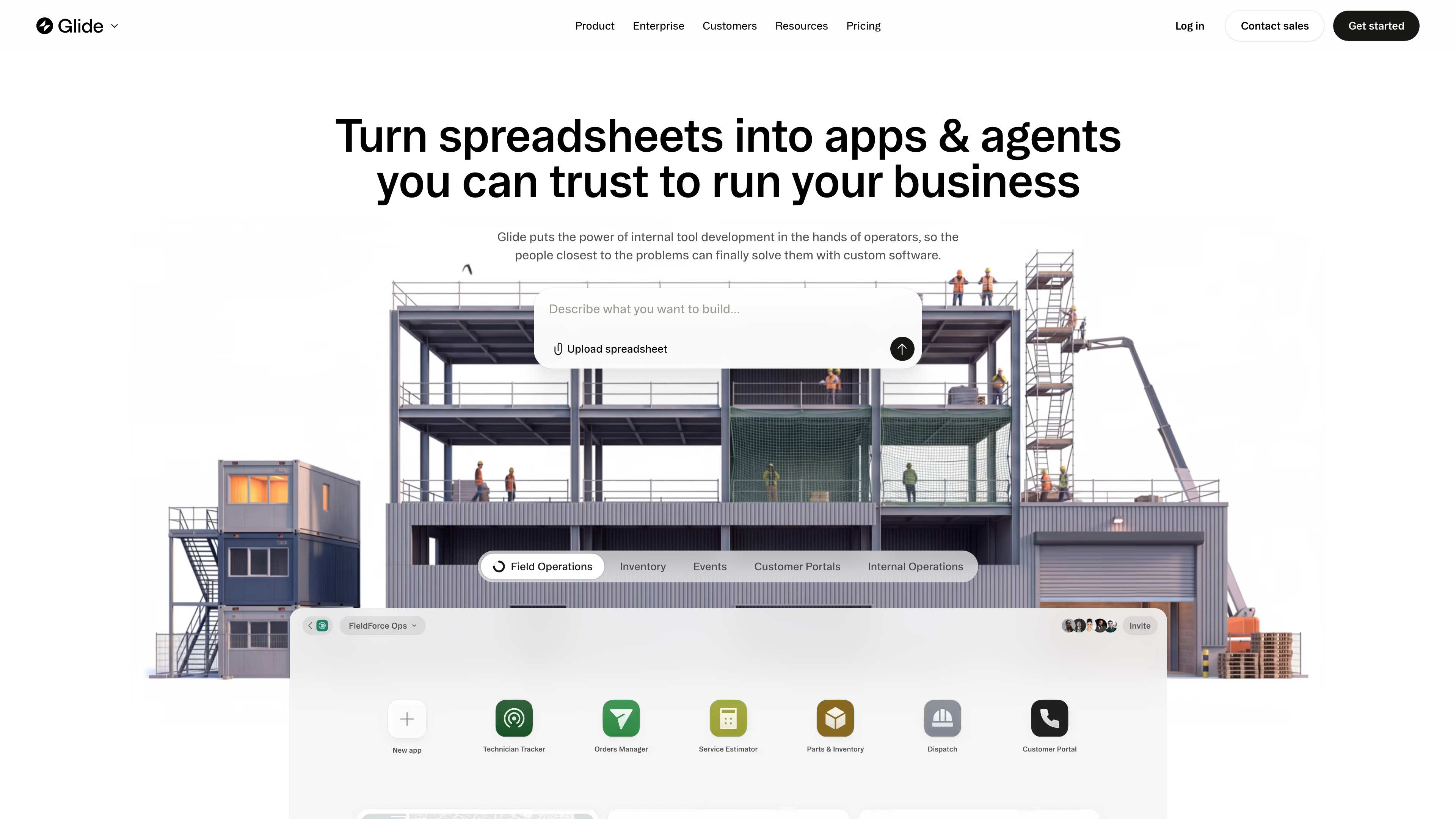
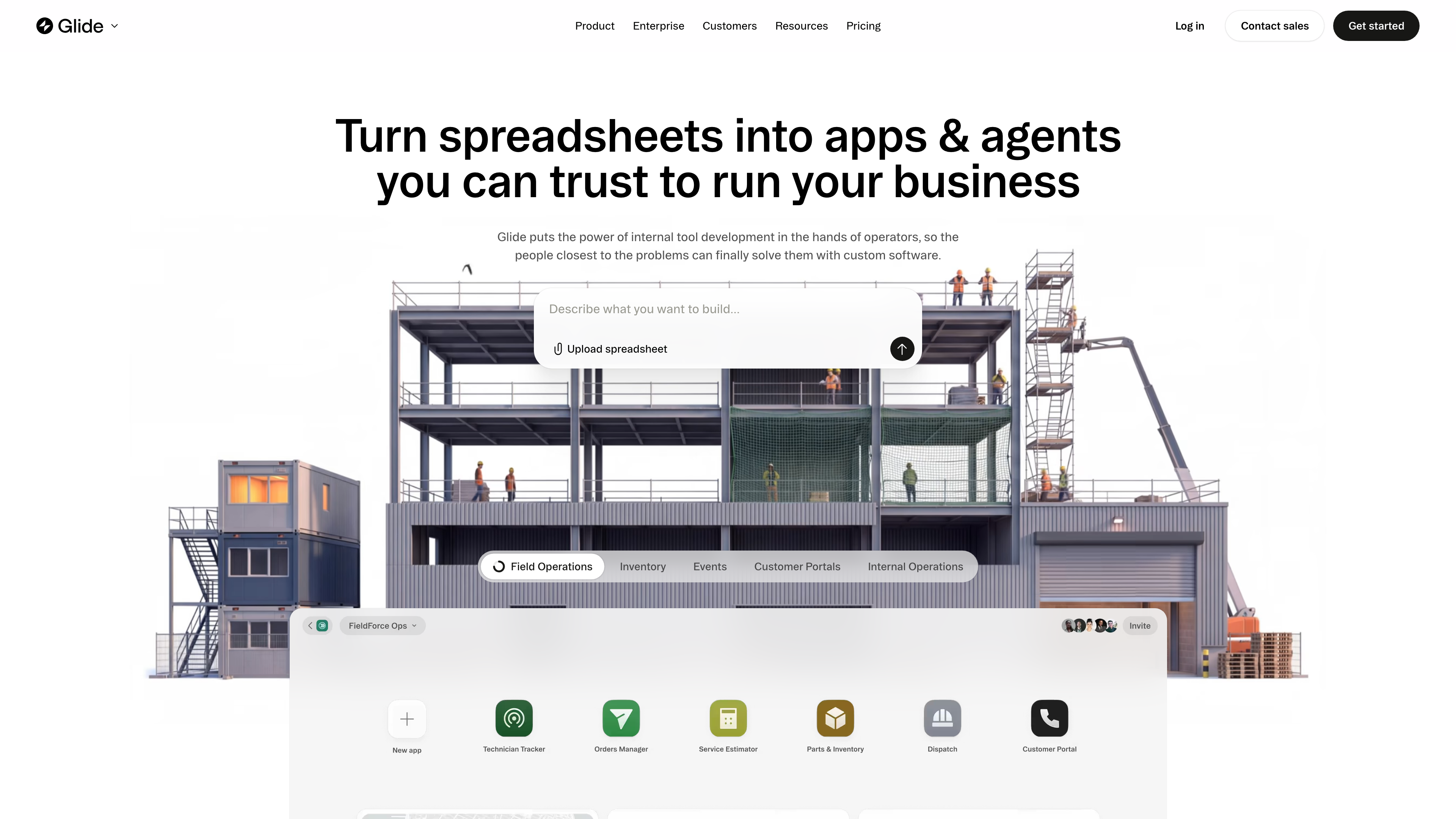
The screenshot above shows Glide's homepage (captured 2026-09-29). The hero is the GlideOS entry point: describe the tool you want in the prompt box, or upload a spreadsheet, and the AI generates the app; below it sits an example field-operations app interface.
At a Glance
- URL: https://www.glideapps.com/
- Type: No-code business app development platform (two product lines: GlideOS and Glide Classic)
- Cost: Both product lines have a free tier; GlideOS paid plans run 125/month, Classic individual plans start at 49/month billed annually and business plans at $199/month (see "Pricing" below, as of 2026-09-29)
- Sign-up: Browsing the site and template gallery requires no account; building and publishing apps does
- Interface language: English only (checked 2026-09-29; no localized versions)
- Operator: typeguard, Inc. (Tiburon, California, USA), doing business as Glide (source: Terms of Service)
Background
Glide's four founders — David Siegel, Jason Smith, Mark Probst and Antonio Garcia Aprea — previously worked together at Xamarin, the cross-platform mobile development company Microsoft acquired for about $500 million in 2016. There they saw first-hand how expensive and painful mobile app development was for companies, and after their time at Microsoft they decided to attack the problem starting from the spreadsheet, the most ubiquitous business tool of all (source: TechCrunch, 2019-02-12). The company was founded in 2018 (source: Crunchbase), joined Y Combinator's Winter 2019 batch, and launched publicly in February 2019: the original capability was turning a Google Sheet into a progressive web app (PWA) with two-way data sync.
On funding, Glide raised a 20 million Series A led by Benchmark in April 2022 — by which time data sources had grown beyond Google Sheets to Airtable and Excel (sources: TechCrunch, 2022-04-21, CB Insights).
On July 14, 2026, Glide announced the open beta of GlideOS, with an official launch event on August 3 (source: Glide blog). Glide describes GlideOS as "a new Glide, built for the AI age": instead of starting by dragging components, you start from a description, a spreadsheet, or a file, and an AI agent builds the app along with the data behind it (source: What is GlideOS?). The original product was renamed Glide Classic and continues to be maintained — Glide says existing Classic apps keep working — but the two are separate products with separate subscriptions and do not interoperate (sources: pricing page FAQ, llms.txt).
Core Capabilities
GlideOS: conversational AI app development
- Start from data or a description: upload a spreadsheet, document, or image, or describe in plain language the process you want to improve; the AI generates the app and its data. Further changes happen in the same chat, and you can target a specific page, component, or even a piece of text for modification (sources: Product, What is GlideOS?).
- Integrations through conversation: the official integrations directory listed 1,000+ services as of 2026-09-29 (Gmail, Slack, Airtable, Salesforce, etc.). There is nothing to pre-install: the AI requests authorization in-chat via a Connect card when an integration is needed, and credentials never pass through the AI.
- Built-in AI features: apps can include AI chat, summarization, image generation and more; paid plans offer agent modes, the Pro plan supports connecting your own AI agent over MCP (Model Context Protocol), and Enterprise lets you choose your organization's LLM provider (source: GlideOS pricing).
- Publishing and permissions: apps can be published as personal, team, or public apps (public apps require Plus or above); organization-level roles and permissions start at Pro (source: GlideOS pricing).
Glide Classic: the mature visual builder
- Broad data sources: native Glide Tables / Big Tables, external sync with Google Sheets, Airtable and Excel, and — on Enterprise — SQL sources such as PostgreSQL, MySQL, Cloud SQL, SQL Server and BigQuery, plus 100+ data sources including HubSpot and Stripe (sources: Classic pricing, Data Sources). Apps sync two-way with the data source.
- Data Editor: a spreadsheet-like interface where computed columns handle relations, calculations, cross-table lookups, QR code generation and API calls — no code or formulas (source: Data Sources).
- Components and workflows: 40+ UI components and 90+ column types; Workflows automate tasks with triggers, conditions, loops and AI steps (sources: Classic pricing, Classic product page).
- Open API: the Glide API (REST) lets you read and write app data programmatically, available from the Business plan (sources: Classic pricing, API docs).
Template gallery and ecosystem
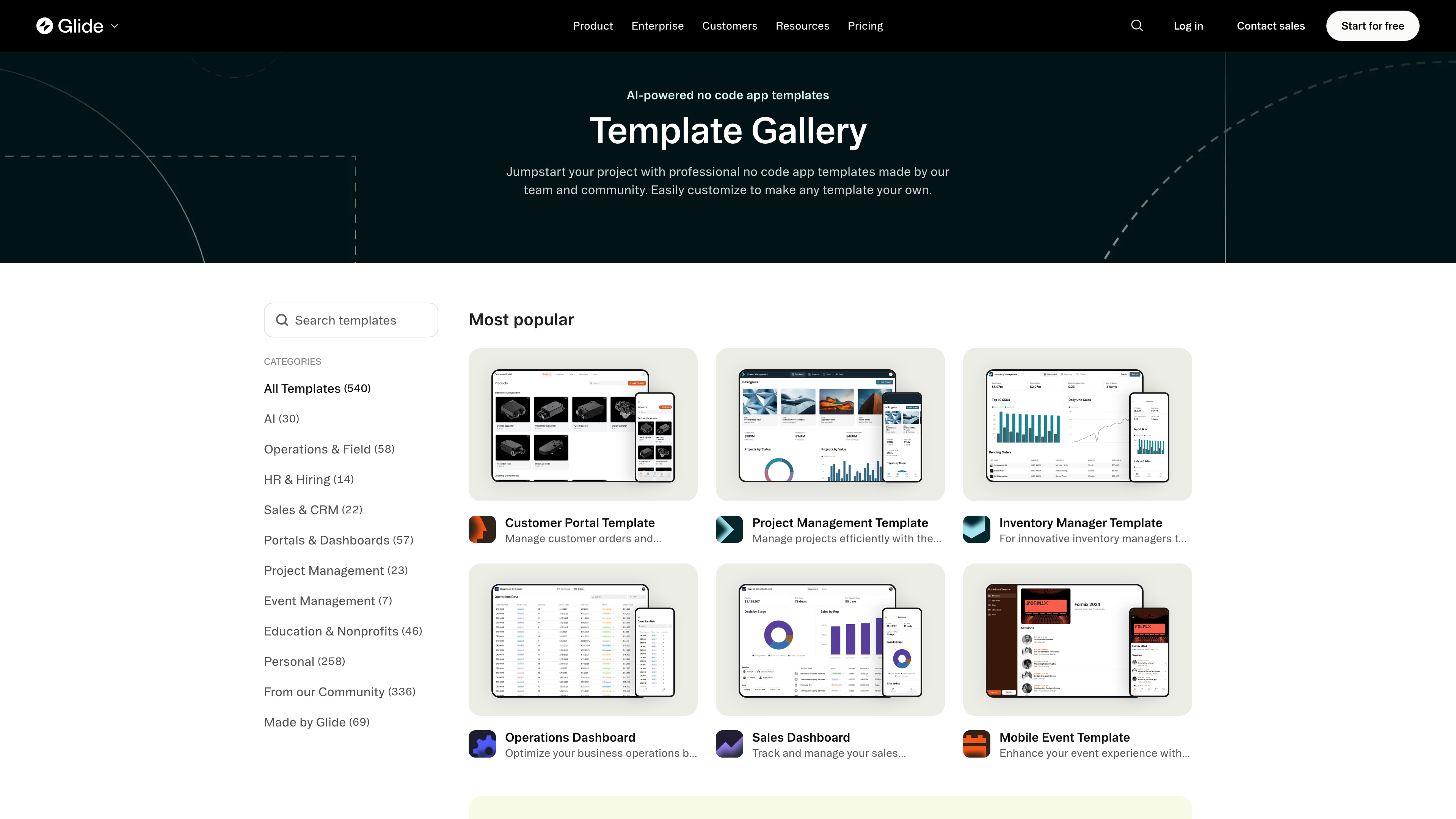
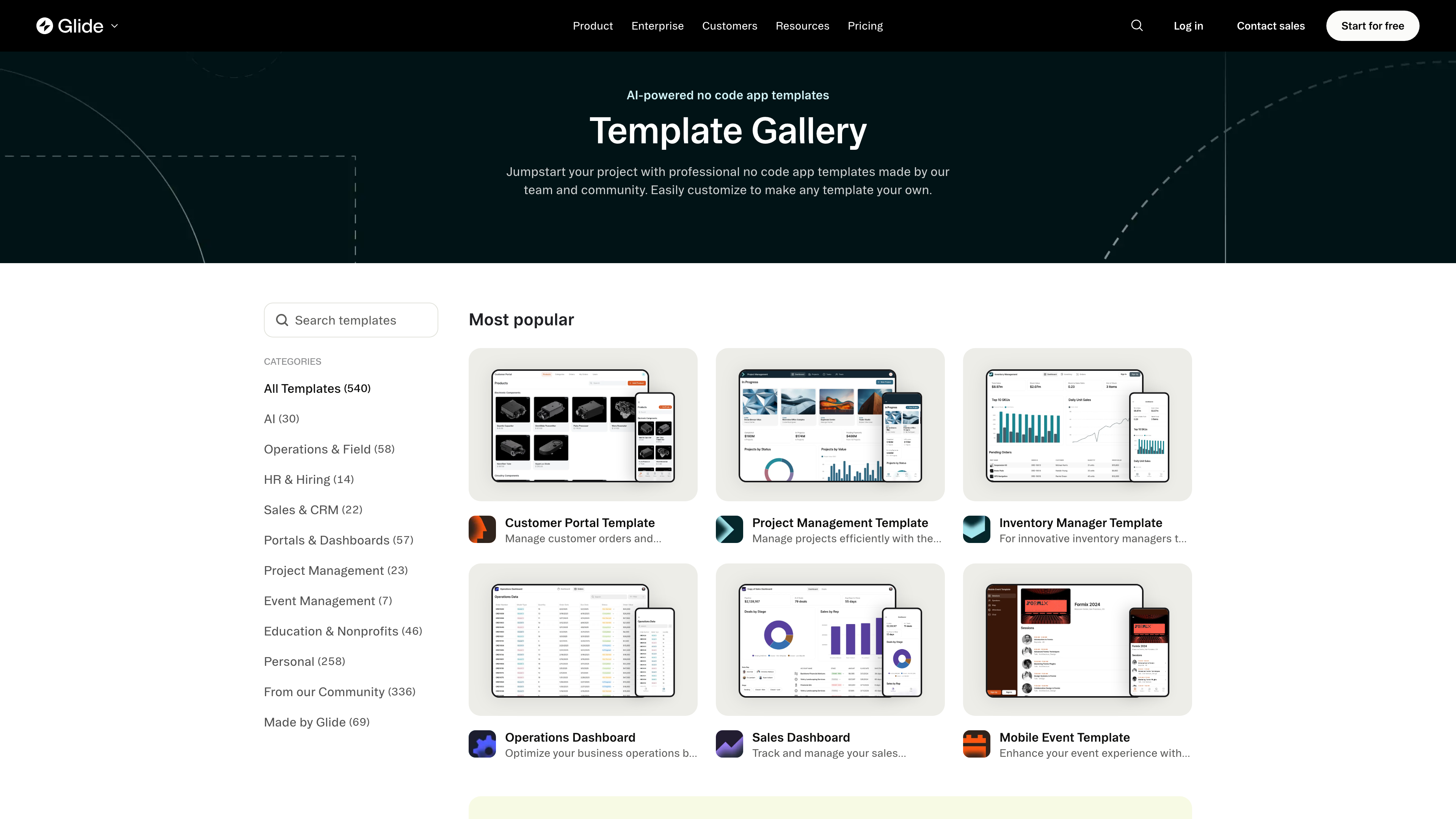
The screenshot above shows the Glide template gallery (captured 2026-09-29). As of that date it held 540 templates — 69 made by Glide and 336 contributed by the community — grouped into categories such as Operations & Field (58), Portals & Dashboards (57), Education & Nonprofits (46), AI (30) and Sales & CRM (22), all copyable and customizable. The wider ecosystem includes a community forum, free courses at Glide University, official certification, and a "Hire an Expert" marketplace (source: llms.txt).
Pricing
The two product lines are billed separately. Official public prices as of 2026-09-29:
GlideOS (pricing), metered in AI credits:
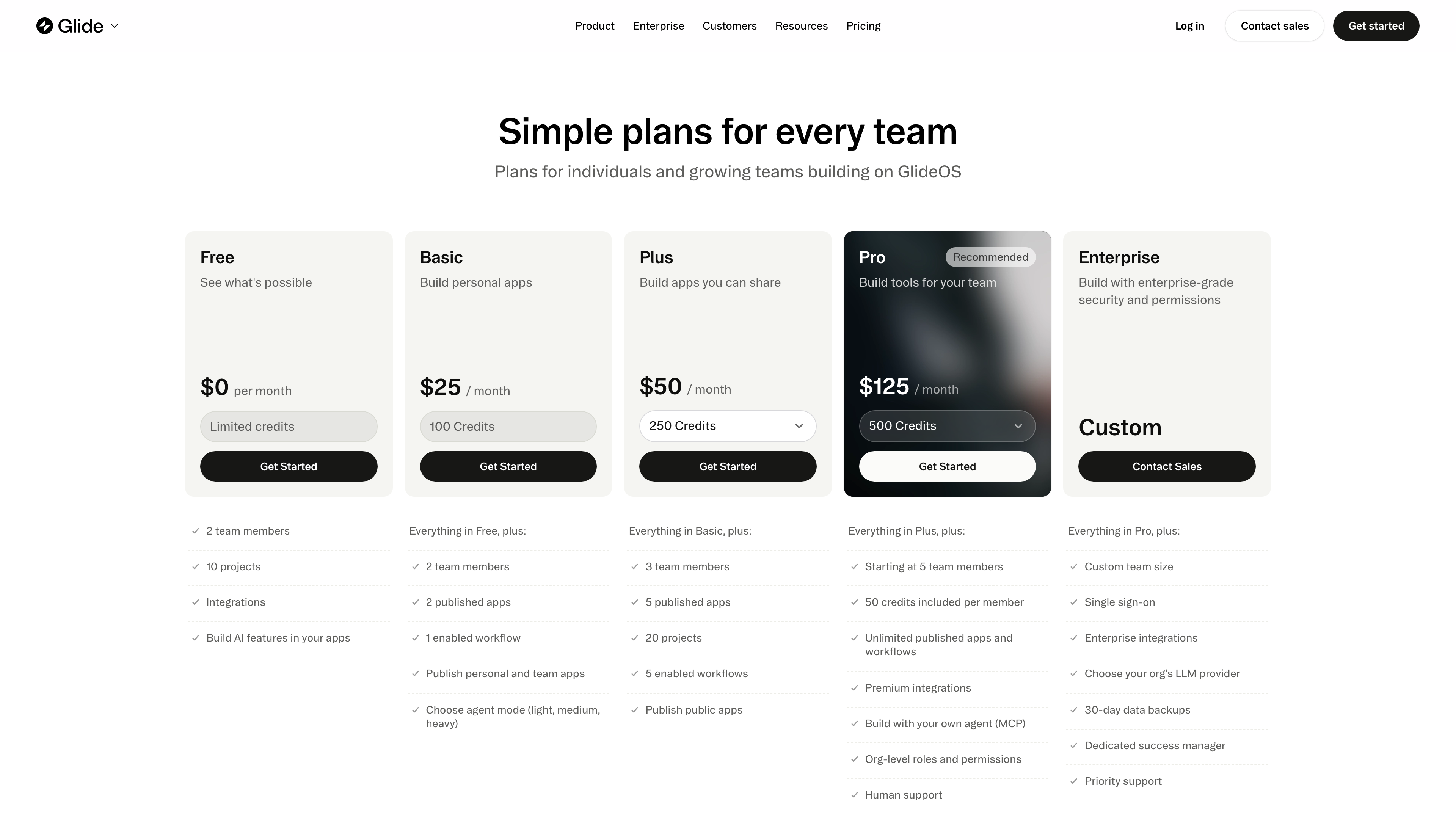
- Free $0: 2 team members, 10 projects, limited credits;
- Basic $25/month: 100 credits, 2 published apps, 1 workflow;
- Plus $50/month: 250 credits, 5 published apps, public app publishing;
- Pro $125/month: 500 credits, 5+ team members, unlimited published apps and workflows, premium integrations, MCP, org-level roles;
- Enterprise custom: SSO, enterprise integrations, choice of LLM provider, 30-day data backups.
Glide Classic (pricing), metered by users and "updates" (the unit for data changes and external syncs):
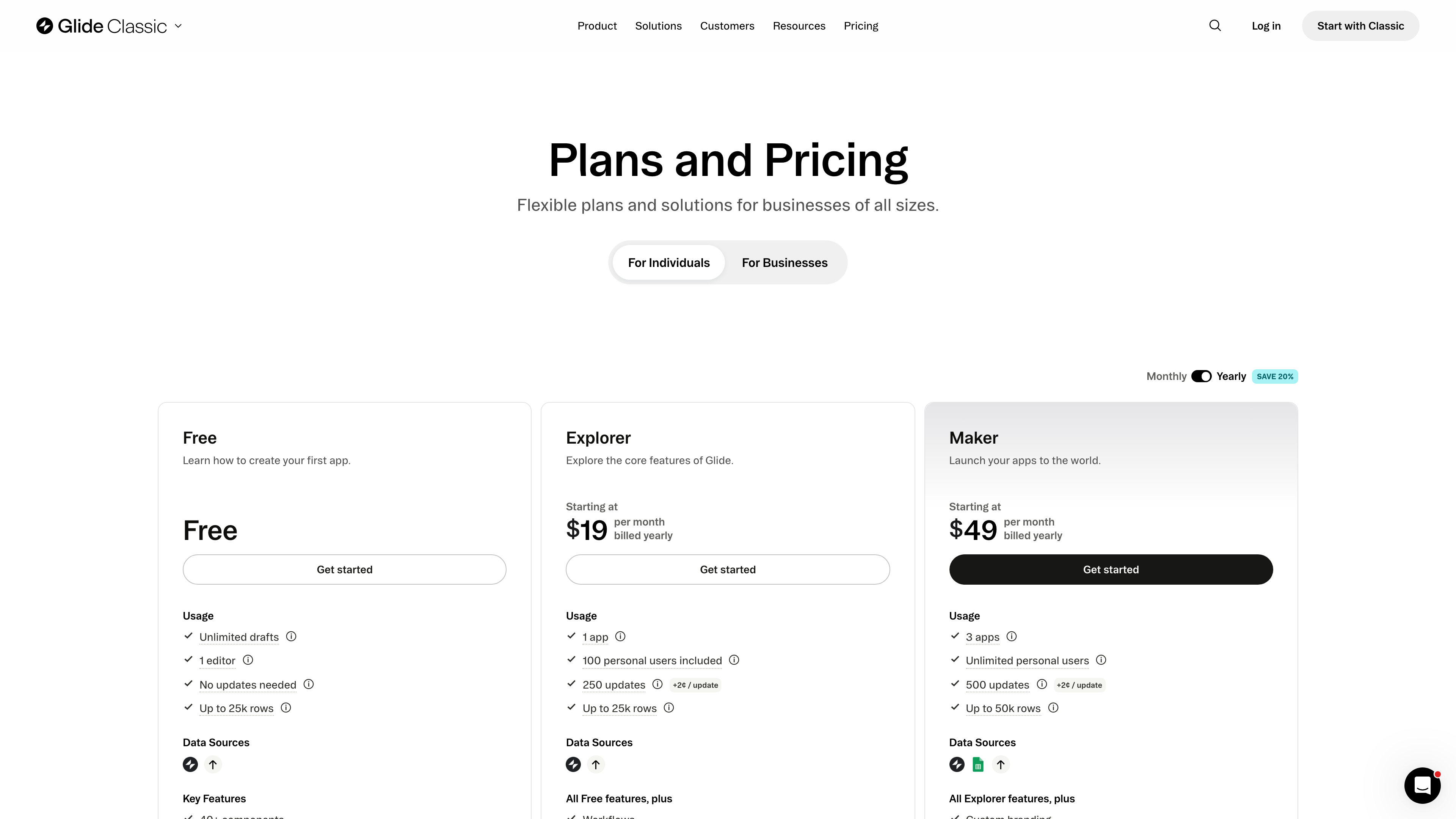
- Free $0: unlimited drafts, 1 editor, up to 25k rows;
- Explorer from $19/month billed annually: 1 published app, 100 personal users, 250 updates;
- Maker from $49/month billed annually: 3 published apps, unlimited personal users (personal/edu email domains), 500 updates, custom branding and domains;
- Business from 5–6 per additional user), 5,000 updates (2¢ per extra update), up to 100k rows on Big Tables, Workflows and the Glide API;
- Enterprise custom: SSO, data backups, SQL and other enterprise data sources.
First-time subscriptions are fully refundable within 14 days (source: Classic pricing FAQ).
Copyright and Content Policy
- Ownership: content you input — including content generated via Glide's AI tools — remains yours; Glide claims no ownership over it. Glide's own platform content belongs to Glide (source: Terms §5–6).
- AI training terms: unless your account type allows opting out and you have opted out, you agree that Glide may use your content and your apps' structure to train AI models for product improvement; Glide commits not to train on any of your content housed in app data sources that relates to an identifiable individual. The clause has been in effect since October 1, 2024 (source: Terms §6).
- App visibility: new apps are private by default; visibility can be changed to public, specific users, or an email domain in the app settings (source: Security Center).
- Use restrictions and complaints: illegal use, spam, and reverse engineering are prohibited; a DMCA notice process is provided (source: Terms §20, §22). The service is limited to users aged 13 and over (source: Terms §1).
- Data and compliance: data is hosted in the United States (source: Privacy Policy). Glide marks itself SOC 2 Type II, GDPR and CCPA compliant, offers a Data Processing Addendum (DPA), and has appointed data protection representatives in the EU and UK (sources: Security Center, Privacy Policy). Note that as an app builder you act as the controller of your end users' data and must provide your own privacy notices to them.
Who It's For
- Operations, supply-chain, and field-service teams turning Excel/Google Sheets ledgers into mobile apps with sign-in and permissions (inventory, work orders, inspections, asset tracking);
- Small and mid-sized businesses quickly standing up customer portals, vendor portals, internal dashboards and CRMs instead of paying for custom development;
- Business users validating a process-digitalization idea: prototype on the free tier, then upgrade as the team grows;
- Teams with existing Airtable (or similar) data assets that want a proper app interface on top.
Limitations
- Not a website builder: Glide produces data-driven business apps, not marketing sites, blogs, or content landing pages — that is the territory of tools like Wix or Framer.
- English only: the platform interface, docs, and templates are English-only. You can localize your own app's copy, but the builder itself has no other language.
- Complex metering: GlideOS bills by credits, Classic by updates and users; real costs scale with usage, overages are billed per unit, and quotas are not transferable between the two product lines.
- GlideOS is still new: it entered public beta only in July 2026, and its features and pricing have already been adjusted several times (plan renames and quota changes in the official changelog); long-term stability remains to be seen. Classic is mature, but Glide has made clear that GlideOS is the future direction.
- Data hosted in the US: organizations with strict data-residency requirements need to evaluate this (source: Privacy Policy).
- Platform lock-in: apps run on Glide's platform; data can be exported (CSV, etc.), but apps themselves cannot be exported as standalone code.
Alternatives
- Google AppSheet: also generates apps from spreadsheets, more deeply tied to the Google ecosystem;
- Softr: builds portals and internal tools on top of Airtable, positioned close to Glide Classic;
- Bubble: a general-purpose web app builder with more freedom and a steeper learning curve;
- Retool: an internal-tools platform aimed at developers, requiring some technical background.
References
- Product - Glide
- What is GlideOS? - Glide Docs
- GlideOS Pricing
- Glide Classic Pricing
- Templates - Glide
- Integrations - Glide
- Try GlideOS in Open Beta - Glide Blog
- Terms of Service - Glide
- Privacy Policy - Glide
- Security Center - Glide
- Glide helps you build mobile apps from a spreadsheet without coding - TechCrunch
- After proving need for no-code apps, Glide rewarded with $20M Series A - TechCrunch