
GitHub is a Git-based code-hosting and collaboration platform: developers keep repositories on it, review and merge code through Pull Requests, track bugs and plans in Issues, and use first-party tools such as Actions, Codespaces, and Copilot for automated builds, cloud development environments, and AI-assisted coding. According to official figures, as of 2026-09-02 the platform serves more than 225 million developers, 4 million organizations, and 800 million repositories, including 90% of the Fortune 100 — making it the largest developer platform and the de facto home of open-source software.

Visiting github.com without an account shows the signup entry and product highlights. Browsing public repositories, searching code, and checking the Trending charts all work without logging in; as the screenshot shows, the homepage now leads with newer offerings such as the Copilot AI assistant.
At a glance
- URL: https://github.com/
- Type: Code hosting and collaborative development platform (Git)
- Cost: Free tier with unlimited public/private repositories; Team at 21 per user/month (official pricing, as of 2026-09-02)
- Registration: Not required for browsing public content; a free account is needed to create repositories or commit code
- Interface language: English only
- Launched: April 10, 2008 (company founded February 8, 2008)
- Operated by: GitHub, Inc., a Microsoft subsidiary since 2018, headquartered in San Francisco
Background
GitHub was founded in San Francisco by Tom Preston-Werner, Chris Wanstrath, P. J. Hyett, and Scott Chacon. The company was incorporated on February 8, 2008 (originally as Logical Awesome), and the site launched on April 10, 2008. It wrapped the then-niche Git version control system in a social, collaboration-oriented website and gradually became the center of the open-source world. (Source: the GitHub Wikipedia article)
On June 4, 2018, GitHub's official blog announced the Microsoft acquisition; Microsoft's announcement (archived by the SEC) put the price at $7.5 billion in Microsoft stock. The deal closed on October 26, 2018, and GitHub has kept its independent brand and operations since.
Core capabilities
- Code hosting and collaboration: Git repository hosting with Pull Request code review, Issues for task tracking, Discussions, wikis, and project boards — the full path from code to collaboration.
- GitHub Actions: the built-in CI/CD and automation platform, triggering build, test, and deploy workflows on events like pushes and merges.
- GitHub Codespaces: browser-based cloud development environments that spin up fully configured containers in seconds, billed by usage.
- GitHub Copilot: the official AI pair programmer, offering code completion, chat, and agent capabilities; the individual lineup includes a free tier (2,000 completions per month), Pro at 39 (Copilot plans, as of 2026-09-02).
- Open-source discovery and funding: Trending charts, Topics, code search, and the GitHub Sponsors funding program.
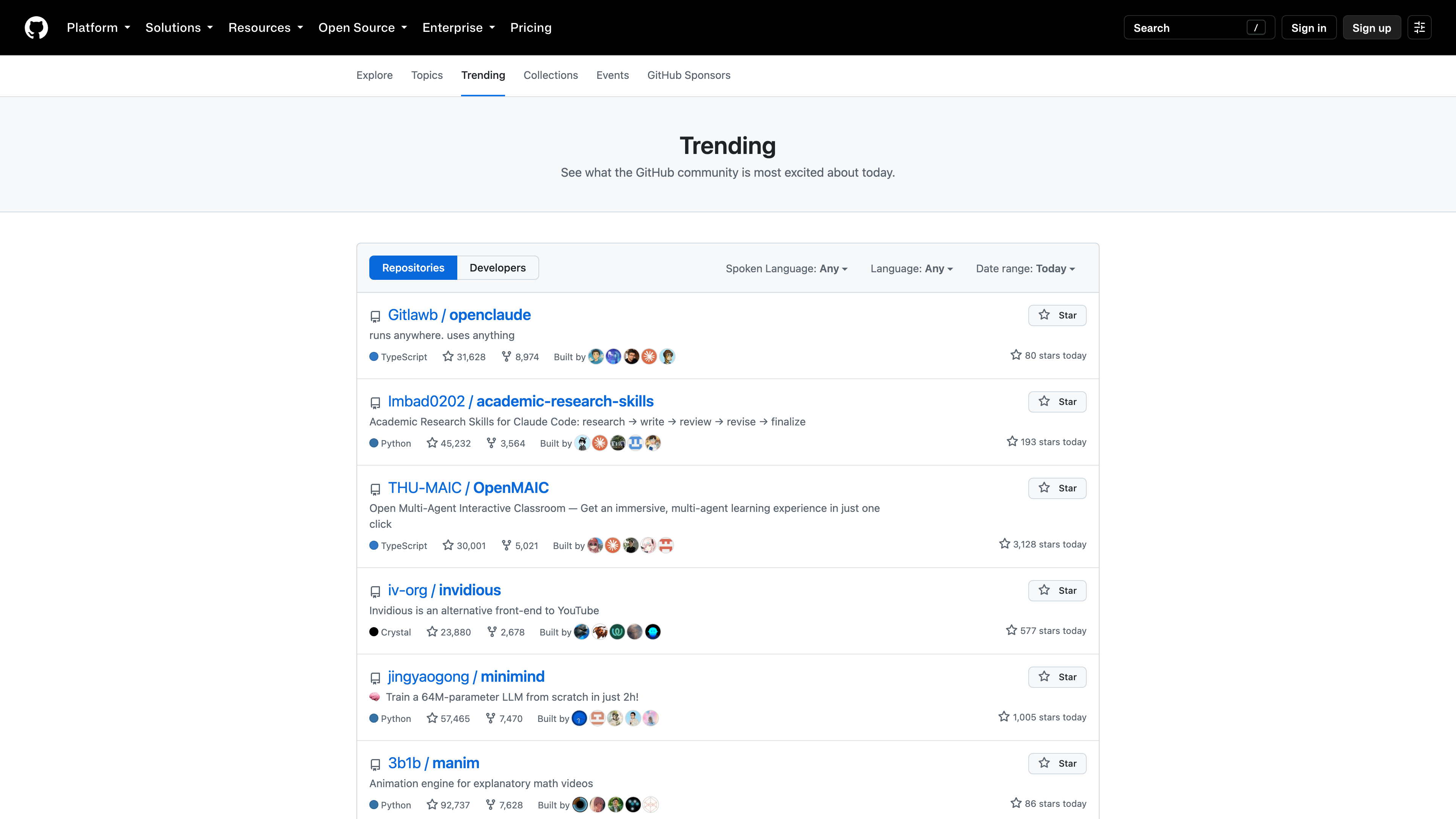
The Trending page lists the repositories gaining community traction fastest, by day, week, or month, filterable by programming language — an open-source discovery entry point that works without an account.
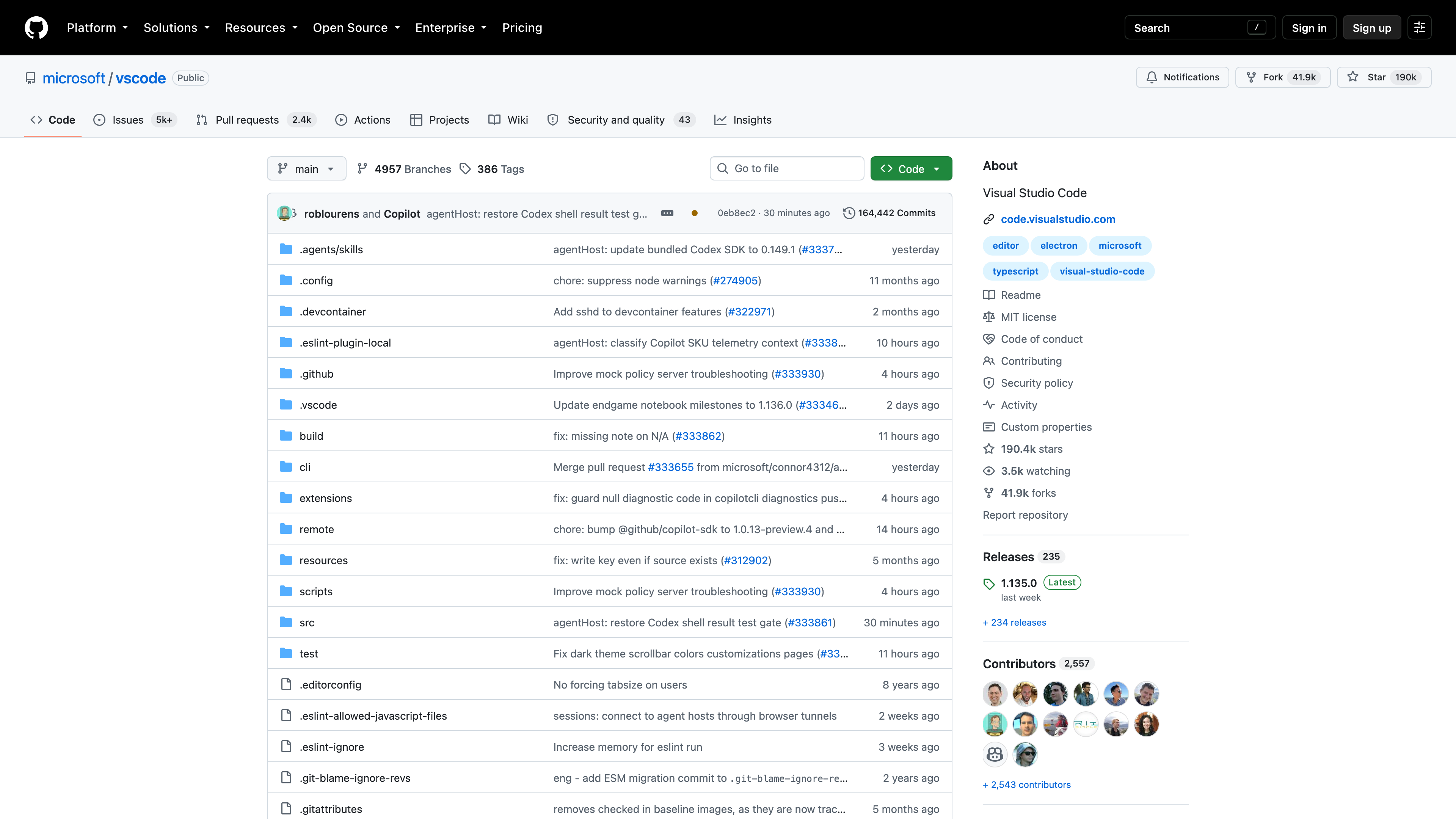
A repository page brings together the code, commit history, branches, and Issues/Pull Requests. Taking Visual Studio Code's official repository as an example: the About panel on the right shows its MIT license and, at capture time (2026-09-02), roughly 190k stars, 41.9k forks, and 2,667 contributors.
Accounts and open capabilities
A free account can create unlimited public and private repositories, with baseline quotas for Actions and Packages. The Team tier adds collaboration features such as protected branches and code-owner review; Enterprise adds security and compliance controls, data residency, and flexible deployment. GitHub also exposes full REST/GraphQL APIs and standard Git protocol access; GitHub Pages hosts static sites for free, and Gist is meant for sharing snippets.
Copyright and content policy
GitHub is a hosting platform: repository content remains the property of its authors, and the Terms of Service grant GitHub the license it needs to host and display that content. One caveat matters to readers: publicly visible does not mean freely usable — without an open-source license, code remains under ordinary copyright and others have no right to copy or modify it. Whether code can be reused depends on the repository's LICENSE file (GitHub Docs: Licensing a repository).
Good for
- Hosting personal or team code with Pull Request–based collaboration and review
- Finding and studying open-source code, and joining communities through Issues/Discussions
- Building CI/CD pipelines with Actions, and hosting static sites or docs for free with Pages
- Day-to-day coding with Copilot, or ad-hoc development in Codespaces without a local setup
- Tracking technology trends through Trending and Topics
Limitations
- English-only interface, and Git itself has a learning curve — a real barrier for newcomers.
- Advanced collaboration and security features (protected branches, Advanced Security) require paid tiers, as do Copilot's premium models.
- There is no local service point of presence in mainland China, and connection speeds vary by network environment (observation, not an official statement).
- Heavy centralization: a large share of open-source infrastructure depends on a single commercial platform, with regional service restrictions — since 2019 GitHub has limited some services for developers in Iran, Crimea, and other U.S.-sanctioned regions (source: the GitHub Wikipedia article).
Alternatives
- GitLab: a comparable DevOps platform whose core is open source and self-hostable.
- Gitee: a code-hosting platform aimed at Chinese developers, with servers in mainland China.
- Bitbucket: Atlassian's code-hosting service, tightly integrated with Jira.
References
- GitHub About (developer and repository counts, checked 2026-09-02)
- GitHub Pricing (Free/Team/Enterprise pricing)
- GitHub Copilot Plans (Copilot pricing)
- GitHub Features (official capabilities including Actions and Codespaces)
- GitHub (Wikipedia article) (founding date, founders, acquisition timeline cross-check)
- GitHub Blog: A bright future for GitHub (June 4, 2018 acquisition announcement)
- Microsoft announcement (SEC archive) ($7.5B stock consideration)
- GitHub Docs: Licensing a repository (copyright and licensing)