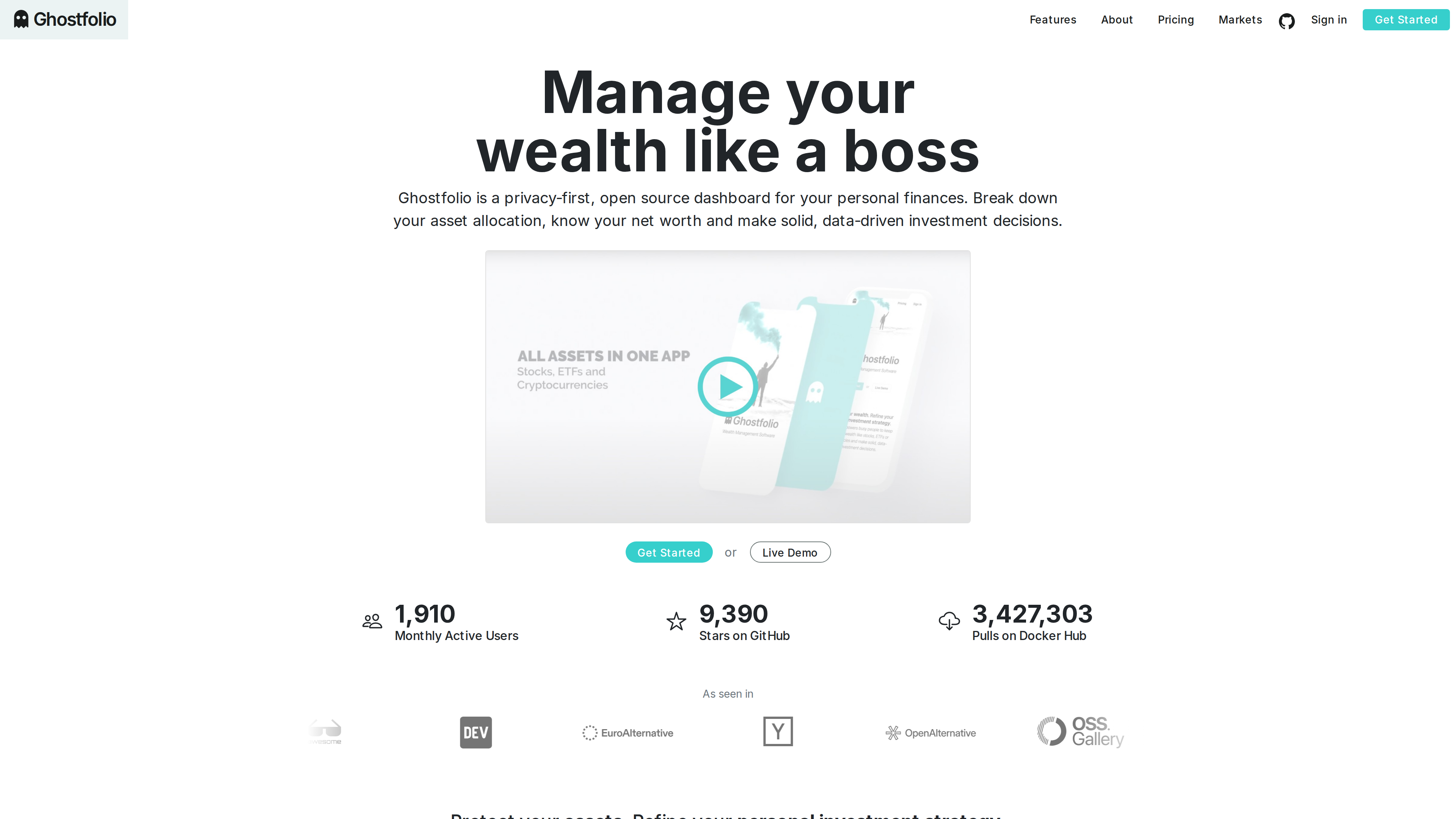
Ghostfolio (ghostfol.io) is an open source wealth management and portfolio tracking application that describes itself as a "privacy-first, open source dashboard for your personal finances." You record the stocks, ETFs, bonds and cryptocurrencies you hold across brokers, banks and exchanges in one place, and get an up-to-date view of your net worth, performance and asset allocation — instead of waiting for the annual tax return to know what you own (website, FAQ, checked 2026-10-02).
Unlike account-aggregation finance tools, Ghostfolio does not connect to your bank and does not sell data: the code is fully open source under the AGPL-3.0 license, sign-up can be anonymous without an email address, and you can either self-host it with Docker or use the official managed cloud. As of 2026-10-02, the GitHub repository has 9,390 stars (GitHub API).
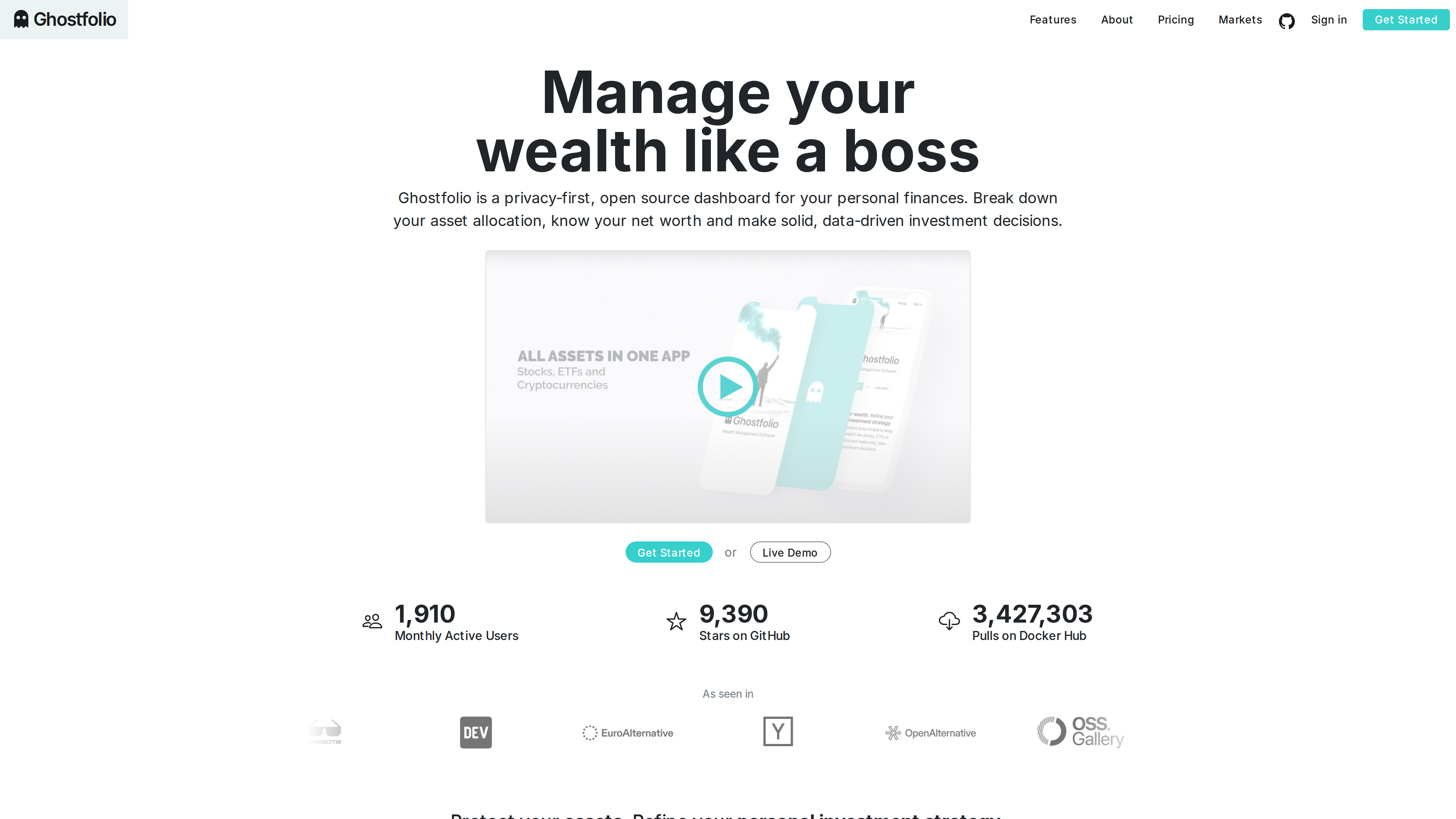
The homepage screenshot above (2026-10-02) shows the hero section; the three figures below the fold come from the project's public Open Startup metrics page and stay in sync with the repository's star count.
At a Glance
| Item | Details |
|---|---|
| URL | https://ghostfol.io/ (redirects by UI language, e.g. /en) |
| Type | Open source wealth management and portfolio tracker (web app, PWA) |
| Cost | Self-hosted free; managed cloud Basic free; managed cloud Premium USD 48/year (pricing, as of 2026-10-02) |
| Sign-up | Anonymous via security token (no email or phone required), or Google Sign-In (FAQ) |
| UI languages | 10+ including Simplified Chinese (features page lists English, Chinese, German, French, Italian, Dutch, Polish, Portuguese, Spanish, Turkish; the footer selector also offers Korean) |
| Mobile | Android app on Google Play for managed-cloud users; no store app for the self-hosted version, but the PWA can be added to the home screen |
| Launched | 2021 (repository created 2021-04; first official blog post 2021-07-31) |
| License | AGPL-3.0 (license page) |
Background
- Built for himself first: Ghostfolio was initiated by Swiss developer Thomas Kaul (About). In the introductory blog post (2021-07-31) he explains that as a buy-and-hold investor with assets spread across platforms, he could not find a tool that aggregated his holdings holistically while staying simple and mobile-friendly — previously he only saw consolidated figures once a year, at tax time. He built the first version with a stack he wanted to work with (TypeScript, Angular, NestJS, PostgreSQL, Docker) and released it as open source.
- Legal entity: the managed cloud is operated by Ghostfolio LLC, Switzerland, which signs both the privacy policy and the terms of service; the privacy policy states that no analytics or advertising cookies are used (Privacy Policy, last revised 2026-06-30).
- Open metrics: the project runs as an Open Startup — as of 2026-10-02 it reports 1,910 monthly active users, 315 GitHub contributors, over 3.42 million Docker Hub pulls and a Slack community of 1,375 (Open Startup). Milestones include 1,000 GitHub stars in March 2023, the 2.0 release in September 2023 and 3.0 in April 2026 (3.0 announcement).
- Actively maintained: the latest entry in the official Changelog is version 3.77.0, dated 2026-10-02 (the day this profile was checked); since 3.0 the stack runs on Angular 21, NestJS 11, Prisma 7 and Nx 22.
Core Capabilities
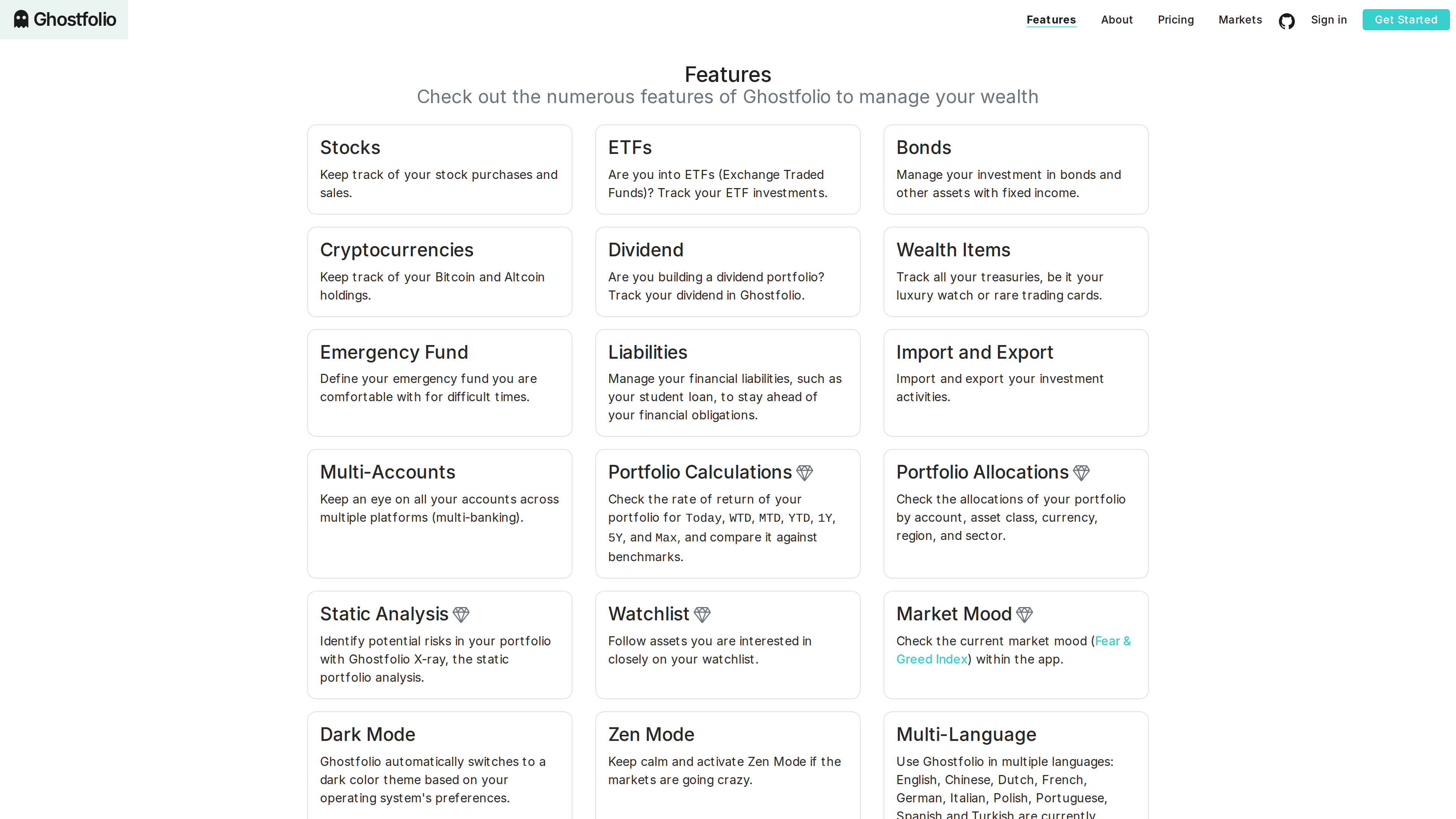
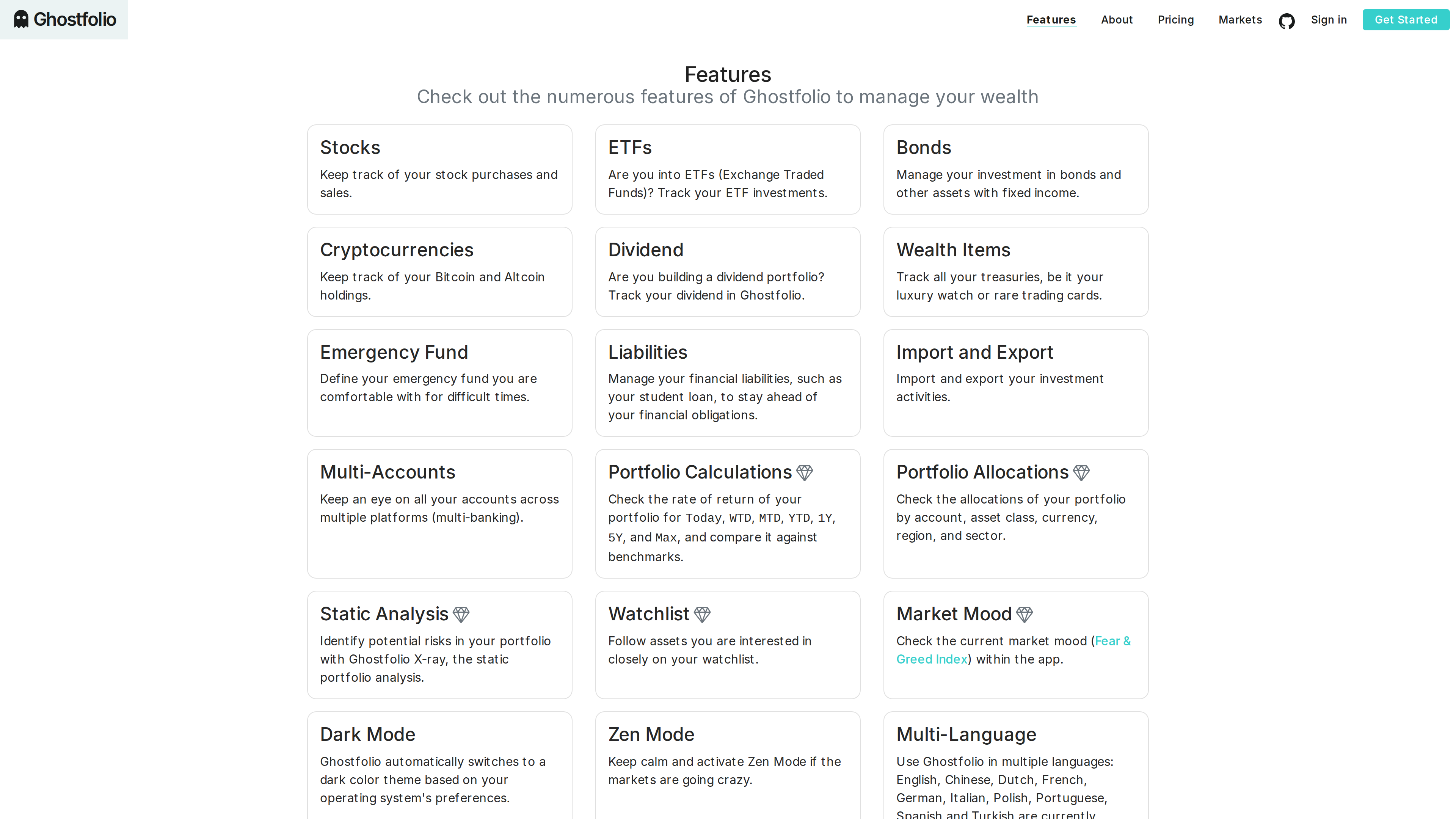
The screenshot above shows the official features page (2026-10-02). The main capabilities in summary:
- Multi-asset, multi-account tracking: record buys, sells and dividends for stocks, ETFs, bonds, cryptocurrencies and commodities, plus cash, an emergency fund, liabilities (e.g. student loans) and even "wealth items" like a luxury watch or trading cards. Accounts can be grouped into "platforms" to surface concentration risk at a single institution.
- Performance and allocation analysis: returns are calculated for Today, WTD, MTD, YTD, 1Y, 5Y and Max, with benchmarks such as Bitcoin, Gold or the S&P 500 for comparison; allocations break down by account, asset class, currency, region and sector. Per the FAQ, performance uses the ROAI method (Return on Average Investment, based on average capital invested over time) and dividends are not part of the calculation (FAQ).
- Ghostfolio X-ray: a static analysis that flags potential portfolio risks (e.g. concentration, region or sector exposure) against configurable rules; since 3.0 the rules can be customized to your strategy (3.0 announcement).
- FIRE calculator and emergency fund: built-in financial-independence/retire-early projections and emergency-fund targets (pricing page feature list).
- Watchlist and market mood: follow assets you do not own; the app shows the Fear & Greed Index and how far major benchmarks sit from their all-time highs (Markets).
- Import, export and API: investment activities can be imported and exported; the repository README documents a REST API v1 (Bearer token auth, with endpoints such as
/api/v1/importand/api/v1/export), and activity types cover BUY, SELL, DIVIDEND, FEE, INTEREST and LIABILITY (GitHub README). - Experience details: dark mode, a "Zen Mode" that hides figures when markets go crazy, and a mobile-first PWA design.
- Try without registering: the public Live Demo exposes the full interface with a demo portfolio.
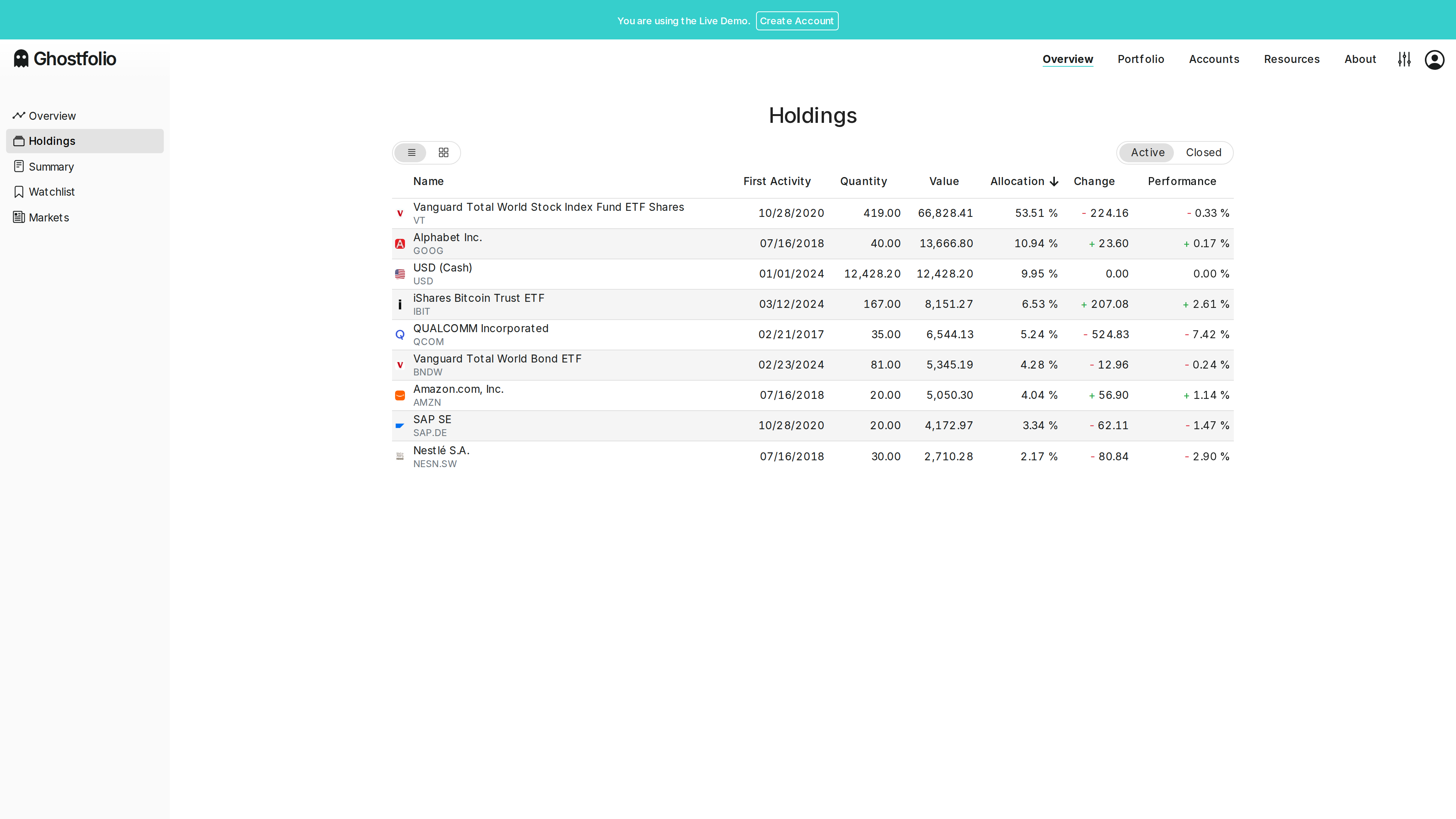
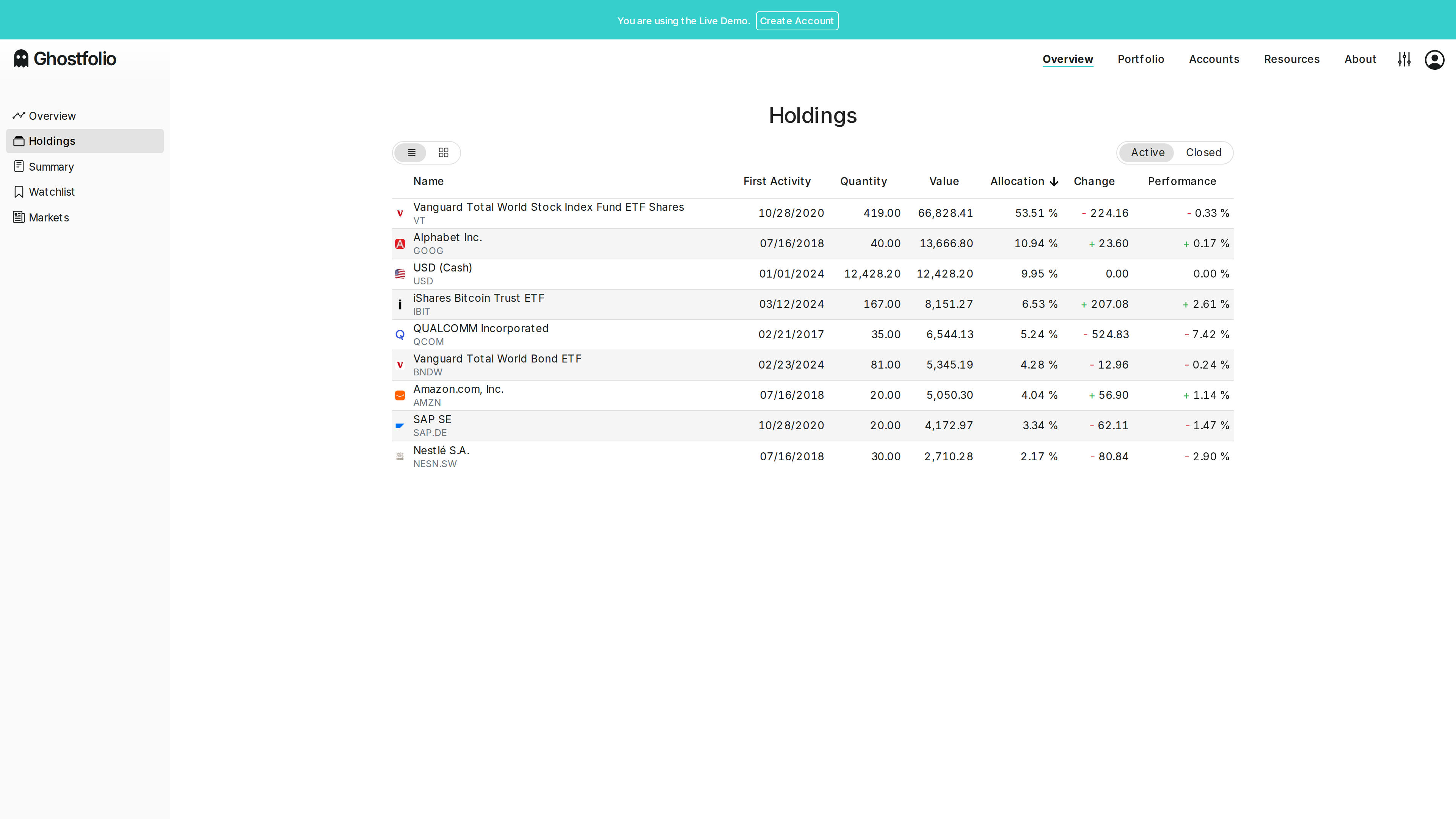
The screenshot above shows the Live Demo's Holdings view (2026-10-02, public demo data): positions are sorted by allocation, with first-activity date, quantity, value and daily change.
Data Sources and Privacy
For market data, four data providers are officially supported: Yahoo (Yahoo Finance), CoinGecko (cryptocurrencies), MANUAL (hand-maintained, combinable with a scraper configuration to pull data from almost any website) and GHOSTFOLIO (the professional data provider bundled with Premium); all other providers are considered experimental (Self-Hosting FAQ).
Privacy is the project's headline stance: the FAQ states that financial data is neither sold nor shared with third parties; anonymous sign-up works via a security token and the service does not even collect an email address, so there is no marketing email either; the business model rests solely on Premium subscriptions and sponsors (FAQ, SaaS FAQ).
Deployment and Pricing
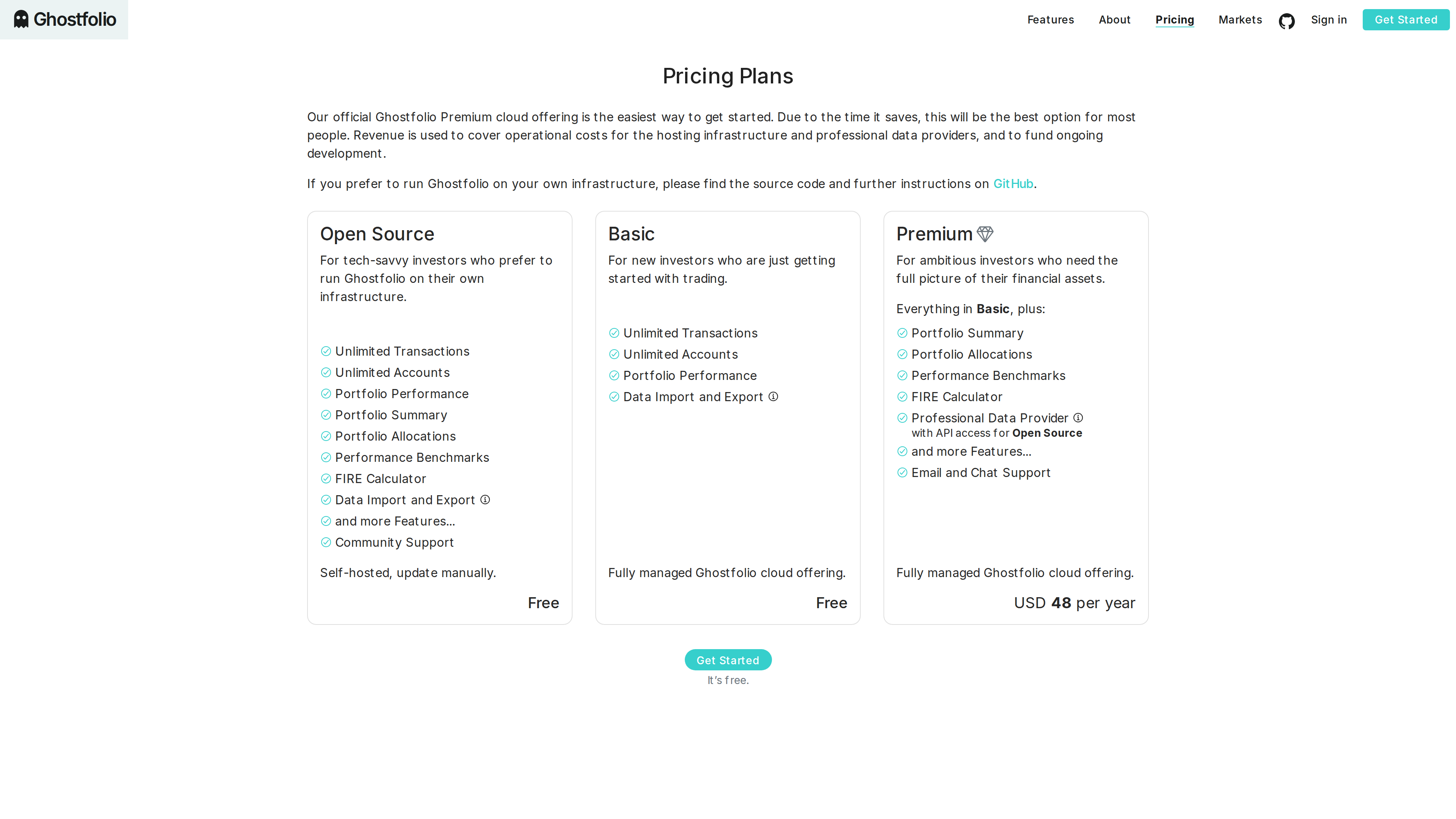
As of 2026-10-02, the pricing page offers three ways to use Ghostfolio:
| Plan | Price | Includes |
|---|---|---|
| Open Source (self-hosted) | Free | Unlimited transactions/accounts, performance, summary, allocations, benchmarks, FIRE calculator, import/export and more; community support; you deploy and update it yourself |
| Basic (managed cloud) | Free | Unlimited transactions/accounts, performance, import/export; fully managed |
| Premium (managed cloud) | USD 48/year | Everything in Basic plus portfolio summary, allocations, benchmarks, FIRE calculator, the professional data provider (with API access for self-hosted instances), and email/chat support |
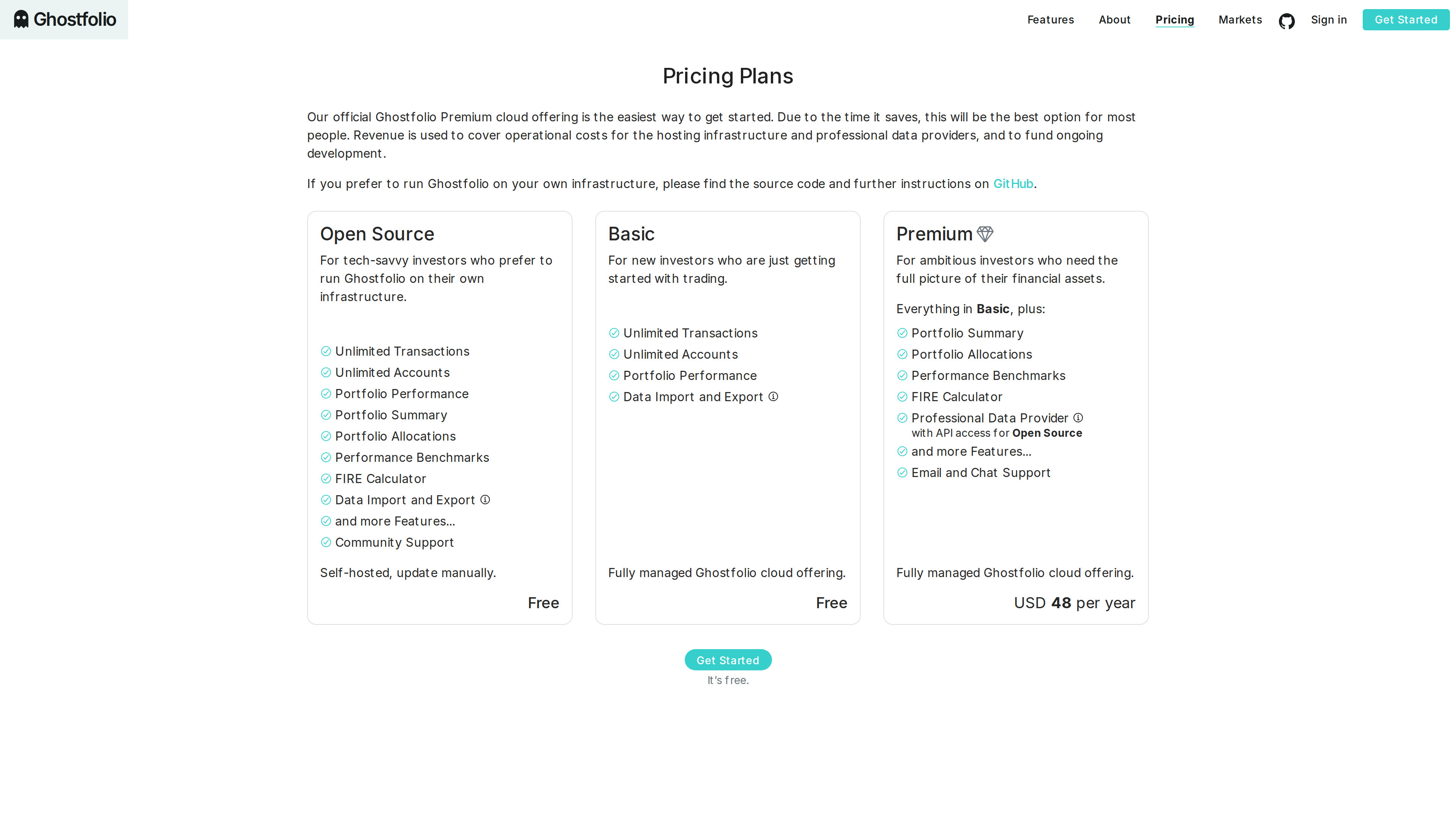
The pricing page screenshot above (2026-10-02). Additional details: Premium does not auto-renew — you decide whether to start a new subscription when it expires; a trial can be requested under Membership after signing up; students can apply for a discount with a university email address (SaaS FAQ).
For self-hosting, official Docker Hub images cover linux/amd64, linux/arm/v7 and linux/arm64, with docker-compose files provided; PostgreSQL and Redis are required. The community has packaged Ghostfolio for home-server systems including CasaOS, Home Assistant, Umbrel, Unraid and TrueNAS (README, Self-Hosting FAQ). Since 3.0, self-hosted instances can also use the official professional data provider via a Premium API key.
Who It Is For
- Investors whose assets are spread across multiple brokers and exchanges, who want a single net-worth and allocation overview without handing bank credentials to an aggregator.
- Buy-and-hold investors, dividend investors and FIRE followers who need long-term performance tracking, benchmark comparison and retirement projections rather than trading tools.
- Privacy-conscious, technical users willing to run Docker so their financial data stays on their own infrastructure.
- Spreadsheet-weary DIY investors: one of the project's stated target audiences is people "saying no to spreadsheets in 2026."
Limitations
- Manual entry first: Ghostfolio does not connect to banks or brokers. Transactions are entered one by one (or loaded in bulk via import/API); there is no automatic position sync, so keeping the ledger current takes discipline.
- Delayed quotes: the Markets page explicitly notes that calculations are based on delayed market data and may not be real-time; free data sources have limited coverage and precision, and higher-quality quotes require Premium's professional data provider.
- Self-hosting overhead: you maintain PostgreSQL/Redis and apply updates yourself; historical exchange rates for newly added currencies must be fetched manually in the admin panel, or performance calculations will fail with missing-rate errors (Self-Hosting FAQ).
- Restricted free cloud tier: the Basic plan excludes the portfolio summary, allocations, benchmarks and the FIRE calculator — per the pricing page these are included in both the self-hosted and Premium tiers.
- Dividends excluded from performance: a deliberate property of the ROAI method — investors who care about total return including dividends should be aware of the convention.
- No public roadmap, no native iOS app: the FAQ states there is no public roadmap; on mobile there is only the Android app for managed-cloud users plus the general PWA.
Alternatives
On the open source, self-hostable path, Maybe focuses on net worth and full-account aggregation while Actual Budget centers on budgeting; if automatic bank syncing matters most, compare commercial services such as Monarch Money or Lunch Money. Ghostfolio's distinction is its focus on portfolio analysis and privacy rather than bookkeeping or budgets.
References
- Ghostfolio website, features, pricing, FAQ (with SaaS and Self-Hosting sections), Open Startup, Markets (checked 2026-10-02)
- GitHub repository and README, GitHub API repository data (queried 2026-10-02)
- Official blog: Hello Ghostfolio (2021-07-31), Ghostfolio 3.0 announcement (2026-04)
- Privacy Policy, Terms of Service, Changelog