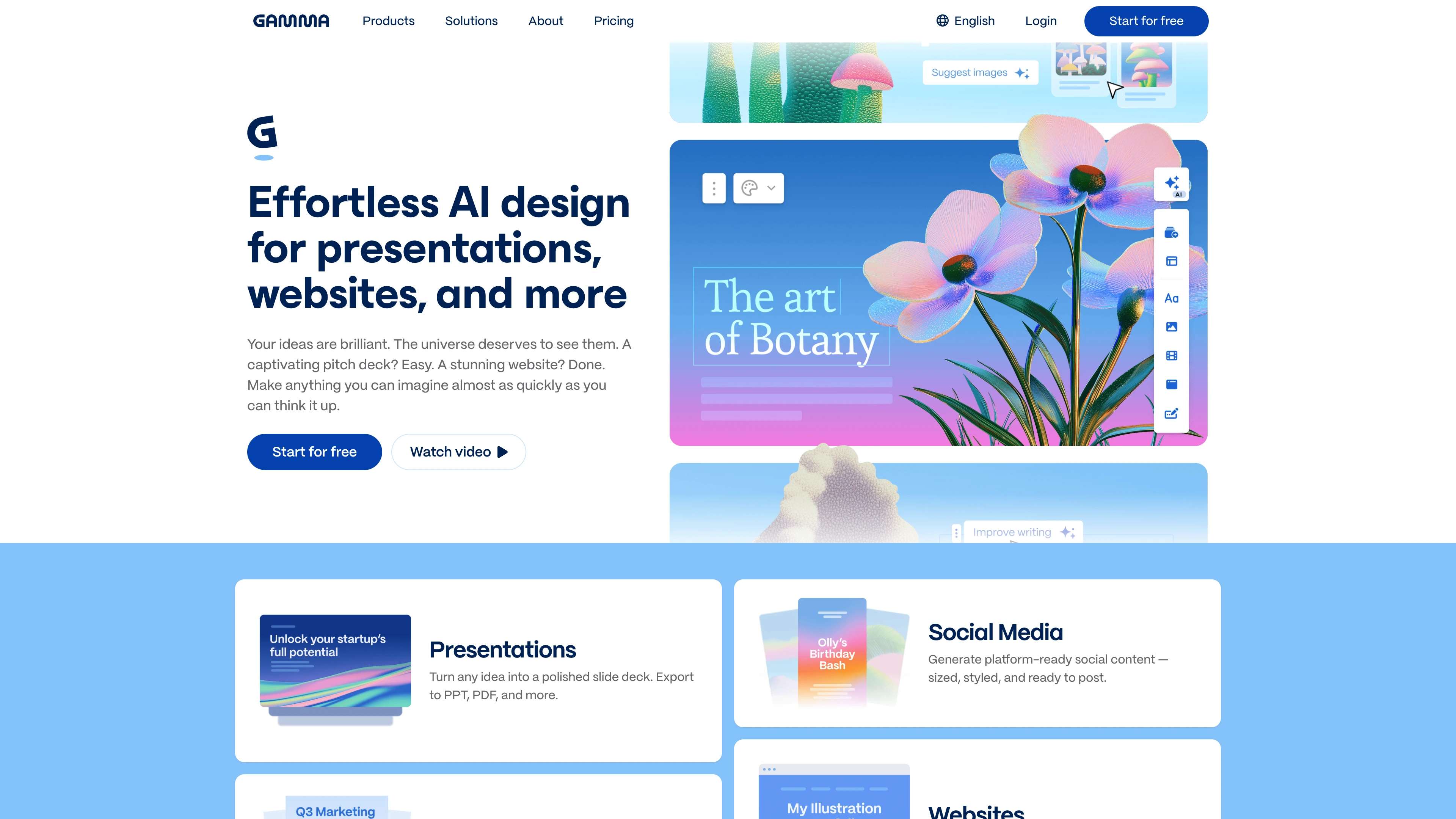
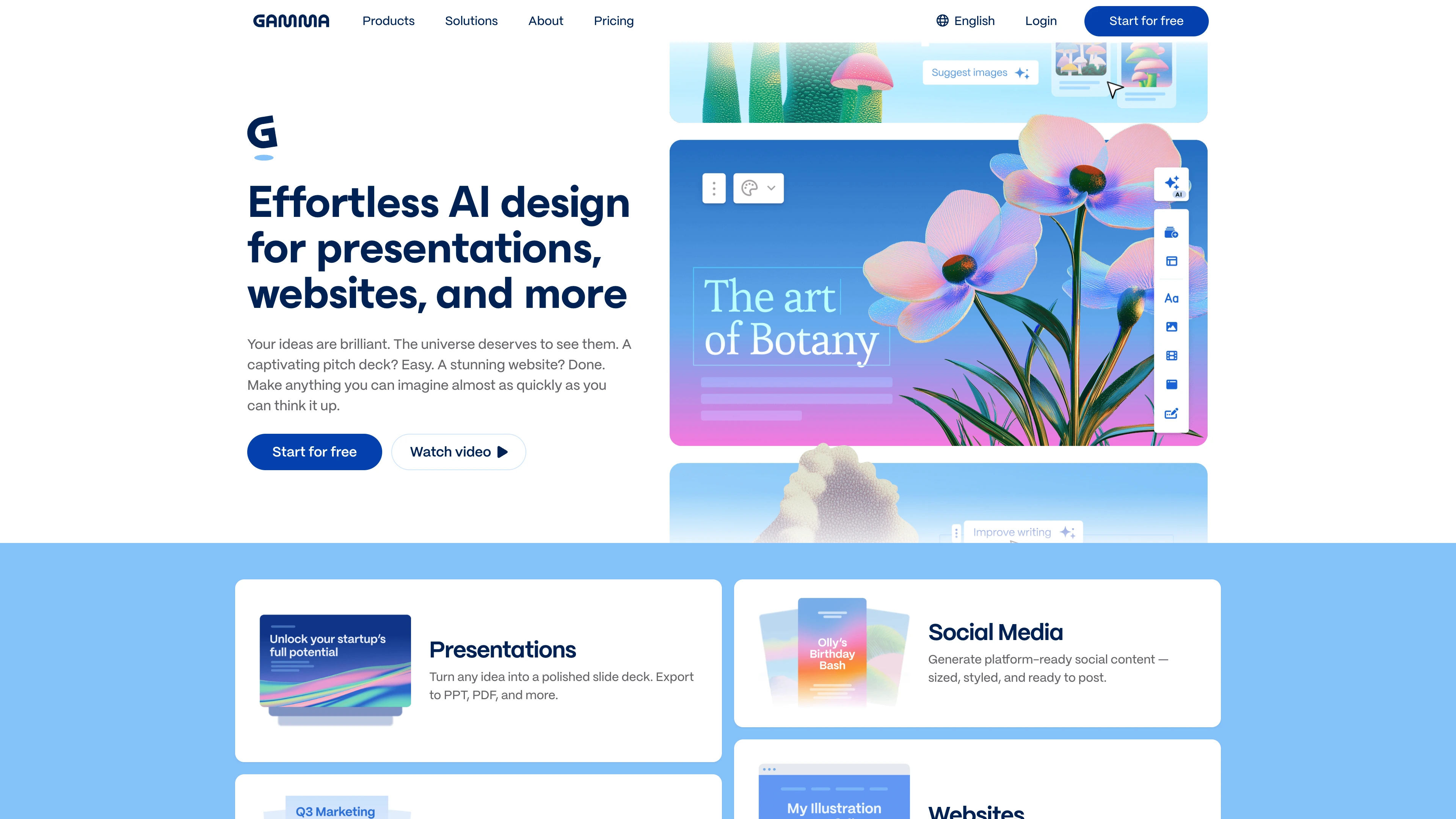
Gamma is a browser-based AI content generation and design platform. Give it a one-line prompt, paste an outline, or import a PDF or PPTX file, and it produces a fully laid-out presentation, document, webpage, or social media asset. You keep refining it in the editor — manually or with AI — and then export to PPT, PDF, or PNG, or publish it straight to the web as a link or a hosted site. Where traditional tools like PowerPoint start from a blank page you format by hand, Gamma hands the first draft and the visual design to AI and leaves content and fact-checking to you.
At a glance
- URL: https://gamma.app/
- Type: AI presentation / document / webpage generation and design tool (runs in the browser, nothing to install)
- Cost: Free tier plus subscriptions; Plus from 18, Ultra $90 (as of 2026-08-31, details below)
- Sign-up: A free account is required to generate content (no credit card); viewing publicly shared content requires no account
- Languages: Multi-language interface that follows your browser language and can be switched in settings; AI generation supports prompts and output in 60+ languages (see "Limitations")
Background
Gamma was founded in San Francisco in late 2020 by Grant Lee, Jon Noronha, and James Fox, who had previously worked together at Optimizely. The product opened to the public in August 2022 and topped Product Hunt's monthly chart that month; growth accelerated after GPT-powered AI generation launched in March 2023 (founder interview summary, 2024-08).
On funding and scale: the company raised a 68 million Series B in November 2025 led by Andreessen Horowitz with Accel and Uncork Capital participating, at a 100 million in ARR, profitability, and roughly 70 million users at the time (TechCrunch, 2025-11-10, Fundz). As of 2026-08-31, its official About page cites more than 100 million users, a $2.1 billion valuation, and about one million creations per day. The site also states the company is SOC 2 Type II compliant.
Generate, edit, share
Three ways in: generate from a single prompt (up to 10 slides per prompt on Free, up to 100 on Plus), paste an outline or long text for the AI to restructure, or import a PDF/PPTX file for conversion. Gamma says it draws on 20+ AI models and offers 100+ themes. Content is organized as flexible "cards" rather than fixed-size slides, so layouts can be mixed within one document.
Editing happens in the web editor. Manual edits cost nothing; AI-assisted actions (rewriting, layout changes, image generation, chatting with the Agent) consume credits per action, and image generation shows the credit price of the selected model before you run it.
Sharing and delivery are central to the product:
- Export to PDF, PPTX, PNG, or directly to Google Slides (all export formats are included in the free tier);
- Share as a link, embed in a page, or publish as a Gamma-hosted website (paid plans support custom domains — 10 on Pro, 100 on Ultra);
- Real-time collaboration and comments for teams;
- Engagement metrics on shared content, with more detailed analytics from Pro up;
- A public API from Pro up for programmatic, large-scale content generation.
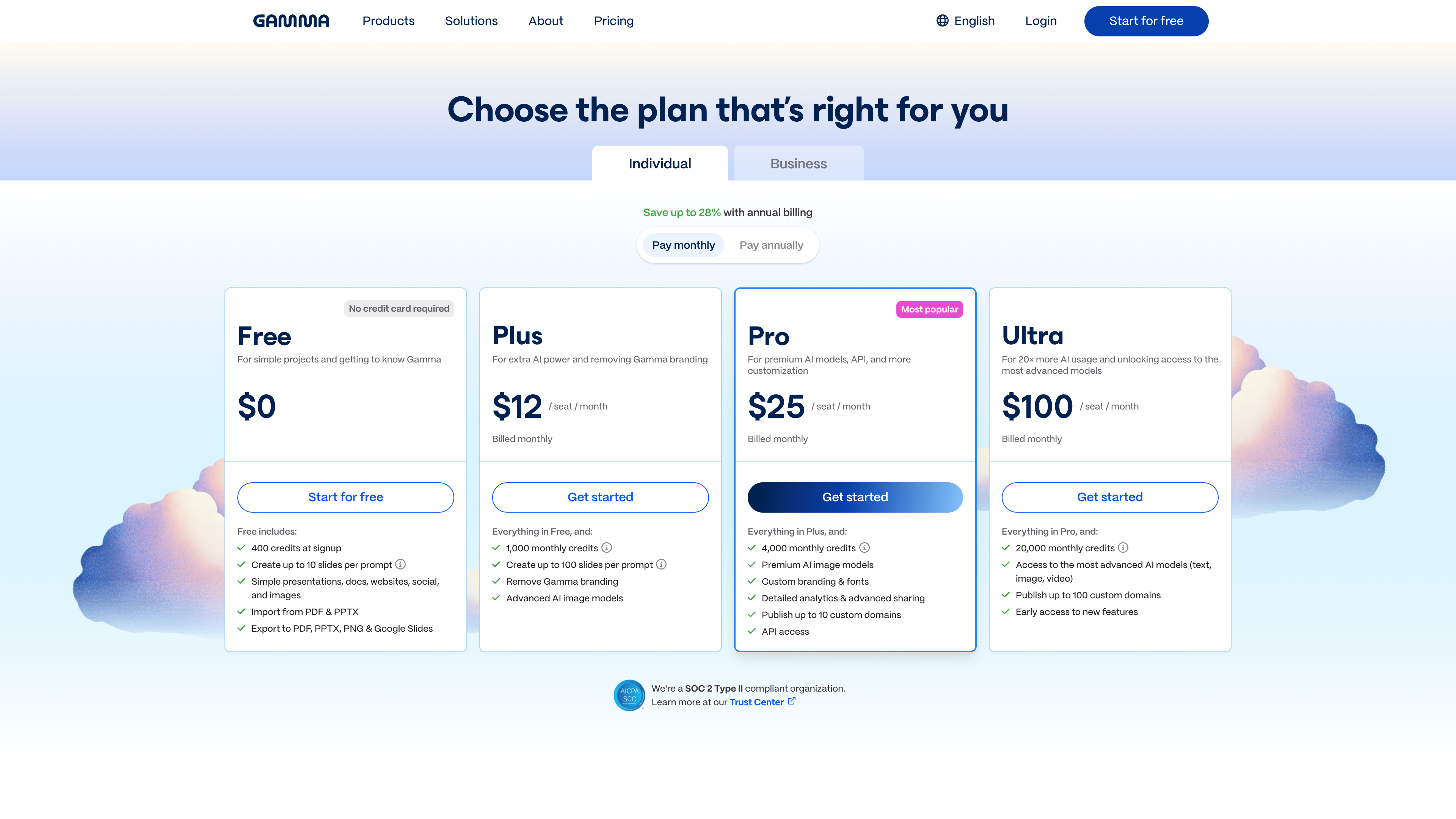
Pricing and credits (official pricing page, as of 2026-08-31):
| Plan | Monthly billing | Annual billing (per month) | Credits |
|---|---|---|---|
| Free | $0 | $0 | 400 at signup, one-time, no refresh |
| Plus | $12/seat/mo | 108/yr) | 1,000/month |
| Pro | $25/seat/mo | 216/yr) | 4,000/month |
| Ultra | $100/seat/mo | 1,080/yr) | 20,000/month |
Per the official credits article: AI actions are metered per slide, per image, and by model, and rates may change as features and models evolve. Free credits never refresh — once spent, you earn more through referrals (200 credits each) or upgrade. Paid credits refill monthly and roll over up to twice the plan's monthly allowance. Removing Gamma branding requires Plus or above — in other words, free-tier exports and shared pages carry a Gamma badge.
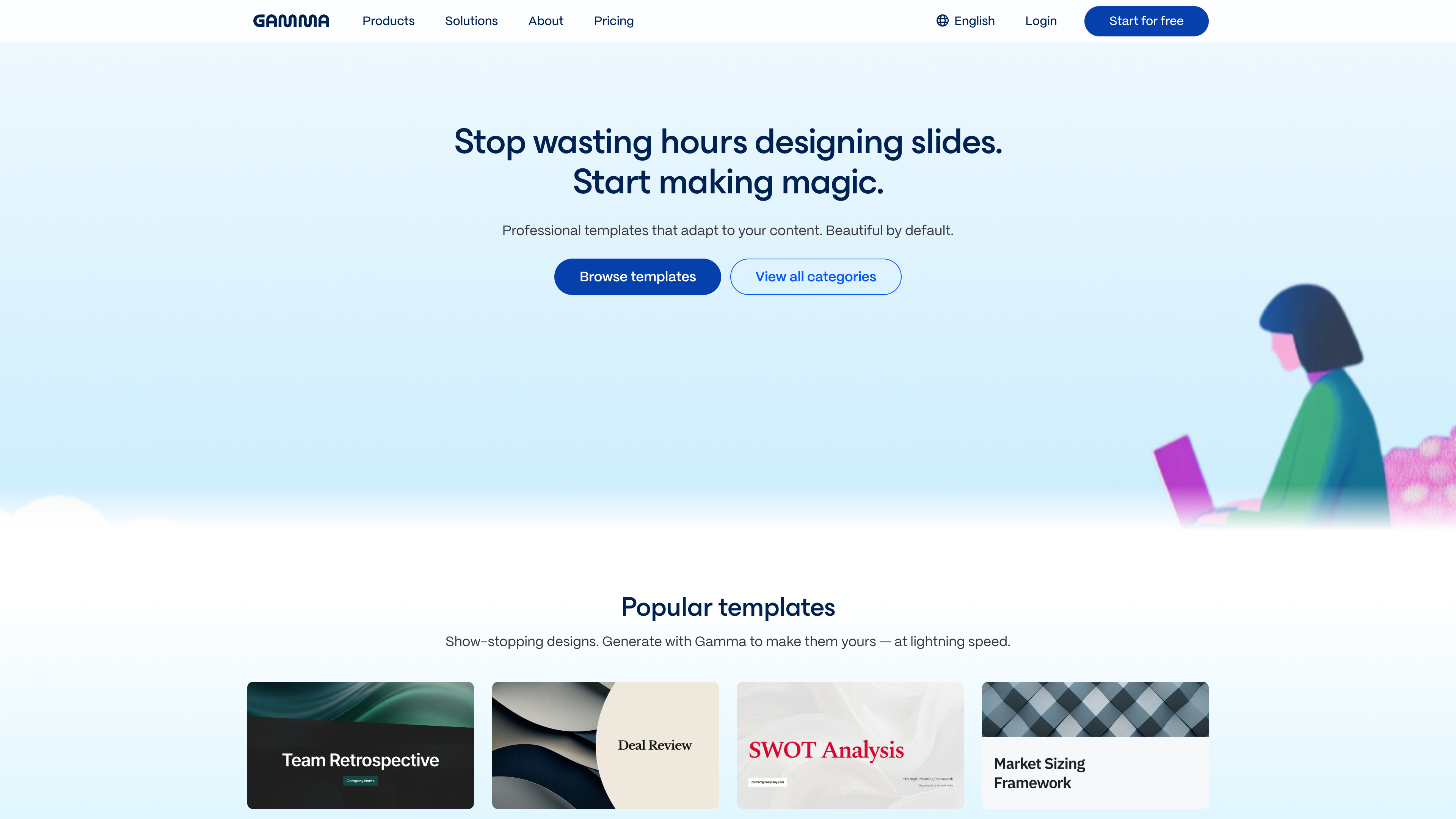
If you'd rather not start from a prompt, the template gallery offers ready-made structures (retrospectives, SWOT analyses, market sizing, and more) that the AI then fills with your content.
Good fits
- People who need a pitch, report, lecture, or training draft fast, and would rather spend their time on content than on layout;
- Teams that deliver material as links instead of attachments (online docs + engagement metrics + real-time collaboration);
- Small teams without design or engineering resources who want a lightweight webpage or event page live quickly;
- Marketers and operators who need the same material reshaped into decks, docs, and social assets;
- Teams that want to generate customized material in bulk via the API (Pro and up).
Limitations
- The free allowance is one-time: the 400 signup credits never refresh (official credits article). At tens of credits per full generation, that covers roughly ten complete pieces; and since credit rates "are subject to change," long-term cost is hard to predict.
- Free content carries Gamma branding: removing the badge requires Plus or above.
- Export fidelity is limited: Gamma's own help center acknowledges that exports differ from what you see in the editor — exports follow Present Mode, and PPTX files opened in Google Slides get their fonts substituted (official export-differences article). Because Gamma is built on fluid web layouts, exported PPTX files generally re-edit less cleanly in traditional office software than natively built decks; teams whose deliverable is a .pptx file should test this first.
- AI output needs human review: as with any generative tool, the text, figures, and images it produces can contain errors and should be verified before publishing (a property of the category, not unique to Gamma).
- Online and account-only: all generation and editing happen in the cloud, with no offline mode, and nothing can be generated without an account.
- No official word on Chinese support: the site's FAQ states that generation and prompts work in 60+ languages (naming Spanish, German, French, Portuguese, Japanese, and Korean, among others, without a full list). The interface follows the browser language and can be switched in settings, but Gamma publishes no definitive list of interface languages — Chinese interface and generation quality are best verified with a free account.
Alternatives for context
Against PowerPoint and Google Slides, Gamma is "generation-first": the draft comes from AI, and the default deliverable is a link rather than a local file — at the cost of fidelity when exporting back to traditional formats. Against Canva, both offer templates plus AI generation, but Canva grew from a template-driven manual design platform into a broader catalog (print, video, and more), while Gamma stays focused on the idea-to-shareable-document pipeline. Tome, once a close competitor in AI presentations, shut down its presentation product in April 2025 (AI Tools Insider, 2026-07) — a useful data point on how volatile this category remains.
Sources
- Gamma homepage: positioning, features, and public figures such as "100M+ users"
- Gamma pricing: four tiers, credit allowances, and feature differences (as of 2026-08-31)
- Gamma About: valuation, ARR, user scale, and company information
- Help Center: How do credits work in Gamma: no free-tier refresh, rollover rules, and referrals
- Help Center: How do I use Gamma in my preferred language: interface language matching and multi-language generation
- Help Center: Why doesn't my exported PDF or PowerPoint match what I see in Gamma: export fidelity and font substitution
- TechCrunch: Gamma hits 100M ARR (2025-11-10)
- Fundz: Gamma $68M Series B (2025-11-10)
- Founder interview summary (2024-08): founding date, public beta, and AI feature timeline