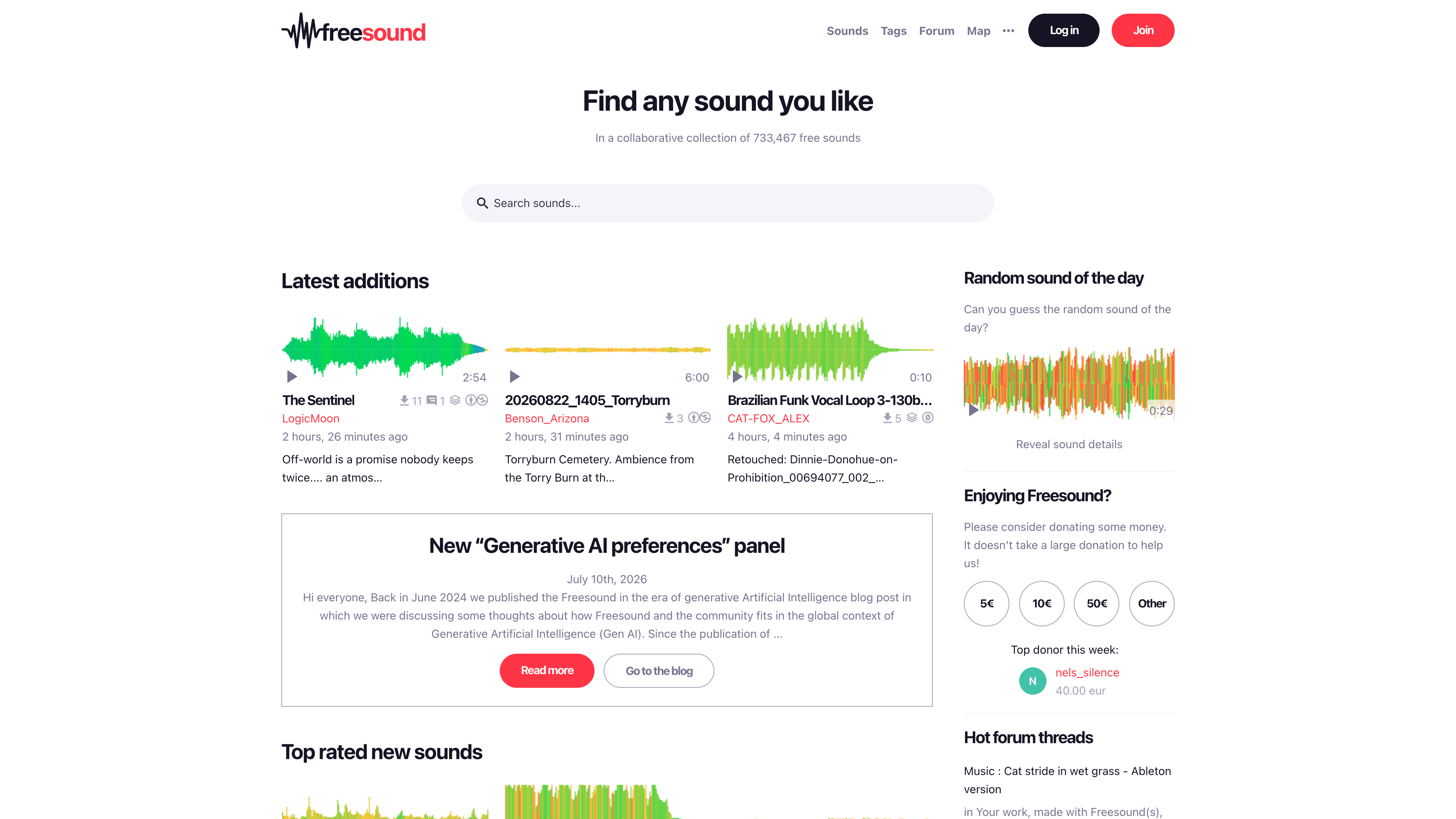
Freesound is a collaborative sound-sharing library: anyone can upload their own field recordings, sound effects or instrument samples, and everyone else can search them, preview them in the browser and reuse the downloads under the Creative Commons license attached to each file. Launched in 2005, it is created and maintained by the Music Technology Group (MTG) at Universitat Pompeu Fabra (UPF) in Barcelona, Spain — one of the oldest and largest projects of its kind, and unusual in being run long-term by a university research group serving both creators and audio researchers.
At a glance
- URL: https://freesound.org/
- Type: collaborative sound / sample sharing library (user-uploaded content)
- Cost: free to use; operations are funded by the university, the Phonos Foundation and user donations
- Registration: browsing, searching and in-browser preview need no account; downloading, uploading, commenting and rating require a free account, and registered users must be 18 or older
- Interface language: English
- Launched: 2005
Background
Freesound was started in 2005 at the Music Technology Group, with Bram de Jong as its original developer. According to the official FAQ, the project has two goals: building a collaborative database of audio released under licenses that permit reuse, and giving audio research an open database with clear licensing — many research institutions have long struggled to find audio they can legally use to test algorithms. The site is maintained today by a Freesound team of MTG researchers and engineers, funded by UPF, the Phonos Foundation and community donations.
The project turned 20 in 2025. Per the official 2025 in numbers blog post, 47,068 new sounds (about 1,494 hours of audio) were uploaded during 2025, and sounds were downloaded more than 23.7 million times that year; as of that post (January 2026) the site hosted 714,671 sounds totalling 536 days and 8 hours of audio, with over 278 million lifetime downloads. As of 2026-09-01, the live counter on the Freesound homepage shows roughly 733,000 free sounds.
Search, preview and download
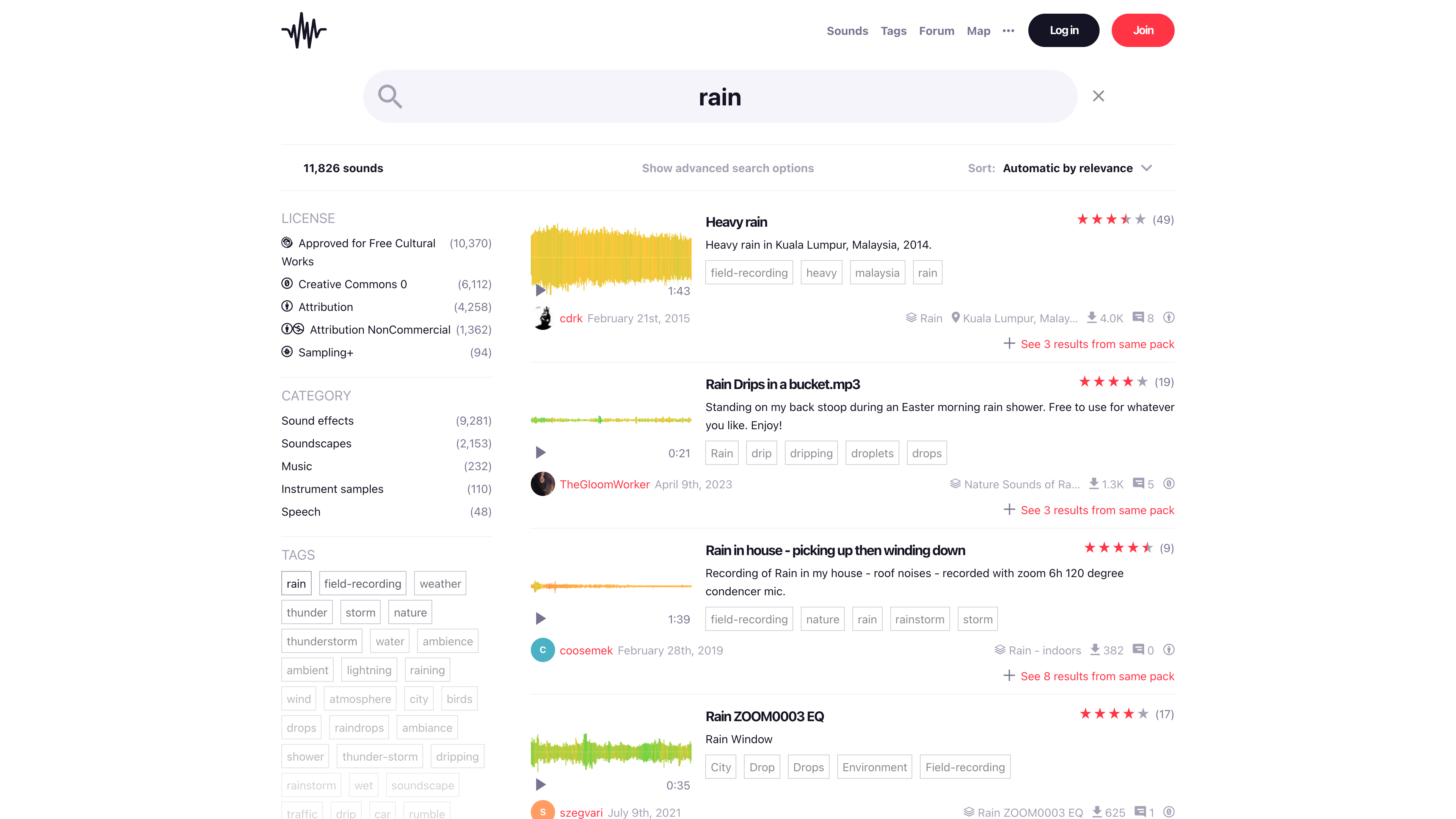
Search is keyword-driven, with an advanced panel for filtering by license, duration, sample rate, tags and more. Since April 2025 the site classifies sounds with its own Broad Sound Taxonomy (5 top-level and 23 second-level classes); uploaders must pick a category, older sounds were auto-classified by an algorithm, and the results page lets you filter directly by sound effects / soundscapes / music / instrument samples / speech as well as by license. Sounds can also carry geotags, browsable on a map view.
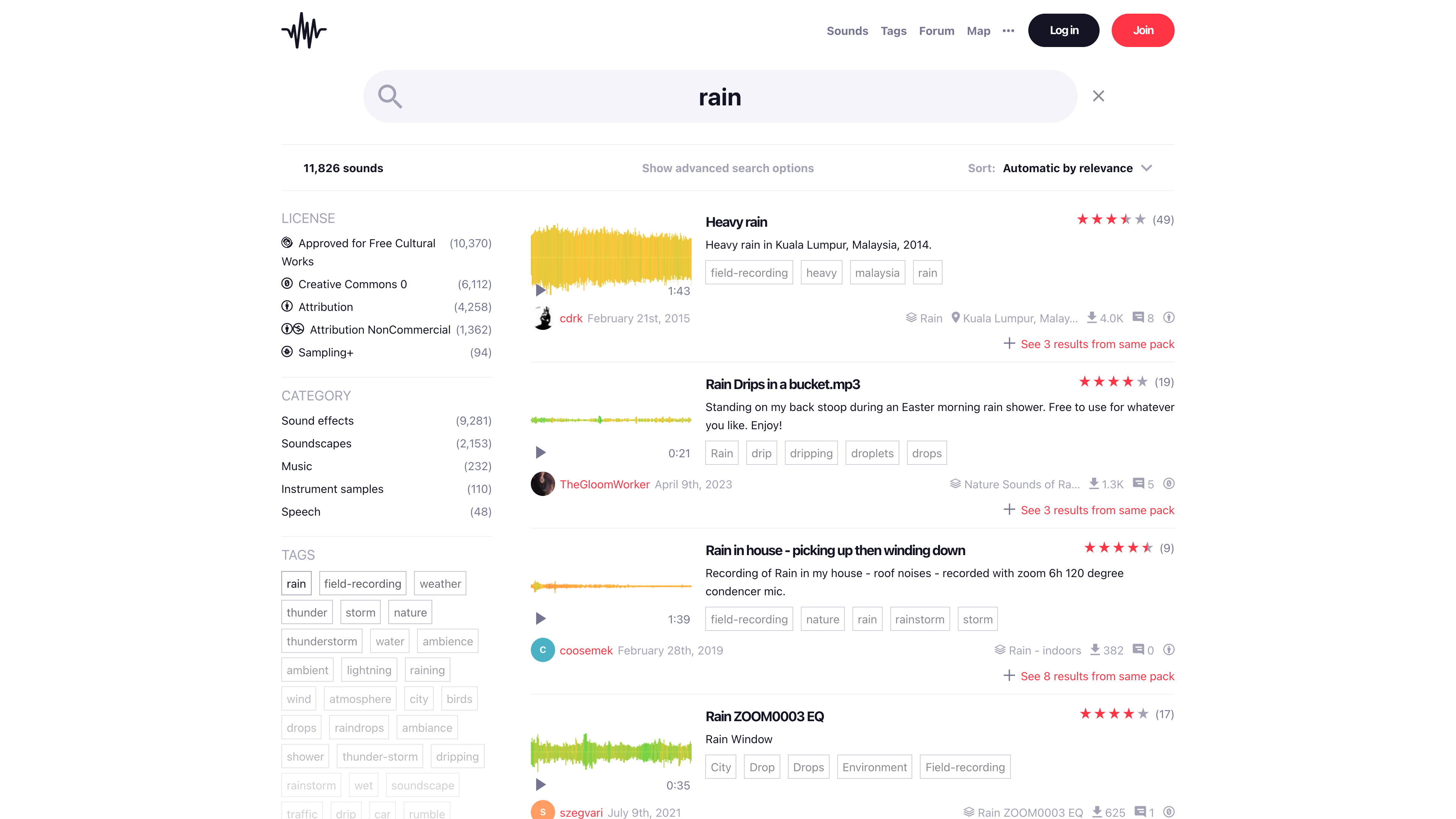
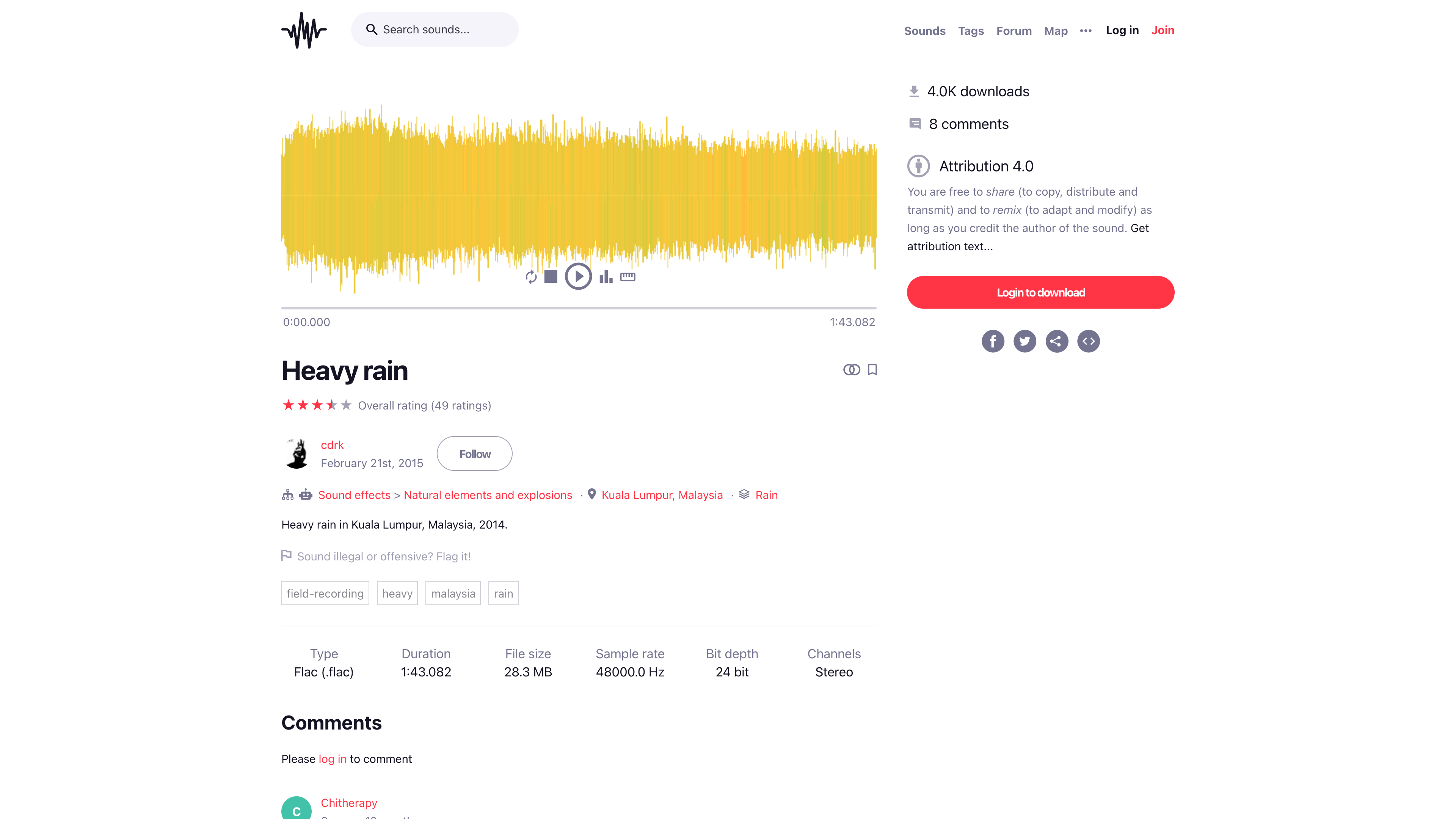
Lists and detail pages embed waveform players for instant preview. The FAQ explains that previews are low-bitrate mp3/ogg encodes to save bandwidth, while downloads are the exact original files as uploaded, with no transcoding. WAV/AIFF, FLAC, Ogg Vorbis and MP3 are supported, and each detail page lists format, duration, sample rate and bit depth. Authors can group sounds into packs for bulk download. Uploads are capped at 1GB total per batch.
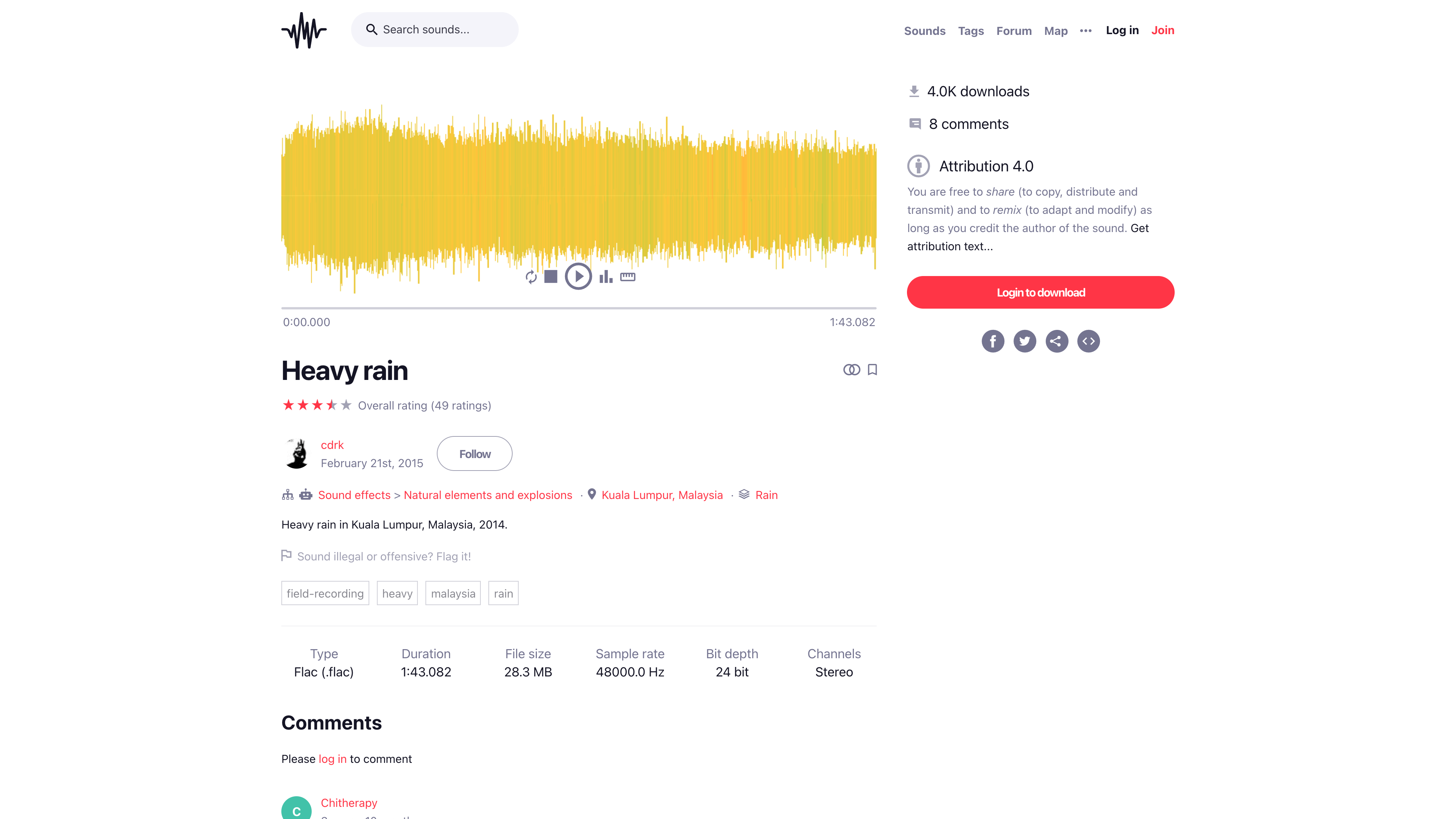
One caveat: although browsing and previewing are fully open, the download button reads "Login to download" when signed out — you need a free registered account to fetch the original files.
Accounts and open access
With an account you can download sounds, upload recordings, rate, comment and bookmark. Your download history is kept on your profile, and the site generates an attribution list from it so you can credit every sound you used in one place. Uploads pass through quality and legality review by volunteer moderators from the community.
For developers there is the Freesound APIv2: beyond standard search and metadata, it offers content-based "similar sounds" queries, automatically extracted audio descriptors, and OAuth2-authenticated uploading, commenting and rating. The API is free but rate-limited, and commercial use is negotiated with the university case by case. Institutions that want bulk downloads — for example to train models — are directed to the Freesound Data Packs portal rather than scraping the API.
Copyright and content policy
Because Freesound is user-generated content, its licensing rules are the part most worth understanding before use. Uploaders choose one of three Creative Commons licenses per sound; the official FAQ summarizes them as follows:
- CC0 (public domain dedication): usable for almost anything, including commercial work, with no attribution required (though you may not claim authorship);
- CC BY 4.0 (Attribution): commercial use allowed, but you must credit the original author — the site suggests a "sound name + author + link + license" format;
- CC BY-NC 4.0 (Attribution–NonCommercial): usable with credit, but not in any money-making context — commercial videos, paid games and advertising are all off-limits for these sounds.
In addition, some sounds uploaded between 2005 and 2012 still carry the Sampling+ license, which Creative Commons has retired. The platform cannot relicense users' sounds for them, so a small number of these legacy entries remain until their uploaders log in and upgrade. For remixes uploaded back to Freesound, the FAQ publishes a license-compatibility table: a derivative of a CC BY sound cannot be republished as CC0, and derivatives of CC BY-NC material must stay BY-NC.
Uploaders warrant that they hold the rights to what they share; material sampled from commercial songs, games, films or broadcasts is not allowed, and a "Flag it!" link on every sound page lets users report violations for removal. Full songs are also rejected — Freesound is a sound library, not a music-sharing site — though self-made loops, stems and solo instrument parts are welcome.
Its generative-AI policy has evolved notably in the past two years: AI-generated sounds may be uploaded but must carry the GenAI tag and name the model in the description. Since July 2026, a Generative AI preferences panel lets uploaders declare, on top of the CC license, whether their sounds may be used to train generative AI (options include "Open Source Models only", "Non-Commercial Open Source Models only" and "No generative AI", with a separate opt-out for voice recordings), and both the API and Data Packs expose these preferences for filtering.
One practical risk: Freesound effects are often used "raw" in songs that are then submitted to YouTube Content ID, so a video using the same effect can receive a copyright claim. The official advice is to dispute the claim through YouTube, using the Freesound upload date as evidence that the sound predates the claimed work.
Good fits
- Video, podcast and animation production needing ambience, transitions and foley;
- Game and interactive-media sound effects, from prototyping to shipped assets (check the license allows commercial use);
- Music producers looking for loops, stems and instrument samples;
- Audio-research work — providing cleanly licensed research data is a stated goal of the project, and the API plus audio descriptors are open to researchers.
Limitations
- The interface is English-only, and sound descriptions and tags are predominantly in English, which limits non-English search;
- Downloading requires a registered account, and registration is restricted to users aged 18+;
- Three coexisting licenses mean nothing is "grab and go": each sound's license must be checked individually, CC BY-NC material is excluded from commercial projects, and the legacy Sampling+ license leaves room for interpretation;
- Content is user-uploaded and community-moderated, so quality varies and infringing material can slip through — verify provenance yourself for high-stakes commercial work;
- It does not host full musical works; look elsewhere for soundtrack music.
Alternatives
For finished music rather than sound effects, Freesound's own FAQ points to ccMixter, Free Music Archive, Bandcamp and SoundCloud. Unsplash, also covered in this collection, plays a comparable role for images.
References
- Freesound homepage (live sound count, checked 2026-09-01)
- Freesound FAQ (history, licenses, download and upload rules)
- Freesound Terms and Conditions (operator, age requirement, content liability)
- 2025 in numbers · The Freesound Blog (2025 statistics)
- Freesound API documentation and API terms of use