freeCodeCamp (freecodecamp.org) is a coding education platform run by a donor-supported, tax-exempt 501(c)(3) charity (EIN 82-0779546) whose stated mission is "to help people learn to code for free." It combines an interactive curriculum with verified certifications, a technical publication, a YouTube channel and a community forum, and its FAQ states that everything — courses, projects and certifications — is 100% free. Compared with freemium platforms such as Codecademy, its verifiable distinctions are the nonprofit charity structure, the absence of any paid tier, a BSD-3-licensed open-source codebase, and a project-based learning path completed mostly by writing code directly in the browser.
At a glance
- URL: https://www.freecodecamp.org/
- Type: Free online coding education platform (nonprofit)
- Cost: Free, including certification exams and certificates; funded by individual donations
- Account: The curriculum and lessons can be browsed without an account; a free account saves your progress and syncs it with the mobile apps (FAQ)
- Languages: The build system supports 12 interface and curriculum languages, including Simplified and Traditional Chinese, Spanish, Japanese and German; the core curriculum is in English
- Operated by: Free Code Camp, Inc., founded by Quincy Larson in 2014
Background
Quincy Larson started the freeCodeCamp community in 2014 and "is now just one of thousands of active contributors," per the official FAQ. The organization is a donor-supported public charity: its IRS determination letter and annual Form 990 filings are linked from the donation page, which also cites a GuideStar.org Platinum transparency rating and describes $5/month recurring gifts as the most common way people give. Donations go toward education initiatives, servers, services and staff.
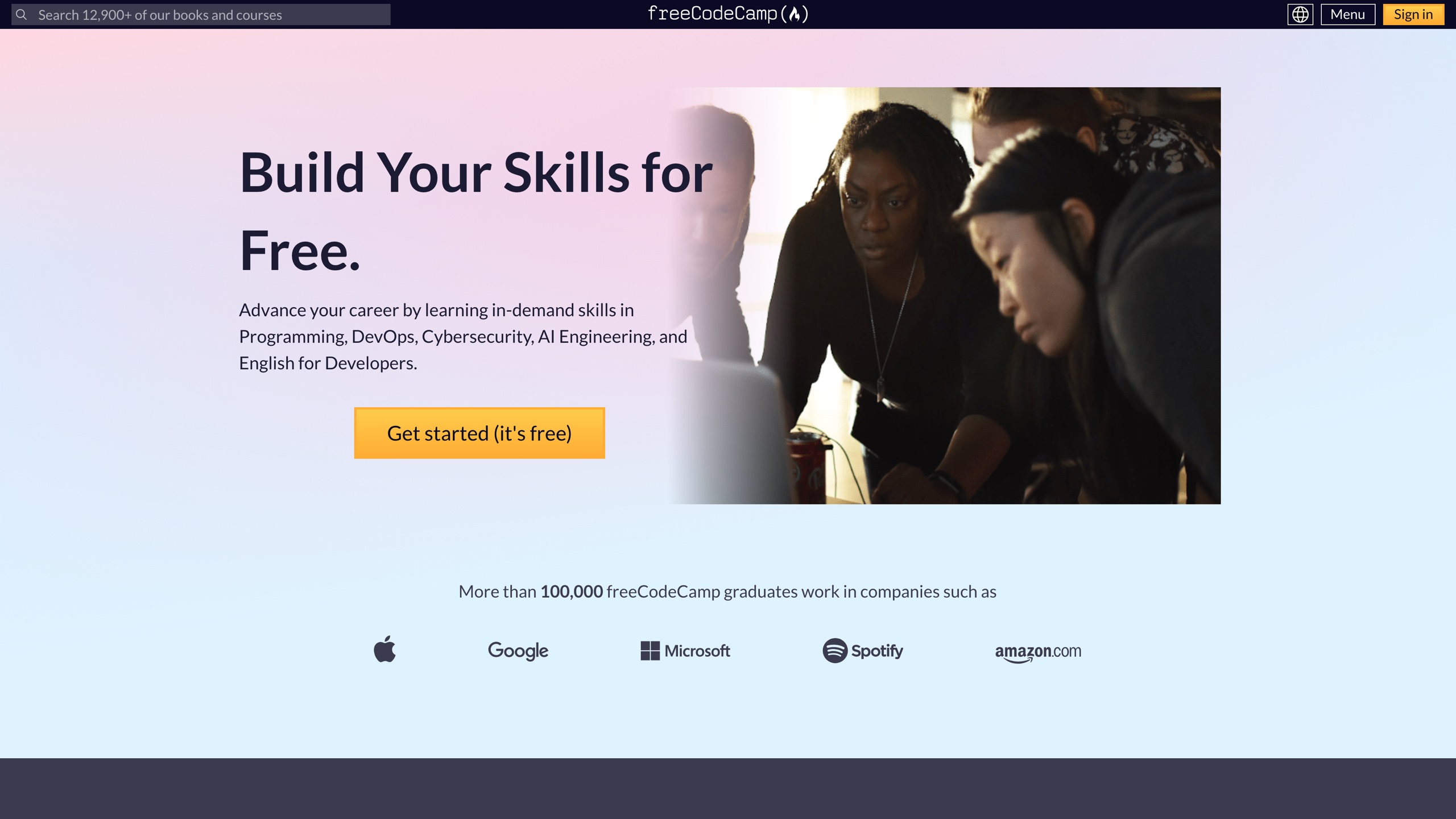
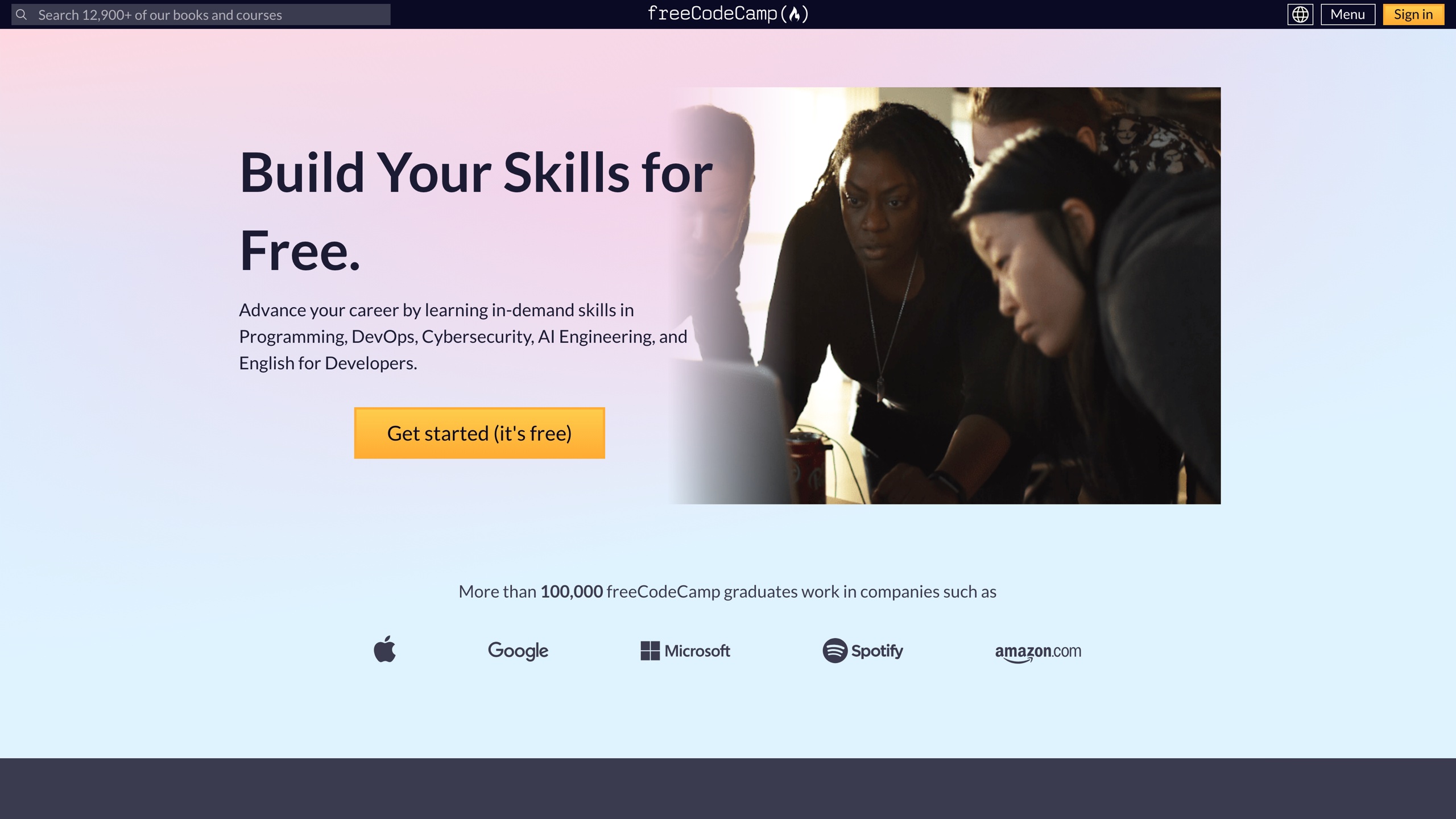
On scale, the FAQ's combined figure is "more than 1 million people every day" across the learning platform, publication, YouTube channel and forum. The site-wide footer states that the open-source curriculum "has helped more than 40,000 people get jobs as developers," while the homepage says more than 100,000 graduates work at companies such as Apple, Google, Microsoft, Spotify and Amazon — these measure different things and should not be conflated.
The curriculum
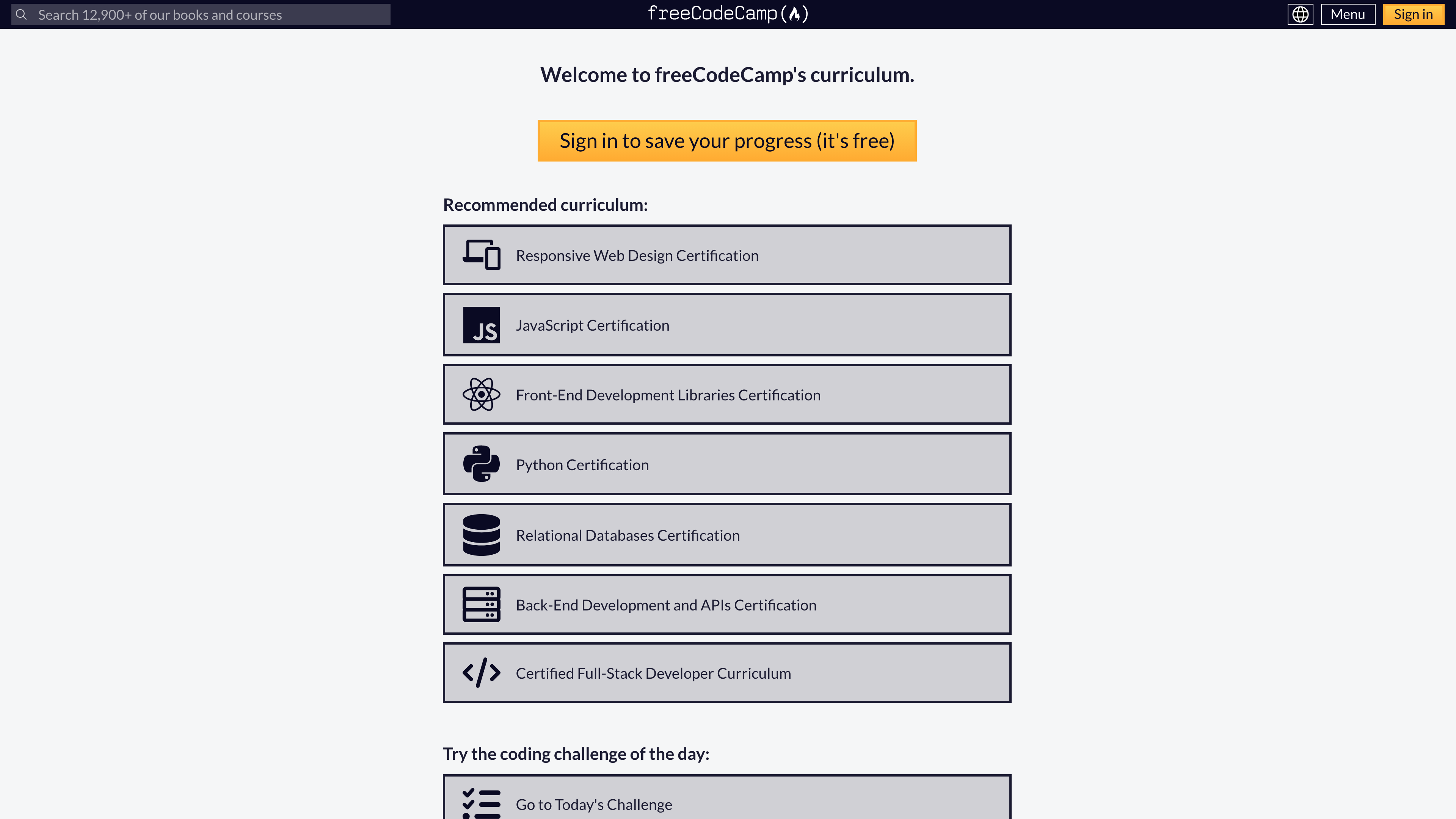
The core of the platform is its free certifications. As of 2026-09-01, the /learn page lists seven current Core certifications:
- Responsive Web Design
- JavaScript
- Front-End Development Libraries
- Python
- Relational Databases
- Back-End Development and APIs
- Certified Full-Stack Developer Curriculum (requires the prerequisite certifications first)
Beyond the Core track there are language certifications for developers (A2/B1 English, A1 Spanish and A1 Chinese, all marked Beta), a Foundational C# certification created with Microsoft, and extras such as Coding Interview Prep and Project Euler. Seventeen legacy certifications from earlier curriculum versions (up to the 2022-era V8 releases) remain "live and claimable." All of the above is based on the curriculum and certification configuration on the main branch of the official open-source repository, checked 2026-09-01.
On effort and requirements: the FAQ puts each certification at around 300 hours of dedicated, fully self-paced learning. The newer V9 certifications are two-stage — complete five required projects to qualify for the certification exam, then pass the exam — while legacy certifications required only the five projects. Front-end projects can be built with any tools, as long as the code is publicly viewable with a live demo. One caveat: the repository configuration marks some new certificates (including Full-Stack Developer V9 and A1 Chinese) as not yet live, and the exam format (question types, duration, proctoring) is not publicly documented, so actual availability should be checked on the site.
Interactive learning in the browser
Lessons are project-based and step-by-step: instructions on the left, a code editor in the middle, a live preview on the right, with automatic checks when you submit. The screenshot below shows Step 1 of a workshop in the Responsive Web Design certification — no sign-in is needed to start:
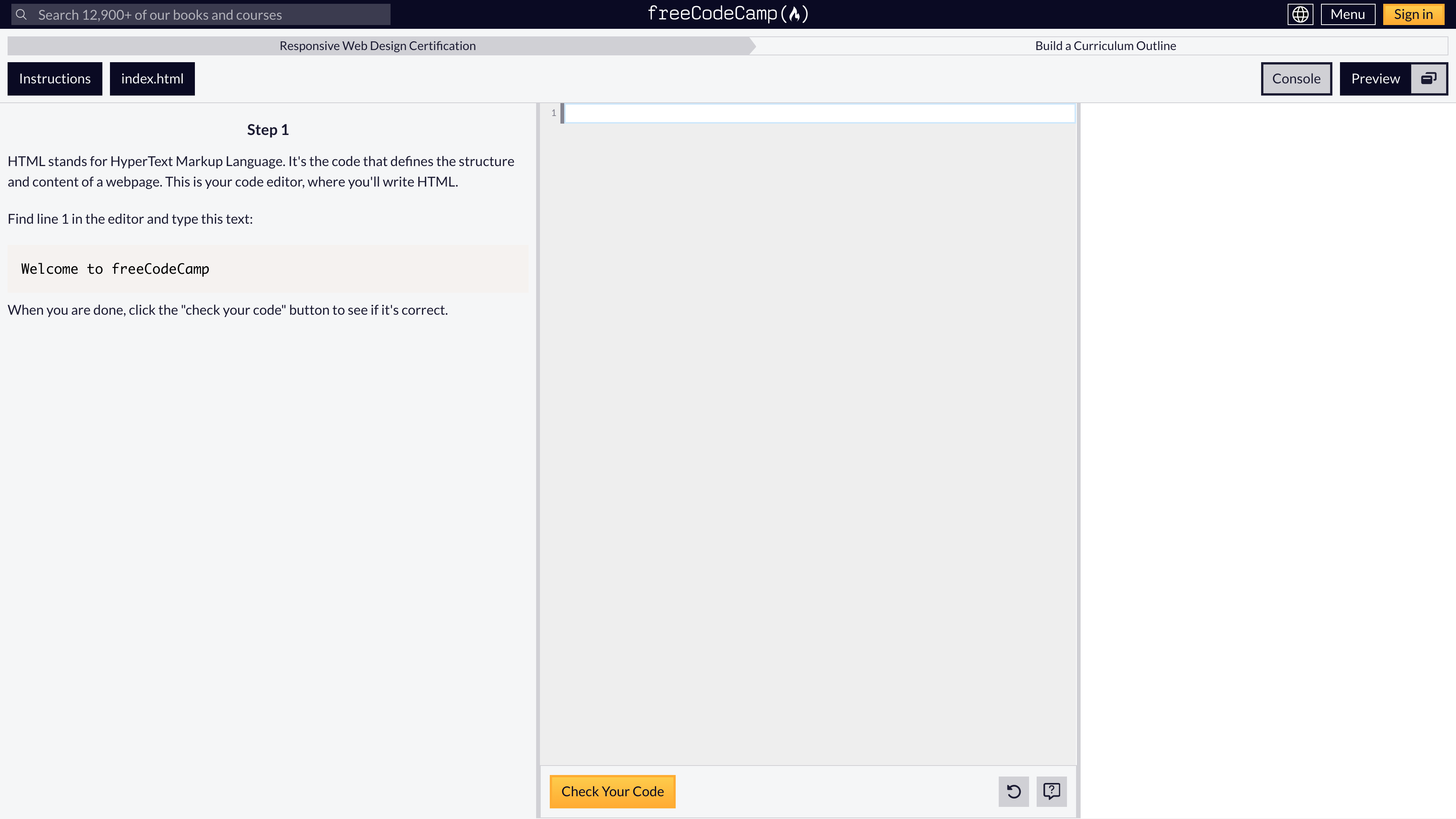
The FAQ summarizes the format as "building dozens of projects step-by-step – right in your browser, code editor, or mobile app." There are also Daily Coding Challenges in JavaScript and Python, plus official iOS and Android apps that sync progress with your account.
Beyond the curriculum
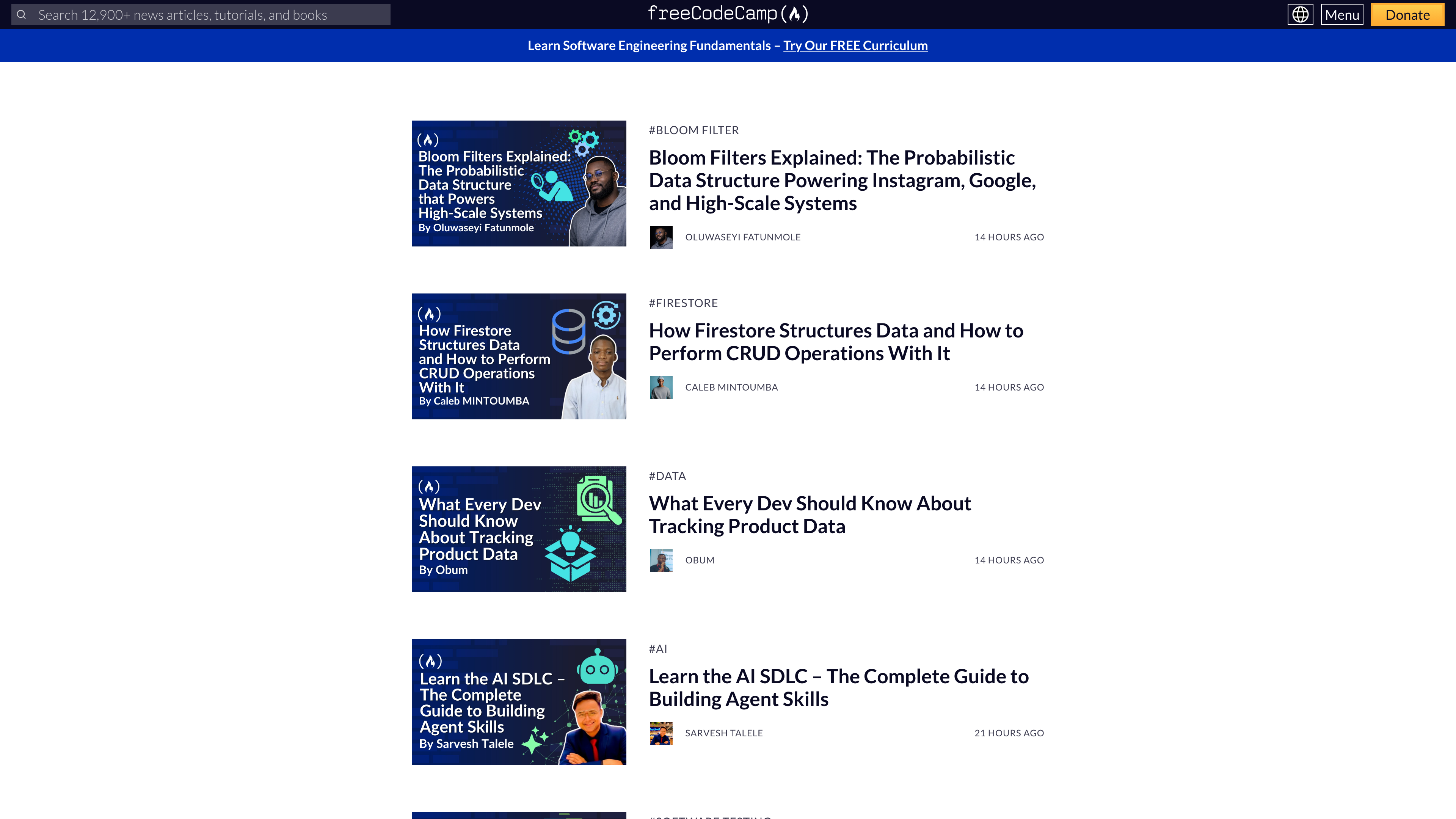
Publication (/news): long-form technical tutorials on Python, JavaScript, Git, AI and more, published at a brisk pace (the homepage below, captured 2026-09-01, shows articles hours old). The mission statement credits the organization with "thousands of videos, articles, and interactive coding lessons."
YouTube channel: @freecodecamp, with roughly 11.9 million subscribers (third-party platform figure captured 2026-08-30), known for full-length video courses.
Forum: forum.freecodecamp.org (Discourse), with about 358,000 registered users and 2.14 million posts as of 2026-09-01, and roughly 3,600 active users in the last 30 days — used mainly for Q&A and project feedback.
Podcast: podcast.freecodecamp.org, hosted on Libsyn.
Open source and openness
The entire platform and curriculum are open source under the BSD-3-Clause license on GitHub. As of 2026-09-01 the repository has over 454,000 stars — among the most-starred on GitHub — and same-day commits fixing curriculum content, indicating active maintenance. The FAQ explicitly permits third-party apps and tools built around the community and platform, noting that "most non-sensitive freeCodeCamp data is publicly available," but requires making clear that your project is not officially endorsed by freeCodeCamp. No official public data API documentation was found; programmatic use generally works from the open-source repository itself.
Chinese-language support
Simplified and Traditional Chinese are among the 12 build languages, and the former Chinese subdomain chinese.freecodecamp.org now redirects to /chinese/ paths on the main site. The Chinese publication (/chinese/news/) is still being updated but infrequently — its newest article was dated 2026-06-01 when checked on 2026-09-01. In practice the curriculum body remains English, localization centers on translated publication articles, and the Chinese-language community is markedly quieter than the English one.
Who it's for
- Beginners and career-changers starting web development, Python or data skills from zero, where cost is no barrier to finishing every certificate.
- Self-learners who want to practice by building projects in the browser and accumulate a portfolio along the way.
- Teachers: classroom use is explicitly welcomed, the open license needs no permission, and livestreaming or publishing solutions is allowed.
- Job seekers using the curriculum as structured pre-interview practice, with the forum for Q&A and résumé/interview advice.
Limitations
- Fully self-paced with no instructors or cohorts: freeCodeCamp itself states it is not a coding bootcamp and not a replacement for a four-year degree; a purely self-directed path offers little structured accountability or personalized feedback, so completion depends heavily on self-discipline (the latter point is an inference).
- Certificates are issued by a charity rather than an accredited institution or industry body, and their weight with employers varies (inference).
- The core curriculum is English-only; Chinese and other translations are community-driven and updated sparsely, so basic English reading ability is effectively required.
- The new certification exam format is undocumented, and some new certificates may not be claimable yet (see "The curriculum").
References
- freeCodeCamp homepage and footer mission statement (checked 2026-09-01)
- About freeCodeCamp - Frequently Asked Questions (checked 2026-09-01)
- How to Donate to freeCodeCamp.org (checked 2026-08-30)
- freeCodeCamp/freeCodeCamp on GitHub (BSD-3 license, star count) (checked 2026-09-01)
- curriculum.ts and certification-settings.ts (current and legacy certification configuration) (checked 2026-08-30)
- freeCodeCamp Chinese publication (checked 2026-09-01)
- freeCodeCamp forum (statistics checked 2026-09-01)