Framer (framer.com) is a website design and publishing platform from the Amsterdam-based company of the same name. You design pages on a free-form canvas that feels like Figma, then publish them as a live website from the same tool — no developer handoff, no rebuilding mockups in code. Its verifiable difference from template builders like Wix or Squarespace is design freedom: the canvas, components, and animation model behave like a professional design tool, while CMS, hosting, SEO, analytics, and A/B testing ship inside the same product. Why it belongs in this directory: it is one of the fastest-growing products in the website-builder space. The company reports more than 500,000 monthly active users and hundreds of thousands of live sites as of August 2025; companies including Perplexity, Miro, Scale AI, Mixpanel, and Zapier run their sites on Framer, and in August 2025 the company raised a 2B valuation.
At a Glance
- URL: https://www.framer.com/
- Type: No-code website design and publishing platform (free-form canvas editor + CMS + hosting + growth tools)
- Pricing: Free plan at 10/month and Pro 20/month each; viewers are free. As of 2026-09-19, see the official pricing page
- Sign-up: A free account gets you the editor and publishing to a framer.website subdomain; connecting a custom domain requires a paid plan (pricing FAQ)
- Interface language: English only; no localized UI options observed (2026-09-19). A desktop app is available alongside the browser editor (official download page)
- Site builder launch: The professional site builder launched in May 2022 (official Series C post)
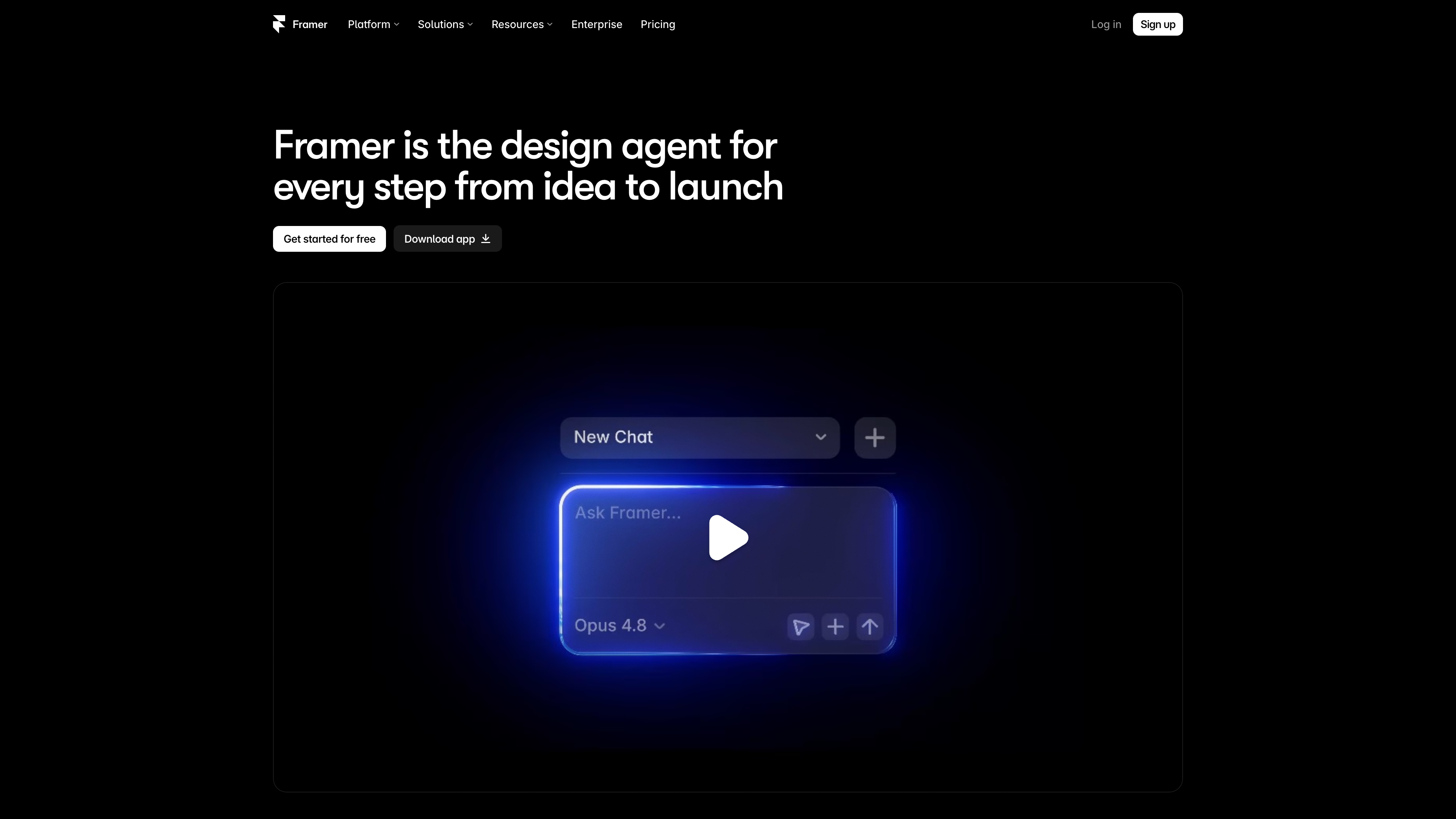
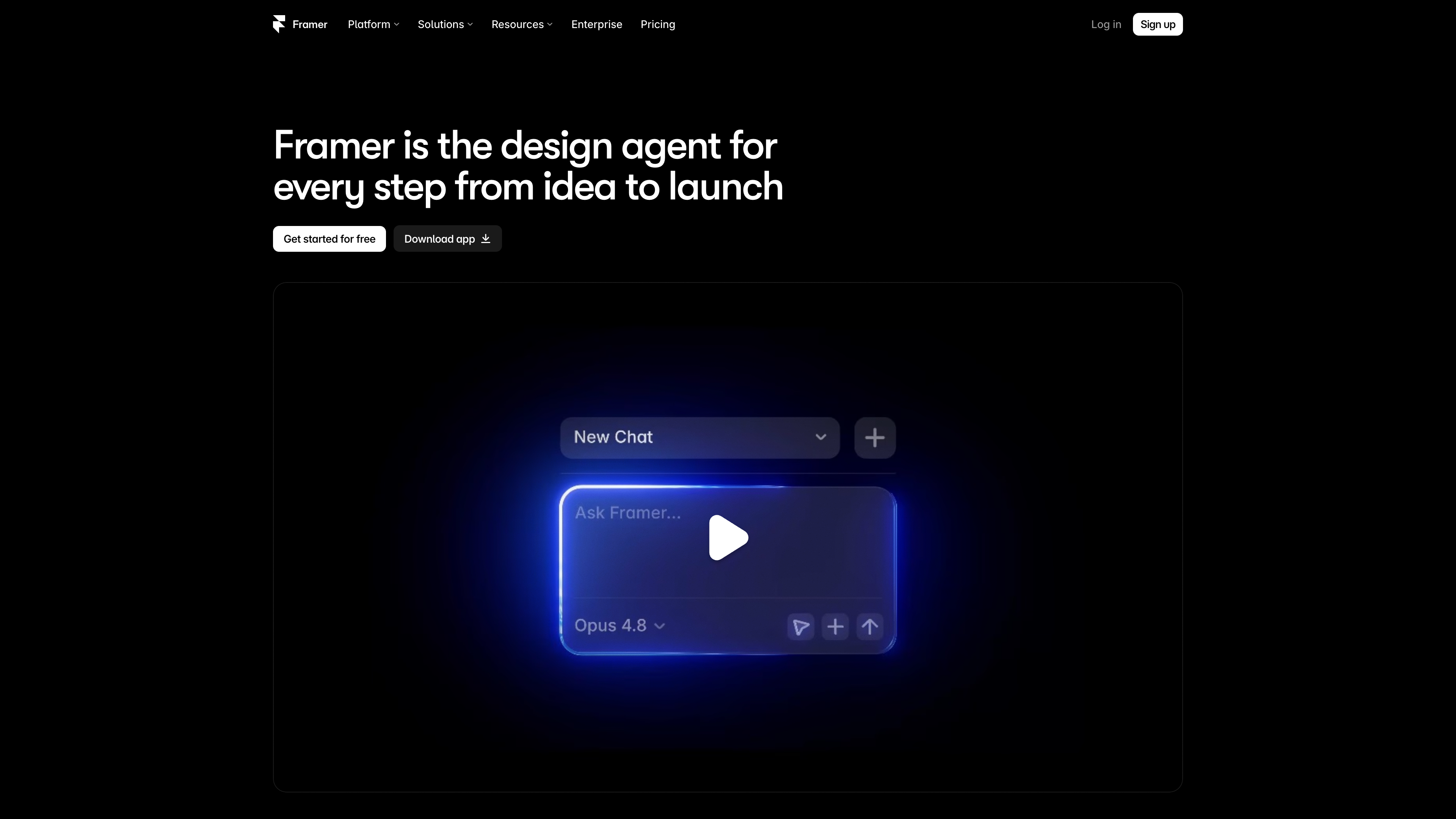
The homepage as of 2026-09-19. The tagline "Framer is the design agent for every step from idea to launch" captures the current product focus — AI design agents that work inside the canvas:
Background
Framer was founded in Amsterdam by Koen Bok and Jorn van Dijk. The pair previously co-founded the design studio Sofa, which Facebook acquired in 2011; both went on to work as product designers at Facebook (Business Insider interview, September 2025). Two founding-year figures circulate: databases such as PitchBook record 2014 (cited in the same interview), while the company's own 2023 blog post says "We started Framer in 2015" — both sources are noted here.
The company's early product was a high-fidelity interactive prototyping tool for designers. In its 2023 Series C post, Framer recounts noticing around 2021 that low-fidelity and whiteboarding tools were winning a broader audience, which prompted a new direction: let the design tool ship real production websites. The professional site builder launched in May 2022 and grew quickly from there (official Series C post, September 2023).
Key milestones since:
- September 2023: $27M Series C led by Meritech Capital (official Series C post).
- August 28, 2025: A 2B valuation, led by existing investors Meritech and Atomico with participation from WiL and HV (official Series D post; covered the same day by Reuters and TechCrunch). Framer also disclosed that more than 500,000 people use the platform each month, hundreds of thousands of sites run on it, the company had been break-even for the past year, and — in the company's own words — close to half of the latest Y Combinator batch launched on Framer.
- Open-source connection: Framer Motion, the React animation library Framer originally open-sourced, has since grown into the independent Motion project (motiondivision/motion, MIT license, ~33.7k stars and actively maintained as of 2026-09-19).
Core Capabilities: Canvas to Launch in One Place
Free-form canvas design. The editor works like Figma: pages, layers, and assets panels; responsive breakpoints for desktop, tablet, and mobile; components and effects. Framer's pitch is "design is the published site" — what you make on the canvas ships without a development handoff. On-page editing, introduced in 2025, lets teammates tweak copy, swap images, or add pages without opening the canvas or CMS (official Series D post).
Built-in CMS. Collections and fields model structured content such as blogs, careers pages, and events, bound directly to the canvas. The free plan includes access to 10 collections for building and previewing; Basic includes 2 collections, Pro includes 10, and add-ons on Pro raise the ceiling to 40,000 CMS items (pricing page and FAQ, as of 2026-09-19).
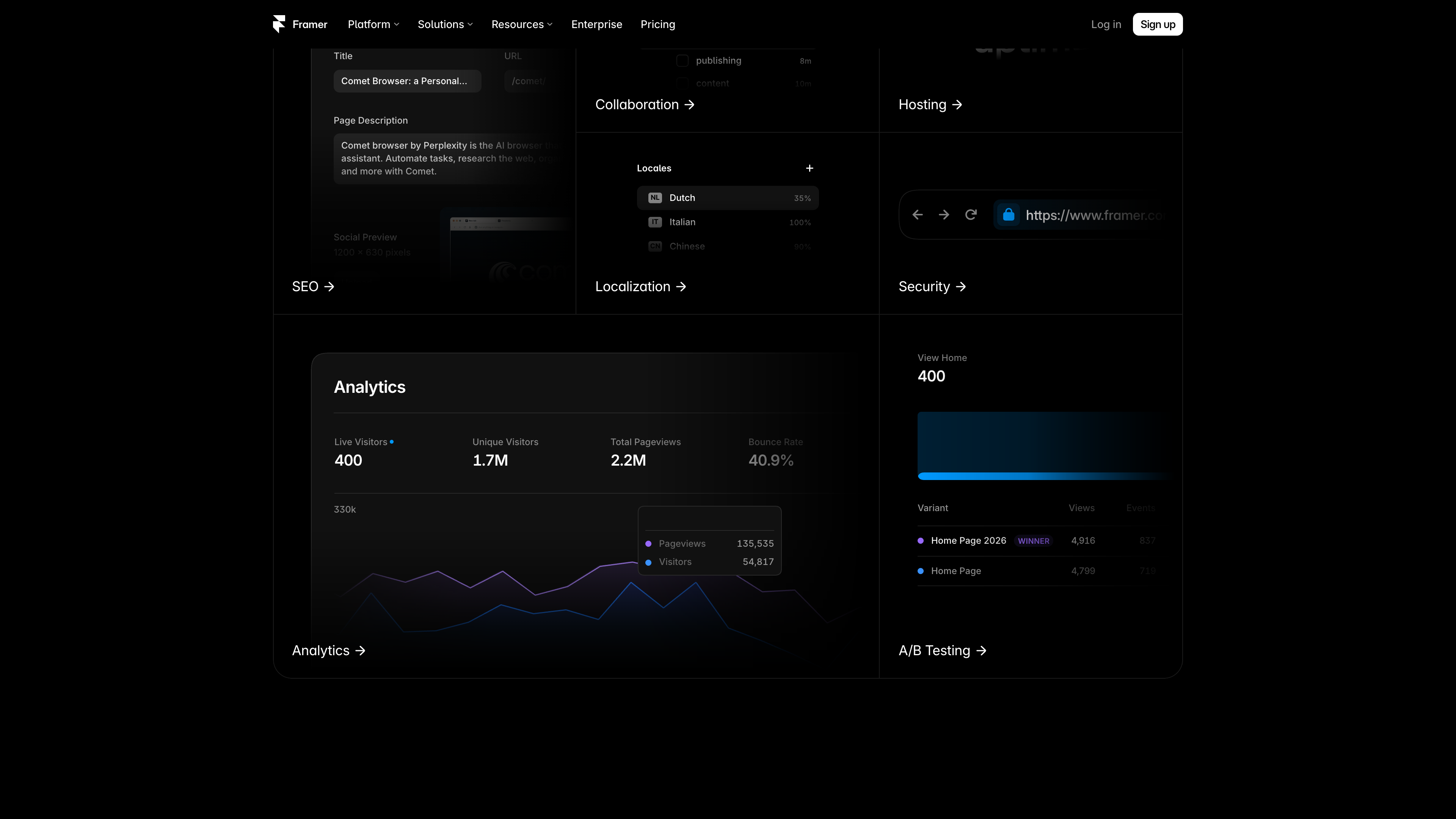
The platform modules shown on the homepage — SEO settings, localization progress, hosting, analytics, and A/B testing all live in the same product:
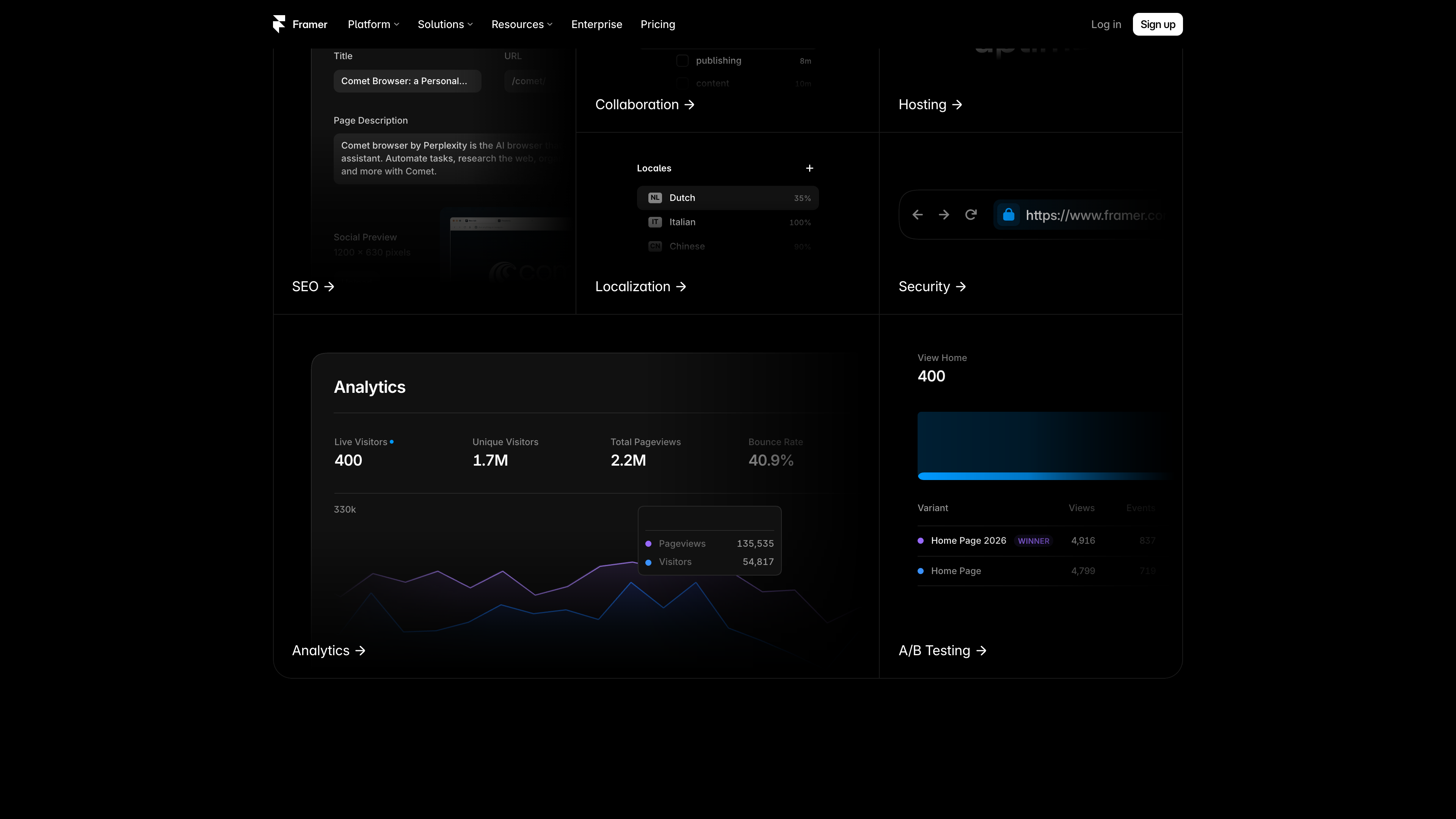
Hosting and growth tools. Sites run on Framer's infrastructure, which the company claims delivers 99.99% uptime and optimized Core Web Vitals. Paid plans add custom domains, redirects, a staging environment, and branching with previews. Built-in analytics covers live visitors, unique visitors, pageviews, and bounce rate; A/B testing comes via the Convert add-on with up to 5 concurrent tests; localization tracks translation progress per language (homepage and pricing page, 2026-09-19).
AI agents. By 2026 the product story has moved from "AI site generation" to "design agents": a design agent works natively on the canvas to generate and refine pages in place, a CMS agent sets up and maintains content, and a code agent turns custom effects and interactions into code on your site. Framer can also connect to external agents — update copy from Slack, trigger CMS changes from a terminal, or ship from a GitHub PR; the site lists Terminal, Codex, Claude Code, and Cursor as supported (homepage, observed 2026-09-19). AI features are metered in credits: the free plan includes a one-time 500-credit trial, Basic gets 1,000 credits per month, and Pro gets 3,000, shared across the workspace (pricing page).
Pricing and Accounts
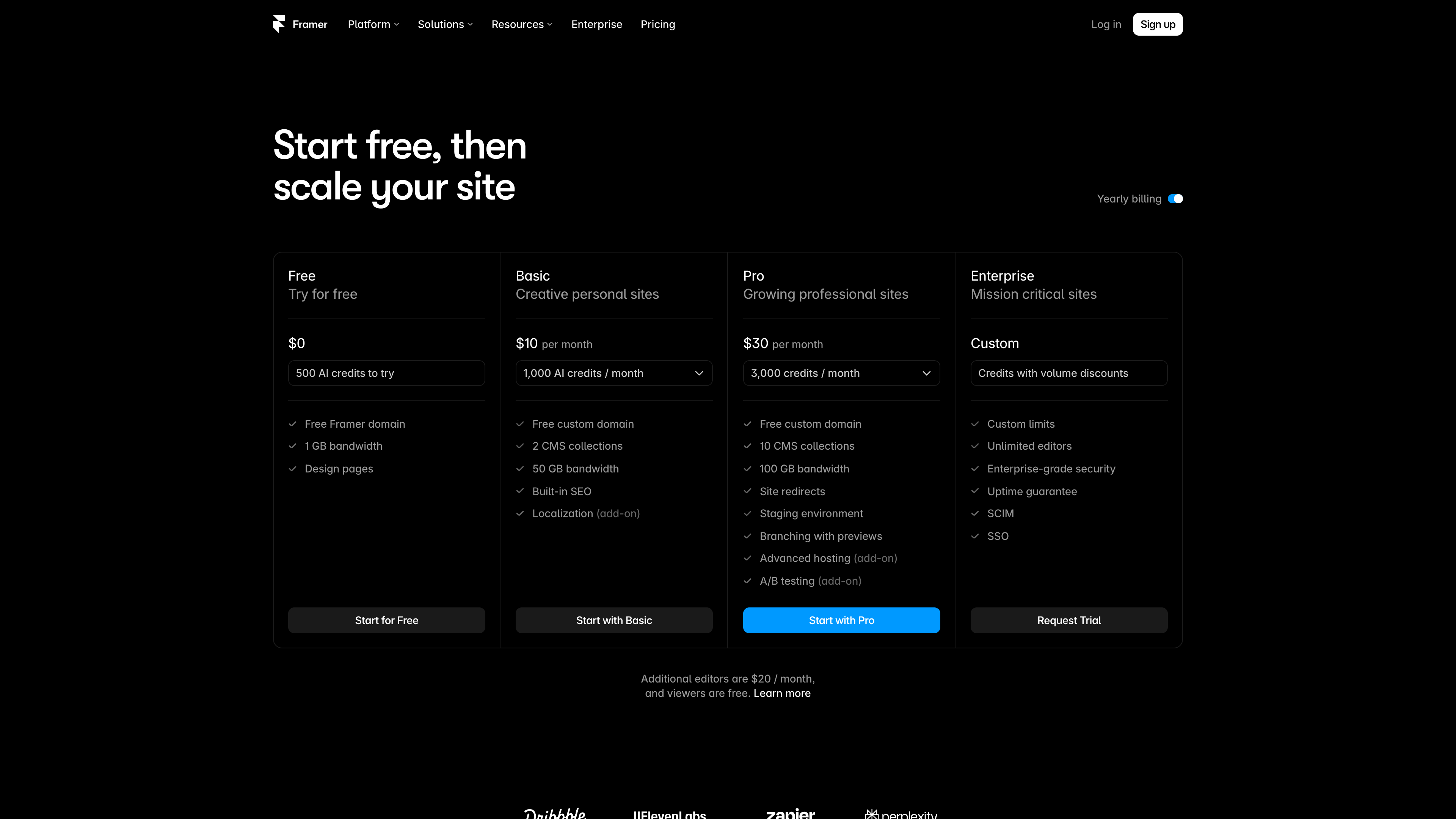
The official pricing page as of 2026-09-19 (annual billing prices):
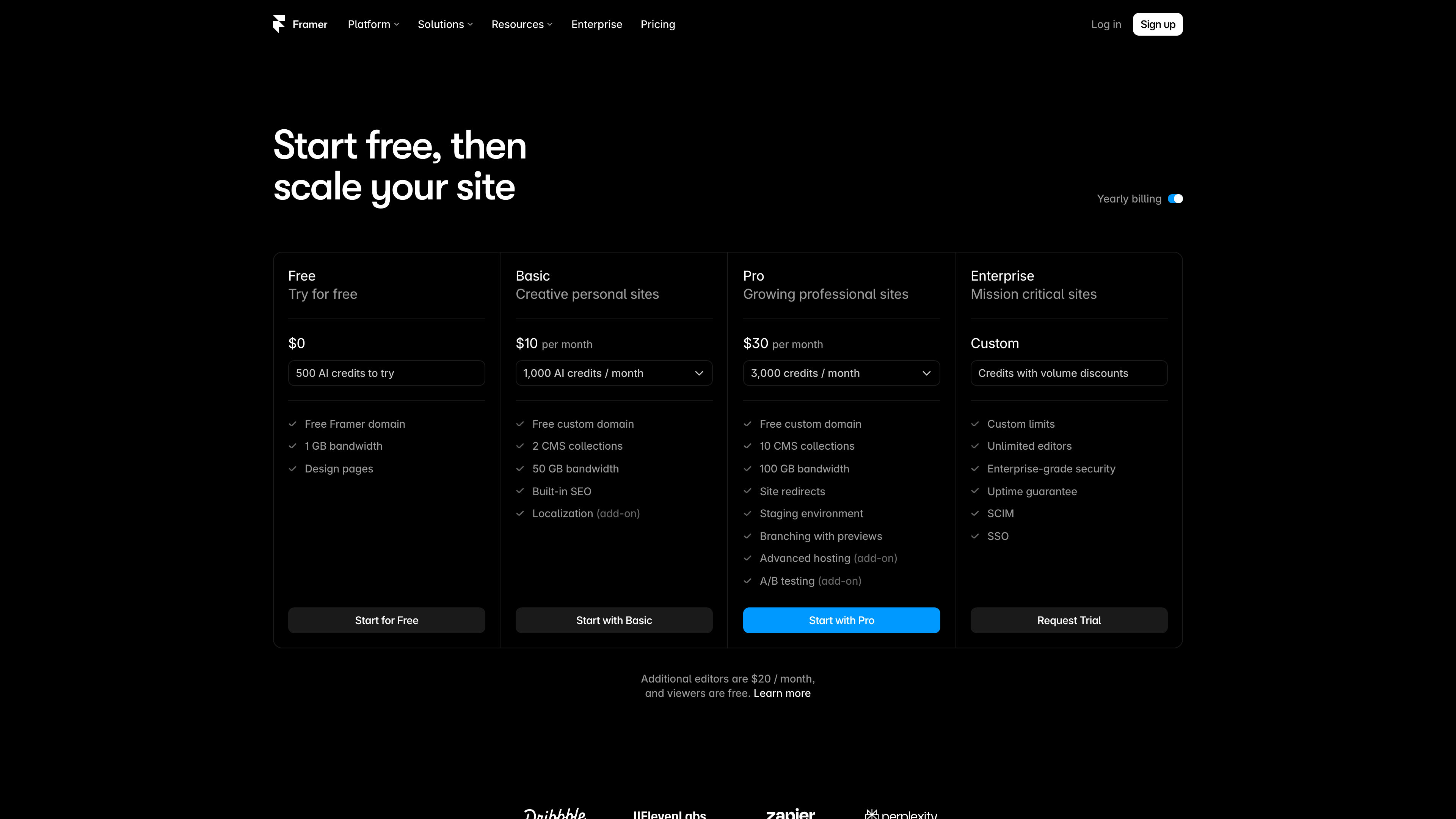
Two structural points matter (official pricing page and FAQ):
- Per-site subscriptions: plans attach to a single published site, so running multiple sites means paying for each. Tiers differ mainly in CMS scale, bandwidth (Basic 50 GB / Pro 100 GB), SEO, redirects, staging, branching, and add-on eligibility.
- Seats are billed separately: additional editors cost $20/month each and viewers are free; workspaces without a subscription support up to three collaborating editors.
The free plan can publish a real site, but only on a framer.website subdomain with 1 GB of bandwidth, and AI credits are a one-time trial allowance. Payment is by credit card (PayPal in some regions); customers in the EU and Turkey are legally entitled to a refund within 14 days (pricing FAQ). The Enterprise plan offers custom limits, unlimited editors, an uptime guarantee, SCIM, and SSO (Enterprise page).
Extensibility and Ecosystem
Developers can use the Server API to bring Framer into their own product, or connect an external agent to work on a Framer project (the "Connect to any agent" capability on the homepage). On the content side, Framer runs an official Marketplace where community authors sell templates and components, plus an Academy and blog with ongoing tutorials. The platform itself is closed source; the only open-source piece is the spun-off Motion animation library.
Who It's For
- Startups and marketing teams that need to launch and iterate on marketing sites and landing pages quickly; Framer's disclosed customer list (Perplexity, Miro, Scale AI, and others) fits this "fully managed marketing site" pattern.
- Designer-led teams already comfortable with a Figma-style canvas who want to skip the design-to-development handoff; the learning curve is mostly the canvas itself.
- Content-driven marketing sites: CMS, localization, SEO, analytics, and A/B testing in one product suit multilingual sites and teams running experiments.
- Template creators: the Marketplace offers a distribution channel for paid templates.
Limitations
- English-only interface: the editor and documentation are English-only, with no official localized UI observed (2026-09-19) — worth noting for teams that need other languages.
- The free plan is not commercial-ready: free sites live on a framer.website subdomain with 1 GB of bandwidth; a custom domain requires a paid plan, and AI credits are a one-time trial.
- Costs stack per site: per-site billing means each site needs its own subscription, editors add $20/month per seat, and month-to-month billing costs more than the annual prices quoted here.
- Hosting lock-in: sites run on Framer's infrastructure with no official full-site export or self-hosting option (observation); leaving the platform effectively means rebuilding.
- Opaque AI metering: credit consumption varies by operation; the pricing page publishes only plan allowances and the upgrade-or-add-on path, not per-action costs.
- Desktop-first editing: real design work requires a desktop browser or the desktop app. On-page editing handles copy and image tweaks on live pages, but full design work isn't possible from a phone (Series D post and product observation).
Alternatives
- Webflow: the established competitor (founded 2013, San Francisco), likewise combining visual site building, a CMS, and hosting; its layout model hews closer to the CSS box model and has a steeper learning curve.
- Wix / Squarespace: the template-builder incumbents Framer itself names as the previous generation in its Series D post — Framer targets "professional, high-traffic, brand-defining" sites instead.
Sources
- Framer homepage (checked 2026-09-19)
- Framer Pricing (plans and FAQ) (checked 2026-09-19)
- Framer AI (checked 2026-09-19)
- Framer Developers (Server API and external agents) (checked 2026-09-19)
- Framer Download (desktop app) (checked 2026-09-19)
- Framer Enterprise (checked 2026-09-19)
- Framer Marketplace (checked 2026-09-19)
- Framer blog: Series D announcement (2025-08-28, checked 2026-09-19)
- Framer blog: Series C announcement (states the site builder launched May 2022) (2023-09-28, checked 2026-09-19)
- Reuters: Framer hits $2 billion valuation in latest funding round (2025-08-28, checked 2026-09-19)
- TechCrunch: No-code website builder Framer reaches $2B valuation (2025-08-28, checked 2026-09-19)
- Business Insider: Framer founder interview (founding year and headcount per PitchBook) (2025-09-16, checked 2026-09-19)
- GitHub: motiondivision/motion (formerly Framer Motion) (checked 2026-09-19)