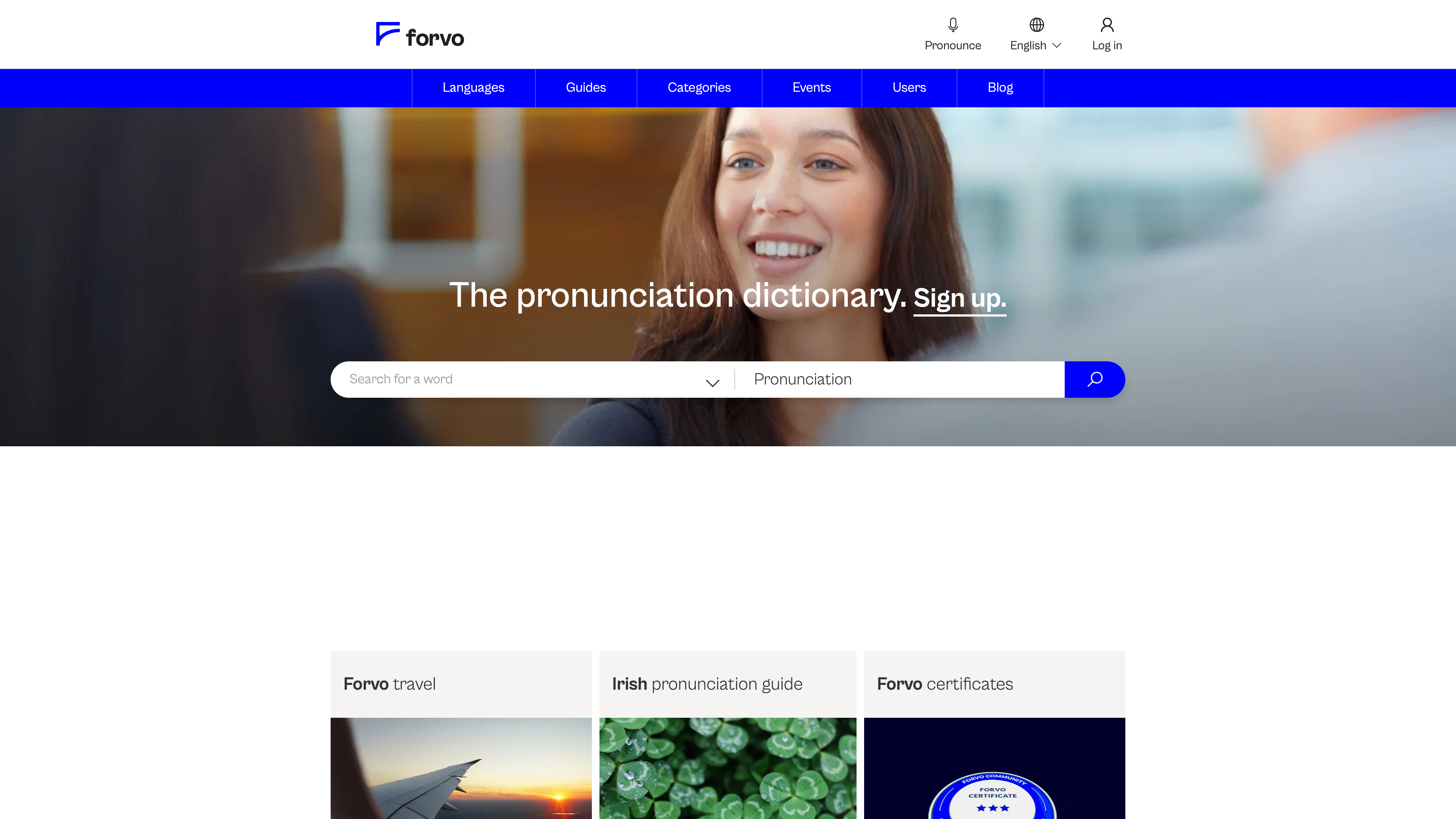
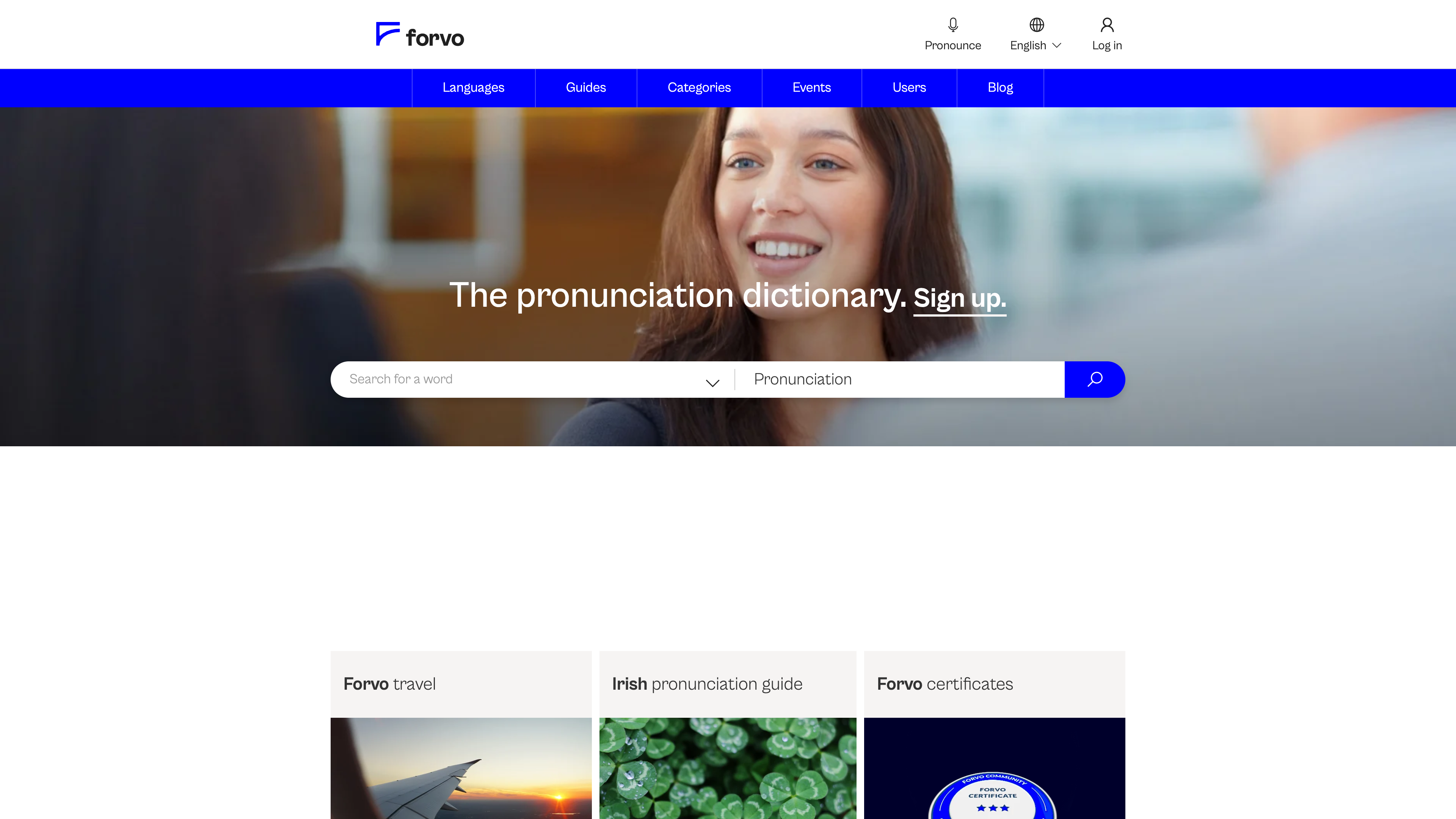
Forvo (forvo.com) is a crowdsourced pronunciation dictionary: native speakers around the world record words, phrases and names in their own languages, and visitors can listen and compare pronunciations by language and accent for free. Unlike a regular dictionary, it is not built around definitions, and it uses no synthesized speech — every audio clip is a real human recording uploaded by a registered user, with quality curated through community voting and volunteer editors. According to its About page, the database holds nearly 6 million pronunciations across more than 430 languages and serves over 110 million visits a year (as of September 3, 2026). The homepage doubles as the main entry point: a word search box and a Pronounce recording button on top, with featured travel guides and other content below.
At a glance
- URL: https://forvo.com/
- Type: Crowdsourced pronunciation dictionary (native-speaker recordings)
- Cost: Free to look up and listen on the web (ad-supported); paid mobile apps and commercial API plans
- Registration: Not needed to search and listen; a free account is required for MP3 downloads, pronunciation requests, voting and recording
- Interface languages: 43, including Chinese (mostly Simplified, with some Traditional or untranslated strings)
Background
Forvo launched in 2008 and is operated by Forvo Media S.L., a Spanish company registered in Rentería, Gipuzkoa, in the San Sebastián metropolitan area — the Terms and Conditions and Privacy Policy both name this entity. According to Wikipedia, co-founder Israel Rondón conceived the site in 2007 and it went live in January 2008. In 2013 it was named one of Time Magazine's "50 Best Websites of the Year", an honor also noted on the About page.
The scale figures Forvo publishes (About, as of September 3, 2026): nearly 6 million pronunciations, 430+ languages and over 800,000 registered users. Since 2021, the company has also been developing a speech-recognition-based pronunciation evaluation project co-funded by the Basque Government's HAZITEK R&D program and the European Regional Development Fund, aimed at education and health applications.
Looking up a word: accent comparison and vote ranking
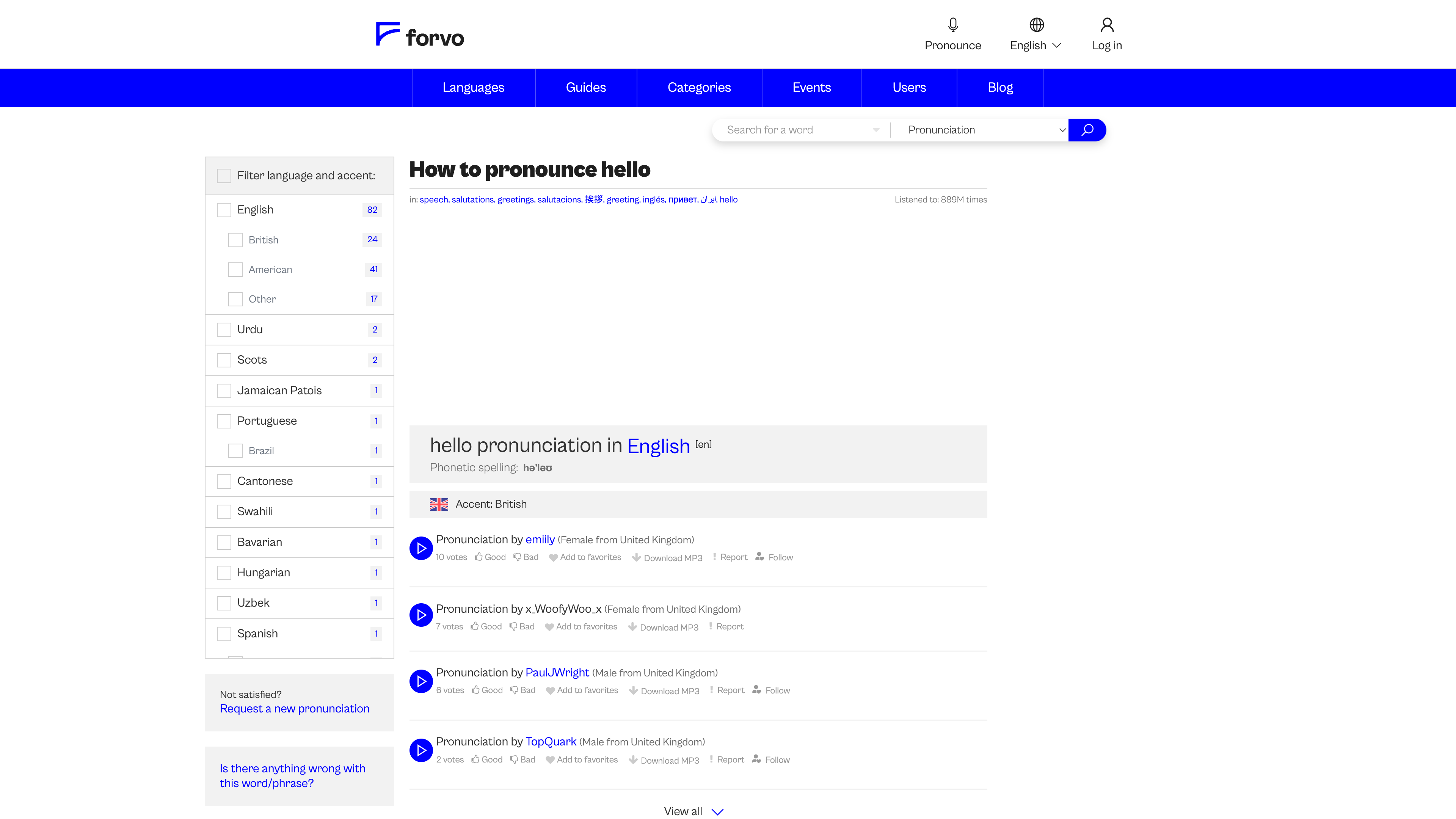
Searching a word brings up a page listing every recording of it across languages and accents. Take hello (checked September 3, 2026): there are 82 recordings in English alone, filterable into British (24), American (41) and Other (17). The page shows the phonetic spelling həˈləʊ, labels each recording with the speaker's gender and country, displays its vote count, and notes that the word has been listened to 889 million times in total.
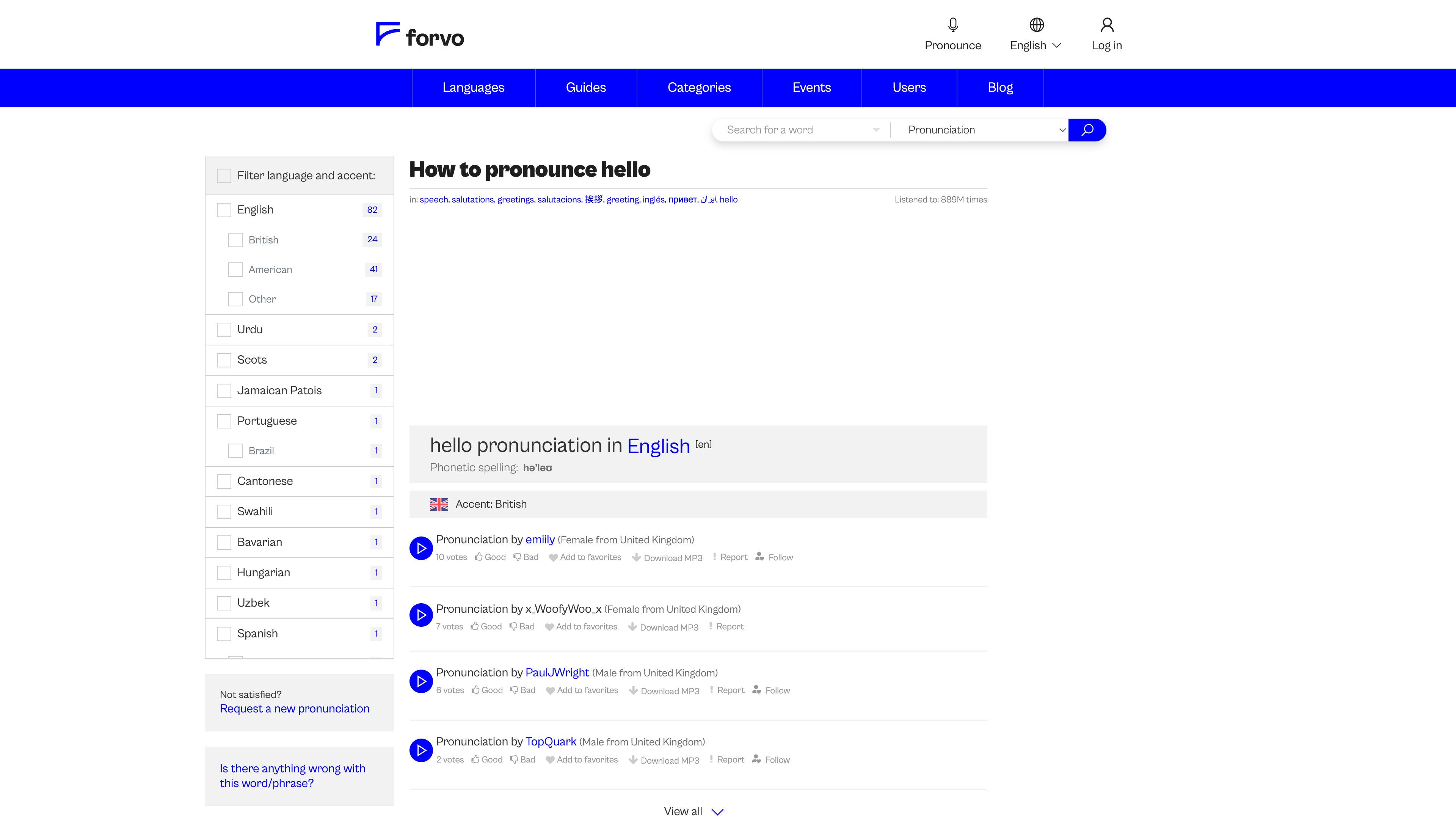
The same spelling can cover many languages. The entry for 你好, for example, is split into about twenty language and dialect groups — Mandarin, Cantonese, Wu, Min Nan, Hakka and more — some with romanization (Cantonese: nei5 hou2) and example phrases. The Good/Bad votes under each recording affect ranking: scores can go negative, pushing mispronounced or poor-quality clips down. If no recording satisfies you, "Request a new pronunciation" adds the word to a pending list for native speakers to pick up; the entry page also shows in which languages the word is still awaiting a recording.
Browsing by language and content tiers
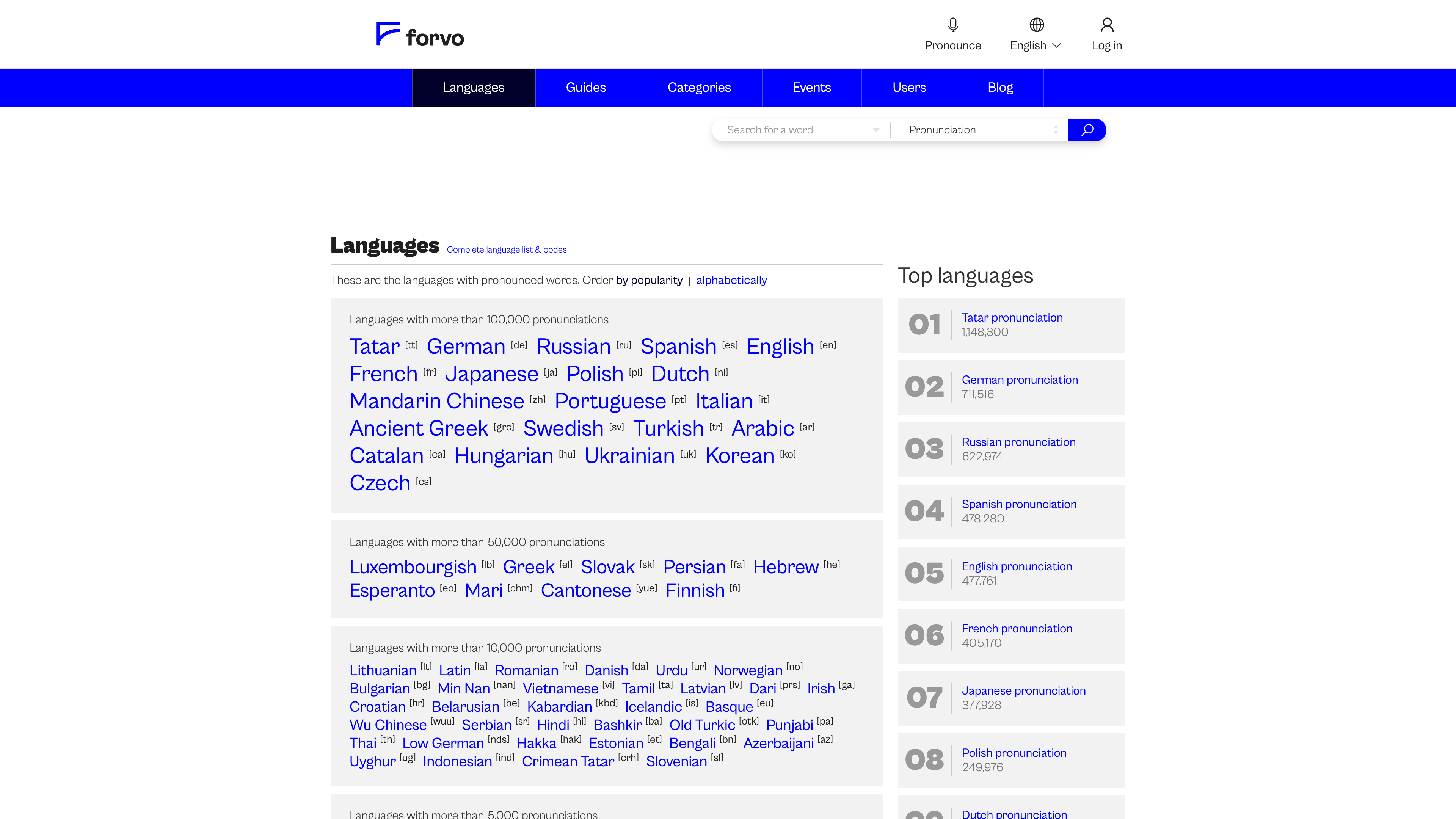
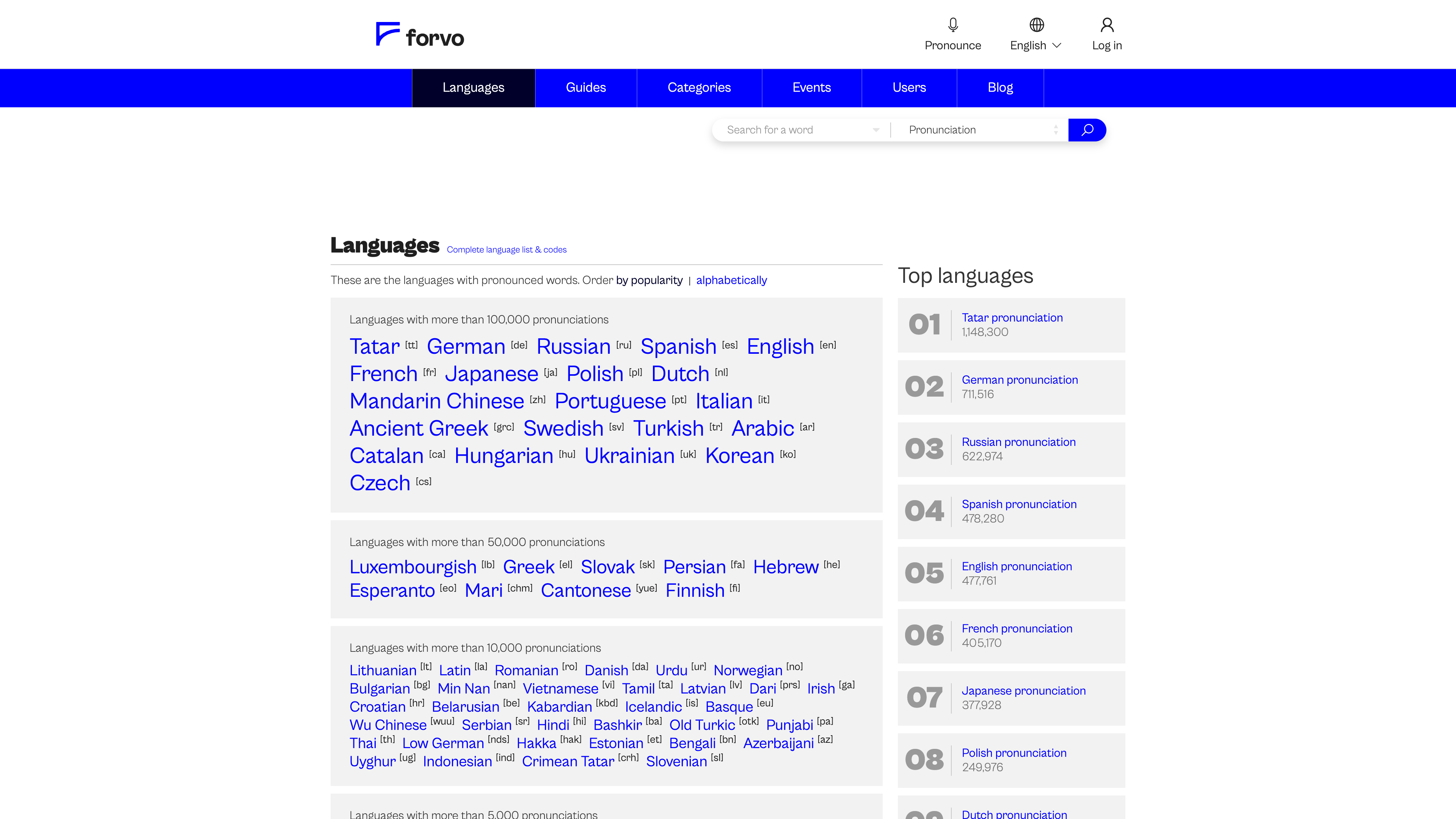
The Languages page groups all covered languages by pronunciation count (as of September 3, 2026): 21 languages have more than 100,000 recordings. The top spot is held not by English but by Tatar (1.148 million) — a minority language in Russia with roughly five million speakers, carried to first place by a highly active contributor community. It is followed by German (712k), Russian (623k), Spanish (478k), English (478k), French (405k) and Japanese (378k); Mandarin Chinese ranks tenth with 228k. More than 80 further languages form a long tail of 500+ recordings each, including constructed languages such as Klingon and Sindarin.
Beyond word lookup, Forvo offers three kinds of supplementary content: Guides (travel phrase guides for various languages), Events (themed pronunciation guides for holidays and events, last updated in 2022), and eLearning vocabulary courses for registered users (described as ten minutes a day, twenty words a day, selected by an algorithm).
Contributing: recording, requests and review
The official FAQ lays out the contribution rules:
- Only registered users can add words and record pronunciations. The gender and country/region provided at signup are shown next to each recording as its accent source.
- Recording happens in the browser with a microphone; uploading ready-made MP3 files is not accepted — Forvo says it cannot verify who actually owns a third-party file.
- Almost any word is allowed, including politely pronounced profanity that appears in well-known dictionaries. Onomatopoeias, made-up words and entries longer than 40 characters are not.
- Quality is enforced in two ways: user Good/Bad voting and volunteer editors, who may remove misspelled, non-native or mispronounced entries. Anyone can flag problems via the Report link on the entry page.
The official help page describes a 2.5-second limit per recording, but it still illustrates the process with a Flash-based recorder and is clearly outdated, so this detail may not reflect current rules.
Accounts and open access
Searching and listening on the web are completely free and require no account, though pages carry ads (the Privacy Policy confirms the use of Google Ad Manager). A free account — via email or Facebook/Google/Apple sign-in — unlocks MP3 downloads, pronunciation requests, favorites, voting and recording. The Terms and Conditions restrict free use to academic or personal non-commercial purposes, capped at 500 requests per user per day. A /premium/ page exists but cannot be viewed without logging in, and Forvo does not publish its price or benefits publicly (unverifiable as of September 3, 2026). Mobile apps are available for iPhone and Android; the iOS app Forvo Pronunciation is a paid one-time purchase priced at $2.99 on the US App Store (as of September 3, 2026).
For developers, the Forvo API comes in three tiers (as of September 3, 2026): Non-Profit at 28.95 per month with 10,000 requests per day and commercial use allowed; and a custom-quoted Corporate tier for higher volumes. Forvo says more than 4,000 developers use the API. The general API terms require attribution; audio links expire after two hours and caching audio files is prohibited; every playback inside your application also counts as a request; daily quotas reset at 22:00 UTC.
Copyright and content policy
Forvo's content is user-generated, and its license terms work as follows: uploaders keep all rights to their recordings and translations but grant Forvo Media S.L. a permanent, non-exclusive, royalty-free worldwide license to reproduce, distribute, publicly communicate, sublicense to third parties and adapt the material for technical needs. Users may use the site's pronunciations for non-commercial purposes. Forvo holds the sui generis database right under Spanish intellectual property law, and systematic extraction of substantial parts of the database is prohibited.
According to Wikipedia (a secondary source), site content was published under CC BY-NC-SA 3.0 from 2008 until around 2019, when Forvo switched to its current custom license — a change that drew complaints from some contributors at the time. Whatever the history, the current terms are far more restrictive than Creative Commons: reusing Forvo audio in your own product requires staying non-commercial or buying a commercial API license.
On privacy, Forvo states GDPR compliance (policy text updated April 8, 2024), collecting username, email, date of birth, gender and languages spoken or studied at registration, with payment data handled by third-party processors. The terms require users to be at least 18, or 14+ with parental consent.
When it is useful
- Checking how a word or phrase is actually pronounced when learning a language — especially comparing regional accents of the same word (e.g., British vs. American English).
- Finding out how to say proper nouns — people, places, brands — which traditional dictionaries rarely cover, while Forvo accepts almost any word class.
- Sourcing scarce native-speaker audio for smaller languages; conversely, native speakers can help preserve their language by recording (the FAQ explicitly welcomes such communities).
- Integrating real pronunciations into Anki decks, dictionary software and the like via the API (subject to attribution and the limits of the chosen plan).
Limitations
- Uneven coverage: top languages have hundreds of thousands of recordings, while many smaller languages are nearly empty. The homepage's Language of the Day widget showed Konkani — spoken by about 12.6 million people — with just 32 Forvo users, 157 pronounced words and 180 pending requests (as of September 3, 2026).
- Variable quality: clips are recorded on personal equipment in uncontrolled environments, so audio quality differs; votes and editor review are the only public quality signals, and obscure entries often have zero-vote recordings that you must judge yourself.
- Non-commercial terms and rate caps: audio may not be used commercially, systematic scraping is prohibited, and free accounts are limited to 500 requests per day.
- Ads on the free tier, and the site sits behind Cloudflare security checks that block automated bulk access.
- Outdated documentation and incomplete localization: the help page still describes a Flash-based recording flow, and the blog and events sections have not been updated since 2020–2022; FAQ and other documentation pages have no Chinese translation, and the Chinese interface itself mixes Traditional characters with untranslated English blocks.
- Opaque premium offering: the subscription page requires login to view, and Forvo publishes no pricing or benefit details.
Similar sites
- Lingua Libre: a free-licensed pronunciation recording library in the Wikimedia ecosystem, with audio that can be freely downloaded and redistributed — a more permissively licensed counterpart to Forvo's non-commercial restrictions.
References
- Forvo homepage (checked: 2026-09-03)
- About Forvo (checked: 2026-09-03)
- Forvo FAQ (checked: 2026-09-03)
- Forvo Help (recording guide) (checked: 2026-09-03)
- Forvo Terms and Conditions of Use (checked: 2026-09-03)
- Forvo License of Use (checked: 2026-09-03)
- Forvo Privacy Policy (checked: 2026-09-03)
- Forvo Languages (checked: 2026-09-03)
- Entry page for "hello" (checked: 2026-09-03)
- Forvo eLearning (checked: 2026-09-03)
- New pronunciation evaluation project - Forvo Blog (checked: 2026-09-03)
- Forvo API (pricing) (checked: 2026-09-03)
- Forvo API General Information & terms of use (checked: 2026-09-03)
- Forvo Pronunciation - App Store (checked: 2026-09-03)
- Forvo - Wikipedia (checked: 2026-09-03)