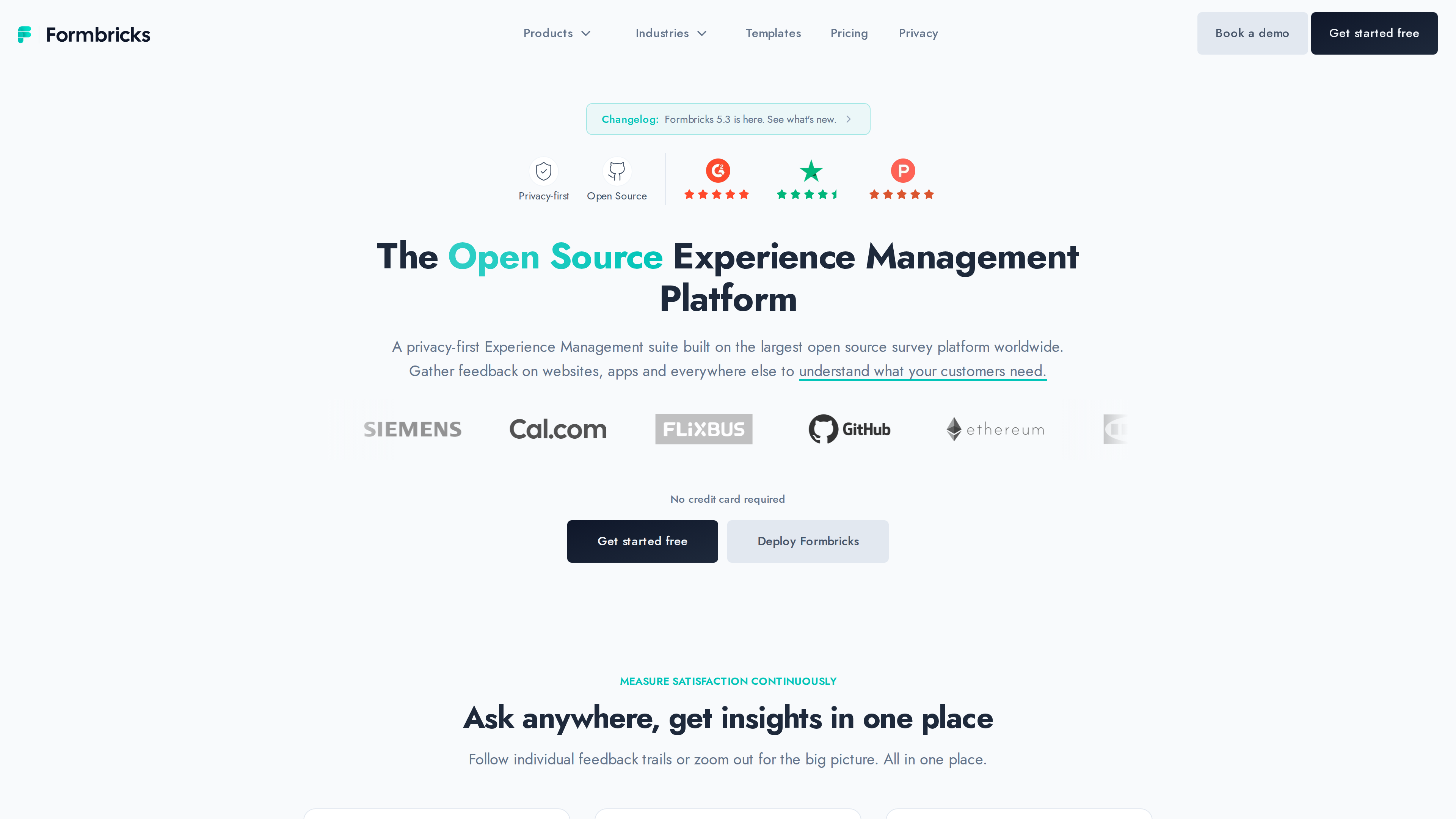
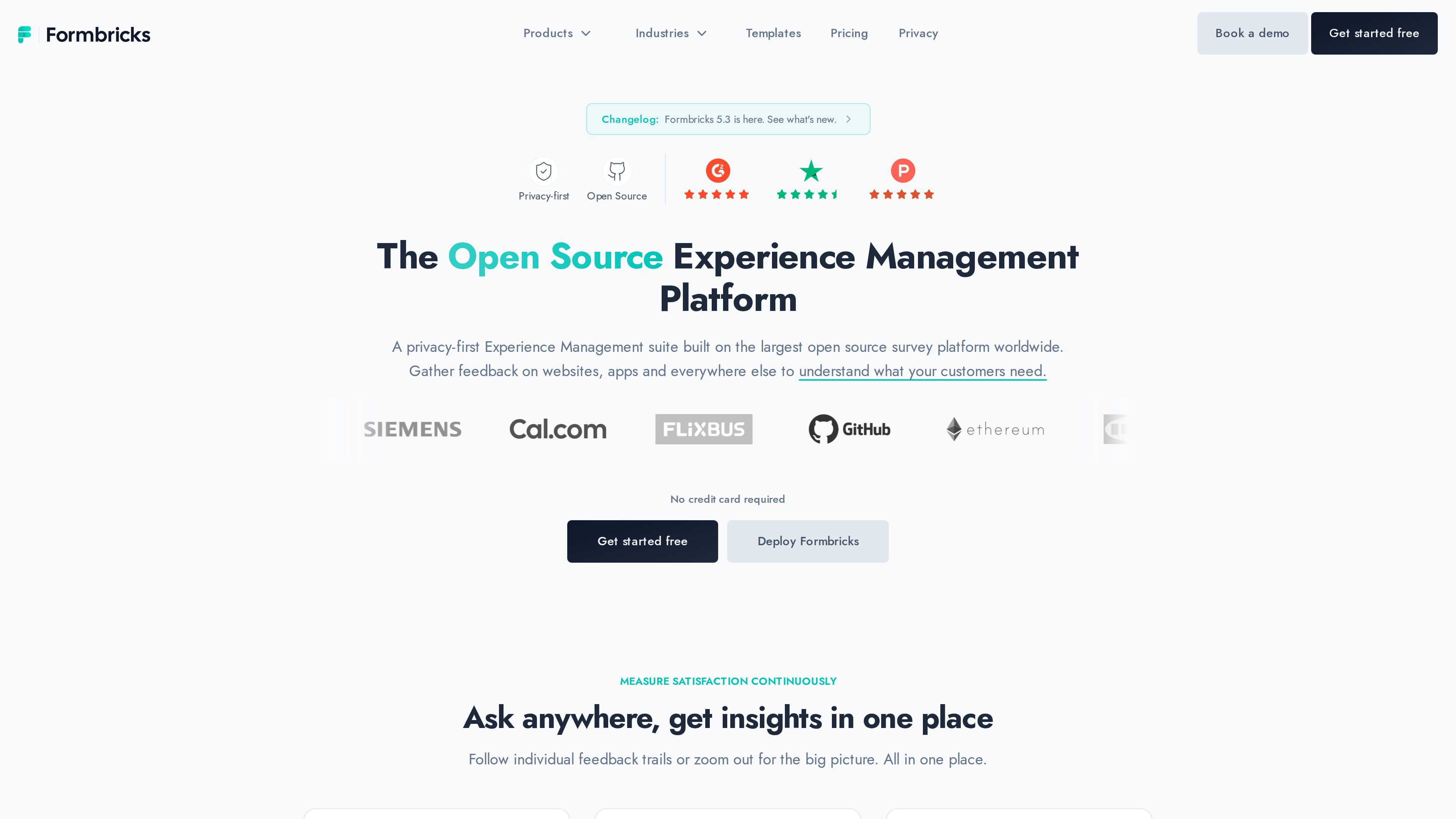
Formbricks is an open-source experience management (XM) platform built by Formbricks GmbH in Germany. Its core capabilities are link surveys and targeted micro-surveys delivered inside websites and apps, and its GitHub repository describes itself as an "Open Source Qualtrics Alternative." What sets it apart from plain form builders is the JS SDK and native iOS/Android SDKs: you decide which users see which survey at what moment, based on attributes, in-app events, and sampling percentages. On top of collection, the product extends into feedback aggregation, AI labeling, and automation workflows. The core code is AGPLv3-licensed and can be fully self-hosted.
At a Glance
- URL: https://formbricks.com/
- Type: Open-source survey / experience management platform (hosted cloud + self-hosted)
- Pricing: Cloud free tier (250 responses/month) plus paid tiers; the self-hosted Community Edition is free (AGPLv3), Enterprise Edition features require a paid license
- Sign-up: Free cloud account, no credit card required
- Interface languages: The management UI ships in 15 languages including Simplified and Traditional Chinese (see
apps/web/localesin the repository); the respondent-facing survey UI supports around 38 languages - Repository: formbricks/formbricks, created June 2022, about 13,000 stars as of 2026-10-01
Background
Formbricks is operated by Formbricks GmbH, based in Kiel, Germany. The About page states the platform has more than 40,000 users, is backed by open-source-focused investor OSS Capital, and counts GitHub co-founder Tom Preston-Werner and Cal.com co-founder Peer Richelsen among its angel investors.
The GitHub repository was created on June 6, 2022. As of 2026-10-01 it has 13,047 stars and 2,555 forks, and the latest stable release is 6.0.1 (September 29, 2026); commit activity indicates the project is actively developed.
Survey Types and Targeting
Formbricks splits delivery into three channels:
- Link surveys: shareable public URLs, with email and iframe embedding, PIN protection, single-use links, URL prefilling, source tracking, and offline completion.
- Website & app surveys: a JS SDK renders a micro-survey widget inside your site or web app, with no-code event triggers (clicks, page views), attribute-based audience segmentation, percentage-based sampling, per-user recontact rules, and a workspace-wide cooldown period.
- Native mobile SDKs: iOS and Android SDKs trigger surveys inside native apps. On the cloud these require the Pro tier; the self-hosted Community Edition includes all SDKs.
Surveys support all common question types, conditional logic, hidden fields, partial responses, file uploads, and custom styling. A single survey can run in multiple languages, managed by BCP-47 tags, translated manually or with one-click AI translation.
Analysis, Automation, and Integrations
The documentation frames the product as three stages: Ask (surveys), Analyze (Unify Feedback to consolidate feedback from multiple sources, AI topic and sentiment labeling, custom dashboards), and Act (Workflows automation). The latter two sit mainly in paid tiers or the Enterprise Edition.
For integrations, cloud Pro and above offer Slack, Zapier, Notion, n8n, Make, Google Sheets, and Airtable, plus custom webhooks, a REST API (v1; v2 in beta), and an MCP interface. The self-hosted Community Edition includes all integrations and full API access.
Cloud Pricing
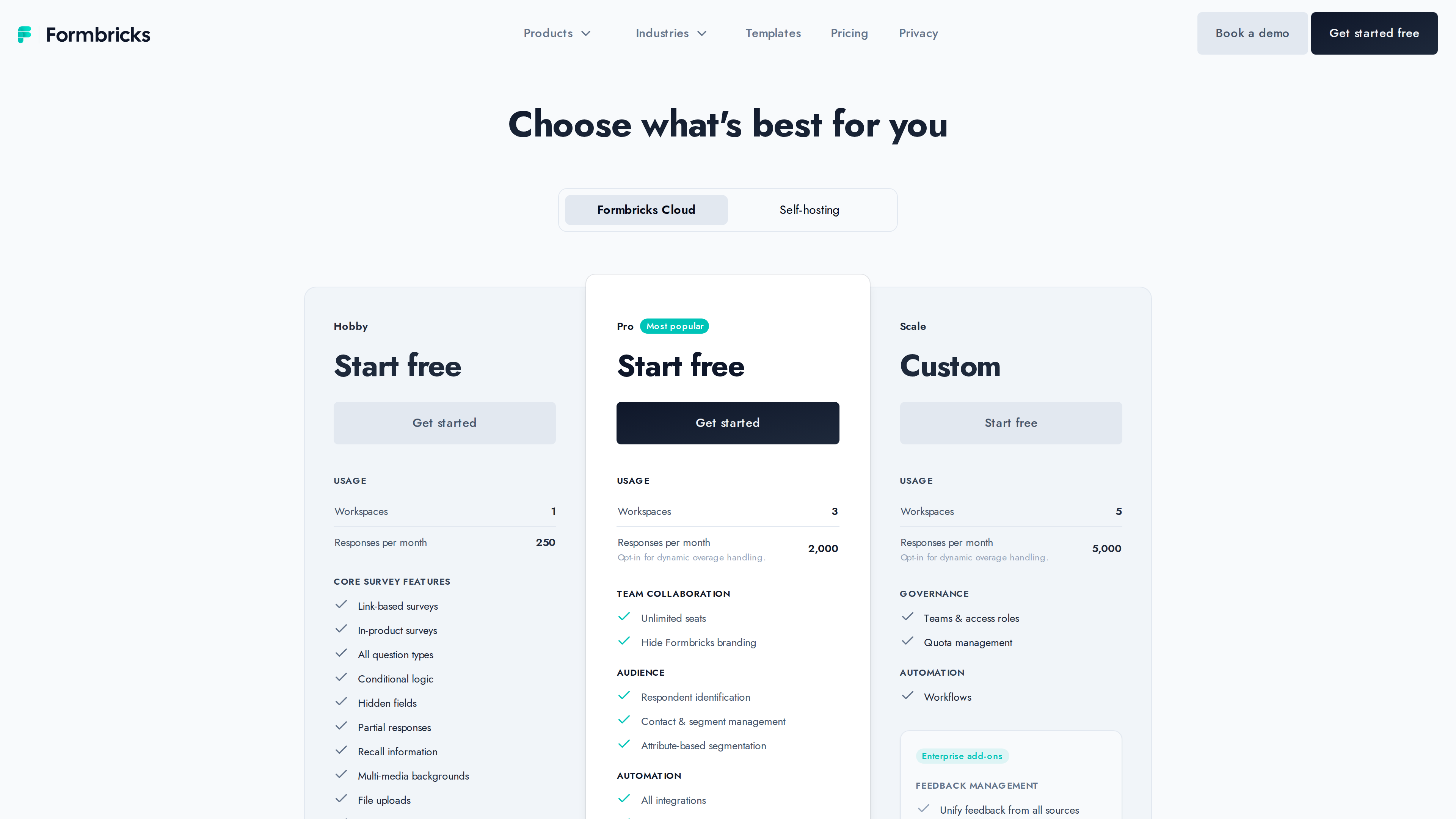
As of 2026-10-01, the pricing page lists the following cloud tiers (hosted in Frankfurt, Germany):
| Tier | Price | Responses/month | Workspaces | Key differences |
|---|---|---|---|---|
| Hobby | Free | 250 | 1 | All core survey features and full API access (incl. MCP) |
| Pro | Shown as "Start free" | 2,000 | 3 | Unlimited seats, no Formbricks branding, respondent identification, contacts & segments, all integrations, mobile SDKs, AI translations |
| Scale | Shown as "Custom" | 5,000 | 5 | Teams & access roles, quota management, Workflows, plus enterprise add-ons (Unify Feedback, AI labeling, custom dashboards, 2FA) |
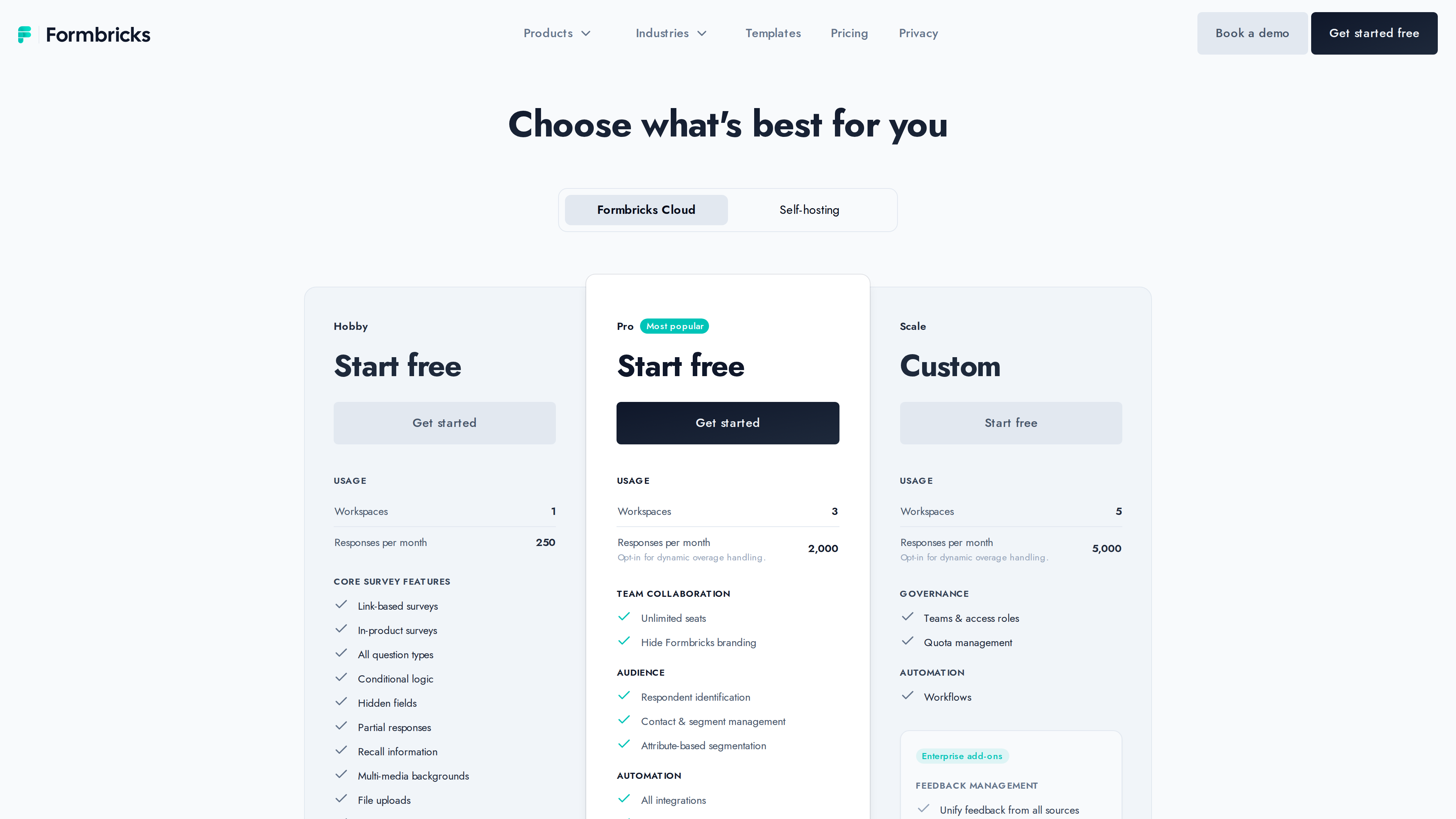
Two caveats. First, the visible page currently does not publish Pro/Scale prices ("Start free" and "Custom"); the annual-billing list prices kept in the page's source markup are 325/month for Scale, so treat those figures as indicative and confirm after signing up. Second, Pro and Scale offer opt-in dynamic overage handling beyond the monthly quota.
Self-Hosting and Licensing
Formbricks follows an open-core model. The LICENSE file and the official license documentation confirm this structure:
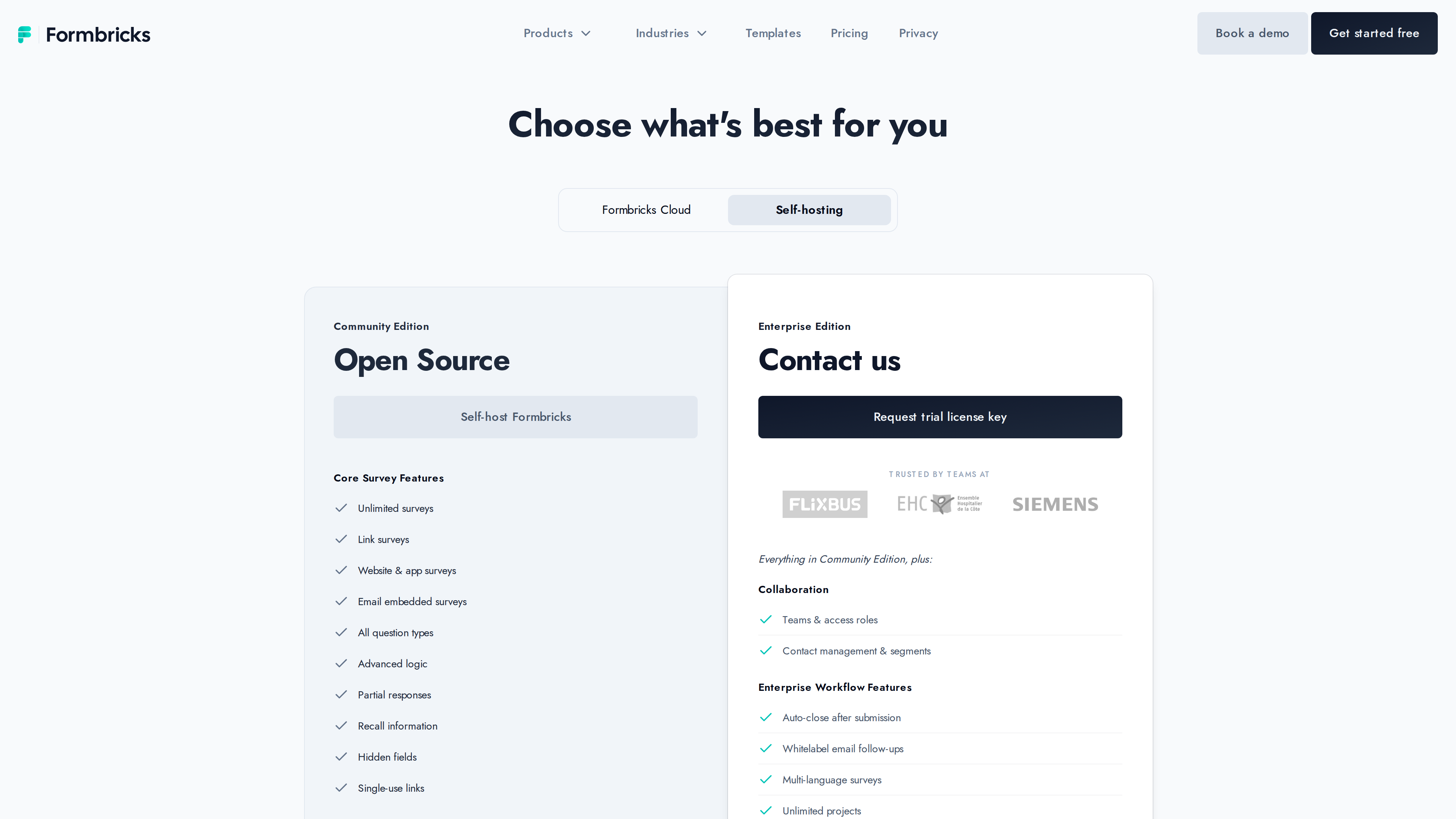
- Core application: AGPLv3, free for personal and commercial use; if you modify it and offer it to others, you must publish your complete source under AGPLv3 as well.
- The
apps/web/modules/eedirectory: a proprietary Enterprise License — the code is visible and ships in the Docker images, but requires a paid license key to unlock; enterprise licensees may keep modifications private. - Client packages (
packages/js,android,ios,api): MIT.
This mixed structure is why the GitHub API reports the repository license as NOASSERTION.
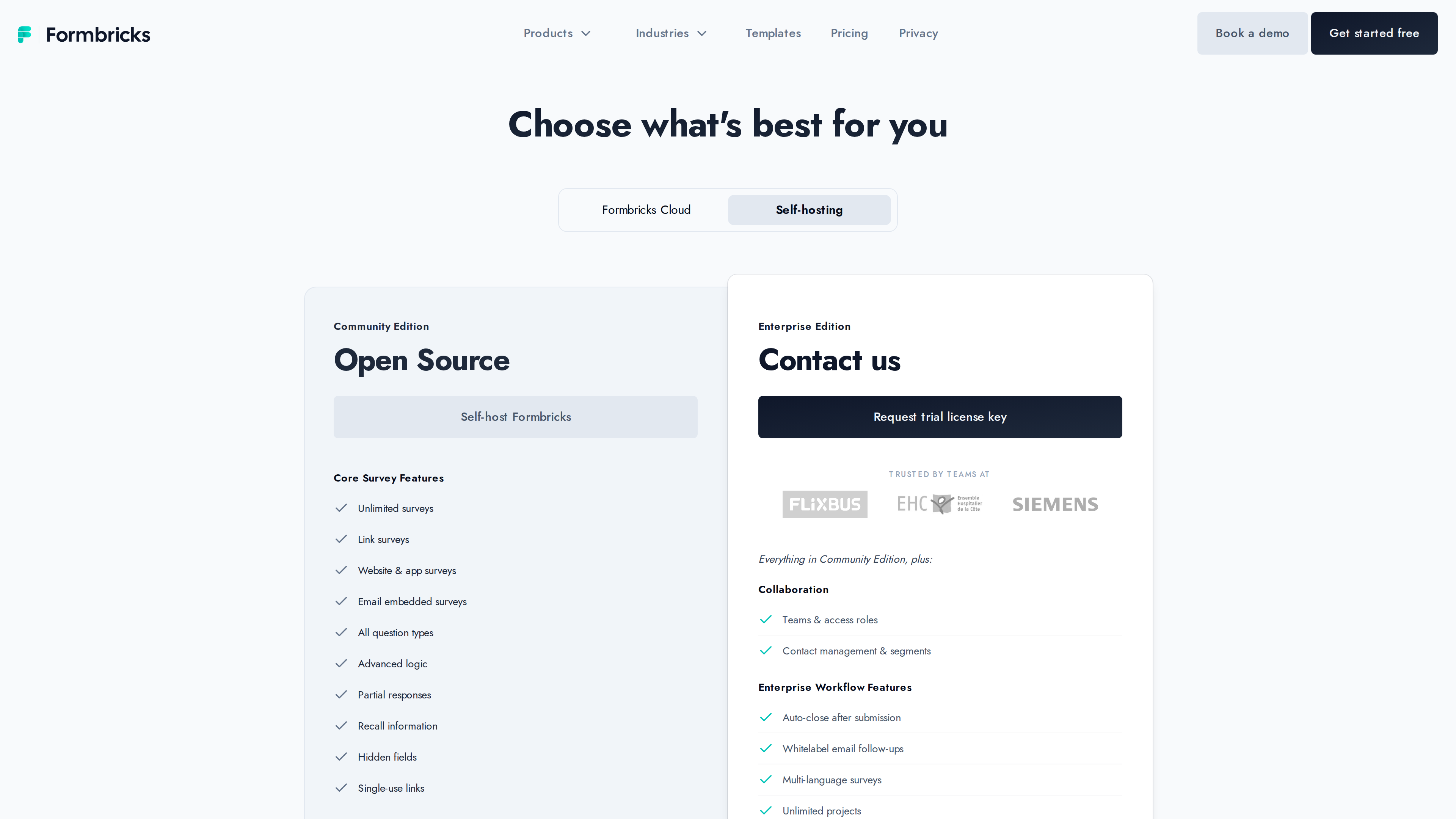
The free Community Edition covers all survey types, all SDKs, all integrations, webhooks, and the API, with unlimited surveys, responses, and users — but only one workspace. Removing the "Powered by Formbricks" badge, teams & roles (RBAC), contact management and segments, OIDC/SAML SSO, audit logging, quota management, Workflows, Unify Feedback, and two-factor authentication are all Enterprise Edition features.
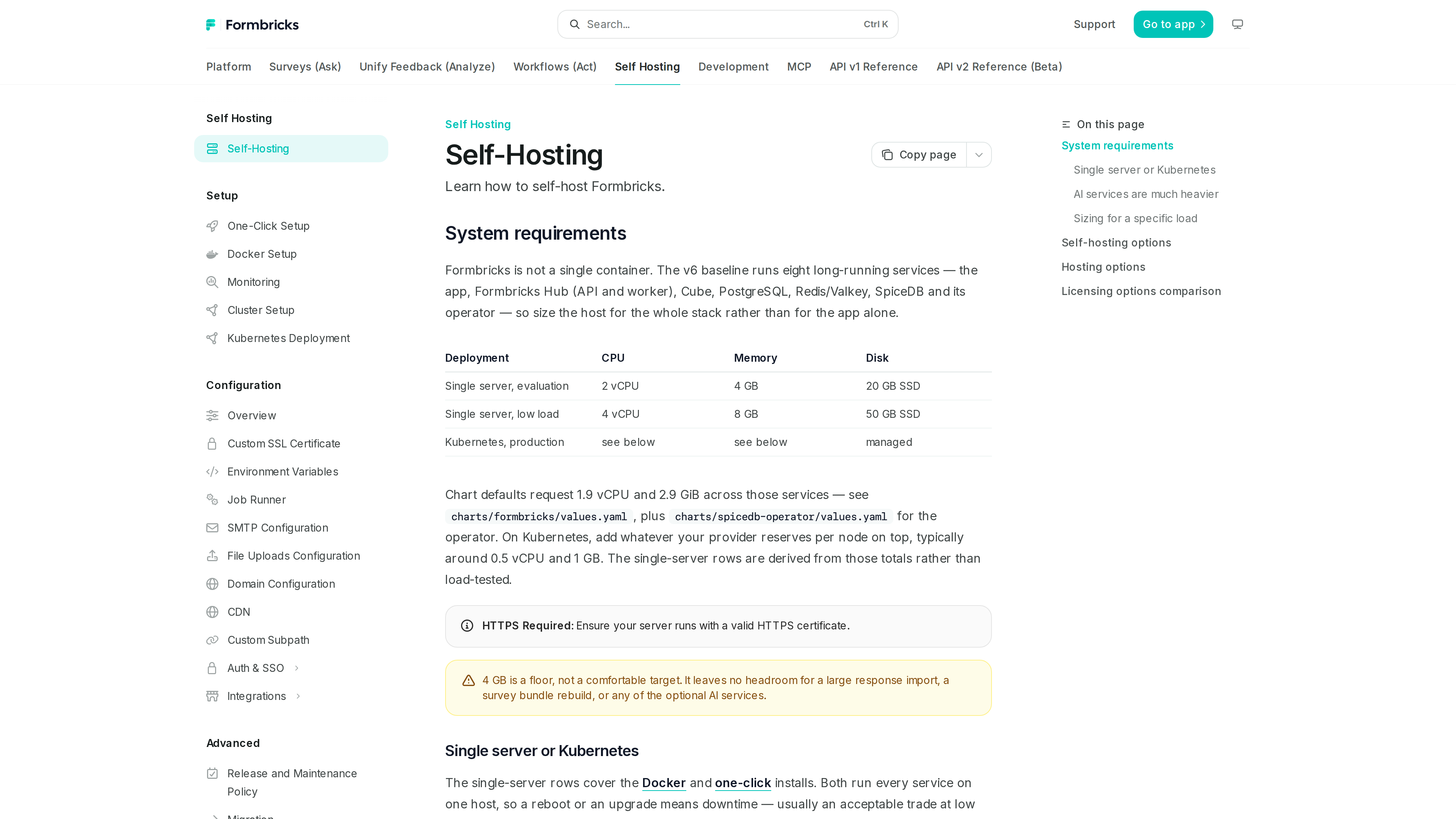
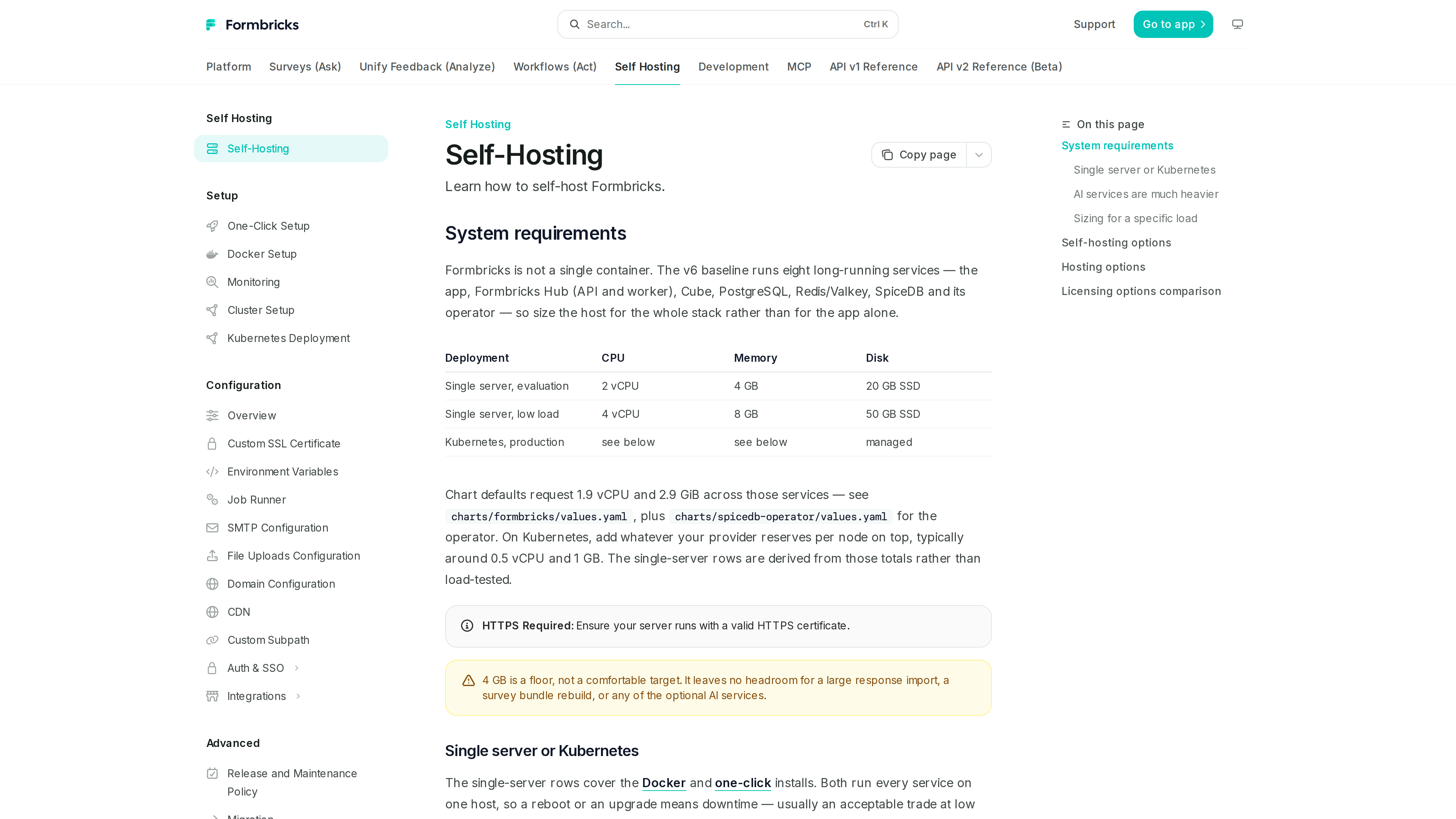
On deployment, the self-hosting documentation makes clear that v6 is not a single container: the baseline runs eight long-lived services — the app, Formbricks Hub (API and worker), Cube, PostgreSQL, Redis/Valkey, and SpiceDB with its operator. A single evaluation server needs 2 vCPU / 4 GB RAM (the docs stress this is a floor, not a comfortable target); 4 vCPU / 8 GB is suggested for low load. Production deployments are expected to run on Kubernetes (3 nodes minimum, with managed PostgreSQL/Redis and S3-compatible object storage), and a Helm chart is provided. A valid HTTPS certificate is mandatory.
Privacy and Compliance
Per the official GDPR FAQ: Formbricks is a German company; cloud survey data is encrypted and stored in Germany (EU); a Data Processing Agreement (DPA) is available on request. The survey creator is the data controller for respondent data, while Formbricks acts as the processor, and responses you delete are permanently removed from backups within 90 days. The site footer also lists a SOC 2 Type II page. Organizations with strict data-residency requirements can self-host to keep all data on their own infrastructure.
Who It's For
- Product teams running in-app or on-site micro-surveys — NPS, PMF, onboarding feedback, pre-churn surveys — triggered by user behavior.
- Organizations subject to GDPR or data-residency constraints that want survey data to stay in the EU or on their own servers.
- Teams that want to modify AGPL-licensed source code and embed the platform deeply into their own stack.
Limitations
- The free cloud tier is small: 250 responses/month and one workspace; mobile SDKs, branding removal, and segment targeting only start at Pro.
- The self-hosted Community Edition is limited to one workspace and lacks SSO, RBAC, and audit logging — these are paid Enterprise features.
- The v6 self-hosted stack is considerably heavier (eight services, and AI features demand much more), raising the operational bar compared to single-container survey tools.
- AGPLv3's copyleft means modified core code offered as a service must be published; closed-source derivatives require the enterprise license.
- Pro/Scale list prices are not currently displayed on the visible pricing page, which hurts price transparency.
Alternatives
Among proprietary products, Typeform, SurveyMonkey, and Qualtrics are the comparisons Formbricks invites most directly (the site maintains dedicated comparison pages). On the open-source side, LimeSurvey is the longer-established option, oriented toward traditional questionnaires, whereas Formbricks emphasizes in-product targeted micro-surveys and a modern stack.