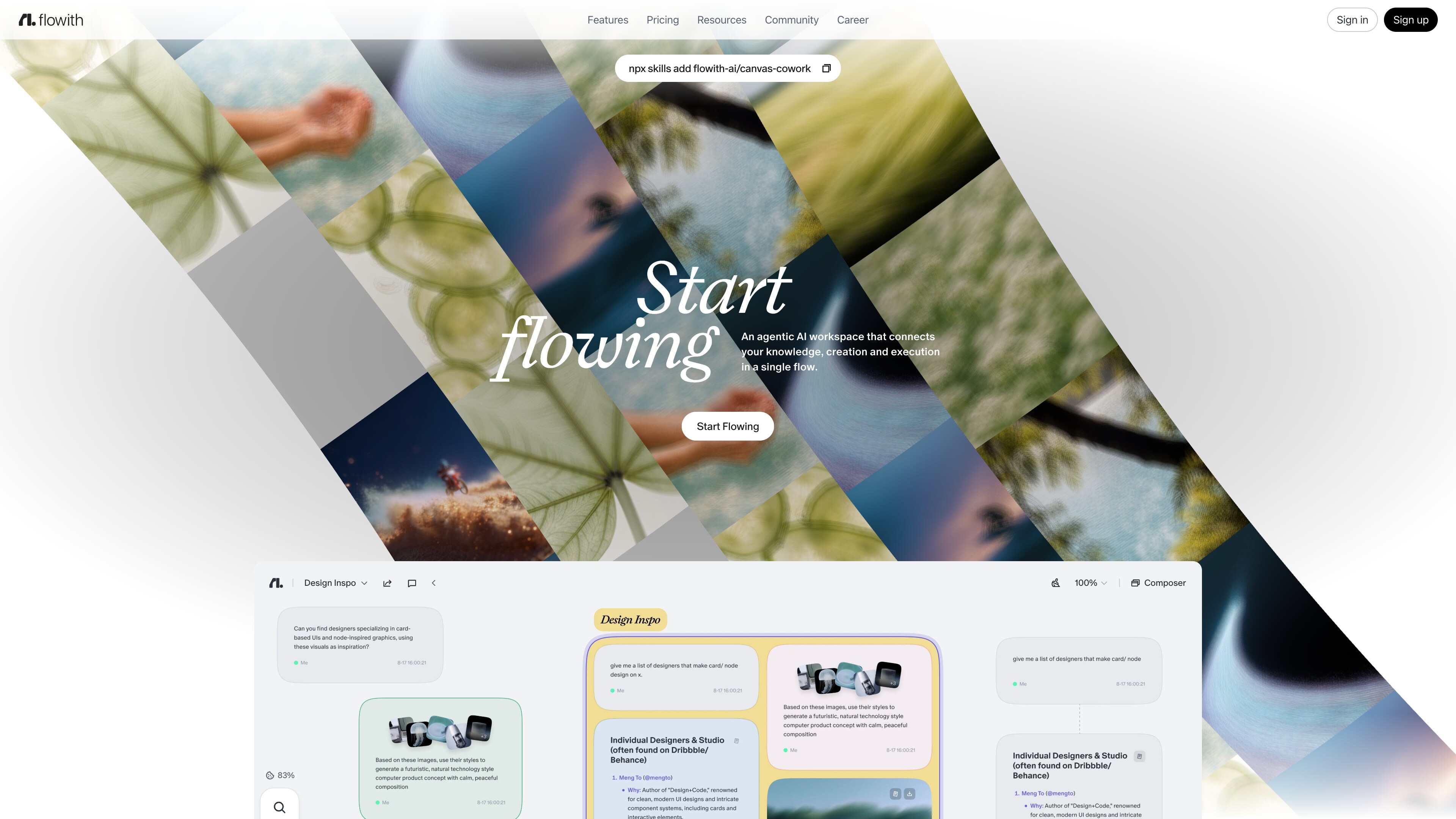
Flowith (flowith.io) is a canvas-based AI creation workspace built by a Shanghai team, positioning itself as "an agentic AI workspace that connects your knowledge, creation and execution in a single flow." The problem it targets: linear chat windows are poor containers for branching exploration, multi-model comparison, and multimodal output. In Flowith, every prompt and every generation is a node on a two-dimensional canvas that can be rearranged, forked, and reused — you can run several conversation threads in parallel and call different models side by side. Its verifiable difference from most AI tools: it is not tied to a single model provider but aggregates 40+ models from OpenAI, Anthropic, Google, xAI, DeepSeek, Moonshot AI, and others (official docs, as of 2026-09-17), and layers on top an autonomous long-task creative agent (Agent Neo), a knowledge system (Knowledge Garden), and a desktop agent product (FlowithOS). The homepage claims a community of 1 million users (homepage, as of 2026-09-17).
At a glance
- URL: https://flowith.io
- Type: Canvas-based AI creation workspace (multi-model hub + autonomous agent + knowledge base)
- Cost: Starter free plan at 19.90/month; Ultimate 499.90/month — see the official pricing page (as of 2026-09-17)
- Account required: Browsing the site, docs, and changelog needs no account; the canvas UI opens logged-out for inspecting models and templates, but actually generating anything requires sign-up (Google, X, GitHub, or email)
- Interface language: The site and workspace ship in 14 languages, including English, Simplified and Traditional Chinese, Japanese, Korean, French, German, Spanish, Portuguese, and Russian (per the sitemap); the documentation is in English
- Launched: Public beta on April 18, 2024; full launch in August 2024 alongside the Oracle agent framework (Baidu Baike); the brand and company were founded in February 2023
Background
Flowith's Chinese entity is Shanghai Hysi Technology Co., Ltd. (上海骇斯科技有限公司, incorporated February 2023), while the site footer names a Singapore entity, Flowith Technologies Pte. Ltd. The founding team is notably young: CEO Derek Nee (倪正民, born 1996, previously a project product manager at YC China), co-founder Zion (吴熠宸, born 1998), and a Gen-Z co-founder and CMO known as Guaizi (Zhidx, Mar 2026; Jazzyear interview via The Paper).
Key product milestones:
- April 2024: Public beta of the canvas-based AI creation tool, which spread on X for its "infinite canvas + multi-threaded chat" format.
- August 8, 2024: Launch of the Oracle autonomous agent framework, which topped Product Hunt's daily chart (APPSO interview, syndicated copy). Oracle plans steps and calls tools to complete multi-step tasks; because it shipped before Manus, Chinese media later dubbed it a "budget Manus." Nee says Oracle typically finishes comparable tasks in about 5 steps and 5–10 minutes (Zhidx).
- January 2025: Flowith 2.0 added the Knowledge Garden, the multi-threaded canvas, the Composer editor, a knowledge-base marketplace, and real-time collaboration; DeepSeek R1 was integrated the same month (Baidu Baike).
- May 2025: Launch of Agent Neo, a long-task creative agent billed around "infinite steps, infinite context, infinite tools" (Crossing podcast interview with the CEO and CMO, 2025-05-18).
- October 2025: Public beta of FlowithOS for macOS and Windows, billed as "an operating system built natively for AI agents," driving cross-app workflows in the browser and desktop software (Zhihu AI digest, 2025-10-29).
- March 2026: Announced eight-figure-USD seed and seed+ rounds — the seed backed by Vertex Ventures and others, the seed+ co-led by Sequoia China Seed Fund and Jiangyuan Capital — earmarked for R&D and global expansion (Zhidx).
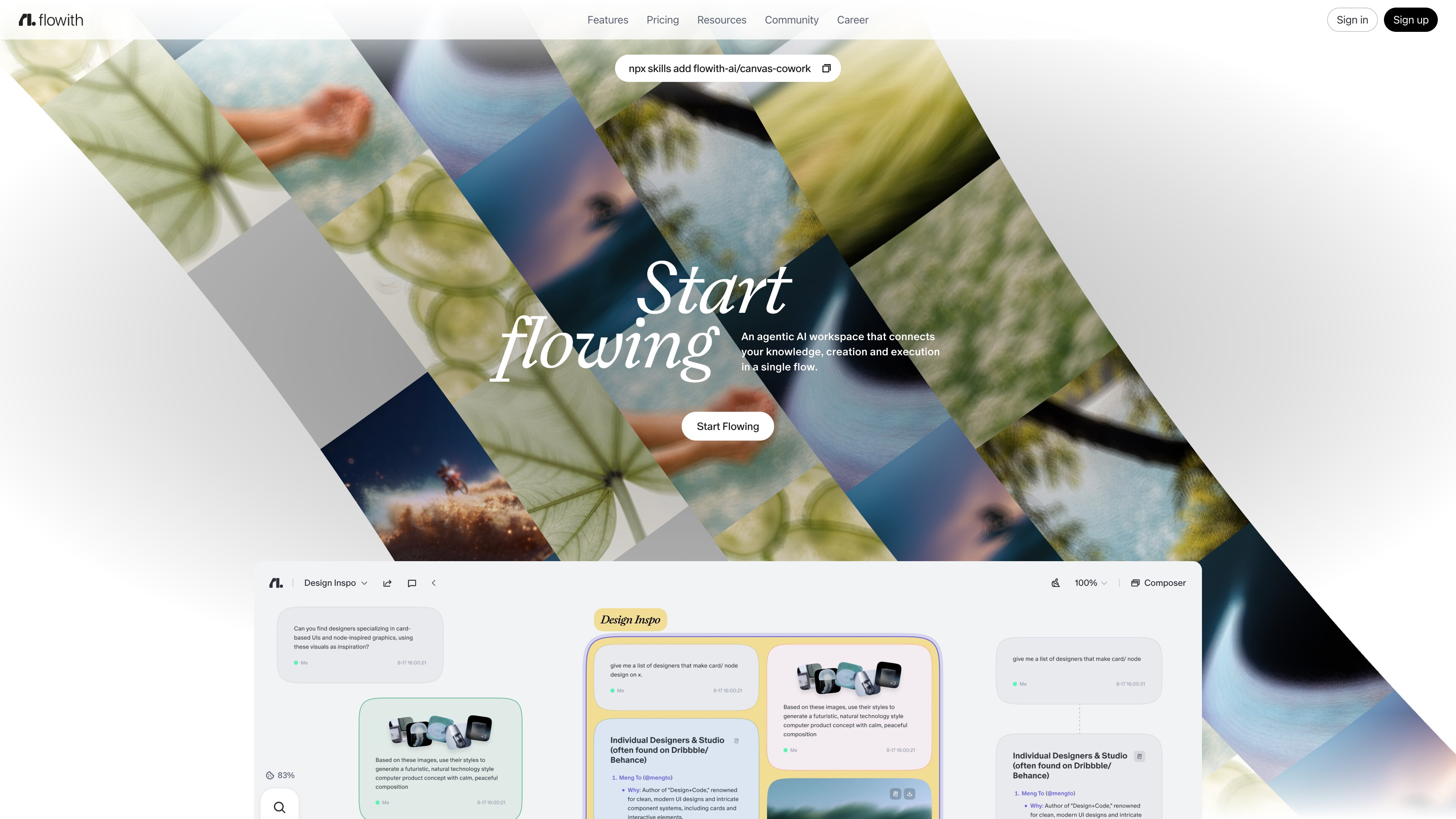
The homepage doubles as a product demo: beneath the "Start flowing" hero sits a real, interactive canvas showing nodes, the Composer editor, and live generation progress — everything in Flowith happens on a canvas like this.
Core capabilities: multi-model creation on one canvas
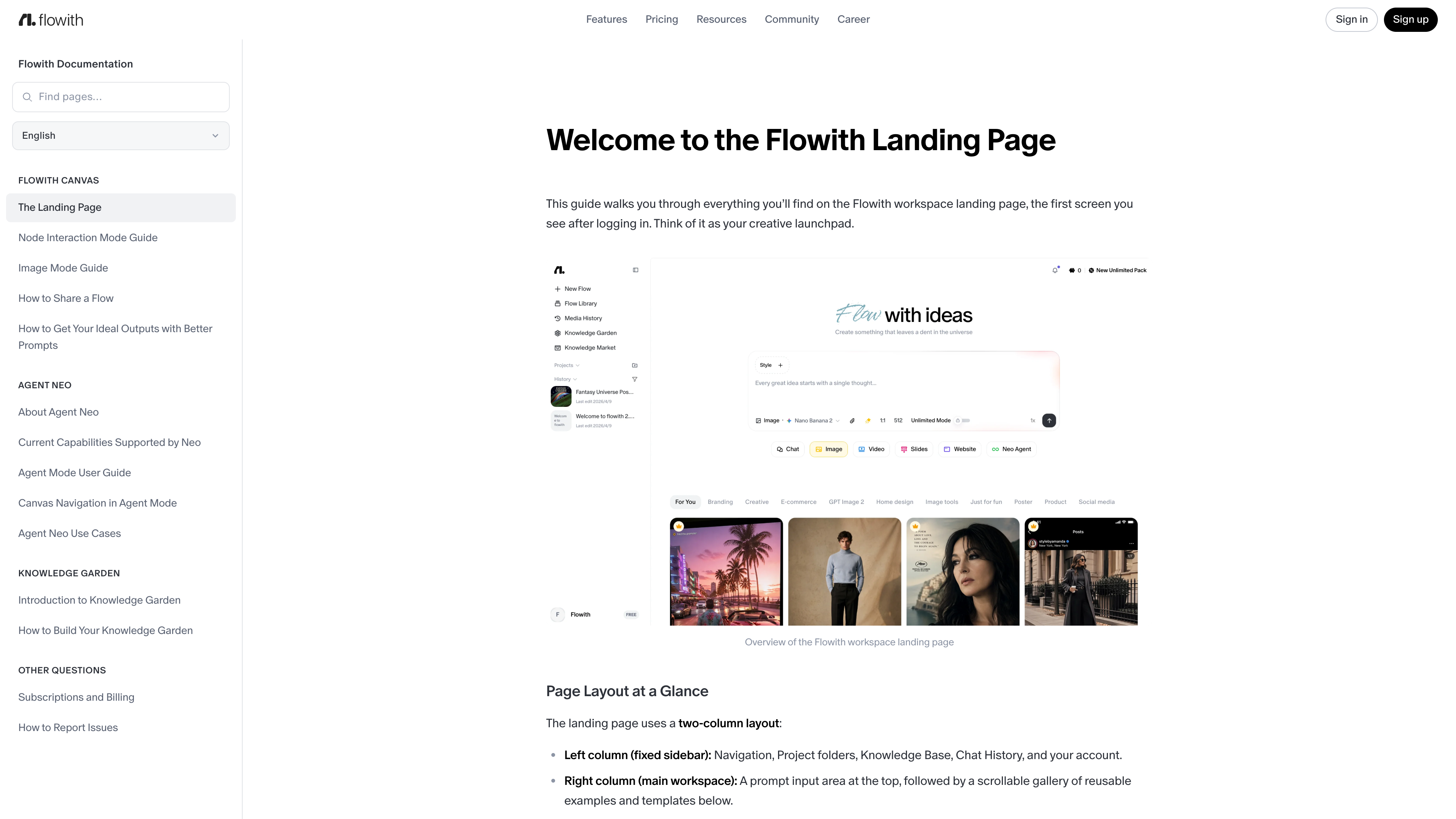
Flowith's workspace is called the Context Playground. From hands-on inspection (opening the canvas logged out): a prompt bar on top switches between six modes — Chat, Image, Video, Slides, Website, and Neo Agent — and the model picker lists available models by modality. Each generation becomes a node you can follow up on, fork, drag around, and reference from other nodes, with multiple threads progressing in parallel (official docs).
Multi-model aggregation is the most concrete capability: the platform is tied to no single vendor, and paid plans advertise "40+ Premium models." Models confirmed by the official changelog in 2026 alone include OpenAI's GPT-5.6 family, GPT-6 Astra, and GPT Image 2.5; Anthropic's Claude Opus 4.8 and Sonnet 5; Google's Gemini 3.7 Flash and the Nano Banana image models; xAI's Grok 4.6; Moonshot AI's Kimi K3; MiniMax M3/H3; ByteDance's Seedream 5.0 Pro and Seedance 2.5; and Alibaba's Wan 3.0 (changelog, as of 2026-09-17). The same prompt can be run through different models side by side, with results compared directly on the canvas.
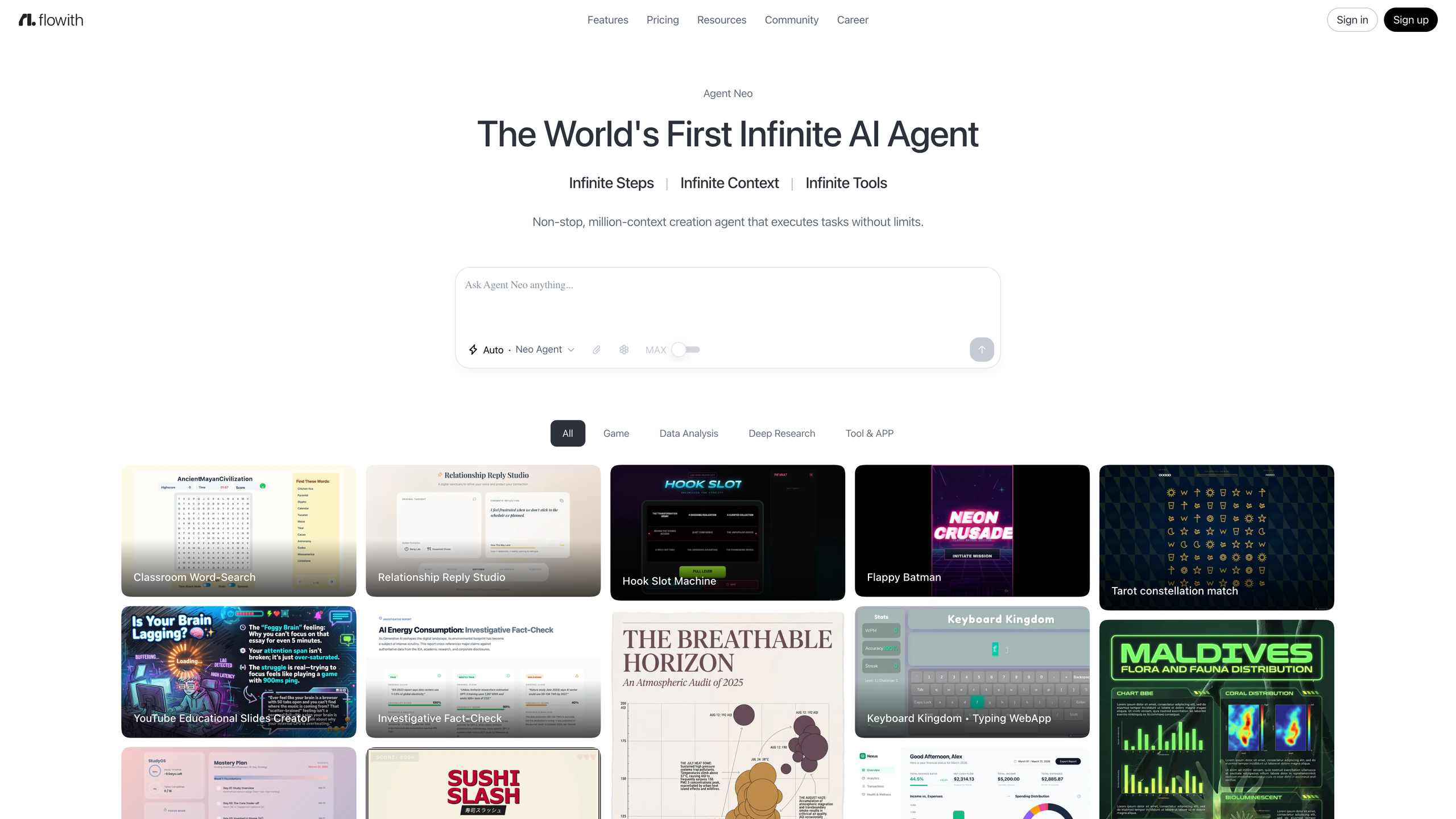
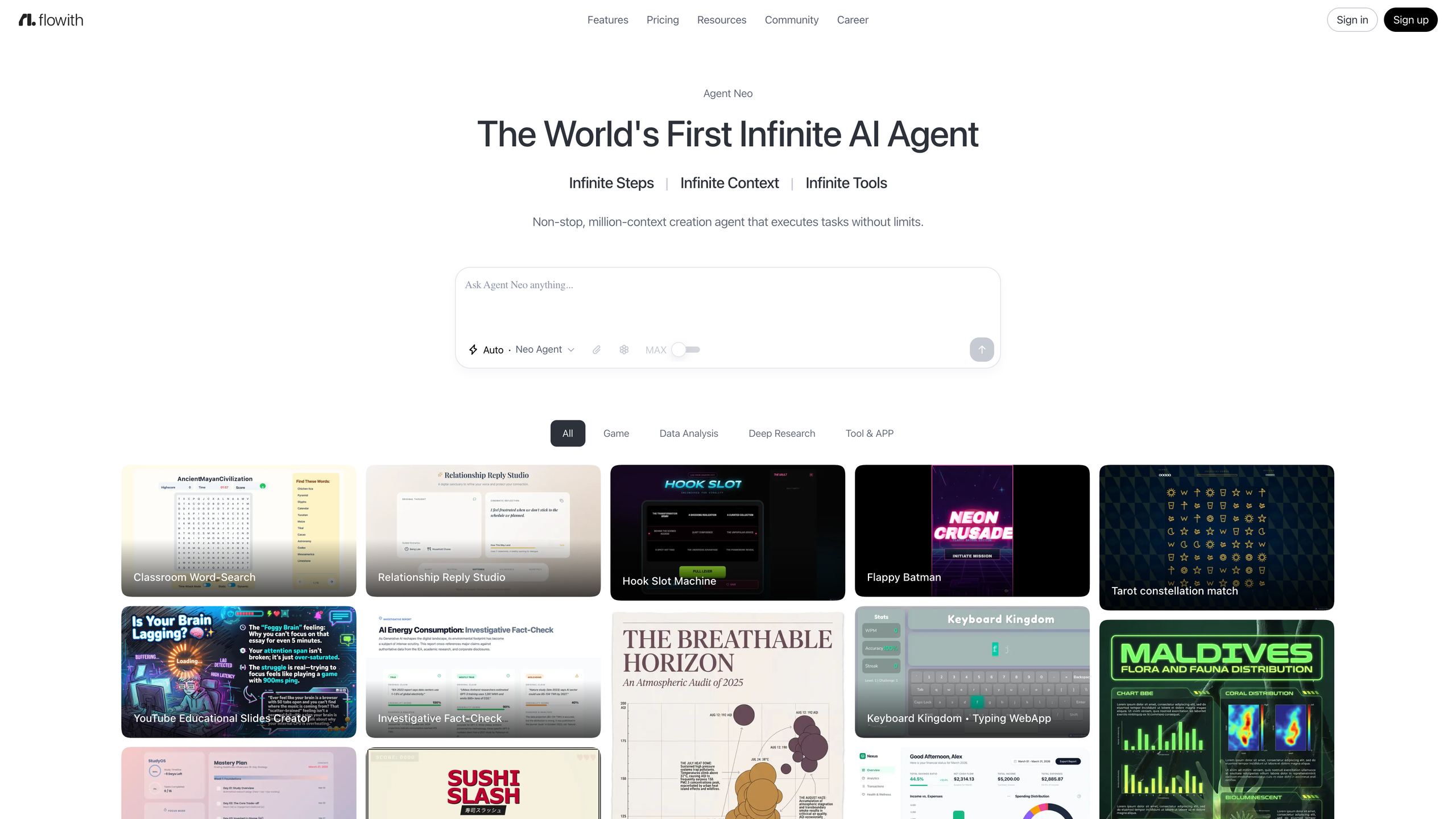
Agent Neo is the autonomous execution layer above the canvas, billed as "The World's First Infinite AI Agent": give it a goal and it plans steps, searches the web, calls tools, and delivers articles, images, videos, slide decks, or complete websites — claimed to support million-token context and nonstop long-running tasks. The page also claims leading GAIA agent-benchmark scores across difficulty levels (a marketing claim; no independent verification). A community gallery lists example runs with replayable execution traces.
The Knowledge Garden is the companion context system: material you save is split into reusable knowledge units that generations can draw on, and a Knowledge Market hosts community-shared knowledge bases (official docs). Since June 2026, all generation history is archived in Media History, searchable on a timeline with one-click jumps back to the original canvas node.
On the desktop, FlowithOS extends the agent locally: driven by natural-language goals, it operates across the browser and desktop applications. It has been in public beta for macOS and Windows since October 2025; Zhidx reports it leading some agent benchmarks at the time.
Accounts and openness
Sign-up supports Google, X, GitHub, and email. Public pages require no account, but the moment you actually generate, a sign-up prompt appears. Beyond the web app, Flowith has an iOS app and launched a mobile web version in June 2026 (changelog).
For developers, the team maintains the MIT-licensed CLI skill flowith-ai/canvas-cowork on GitHub (created March 2026), which creates canvases and runs image/text/video/agent generations from the command line for tools like Claude Code. Broader openness is still incomplete: the pricing page marks custom integrations and API access as "coming soon," and the Knowledge Garden API was temporarily taken offline in July 2026 over abuse (changelog).
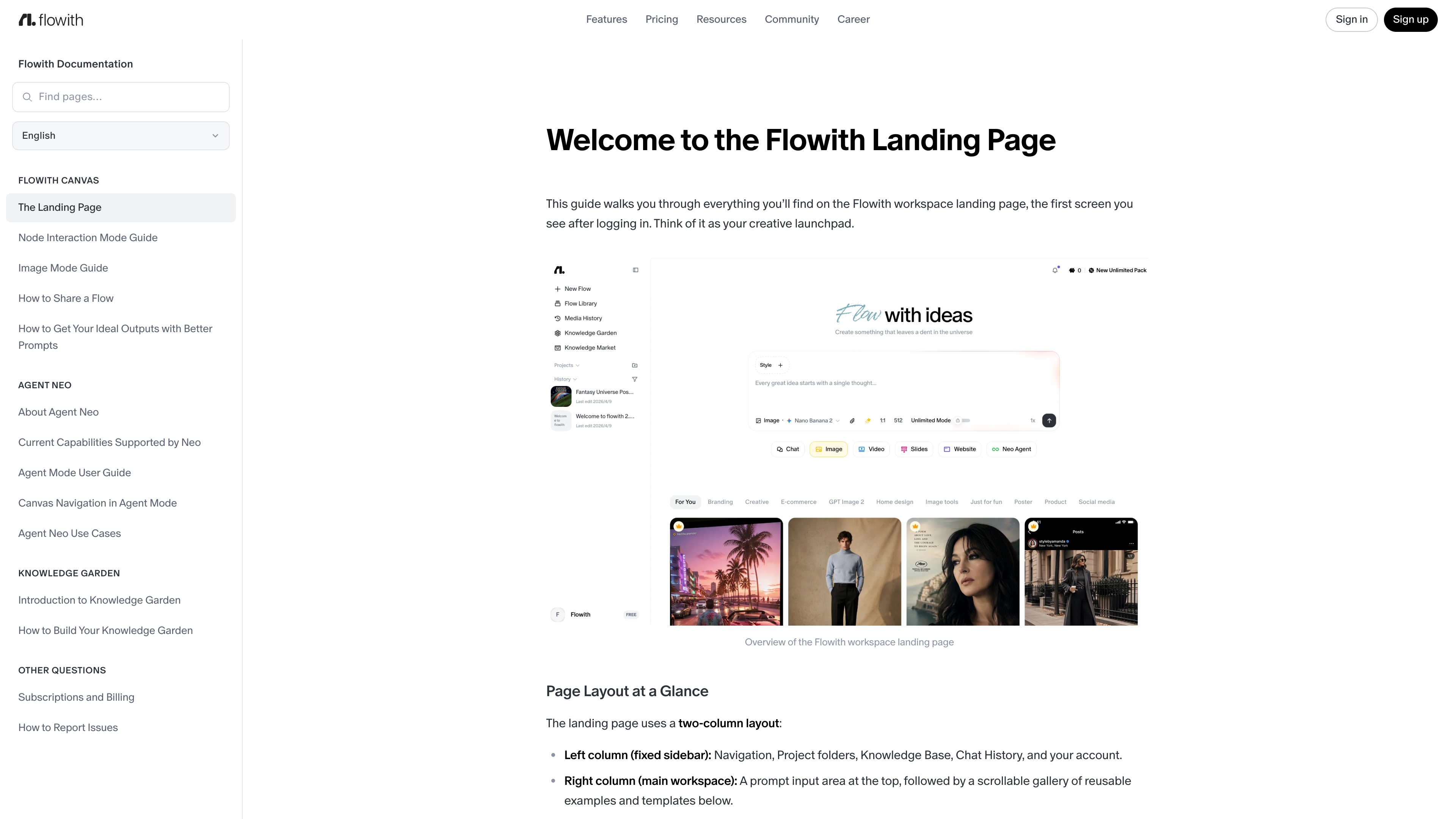
The documentation site is publicly readable without an account, covering canvas guides, Agent Neo instructions, the Knowledge Garden, and subscription details — the most reliable first-hand source for product specifics.
Pricing: everything metered in credits
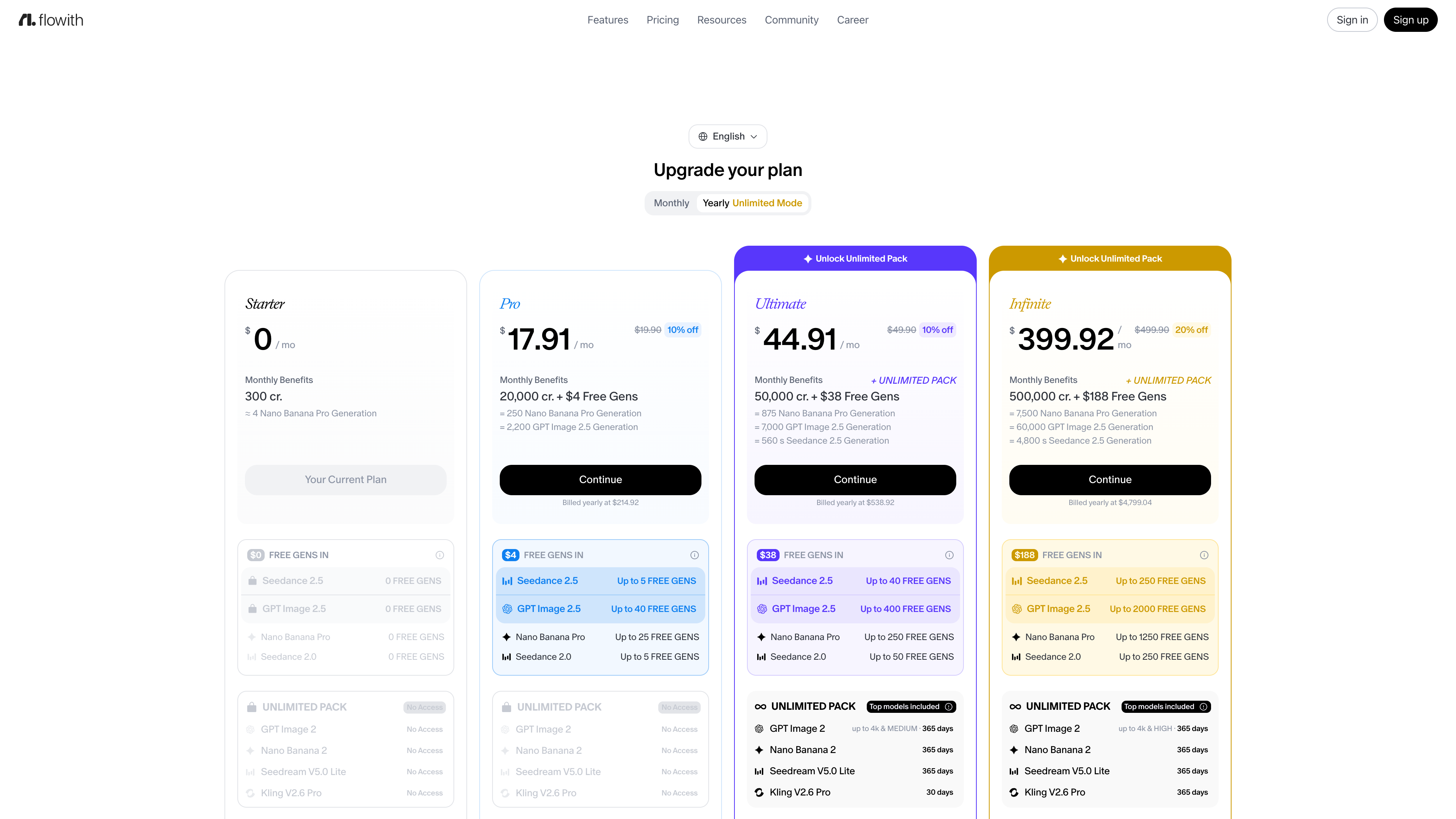
Flowith meters generation in credits, with per-model pricing, separate "free generations" grants for designated models, and an Unlimited Mode on higher tiers (pricing page, as of 2026-09-17):
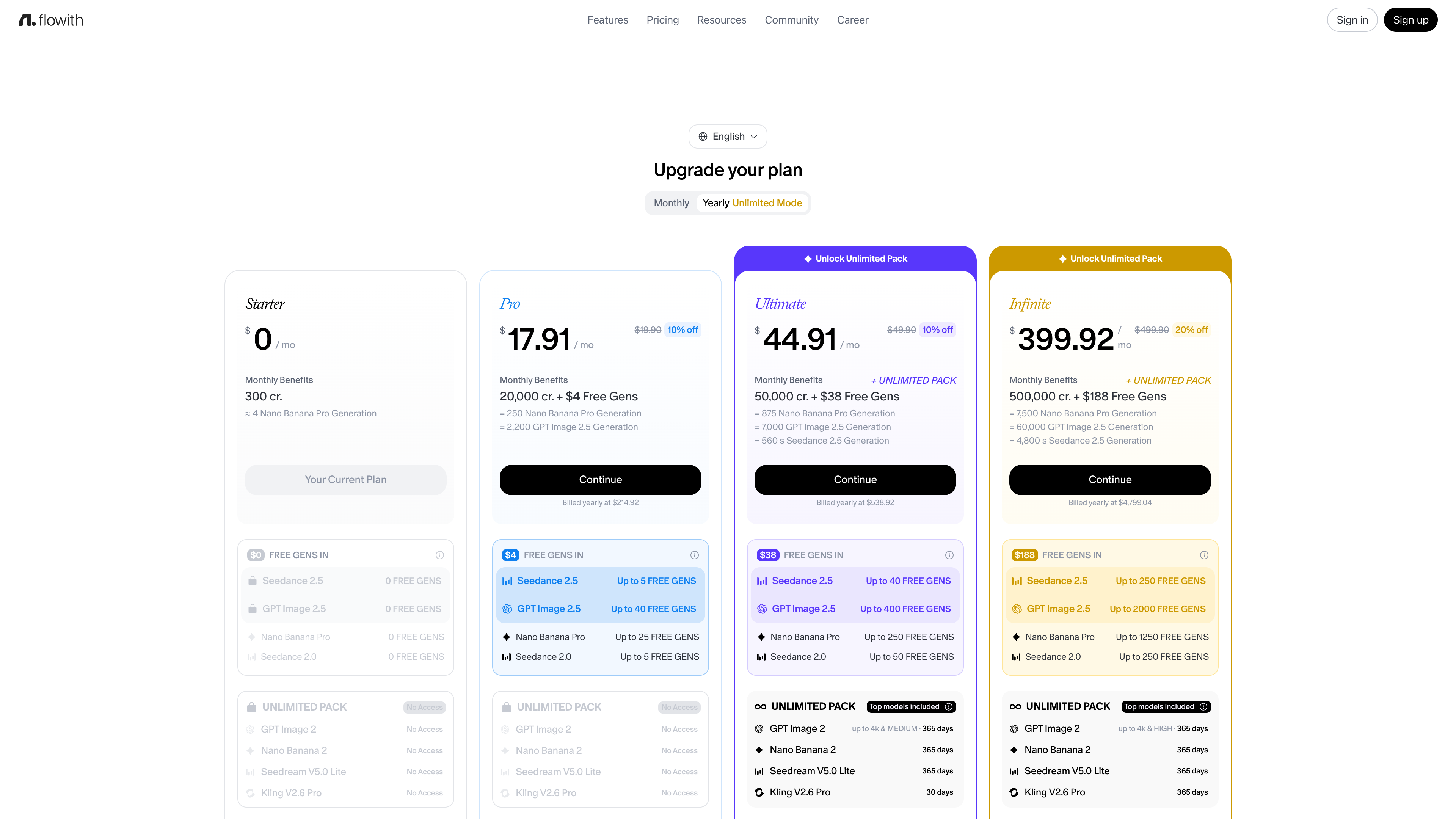
| Tier | Monthly | Annual (per month) | Monthly allowance highlights |
|---|---|---|---|
| Starter | $0 | — | 300 one-time credits; limited models; 1 Agent Neo run per task type |
| Pro | $19.90 | $17.91 | 20,000 credits + $4 of free generations; 40+ models; batch generation; top-up packs |
| Ultimate | $49.90 | $44.91 | 50,000 credits + $38 of free generations; Unlimited Pack (unlimited use of designated models such as GPT Image 2) |
| Infinite | $499.90 | $399.92 | 500,000 credits + $188 of free generations; unlimited concurrent tasks; custom integrations and API (coming soon) |
Details worth noting:
- Unlimited Mode is not unlimited speed: designated models stop consuming credits, but they run in a separate, lower-priority queue with dynamic throttling and concurrency caps at peak load. Automation scripts and account sharing are explicitly banned; abnormal traffic triggers suspension and manual review.
- Agent Neo is quota-based per run: monthly Deep Research / Slides / Website allowances are 36/22/92 on Pro and 1,000/600/2,520 on Infinite.
- Strict refunds: subscription fees are non-refundable except within 48 hours of payment with fewer than 200 paid credits consumed. Plans can be cancelled, upgraded, or downgraded anytime, taking effect the next billing cycle.
- Payment methods include major credit cards and PayPal; the site says 1% of revenue goes to carbon-removal projects via Stripe Climate and Frontier.
Good fits
- Heavy multi-model users: instead of subscribing to several providers separately, switch models per task on one canvas and compare outputs side by side.
- Research and content work: hand research, long-form writing, slide decks, and data-viz pages to Agent Neo for a first draft, then revise node by node on the canvas.
- Multimodal asset production: image and video models share the canvas with text models, so assets can feed directly into the next generation step as reference nodes.
- Knowledge-heavy workflows: the Knowledge Garden suits work that repeatedly draws on the same material, such as serialized content or competitor tracking.
Limitations
- The free tier is a demo: 300 one-time credits on limited models won't sustain real use; serious work requires a subscription.
- Complicated metering: per-model credit pricing plus overlapping allowances (free generations, Unlimited Pack, top-ups) make the real cost of a finished piece hard to predict — a point third-party reviews also raise.
- No official guarantee of output quality: the Agent Neo page itself warns that generated output is no substitute for professional, legal, medical, financial, or identity verification; "infinite" and "GAIA-leading" are the company's own claims.
- Openness is incomplete: API access and custom integrations remain unreleased, and the Knowledge Garden API was suspended once over abuse.
- Learning curve: from hands-on inspection, the workspace packs dense modes, node parameters, and model options; new users will need the (English-only) docs.
- Terms to note: subscriptions are in principle non-refundable, with only a 48-hour, usage-capped refund window.
Alternatives
- Manus: a general autonomous agent running long tasks in a cloud virtual machine; Flowith's Oracle/Neo are often compared with it in the press, differing on canvas interaction and multi-model aggregation.
- Genspark: a "Super Agent" workspace with similar task decomposition and multimodal output, organized around linear task pages.
- Lovart: a canvas-based AI design agent aimed at visual design; Flowith's canvas spans a wider range — text, research, slides, and websites.
Sources
- Flowith homepage (checked 2026-09-17)
- Flowith pricing (checked 2026-09-17)
- Agent Neo page (checked 2026-09-17)
- Flowith changelog (checked 2026-09-17)
- Flowith documentation (checked 2026-09-17)
- Zhidx: two post-95 founders and a post-00 build an Agent OS, raising an eight-figure USD round (checked 2026-09-17)
- Jazzyear interview with Flowith's founder (via The Paper) (checked 2026-09-17)
- Crossing podcast: Agent Neo launch interview with CEO Derek and CMO Guaizi (checked 2026-09-17)
- APPSO: the AI agent that predates Manus (syndicated on Sohu) (checked 2026-09-17)
- Baidu Baike: Flowith 2.0 (checked 2026-09-17)
- Baidu Baike: Flowith (Shanghai Hysi Technology) (checked 2026-09-17)
- Zhihu AI digest: FlowithOS public beta (2025-10-29) (checked 2026-09-17)
- GitHub: flowith-ai/canvas-cowork (checked 2026-09-17)