flomo (flomoapp.com), officially 浮墨笔记 ("flomo Fumo Notes"), is a card-note cloud service by Shanghai Xandi Network Technology Co., Ltd., launched on April 18, 2020. Rather than helping you write polished documents, it targets a different problem: most ideas never get written down at all. Input is deliberately reduced to a chat-like stream of cards — no formatting, no mandatory folders, with tags and search applied after the fact. Three verifiable choices set it apart from other note apps: you can record notes by messaging a WeChat official account; the team publicly refuses document editing, backlinks and to-dos; and it publishes an unusual operating philosophy — zero outside funding, subscription-only revenue, no lifetime plans, plus a reserve fund pledged to cover seven more years of running costs. The company claims "millions of lifelong learners" as users (vendor-reported).
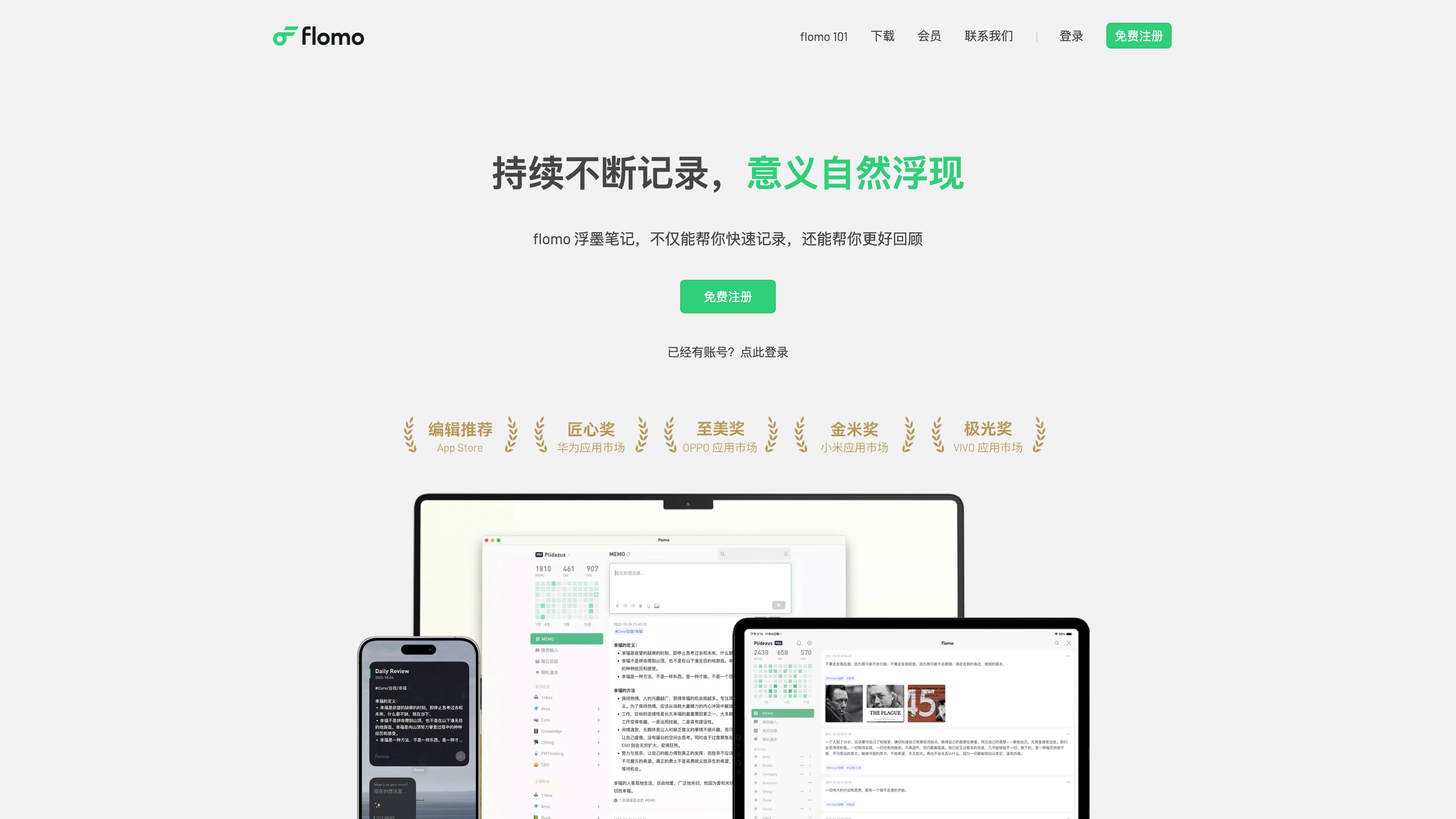
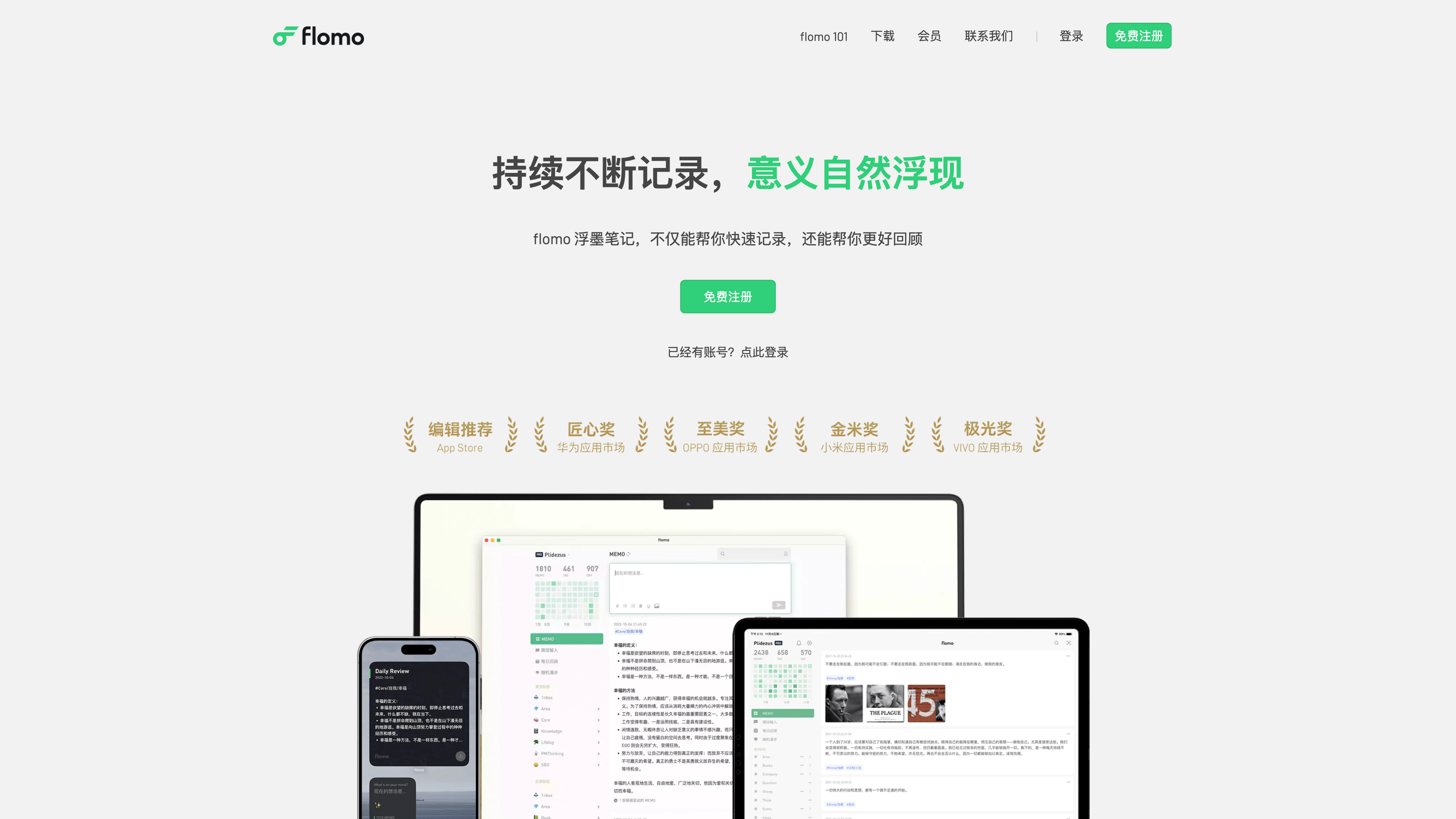
The screenshot above shows flomo's homepage. The hero slogan translates as "Keep recording, and meaning emerges on its own." Below it are badges for App Store Editors' Choice and awards from Huawei, OPPO, Xiaomi and vivo's app stores, alongside mockups of the desktop and mobile apps.
At a glance
- URL: https://flomoapp.com
- Type: Cloud card-note service (consumer subscription SaaS)
- Pricing: Free tier (500 MB storage); PRO ¥15/month or ¥99/year; MAX ¥39/month or ¥299/year (App Store China listing, as of 2026-09-25; flomo notes that in-app prices prevail)
- Sign-up: Account required (phone number or email); WeChat scan login and carrier one-tap login supported
- Interface language: Website in Simplified Chinese only; the iOS app lists Simplified Chinese, Traditional Chinese and English
- Platforms: iOS, iPadOS, Android, HarmonyOS NEXT, macOS, Windows, Web (v.flomoapp.com) and PWA (official FAQ)
- Launched: April 18, 2020 (help center)
Background
flomo was designed and built by Shao Nan (Plidezus) and Lightory. The official About page describes them as friends of ten years who previously collaborated on a bookshelf app and had each founded companies before; the privacy policy names Liu Shaonan as the personal-information officer. The name flomo = flow + memo; the Chinese name 浮墨 and the logo were created by designer LUXU (credits page).
In his December 2020 origin essay, Shao Nan traces the product's philosophy to Niklas Luhmann's Zettelkasten card-box method and Andy Matuschak's Evergreen Notes. Their premise: most people lack not better writing or organizing tools, but the habit of recording at all. The pair spent two weeks logging ideas in Slack channels to prove that "chat is the least stressful input method," and early flomo was pitched as "a microblog for an audience of one" and "a beefed-up File Transfer Assistant."
On operations, Lightory's August 2021 essay "flomo's business philosophy" states the company had taken zero funding, ran with just two full-time founders at the time, kept costs extreme, and earned only from subscriptions. It refuses to sell lifetime memberships — instead pledging a reserve fund covering seven years of server and minimal maintenance costs ("another 7 years of service"). No funding round has been announced since. In June 2023, ByteDance's outline-note app Mubu was handed over to the flomo team; the team also published a book on note-taking methodology (《笔记的方法》).
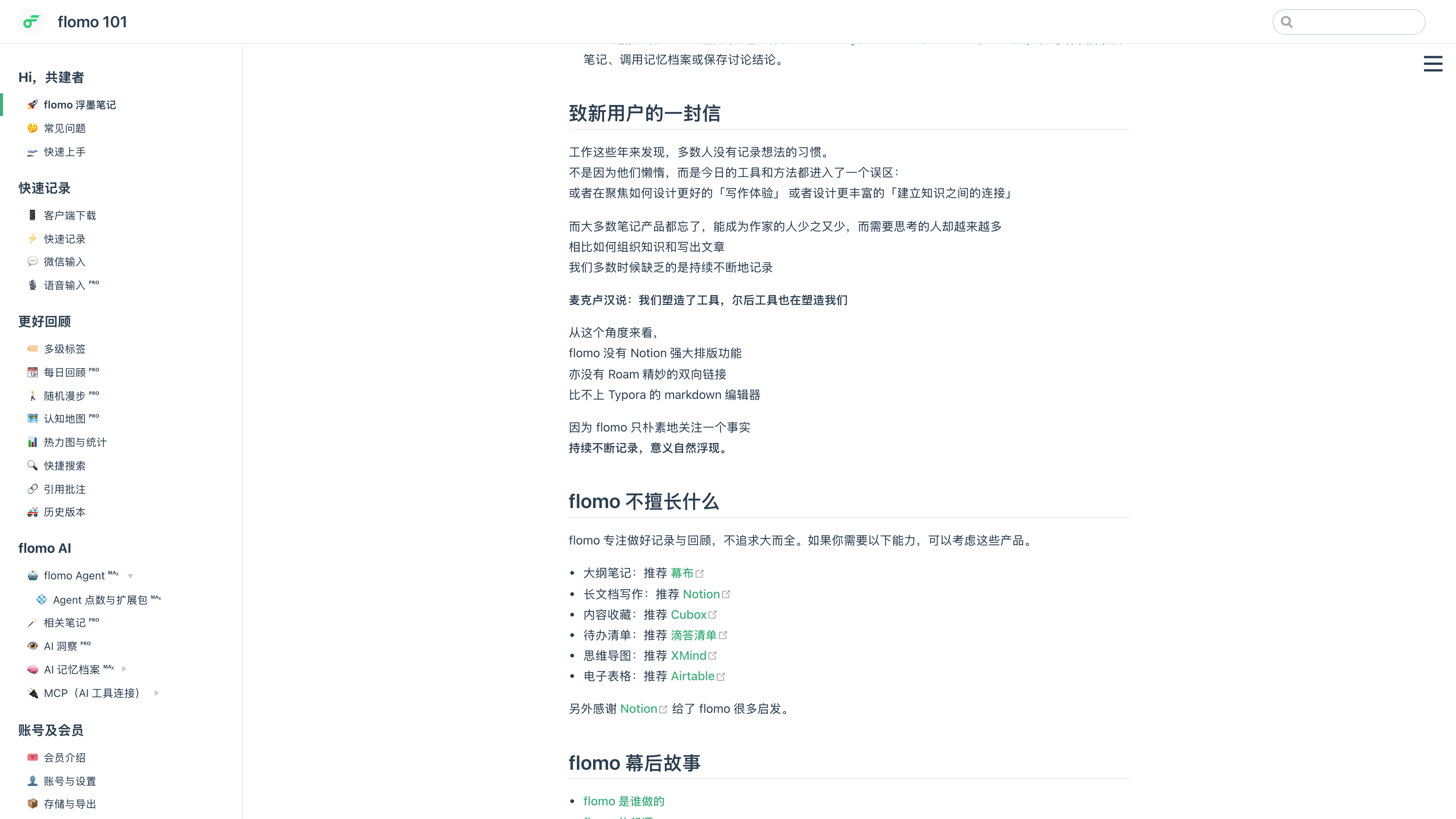
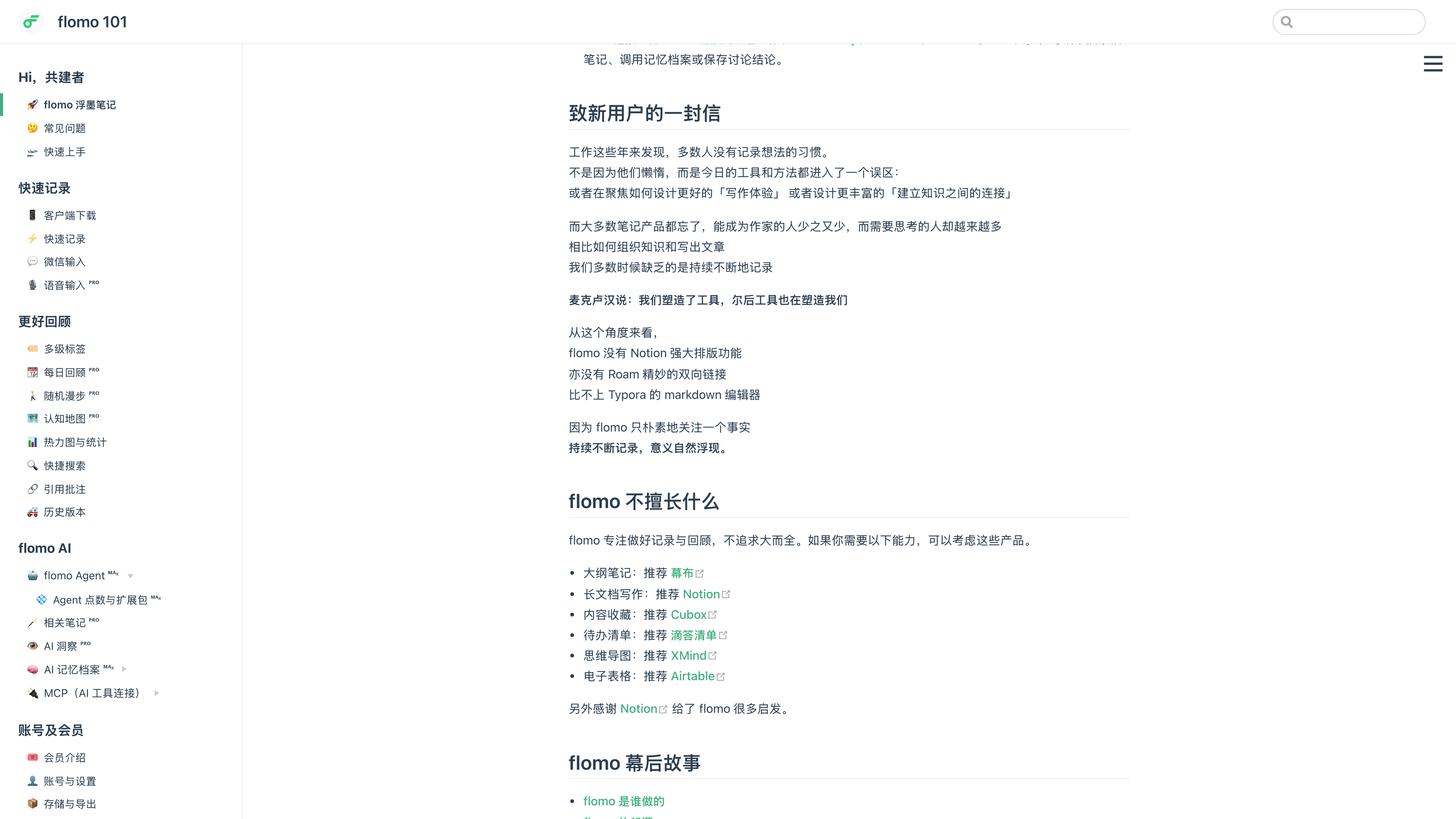
The screenshot above shows two sections of the flomo 101 help-center homepage. In the "Letter to new users," the team states flomo has neither Notion's powerful formatting, nor Roam's elegant backlinks, nor Typora's Markdown editor — it simply cares about "keep recording." Below, "What flomo is not good at" recommends other products for long-form writing, web clipping, to-dos and mind maps.
What it does: capture first, review second
On the capture side, everything serves friction reduction:
- WeChat official-account input: after binding the flomoapp official account, you can send text and photos in the chat window and they sync as notes; WeChat API limits mean no forwarded articles, stickers or files (WeChat input guide).
- Multi-platform sync: mobile (including HarmonyOS), desktop and web clients sync in the cloud; flomo says sync is free across all platforms with no device limit, and the desktop and web 2.0 clients work offline, syncing once reconnected.
- Voice input: speech-to-text memos, with monthly quotas of 500 minutes (PRO) and 1,500 minutes (MAX).
The review side is what separates flomo from a plain memo app: multi-level tags, fast and advanced search, plus Daily Review (push, widgets, WeChat reminders), Random Walk (wandering through old notes), Related Notes (surfacing hidden links between entries), Cognitive Map (described as themes that "emerge automatically from what you keep thinking about") and a note graph. The boundary is equally explicit: the help center and App Store description state flomo is "not good at" long-form writing, full-page web clipping, to-dos or mind maps — and they recommend Mubu, Notion and Cubox for those jobs. A single note caps at 30,000 characters and a single paste at 8,000.
AI features (added progressively since 2024): PRO includes AI Insights (patterns and themes across your notes), Related Notes and "Look It Up" (natural-language queries over past notes). MAX unlocks flomo Agent ("an AI that has read all your notes and chats with you inside WeChat," metered by points), an AI Memory Profile, and an MCP connection that pipes flomo into external AI tools such as ChatGPT and Claude.
Membership and pricing
flomo is freemium: a free account records indefinitely with 500 MB of storage (images compressed); paid plans are PRO and MAX. As of 2026-09-25, the App Store China listing shows PRO at ¥15/month or ¥99/year and MAX at ¥39/month or ¥299/year, plus Agent point packs (from ¥9 for 3,000 points). The membership page notes in-app prices prevail and offers an education-discount entry for students, university teachers and recent graduates (within two years).
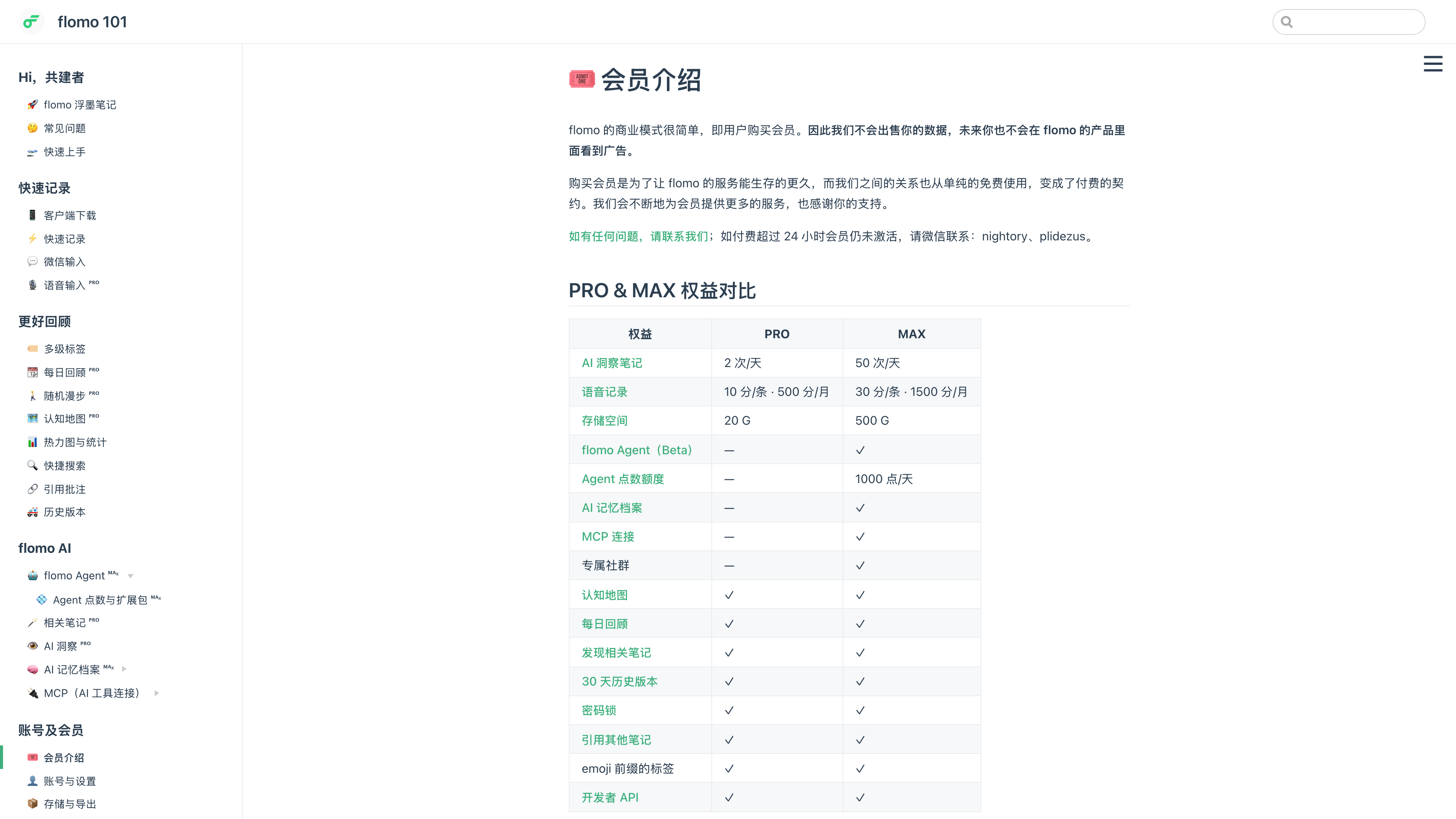
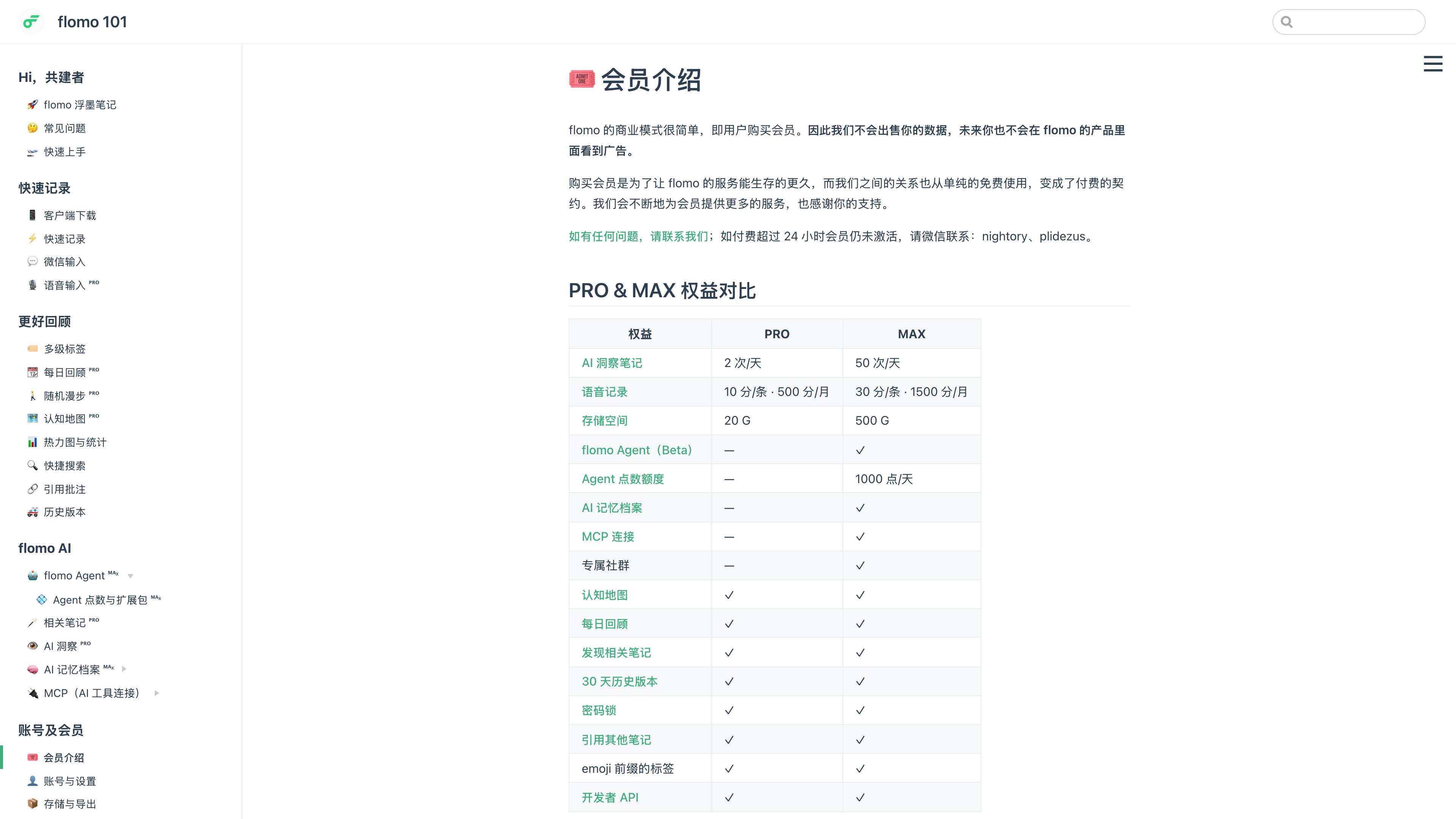
The screenshot above is the PRO/MAX comparison table from the help center. Both tiers include Daily Review, Cognitive Map, 30-day version history and the developer API; MAX adds flomo Agent (with a daily 1,000-point quota), the AI Memory Profile, MCP, a members-only community, and raises storage from 20 GB to 500 GB. When a membership lapses, storage falls back to the free 500 MB — existing attachments remain accessible but new uploads are blocked until usage drops below the cap (terms of service).
Account system and openness
Sign-up takes a phone number or email, with WeChat scan login as an alternative. For developers, flomo offers a PRO-tier capture API (an incoming-webhook style endpoint, capped at 100 writes per day per the FAQ) and a URL scheme (flomo://create), which the community uses for iOS Shortcuts and other automation; MCP connectivity is a MAX feature.
Data portability is a repeated promise: all users can export everything as HTML from the web app's settings page (an early once-per-7-days limit has since been removed), or export selectively by search or tag; the web app also imports from WeChat Reading, Dedao, Apple Notes, Apple Journal and Day One (FAQ). flomo is closed-source and hosted — no self-hosting option exists.
Privacy and content policy
The terms of service (2026-07-29 version) restrict flomo to personal, non-commercial use; users keep the IP rights to their content, which flomo may not copy, share or transmit to third parties without permission; account sharing is prohibited; and the terms are governed by PRC law. The privacy policy (2026-07-29) states data collected in mainland China stays in China, traffic is SSL-encrypted, and features like search, Related Notes and Agent process data automatically, with staff not reading note content except for troubleshooting and support. The membership page pledges "we will not sell your data, and you will never see ads in flomo." Caveats: the Android app embeds a long list of third-party SDKs (Umeng analytics, WeChat, Alipay, Bugly, Volcano Engine speech recognition and more), each itemized in the policy, and accounts can only be deleted after any PRO subscription expires.
Good fits
- WeChat-centric users who want "send a message, it's saved" capture; iOS Shortcuts fans can also write in bulk via the API.
- Zettelkasten practitioners building a card box of reading notes and ideas; the team publishes matching methodology content (flomo 101 and a published book).
- Heavy users who want AI to review and answer questions over their entire note history (MAX's Agent and MCP).
Limitations
- Deliberately narrow scope: no rich text layout, long documents, backlinks, to-dos or outlines; 30k-character note and 8k-character paste limits rule it out as a primary document or wiki tool.
- Best features ride on WeChat: official-account input, WeChat reminders and Agent chat all assume WeChat; forwarded articles, stickers and files can't be saved, and the experience degrades without it.
- Closed-source cloud, no self-hosting: data lives on servers in mainland China and depends on the vendor's continuity; HTML export and the "7-year reserve" pledge help, but are not real-time backups or open-source alternatives.
- Free tier constraints: 500 MB with compressed images; API access, AI features and original-image upload all require payment; AI quotas are metered daily/monthly, with Agent billed by points.
- Chinese-first: the website is Simplified Chinese only, and user-scale figures ("millions") are vendor-reported.
- Long privacy inventory: the Android app's third-party SDK and device-data collection list is extensive — worth reading the privacy policy if that concerns you.
Alternatives
- Obsidian: local-first Markdown notes with backlinks and a vast plugin ecosystem — the opposite of flomo's minimal cloud approach, with data fully under your control.
- Cubox: another Chinese subscription tool, focused on read-it-later and content collection — precisely the job flomo says it's "not good at" and recommends Cubox for.
- Apple Notes: the zero-cost, built-in quick-capture option, lacking a review system and non-Apple platform support.
References
- flomo homepage (checked 2026-09-25)
- flomo 101 help center (checked 2026-09-25)
- About flomo (checked 2026-09-25)
- The origin of flomo - Shao Nan (checked 2026-09-25)
- flomo's business philosophy - Lightory (checked 2026-09-25)
- Membership - flomo (checked 2026-09-25)
- FAQ - flomo (checked 2026-09-25)
- WeChat input - flomo (checked 2026-09-25)
- API & URL Scheme - flomo (checked 2026-09-25)
- Terms of Service - flomo (checked 2026-09-25)
- Privacy Policy - flomo (checked 2026-09-25)
- flomo on the App Store (checked 2026-09-25)
- Mubu joins the flomo team - DoNews / ITHome (checked 2026-09-25)