The National Database of Laws and Regulations (flk.npc.gov.cn) is China's official statute search platform, maintained by the General Office of the Standing Committee of the National People's Congress (NPC). Launched in February 2021, it gives the public free access to the current texts of the Constitution, national laws, administrative regulations, supervision regulations, judicial interpretations, and local regulations. What verifiably sets it apart from commercial legal databases is that the texts come from the legislature's official channel, every entry carries a validity label (effective, amended, repealed, or not yet in force), each instrument can be downloaded as a "gazette original" matching the official government gazette, and no account is required for any feature.
At a glance
- URL: https://flk.npc.gov.cn/
- Type: Official statute and regulation database
- Cost: Free
- Registration: None; the site has no account system at all
- Interface language: Simplified Chinese only
- Launched: February 24, 2021
- Operator: General Office of the NPC Standing Committee (per the site's own "About" note and footer)
Background
According to a People's Daily report, the database officially opened on February 24, 2021 as part of a national government informationization project, with a companion WeChat mini program alongside the website. At launch it held the Constitution and 275 laws in force, 25 legal interpretations, 147 decisions on legal and major issues, 609 administrative regulations, more than 16,000 local regulations and similar instruments, and 637 judicial interpretations (National Library of China / CASS Library summary).
In March 2024 the NPC ran a public procurement for a "search system upgrade" of the database (China Government Procurement Network notice), and in August 2025 the redesigned search and page layout went live. Per a repost of the official upgrade note, the new version added hit highlighting, related-material suggestions, revision-history display, and search history (the latter two were not individually verified in this review).
Coverage
The site's official "About" note lists the scope as the electronic texts of: the Constitution (including amendments) in force, national laws, administrative regulations, supervision regulations, local regulations, autonomous and separate regulations, Special Economic Zone regulations, Pudong New Area regulations, Hainan Free Trade Port regulations, and judicial interpretations.
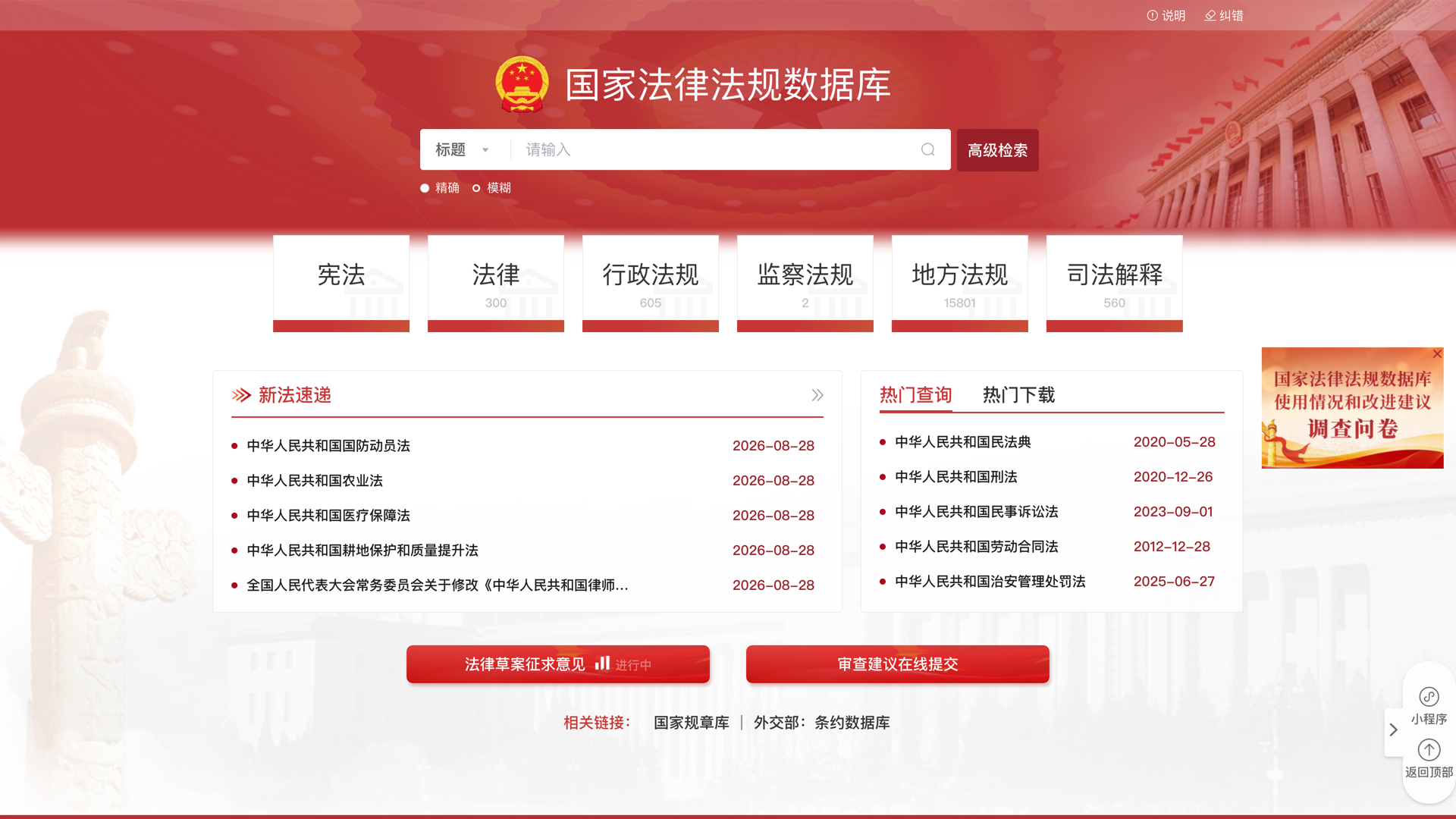
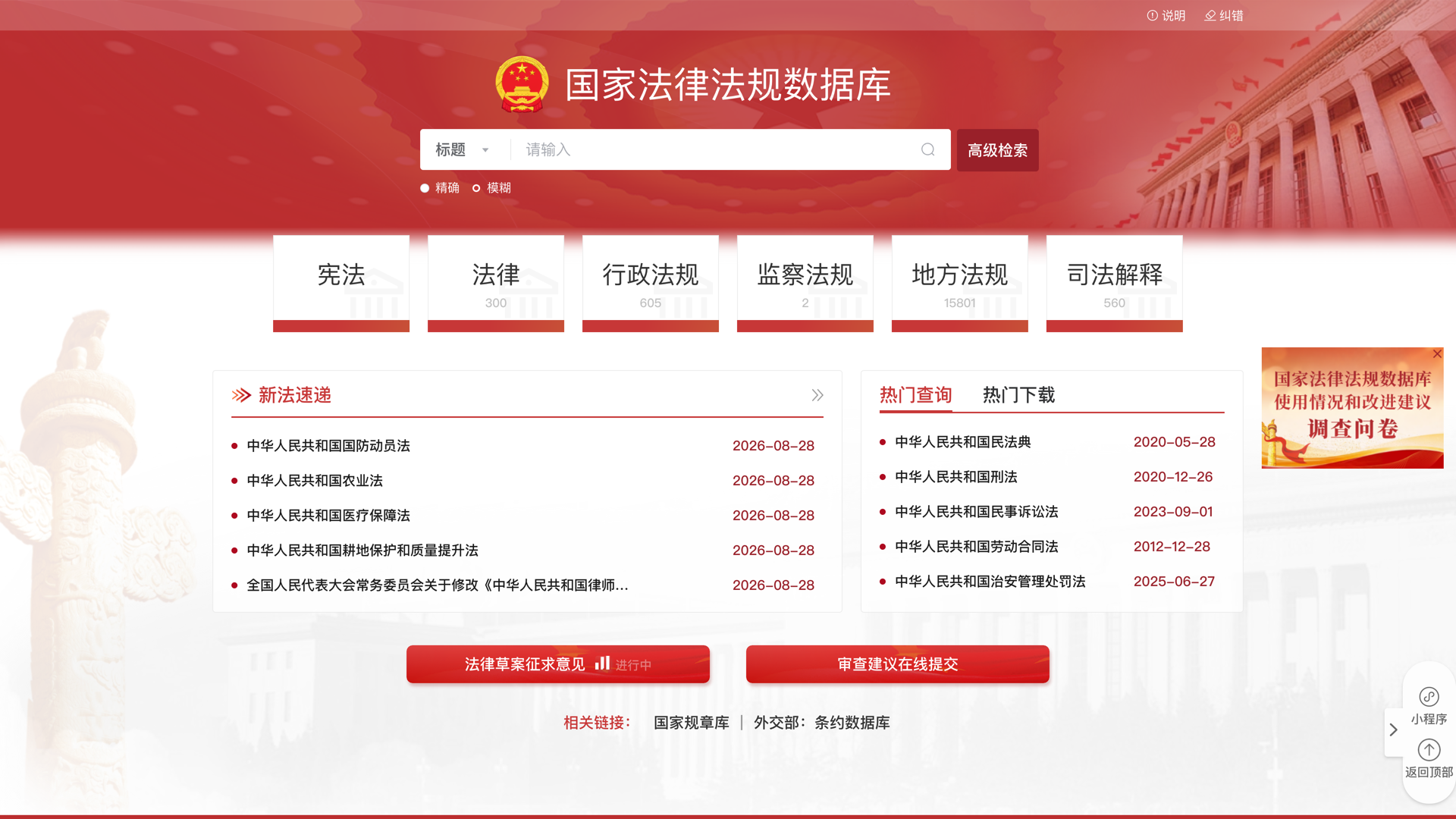
The homepage groups content into six category entrances by hierarchy of legal effect and shows the count of instruments currently in force. As of 2026-09-01: 300 laws, 605 administrative regulations, 2 supervision regulations, 15,801 local regulations, and 560 judicial interpretations (the Constitution tile shows no count).
Notably, the database does not include departmental rules issued by State Council ministries or local government rules — the homepage's "related links" point those to the State Council's separate National Rules Database, and treaties to the MFA Treaty Database. For rules and treaties you need those two sites instead.
Search and reading
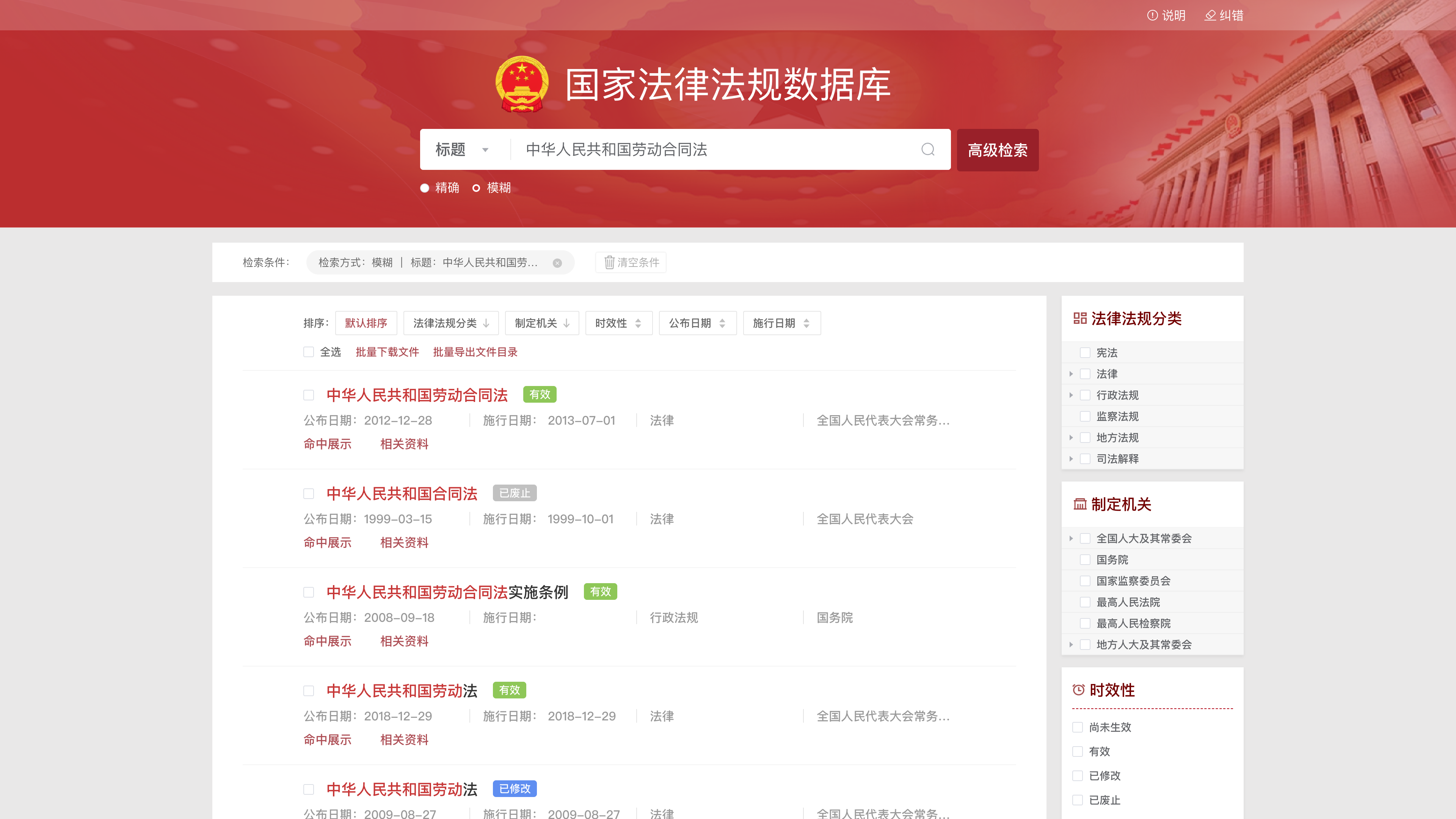
The homepage offers title search with exact and fuzzy modes plus auto-completion of statute names as you type, and an advanced search entrance. The results page supports filtering and sorting by category, issuing authority, validity status, publication date, and effective date; selected entries can be batch-downloaded or exported as a file catalog.
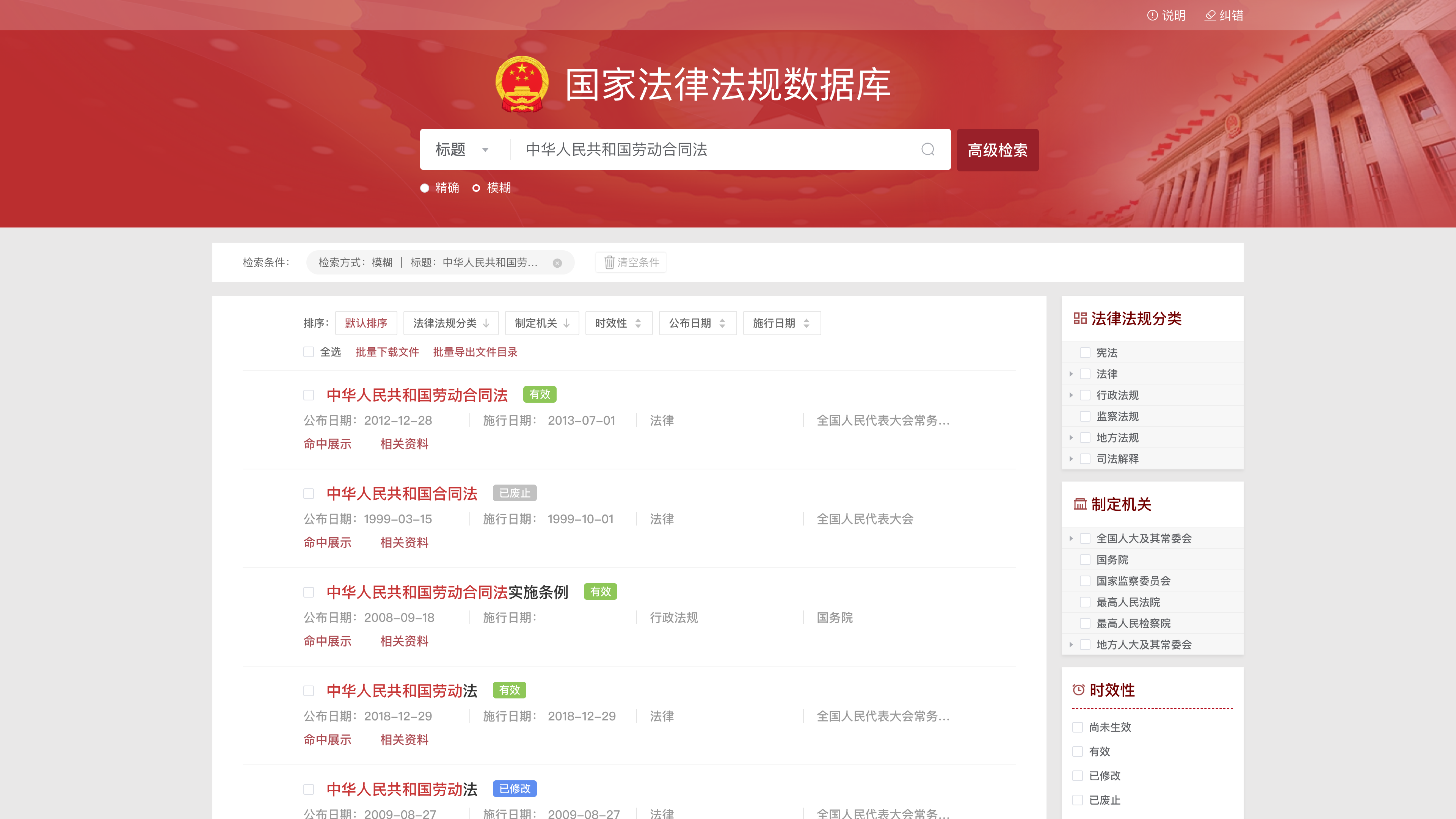
The validity labels are among the most useful signals on the results page: for similarly named laws, the page marks each as "effective", "amended", "repealed", or "not yet in force", which helps avoid citing a superseded text.
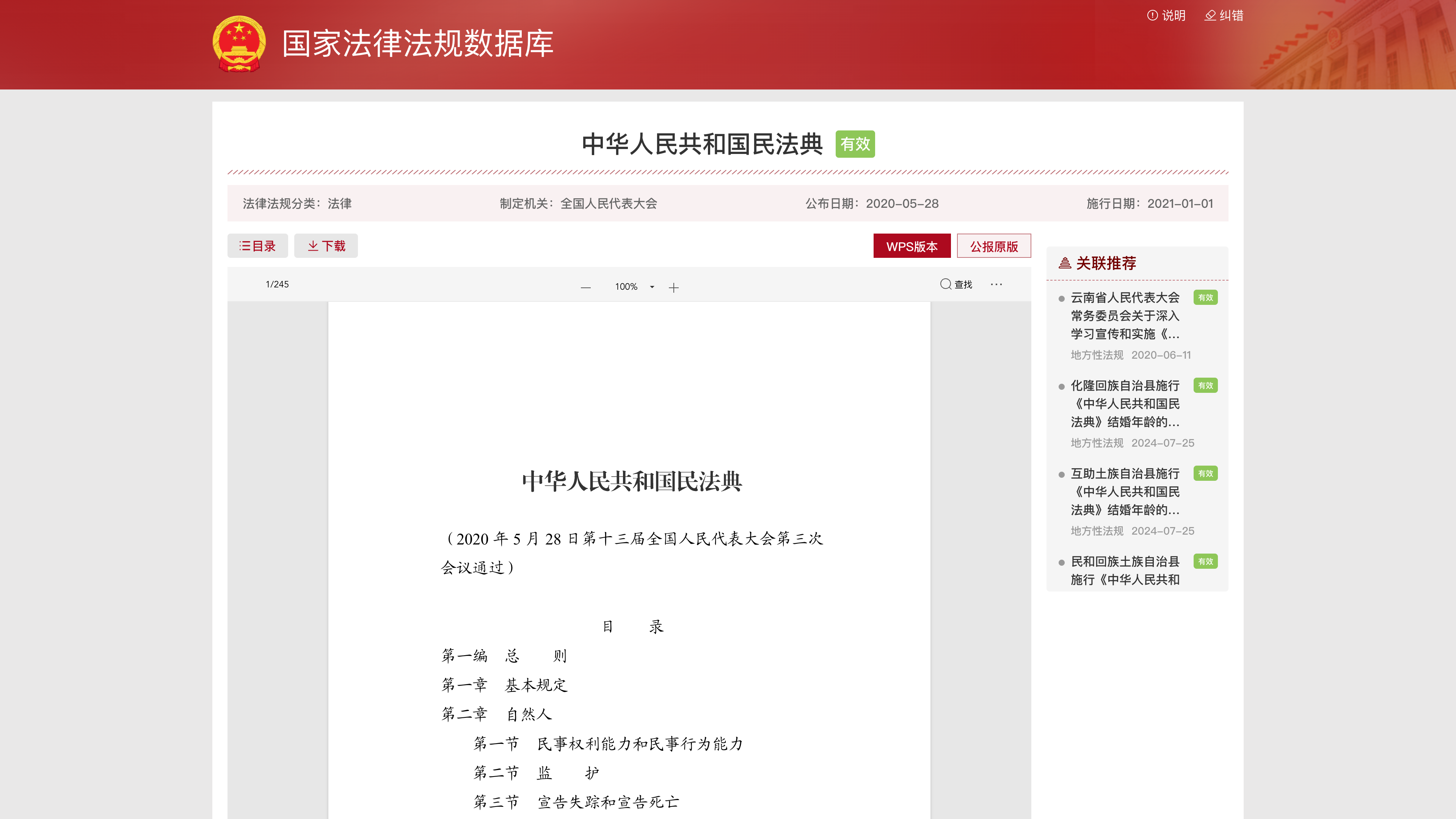
A detail page shows the validity status, category, issuing authority, publication date, and effective date. The full text is paginated inside an embedded OFD reader (the Civil Code runs to 245 pages), with a table of contents and "related recommendations" (for example, local regulations connected to the Civil Code's implementation). Two downloads are offered: an editable "WPS version" and the "gazette original" — the layout version as published in the issuing body's official gazette; in testing, both online reading and downloads use OFD layout files.
A note on textual authority
The official "About" note states explicitly that where an electronic text provided by the database differs from the standard text prescribed by law, the standard text should be cited. In practice, the database is fine for everyday reference and drafting, but formal citation (such as in legal documents) should rely on the gazette standard text — which is exactly what the "gazette original" download provides. A "corrections" entry in the page header lets users report textual errors to the maintainers.
Companion services
- WeChat mini program: a QR code on the homepage opens the same-name mini program inside WeChat.
- Draft law consultation: a homepage link leads to the NPC website's draft law comment system, where the public can submit opinions on bills under review (a separate system from the database itself).
- Filing-review suggestions: a link to the NPC Standing Committee's portal for submitting regulation review suggestions.
Good use cases
- Checking the current, in-force text and validity status of a Chinese law, administrative regulation, or judicial interpretation;
- Obtaining a gazette-consistent layout version when a formal citation basis is needed;
- Tracking newly published or amended laws via the "new laws" section;
- Finding local regulations, autonomous regulations, and Special Economic Zone rules that are otherwise scattered across provincial legislature websites.
Limitations
- Departmental rules of State Council ministries and local government rules are not included; use the National Rules Database for those;
- The interface is Simplified Chinese only, with no multilingual version;
- Reading relies on an embedded OFD reader; the site recommends Edge 129+, Chrome 125+, or 360 Browser v15+, and explicitly excludes IE;
- There is no public API or whole-database export; batch download works only for entries selected on a results page;
- It is an authoritative text repository, not a research platform — no case law, annotations, or practice commentary, which remain the territory of commercial legal databases.
References
- Database homepage and official "About" note
- Civil Code of the PRC — detail page
- Example search results page
- People's Daily: National Database of Laws and Regulations opens
- CASS Library: overview of the database
- China Government Procurement Network: search upgrade procurement notice
- Official search upgrade note (repost)