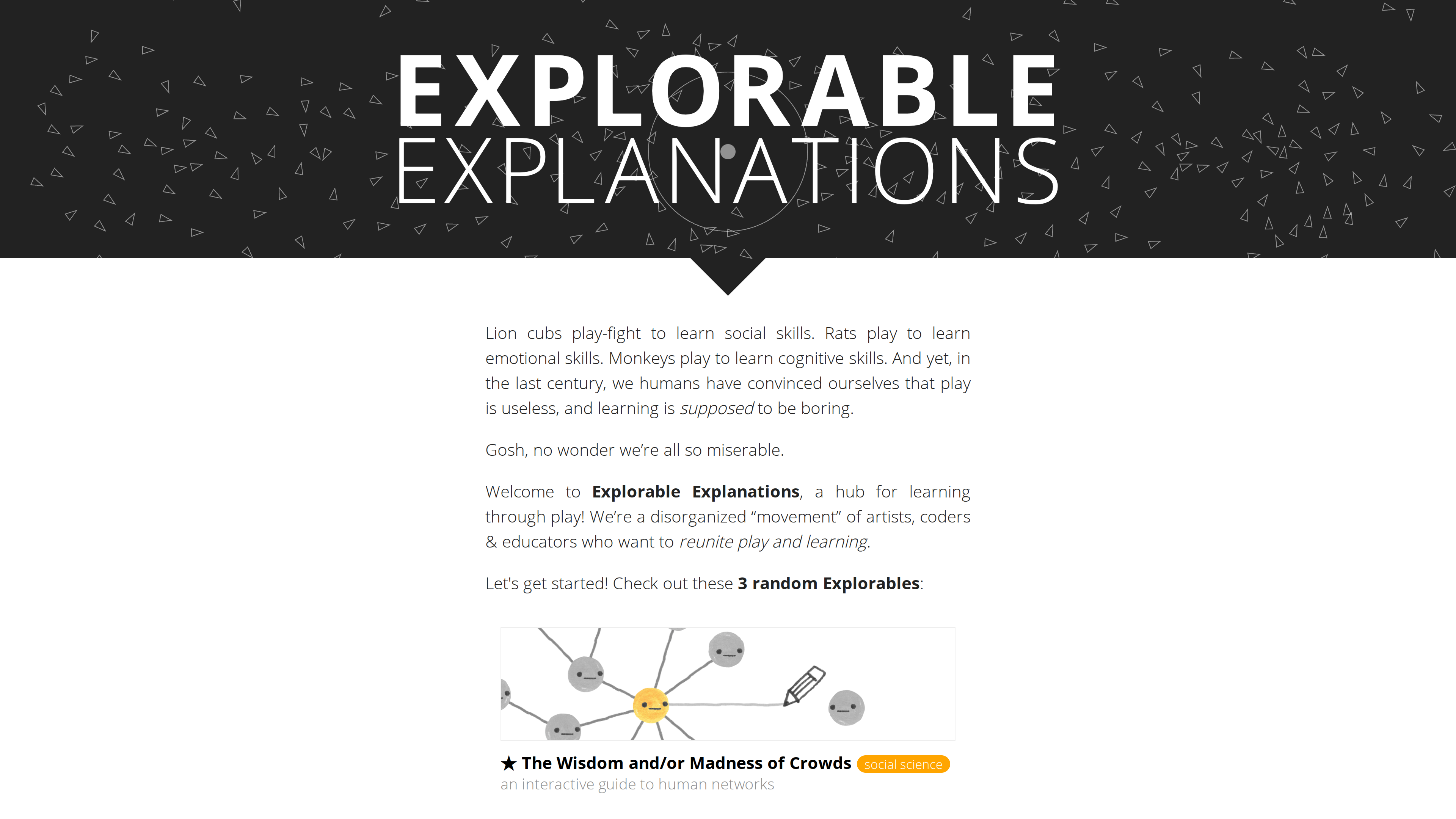
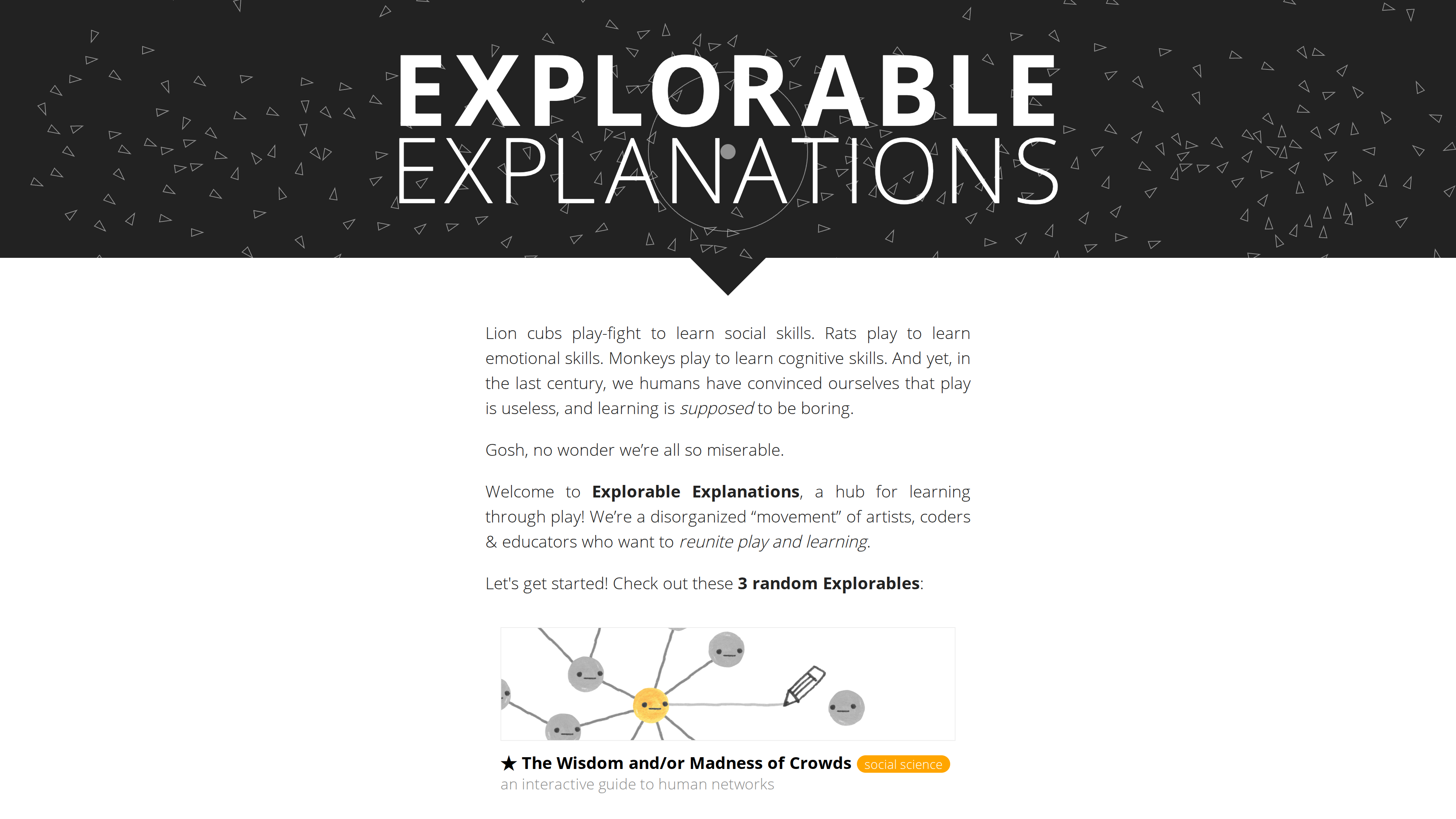
Explorable Explanations is the aggregation hub for the content form it is named after. An "explorable explanation" is a web experience you learn from by playing — manipulating simulations and games. The homepage describes it plainly: a "disorganized movement" of artists, coders and educators who want to reunite play and learning. The site greets you with three random picks, lets you filter by subject, and offers an ALL OF IT page listing everything.
At a Glance
| Item | Details (as of 2026-09-30) |
|---|---|
| URL | explorabl.es |
| Type | Directory of interactive works |
| Cost | Free |
| Account | None required |
| Language | Site in English; listed works in various languages |
| License | Site code and data under CC0 ("open sauce", per the footer) |
Background
Bret Victor coined the term with his 2011 essay "Explorable Explanations," but the moment that turned it into a movement was the viral success of Vi Hart and Nicky Case's Parable of the Polygons in late 2014 — Nicky Case announced the hub in a March 2015 blog post, and the site's repository was created the same month. The directory is maintained collaboratively through GitHub with deliberately loose inclusion criteria: interactive works as well as articles and talks about the form itself. The community also runs @explorables on Twitter/X and r/explorables on Reddit.
What You'll Find
- Entries are tagged by subject (math, physics, social science, economics and more); most are free and run in the browser;
- Well-known listings include interactive-narrative classics like Parable of the Polygons and The Evolution of Trust, plus countless small indie experiments;
- The directory also collects articles and talks about how to make explorable explanations, which is useful if you want to build one yourself.
Good For
- Teachers and course designers hunting for classroom-ready interactive demos by subject;
- Interactive content creators studying canonical examples and craft essays;
- Curious readers treating it as a high-quality "learn through play" portal.
Limitations
- A directory, not a platform: links take you to each author's own site, so quality varies and old links may rot.
- English-only interface with no search box — finding a topic means browsing subject tags or the /all page manually.
- Inclusions depend on community submissions, so updates arrive at an irregular pace.
- Most listed works are personal projects with no shared accessibility or mobile standards.