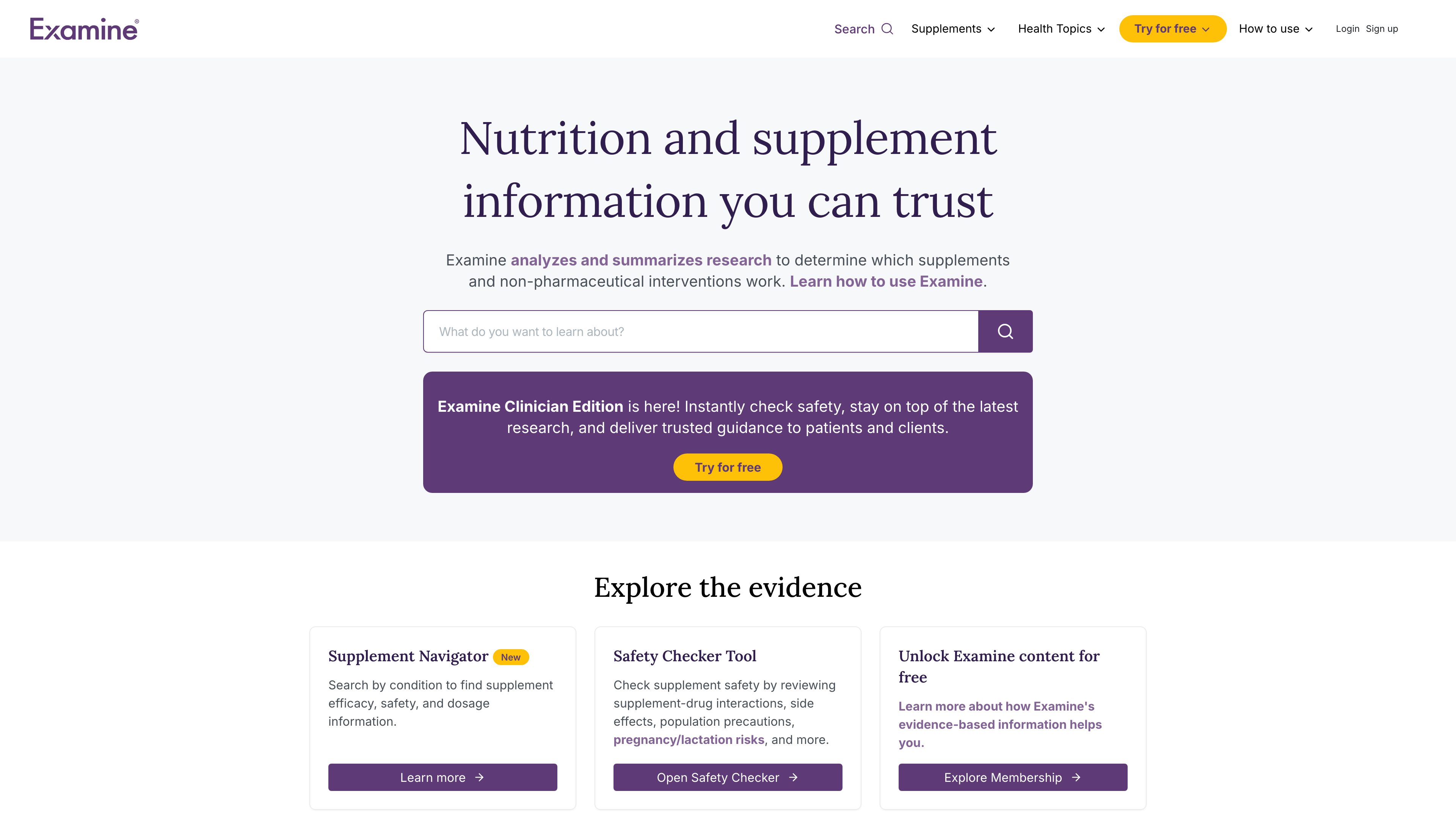
Examine (examine.com) is an evidence-based nutrition and supplement research reference run by Examine.com Inc. of Toronto, Canada, founded in early 2011. It exists to solve a specific problem: in the supplement and nutrition space, marketing claims vastly outnumber reliable evidence, leaving readers unable to tell whether a given supplement actually works for a given health goal. Examine's answer is to have its research team read the full text of primary studies, synthesize the entire human evidence base on a topic, and assign an A–F evidence grade to each intervention–outcome pair. Its verifiable distinctions among health websites: it accepts no advertising, sponsorships, or supplement-industry money and is funded entirely by subscriptions (About page); every claim is referenced, with over 60,000 unique citations per the company's own count; and every page names its authors, fact-checkers, and last-updated date.
At a Glance
- URL: https://examine.com/
- Type: Evidence-based nutrition and supplement research database (subscription reference)
- Operator: Examine.com Inc., Toronto, Canada (per its Terms of Service)
- Cost: Core encyclopedia content is free; Examine+ is US198/year; a Clinician Edition for health professionals costs more (details below; prices as listed on 2026-09-02)
- Registration: Not required for reading base content; a free account unlocks limited ExamineAI queries and study summaries
- Interface language: English only (no language switcher found on 2026-09-02)
Background
Examine was co-founded by Sol Orwell and Kamal Patel. According to the official Our Story page, Orwell lost over 60 pounds starting in 2008 and discovered how little evidence backed most online health and nutrition advice; he and Patel both live with Ehlers-Danlos syndrome (EDS) and met while searching for ways to manage joint pain, which led them to start Examine in 2011. Orwell was previously a domain investor (his Wikipedia entry says he bought the examine.com domain for US$41,000), and the company was self-funded in its early years, growing largely through Reddit (2018 Grow and Convert interview).
Per the About page, the team now counts more than 30 researchers, roughly half of them full-time, with backgrounds spanning registered dietitians, PharmDs, MDs, and PhD researchers, plus dedicated copy editors and external reviewers. Director Kamal Patel holds two master's degrees from Johns Hopkins (public health and business); editor in chief Gregory Lopez is a PharmD. The same page calls Examine "the largest database of nutrition and supplement research on the internet" — the company's own characterization, not independently verified.
On independence, the About page and editorial policy state that Examine accepts no donors, sponsors, consulting clients, advertisements, or affiliations, and that 100% of revenue comes from Examine+ and Clinician Edition subscriptions; research staff are contractually barred from any ties to supplement, food, or health companies and may not accept gifts from them. One nuance worth knowing: Examine runs a referral program that pays commissions to people who refer new subscribers. The commissions concern Examine's own subscriptions, not supplement products, so this does not contradict the no-industry-money policy — but readers should be aware the mechanism exists.
Content Model and Evidence Grading
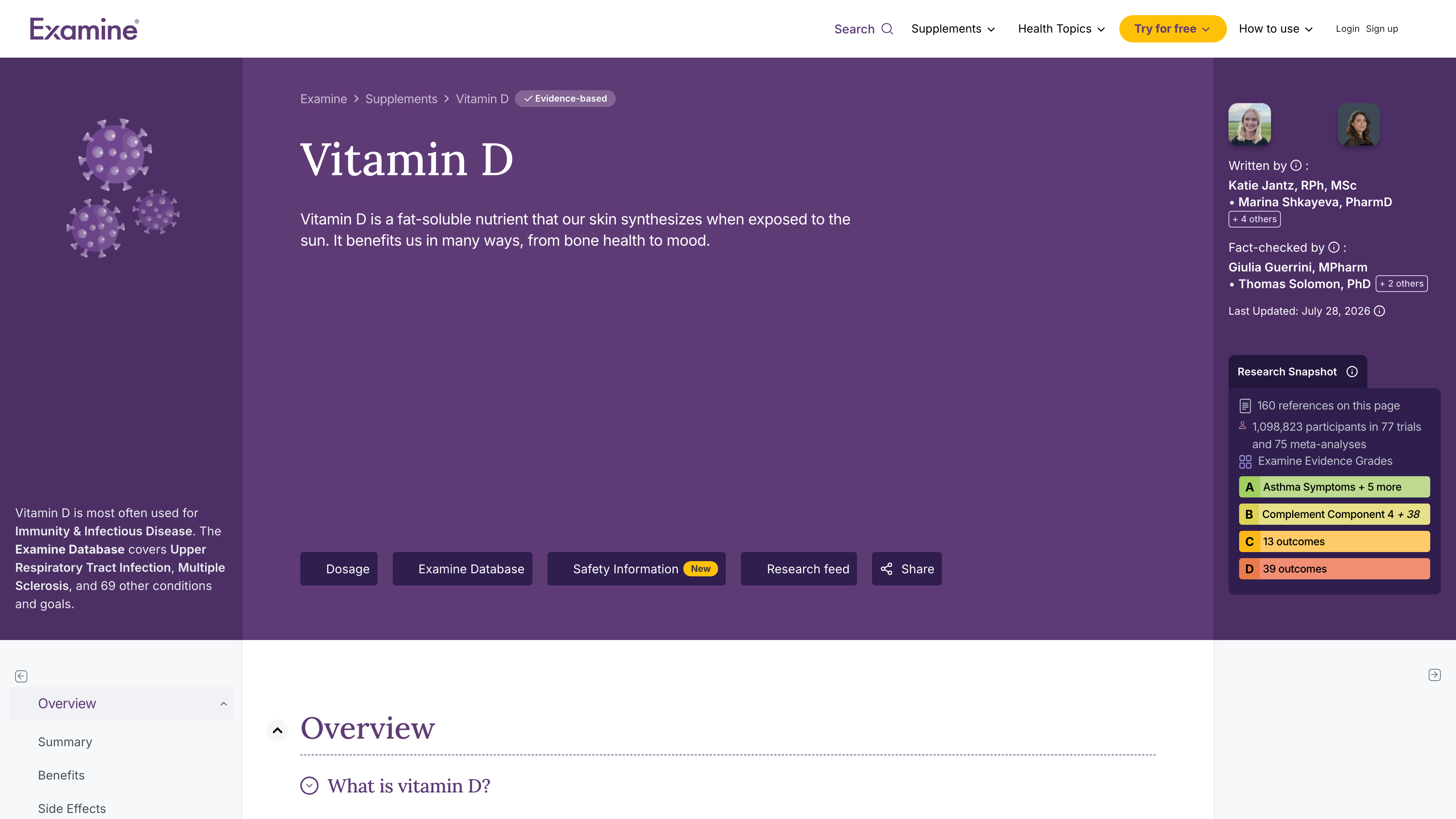
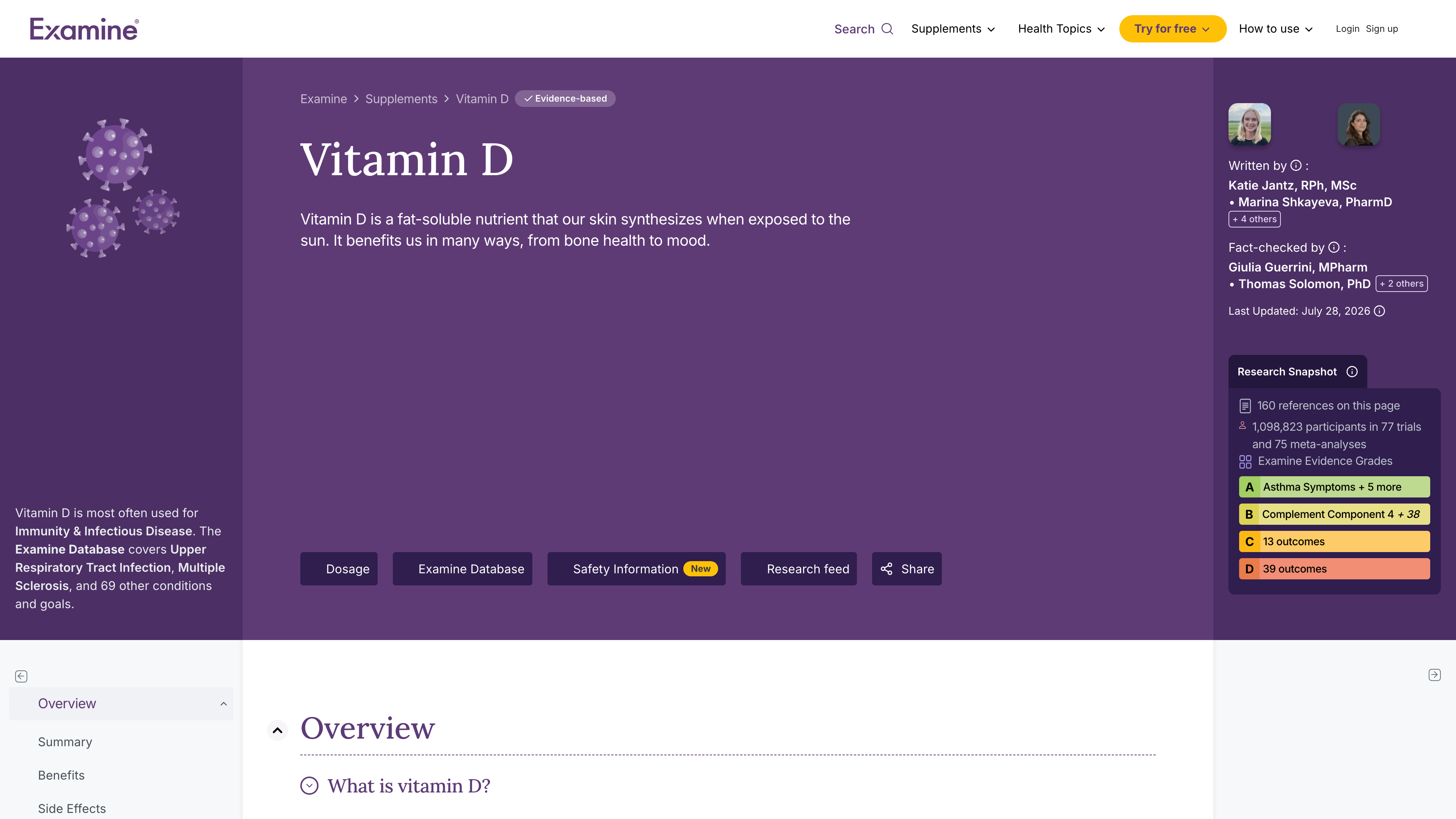
Take the vitamin D page as an example (visited without an account on 2026-09-02). Each supplement page contains an overview, dosage information, the Examine Database, safety information, a research feed, FAQs, and an update history. The header publicly lists the "Written by / Fact-checked by" researchers and the last-updated date (July 28, 2026 for this page, with a revision log going back years). A "Research Snapshot" box quantifies the evidence base — for vitamin D, 160 references covering 77 trials and 75 meta-analyses with about 1.1 million participants in total.
The centerpiece is the Examine Database. According to the editorial policy, it draws exclusively on human randomized controlled trials (RCTs) and meta-analyses of RCTs, and evaluates each intervention–outcome pair in two ways:
- Effect-magnitude arrows: after reading the full body of evidence, researchers manually judge the direction (increase/decrease/mixed/no effect) and size (small/medium/large) of the effect, and label whether the change counts as an improvement or a detriment;
- A–F letter grades: computed automatically from effect magnitude, consistency across studies, and number of studies. An A means multiple, mostly consistent studies suggest at least a moderate effect; B–C means fewer studies, some inconsistency, or a small effect; D means very little research, high inconsistency, or a null/tiny effect; F means the evidence suggests the intervention may make that specific outcome worse.
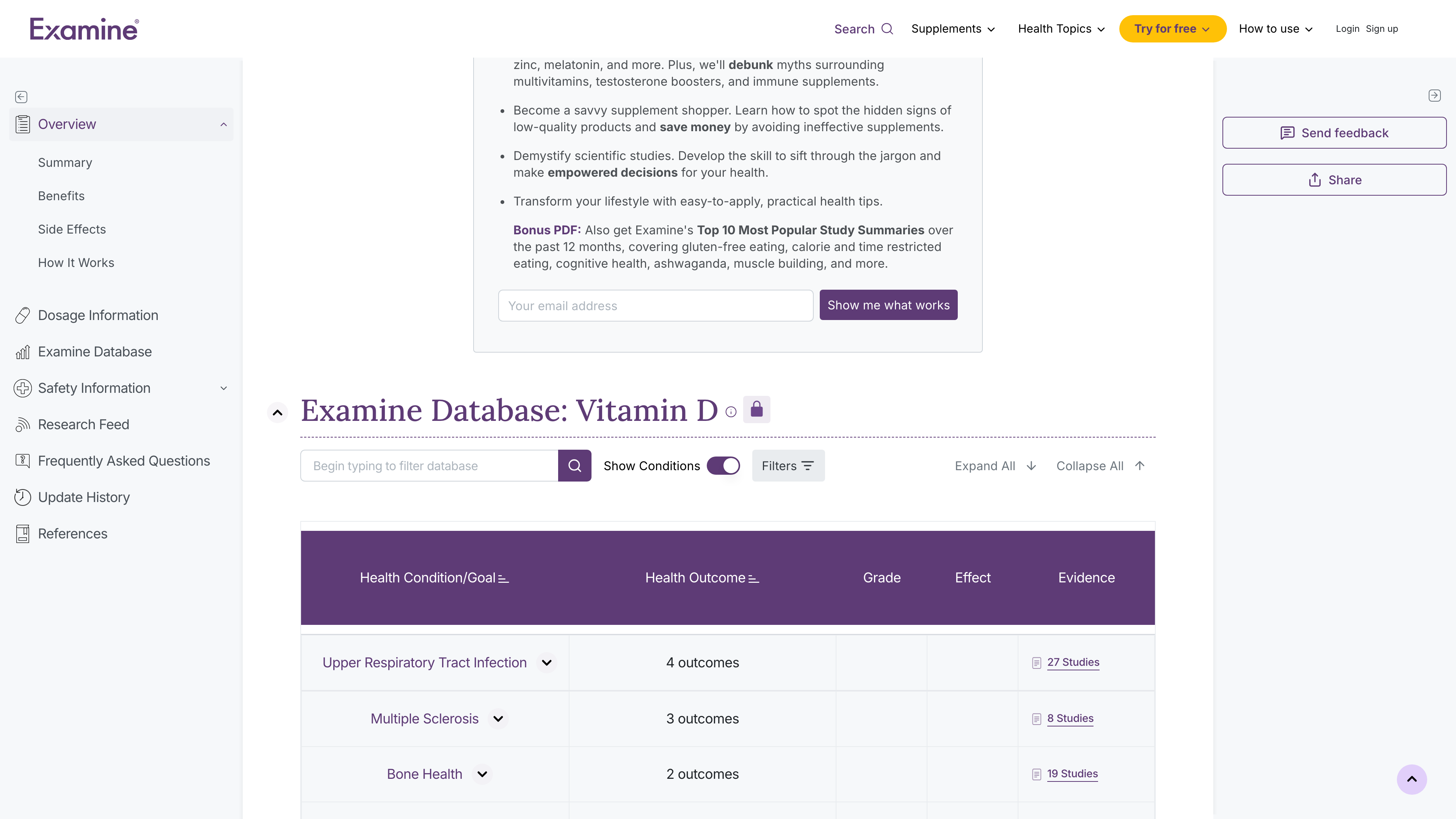
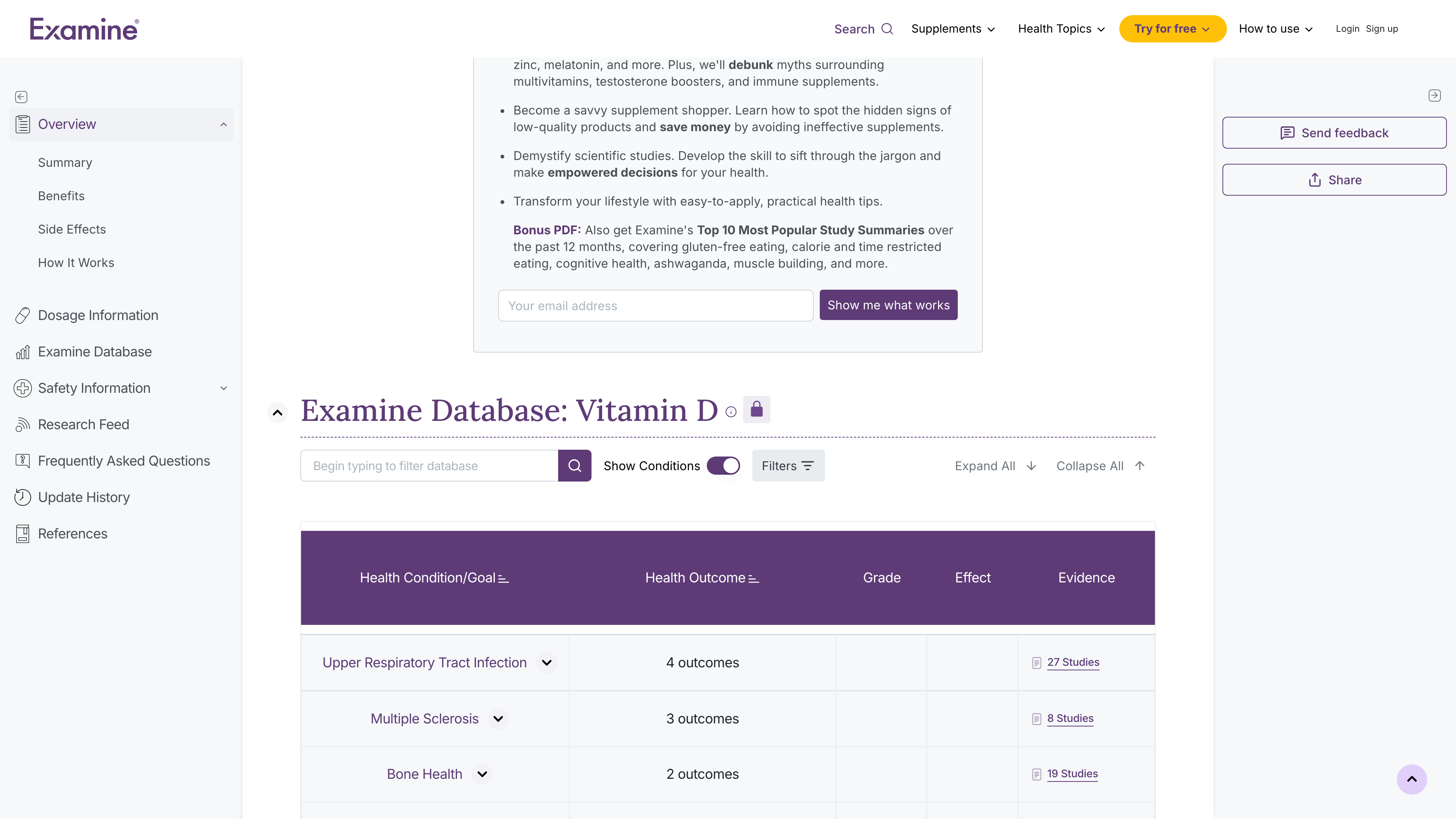
The database is grouped by health condition or goal (above: vitamin D listed against upper respiratory tract infection, multiple sclerosis, bone health, and more, with outcome and study counts for each). Two caveats matter. First, grades are specific to one intervention for one outcome: the same supplement can score very differently across outcomes, and grades change as new evidence arrives. Second, these grades are Examine's structured expression of its own literature-review conclusions — they are not medical advice and not this site's claims.
Beyond the database, each page carries a Safety Information section covering a safety summary, side effects, drug interactions, pregnancy and lactation safety, and WADA anti-doping status. Interactions are rated for evidence strength (probable/possible/theoretical) and severity (severe/moderate/minor/unknown), per the editorial policy. The Research Feed publishes structured summaries of individual studies shortly after publication — the homepage says the team summarizes about seven new studies a day — plus ten monthly "Editor's Picks" with broader context.
On process, the editorial policy describes a two-track surveillance system: "active" searches of PubMed and Google Scholar using several hundred search strings maintained with the help of a librarian holding a master's in nutrition, and "passive" RSS monitoring of top nutrition journals. Everything is described as "triple-checked" by researchers, copy editors, and internal or external reviewers, and a tool automatically cross-checks the site against the Retraction Database so citing a retracted paper triggers a correction.
What Is Free and What Is Paid
Examine's tiers as of 2026-09-02, per the membership comparison, the Examine+ pricing page, and the ExamineAI page:
- Anonymous visitors can freely read supplement and health-topic pages — overview, dosage information, safety summary, FAQs, and the full reference list. The database section shows a lock icon: you see the grouping structure and some grades, not the full data.
- Free account: 5 ExamineAI queries per month, 2 study summaries per day, more database grades, and a weekly newsletter.
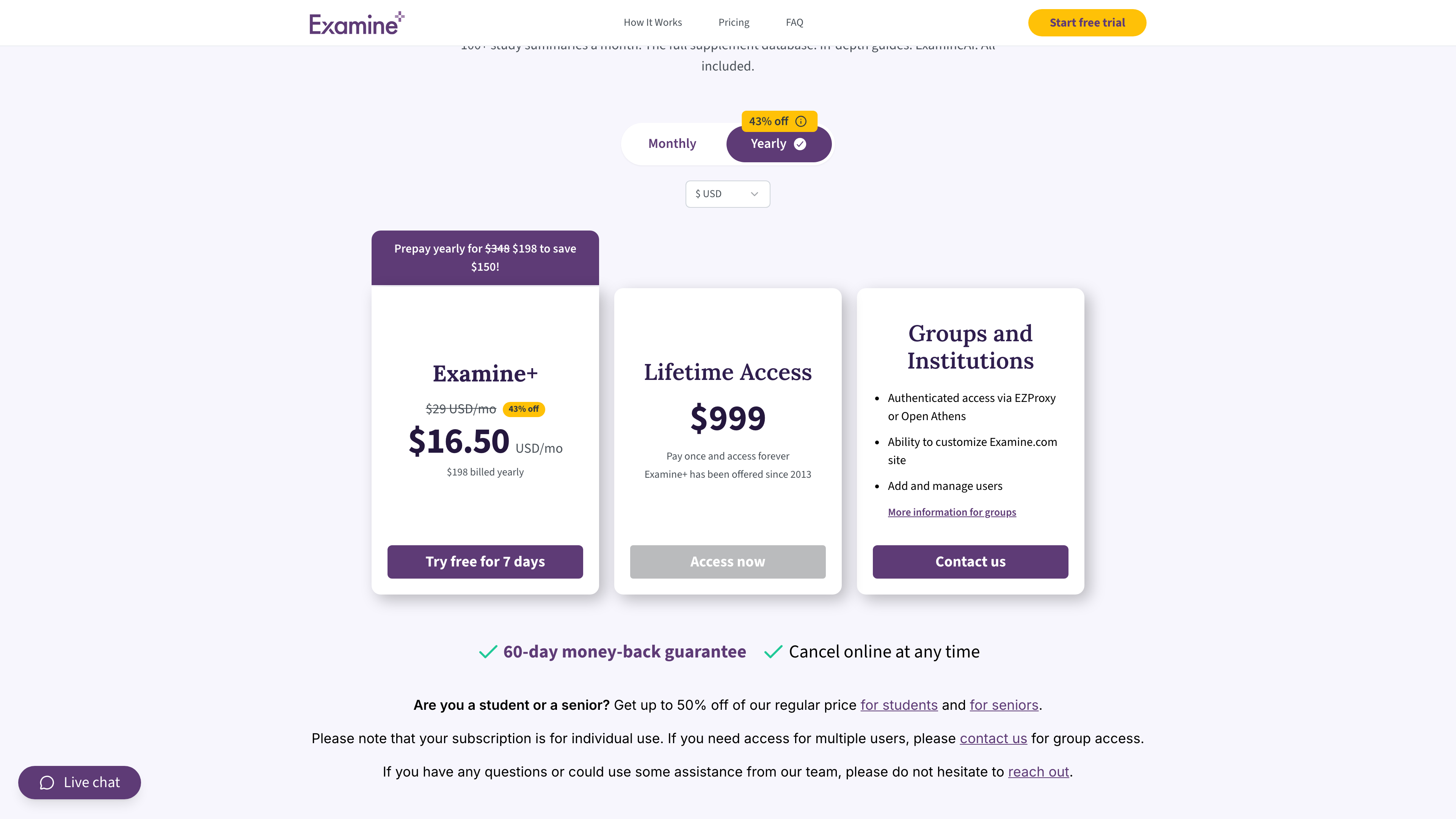
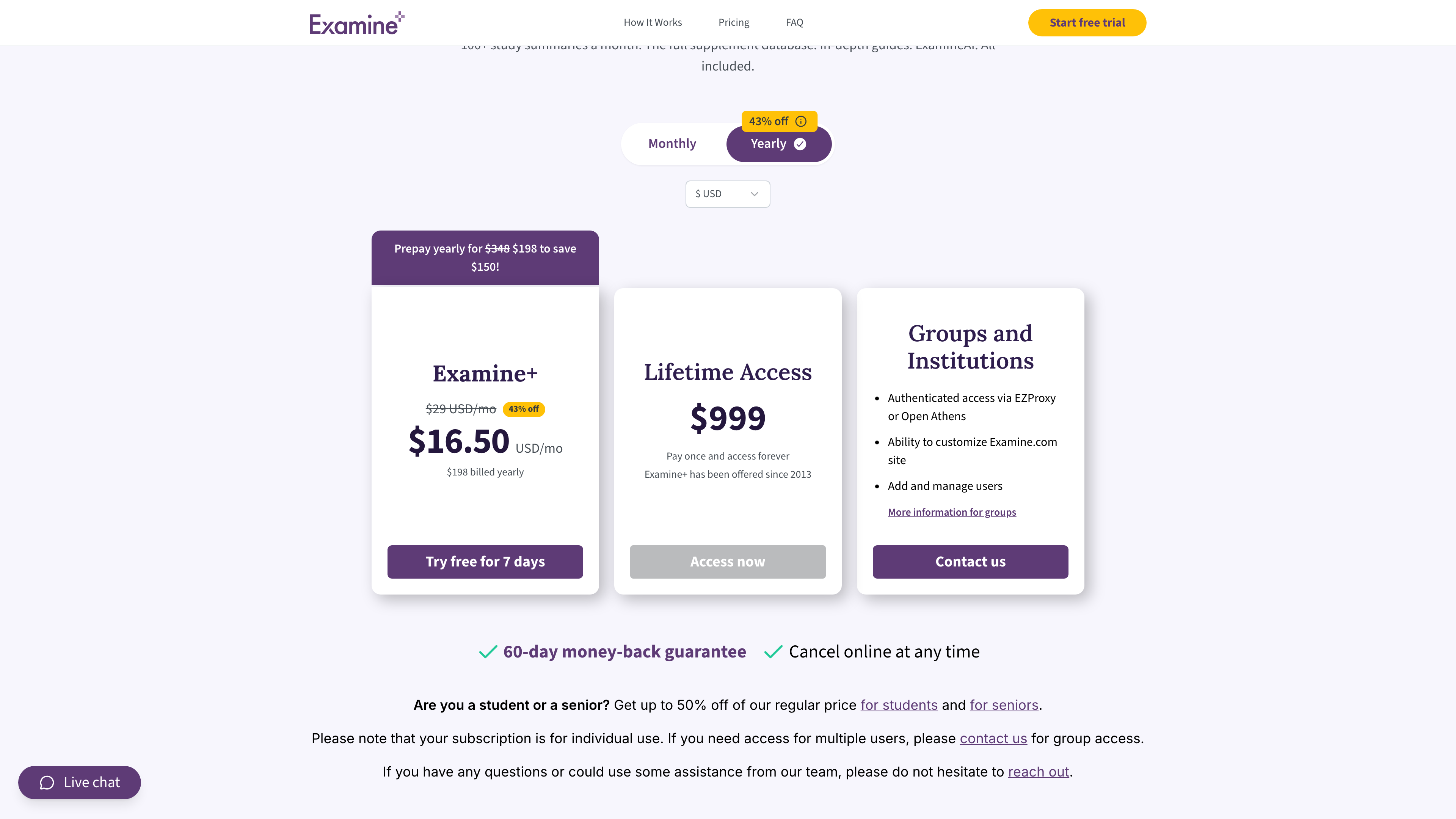
- Examine+: US16.50/month billed yearly at US999 lifetime option is also offered (the page notes Examine+ has existed since 2013); students and seniors get up to 50% off; 7-day free trial and a 60-day money-back guarantee. It includes all database grades and study details, 150+ study summaries per month, 17 Supplement Guides, unlimited ExamineAI, and continuing-education credits.
- Examine Clinician Edition: aimed at physicians, registered dietitians, pharmacists, and other professionals. On top of everything in Examine+ it adds clinical-workflow tools — Supplement Navigator, Safety Checker, Protocol Builder, and Handout Builder. Three tiers (Starter/Standard/Premium) run US41/49/66 per month billed yearly, with a 14-day free trial (Clinician pricing page). Subscriptions are individual; team and institutional access (with EZProxy/Open Athens support) requires contacting Examine.
ExamineAI is an on-site chatbot that, per the company, answers only from Examine's published, human-written content rather than retrieving external information, and links its references in each response — with the caveat that LLMs can still make mistakes and the cited references are authoritative (editorial policy). Examine states that its articles are not AI-generated; AI is used only for grammar- and spelling-level cleanup.
Payments: the Terms of Service say credit-card data is encrypted in transit and processed by Stripe and PayPal.
Disclaimers and Content Policy
Section 1 of the Terms of Service (version dated June 16, 2026) is an explicit medical disclaimer: all content is for informational purposes only and does not constitute advice, diagnosis, or treatment from a qualified medical professional; readers should consult a physician before changing diet or exercise or taking any supplement, especially if they take medications, are undergoing treatment, are pregnant, or are elderly; and Examine does not advocate nutritional supplementation over proper medical advice or treatment. The editorial policy repeats that Examine is "not an alternative to professional medical advice." The same applies here: every "evidence grade" and "effect" mentioned above is Examine's account of its own literature reviews — not a claim made by this site, and not medical advice.
On copyright, the terms limit site content to personal, non-commercial use and require the notice "© 2011–2026 Examine.com" on any permitted copy; only Clinician Edition subscribers may distribute portions of content to patients, with conditions (attribution, no misleading edits, private and limited sharing). The privacy policy lives at examine.com/privacy-policy/, and the terms explicitly prohibit entering information that could identify another person (such as a patient's name) into the tools — the site is not meant for protected health information.
Good Use Cases
- Quickly gauging how strong the human evidence is for a supplement targeting a specific goal — check the grade first, then follow the citations back to the primary studies;
- Looking up structured safety data: dosages, drug interactions, pregnancy/lactation notes (full safety tables require the Clinician Edition);
- Nutrition, medical, and pharmacy professionals keeping up with new research through daily study summaries;
- A fact-checking starting point before writing about, or buying, supplements.
Limitations
- English-only interface, with no other languages offered as of 2026-09-02;
- The core data sits behind a paywall: anonymous visitors see the database structure and a handful of grades; full grades, study details, study summaries, Supplement Guides, and unlimited ExamineAI all require a subscription;
- Grades are second-hand interpretation: researchers manually judge effect sizes before the grade is computed, so a grade is fundamentally a literature-review conclusion — reading the primary papers yourself may lead to a different view;
- Scope is limited to nutrition, supplements, and non-pharmaceutical interventions; it is not a general medical reference covering diagnosis or prescription drugs;
- Prices can change: labels like "43% off" are promotional framing — treat the checkout page as authoritative;
- "Largest database" and similar scale claims are self-reported and not independently verified;
- ExamineAI is built on an LLM, and Examine itself warns that its answers can be wrong and should be checked against the linked references.
Related References
Also covered on this site, the MSD Manual Consumer Version is a general medical reference for the public — free, multilingual, and focused on diseases, symptoms, and standard care. Examine instead specializes in grading evidence for supplements and nutritional interventions behind a subscription, so the two complement each other. For primary literature, PubMed (free citations) and the Cochrane Library (systematic reviews) are the direct sources; Examine's value is turning that scattered literature into graded, structured conclusions.
References
- Examine official site, About (team and independence statements), Our Story (checked 2026-09-02)
- Editorial policy (research process, grading system, AI policy)
- Membership comparison, Examine+ pricing, Clinician Edition pricing, ExamineAI page
- Terms of Service (medical disclaimer, copyright, refunds), Privacy policy
- Vitamin D page (content-structure example)
- Sol Orwell on Wikipedia, Grow and Convert interview with Sol Orwell (2018)