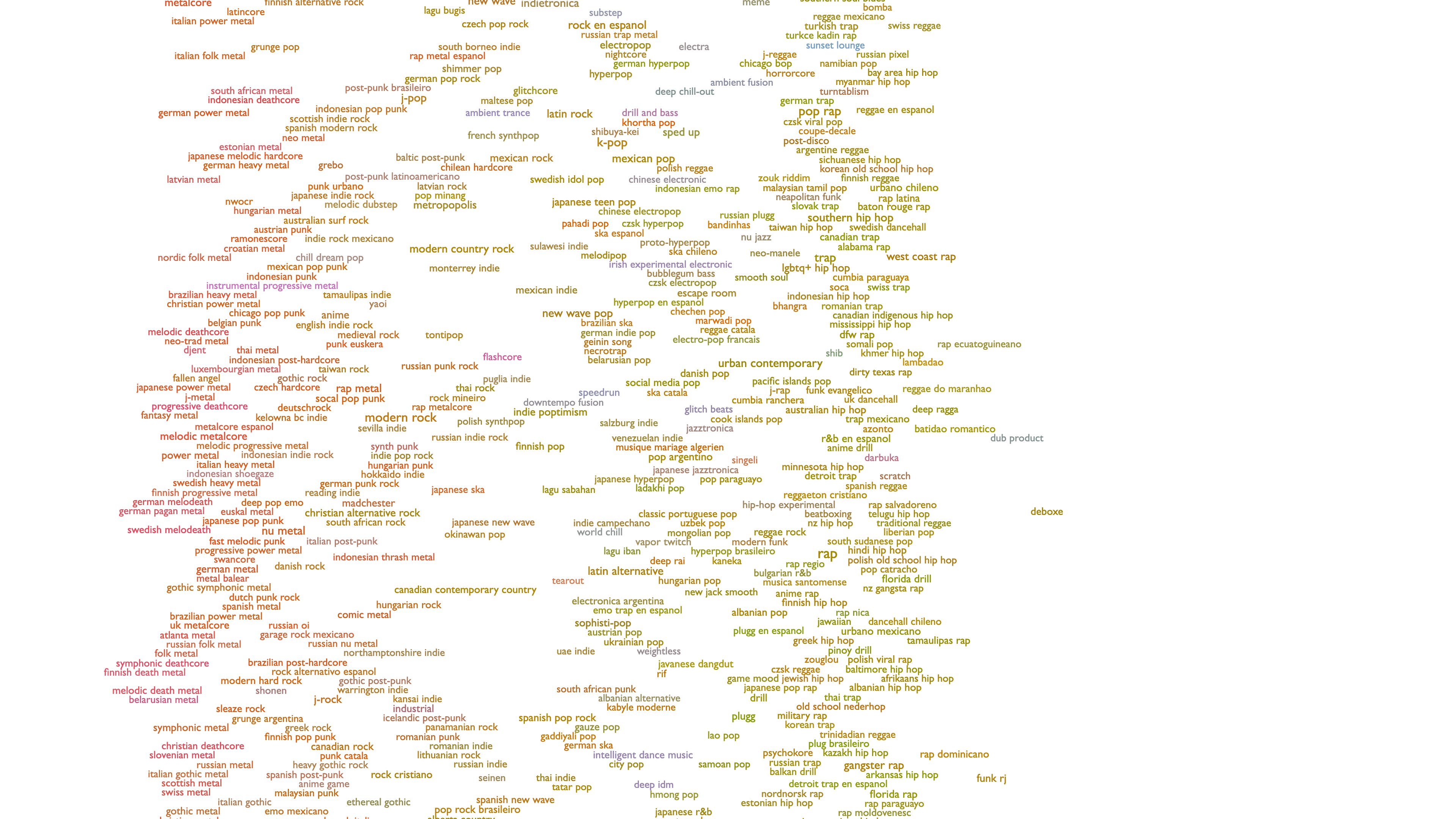
Every Noise at Once (everynoise.com) is a music discovery website with an unusual premise: it takes the thousands of genre distinctions that Spotify uses internally — most of which are invisible in the Spotify app itself — and lays all of them out on a single clickable scatter-plot map, where clicking any genre name plays a roughly 30-second audio sample. When the data was frozen in November 2023, the map held 6,291 genres, from pop and rock down to algorithmically named microgenres like escape room and dungeon synth. Unlike typical recommendation products, it doesn't learn from your listening history; it simply publishes the whole genre space arranged by acoustic similarity and lets you wander through it — its most verifiable difference from other music discovery tools.
At a Glance
- URL: https://everynoise.com/
- Type: Music genre map / music discovery
- Cost: Free
- Sign-up required: None for browsing the map, list, or playing samples; listening to the full genre playlists on Spotify requires a Spotify account
- Interface language: English
- Data currency: The genre map is a static snapshot as of 2023-11-19 (see "Maintenance Status" below)
Background
Every Noise at Once was created by Glenn McDonald, whose job title at the music-intelligence company The Echo Nest was "Data Alchemist." Spotify acquired The Echo Nest in 2013, McDonald joined Spotify with it, and the genre-classification data he built was wired into Spotify features such as Daily Mix and Fans Also Like (The Verge, 2024-02-13). The genre metadata also had an outsized cultural footprint: according to the Wikipedia entry, Spotify's editorial team used his genre tags to launch the official hyperpop playlist in 2019, which helped popularize the movement.
The site kept growing for a decade: 5,071 genres in December 2020, 5,602 by October 2021, and 6,291 by the end of 2023 — including, by the author's count, 56 kinds of reggae, 202 kinds of folk, and 230 kinds of hip hop (Wikipedia). On December 4, 2023, McDonald was among the 1,500 employees laid off by Spotify, losing the internal data access needed to keep updating the site, and the map froze (The Verge). His 2024 book You Have Not Yet Heard Your Favourite Song, about how streaming changes music, is linked from the site's homepage.
The Genre Map and Audio Samples
The homepage is the famous map. In the site's own words, it is "an algorithmically-generated, readability-adjusted scatter-plot of the musical genre-space." The axis calibration is fuzzy, but the general orientation is: down is more organic, up is more mechanical and electric; left is denser and more atmospheric, right is spikier and bouncier. Font size and color carry meaning too, and neighboring genres generally do sound alike.
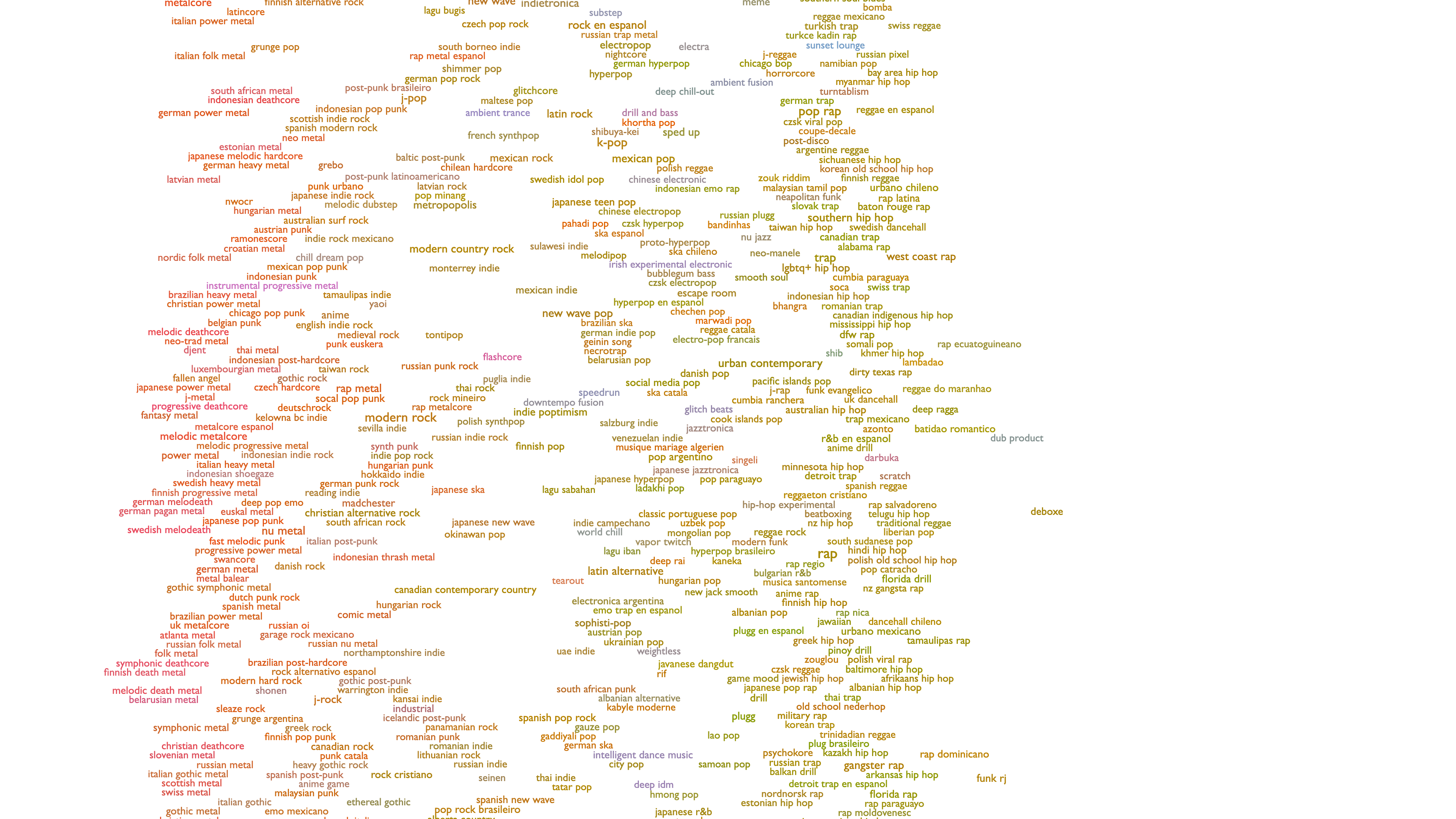
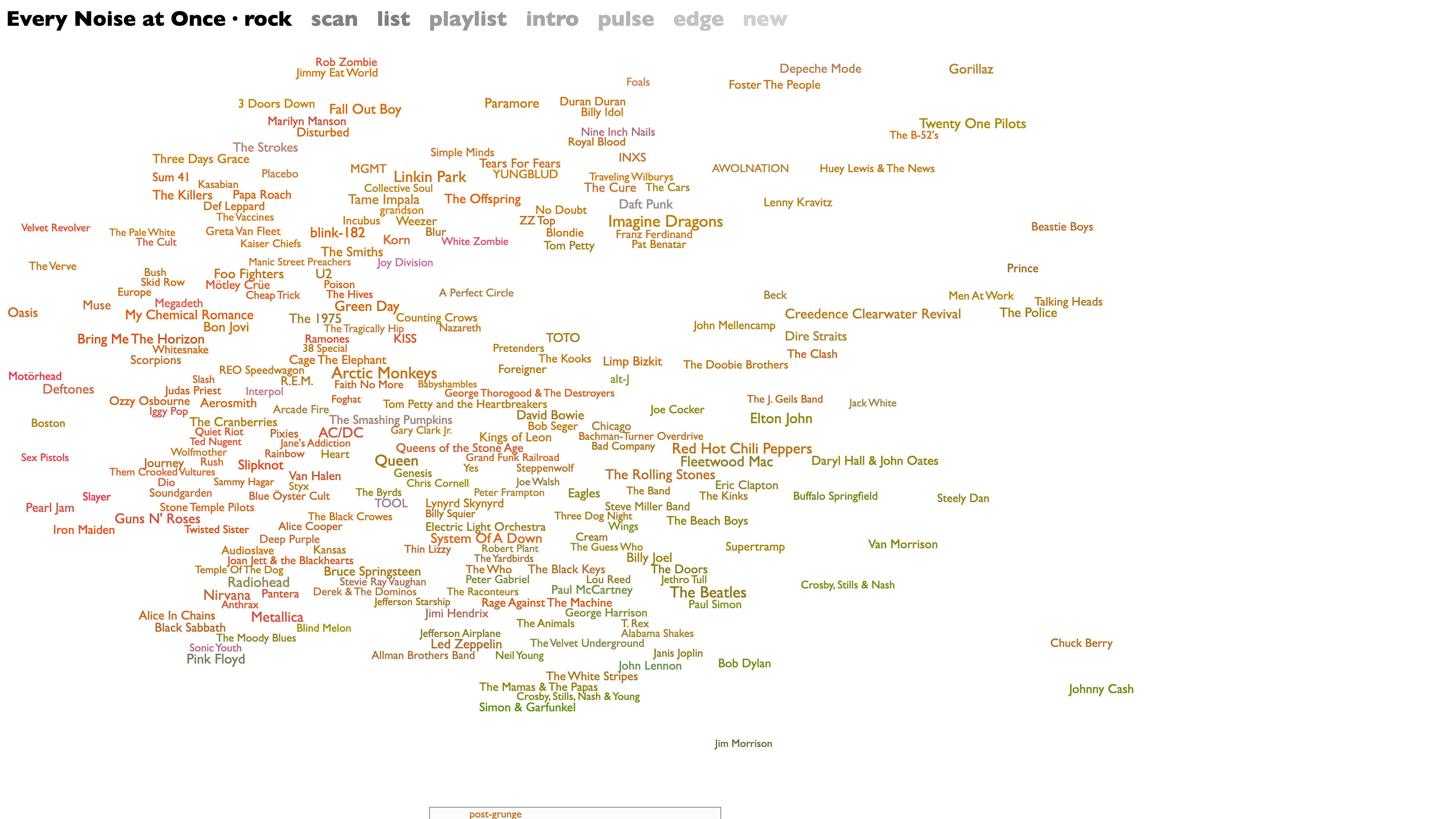
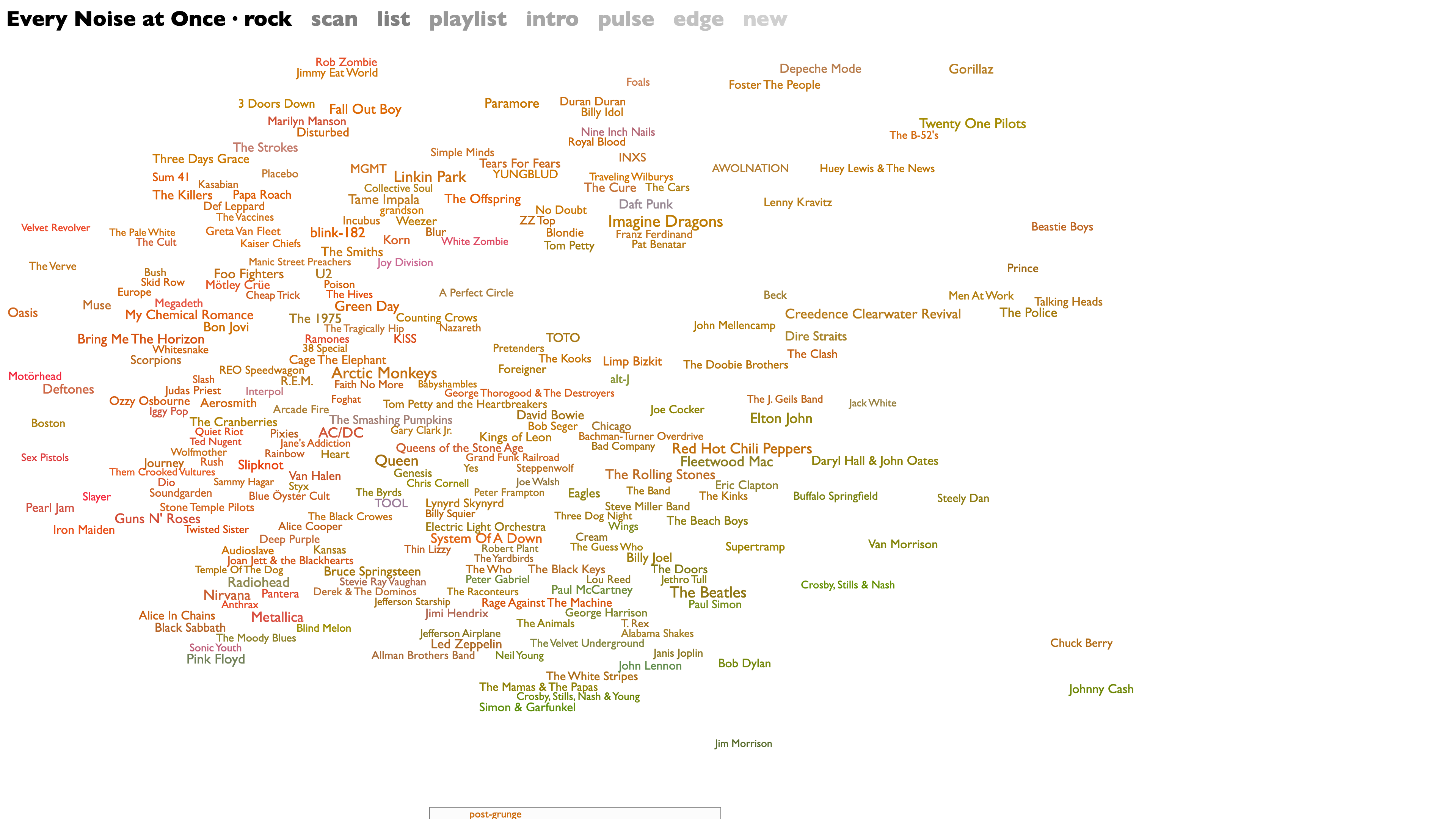
The interaction has just two rules: click any genre name and a representative track sample plays right on the page (about 30 seconds, no login); click the "»" next to a genre name to open a map of that genre's artists. Verified as of 2026-09-01, the sample audio URLs still respond and play. Clicking the "»" next to an artist on an artist map is supposed to open that artist's profile page, but it depends on a live API and currently does not load (see "Maintenance Status").
List Mode and Genre Playlists
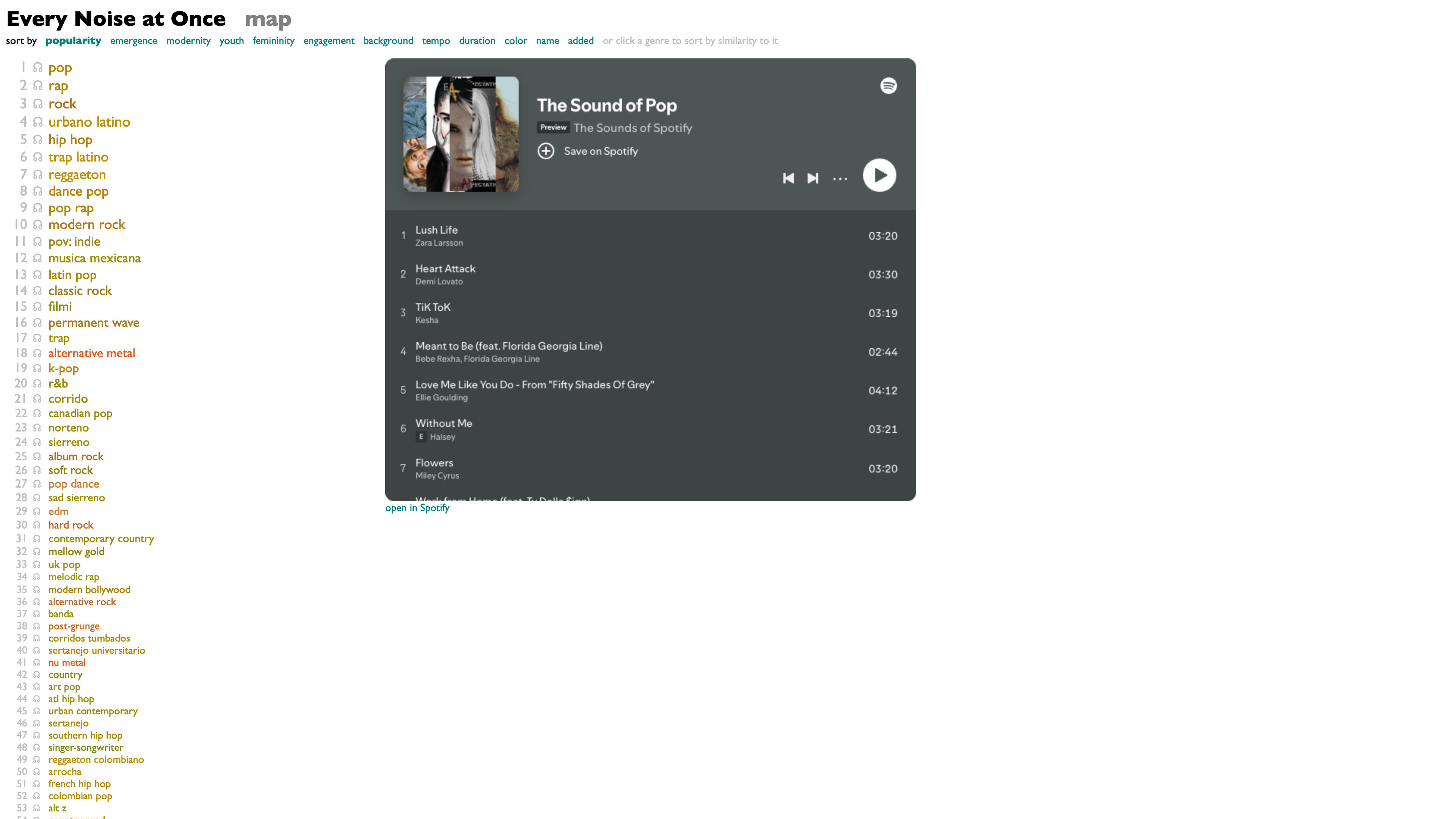
If scatter plots aren't your thing, the list mode in the top navigation lines up all 6,291 genres (count verified on the page as of 2026-09-01) and can sort them by popularity, emergence, modernity, youth, femininity, engagement, background, tempo, duration, color, name, or date added. You can also click any genre to re-sort the entire list by similarity to it — the most practical entry point for slicing the genre space along a specific dimension.
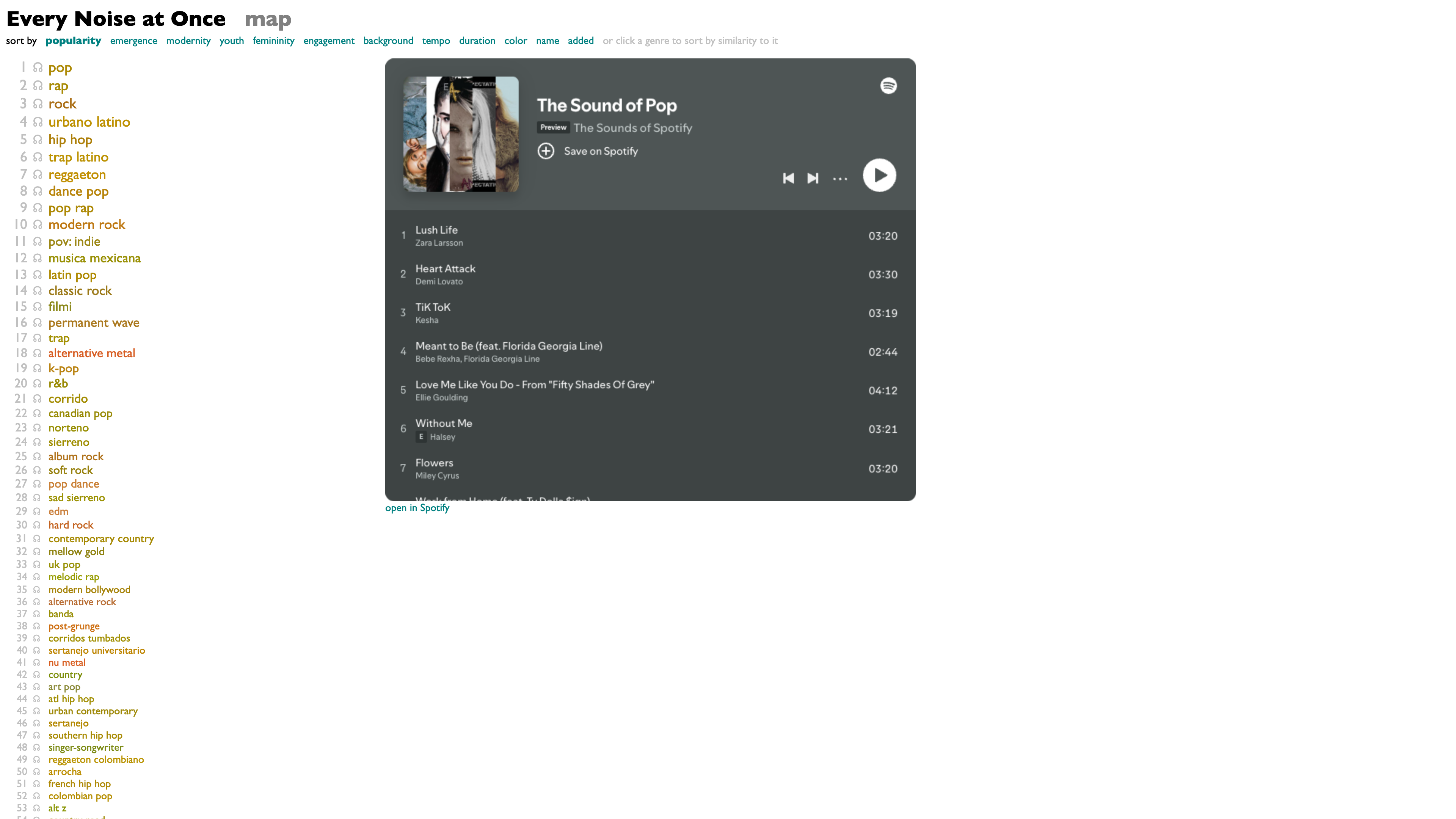
Every genre has a companion Spotify playlist maintained by an account called The Sounds of Spotify. The list page embeds a Spotify player for immediate previews; full playback and following the playlist happen on Spotify and require a Spotify account (a free one works).
Research Tools and the New-Releases Finder
Beyond the map, the footer links a family of tools built on the same dataset: Genres by Country breaks genres down by strength of association with countries, Every Place at Once indexes the distinctive listening of individual cities, and a research page offers do-it-yourself queries. Note that most of these rely on the live Spotify API.
The newest of them is New Releases by Genre (NRbG): a weekly new-release finder filtered by genre, with a query syntax that supports combining multiple genres, pinning a release week or an exact date range, and mixing in artist names, playlist URLs, or record labels ("@" plus the label name). The page stresses that it "doesn't log into your Spotify listening account" — it is for exploring your curiosity, not your history. A second project, Curio, grew from a playlist editor into a holistic listening and collecting application. Per the author's 2026-05-14 note, neither tool requires bringing your own Spotify API key anymore.
Maintenance Status (with Uncertainties)
The site's condition has changed several times, and the only first-hand source is the author's running notes in the homepage footer. In chronological order (checked 2026-09-01):
- 2024-01-05: The author explains that the 2023-12-04 Spotify layoff cost him the internal data access behind the site. Most of it became "the final state from the site's 10-year history," a static snapshot now self-hosted, with a backup preserved in the Internet Archive.
- 2024-11-14: An addendum says the public research features are "technically and emotionally independent of my employment status" and that he is still actively maintaining them, with NRbG and Curio as two DIY experiments — which at the time required users to supply their own Spotify API key.
- 2025-01-25: After Spotify replaced the genre data in its API with machine-learning tags, the author switched the site's genre search, NRbG, Curio, and other lookups to the internal dataset derived from the map. The trade-off: artists who emerged in the last year are no longer automatically categorized.
- 2026-05-14: NRbG and Curio became usable without a personal API key.
- 2026-08-07: The author reports that Spotify unexpectedly disabled everynoise's API key with no notice or explanation, breaking all live API-based functions for the time being.
Hands-on verification on 2026-09-01 matches these notes: the genre map, list mode, and audio samples all work, while the API-dependent artist profile page stalls on "loading..." Whether and when the live features will return is currently unknown; check the homepage footer for the latest word before relying on them.
Good For
- Escaping the recommendation bubble and deliberately discovering genres you've never heard of by acoustic proximity;
- Finding out what an unfamiliar genre (say, shoegaze or corridos tumbados) actually sounds like and who its representative artists are;
- Having an exceptionally complete genre frame of reference for music writing, podcasting, or playlist curation;
- Tracking weekly new releases by genre with NRbG, once the live features are back.
Limitations
- Frozen data: The genre map stops at 2023-11-19; artists who debuted or broke through afterward are not on it.
- Unstable live features: Artist profiles, NRbG, Curio, and other Spotify-API-dependent functions have been down since 2026-08-07, with no known recovery timeline.
- Tied to the Spotify ecosystem: Samples run about 30 seconds; full listening requires jumping to Spotify and signing in.
- Minimalist interface: English only, and the map page is designed for wide desktop screens (fixed at roughly 1600px), making it awkward on phones and other small screens.
Related Sites
If "map-style exploration" is the appeal, the already-listed Radio Garden is a kindred approach along a different axis: it spreads the world's radio stations across a rotatable globe, letting you explore sound by geography rather than stylistic similarity. Spotify itself offers no equivalent genre browser — which is exactly why critics called Every Noise at Once Spotify's best (unofficial) discovery resource.